



Services on Demand
Journal

Article
 English (pdf)
 Article in xml format
 Article references
 Automatic translation
 Send this article by e-mail
Indicators
Related links
-
 Cited by Google
 -
 Similars in Google
Share

 Permalink
Journal of the Southern African Institute of Mining and Metallurgy
On-line version ISSN 2411-9717Print version ISSN 2225-6253
J. S. Afr. Inst. Min. Metall. vol.125 n.6 Johannesburg Jun. 2025
https://doi.org/10.17159/2411-9717/3685/2025
PROFESSIONAL TECHNICAL AND SCIENTIFIC PAPERS
Evaluating destress blasting for rock fracture and rockburst prediction in deep level hardrock mining
T. ZvarivadzaI; C. YiI; S. DinevaI; M. OnifadeII; M. KhandelwalII; B. GencIII
IDivision of Mining and Geotechnical Engineering, Luleå University of Technology Sweden. ORCiD: T. Zvarivadza http://orcid.org/0000-0003-1014-0405 . C. Yi http://orcid.org/0000-0002-5872-5173 . S. Dineva http://orcid.org/0000-0001-9419-2207
IIInstitute of Innovation, Science and Sustainability, Federation University Australia, Australia. ORCiD: M. Onifade http://orcid.org/0000-0001-9933-266X . M. Khandelwal http://orcid.org/0000-0003-0368-3188
IIISchool of Mining Engineering, University of the Witwatersrand, South Africa. ORCiD: B. Genc http://orcid.org/0000-0002-3943-5103
ABSTRACT
Deep level hardrock mining faces increasing challenges from elevated in situ stresses and associated rockbursts. This study aims to develop a systematic framework for evaluating destress blasting effectiveness, with a focus on deep Swedish hardrock mines. The methodology integrates a critical review and adaptation of global best practices: advanced numerical modelling (static and dynamic simulations), field-based rock fracture monitoring using ground penetrating radar and borehole imaging, and application of rockburst prediction criteria including the strain energy storage coefficient (F), brittle shear ratio, and burst potential index. Geostatistical simulations, machine learning models, and industrial internet of things-based, real-time monitoring are proposed to enhance predictive accuracy, model calibration, and operational adaptability. Key findings show that effective destress blasting evaluation requires multi-modal integration of numerical outputs, field observations, microseismic trends, and uncertainty quantification, accounting for site-specific geological variability and dynamic stress redistribution. The study advances the field by proposing a predictive, feedback-driven evaluation framework tailored for deep Swedish mining conditions, capable of improving proactive rockburst risk management. It offers both practical tools for mining practitioners to optimise stress management, reduce seismic hazards, and enhance excavation safety, and academic foundations for future refinement of destress blasting models, geotechnical monitoring strategies, and adaptive design protocols. This research contributes to safer, more efficient deep mining operations by bridging gaps between theoretical modelling, empirical monitoring, and real-time, data-driven blast design optimisation strategies.
Keywords: destress blasting evaluation, deep-level hardrock mining, numerical modelling, rockburst prediction criteria, seismicity, geostatistical simulation, real-time monitoring (IIoT)
Introduction
Deep level hardrock mining presents significant geomechanical challenges, particularly due to the elevated stress conditions that lead to strain bursts, rockbursts, and structural failures (Li et al., 2017; Wagner, 2019; Malkowski, Niedbalski, 2020; Swan, Li, 2023; Cai, 2024; An, Mu, 2025). As mining operations progress to greater depths, the management of stress redistribution becomes increasingly critical to ensuring the safety of workers and the stability of underground excavations. Traditional support and stress management techniques often become insufficient to control extreme stress concentrations and associated rockburst hazards as mining progresses to ever greater depths. This reality necessitates the exploration of proactive rock engineering methods capable of modifying the in situ stress field before failure occurs. Among these methods, destress blasting has emerged as a particularly promising approach for mitigating dynamic failure risks by strategically redistributing stress ahead of excavation faces. Destress blasting is a proactive rock engineering technique, which has gained recognition as a viable method for mitigating the risks associated with mining-induced seismicity and dynamic rock failures (Tang, 2000; Sainoki et al., 2017; Vennes, Mitri, 2017; Drover et al., 2018; Drover, Villaescusa, 2019; Vennes et al., 2020; Mertuszka et al., 2022; Shnorhokian, Ahmed, 2024a; Shnorhokian, Ahmed, 2024b). The fundamental principle of destress blasting is to precondition the rockmass ahead of mining faces, reducing its stored elastic strain energy and altering the in situ stress field to minimise the likelihood of catastrophic rock failures. Despite its engineering value, the practical application of destress blasting in deep hardrock mines remains a complex engineering challenge. Variations in geological conditions, rockmass properties, and stress anisotropy necessitate site-specific optimisation of blast design parameters, including charge distribution, hole spacing, initiation sequences, and delay timing. Whereas field observations and empirical studies have demonstrated the benefits of destress blasting in alleviating rockbursts and seismic risks, comprehensive evaluations of its effectiveness require effective methodologies that integrate numerical modelling, field instrumentation, and microseismic monitoring.
This study focuses on evaluating the performance of destress blasting in deep hardrock mining environments, with an emphasis on Swedish mining operations. Although extensive research on destress blasting has been conducted in other mining regions such as Canada (Cullen, 1988; Labrie et al., 1997; O'Donnell, 1999; Tang, 2000; Sampson-Forsythe et al., 2002; Andrieux et al., 2003; Andrieux, Hadjigeorgiou, 2008; Sainoki et al., 2017; Vennes, Mitri, 2017; Yao et al., 2019; Drover , Villaescusa, 2019; Vennes et al., 2020, among others) and South Africa (Hill et al., 1966; Malan et al., 1997; Toper et al., 1997; Toper et al., 2000; Toper, 2002; Toper et al., 2003; Durrheim, 2010; Modisha, Zvarivadza, 2015; Sengani, Amponsah-Dacosta, 2018; Sengani, Zvarivadza, 2018a; Sengani, Zvarivadza, 2018b; Zvarivadza, Sengani, 2018; Sengani et al., 2019; Sengani, 2020a; Sengani, 2020b, among others), where several important regional differences must be recognised. Even though valuable knowledge has been gained from extensive studies conducted in South African gold mines and Canadian hardrock operations, the direct application of these strategies to the deep hardrock mining environment of Sweden remains underexplored. Differences in geological structure, rockmass competency, stress regimes, and seismic response necessitate careful regional adaptation of destress blasting principles. Despite global advancements, there remains a critical research gap, i.e., a lack of systematically validated methodologies for evaluating the effectiveness of destress blasting under the unique geological and operational conditions found in Swedish deep hardrock mines. Current numerical modelling and field monitoring techniques are not fully calibrated to the rockmass conditions typical of Sweden. Without adaptation and validation, existing methods risk misrepresenting destress blasting performance, compromising operational safety and efficiency. The study aims to address the research gap by investigating the most suitable methodologies for assessing the efficiency of destress blasting under deep underground mining conditions. Comprehensive evaluations of destress blasting must consider both site-specific geological conditions and evolving monitoring technologies to ensure that methods are appropriately adapted for local conditions.
Some research gaps in the literature
Destress blasting has been studied in various underground mining contexts, with notable contributions focusing on its theoretical basis, practical implementation, and field performance assessments. Early studies by Roux et al. (1957), Cook et al. (1966), and Blake (1972) introduced the concept of preconditioning brittle rockmasses to mitigate rockburst hazards. Subsequent investigations expanded on these ideas, developing numerical models and field validation techniques to refine destress blasting strategies (Miao et al., 2022; Tang, Mitri, 2001; Andrieux, Hadjigeorgiou, 2008). These studies highlighted key design considerations, including the need for appropriate explosive energy levels, borehole configurations, and initiation sequences tailored to specific geological settings. One of the primary research gaps in existing literature is the challenge of accurately predicting and quantifying the effectiveness of destress blasting. Traditional evaluation methods have relied on empirical observations and qualitative assessments, which, in as much as informative, lack the predictive capability needed for optimising blast designs in variable rockmasses. More recent studies have employed numerical modelling approaches, such as finite element and discrete element methods, to simulate stress redistribution and fracture propagation resulting from destress blasting (Miao et al., 2022). These models, however, often require extensive calibration and may not fully capture the complex interactions between pre-existing geological discontinuities and blast-induced stress waves. Another limitation in current research is the lack of standardised criteria for assessing destress blasting performance. Various metrics have been proposed, including stress dissipation factors, elastic modulus reductions, and seismic event reductions (Sainoki et al., 2017). The relative effectiveness of these criteria remains an open question, particularly in the context of different mining environments. Despite microseismic monitoring having been used to track stress changes following destress blasting, there is a need for more refined methodologies that integrate multiple data sources, including geophysical surveys, borehole imaging, and numerical simulations to provide a comprehensive evaluation framework.
Scope, objectives, and contributions of the study
This study systematically evaluates the effectiveness of destress blasting in deep hardrock mining, with a specific focus on Swedish underground mines. It consolidates existing research on numerical modelling, evaluation techniques, and seismic monitoring to understand how destress blasting influences stress redistribution, rockmass response, and seismic hazard mitigation. The study critically reviews numerical simulations, comparing static and dynamic approaches, and assesses key design parameters such as blast energy distribution and borehole spacing. It also examines geophysical monitoring techniques, including ground penetrating radar (GPR) and borehole periscopes, as well as seismic monitoring and rockburst prediction criteria, such as the strain energy storage coefficient (F), brittle shear ratio (BSR), and burst potential index (BPI). The study also proffers some innovative destress blasting evaluation methods incorporating geostatistics, machine learning, and IloT real-time monitoring. The research highlights optimisation strategies and decision-support frameworks that improve destress blasting applications, drawing crucial perspectives from global best practices. The study provides a structured framework for evaluating destress blasting efficiency by integrating theoretical models, empirical assessments, and monitoring techniques. Unlike previous studies that focus solely on numerical simulations or qualitative observations, this research offers a holistic approach to stress relief assessment. It also addresses a critical knowledge gap by exploring how destress blasting can be adapted to the unique geological and operational conditions of Swedish hardrock mines. The findings of the study contribute to improved safety, enhanced operational decision-making, and the refinement of destress blasting strategies in deep underground mining.
Several approaches can be used to evaluate the efficiency of a particular chosen destress blasting design. Most of the approaches are based on the ability of the destress blast design to reduce rockburst potential (burst proneness) of the rockmass or on reducing the deformation potential of the exposed rockmass after excavation. Each approach utilises key parameters associated with rock bursting which can be assessed before and after the implementation of a chosen destress blasting design. This paper dwells on those key evaluation techniques, which are suitable for informing destress blasting practice in deep underground hardrock mines of Sweden. It is of significant importance to use at least two different approaches to assess the performance of a destress blast design to consolidate confidence in the performance results. Through its coverage, the study contributes to the scientific advancement of stress management strategies in deep mining and offers practical guidance for safer, more efficient underground operations in Sweden.
Numerical modelling
Calibrated numerical models can be used to assess the efficiency of an adopted destress blast design. Several researchers have evaluated destress blast designs through numerical modelling with a view to select the most appropriate design for a given set of mining conditions (Sui et al., 2025; Shnorhokian, Ahmed, 2024a; Hashemi et al., 2023; Fulawka et al., 2022a; Hashemi, Katsabanis, 2021; Baranowski et al., 2019; Drover et al., 2018; Sainoki et al., 2017; Andrieux, Hadjigeorgiou, 2008; Saharan, 2004; Toper et al., 2003; Toper, 2003; Borg, 1988). The discussion on numerical modelling and its application in destress blasting can be lengthy and extensive. Miao et al. (2022) provide a detailed review on the application of numerical modelling in destress blasting design. They note that two main modelling approaches, static and dynamic, are commonly employed - the static method modifies rockmass properties to simulate destress blasting's impact, while dynamic modelling focuses on the dynamic fracture process without predetermined damage. Miao et al. (2022) compare different destress blasting numerical methods, including continuum-based, discrete-based, and coupled methods. Other key issues they explore in detail include the fracture mechanism, the assessment of destress blasting designs efficiency, factors influencing destress blasting efficiency, and highlighting the challenges and difficulties associated with numerical modelling of destress blasting.
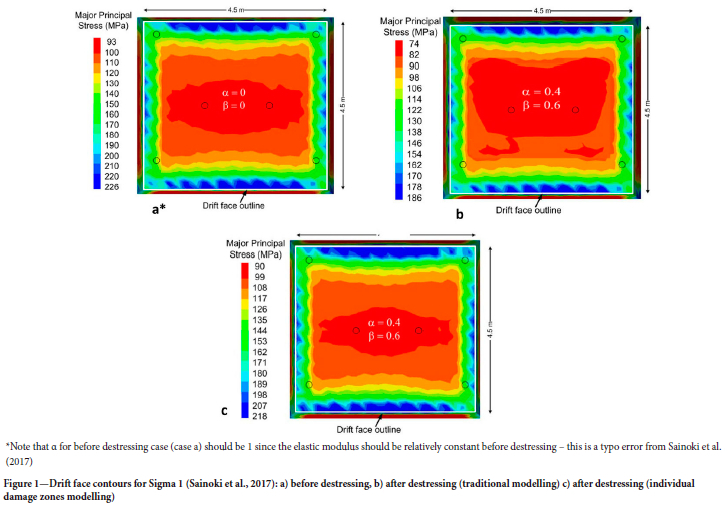
To maintain some modicum of brevity of this paper, and yet cover key issues relevant to the successful use of numerical modelling as a destress blasting design tool, this discussion zooms into and shines the spotlight on the work by Sainoki et al. (2017). Sainoki et al. (2017) warn that traditional ways of modelling, which assume that the damage zone induced by the destress blast is spread over the whole drift face, may result in overly optimistic destress blast results. This is a result of the models predicting lower than actual resultant stresses around the destressed excavation due to oversimplification of the prevailing conditions in the rockmass. To mitigate against this, Sainoki et al. evaluated the damage of each hole individually and obtained results more reflective of prevailing ground conditions after preconditioning as shown in Figure 1. Assessing the major principal stress (MPa) legend for each case in Figure 1, it can be noted that the stress drops from a maximum of 226 MPa (before destressing) to 186 MPa and 218 MPa for the traditional modelling case and the individual damage zones modelling case, respectively. This shows that the traditional modelling approach potentially underestimates the peak major principal stress after destress blasting by about 32 MPa in this scenario.
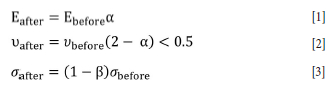
In the destress blast evaluation model, Sainoki et al. (2017) adopted the concept of rock fragmentation factor (α) as introduced by Blake (1972) as per Equation 1. The concept is based on the observation that effective destress blasting leads to the widespread extension of cracks existing in the rockmass and generation of more cracks, leading to significant stress release ahead of the mining drift face. When this happens, the stiffness of the rockmass is significantly reduced, resulting in a much lower elastic modulus compared to the elastic modulus before destressing. As expected, the elastic modulus of the rockmass remains about the same when α is 1; that is when there is little to no rock fragmentation before destressing. In rock mechanics terms, the softening of the rock due to action of stress can be explained using the Poissons effect. The changes in Poissons ratio before and after destress blasting, can also be used to evaluate the efficiency of a destress blast design using Equation 2, as suggested by Tang and Mitri (2001) as per Equation 2. When α is 1 (relatively unfragmented rockmass), the Poissons ratio remains almost the same. When α is 0 (significantly fragmented rockmass) the Poissons ratio almost doubles, signifying enormous softening of the rockmass due to destress blasting.
Sainoki et al. (2017) also use the concept of stress dissipation factor (β) developed by Tang and Mitri (2001) to assess destress blasting efficiency (Equation 3). When β is 1, the stress after destress blasting is reduced significantly, showing that the high stress in the immediate vicinity of the mining drift face has been dissipated further into the rockmass, reducing the strain burst risk at the mining face. β = 0 indicates a scenario where the stress in the immediate vicinity of the mining face remains the same, that is when no destress blasting is employed.
Practical implementation of several different destress blasting designs is obviously expensive, hence the need to simulate several different destress blasting designs using numerical models to select a few suitable designs to physically assess. The field tests of the few suitable designs allow practitioners to choose the best destress design for a particular set of geotechnical ground conditions. Numerical modelling in three dimensions facilitates the identification of underground areas prone to rockbursts and, therefore, aids design of underground constructions (Kaiser, Cai, 2012). It cannot be overemphasised that numerical modelling to prescribe a suitable destress blasting design for a deep hardrock mining operation should follow the standard modelling stages (procedure) posited by Starfield and Cundall (1988).
Although Sainoki et al. (2017) introduced the fragmentation factor (α) and stress dissipation factor (β) to improve evaluation metrics, studies rarely integrate these parameters into real-time, adaptive modelling frameworks. The present study identifies this as a critical gap: linking numerical outputs (e.g., changes in α and β) dynamically to field-monitored seismic responses would enable feedback-driven optimisation of destress blast designs, something not yet systematically achieved. Cross-validation of numerical predictions with independent fracture network imaging data, such as GPR or borehole periscope observations is critical for a successful destress blasting strategy. This study supports multi-modal integration, combining numerical simulations with direct fracture monitoring and seismic monitoring trends, to holistically evaluate and refine destress blasting performance.
Rock fracture monitoring ahead of the excavation face
To gauge the effectiveness of an adopted, destress blast design, evaluation of the rock fracturing ahead of the mining face after the blast can be done. Effective destress blasting is expected to create or extend a network of fractures, which connect the destress blast holes sockets. This is critical in assessing the most optimum number of destress blast holes to use with the production blast holes. The network of fractures provides a path for stress relief from the immediate vicinity of the blasting face into the rockmass. The intensity of fracturing ahead of the mining face due to destress blasting can be assessed using ground penetrating radar, borehole periscope, and mining face drill core discing observations.
Ground penetrating radar
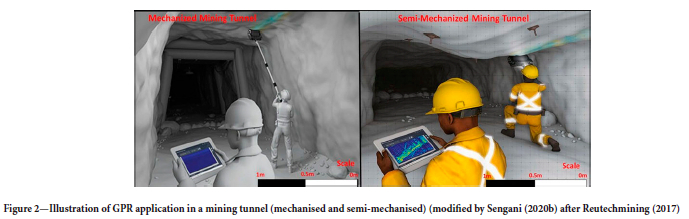
In the study of application of destress blasting to manage seismic hazard, Sengani (2020b) noted that the application of the ground penetration radar technique successfully identified seismic and non-seismic hazards, which could not be identified through conventional and numerical evaluations in hardrock mining. Fractures in the rockmass and geological structures causing breaks in the rockmass (discontinuities) can be picked using the GPR technique. The technique uses the geophysics approach of rapidly reflecting electromagnetic waves at high resolution in a scan target, providing vital information about the distribution of rockmass discontinuities. Sengani (2020b) provides an account of the theoretical background of the GPR and its application in different fields including archaeology, construction, mining, exploration of gem tourmaline pockets and vugs, identification of voids and cavities, and assessing the depth of a water table. Sengani (2020b) notes that, although GPR has been extensively used in mining and construction (Shi et al., 2018; Liu et al., 2018; Hao et al., 2016; Fedorova et al., 2016; Moradipour et al., 2015; Ralston, Strange, 2015; Lualdi, Zanzi, 2004; Jha et al., 2004; Toper et al., 1999; Ralston et al., 2001; Ralston, Hainsworth, 1999; Hainsworth et al., 1999; Murray et al., 1996; Noon, 1996; Chufo, Johnson, 1993; Mowrey et al., 1995; Daniels, 1980; Ellerbruch, Belsher, 1978), there are few studies, which cover particular application of GPR in rock mechanics (Sengani et al., 2019; Sengani, Zvarivadza, 2018a; Sengani, Amponsah-Dacosta, 2018; Sengani, Zvarivadza, 2017; Toper, 2003; Grodner, 2001). Figure 2 illustrates the application of GPR in a mining tunnel.
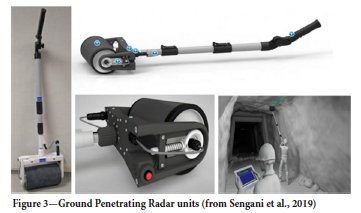
The GPR equipment is shown in Figure 3.
The intensity of fracturing ahead of the mining face can be assessed using colour coding, as presented in Table 1. Dark red colour indicates a fracture frequency of more than 20 fractures per metre and dark blue colour represents a fracture frequency of less than 5 fractures per metre.
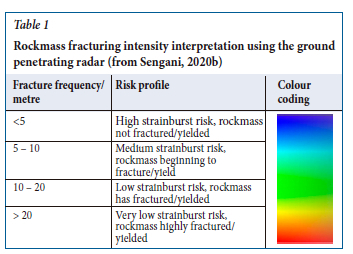
Example GPR scans for destress blasting using four destress blast holes and five destress blast holes on the mining face for deep level hardrock mining in South Africa are presented in Figure 4 and Figure 5, respectively. Using Table 1 to interpret the results, it can be seen that more intensive fracturing ahead of the mining face is achieved when using five destress blast holes compared to four destress blast holes.
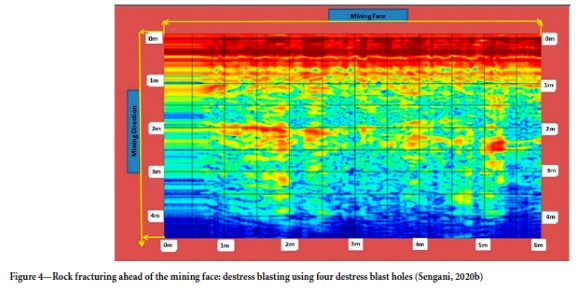
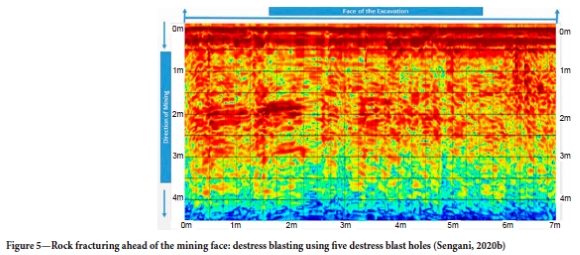
It then becomes critically important to choose the optimum number of destress blast holes or blast hole spacing to achieve optimum destress blasting results. It should be noted that using more holes than necessary leads to unnecessary costs and waste of time in drilling the additional holes.
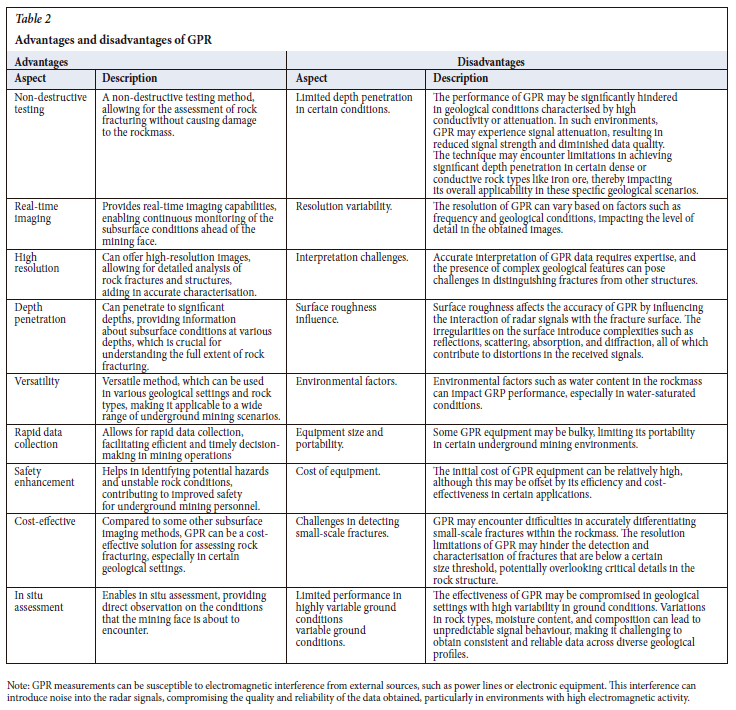
Understanding both the advantages and disadvantages of using GPR allows for a balanced assessment of its suitability in specific underground mining contexts. Consideration of geological conditions, expertise in data interpretation, and the specific goals of the mining operation are crucial in determining the effectiveness of GPR for assessing rock fracturing ahead of the mining face. The advantages and disadvantages of GPR are presented in Table 2.
A close look at some practical applications and case studies demonstrating GPR effectiveness
GPR has been increasingly applied in underground mining environments to assess rockmass fracturing, evaluate the effectiveness of destress blasting, and detect hazardous geological structures that conventional methods often miss. Several practical examples demonstrate the reliability and operational value of GPR for these purposes. One notable application was documented in great technical detail at Mponeng Mine (in South Africa), one of the deepest hardrock gold mines in the world, by Thebethe, (2018). Van Schoor et al. (2022) report on the successful application of GPR in South African deep platinum and gold mines to detect and characterise fracture intensities ahead of mining faces. Momayez et al. (1996) present the application of GPR in Canadian mines to enhance safety, reduce costs, and improve productivity. They note that, in the Kidd Creek base metal mine, GPR was used to monitor the stability of a sill pillar, detect sulphide pockets, assess rockfill quality, and identify voids or fractures in filled areas. The technology proved effective in mapping geological structures and evaluating the integrity of underground supports, such as culvert systems (Momayez et al.,1996). These case studies, among many others, collectively validate GPR as a practical, non-destructive, and real-time method, which can be used for evaluating destress blasting effectiveness through rockmass fracturing characterisation and guiding proactive ground control strategies. Although challenges such as signal attenuation in conductive environments remain, advances in GPR antenna technology and data processing have significantly improved its penetration depth and resolution, making it an essential tool in modern deep mining operations.
Borehole periscope
The GPR scan results can be verified using the technique of borehole camera. Rock fracturing ahead of the mining face can also be evaluated using a borehole periscope (camera). The technique can be used to verify the results of the GPR scans. This is a distinctly valuable alternative ,which can be used to detect some of the errors, which may occur due to a malfunctioning GPR. The reverse also applies in verifying borehole camera results using the GPR technique. The borehole camera can detect the fracture frequency from the collar of a borehole all the way up to the end of the borehole. Integrating borehole cameras with GPR has emerged as a powerful method to improve subsurface interpretation in deep underground hardrock mining. In spite of the fact that GPR provides broad detection of geological structures, it is prone to false anomalies due to environmental interference (Dang et al., 2018). Borehole cameras offer high-resolution visual imaging that verifies and refines GPR interpretations by directly observing fractures and discontinuities (Zou et al., 2021; Yuan et al., 2023). This combination addresses the calibration challenges of GPR, enhancing the certainty of features like fault zones and supporting more accurate rockmass modelling (Kulich, Bleibinhaus, 2020). Borehole camera data also enable advanced image processing and automated analysis, further improving reliability (Zou et al., 2021). This integrated approach strengthens subsurface characterisation, optimises mining support design, and enhances operational safety by cross-validating anomalies detected by GPR (Yuan et al., 2023). Together, the methods overcome the individual limitations of each technology, offering a reliable framework for managing geological risks in deep mining environments (Dang et al., 2018; Zou et al., 2021; Yuan et al., 2023; Kulich, Bleibinhaus, 2020).
Sengani and Zvarivadza (2018a) present the application of borehole periscope in the assessment of rock fracturing ahead of deep level hardrock mining faces destressed using destress blasting. Figure 6 illustrates borehole periscope observations of rock fracturing ahead of a mining pillar face destressed using destress blasting. The interpretation of the fracture frequency relative to rockburst potential of the mining face can be done using the criteria suggested by Sengani and Zvarivadza (2017) in Table 3.
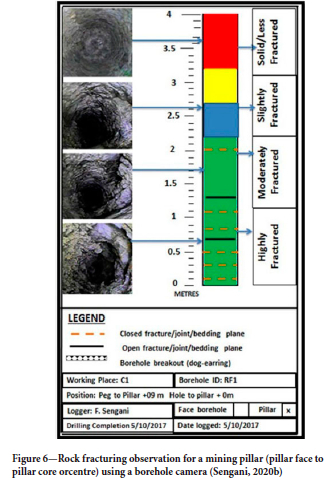
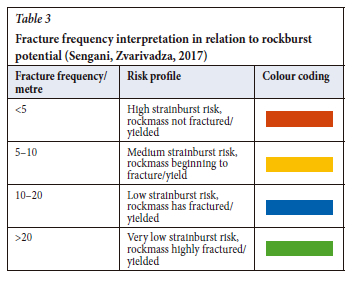
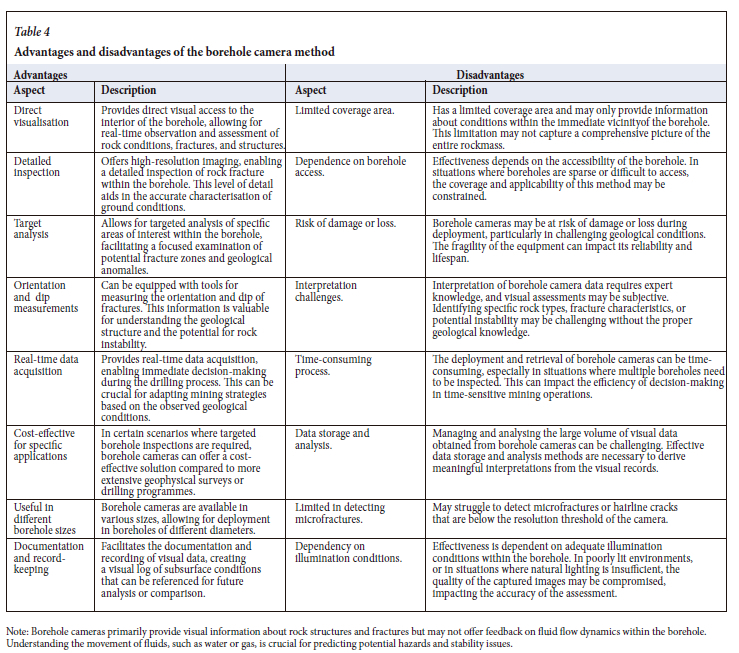
As expected, the fracturing is high in the immediate vicinity of the pillar face and decreases towards the pillar core. Table 4 gives the advantages and disadvantages of the borehole camera method.
Drill core observations
The degree of fracturing ahead of the excavation face can also be observed by collecting drill core from the excavation face before and after destress blasting and analysing it, as per Figure 7.
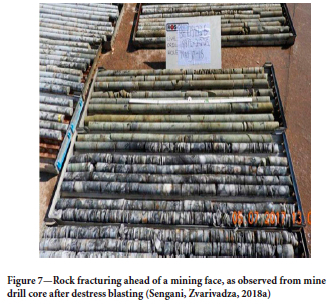
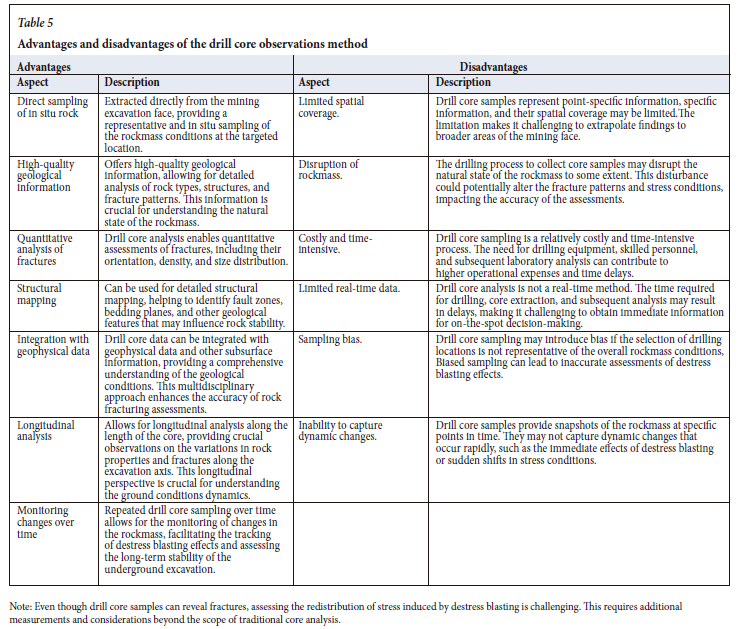
The advantages and disadvantages of the drill core observations method are presented in Table 5.
Key insights on evaluating destress blasting performance using rock fracture monitoring
The evaluation of rock fracturing ahead of the excavation face is a critical aspect in the assessment of destress blast designs within underground mining operations. Various techniques are employed to understand the effectiveness of these designs, each offering unique perspectives into the condition of the rockmass. The discussion revolves around three primary methods: GPR, borehole periscope, and drill core observations.
GPR emerges as a non-destructive testing method, allowing for the assessment of rock fracturing without causing any damage to the rockmass. Its real-time imaging capabilities and high resolution provide detailed evaluation of rock fractures and structures, facilitating accurate characterisation. One of its key advantages lies in its versatility, making it applicable in various geological settings and rock types. Studies show that GPR can be used accurately to identify rock fracturing and geological discontinuities in a rockmass, thereby serving as a reliable tool to assess destress blast design effectiveness for deep underground mining. Limitations come to light in conditions characterised by high conductivity or attenuation, hindering its depth penetration capabilities. Challenges in resolution variability based on frequency and geological conditions, also pose complexities in data interpretation. The accuracy of GPR is influenced by surface roughness, affecting the interaction of radar signals with fracture surfaces.
The borehole periscope serves as a valuable alternative, providing direct visual access to the interior of the borehole for real-time observation and assessment of rock conditions. Its detailed inspection capabilities offer high-resolution imaging, enabling a focused examination of potential fracture zones and geological anomalies. Despite its advantages, limitations arise from its dependence on borehole accessibility. In situations where boreholes are sparse or difficult to access, the coverage and applicability of this method may be constrained. The risk of equipment damage or loss also poses challenges, impacting reliability and lifespan.
Drill core observations involve direct sampling of in situ rock from the mining excavation face. This method offers high-quality geological information, allowing for a detailed analysis of rock types, structures, and fracture patterns. Quantitative assessments of fractures, including orientation, density, and size distribution, provide valuable knowledge. Integration with geophysical data enhances the accuracy of rock fracturing assessments. Restrictions come from the disruption caused by the drilling process, potentially altering fracture patterns and stress conditions. The process is also relatively costly and time-intensive, with delays in obtaining real-time data. The spatial coverage of drill core samples is limited, making it challenging to extrapolate findings to broader areas of the mining face.
Each method, despite providing valuable information, comes with its own set of advantages and disadvantages. A critical consideration is the specific context of the underground mining operation. For instance, GPR is lauded for its non-destructive nature and versatility, yet its limitations in certain geological conditions must be acknowledged. Borehole periscope, with its direct visual access, proves advantageous in targeted analysis but faces challenges in accessibility and equipment fragility. Drill core observations offer high-quality geological information but are constrained by their cost, time intensity, and limited spatial coverage.The choice of technique is not a one-size-fits-all decision but depends on the goals, geological conditions, and safety objectives of the mining operation. Combining these methods can offer a more comprehensive understanding of the rockmass, mitigating the limitations of individual techniques. It is crucial to recognise that accurate interpretation of data from these methods requires expertise, and challenges may arise in distinguishing fractures from other geological structures, especially in complex conditions.
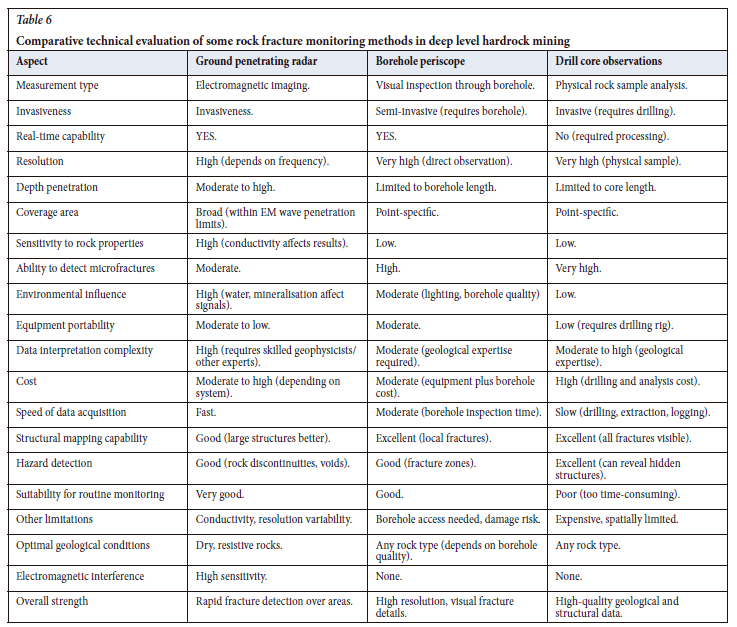
The significance of considering environmental factors, such as water content in the rockmass, cannot be overstated. The performance of these methods, particularly GPR, may be influenced by factors like water saturation, impacting their effectiveness. The issue of electromagnetic interference is also raised, where external sources like power lines can compromise the quality and reliability of data obtained. Such considerations highlight the need for a holistic approach that incorporates not only the technical aspects of these methods but also the external conditions that may affect their performance.It can be noted that the evaluation of rock fracturing ahead of the mining face is a multifaceted task that requires a careful balance between various techniques. The advantages of non-destructive testing, real-time imaging, and high-resolution analysis must be weighed against limitations in depth penetration, resolution variability, and interpretational challenges. The application of these methods should align with the specific goals of the mining operation and the geological context, ensuring a comprehensive and reliable assessment of rockmass conditions.To further assist readers in appreciating the relative strengths and limitations of different rock fracture monitoring methods, a detailed side-by-side technical comparison of ground penetrating radar, borehole periscope inspections, and drill core observations is presented in Table 6.
This structured comparison enables a clearer understanding of how each method complements the others and informs the choice of evaluation techniques in practical deep mining environments.
The comparison clearly shows that no single method is universally superior; rather, each offers distinct technical advantages under different operational conditions. An integrated monitoring approach, taking the advantages of the rapid survey capabilities of GPR, the detailed visualisation offered by borehole periscopes, and the geological richness captured in drill cores, is recommended for achieving a robust, high-confidence assessment of rock fracture networks following destress blasting interventions.
Use of rockburst prediction criteria
Calculation of the energy balance in terms of the strain energy stored in the rockmass and the energy released by the rockmass enables rockburst control practitioners to determine the propensity of the rockmass to burst. In view of destress blasting, the energy balance can be determined before and after destress blasting to evaluate the efficiency of the destress blast design.
From the work of his research team conducted over many years, together with observations from several other expert researchers, Mitri (2022) provided three key rockburst criteria, which can be used to assess the efficiency of destress blasting in deep underground hardrock mining, which are F, BSR, and BPI. Each criterion provides valuable perspectives into the potential for rockmass failure and aids in optimising destress blasting strategies for enhanced safety and efficiency. The technical details and motivation behind the use of F, BSR, and BPI in evaluating destress blasting design performance revolve around their capabilities to quantify energy storage, assess brittleness, and provide a comprehensive index of rockmass properties. These criteria, when integrated and monitored over time, enable practitioners to make informed decisions to prevent or mitigate the risk of rockbursts in underground mining operations through the design of efficient destress blasts. The three are discussed as follows.
Strain energy storage coefficient (F)
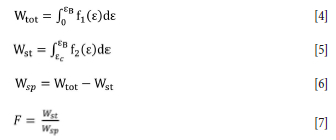
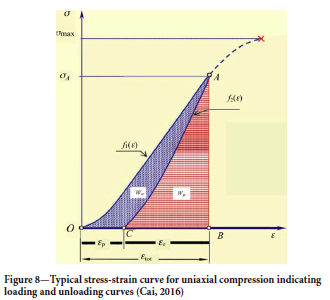
The principle of F is premised on the observations of strain energy (area under a stress-strain curve of a rock sample) changes when a rock sample is uniaxially compressed to 80% of its maximum uniaxial compressive strength and the load is released gradually to zero. Since loading the specimen to 0.8UCS makes transition from elastic behaviour to plastic behaviour, permanent damage is experienced by the specimen, leading to strain energy being spent on plastic deformation (represented as Wsp (area OAC) in Figure 8). The total strain energy generated in the specimen when it is uniaxially compressed to 0.8UCS is represented as Wtot (area OAB in Figure 8). The strain energy stored in the specimen (Wst) is the difference between Wtot and Wsp. From the work of Kidybinski (1981) and Wang et al. (1998), F is defined as the ratio of Wst to Wsp and Equations 4 to 7 are used in the formulation of the ratio using Figure 8.
The criterion for judging rockburst intensity based on F is given in Table 7.
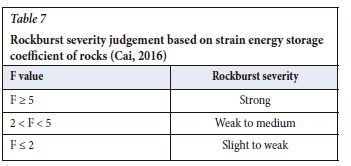
F serves as an indicator of the energy that can be released during a rockburst. Higher values of F imply a greater potential for energy release, signalling a higher risk of rockmass failure. Monitoring changes in F before and after destress blasting helps evaluate the effectiveness of the blasting in reducing strain energy storage. A decrease in F indicates successful energy dissipation, contributing to rockburst prevention.
Despite the fact that F provides critically valuable information into the propensity of a rockmass to release stored strain energy during failure, it is important to recognise that the determination of F is sensitive to sampling variability and the inherent differences between laboratory testing conditions and actual in situ field conditions. Sampling variability arises due to the natural heterogeneity of rockmasses. Laboratory specimens are often extracted as relatively small, intact core samples that may not fully represent the large-scale variability found underground. Factors such as mineral composition, grain size distribution, microfracturing, alteration zones, and anisotropy within the rockmass may not be adequately captured in the limited volume of laboratory samples. Laboratory-derived F values might either underestimate or overestimate the energy storage potential of the broader rockmass as a result, depending on whether the sampled cores are stronger or weaker than the average in situ conditions. Laboratory tests typically impose idealised loading conditions, such as uniform uniaxial compression at controlled strain rates, that differ significantly from the complex, multi-axial and time-dependent stress regimes experienced in situ. Stress states are influenced by excavation-induced stress concentrations, seismic wave propagation, and long-term creep behaviour in the field, which are not easily replicated in laboratory environments. Laboratory tests are performed on relatively dry samples, whereas in situ rockmasses may be saturated or partially saturated, further altering their mechanical response and energy storage behaviour.
The transition from laboratory to field conditions therefore introduces uncertainty into the direct application of F values. It is recommended to use a statistically significant number of samples for laboratory testing to mitigate this, capturing a broad spectrum of geological variability. Laboratory-derived F values should ideally be calibrated against observed field behaviour, such as the incidence and severity of rockbursts, microseismic energy release patterns, and measured deformation responses. Integrating F with in situ stress measurements, seismic monitoring, and numerical modelling in high-risk areas enhances the robustness of destress blasting design and rockburst risk assessments. Acknowledging these limitations ensures that the interpretation of F is contextually appropriate, and that risk management strategies based on F are both technically defensible and operationally effective in complex deep mining environments.
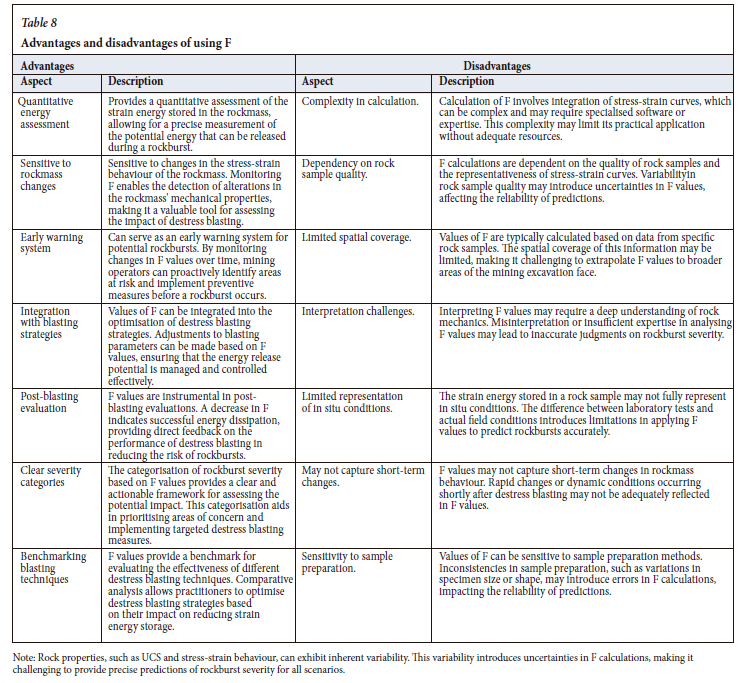
The advantages and disadvantages of using F for rockburst prediction, and destress blasting design and evaluation are given in Table 8.
Brittle shear ratio (BSR)
Adopting the work of Castro et al. (1997) on rockmass damage initiation, Mitri (2022) explains the application of BSR in hardrock mining to evaluate rockburst potential. The key aspects of the criterion are summarised as follows:

Where:
σ1 is the major principal stress.
σ3 is the minor principal stress.
UCS is the uniaxial compressive strength.
The rockburst propensity using the BSR criterion is assessed using potential for strain bursting as shown in Table 9.
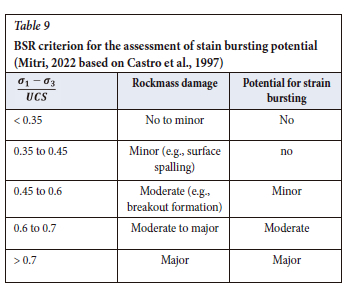
BSR values less than 0.35 suggest no to minor rockmass damage, with no potential for strain bursting. As BSR values increase, the potential for strain bursting escalates, moving from minor to major damage categories. Before destress blasting, BSR can be calculated based on stress conditions and rock properties. This pre-blasting assessment sets a baseline for evaluating the effectiveness of destress blasting in altering the stress state and reducing the potential for brittle failure. After destress blasting, changes in BSR can be monitored. A decrease in BSR indicates a reduction in the potential for brittle failure, suggesting successful stress redistribution and a lowered risk of strain bursting. BSR values guide the optimisation of destress blasting parameters. Adjustments can be made to the blasting design to achieve the desired reduction in BSR, aligning with safety objectives and minimising the risk of rockbursts.
BSR has proven to be an effective indicator for assessing rockburst potential in hardrock mining environments, yet it is critical to acknowledge that its reliability is strongly context-dependent. The BSR calculation fundamentally relies on accurate measurements of the major and minor principal stresses (σ1 and σ3) and the uniaxial compressive strength (UCS) of the rockmass. In deep level mining, obtaining precise in situ stress measurements presents considerable challenges due to complex geological structures, variable rockmass properties, and operational constraints. In situ stress fields in deep hardrock mines are often highly heterogeneous in practice, influenced by factors such as lithological layering, faulting, historical mining-induced stress redistributions, and natural anisotropies. Techniques commonly used to measure in situ stresses, such as overcoring, hydraulic fracturing, and borehole slotter methods, are each subject to inherent limitations, measurement errors, and assumptions that may not fully capture the true stress state, especially at great depth (Ljunggren et al., 2003; Gaines et al., 2012; Lin et al., 2018; Li et al., 2024; Li et al., 2025). These uncertainties directly propagate into BSR calculations, affecting the accuracy of the predicted rockburst proneness.
BSR values are also sensitive not only to the absolute magnitudes of principal stresses, but also to the stress ratio between σ1 and σ3. Localised stress concentrations, stress shadow effects from nearby excavations, and time-dependent stress changes can all skew the stress measurements, thereby impacting the calculated BSR. Caution must be exercised when interpreting BSR in isolation, particularly in geologically complex or seismically active areas. To enhance the robustness of BSR-based assessments, it is recommended that BSR be used alongside multiple independent data sources. These may include microseismic monitoring data, numerical modelling outputs (e.g., elastic or elastoplastic stress models), mapped fracture orientations, and observational records of rockmass behaviour (e.g., spalling, slabbing, or strainbursting). Sensitivity analyses, considering plausible variations in stress magnitude and orientation, are also vital to quantify the impact of uncertainty on BSR predictions. It can be noted that BSR remains a valuable and practical tool for evaluating brittle failure potential in underground mines, but a clear understanding of its context dependence and sensitivity to in situ stress uncertainties is essential. Integrating BSR assessments with other empirical, observational, and numerical techniques provides a more comprehensive and justifiable approach to managing rockburst hazards in deep mining environments.
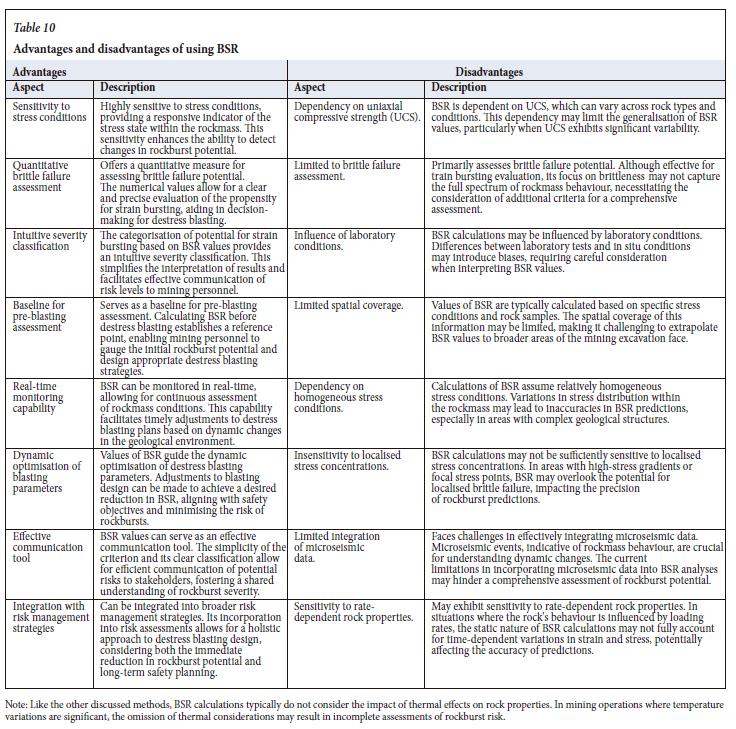
Several studies shed more light on the concept of BSR, coverage of which is significant to destress blasting studies. These studies include the following: Rojas-Perez et al., 2024; Shnorhokian, Ahmed, 2024a; Kabwe et al., 2023; Zhang et al., 2023b; Shnorhokian, Mitri, 2022; Vennes, Mitri, 2022; Heidarzadeh et al., 2021; Heidarzadeh et al., 2020; Vennes et al., 2020; Sainoki et al., 2019; Vennes, 2019; Zhou et al., 2018; Shnorhokian et al., 2018; Vennes, Mitri, 2017; Vennes, Mitri, 2016; Sainoki et al., 2016; Shnorhokian et al., 2015; Shnorhokian et al., 2014. The advantages and disadvantages of using BSR for rockburst prediction and destress blasting design and evaluation are presented in Table 10.
Burst potential index (BPI)
The concept of energy balance can be used to evaluate the burst potential of the rockmass as a result of stress redistribution when destress blasting is implemented. This entails manipulation of the energy balance equations to ascertain the amount of energy available to induce rockbursting. Several studies on rockburst prediction based on energy balance evaluation have been done and are crucial to destress blasting design research (Watson et al., 2025; Gao et al., 2024; Zhang et al., 2023b; Luo, Gong, 2023; Askaripour et al., 2022; Li et al., 2022; Papadopoulos, Benardos, 2021; Gao et al., 2020; Khademian, Ozbay, 2019; Zhao et al., 2019; Khademian, Ugur, 2018; Zhou et al., 2018; Hamdi et al., 2017; Mazaira, Konicek, 2015; Qiu et al., 2014; Sirait et al., 2013; Lafont et al., 2013; Konicek et al., 2013; Al Heib et al., 2013; Wattimena et al., 2012; Brady, Brown, 2006; Tang, 2000; Tang, Mitri, 2001; Tajdus et al., 1997; Mitri et al., 1993; Minney, Naismith, 1993; Hedley, 1992; Boldstad, 1990; Salamon, 1984, 1983, 1974,1970; Walsh, 1977; McMahon, 1988; Budavari, 1983; Ivanov et al., 1980; Cook et al., 1966, 1978). The rockburst potential is influenced by excavation geometry and stress changes. Studies by Ortlepp (1983) show that the rockmass behaves elastically in rockburst scenarios. Mitri et al. (1999) note that, due to this elastic behaviour, the energy changes in the rockmass as a result of rock bursting can be modelled using elastic constitutive laws. The use of elastic laws to evaluate the energy available to induce rock bursting is conservative, since the energy used in fracturing the rock is not accounted for, therefore overestimating the energy available to induce rock bursting (Mitri et al., 1999). For practical purposes, Mitri et al. (1999) provide the following formulation (Equation 9), which can be used to evaluate the burst potential of a rockmass due to stress and excavation geometry changes.
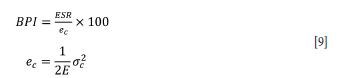
Where:
ESR is energy stored in the rock as determined through numerical modelling.
ec is the critical energy capacity of the rock.
σc is uniaxial compressive strength.
Strain bursting is highly likely to occur when the BPI is greater than 100%.
In as much as BPI offers a powerful quantitative method for assessing the propensity of rockmass failure based on the energy balance approach, it is important to recognise that its accuracy is inherently dependent on the reliability of the numerical modelling inputs used to estimate the energy stored in the rockmass (ESR). Uncertainties in critical input parameters, including in situ stress magnitudes and orientations, mechanical properties such as Young's modulus, Poissons ratio, uniaxial compressive strength (UCS), and rockmass anisotropy, can significantly influence the predicted energy accumulation and dissipation within the rockmass. Slight variations in measured UCS or elastic modulus due to sample heterogeneity, scale effects, or laboratory testing variability, as an example, can lead to notable differences in modelled stress fields and therefore the computed ESR values. Geological complexities such as unaccounted for joint sets, faults, or heterogeneous lithological transitions, may not be fully captured in the numerical model, introducing further uncertainties into the energy distribution predictions. Boundary conditions, assumed failure criteria (e.g., Mohr-Coulomb versus Hoek-Brown), and simplifications in material behaviour (linear elasticity versus strain-softening) within the model can introduce systematic biases. These factors can result in either underestimation or overestimation of BPI values, potentially affecting the assessment of burst proneness and leading to either excessive conservatism or overlooked hazards. Recognising these limitations, it is recommended that BPI assessments be supported by careful sensitivity analyses, wherein the impacts of key parameter variations are systematically evaluated. Probabilistic modelling approaches and back-analysis of historical seismic events, where feasible, can also help in refining the input parameters and reducing uncertainty. BPI results, ultimately, should not be interpreted in isolation but rather integrated with complementary observational data, such as microseismic monitoring trends, rock fracture mapping, and field-measured stress changes, to provide a balanced and robust evaluation of rockburst risk following destress blasting. Acknowledging and appropriately managing input uncertainties is critical for ensuring that BPI-based assessments remain a reliable and practical tool for rockburst hazard management in deep level mining operations.
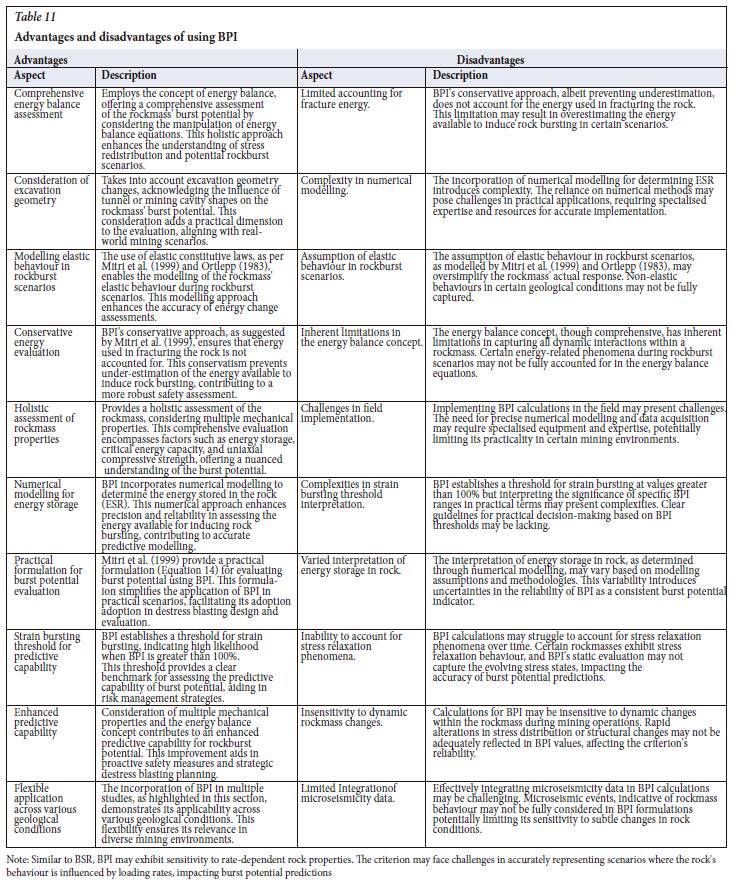
BPI provides a holistic assessment of the rockmass, considering multiple mechanical properties. This comprehensive approach enhances the predictive capability of rockburst potential. Evaluating changes in BPI before and after destress blasting aids in optimising blasting parameters. A decrease in BPI signifies positive modifications in the rockmass properties, indicating successful destress blasting. The advantages and disadvantages of using BPI for rockburst prediction and destress blasting design and evaluation are presented in Table 11.
Key insights on evaluating destress blasting performance using rock burst prediction criteria
Rockburst prediction criteria can be handy in the design of efficient destress blasting. Some of the key rockburst prediction criteria applicable to hardrock mining, as presented by Mitri (2022), are F, BSR, and BPI. The energy balance method is pivotal in the assessment of the burst potential of underground mining excavations. It involves assessing the strain energy stored in the rockmass against the energy released, aiding in the determination of rockmass propensity to burst. The three criteria presented by Mitri (2022) are derived from this method, offering a holistic approach to evaluating destress blasting efficiency. Selected practical examples from deep mining operations are integrated in this discussion to further illustrate the applicability of these criteria in evaluating destress blasting performance.
F is a crucial indicator representing the ratio of strain energy stored to that spent on plastic deformation during uniaxial compression. High F values suggest a greater potential for energy release, signifying a higher risk of rockmass failure. Monitoring F changes post-destress blasting aids in assessing its effectiveness. The advantages include quantitative energy assessment, sensitivity to rockmass changes, and serving as an early warning system. Challenges arise from its complexity of calculation, dependency on sample quality, and limited spatial coverage.
In the Sanshandao gold mine case study conducted by Cai (2016), F was applied to evaluate five rock types, resulting in the classification of four rock types as having strong rockburst potential and one as medium. The findings aligned with other indices (e.g., brittleness coefficient, burst energy coefficient), confirming the high rockburst risk of the mine and, showing that F serves as a predictive tool, enabling proactive rockburst prevention in deep mining operations (Cai, 2016). Targeted destress blasting can successfully reduce F values in rockburst prone zones, and subsequent operational records can confirm this by showing a marked decline in burst events to validate F as a practical tool for pre- and post-blasting evaluation.
Rockburst potential is assessed by BSR based on the ratio of major to minor principal stress over the uniaxial compressive strength. It categorises potential for strain bursting from 'no' to 'major.' BSR proves sensitive to stress conditions, allowing real-time monitoring and dynamic optimisation of blasting parameters. Its challenges involve dependency on UCS, limited spatial coverage, and potential oversimplification of rockmass behaviour. Vennes et al. (2020) employed the BSR technique (creating fractured panels to dissipate stress in ore pillars, reducing local stiffness and stress concentrations) to evaluate the effectiveness of large-scale destress blasting for their case study of the Copper Cliff mine. Numerical modelling, validated by field stress measurements, showed that destress blasting lowered BSR values in targeted zones. In one stope, they noted that BSR decreased from 0.93 to 0.87 after blasting, reducing the volume of high-risk ore (BSR > 0.7) from 15% to 7.7% (Vennes et al., 2020). The practical application of BSR lies in guiding blast design and mining sequences. Mining practitioners can optimise destress blasting parameters (e.g., explosive energy, panel geometry) by monitoring BSR changes to ensure stress relief and safer extraction. The study by Vennes et al. (2020) confirmed that BSR, combined with other indices like the BPI, provides a reliable framework for rockburst risk management in deep, high-stress mining environments.
BPI evaluates burst potential by considering energy storage, excavation geometry, and rock properties. It provides a comprehensive assessment, incorporating multiple mechanical properties. Decreases in BPI post-destress blasting indicate positive modifications in rockmass properties. Advantages include a holistic evaluation and consideration of excavation geometry, while challenges include complexity in numerical modelling, potential conservatism, and difficulties in field implementation. One effective application of the BPI is demonstrated in the study by Xu et al. (2022), which evaluates rockburst tendencies in the context of sill pillar recovery strategies using finite element modelling. They reveal that the assessment of tangential stress, alongside the BPI, provides more clarity into the stability of stope accesses during recovery operations, thereby facilitating safe mining practices. Verma et al. (2024) propose an energy-based strain burst criterion that integrates stress conditions and material characteristics. They introduce a 'Burst Envelope' concept, which aids in understanding localised failure mechanisms, and develop a scalar burst index that quantifies burst potential. This approach underscores the significance of material properties and stress conditions in predicting rockburst events. Numerical simulations based on mining-induced stress redistribution can predict BPI values exceeding 100% in mining areas. Controlled destress blasts can be strategically deployed together with monitoring BPI values to decrease the BPI values below critical threshold. This intervention holds great potential to directly mitigate the risk of large-scale violent failures in high-extraction stopes and can demonstrate the operational value of BPI in guiding destress strategies.
The three criteria offer a comprehensive toolkit for assessing rockburst potential. F, BSR, and BPI, even alongside their advantages, share common challenges such as sensitivity to sample quality, limited spatial coverage, and the need for expertise in interpretation. It can be noted that a holistic approach, combining multiple criteria for a more robust assessment, is of significant importance. The practical application of these criteria in real-world mining scenarios is notable. Each criterion provides evaluation, yet the interplay between them and their integration into broader risk management strategies is crucial. Practical challenges, such as the complexity of calculations and limitations in field implementation, need to be addressed for effective use. The practical examples highlighted in this study collectively underline that rockburst prediction criteria such as F, BSR, and BPI are not just theoretical tools; they have proven, tangible application in real mining scenarios. Integrating these indices into routine mining practice, alongside numerical modelling and seismic monitoring, provides a powerful, validated methodology for optimising destress blasting and improving underground mine safety.
The extensive list of studies cited highlights the depth of research in this field. It also points to potential gaps, such as the limited integration of microseismic data and challenges in representing dynamic rockmass changes. Future research could focus on refining these criteria and addressing the evolving needs of mining operations. The rockburst prediction criteria offer a nuanced approach to destress blasting design. Recognising their challenges, their potential in enhancing safety and efficiency in underground mining operations is evident. A collaborative effort in further research and practical implementation is crucial for refining these criteria and ensuring their effectiveness in diverse geological conditions.
Seismic monitoring
Mining-induced seismic events can be monitored using seismic monitoring systems, enabling mining personnel to forecast rockburst hazards and effectively manage them (Durrheim, 2025; Rapetsoa et al., 2025; Wu et al., 2024; Zhang et al., 2023a; Li et al., 2023; Fulawka et al., 2022a; Fulawka et al., 2022b; Zhao et al., 2022; Feng et al., 2022; Wang et al., 2022; Wang et al., 2021; Zhang et al., 2021; Vennes et al., 2020; Rahimi et al., 2020, Ma et al., 2020; Dahnér, Dineva, 2020; Simser, 2019; De Santis et al., 2019; Wesseloo, 2018; Ma et al., 2018; Konicek, Waclawik, 2018; Brown, Hudyma, 2018, He et al., 2017; Sainoki et al., 2017; Sengani, Zvarivadza, 2017; Zhang et al., 2017; Glazer, 2016; Mendecki, Malovichko, 2010; Hudyma, Potvin, 2010; Durrheim, 2010; Hudyma, Brummer, 2007; Hudyma, Potvin, 2004; Blake, Hedley, 2003; Beck, Brady, 2002; Potvin, Hudyma, 2001; Duplancic, Brady, 1999; Mendecki, 1996; Hasegawa et al., 1989, among many others). Figure 9 and Figure 10 illustrate the distribution of micro seismic events before and after implementing destress blasting respectively for a deep underground hardrock mine.
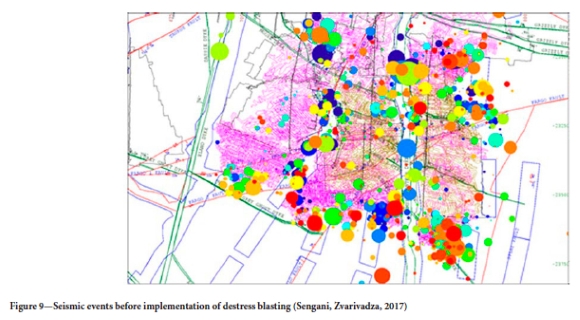
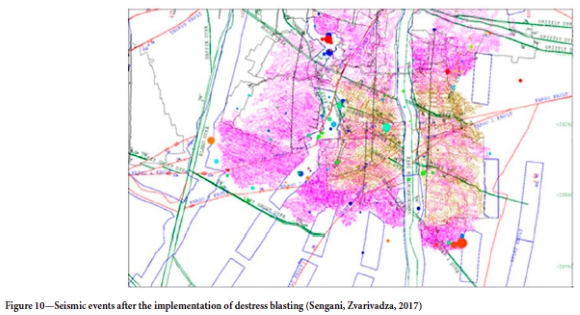
It is evident from field observations that destress blasting is accompanied by significantly reduced seismic events at a local scale of the mine. A properly functional seismic monitoring system is a practical and handy tool to observe destress blasting efficiency. Noting the significant value of seismic monitoring, Simser (2019) argues that: A modern deep hardrock mine arguably should not operate without a seismic monitoring system. Simser's (2019) assertion is fundamentally accurate, still, it is important to provide a balanced discussion by acknowledging practical considerations such as costs, system limitations, and data resolution challenges. Seismic monitoring systems are invaluable for detecting stress redistribution, locating seismic sources, and tracking precursors to dynamic failures, thereby enabling proactive rockburst management. The installation, operation, and maintenance of high-quality seismic arrays, however, entail significant financial investment. Costs include not only the initial purchase of geophones, accelerometers, and associated hardware, but also the ongoing requirements for data processing infrastructure, specialist staff, calibration, and periodic system upgrades to maintain sensitivity and reliability. The spatial resolution and sensitivity of seismic monitoring systems are also inherently limited by the number and placement of sensors. Insufficient sensor density can result in large uncertainties in event localisation, magnitude estimation, and focal mechanism analysis, particularly in complex geological environments where wave propagation is heterogeneous. On top of that, distinguishing between mining-induced seismicity and background microseismic noise often demands sophisticated signal processing techniques and expert interpretation, increasing operational complexity. Technological advances such as micro electro mechanical system (MEMS) based accelerometers and machine learning enhanced data interpretation are improving capabilities, but challenges persist, especially for detecting low-energy microseismic events critical for early warning. It can be noted from this that, although seismic monitoring is imperative for deep level mines, a well refined perspective recognises that its deployment must be optimised relative to mine-specific risk profiles, operational budgets, and geotechnical conditions. A tiered approach is recommended: critical areas of the mine may warrant dense, high-resolution monitoring, while less active zones could be covered with lower-density arrays, ensuring effective, risk-prioritised seismic hazard management without excessive financial burden. Amid the clear value of seismic monitoring for managing rockburst risk and evaluating destress blasting effectiveness, it is equally important to critically consider the limitations of seismic systems, their complementary role alongside other monitoring techniques, and practical evidence of their integrated application in deep mining operations.
Limitations, complementary value, and practical evidence of seismic monitoring
Seismic monitoring plays a critical role in managing rockburst risks and evaluating the effectiveness of destress blasting in deep level hardrock mining. Seismic systems provide vital real-time feedback into stress redistribution and dynamic failure mechanisms; there are, however, practical limitations that must be acknowledged when implementing these systems. Spatial resolution and event detection thresholds pose significant challenges. The ability of a seismic system to accurately locate and characterise events is heavily dependent on the number, sensitivity, and strategic placement of sensors. Sparse networks can result in large location uncertainties, misinterpretation of source mechanisms, and failure to detect small, but important, microseismic precursors (Mendecki, 1996; Hudyma, Potvin, 2004; Peng et al., 2020; Barthwal, Van der Baan, 2020). Hidayat et al. (2021) discuss the importance of hypocenter relocation to minimise uncertainties in microseismic activity identification, which is crucial for ensuring the safety of mining operations under complex geological conditions. High-frequency, low-energy microseismic events, which often precede larger rockbursts, may go undetected if sensor sensitivity or density is insufficient. Environmental and operational noise in an active mine, caused by drilling, blasting, equipment operation, and ventilation, can mask true seismic signals. Discriminating between mining-induced seismicity and background noise demands sophisticated signal processing and experienced interpretation, increasing operational complexity (Wesseloo, 2018).
Financial costs present another constraint. Seismic monitoring systems require substantial investment for high-quality sensors, cabling, data acquisition systems, and ongoing maintenance. Additional costs are associated with data analysis expertise, either internally trained or outsourced (Durrheim, 2010). Mines must balance the cost of the system against the potential risk reduction benefit it provides. Another limitation lies in data interpretation complexity. Even with real-time monitoring, understanding the implications of seismic trends requires integration with geological models, mining sequences, and stress analysis. Standalone seismic data, without correlation to other monitoring data, may lead to incomplete or misleading conclusions regarding rockmass stability. Despite these limitations, seismic monitoring complements other rock engineering techniques effectively. When combined with numerical modelling, seismic monitoring validates model predictions of stress redistribution, allowing dynamic updating of rockburst risk maps (Ma et al., 2020). Ground penetrating radar and borehole periscope inspections provide direct imaging of fracture development, which can be correlated with microseismic event clustering zones, enhancing fracture network interpretation. Drill core analysis, in a similar approach, provides physical verification of fracture patterns predicted by seismicity patterns, strengthening confidence in rockmass behaviour models.
Practical evidence of the value of integrated seismic monitoring exists. Simser (2019) reports on Canadian hardrock mines that implemented comprehensive seismic monitoring systems integrated with numerical modelling to manage rockburst risks during deep mining. Seismic monitoring remains one of the best tools for estimating rockburst risk, asserts Simser (2019) from his practical observations from the Canadian hardrock mines. For effective large-scale destress blasting campaigns, seismic data can reveal spatial migration of seismicity away from production areas. Seismic moment tensor analysis correlation with fracture orientations observations through borehole logging can provide strong validation of the combined monitoring approach. In the deep gold mines of South Africa, seismic systems have been used in conjunction with visual geological mapping and borehole imaging to predict and manage strainbursts in high-risk panels, notably improving safety performance (Durrheim, 2010; Sengani, Zvarivadza, 2017; Sengani, 2020a). Seismic monitoring systems have practical limitations related to resolution, noise sensitivity, cost, and interpretation complexity, but they are indispensable for effective rockburst risk management. Their power lies not in standalone deployment but in strategic integration with other monitoring and modelling techniques, providing a holistic, dynamic understanding of the evolving rockmass response to mining activities. Future advancements in real-time data fusion, machine learning event classification, and integration with energy-based rockburst prediction models are expected to further enhance the role of seismic monitoring in modern deep level mining.
Innovative destress blasting evaluation methods incorporating geostatistics, machine learning, and IIoT real-time monitoring
Employing geostatistical methods like kriging or conditional simulation could strongly quantify spatial uncertainty and enhance the reliability of blast performance predictions. Geostatistics could help optimise the placement and configuration of destress blast holes by precisely modelling rockmass heterogeneity and identifying areas with higher probabilities of rockburst occurrences. Zvarivadza (2023) covers key concepts on the application of geostatistical methods in the evaluation of destress blasting efficiency.
Incorporation of machine learning techniques could significantly advance the predictive capabilities of the destress blasting evaluation framework. Given the complex, multivariate nature of the data involved, ranging from rock mechanics parameters, seismic data, fracture network imaging, and geomechanical modelling outputs, machine learning approaches such as random forests, gradient boosting, or neural networks could efficiently handle non-linear interactions and provide predictive perspectives with higher accuracy. Machine learning models could also dynamically adapt to incoming data, continually refining destress blasting strategies based on historical outcomes, thereby promoting proactive management of rockburst risks.
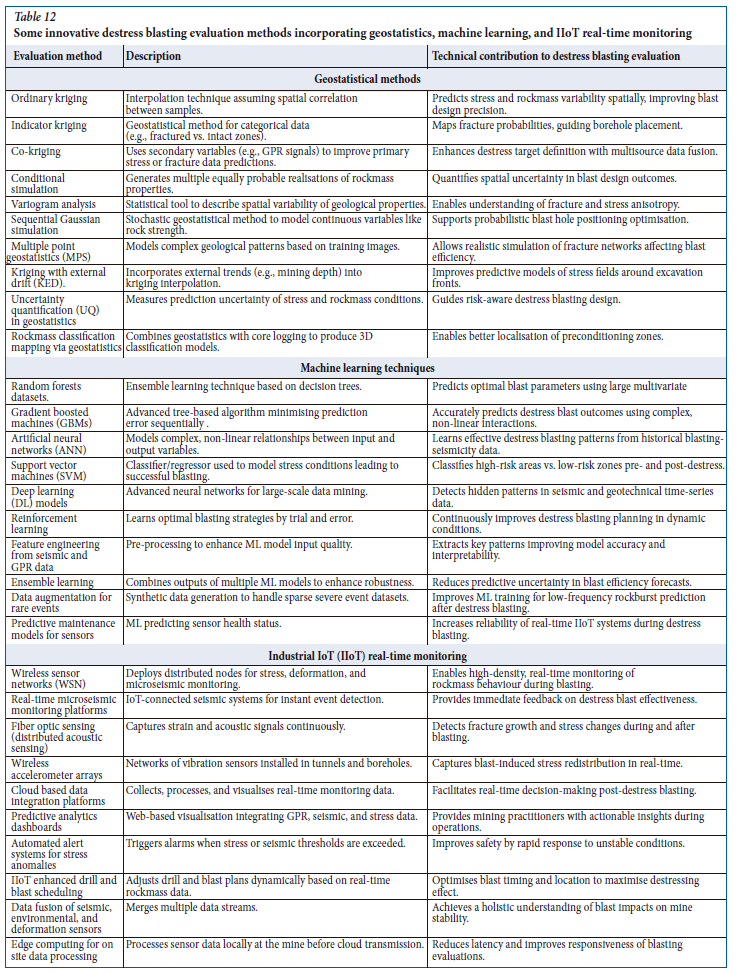
Integrating Industrial IoT based real-time monitoring systems, could further enhance data quality and operational responsiveness (Zvarivadza et al., 2024). Deploying sensor networks that continuously capture seismic, deformation, and environmental data in real-time could markedly improve the temporal resolution and accuracy of the evaluation. Such real-time data streams, combined with advanced analytics and cloud-based visualisation platforms, would allow immediate detection and response to stress changes and rockmass behaviour. This integration could substantially elevate the operational reliability of destress blasting, transitioning from retrospective assessments to real-time, data-driven decision-making frameworks. Table 12 presents some innovative destress blasting evaluation methods incorporating geostatistics, machine learning, and IIoT real-time monitoring.
The integration of geostatistical methods, machine learning models, and real-time IIoT monitoring frameworks significantly broadens the traditional destress blasting evaluation approach, offering a multi-dimensional, data-driven, and adaptive strategy that enhances both scientific rigour and operational resilience in deep underground hardrock mining environments.
Conclusions
Practically reliable evaluation of destress blasting is vitally important for developing a reliable destress blasting strategy. This study advances the evaluation of destress blasting by moving beyond traditional descriptive summaries and providing a structured, integrated framework that critically addresses key gaps in current practice. Previous research has highlighted the importance of destress blasting in mitigating seismic hazards in deep hardrock mining. Our work systematically tailors global best practices to the unique geological and operational challenges of deep Swedish mines. The study proposes refinements better suited for Sweden's deep hardrock mining environments by critically reviewing numerical modelling approaches and highlighting their limitations, such as oversimplification of damage zones and the need for anisotropic, time-dependent models. The integration of field-based fracture monitoring methods (GPR, borehole periscope imaging, and drill core observations) with predictive numerical simulations provides a notable, multi-modal evaluation framework. This study also reflects on the combined application of rockburst prediction criteria (F, BSR, BPI) as essential quantitative tools for assessing stress relief effectiveness pre- and post-destress blasting, offering a more robust and risk-informed evaluation process. It is also important to note that this work considers the incorporation of emerging technologies, such as geostatistical simulations to characterise spatial variability, machine learning to predict blast outcomes dynamically, and Industrial IoT-based real-time monitoring to move evaluation from retrospective assessments to predictive, adaptive control.
The new insights gained include:
> Emphasising the critical role of uncertainty quantification in blast performance prediction.
> Highlighting the importance of integrating low-magnitude seismic responses into adaptive destress blasting optimisation.
> Proposing an operational pathway for real-time feedback loops linking monitoring data to model recalibration during ongoing mining.
The proposed framework practically enables mining practitioners to design destress blasting strategies that are site-specific, dynamically adaptable, and scientifically grounded. This can improve operational safety, reduce unplanned seismic disruptions, and optimise drilling and blasting costs for the mining industry. From an academic perspective, the study contributes a refined evaluation methodology that future researchers can extend, particularly by combining energy-based rockburst prediction models with real-time data streams. Future research should focus on validating the proposed framework through field trials in deep Swedish mines, refining machine learning predictive models with larger datasets, and developing standardised protocols for real-time blast effectiveness evaluation based on integrated multi-sensor data. Our study lays the groundwork for a more rigorous, predictive, and operationally impactful approach to destress blasting evaluation in deep hardrock mining environments. It bridges the gap between theoretical destress blasting models and practical deep mining realities, offering a predictive, adaptable framework that strengthens both scientific understanding and field-based application in high-stress mining environments.
Acknowledgements
The authors gratefully acknowledge the financial support from the Strategic Innovation Programme for the Swedish Mining and Metal Producing Industry (STRIM), which is a joint investment from VINNOVA (The Swedish Governmental Agency for Innovation Systems), the Swedish Energy Agency, and Formas, with an additional in-kind contribution from Zinkgruvan Mining AB, LKAB, and Boliden (Ref. No.: 2020-04459).
References
Al Heib, M., Lafont, G., Didier, C., Gunzburger, Y., Piguet, J.P., Pytel, W., Mitri, H. 2013. Critical energy and mine rockburst potential. ISRM International Symposium-EUROCK, October 2013. OnePetro. [ Links ]
An, H., Mu, X. 2025. Contributions to Rock Fracture Induced by High Ground Stress in Deep Mining: A Review. Rock Mechanics and Rock Engineering, vol. 58, no. 1, pp. 463-511. [ Links ]
Andrieux, P., Hadjigeorgiou, J. 2008. The destressability index methodology for the assessment of the likelihood of success of a large-scale confined destress blast in an underground mine pillar. International Journal of Rock Mechanics and Mining Sciences, vol. 45, no. 3, pp.407-421. [ Links ]
Andrieux, P.P., Brummer, R.K., Liu, Q., Simser, B.P., Mortazavi, A. 2003. Large-scale panel destress blast at Brunswick mine. CIM Bulletin, pp. 78-87. [ Links ]
Askaripour, M., Saeidi, A., Rouleau, A., Mercier-Langevin, P. 2022. Rockburst in underground excavations: A review of mechanism, classification, and prediction methods. Underground Space, vol. 7, no. 4, pp. 577-607. [ Links ]
Baranowski, P., Damaziak, K., Mazurkiewicz, t., Mertuszka, P., Pytel, W., Malachowski, J., Palac-Walko, B., Jones, T. 2019. Destress blasting of rockmass: multiscale modelling and simulation. Shock and Vibration, 2019. [ Links ]
Barthwal, H., Van der Baan, M. 2020. Microseismicity observed in an underground mine: Source mechanisms and possible causes. Geomechanics for Energy and the Environment, vol. 22, p. 100167. [ Links ]
Beck, D.A., Brady, B.H.G. 2002. Evaluation and application of controlling parameters for seismic events in hardrock mines. International Journal of Rock Mechanics and Mining Sciences, vol. 39, no. 5, pp. 633-642. [ Links ]
Blake, W. 1972. Destressing test at the Galena Mine. In Transaction of SME-AIME. pp. 294-299. As cited in Sainoki, A., Emad, M.Z. and Mitri, H.S., 2017. Study on the efficiency of destress blasting in deep mine drift development. Canadian Geotechnical Journal, vol. 54, no. 4, pp. 518-528. [ Links ]
Blake, W., Hedley, D.G. 2003. Rockbursts: case studies from North American hardrock mines. SME. [ Links ]
Bolstad, D.D. 1990. Rockburst control research by the US Bureau of Mines. Rockbursts and Seismicity in Mines, pp. 371-375. [ Links ]
Borg, T. 1988. Ortdrivning med avlastningssprängning; Bergmekanisk uppföljningpã 815m nivãn i Malmberget. Report BeFo 331:1/88, SveDeFo 1989:1 (In Swedish). [ Links ]
Brady, B.H., Brown, E.T. 2006. Rock mechanics: for underground mining. Springer science & business media. [ Links ]
Brown, L.G., Hudyma, M.R. 2018. Mining-induced seismicity in Canada: a 2017 update. 52nd US Rock Mechanics/Geomechanics Symposium, June 2018. OnePetro. [ Links ]
Budavari, S. 1983. Response of the rockmass to excavations underground. Rock Mechanics in Mining Practice. The South African Institute of Mining and Metallurgy Monograph Series M, 5, pp. 55-76. [ Links ]
Cai, M. 2016. Prediction and prevention of rockburst in metal mines-A case study of Sanshandao gold mine. Journal of Rock Mechanics and Geotechnical Engineering, vol. 8, no. 2, pp. 204-211. [ Links ]
Cai, M. 2024. Rockburst risk control and mitigation in deep mining. Deep Resources Engineering, vol. 1, no. 2, p. 100019. [ Links ]
Castro, L.A., Grabinsky, M.W., McCreath, D.R. 1997. Damage initiation through extension fracturing in a moderately jointed brittle rockmass. International Journal of Rock Mechanics and Mining Sciences, vol. 34, no. 3-4, pp. 110-e1. [ Links ]
Chufo, R.L., Johnson, W.J. 1993. A radar coal thickness sensor. IEEE Transactions on Industry Applications, vol. 29, no. 5, pp.834-840. [ Links ]
Cook, N.G.W., Fenton, C.T., Lancaster, F.H., More-O'Ferall, R.C., Nienaber, W.C., Van Schalkwijk, A.J.H., Steijn, R.P.G., Tyser, J.A., Wagner, H., Waterman, D.D. 1978. An industry guide to the amelioration of hazards of rockbursts and rockfalls. Chamber of Mines of South Africa. [ Links ]
Cullen, M. 1988. Studies of destress blasting at Campbell Red Lake mine. MSc Thesis. McGill University, Montreal, Canada. [ Links ]
Dahnér, C., Dineva, S. 2020. Small-scale variations in mining-induced stresses, monitored in a seismically active underground mine. Proceedings of the Second International Conference on Underground Mining Technology, November 2020, pp. 233-246. Perth: Australian Centre for Geomechanics. [ Links ]
Dang, L., Yang, H., Teng, B. 2018. Detection imaging of impulse borehole well-logging radar. EURASIP Journal on Image and Video Processing, 2018, pp. 1-14. [ Links ]
Daniels, D.J. 1980. Short pulse radar for stratified lossy dielectric layer measurement. IEE Proceedings F-Communications, Radar and Signal Processing, vol. 5, no. 127, pp. 384-388). [ Links ]
De Santis, F., Conin, M., Renaud, V., Bernard, P., Dineva, S. 2019. Seismic and aseismic rockmass deformation induced by underground excavations: in-situ monitoring and 3D-numerical modeling in a deep mine. [ Links ]
Drover, C., Villaescusa, E. 2019. A comparison of seismic response to conventional and face destress blasting during deep tunnel development. Journal of Rock Mechanics and Geotechnical Engineering, vol. 11, no. 5, pp. 965-978. [ Links ]
Drover, C., Villaescusa, E., Onederra, I. 2018. Face destressing blast design for hardrock tunnelling at great depth. Tunnelling and Underground Space Technology, vol. 80, pp. 257-268. [ Links ]
Duplancic, P., Brady, B.H. 1999. August. Characterisation of caving mechanisms by analysis of seismicity and rock stress. 9th ISRM Congress. OnePetro. [ Links ]
Durrheim, R.J. 2010. Mitigating the risk of rockbursts in the deep hardrock mines of South Africa: 100 years of research. Extracting the science: A century of mining research, pp. 156-171. [ Links ]
Durrheim, R.J. 2025. Seismic activity related to mining. Journal of the Southern African Institute of Mining and Metallurgy, vol. 125, no. 1, pp. iv-iv. [ Links ]
Ellerbruch, D.A., Belsher, D.R. 1978. Electromagnetic technique of measuring coal layer thickness. IEEE Transactions on Geoscience Electronics, vol. 16, no. 2, pp. 126-133. [ Links ]
Fedorova, L.L., Savvin, D.V., Fedorov, M.P., Struchkov, A.S. 2016. GPR monitoring of cryogenic processes in subgrade soils. 2016 16th International Conference on Ground penetrating radar (GPR). IEEE, Hong Kong, pp. 1-5. [ Links ]
Feng, G.L., Chen, B.R., Xiao, Y.X., Jiang, Q., Li, P.X., Zheng, H., Zhang, W. 2022. Microseismic characteristics of rockburst development in deep TBM tunnels with alternating soft-hard strata and application to rockburst warning: A case study of the Neelum-Jhelum hydropower project. Tunnelling and Underground Space Technology, vol. 122, p. 104398. [ Links ]
Fulawka, K., Mertuszka, P., Pytel, W., Szumny, M., Jones, T. 2022a. Seismic evaluation of the destress blasting efficiency. Journal of Rock Mechanics and Geotechnical Engineering. [ Links ]
Fulawka, K., Mertuszka, P., Szumny, M., Stolecki, L., Szczerbinski, K. 2022b. Application of MEMS-Based Accelerometers for Near-Field Monitoring of Blasting-Induced Seismicity. Minerals, vol. 12, no. 5, p. 533. [ Links ]
Gaines, S., Diederichs, M.S., Hutchinson, D.J. 2012. Review of borehole in-situ stress measurement techniques for various ground conditions and numerical stress estimation considerations. ARMA US Rock Mechanics/Geomechanics Symposium, June 2012, pp. ARMA-2012. ARMA. [ Links ]
Gao, H., Xie, H., Zhang, Z., Lu, J., Zhang, D., Zhang, R., Wu, M. 2024. True triaxial energy evolution characteristics and failure mechanism of deep rock subjected to mining-induced stress. International Journal of Rock Mechanics and Mining Sciences, vol. 176, p. 105724. [ Links ]
Gao, L., Gao, F., Xing, Y., Zhang, Z. 2020. An energy preservation index for evaluating the rockburst potential based on energy evolution. Energies, vol. 13, no. 14, p. 3636. [ Links ]
Glazer, S.N. 2016. Applications of seismic monitoring in combating rock burst hazard. Mine Seismology: Data Analysis and Interpretation: Palabora Mine Caving Process as Revealed by Induced Seismicity, pp. 9-29. [ Links ]
Grodner, M. 2001. Delineation of rockburst fractures with ground penetrating radar in the Witwatersrand Basin, South Africa. International Journal of Rock Mechanics and Mining Sciences, vol. 38, no. 6, pp. 885-891. [ Links ]
Hainsworth, D.W., McPhee, R.J., Ralston, J.C. 1999. Longwall horizon control (ACARP project C4018): CSIRO Exploration and Mining Report 658F. Kenmore, QLD, Australia. [ Links ]
Hamdi, J., Souley, M., Scholtès, L., Al Heib, M., Gunzburger, Y. 2017. Assessment of the energy balance of rockmasses through discrete element modelling. Procedia engineering, vol. 191, pp. 442-450. [ Links ]
Hao, L.S., Xu, X.L., Peng S.P., Feng, Y. 2016. Development and application of a novel combined low-frequency antenna for ultra deep advanced detection in mine. 201616th International Conference on Ground Penetrating Radar (GPR), Hong Kong, pp. 1-4. https://doi.org/10.1109/ICGPR.2016.7572632 [ Links ]
Hasegawa, H.S., Wetmiller, R.J., Gendzwill, D.J. 1989. Induced seismicity in mines in Canada-an overview. Pure and Applied Geophysics, vol. 129, no. 3, pp. 423-453. [ Links ]
Hashemi, A.S., Katsabanis, P. 2021. Tunnel face preconditioning using destress blasting in deep underground excavations. Tunnelling and Underground Space Technology, vol. 117, p. 104126. [ Links ]
Hashemi, A.S., Dadashzadeh, N., Kalenchuk, K. 2023. An Implicit Numerical Modeling Approach for Destress Blasting Design Optimisation for Tunneling and Mine Development in High Stress Conditions. ISRM Congress, October 2023 (pp. ISRM-15CONGRESS). ISRM. [ Links ]
He, J., Dou, L., Gong, S., Li, J., Ma, Z. 2017. Rockburst assessment and prediction by dynamic and static stress analysis based on micro-seismic monitoring. International Journal of Rock Mechanics and Mining Sciences, vol. 93, pp. 46-53. [ Links ]
Hedley, D.G.F. 1992. Rockburst Handbook for Ontario Hardrock Mines, CANMET Special Report SP92-1E, Energy, Mines and Resources Canada. Canada Center for Mineral and Energy Technology, Quebec, p. 305. [ Links ]
Heidarzadeh, S., Saeidi, A., Rouleau, A. 2020. Use of probabilistic numerical modeling to evaluate the effect of geomechanical parameter variability on the probability of open-stope failure: a case Study of the Niobec Mine, Quebec (Canada). Rock Mechanics and Rock Engineering, vol. 53, pp. 1411-1431. [ Links ]
Heidarzadeh, S., Saeidi, A., Rouleau, A. 2021. The damage-failure criteria for numerical stability analysis of underground excavations: A review. Tunnelling and Underground Space Technology, vol. 107, p. 103633. [ Links ]
Hidayat, W., Sahara, D.P., Widiyantoro, S., Putra, I.P.R.A., Shihab, N.H., Amalia, R., Harisandi, A. 2021. Analysis of Hypocenter Relocation by Using Double Difference Method in a Deep Underground Mining. IOP Conference Series: Earth and Environmental Science, October 2021, vol. 873, no. 1, p. 012099. IOP Publishing. [ Links ]
Hill, F.G., Cook, N.G.W., Hoek, E., Pretorius, J.P., Ortlepp, W.D., Salamon, M. 1966. Rock mechanics applied to study of rockbursts. Journal of the South African Institute of Mining and Metallurgy, vol. 66, no. 10, p. 435. [ Links ]
Hudyma, M., Potvin, Y. 2004. Seismic hazard in Western Australian mines. Journal of the Southern African Institute of Mining and Metallurgy, vol. 104, no. 5, pp.265-275. [ Links ]
Hudyma, M., Potvin, Y.H. 2010. An engineering approach to seismic risk management in hardrock mines. Rock Mechanics and Rock Engineering, vol. 43, no. 6, pp. 891-906. [ Links ]
Hudyma, M.R., Brummer, R.K. 2007.May. Seismic monitoring in mines-Design, operation, tricks and traps. 1st Canada-US Rock Mechanics Symposium, May 2007. OnePetro. [ Links ]
Ivanov, B.M., Malinnikova, O.N., Tomilin, P.I. 1980. Methods for determining energy balance during rock bursts. Nauchn. Soobshch.-Inst. Gorn. Dela im. AA Skochinskogo; (USSR), 186. [ Links ]
Jha, P.C., Balasubramaniam, VR., Sandeep, N., Sivaram, Y.V., Gupta, R.N. 2004. GPR applications in mapping barrier thickness in coal mines: Some case studies. Proceedings of the Tenth International Conference on Grounds Penetrating Radar, June 2004. GPR 2004, pp. 605-608. IEEE. [ Links ]
Kabwe, E., Banda, W., Bowa, V.M., Kabwe, E. 2023. Back analysis of the strainburst associated rock fragment ejection in an underground crosscut. Tunnelling and Underground Space Technology, vol. 140, p. 105286. [ Links ]
Kaiser, P.K., Cai, M. 2012. Design of rock support system under rockburst condition. Journal of Rock Mechanics and Geotechnical Engineering, vol. 4, no. 3, pp. 215-227. [ Links ]
Khademian, Z., Ozbay, U. 2019. Modeling violent rock failures in tunnelling and shaft boring based on energy balance calculations. Tunnelling and Underground Space Technology, vol. 90, pp. 62-75. [ Links ]
Khademian, Z., Ugur, O. 2018. Computational framework for simulating rockburst in shear and compression. International Journal of Rock Mechanics and Mining Sciences, vol. 110, pp. 279-290. [ Links ]
Kidybinski A. 1981. Bursting liability indices of coal. International Journal of Rock Mechanics and Mining Sciences and Geomechanics Abstracts, vol 18, no. 4. pp. 295-304. [ Links ]
Konicek, P., Waclawik, P. 2018. Stress changes and seismicity monitoring of hard coal longwall mining in high rockburst risk areas. Tunnelling and Underground Space Technology, vol. 81, pp. 237-251. [ Links ]
Konicek, P., Soucek, K., Stas, L., Singh, R. 2013. Long-hole destress blasting for rockburst control during deep underground coal mining. International Journal of Rock Mechanics and Mining Sciences, vol. 61, pp. 141-153. [ Links ]
Kulich, J., Bleibinhaus, F. 2020. Fault detection with crosshole and reflection geo-radar for underground mine safety. Geosciences, vol. 10, no. 11, p. 456. [ Links ]
Labrie, D., Plouffe, M., Haevey, A., Major, C. 1997. Destress blast testing at Sigma Mine: experimentation and results. Mining & Mineral Sciences Laboratories. [ Links ]
Lafont, G., Gunzburger, Y., Mitri, H.S., Al Heib, M., Didier, C., Piguet, J.P. 2013. Influence of mining excavation on energy redistribution and rockburst potential. 23rd World Mining Congress, August 2013 (p. NC). [ Links ]
Li, C.C., Zhao, T., Zhang, Y., Wan, W. 2022. A study on the energy sources and the role of the surrounding rockmass in strainburst. International Journal of Rock Mechanics and Mining Sciences, vol. 154, p. 105114. [ Links ]
Li, J., Tang, S., Tang, L., Zhu, C., Liu, Z., Zhao, L., Yang, D., Ma, L. 2023. Study on the characteristics of rockbursts in deep-buried tunnels based on microseismic monitoring. Environmental Earth Sciences, vol. 82, no. 14, p. 357. [ Links ]
Li, P., Cai, M., Miao, S., Li, Y., Sun, L., Wang, J., Gorjian, M. 2024. Accurate measurement techniques and prediction approaches for the in-situ rock stress. Scientific Reports, 14(1), p.13226. [ Links ]
Li, P., Liu, Y., Cai, M., Miao, S., Li, Y., Hu, Y., Gorjian, M. 2025. The Overcoring Technique for Precise Measurement of In-Situ Rock Stress at Great Depths: Challenges and Solutions. Engineering, vol. 46, pp. 9-15. [ Links ]
Li, X., Gong, F., Tao, M., Dong, L., Du, K., Ma, C., Zhou, Z., Yin, T. 2017. Failure mechanism and coupled static-dynamic loading theory in deep hardrock mining: a review. Journal of Rock Mechanics and Geotechnical Engineering, vol. 9, no. 4, pp. 767-782. [ Links ]
Lin, H., Oh, J., Masoumi, H., Canbulat, I., Zhang, C., Dou, L. 2018. A review of in-situ stress measurement techniques. Proceedings of the 2018 Coal Operators' Conference, February 7, vol. 9, pp. 95-102. [ Links ]
Liu, L., Han, Y., Li, J., Xu, H., Wang, B. 2018. GPR detection of underground void based on low-rank and sparse representation. 2018 17th International Conference on Ground Penetrating Radar (GPR), Rapperswil, 2018, pp. 1-4. https://doi.org/10.1109/ICGPR.2018.8441686 [ Links ]
Ljunggren, C., Chang, Y., Janson, T., Christiansson, R. 2003. An overview of rock stress measurement methods. International Journal of Rock Mechanics and Mining Sciences, vol. 40, nos. 7-8, pp. 975-989. [ Links ]
Lualdi, M., Zanzi, L. 2004. 2D and 3D experiments to explore the potential benefit of GPR investigations in planning the mining activity of a limestone quarry. Proceedings of the Tenth International Conference on Grounds Penetrating Radar, June 2004. GPR 2004, pp. 613-616. IEEE. [ Links ]
Luo, S., Gong, F. 2023. Evaluation of energy storage and release potentials of highly stressed rock pillar from rockburst control perspectives. International Journal of Rock Mechanics and Mining Sciences, vol. 163, p. 105324. [ Links ]
Ma, X., Westman, E., Counter, D., Malek, F., Slaker, B. 2020. Passive seismic imaging of stress evolution with mining-induced seismicity at hardrock deep mines. Rock Mechanics and Rock Engineering, vol. 53, no. 6, pp. 2789-2804. [ Links ]
Ma, X., Westman, E., Slaker, B., Thibodeau, D., Counter, D. 2018. The b-value evolution of mining-induced seismicity and mainshock occurrences at hardrock mines. International Journal of Rock Mechanics and Mining Sciences, vol. 104, pp. 64-70. [ Links ]
Malan, D.F., Vogler, U.W., Drescher, K. 1997. Time-dependent behaviour of hardrock in deep level gold mines. Journal of the Southern African Institute of Mining and Metallurgy, vol. 97, no. 3, pp. 135-147. [ Links ]
Malkowski, P., Niedbalski, Z. 2020. A comprehensive geomechanical method for the assessment of rockburst hazards in underground mining. International Journal of Mining Science and Technology, vol. 30, no. 3, pp. 345-355. [ Links ]
Mazaira, A., Konicek, P. 2015. Intense rockburst impacts in deep underground construction and their prevention. Canadian Geotechnical Journal, vol. 52, no. 10, pp. 1426-1439. [ Links ]
McMahon, T. 1988. Rockburst research and the Coeur d'Alene District (Vol. 9186). US Department of the Interior, Bureau of Mines. [ Links ]
Mendecki, A.J. ed. 1996. Seismic monitoring in mines. Springer Science & Business Media. [ Links ]
Mendecki, A.J., Lynch, R.A., Malovichko, D.A. 2010. Routine micro-seismic monitoring in mines. Australian Earthquake Engineering Soc., Annual Conference, Perth, Australia, November 2010, pp. 1-33. [ Links ]
Mertuszka, P., Szumny, M., Fulawka, K., Kondol, P. 2022. Novel approach for the destress blasting in hardrock underground copper mines. Journal of Sustainable Mining, vol. 21. [ Links ]
Miao, S., Konicek, P., Pan, P.Z., Mitri, H. 2022. Numerical modelling of destress blasting-A state-of-the-art review. Journal of Sustainable Mining, vol. 21, no. 4, pp. 278-297. [ Links ]
Minney, D.S., Naismith, W.A. 1993. Quantitative analysis of seismic activity associated with the extraction of a remnant pillar in a moderately deep level gold mine. Rockbursts and Seismicity in Mines, vol. 93, pp. 95-100. [ Links ]
Mitri, H.S, Tang, B., Simon, R. 1999. FE modelling of mining- induced energy release and storage rates. Journal of the Southern African Institute of Mining and Metallurgy, vol. 99, no. 2, pp. 103-110. [ Links ]
Mitri, H.S. 2022. Destress Blasting. ISRM Commission on Deep Mining. Internet. https://www.youtube.com/watch?v=4Pc9WEqHK0 Accessed 18 March 2022. [ Links ]
Mitri, H.S., Hassani, F.P., Kebbe, R. 1993. A strain energy approach for the prediction of rockburst potential in underground hardrock mines. Proc., 1st Canadian Symp. Numerical Modelling Applications in Mining and Geomechanics, May 1993, pp. 228-239). McGill Univ., Montréal. [ Links ]
Modisha, S., Zvarivadza, T. 2015. A review of preconditioning and its influence on mining conditions with particular emphasis on health and safety. Proceedings of the 24th International Mining Congress and Exhibition of Turkey-IMCET, vol. 15, pp. 113-122. [ Links ]
Momayez, M., Hassani, F.P., Hara, A., Sadri, A. 1996. Application of GPR in Canadian mines. CIM(Canadian Mining and Metallurgical) Bulletin, vol. 89, 1001), pp. 107-110. [ Links ]
Moradipour, M., Hojat, A., Ranjbar, H., Nasab, S.K., Roodposhti, H.R., Daneshpajouh, S. 2015. Application of geophysical methods to determine subsurface acid saturated zones of heap No. 3 at Sarcheshmeh copper mine, Iran. 2015 8th International Workshop on Advanced Ground Penetrating Radar (IWAGPR), Florence, pp. 1-4. https://doi.org/10.1109/IWAGPR.2015.7292630 [ Links ]
Mowrey, G.L., Ganoe, C.W., Monaghan, W.D. 1995. A radar-based highwall rib-thickness monitoring system. Transactions-Society for Mining Metallurgy and Exploration Incorporated, vol. 298, pp. 1865-1869. [ Links ]
Murray, W., Lewis, C., Yang, Z., Pollock, J. 1996. Development of high resolution GPR hardware in the frequency range 300 MHz-3.5 GHz. Proceedings of the 6th International Conference on Ground Penetrating Radar, September 1996 (GPR,'96), pp. 509-510. [ Links ]
Noon, D.A. 1996. Stepped-frequency radar design and signal processing enhances ground penetrating radar performance, PhD thesis, Department of Electrical & Computer Engineering, University of Queensland and Cooperative Research Centre for Sensor Signal and Information Processing. [ Links ]
O'Donnell, J.D.P. 1999. The development and application of destressing techniques in the mines of INCO Limited. Citeseer, Sudbury. MSc Thesis. Laurentian University, Sudbury, Canada. [ Links ]
Ortlepp, W.D. 1983. 'The mechanics and control of rockbursts, Rock Mechanics in Mining Practice, Budavari (ed.). Southern African Institute of Mining and Metallurgy, pp. 257-282. [ Links ]
Papadopoulos, D., Benardos, A. 2021. Enhancing machine learning algorithms to assess rockburst phenomena. Geotechnical and Geological Engineering, vol. 39, no. 8, pp. 5787-5809. [ Links ]
Peng, P., He, Z., Wang, L., Jiang, Y. 2020. Microseismic records classification using capsule network with limited training samples in underground mining. Scientific Reports, vol. 10, no. 1, p. 13925. [ Links ]
Potvin, Y., Hudyma, M.R. 2001. Seismic monitoring in highly mechanised hardrock mines in Canada and Australia. The Fifth International Symposium on Rockburst and Seismicity in Mines, South African Institute of Mining and Metallurgy, January 2001, pp. 267-280. [ Links ]
Qiu, S., Feng, X., Zhang, C., Xiang, T. 2014. Estimation of rockburst wall-rock velocity invoked by slab flexure sources in deep tunnels. Canadian Geotechnical Journal, vol. 51, no. 5, pp. 520-539. [ Links ]
Rahimi, B., Sharifzadeh, M., Feng, X.T. 2020. Ground behaviour analysis, support system design and construction strategies in deep hardrock mining-Justified in Western Australian's mines. Journal of Rock Mechanics and Geotechnical Engineering, vol. 12, no. 1, pp. 1-20. [ Links ]
Ralston, J.C., Hainsworth, D.W. 1999. Application of ground penetrating radar for coal depth measurement. 1999 IEEE International Conference on Acoustics, Speech, and Signal Processing. Proceedings. ICASSP99, March 1999 (Cat. No. 99CH36258), vol. 4, pp. 2275-2278. IEEE. [ Links ]
Ralston, J.C., Strange, A.D. 2015. An industrial application of ground penetrating radar for coal mining horizon sensing. 2015 International Symposium on Antennas and Propagation, November 2015 (ISAP), pp. 1-4. IEEE. [ Links ]
Ralston, J.C., Hainsworth, D.W., Reid, D.C., Anderson, D.L., McPhee, R.J. 2001. Recent advances in remote coal mining machine sensing, guidance, and teleoperation. Robotica, vol. 19, no. 5, pp. 513-526. [ Links ]
Rapetsoa, M.K., Manzi, M.S.D., Sihoyiya, M., Malehmir, A., James, I., Socco, L.V., Lepine, J., Colombero, C., Valeshin, O., Durrheim, R.J. 2025. Advanced seismic acquisition techniques in South African mines: Insights from the FUTURE project. Journal of the Southern African Institute of Mining and Metallurgy, vol. 125, no. 1, pp.25-32. [ Links ]
Reutechmining. 2017. SSP Sub Surface Profiler (Ground Penetration Radar) manual and other documents. Online. https://www.reutechmining.com/ssp/. Accessed: 07/07/2019. [ Links ]
Rojas Perez, C., Wei, W., Gilvesy, A., Borysenko, F.J., Mitri, H.S. 2024. Rockburst assessment and control: a case study of a deep sill pillar recovery. Deep Mining 2024: Proceedings of the 10th International Conference on Deep and High Stress Mining, September 2024, pp. 659-672. Australian Centre for Geomechanics. [ Links ]
Roux, A.J.A., Leeman, E.R., Denkhaus, H.G. 1957. Destressing: a means of ameliorating rockburst conditions. Part I: the concept of destressing and the results obtained from its applications. Journal of the Southern African Institute of Mining and Metallurgy, vol. 57, pp. 101-119. [ Links ]
Saharan, M.R. 2004. Dynamic modelling of rock fracturing by destress blasting. PhD Thesis. McGill University, Montreal, Canada. [ Links ]
Sainoki, A., Emad, M.Z., Mitri, H.S. 2017. Study on the efficiency of destress blasting in deep mine drift development. Canadian Geotechnical Journal, vol. 54, no. 4, pp. 518-528. [ Links ]
Sainoki, A., Mitri, H.S., Chinnasane, D., Schwartzkopff, A.K. 2019. Quantitative energy-based evaluation of the intensity of mining-induced seismic activity in a fractured rockmass. Rock Mechanics and Rock Engineering, vol. 52, pp. 4651-4667. [ Links ]
Sainoki, A., Mitri, H.S., Yao, M., Chinnasane, D. 2016. Discontinuum modelling approach for stress analysis at a seismic source: case study. Rock Mechanics and Rock Engineering, vol. 49, pp. 4749-4765. [ Links ]
Salamon, M.D.G. 1970. Stability, instability and design of pillar workings. International Journal of Rock Mechanics and Mining Sciences and Geomechanics Abstracts, November 1970, vol. 7, no. 6, pp. 613-631. Pergamon. [ Links ]
Salamon, M.D.G. 1974. Rock mechanics of underground excavations, Advances in Rock Mechanics. Proceedings of 3rd congress of the International Society for Rock Mechanics National Academy of Sciences, Washington, DC, Denver, pp. 951-1099. [ Links ]
Salamon, M.D.G.1984. Energy considerations in rock mechanics: fundamental results. Journal of the Southern African Institute of Mining and Metallurgy, vol. 84, no. 8, pp. 233-246. [ Links ]
Salamon, M.G. 1983. Rockburst hazard and the fight for its alleviation in South African gold mines. Rockbursts: prediction and control. Symposium, pp. 11-36. [ Links ]
Sampson-Forsythe, A., Andrieux, P., Brummer, R. 2002. Report on the Destress Blast of 24 December 2001 in 42-1-1620 Stope, 080 Access, Fraser Copper Mine. Report to Fraser Mine, Falconbridge Ltd. [ Links ]
Sengani, F., Amponsah-Dacosta, F. 2018. The application of the face-perpendicular preconditioning technique for de-stressing seismically active geological structures. Mining Technology, vol. 127, no. 4, pp. 241-255. [ Links ]
Sengani, F., Zvarivadza, T. 2017. Review of pre-conditioning practice in mechanised deep to ultra deep level gold mining. 26th International Symposium on Mine Planning and Equipment Selection (MPES2017). 29-31 August 2017, Luleâ, Sweden. [ Links ]
Sengani, F., Zvarivadza, T. 2018a. Borehole periscope observations of rock fracturing ahead of the preconditioned mining faces in a deep level gold mine. ISRM International Conference on Advances in Rock Mechanics-TuniRock, March 2018, pp. ISRM-TUNIROCK. ISRM. [ Links ]
Sengani, F., Zvarivadza, T. 2018b. The development and optimization of face-perpendicular preconditioning technique for development ends. Rock Dynamics and Applications 3, pp. 349-354. CRC Press. [ Links ]
Sengani, F. 2020a. Characterisation of rock fracturing ahead of the preconditioned mining faces in a hardrock mining. Arabian Journal of Geosciences, vol. 13, no. 14, p. 670. [ Links ]
Sengani, F. 2020b. The use of ground Penetrating Radar to distinguish between seismic and non-seismic hazards in hardrock mining. Tunnelling and Underground Space Technology, vol. 103, p. 103470. https://doi.org/10.1016/j.tust.2020.103470 [ Links ]
Sengani, F., Zvarivadza, T., Adoko, A.C. 2019. Comparison of two adopted face perpendicular preconditioning techniques. Mining Technology, vol. 128, no. 1, pp. 21-38. [ Links ]
Shi, X., Cheng, D., Song Z., Wang, C. 2018. A Real-time Method For Landmine Detection Using Vehicle Array GPR. 2018 17th International Conference on Ground Penetrating Radar (GPR), Rapperswil, 2018, pp. 1-4. https://doi.org/10.1109/ICGPR.2018.8441584. [ Links ]
Shnorhokian, S., Ahmed, S. 2024a. 3D Modelling of Destress Slots at a Scandinavian Mine. Rock Mechanics and Rock Engineering, pp. 1-24. [ Links ]
Shnorhokian, S., Ahmed, S. 2024b. Mechanisms and Measurements of Destressing in Underground Mines: A State-of-the-Art Review. Mining, Metallurgy and Exploration, pp. 1-47. [ Links ]
Shnorhokian, S., Mitri, H. 2022. Quantifying the influence of variations in rockmass properties on stope stability. Journal of Sustainable Mining, vol. 21, no. 4, p. 331. [ Links ]
Shnorhokian, S., MacNeil, B., Mitri, H.S. 2018. Volumetric analysis of rockmass instability around haulage drifts in underground mines. Journal of Rock Mechanics and Geotechnical Engineering, vol. 10, no. 1, pp.60-71. [ Links ]
Shnorhokian, S., Mitri, H.S., Moreau-Verlaan, L. 2014 September. Analysis of microseismic cluster locations based on the evolution of mining-induced stresses. Deep Mining 2014: Proceedings of the Seventh International Conference on Deep and High Stress Mining, September 2014, pp. 709-722. Australian Centre for Geomechanics. [ Links ]
Shnorhokian, S., Mitri, H.S., Moreau-Verlaan, L. 2015. Stability assessment of stope sequence scenarios in a diminishing ore pillar. International Journal of Rock Mechanics and Mining Sciences, vol. 74, pp. 103-118. [ Links ]
Simser, B.P. 2019. Rockburst management in Canadian hardrock mines. Journal of Rock Mechanics and Geotechnical Engineering, vol. 11, no. 5, pp. 1036-1043. [ Links ]
Sirait, B., Wattimena, R.K., Widodo, N.P. 2013. Rockburst prediction of a cut and fill mine by using energy balance and induced stress. Procedia Earth and Planetary Science, vol. 6, pp. 426-434. [ Links ]
Starfield, A.M., Cundall, P.A. 1988. Towards a methodology for rock mechanics modelling. International Journal of Rock Mechanics and Mining Sciences and Geomechanics Abstracts, June 1988, vol. 25, no. 3, pp. 99-106. Pergamon. [ Links ]
Sui, Z., Yang, L., Xu, J., Li, C., Chen, T., Ding, C. 2025. Stress interaction and crack penetration mechanism between slit charge blasting holes in high in-situ stress rockmass. Journal of Geophysics and Engineering, p. gxaf019. [ Links ]
Swan, G., Li, C.C. 2023. Hardrock burst mechanisms and management strategies. Geohazard Mechanics, vol. 1, no. 1, pp. 18-31. [ Links ]
Tajdus, A., Flisiak, J., Cala, M. 1997. Estimation of rockburst hazard basing on 3D stress field analysis. Ratio, vol. 1, no. 2, p. 1-6. [ Links ]
Tang, B., Mitri, H. 2001. Numerical modelling of rock preconditioning by destress blasting. Proceedings of the Institution of Civil Engineers-Ground Improvement, vol. 5, no. 2, pp. 57-67. [ Links ]
Tang, B. 2000. Rockburst control using destress blasting. PhD Thesis. McGill University, Montreal, Canada. [ Links ]
Thebethe, Z. 2018. Assessing preconditioning effectiveness using ground penetrating radar mapping. MSc Thesis. University of the Witwatersrand, Johannesburg, South Africa. [ Links ]
Toper, A.Z, Kabongo, K.K, Stewart, R.D., Daehnke, A. 2000. The mechanism, optimisation and effects of preconditioning. Journal of the Southern African Institute of Mining and Metallurgy, vol. 100, no. 1, pp. 7-15. [ Links ]
Toper, A.Z. 2002. Destressing/preconditioning to control rockbursts in South African deep level gold mines. International Seminar on Deep and High-Stress Mining. Australian Centre for Geomechanics, November 2002. Perth. [ Links ]
Toper, A.Z. 2003. The effect of blasting on the rockmass for designing the most effective preconditioning blasts in deep level gold mines. Doctoral Thesis. University of the Witwatersrand). [ Links ]
Toper, A.Z., Grodner, M., Stewart, R.D., Lightfoot, N. 1997. Preconditioning: A rockburst control technique. Rockbursts and Seismicity in Mines, pp. 267-272. [ Links ]
Toper, A.Z., Janse van Rensburg, A.L., Milev, A.M., Grodner, M.W., Noble, B.R. 2003. Criteria for preconditioning at varying stoping widths in different geotechnical areas. SIMRAC Project number: GAP, 811. [ Links ]
Toper, A.Z., Kabongo, K.K., Stewart, R.D., Daehnke, A. 1999. The mechanism, optimisation and effects of preconditioning. 6th International Symposium for Rock Fragmentation by Blasting. [ Links ]
Van Schoor, M., Nkosi, Z., Magweregwede, F., Kgarume, T. 2022. Deep Level Gold and Platinum Mining: The Application of Geophysics in South Africa. Springer Nature. [ Links ]
Vennes, I., Mitri, H. 2017. Geomechanical effects of stress shadow created by large-scale destress blasting. Journal of Rock Mechanics and Geotechnical Engineering, vol. 9, no. 6, pp. 1085-1093. [ Links ]
Vennes, I., Mitri, H. 2022. Panel destressing strategies for remnant pillar extraction. Journal of Sustainable Mining, 21. [ Links ]
Vennes, I., Mitri, H.S. 2016. Large-scale panel destress blasting parametric study. 3rd International Symposium on Mine Safety Science and Engineering, November 2016, pp. 65-70. [ Links ]
Vennes, I. 2019. Improved Ore Recovery in Burst Prone Ground using Destress Blasting (Doctoral dissertation, McGill University). [ Links ]
Vennes, I., Mitri, H., Chinnasane, D.R., Yao, M. 2020. Large-scale destress blasting for seismicity control in hardrock mines: a case study. International Journal of Mining Science and Technology, vol. 30, 2, pp. 141-149. [ Links ]
Verma, R.K., Nguyen, G.D., Karakus, M., Taheri, A. 2024. A size-dependent energy-based strain burst criterion. International Journal for Numerical and Analytical Methods in Geomechanics, vol. 48, no. 12, pp. 3186-3209. [ Links ]
Wagner, H. 2019. Deep mining: a rock engineering challenge. Rock Mechanics and Rock Engineering, vol. 52, pp. 1417-1446. [ Links ]
Walsh, J.B. 1977. Energy changes due to mining. International Journal of Rock Mechanics and Mining Sciences and Geomechanics Abstracts, January 1977, vol. 14, no. 1, pp. 25-33. Pergamon. [ Links ]
Wang, Y., Li, W., Lee, P.K.K. 1998. Method of fuzzy comprehensive evaluations for rockburst prediction. Chinese Journal of Rock Mechanics and Engineering, vol. 17, no. 5, pp. 493-501 (in Chinese). As cited in Cai, M., 2016. Prediction and prevention of rockburst in metal mines-A case study of Sanshandao gold mine. Journal of Rock Mechanics and Geotechnical Engineering, 8(2), pp.204-211. [ Links ]
Wang, C., Si, G., Zhang, C., Cao, A., Canbulat, I. 2021. A statistical method to assess the data integrity and reliability of seismic monitoring systems in underground mines. Rock Mechanics and Rock Engineering, vol. 54, no. 11, pp. 5885-5901. [ Links ]
Wang, C., Si, G., Zhang, C., Cao, A., Canbulat, I. 2022. Ground motion characteristics and their cumulative impacts to burst risks in underground coal mines. Geomechanics and Geophysics for Geo-Energy and Geo-Resources, vol. 8, no. 1, pp.1-18. [ Links ]
Watson, J., Canbulat, I., Zhang, C., Wei, C. 2025. Energies within rockmass and the associated dynamic rock failures. Rock Mechanics and Rock Engineering, pp. 1-24. [ Links ]
Wattimena, R.K., Sirait, B., Widodo, N.P., Matsui, K. 2012. Evaluation of rockburst potential in a cut-and-fill mine using energy balance. International Journal of the JCRM, vol. 8, no. 1, pp. 19-23. [ Links ]
Wesseloo, J. 2018. The spatial assessment of the current seismic hazard state for hardrock underground mines. Rock Mechanics and Rock Engineering, vol. 51, no. 6, pp. 1839-1862. [ Links ]
Wu, T., Liu, Z., Yan, S. 2024. Detection and Monitoring of Mining-Induced Seismicity Based on Machine Learning and Template Matching: A Case Study from Dongchuan Copper Mine, China. Sensors, vol. 24, no. 22, p. 7312. [ Links ]
Xu, H., Apel, D.B., Wang, J., Wei, C., Skrzypkowski, K. 2022. Investigation and stability assessment of three sill pillar recovery schemes in a hard rock mine. Energies, vol. 15, no. 10, p. 3797. [ Links ]
Yao, M., Chinnasane, D.R., Sampson-Forsythe, A. 2019. De-Stress Blasting Strategy: Case Studies for Mining in Highly Stressed Sill Pillars at Vale's Ontario Operations. ARMA US Rock Mechanics/Geomechanics Symposium, June 2019, pp. ARMA-2019. ARMA. [ Links ]
Yuan, W., Liu, S., Zhao, Q., Deng, L., Lu, Q., Pan, L., Li, Z. 2023. Application of Ground-Penetrating Radar with the Logging Data Constraint in the Detection of Fractured Rockmass in Dazu Rock Carvings, Chongqing, China. Remote Sensing, vol. 15, no 18, p. 4452. [ Links ]
Zhang, C., Canbulat, I., Hebblewhite, B., Ward, C.R. 2017. Assessing coal burst phenomena in mining and insights into directions for future research. International Journal of Coal Geology, vol. 179, pp. 28-44. [ Links ]
Zhang, M., Hu, X., Huang, H., Chen, G., Gao, S., Liu, C., Tian, L. 2021. Mechanism and prevention and control of mine earthquake in thick and hardrock strata considering the horizontal stress evolution of stope. Shock and Vibration, 2021. [ Links ]
Zhang, Q., Zhang, X.P., Liu, Q., Pan, Y., Chi, J., Qiu, J., Yin, X. 2023a. Microseismic Monitoring and Rockburst Characteristics in a Deep-Buried Tunnel Excavated by TBM. Rock Mechanics and Rock Engineering, pp. 1-14. [ Links ]
Zhang, X., Yan, P., Lu, W., Pan, X., Liu, X., Zhu, J., Huang, S. 2023b. Energy release and damage characteristics induced by fracture planes in face destress blasting. International Journal of Impact Engineering, vol. 173, p. 104485. [ Links ]
Zhao, J.S., Jiang, Q., Lu, J.F., Chen, B.R., Pei, S.F., Wang, Z.L. 2022. Rock fracturing observation based on microseismic monitoring and borehole imaging: In-situ investigation in a large underground cavern under high geostress. Tunnelling and Underground Space Technology, vol. 126, p. 104549. [ Links ]
Zhao, Z., Ma, W., Fu, X., Yuan, J. 2019. Energy theory and application of rocks. Arabian Journal of Geosciences, 12, pp. 1-26. [ Links ]
Zhou, J., Li, X., Mitri, H.S. 2018. Evaluation method of rockburst: state-of-the-art literature review. Tunnelling and Underground Space Technology, vol. 81, pp. 632-659. [ Links ]
Zou, X., Wang, C., Song, H. 2021. Applications of high-resolution borehole image rapid synthesis method for the refined detection of in-suit rockmass structural features during deep buried geotechnical engineering. International Journal for Numerical and Analytical Methods in Geomechanics, vol. 45, no. 17, pp. 2565-2580. [ Links ]
Zvarivadza, T., Sengani, F. 2018. Practice of face-perpendicular preconditioning for safe remnant extraction. Rock Dynamics and Applications 3, pp. 355-359. CRC Press. [ Links ]
Zvarivadza, T. 2023. A conceptual study on the prediction of destress blasting efficiency using geostatistical approaches. ISRM Congress, October 2023 (pp. ISRM-15CONGRESS). ISRM. [ Links ]
Zvarivadza, T., Onifade, M., Dayo-Olupona, O., Said, K.O., Githiria, J.M., Genc, B., Celik, T. 2024. On the impact of Industrial Internet of Things (IIoT)-mining sector perspectives. International Journal of Mining, Reclamation and Environment, vol. 38, no. 10, pp. 771-809. [ Links ]
 Correspondence:
B. Genc
Email: bekir.genc@wits.ac.za
Received: 6 Mar. 2025
Revised: 21 Apr. 2025
Accepted: 2 May 2025
Published: June 2025