The Miracle Rising® as source for teaching History: Theoretical and practical considerations
Abstract
Twenty years ago, all South Africans - for the first time - had the privilege to vote on an equal basis for the political party to govern the country in the years to come. It was an extraordinary and a momentous phase in the country's history - a historical milestone indeed. Mr Mandela referred to this occasion as a small miracle. This was undeniably so if one considers that colonial, apartheid, racial and cultural legacies have immensely contributed to divisions, distrust, violence and killings among people of all races and colour. To digestibly capture relics of these memories of reality in a single historical documentary accessible to the ordinary man through the Internet and other media, the producing of Miracle Rising® was and is welcomed in the public domain. To what extent educators of History in South Africa have responded to this documentary since 2012, and have considered using it in History classes, is not known. However, this paper intends to focus on its theoretical and practical value for teaching History that should be embraced in every History class. Teaching Miracle Rising® provides for opportunities to address a very difficult yet jubilant phase in the history of a country so long aspiring for equality and peace. The process leading to South Africa becoming democratic can be regarded as a sensitive topic to teach because of the racist, politically violent and culturally intolerant undertones that occurred decades before the April 1994 election. A maturity with regard to teaching, comprehensive knowledge, as well as an efficient application of teaching skills and assessment techniques will be pivotal in overcoming the moments of sensitivity, especially those captured in Miracle Rising®.
History teaching; Teaching democracy; Leadership; Miracle Rising®; South Africa; History documentaries
Introduction
Several, or probably thousands of pens and minds in different forms and shapes recorded or revisited South Africa's most historical moment ever, namely 27-28 April 1994.2 Those were two historical days on which all South African citizens had the opportunity to cast their vote for a democratic South Africa. At the time, I had already spent years as a school teacher. I passionately taught History despite still knowing so little about my country's deeply wounded past. Perhaps histories of countries and the histories of peoples are mostly groomed by the beautiful, the bitter, the sad and even the better days and years. I remember singer Laurika Rauch's captivating song Hot Gates3in 1995, in which song writer Christopher Torr4 captured in this song several places all over the world as spaces of human hardships. The song also included some erstwhile black townships in South Africa, like Sharpeville (March I960),5 Boipatong (June 1992),6 and Mitchell's Plain (19927 and, alas, ongoing).8 It might just as well have been any other place in the country experiencing distress in the early 1990s. Think of Bekkersdal9 or Soweto10 or Alexandra,11 perhaps thoughts about the demolishing of Sophiatown12 in its original glory and pain? It is against the broader reality of the country's rich history and the historical state of violence after 199013 that the "small miracle" of successfully seeing through a democratic election in April of 1994 was to be coined by the first democratically elected President of South Africa, Mr Nelson Mandela.14 The production of the documentary Miracle Rising®17 years later can be viewed as a successful result in which noticeable efforts were made to view events and actions as contributions towards progressing to a democratic South Africa from diverse perspectives (however, not yet a "complete" perspective).15
Miracle Rising®is a 92-minute historical documentary on South Africa that was inspired by the companies MultiChoice and A & E Networks, and financially sponsored by Dimension Data. The South African company, Combined Artist, was commissioned - supported by History™ - to produce this documentary as from late 2011. Brett L Best (Writer and Director), Jonathan Sparks (Executive Producer) and Adam McDonald (Executive Producer for History) brought the project to completion in 2012. An impressive cast of interviewees from a variety of countries, professions and descent were involved by reliving their experiences and impressions of South Africa's difficulties, its leadership and its becoming a democratic state. The production was efficiently combined with either true to life visual moments from the past or reproduced to reflect past events that led up to South Africa's "miracle" democratic election of April 1994.
As Miracle Rising®is regarded as the most often watched documentary ever produced in South Africa, its value and usefulness deserves to be considered for application as teaching source in general, and in Further and/or Higher Education and Training environments. The focus of this paper will therefore be from the stand that learners will be exposed to parts of the documentary. Based on this exposure some ideas are exchanged and shared regarding constructive assessment as possibilities for using Miracle Rising® in an environment where History is taught.
What follows, is a historian and an educator's approach to make sense of this documentary as a valuable visual medium and tool in the History classroom from the GET16 to the FET17 and the HET18 educational phases. The theoretical consideration of the article is embedded in the country's history (thus in historical knowledge) of progressing towards democracy (thus an understanding of democracy in theory). The practical side of the discussion (exposed in some additional knowledge and memories) with regard to the 1994-election and its assessment possibilities are pointers to themes in the current Curriculum and Assessment Policy Statement (CAPS) curriculum document. Ways of engaging and forms of assessing are exchanged. Before doing so, however, a concise historical account of South Africa and the main contents of the documentary Miracle Rising®are also provided against the background of an understanding of democracy.
Political, intellectual, social and economic strides towards a "miraculous" democratic South Africa
Underlying historical and theoretical considerations
Though it may be tempting to simply view the history of any event from a mere anecdotal, event-detailed and perhaps parochial or sometimes trivial-seen-in-later-years view, most events that actually did happen19 remain rooted in deeper reasons, trends and developments.20 Thus, for example, the Southern African region has as a result been exposed historically to the impact of modernism21 resulting from European industrialisation and territorial colonialism.22 In turn, several military rivalries,23 political tug of war scenarios24 and instances of religious intolerance25also allowed for circumstances in Europe and elsewhere to have further bearing on the incoming and indigenous peoples at the tip of Africa.26 With time, other forces present in South Africa also contributed to the escalating violence, racism and politically inspired nationalism. Despite the impact of history, time has allowed for the realisation of a "small miracle" in South Africa in 1994 - one embedded in democracy.27
According to an expert on democracy, Charles Tilly,28 the concept democracy's visibility in countries could include the following four features:
• Constitutional democracy (a focus on laws - legal arrangements);
• Substantive democracy (an emphasis on conditions of life and politics that a given regime promotes);
• Procedural democracy (the visibility of democracy through the appearance of elections and who may vote);
• Process-oriented democracy (attention to a minimum set of processes that must continuously apply to be recognised as democratic like effective participation; voting equality and enlightened understanding).
In progressing towards a democracy most countries experienced precursors that signalled an action as a result of dissatisfaction with a government. These precursors or signs could have been proactive responses by strong businesses (merchant oligarchies); a consolidated reaction by ordinary people (peasant communities); responses of discontent by for example non-governmental groups and denominations because of a perceived violation of human rights. Lastly, some revolutionary moments in a country's history can also contributing in progressing towards a democracy.29
Though, in Africa the concept democracy in a postcolonial phase rather signalled autocracy and dictatorships30 since the end of the Cold War.31 Therefore, South Africa's successful transition to a democracy in 1994 is meritorious and worth it to understand32 against the utilising of a visual tool such as Miracle Rising®. This should be done with a solid emphasis on obtaining a thorough historical knowledge of the period before South Africa's becoming a democracy in April 1994, as well as consider using a meaningful variety of assessment possibilities for various grades that captures South Africa's road to democracy as is presented in the CAPS.
The road towards accomplishing the "small miracle"
Educators of History are encouraged to read the South African Review 7 (1994)33 in order to be able to follow a detailed account of events that led to the 1994 democratic election in South Africa as recorded at the time.
An interesting approach is followed by Doreen Atkinson in her contribution of the South African Review34towards discussing a very complicated political set up. Atkinson (like the world renowned Wangari Maathai) relies on a metaphor in the field of transport when discussing postcolonial political developments in Africa which, amongst others, led to the "small miracle" of 1994 in South Africa. Maathai, for example, does so when referring to poor leadership on the African continent since freedom was gained as a "travelling on the wrong bus":35
Like travellers who have boarded the wrong bus, many people and communities are heading in the wrong direction or following a wrong route, while allowing others (often their leaders) to lead them farther from their desired destination. I hold to the conviction that most of Africa is on the wrong bus today.
Atkinson, in her discussion of South Africa's "small miracle", uses the metaphor of a train when she explains the difficulties among leadership and their parties to find consensus on "travelling" the way forward. Quite appropriately, the following historical events representing difficulties and hardships are listed briefly. Some are also highlighted in Miracle Rising®:
Back aboard the train
• Failure of CODESA:36 both the ANC and the NP overestimated their strength and underrated that of their opponents. August 1992 marked a new phase of negotiations that led to a Record of Understanding between Mandela and De Klerk (made possible by "the channel", alias Cyril Ramaphosa and Roelf Meyer;37
• The ANC regarded a set date for the election as pivotal to continue constructive discussions.
The derailment danger
• As the NP and the ANC moved closer, it was the IFP that became restive. Their leader Mangosutho Buthelezi was enraged by the Record of Understanding, the prospect of possible exclusion of future negotiations and the fact that the issue of violence was not addressed;
• The rift was more about protocol than about principle;
• Under a group, known as COSAG,38 Buthelezi, President Lucas Mangope (Bophuthatswana), Oupa Gqoso (Ciskei)39 and the Conservative Party of Dr Andries Treunicht formed a loose alliance against the ANC and NP;
• Eventually a second "channel" was set up between the NP (Roelf Meyer) and IFP (Dr Frank Mdlalose);
• Draft laws in process to scrap the "homelands" and start an interim government caused alarm in COSAG. While Mdlalose seemed to have made progress with Meyer, Buthelezi warned of the possibility of civil war;
• The IFP wanted a constitution written before any election so that all parties could indicate either their approval or disapproval thereof;
• A possible refusal to negotiate was not popular among IFP supporters;
• After three days' talks in seclusion between the IFP and the NP, the IFP agreed to enter into further discussions.40
Shelter from the storm
• The PAC was another Party that needed to be spoken to because they threatened the order if excluded. There was a guerrilla army, the Azanian People's Liberation Army (APLA) under PAC command;
• The NP government initiated talks with the PAC;
• Factions within the PAC did not allow for progress. APLA commanders declared 1993 as "The Year of the Storm";
• Eventually, the PAC joined the negotiations without APLA ending their military actions.41
Boarding the right train?
• The CP split in white circles allowed for the breakaway of the Afrikaner Volksunie under Andries Beyers. This group entered into discussions with the ANC as the major representative of black people to opt for a federal system in which an Afrikaner fatherland was to be the focus;
• Dr Treunicht and the CP also entered the planning conference under several preconditions.42
Leaving the station: The sparring begins
• The first day of negotiations was mainly a scuffling around very important concepts, namely what "sufficient consensus" implied before any justification whatsoever for any resolution was possible. From the NP-member came the proposal that "all participants must be prepared to give up something to achieve consensus. This must go hand in hand with a positive and constructive attitude and "to put settlement first, even if their [the participants'] concerns were not met";
• The PAC was also critical of the power of the chairperson;
• Fear of possible formation of elitist groups concerning the CODESA agreements featured amongst Ciskei's delegates. Ramaphosa observed that "...there was nothing wrong with elitism if it got things done";
• An 11-member subcommittee was formed;
• It was said that, "Despite disagreements, there was remarkable bonhomie [cheerful friendliness; geniality] among delegates" and only the CP remained in doubt.43
Engineering the process 44
• To ensure a healthy flow of discussion and minimize conflict, an elaborative number of bodies contributed to making progress regarding united decision-making for South Africa possible, namely:
» Forum (highest decision-making body);
» A negotiating council (each party's chief negotiator and one adviser);
» Subcommittee;
» Planning committee (meetings in secrecy, known as the "black box" from which processes were steered);
» Facilitating Committee;
» Technical Committees;
» Bosberaad (opportunities organised in making decisions about critical issues by mainly the NP and the ANC).
Atkinson responds to these tools as devices by stating: "[They] could only ensure progress among those who wanted to make it. As events showed, they would not prevent those who wanted to slow or to stop the process from doing so".45
Parties to the party 46
• Though the Forum was said to be more inclusive than the CODESA process, it still was a challenge to manage pressure from the participation of more parties. Criteria for Kempton Park Forum membership were laid down and, in order to address the gender imbalance, it was decided that each participatory delegation had to include at least one woman. The Forum criteria for parties or groups wanting to join, were:
» Proven support;
» Recognition in the political arena;
» Recognition in the world community;
» The existence of membership lists, and
» The extent of political activity.
• Tight chairing in the negotiating council made it difficult for delegates to raise issues outside the limits set by resolutions.
• Incidents beyond the control of negotiators threatened the process. Amongst others, the leaking of plans to end the independence of the TBVC states; continuing violence and the IFP's Buthelezi accusing the ANC's Umkhonto we Sizwe; the murder of Chris Hani (though Hani's death fuelled an increasing pressure to speed up with talks), and "damage control" with regard to several matters was done by the planning committee or the "black box".
• Each party aimed at different priorities as reasons for participating, amongst others:
» the ANC wanted an election date;47
» the NP worked towards a Transitional Executive Council and interim constitution;48
» COSAG wanted a decision on the form of state.
• Pressure allowed for the planning committee to find "sufficient consensus" to agree on an election date within four weeks, while the ANC also expressed a "softer stance" on regional government.49
• The IFP, however, left the process and the TEC bill was adopted in August 1993 in its absence.
• On 2 December, the TEC took office amidst several rejections of some parties and groups, but with limited standing to prevent the process from progressing in the direction of a democracy, and eventually boarded the "train" heading in the direction of an election - this despite continual incidences of violence, racism and conflicts in homelands like Bophuthatswana.50
Atkinson remarks: Some analysts argue that deals between elites are essential if conflictual societies are to be steered to democracy. The Kempton Park deal was a typical elite settlement.51Steven Friedman and Louis Stack then continue the discussion in the South African Review by discussing the magic moment that followed five months after the Kempton Park negotiations had ended.52
The magic moment
Friedman and Stack observe the following53 regarding the historical election days of 27-28 April 1994 (apart from hosts of difficulties faced by the IEC54 in the preceding months:
The election's administration exceeded the fears ofmany; the behaviour of voters exceeded the hopes of most...the white right had been more subdued than anticipated...Rumours of impending action ranged from a strike or sabotage which would close down electricity supply... Fears of right-wing action proved justified; but it was restricted to bomb blasts directed at people and at voting stations which, while damaging, did not derail the elections. The patience [at polling stations] had little to do with indifference. Many white voters confessed afterwards that they had never realised how important the vote was to their black compatriots. This perhaps also explained the little miracle of the voting days and the sharp drop in violence which persisted in the days after the ballot.
Recordings of the days characterised by conflict and consensus leading to the 27 April 1994 election eventually found their way into the classroom under several themes as outlined in history curricula as well as in modules on tertiary level. The following sections were efforts to provide guidance with regard to ideas on how to utilise the arrival of a democracy in South Africa as a major historical milestone through a tool such as the documentary Miracle Rising® .
Miracle Rising®as source for teaching History
As miraculous as South Africa's 1994 historical turn-around was, equally so was the bloody55 path on which it was paved, as well as the determination that would characterise it subsequently. It can rightly be assessed as very sensitive years and perhaps too difficult to come to grips with regarding moments and detail of the past in the classroom or lecture hall.56Miracle Rising®provides an opportunity to approach the content or parts of the documentary with the intention to visually remember how certain events actually occurred and were reported on, or were judged by both experts and ordinary people - both in South Africa and internationally.
To visually engage with this past (whether in a more simplistic way on GET level, or perhaps a more thematic way on FET level and progressing towards a more mature critical analysis level on HET level) is always more beneficial for addressing curriculum content in the learning process. To follow an approach of consciously and deliberately understanding the diversity of people, their perspectives and political sentiments cannot be done justice to in a single documentary. Yet Miracle Rising®57 provides enough food for thought for the serious and responsible educator of History to utilise the documentary in several meaningful ways, even though it contains sensitive, perhaps conflicting58 moments. Yet its utility is also reliant on the learners having prior content knowledge of chronological developments... which may limit its utility in terms of the GET phase, unless the educator fills the knowledge gap with a proper (but concise) narrative to overcome the learner's historical silence.
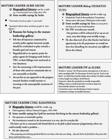
In Miracle Rising®, the following histories (see the mind map below) are covered either concisely or in depth and not necessarily absolutely chronologically (but understandably so). The map of Africa on the democratic status of Africa by 2012 as well as the visual of the tree as metaphor for outlining the status and/ or features of democracy in Africa are additional to Miracle Rising®and could be utilised to debate the status of South Africa's democratic miracle close to present times and people's thoughts about democracy in theory:
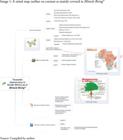
Themes from CAPS and others for assessing different levels of GET, FET and HET education when utilising Miracle Rising ®
GET-level:
Grade 4
• Learning from leaders: Ask and answer questions about the lives and qualities of good leaders; Life stories of leaders who show the above qualities: Nelson Mandela. Guiding questions:
» Focus: Leadership qualities as expressed in the documentary Miracle Rising®[an educator's effort to identify the leadership qualities, though the learners could be exposed specifically to the last parts of the documentary where there is reporting on the voting days and where Mr Mandela features in the announcement of the ANC victory at the ballot box].
» Ways of utilising Miracle Rising® in this curriculum outcome: Outline the reasons (as observed from historical moments) why Mandela can be regarded as a good leader.
» Additional sources for educators:
• Peter Limb, Nelson Mandela: A biography (2008);
• Nelson Mandela, Long walk to freedom: The autobiography of Nelson Mandela (2008);
• Jean Guiloneau, Nelson Mandela: The early life of Rolihlahla Mandiba (2002);
• Chris van Wyk, Nelson Mandela (2003);
• Nelson Mandela, No easy walk to freedom (1973);
• Anders Hallengren, Nobel Laureates in search of identity and integrity: Voices of different cultures (2004, pp. 215-232);
• Wangari Maathai, The challenge for Africa (Heinemann, London, 2009, chapter on leadership.
Grade 6
• Democracy and citizenship in South Africa: How people govern themselves in a democracy: our national government; Rights and responsibilities of citizens in a democracy; Children's rights and responsibilities; National symbols since 1994; Research project.
Grade 7
• Colonisation of the Cape in the 17th to 18th centuries: Dutch settlement: Reasons for the VOC's permanent settlement at the Cape in 1652; Results of the Dutch settlement: Slaves at the Cape; Free burghers; Land dispossession and consequences for the indigenous population.
• Co-operation and conflict on the frontiers of the Cape Colony in the early 19th century: Arrival of the British and expansion of the frontiers of the European settlement; The Eastern frontier of European settlement: Frontier wars; Case study; British immigration; Boers migrate and move to the interior.
» Focus: Features of democracy (Grade 6) and aspects of the historical legacy of South Africa (Grade 7) apply.
» Ways of utilising Miracle Rising® in this curriculum outcome: For Grade 6, the images of the election days as in Miracle Rising® and the counting of the ballot papers as a means to illustrate the process after an election as well as the value thereof. There was also the historical lowering of the "Union flag" to be replaced at the evening prior to the April 1994 election, which could be further explored.
FET-level:
Grade 9
• Turning points in South African history in 1948 and in the 1950s: The Universal Declaration of Human Rights after World War II; Definition of racism; 1948 National Party and Apartheid; Case studies: Group Areas Act and Bantustans; 1950s: Repression and non-violent resistance to Apartheid; Oral history and research project.
• Turning points in South African history in 1960, 1976 and 1994: 1960: Sharpeville massacre and Langa march; 1976: Soweto uprising; 1990: Release of Nelson Mandela and unbanning of liberation movements.
» Focus: Turning points in South Africa's history followed by the Soweto uprising as well as Mandela's release.
» Ways of utilising Miracle Rising® in this curriculum outcome: Parts of Miracle Rising®take its audience back to some historical moments in the heydays of apartheid. Boipatong as a turning point is accentuated and could be further explored. The National Party and apartheid (and the views of Meyer as well as De Klerk in Miracle Rising®) could be listed and extended with historical research on a diversity of views (such as that of Cyril Ramaphosa) on the Apartheid years. Also see Appendix B; the Yesterday & Today Dec 2011 issue, in its practical hands-on section, which provides memories of people regarding the Soweto uprising, Afrikaans and the apartheid years. The contributions by intellectuals who advised the De Klerk government of the day concerning the release of Mr Mandela can be further explored.59
Grade 10
• The South African War and Union: Background to the South African War: mining capitalism; The South African War from 1899 to 1902; the Union of South Africa (a brief overview); The Natives Land Act of 1913.
» Focus: South Africa becoming a Union is the point in the curriculum to be focussed on. Its history, and the exclusion of all South Africans by means of the British Indirect Rule system, could be accentuated. Because of this history and partly due to this history, the nurturing and entrenchment of racism were ultimately to be transformed into formal apartheid.
» Indirect ways of using Miracle Rising® in this curriculum outcome: Parts of arguing the past and the process of transforming formal apartheid into a democracy could be used. An indirect focus on the exchanging of the Union flag for a new South African flag as symbol could also be investigated.
Grade 11
• Nationalism - South Africa, the Middle East and Africa: What is nationalism? Case study: South Africa: Rise of African nationalism; Rise of Afrikaner nationalism; Case study: Middle East; Case study: From "Gold coast" to Ghana; Review: The positive and negative factors of nationalism.
• Apartheid South Africa 1940s to 1960s: Racism and segregation in the 1920s and 1930s; Segregation after forming of Union; National Party victory 1948; Legalising Apartheid; From petitions to Programme of Action; Response of the Apartheid state; Sharpeville massacre; Rivonia Trial.
» Focus: By identifying and understanding various forms of nationalism in South Africa, especially their status in recent times when South Africa became a democracy, can add value to an improved understanding of other forms of African nationalism as opposed to colonial and other autocratic leaderships. The response to the apartheid state is another complementary theme.
» Indirect ways of utilising Miracle Rising®in this curriculum outcome: See Appendix B for some examples in the Example 2 section, especially the questions based on Njabulo S Ndebele's memories of the election days of April 1994.
Grade 12
• Civil resistance in South Africa 1970s to 1980s: The challenge of Black Consciousness to the Apartheid State; The crisis of Apartheid in the 1980s: Government attempts to reform Apartheid; Internal resistance to reforms: International response; The beginning of the end.
• The arrival of democracy in South Africa and coming to terms with the past: The negotiated settlement and the Government of National Unity; How has South Africa chosen to remember the past? The Truth and Reconciliation Commission: Reasons for the TRC; Remembering past: memorials.
» Focus: All aspects of the curriculum content apply.
» Ways of utilising Miracle Rising®in this curriculum outcome: The full spectrum of Miracle Rising®can be utilised as it covers aspects of civil resistance in early days, international responses through journalists and respected leaders. Glimpses of the settlement process evolving into a Government of National Unity as well as the TRC proceedings are covered visually. A historical moment that could be accentuated more in the classroom as an operational effort from the level of ordinary citizens (an approach from below) is represented by the Peace Committees that were established all over the country after 1992 to address and reduce the flare-ups of violence and intolerance.
See Appendix B where examples 1 and 2 are fully applicable.
HET-level (AN EXAMPLE):
History 2nd year level re Africa, South Africa and politics
One of four broad AIMS:
Traces of democracy from early times through the pre- to the post-colonial era - reviewing its impact on Africa and the local area or region (with reference to leadership):» Focus: South Africa's becoming a democracy60 amidst traces of a "destructive" past.
» Ways of utilising Miracle Rising®in assessments regarding this curriculum outcome: See Appendix C
» Additional sources for educators post 1994 [Some are contentious or critical debates against or sceptical about the achievement of a 1994 miracle.]:
• Elizabeth B van Heyningen, The "Small Greek Cities" of the Cape Peninsula" Contree, 10, pp. 5-8 on democracy traces in a regional context in South Africa in the early 20th century.
• Wangari Maathai, The challenge for Africa (Heinemann, London, 2009), Chapter 2 on leadership.
• Thula Simpson, "Indirect Rule in South Africa: Tradition, modernity, and the costuming of political power", African Historical Review, 43(2), 2011, pp. 84-86.
• Elize S van Eeden, "Informing history students/learners regarding an understanding and experiencing of South Africa's colonial past from a regional/local context", Yesterday & Today, 10, pp. 1-24.
• "Frederick Lugard and the policy of Indirect Rule in British colonial Africa, http://voices.yahoo.com/frederick-lugard-policy-indirect-rule-in-3900060.html, 16 March 2014.
• SAHO, South Africa: Not yet post-colonial, 13 August 2008 as in Democracy, Featured South Africa: not yet post-colonial, by Johann Rossouw, pp. 1-20.
• Dare Arowolo, The effects of Western Civilisation and culture on Africa, Afro Asian Journal of Social Science, 1(1), December 2010, pp. 1-13. [OPTING AGAINST DEMOCRACY - Return to traditional governing systems supported. Nigeria-Muslim militancy in Boko-Haram also supportive of anti-Western thoughts and governing mechanisms].
• Jason C Myers on tradition and tribe in the days of British indirect rule in South Africa in his book: indirect Rule in South Africa: Tradition, Modernity and the costuming of political power (University of Rochester Press, 2008, 140 pp).
• Walter D Mignolo, The darker side of Western Modernity. Global futures, decolonial options (USA, Duke University Press, 2011), pp. 408.
• Development Research Centre (LSE), Laurie Nathan, "Accounting for South Africa's successful transition to democracy" (Discussion Paper no 5, June 2004), pp. 1-10.
Some other teach-worthy themes and topics from the documentary Miracle Rising®
•
Themes to be considered on their own or combined for especially learners or students on FET and HET levels:» History method: Source criticism; diverse perspectives and approaches
• Oral history;
• Visual history;
• Biographical and leadership histories;
• Regional and local historical events prior to 1994 (making up the broader history);
• Cultural histories;
• Truth and Reconciliation memories and using memories concerning history, and
• History from below input and history from above recount diversity of efforts and opinions.
* In some of the themes listed above, there are also ample possibilities to extend the learner's and/or student's level of thinking about themes or topics by asking questions related to:
» Social theory/ies and historical knowledge such as man's ability to distort the historical consciousness of his own mind and the minds of other people;
» Contentious debatable questions (after sufficient historical research) about violence, racism, economic boycotts; deeds of terror on soft targets; political blindness and human intolerance; the youth's present and future in histories of violence and political restrictions; gender issues etc.;
» A definite approach towards exposing the impact of individuals' actions on the masses and a minority group's actions or decision making allowance for major changes and their inevitable consequences;
» The history and the level of impact by the following community groups on expressing or enforcing societal and political change:61
• Merchant oligarchies or major businesses;
• Peasant communities/ordinary people/communities;
• Religious sects/groups/denominations;
• Revolutionary moments - a combination of different classes and races and individual initiatives.
Conclusion
This discussion of Miracle Rising® was mainly an effort to open up opportunities for educators of History to see how this historical milestone of South Africa becoming a democratic country can be used in multifaceted ways for the instruction of both learners and students. Several themes in the current CAPS curriculum for History themes with regard to the GET as well as the FET levels, and equally so on HET-level, allow for an opportunity by educators and specialists to visually, theoretically and practically engage in this particular past. To experience it live and virtually "first-hand" allows for a better understanding if educators of History will use the selected history sections and/or available informative material in Miracle Rising® responsibly and efficiently during assessment opportunities.
In the political order we have established there will be regular, open and free elections, at all levels of government - central, provincial and municipal. There shall also be a social order which respects completely the culture, language and religious rights of all sections of our society and the fundamental rights of the individual.
Nelson Mandela, Inaugural speech, 1994.
References
- 1 S Friedman and D Atkinson (eds.), South African Review 7, The small miracle. South Africa's negotiated settlement (Johannesburg, Ravan Press, 1994), back page.
- 2 From a historical angle some standard publications that should be consulted when seriously engaging in gaining knowledge prior to 1994 and from 1994 the following can apply: S Friedman and D Atkinson (eds.), South African Review 7..., pp. 1-68; HB Giliomee & B Mbenga (eds.), New history of South Africa (Cape Town, Tafelberg, 2007), pp. 454; FJ Pretorius (ed.), A history of South Afica. From the distant past to the present day (Pretoria, Protea Book House, 2014), Chapters 17-19, 23-24.
- 3 The meaning of Torr's Hot Gates maybe a duality of meaning, referring to the Battle of Thermopylae in Greece, fought between the Spartans of Greece and Persia in August-September 480BC or/and also hinting towards life after death in a religious way. See E Bradford, Thermopylae: The battle for the West (Open Road Media, 2014), p. 256.
- 4 Torr is the husband of Rauch.
- 5 T Lodge, Sharpeville a massacre and its consequences (New York, Oxford University Press, 2011), p. 423.
- 6 See P Noonan, They're burning the churches: The final dramatic events that scuttled apartheid (Durban, Jacana Media, 2003), pp. 285; MJ Evans, Broadcasting the end of apartheid: Live television and birth of a new South Africa (New York, I.B. Taurus, Oct 2014), p. 320.
- 7 B Dixon & L-M Johns, "Gangs, Pagad & the State: Vigilantism and revenge violence in the Western Cape", Violence and Transition Series, 2, May 2001 (available at http://www.csvr.org.za/wits/papers/papvtp2.htm, as accessed on August 2014; WG James & M Simons (eds.), The angry divide. Social & economic history of the Western Cape (Cape Town, David Phillip, 1989).
- 8 On 20 September 2013 gang violence in Mitchell's Plain was said to be the worst crime area in South Africa. See M Gebhardt, "Mitchells plain worst area of crime in SA" (available at BDAlive: http://www.bdlive.co.za/national/2013/09/20/mitchells-plain-worst-area-for-crime-in-sa, as accessed on August 2014.
- 9 ES van Eeden, "Profiling another 'Bekkersdal marathon': Several angles from history on a community in the West Rand mining region of South Africa, 1949-2013", Draft Manuscript prepared for publication in 2015.
- 10 E Bornman, R van Eeden, M Wentzel, Violence in South Afica: A variety of perspectives (Pretoria, HSRC Press, 1998), p. 457.
- 11 DY Curry, Apartheid on a Black Isle: Removal and resistance in Alexandra South Afica (Johannesburg, Palgrave Macmillan, 2012), p. 224; L Sinwell, "Rethinking South Africa's transition: From transformative to mainstream approaches to participatory development", African Studies, 70(3), December 2011.
- 12 DM Hart and GH Pirie, "The sight and soul of Sophiatown", Geographical Review, 74(1), January 1984, pp. 38-47.
- 13 Compare S Ellis, "The historical significance of South Africa's third force", Journal of Southern African Studies, 24(2), 1998, pp. 261-299; B McKendrick & W Hoffmann, People and violence in South Africa (USA, Oxford University Press, 1990), p. 495; HPP Lotter, Injustice, violence and peace: The case of South Africa (Amsterdam, Rodopi, 1997), p. 223; Anon., "Comment", Sowetan, 8 March 1994, p. 8.
- 14 S Friedman and D Atkinson (eds.), South African Review 7..., back page. See also the South African Democracy Education Trust's, The road to democracy in South Africa, 4 (parts 1 and 2), 1980-1990 (Pretoria, Unisa Press, 2010).
- 15 Critical viewers and supporters of for example the Pan Africanist Congress, Inkatha, the erstwhile Conservative Party and the Afrikaner Weerstandsbeweging [Resistance Movement] (AWB) might argue an absence of voice or/ and a visibility of only a negative side of their activities.
- 16 General Education and Training Phase, Grades 1-6.
- 17 Further Education and Training Phase, Grades 7-12.
- 18 Higher Education and Training phase which covers tertiary level education.
- 19 A reference and acknowledgement to the well-known historian-pioneer Leopold von Ranke.
- 20 Compare J Comaroff, Body of power, spirit of resistance: The culture and history of a South African people (USA, University of Chicago Press, 2013), p. 303; G Rist, The history of development: From Western origins to global faith (New York, Zed Books, 2002), p. 286; JN Pieterse, Development theory, 2 (London, SAGE, 2010), p. 252.
- 21 JC Myers, Indirect rule in South Africa: Tradition, modernity and the costuming of political power (USA, University of Rochester Press, 2008), p. 140.
- 22 See CA Bayly, The birth of the modern world, 1780-1914: Global connections and comparisons (UK, Oxford, 2004), p. 568; T Pakenham, The scramble for Africa (London, Harper Collins, 1992), p. 800.
- 23 AJP Taylor, Struggle for mastery in Europe 1848-1914 (Oxford History of Modern Europe, OUP, 1998), p. 690; M Howard, War in European history (UK, Oxford University Press, 2001), p. 192.
25 AH Anderson, African Reformation: African initiated Christianity in the 2(Jh century (Eritrea, Africa World Press, 2001), p. 282; JLG Gray, The French Huguenots: Anatomy of courage (Barker Book House, 1981), p. 282; OP Grell and B Schribner, Tolerance and intolerance in the European Reformation (UK, University of Cambridge, 2002), p. 292.
26 LM Thompson, A history of South Africa (USA, Yale University Press, 2001), p. 358; L Hartz, The founding of new societies: Studies in the history of the United States, Latin America, South Africa, Canada and Australia (USA, Houghton Mifflin Harcourt, 1969), p. 336.
27 A Lester, From colonization to democracy. A new historical geography of South Africa (London, I.B.Taurus, 1998), p. 288.
28 C Tilly, Democracy (UK, Cambridge University Press, 2007), p. 313, with particular emphasis on pp. 1-24.
29 Compare RC Box, Public Administration and Society (USA, M.E. Sharpe, 2009), pp. 25-27.
30 Compare M Meredith, The state of Africa. A history of fifty years of independence (Johannesburg, Jonathan Ball Publishers, 2005). See Part III, Chapter 23, pp. 378-411 on the struggle for democracy; A Thomson, An introduction to African politics, 3rd Edition (London, Routledge, 2010), pp. 243-271.
31 A Green, "Democracy and institutions in postcolonial Africa" (available at http://ssrn.com/abstract=2120837, as accessed on March 2012), pp. 1-28.
32 For more background on South Africa's road to a democracy the writing of Laurie Nathan could be considered, titled "Accounting for South Africa's successful transition to democracy", Crisis States Development Research Centre, Discussion Paper 5, June 2004, pp. 1-10.
33 D Atkinson, "Brokering a miracle? The multiparty negotiating forum", S Friedman and D Atkinson (eds.), South African Review 7. , pp. 13-43.
34 D Atkinson, "Brokering a miracle?...", S Friedman and D Atkinson (eds.), South African Review 7..., p. 13.
35 W Maathai, The challenge for Africa - a new vision (UK, Heinemann, 2009), p. 336 (introduction).
36 CODESA known as the Convention for a Democratic South Africa and convened as from December 1991. Explore for some baseline information in standard works on South Africa's history as well as http://www.sahistory.org.za/codesa-negotiations in South African History Online. See also the reference to Appendix C questions and Vladimir I Tikhomirov, CODESA: New realities and old contradictions (International Freedom Foundation, 1992), p. 24.
37 M Gevisser, Portraits of power: Profiles in a changing South Africa (New Africa Books, 1996), p. 175; A Butler, Cyril Ramaphosa (revised) (South Africa, Jacana Media, 2011), p. 442.
38 COSAG known as the Concerned South African Group. See D Atkinson, "Brokering a miracle?...", p. 16; K Cole (ed.), Sustainable development for a democratic South Africa (USA, Routledge, 2014), p. 256.
39 Freedom House Survey Team, Freedom in the world: The annual survey of political rights and civil liberties, 19921993 (USA, University Press, 1994), p. 650 and particularly p. 639 on Ciskei.
40 For more on the IFP see KE Ferree, Framing the race in South Africa: Political origins of racial census elections (USA, Cambridge University Press, 2011), p. 273; D Atkinson, "Brokering a miracle?...", pp. 17-18.
41 D Atkinson, "Brokering a miracle?...", pp. 19-20; N Worden, The making of modern South Africa: Conquest, apartheid, democracy ( John Wiley & Sons, 2012), pp. 204, particularly pp. 156-169.
42 D Atkinson, "Brokering a miracle?...", pp. 20-21.
43 D Atkinson, "Brokering a miracle?...", pp. 22-23.
44 See also DL Horowitz, A democratic South Africa?: Constitutional engineering in a divided society (USA, University of California Press, 1991), p. 293.
45 D Atkinson, "Brokering a miracle?...", pp. 26-27.
46 RB Horwitz, Communication and democratic reform in South Africa (UK, Cambridge, 2004), Chapter 3.
47 Compare A Sa'adah, "Hope, disappointment, and self-restraint: Reflections on the democratic experiment", TK Rabb and EN Suleiman(eds.), The making and unmaking of democracy: Lessons from history and world politics (New York, Routledge, 2013), Chapter 5, pp. 66-79; A Lissoni, J Soske, N Erlank, N Nieftagodien & O Badsha, One hundred years of the ANC: Debating liberation histories today (Wits University Press, 2013), p. 396.
48 Compare H Klug, The constitution of South Africa: A contextual analysis (Oregon, Bloomsbury Publishing, 2010), Chapters 1-2.
49 D Atkinson, "Brokering a miracle?...", pp. 27, 36-37.
50 Y Ronen, Transitions from illegal regimes under international law (New York, Cambridge University Press, 2011), pp. 53-54; A Kemp, Victory or violence - The story of the AWB of South Africa (South Africa, Lulu.com, 2008), p. 216.
51 D Atkinson, "Brokering a miracle?...", p. 35.
52 S Friedman and L Stack, "The magic moment. The 1994 election", S Friedman and D Atkinson (eds.), South African Review 7, The small miracle..., pp. 301-330.
53 S Friedman and L Stack, "The magic moment...", pp. 318-319. See also AP Brink's source, mention later in the Appendix B and C for a more explicit focus on ordinary voices regards the election days for exploring in the classroom.
54 The IEC was appointed in December 1993.
55 See on YouTube the 90 minute, 1994 Bloody Miracle, downloaded by Sabido productions (available at www.youtube.com/watch?v=9_usdNcnJp0).
56 Compare JA Williams, Classroom in conflict: Teaching controversial subjects in a diverse society (New York, SUNY Press, 1994), p. 204, particularly pp. 85-86.
57 See YouTube, "Miracle Rising South Africa [Full Movie]", downloaded by Sambotin Alexandru (available at www.youtube.com/watch?v=IKDrRdfvUg8, as accessed on 17 April 2013).
58 See also G Weldon, "Post-conflict teacher development: Facing the past in South Africa", Journal of Moral Education, 39(3), 2010, pp. 353-364.
59 The history of the PU for CHE/PU vir CHO, before amalgamation and becoming the NWU, should be considered. The chapter on the Stem of Potchefstroom/Voice of Potchefstroom as in ES van Eeden (Red.), "IN U LIG": Die PU vir CHO van selfstandigwording tot samesmelting, 1951-2004 (NWU, Potchefstroom,2005), provides insight into this era in history.
60 A source of value to use as a reflection on the 20 years of democracy can be that of A Johnston, South Africa. Inventing the nation (UK, A&C Black, Bloomsbury ), p. 336.
61 Question based on the writings of C Tilly (edited by T Skocpol), Democracy, revolution and history (USA, Cornell University, 1999), p. 273.
62 AP Brink (compiler/samesteller), S.A. April 1994 an author's diary * n skrywersdagboek (Kaapstad, Quellerie, 1994), p. 171.
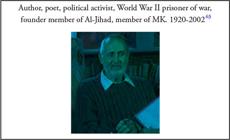
63 Available at http://www.sahistory.org.za/people/tatamkhulu-afrika, as accessed in August 2014.
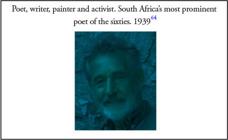
64 Available at: http://www.stellenboschwriters.com/breyten.html, as accessed in August 2014.
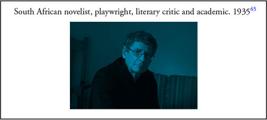
65 Available at http://victordlamini.bookslive.co.za/blog/2009/06/03/podcast-with-south-africas-great-homme-des-lettres-andre-brink/, as accessed in August 2014.
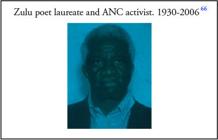
66 S Adenekan, "Mazisi Kunene. South African poet laureate and key player in the ANC", The Guardian, 17 October 2006.
67 Available at http://randomstruik.co.za/us3rd0cs/Author1281519332.jpg; See also "Who's Who Southern Africa" as accessed on http://whoswho.co.za/njabulo-ndebele-1513, as accessed in August 2014.
68 P Barkham, "Albie Sachs: 'I can't tell my son everything'", The Guardian, 8 October 2011.