Forgotten Footsteps: Reclaiming the Legacy of South Africa's Unsung Heroines in History Education
Abstract
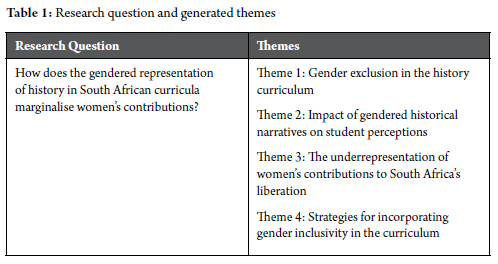
The representation of historical figures in school curricula significantly shapes national identity and societal values. In South Africa, despite its rich and diverse history, the official history curriculum remains largely male-centric, often underrepresenting the contributions of women. Previous research has highlighted the exclusion of women from mainstream historical narratives, reinforcing gender inequalities in both education and broader society. Feminist scholars argue that such marginalisation not only distorts historical truth, it also perpetuates systemic gender biases. The primary aim of this study is to examine the systematic exclusion of women and girls from the South African history Curriculum and Assessment Policy Statement (CAPS) in the Department of Basic Education. Moreover, assess its implications for gender equality in education. By identifying gaps and biases in historical representation, the study seeks to advocate for a more inclusive and equitable curriculum that accurately reflects the diverse contributions of all individuals to South Africa's past. This research focuses on the South African educational landscape, particularly history curricula implemented in the Department of Basic Education. The study draws on a wide range of academic sources and curriculum documents to provide an analysis of gender representation in historical education. The research spans materials published between 2000 and 2024, offering a contemporary perspective on curriculum developments and persistent biases. The study employs a systematic literature review (SLR) adhering to the preferred reporting items for systematic reviews and meta-analyses (PRISMA) protocols. The sources analysed include peer-reviewed academic articles, historical documents, curriculum guidelines and case studies. The research process involves identifying relevant literature, screening sources for eligibility, extracting key themes and synthesising findings to assess the representation of women in the history curriculum. Feminist theoretical frameworks are applied to critically examine how gender biases are embedded in historical narratives and educational materials. The findings reveal that the South African history curriculum overwhelmingly prioritises male figures, marginalising the contributions of women. Gender exclusion in historical narratives reinforces stereotypes and limits students' understanding of women's roles in shaping the country's history. The recommendations call for inclusive teaching practices and a more equitable educational framework that fosters gender equality and a comprehensive understanding of the nation's past.
History curriculum; Gender exclusion; Women; Feminist theory