Forgotten Footsteps: Reclaiming the Legacy of South Africa's Unsung Heroines in History Education
Abstract
The representation of historical figures in school curricula significantly shapes national identity and societal values. In South Africa, despite its rich and diverse history, the official history curriculum remains largely male-centric, often underrepresenting the contributions of women. Previous research has highlighted the exclusion of women from mainstream historical narratives, reinforcing gender inequalities in both education and broader society. Feminist scholars argue that such marginalisation not only distorts historical truth, it also perpetuates systemic gender biases. The primary aim of this study is to examine the systematic exclusion of women and girls from the South African history Curriculum and Assessment Policy Statement (CAPS) in the Department of Basic Education. Moreover, assess its implications for gender equality in education. By identifying gaps and biases in historical representation, the study seeks to advocate for a more inclusive and equitable curriculum that accurately reflects the diverse contributions of all individuals to South Africa's past. This research focuses on the South African educational landscape, particularly history curricula implemented in the Department of Basic Education. The study draws on a wide range of academic sources and curriculum documents to provide an analysis of gender representation in historical education. The research spans materials published between 2000 and 2024, offering a contemporary perspective on curriculum developments and persistent biases. The study employs a systematic literature review (SLR) adhering to the preferred reporting items for systematic reviews and meta-analyses (PRISMA) protocols. The sources analysed include peer-reviewed academic articles, historical documents, curriculum guidelines and case studies. The research process involves identifying relevant literature, screening sources for eligibility, extracting key themes and synthesising findings to assess the representation of women in the history curriculum. Feminist theoretical frameworks are applied to critically examine how gender biases are embedded in historical narratives and educational materials. The findings reveal that the South African history curriculum overwhelmingly prioritises male figures, marginalising the contributions of women. Gender exclusion in historical narratives reinforces stereotypes and limits students' understanding of women's roles in shaping the country's history. The recommendations call for inclusive teaching practices and a more equitable educational framework that fosters gender equality and a comprehensive understanding of the nation's past.
History curriculum; Gender exclusion; Women; Feminist theory
Introduction
History education plays a vital role in shaping national identity and collective memory. However, in South Africa, the history curriculum has long perpetuated systemic inequalities, such as sexism and racism (Shabangu, 2021). While post-apartheid reforms aimed to promote inclusivity, the curriculum remains gendered, with male figures dominating the historical narrative, while women's roles are largely marginalised. Scholars have long highlighted this gender imbalance, showing how women's contributions are minimised in history education (Noddings, 2001; Sincero & Woyshner, 2003). This exclusion distorts history and perpetuates patriarchal ideologies, shaping societal norms and expectations. For example, the emphasis on male political figures and revolutionaries reinforces the belief that leadership, courage, and public influence are traits naturally associated with men. This perpetuates a wider cultural belief that men are suited for leadership roles, while women are positioned as secondary or supportive. When women do appear in historical narratives, they are often confined to domestic or subordinate roles, such as caregivers, spouses, or behind-the-scenes supporters, rather than being recognised as key change-makers. Such portrayals imply that only visible, public and traditionally male-dominated forms of action are historically valuable, thereby diminishing the importance of the informal, grassroots and community-oriented efforts often driven by women. As a result, students are presented with a one-sided history that fails to acknowledge the full spectrum of contributions to South Africa's liberation and social progress. The underrepresentation of women reflects broader structural inequalities, such as patriarchy, economic inequality and dominant narratives that reinforce gender biases (Sonkqayi, 2020). Despite some efforts to include women in the curriculum, their representation remains marginal and tokenistic. Wills (2016) critiques the way women are often included in history education in a tokenistic manner, meaning their presence is symbolic, rather than substantive (Wills, 2016). the author argues that rather than integrating women's experiences and contributions throughout the historical narrative, they are often inserted as isolated figures or brief mentions. This approach fails to challenge dominant male-centric narratives and instead reinforces the idea that women's roles in history are exceptions rather than the norm. Tokenism, as Wills (2016) explains, gives the illusion of inclusivity without addressing the deeper structural biases that shape historical discourse and education.
In South Africa, significant progress has been made in curriculum reform, however, colonial legacies and deep-rooted epistemic injustices continue to shape the way curricula are developed. As a result, the slow pace of reform and continued male-centric framing in historical education limit students' ability to critically engage with gender and power dynamics, perpetuating exclusion rather than transformation. This study adopts feminist theory to analyse the systemic exclusion of women in historical education and to challenge the power dynamics in historical narration that perpetuate gendered stereotypes (Lerner, 2019). Feminist pedagogy advocates for a more inclusive curriculum that actively integrates women's contributions and experiences. The study employed a systematic literature review (SLR) guided by the Preferred Reporting Items for Systematic Reviews and Meta-Analyses (PRISMA), an evidence-based framework designed to enhance the reporting quality of systematic reviews and meta-analyses. Following the PRISMA protocols, the study emphasises the importance of gender-sensitive curriculum reforms. The findings stress the importance of integrating women's roles in South Africa's history, urging policy changes, textbook revisions, and teaching strategies that promote gender equity in history education. For example, using inclusive and diverse historical sources, fostering critical thinking about gender bias in traditional narratives and applying intersectional approaches that consider race, class and sexuality alongside gender. Teachers can further support equity by challenging stereotypes, using gender-inclusive language, creating a classroom environment that ensures equal participation and encouraging student-led exploration of underrepresented historical perspectives.
Addressing this gap, the study contributes to broader discussions on curriculum reform and social justice in education, promoting a more inclusive and equitable representation of historical narratives.
Problem statement
Despite post-apartheid efforts to transform South Africa's education system, the history curriculum continues to marginalise the contributions of women, perpetuating gendered biases and reinforcing patriarchal narratives (Shabangu, 2021; Sonkqayi, 2020). Women's roles in resistance movements and nation-building are largely underrepresented, resulting in a distorted historical narrative that fails to reflect the diverse contributions to South Africa's liberation and social progress (Chimbunde & Moreeng, 2023; Lerner, 2004). This gender imbalance, compounded by epistemic issues and intersectional factors such as race and class, limits students' ability to critically engage with power dynamics and gender issues in history (Crenshaw, 2021; hooks, 1994). The continued dominance of male figures in historical education restricts efforts toward social justice, inclusion and gender equity (Meyiwa & Cekiso, 2020). Hence, there is a need for comprehensive gender-sensitive curriculum reforms that challenge traditional, exclusionary historical narratives and promote a more inclusive, balanced representation of South African history (Lerner, 2019).
Research question
The paper responded to the following question:
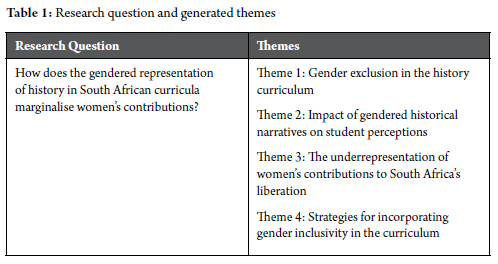
How does the gendered representation of history in South African curricula marginalise women's contributions?
This study engages with a range of interconnected themes drawn from literature, including the systemic erasure of women from historical narratives. For example, the often-overlooked, yet pivotal roles played by women in the South African liberation struggle and the transformative potential of feminist pedagogy and curriculum reform in fostering gender-sensitive education. These themes serve as a foundation for the critical discussions presented in the following sections.
The historical elimination of women in the history curriculum
The marginalisation of women in South African history education, particularly within the national curriculum, has shaped how historical narratives are constructed and taught. Women's contributions to political resistance and social transformation have been systematically excluded, reinforcing a patriarchal historiography that minimises their roles. Walker (1991) critiques this erasure, arguing that women's efforts in formal resistance and grassroots activism have been relegated to the margins, distorting the broader liberation narrative. Similarly, Gasa (2007) highlights the dominance of male-centred historical discourse, emphasising how women's resistance efforts from political activism to cultural engagement are often overlooked, despite their significance in national movements. Erlank (2022) examines the intersection of gender, nationalism, and colonial ideologies, demonstrating how historical exclusion extends to the construction of South African identity. The author argues that the omission ofwomen's contributions reinforces patriarchal structures within education and broader society. Gqola (2007) expands on this perspective by addressing the specific marginalisation of Black women, asserting that their historical exclusion perpetuates harmful stereotypes that shape contemporary social and political discourse. The continued erasure of Black women's roles, as discussed by Lewis (2021), has long-term implications for gender representation in historical education. Jaffer (2016), in her biography of Charlotte Maxeke, challenges this historical neglect by emphasising the crucial, yet frequently overlooked contributions of Black women to South African political and educational movements. Maluleka's (2021) work further enriches this discourse by critically analysing how curriculum design and knowledge production maintain epistemic silences on women's histories, advocating for transformative approaches to curriculum reform that foreground marginalised voices. Similarly, Godsell (2024) focuses on the politics of knowledge and memory in post-apartheid education. The author highlighted the need to decentre dominant master narratives to create space for women's diverse experiences in history education. Beyond political activism, this exclusion extends to critical events such as the 1976 Soweto Uprising, where the role of young women has been largely ignored in favour of male-dominated narratives. Although the uprising is widely recognised for its significance in the anti-apartheid struggle, the leadership and participation of young female activists remain overshadowed. Figures like Nokutela Mdima Dube, Miriam Tladi and Sibongile Mkhabela, pioneering activists, have been largely absent from mainstream historical accounts, highlighting the need for a more inclusive approach to South African history education (Gasa, 2007;Jaffer, 2016). Addressing these gaps is essential for ensuring a more representative and equitable portrayal of women's contributions in shaping South Africa's liberation and political landscape.
The role of women in the South African liberation struggle: Curriculum overview
South Africa's curriculum has historically reflected Eurocentric and patriarchal ideologies, especially during apartheid, which marginalised the histories of women, particularly Black, Coloured, and Indian women (Mahabeer, 2021). Although post-apartheid reforms like Curriculum 2005 and Curriculum and Assessment Policy Statement (CAPS) aimed to promote inclusivity and social justice, women's contributions remain limited and often tokenised (Bhat et al., 2023; Wills, 2016). These highlight ongoing epistemic issues in knowledge production, calling for a more inclusive curriculum that reflects diverse historical narratives (Bhat et al., 2023). Women played a crucial role in the South African liberation struggle, contributing significantly to political activism, grassroots mobilisation and resistance against apartheid (Cohen & Cobbett, 2024; Schwalm, 2023). Women organised protests, strikes and participated in underground movements, yet their contributions remain marginalised in the Department of Education policy statements. Nokutela Mdima-Dube was an early feminist activist advocating for African women's education and social upliftment, however, her efforts are largely unrecognised in mainstream history (Bell, 2020). Similarly, Lillian Ngoyi, a key leader in the Federation of South African Women, was central in organising the historic 1956 Women's March against pass laws, which drew 20 000 women to the Union Buildings in Pretoria (Devenish, 2025). Albertina Sisulu, a nurse and anti-apartheid activist, supported underground ANC networks and helped sustain resistance movements while male leaders were imprisoned (Van Niekerk & Freedman, 2023). Despite their pivotal roles, women's contributions to the anti-apartheid struggle are often overshadowed by dominant narratives focusing on male leaders such as Nelson Mandela, Oliver Tambo, and Steve Biko in the South African history curriculum (Britton, 2005; Gasa, 2007). Even when women are mentioned in historical records, they are frequently positioned behind their husbands or male counterparts, reinforcing the perception that their activism was secondary. The 1976 Soweto Uprising is often framed through the actions of male figures such as Hector Pieterson and Tsietsi Mashinini, whilst young women played a crucial role in mobilising students, organising protests and resisting state violence (Meinties, 1998; Walker, 1991). Many female students, including Antoinette Sithole and Mbuyisa Makhubo, were instrumental in sustaining the momentum of the movement, yet their names are rarely recorded in the history curriculum (South African History Online [SAHO], n.d.). Beyond street protests, these young women engaged in underground resistance by distributing pamphlets, attending secret meetings, and challenging the apartheid education system (Walker, 1991). Despite their indispensable contributions, their roles continue to be marginalised, reinforcing male-centred narratives of the uprising (Gasa, 2007). The failure to adequately acknowledge women's roles in South Africa's liberation struggle is reflected in gaps within the country's history curriculum. Policy documents analyses reveal that the contributions of male leaders such as Mandela, Tambo and Biko are prioritised, while female revolutionaries receive minimal or superficial recognition (Geisler, 2004; SAHO, n.d.). Even when women are included, their activism is often framed in relation to their husbands or male comrades, rather than as independent political contributions (Britton, 2005).This exclusion has far-reaching consequences, shaping contemporary gender perceptions and reinforcing the notion that women's involvement in political movements is secondary (Britton, 2005). Furthermore, the omission of female freedom fighters from historical discourse distorts South Africa's past and affects discussions on gender equality, representation, and leadership today (Gasa, 2007). Addressing these gaps requires a concerted effort to incorporate women's voices into historical narratives, ensuring that their sacrifices and contributions are fully recognised in academic scholarship and public memory (Walker, 1991). A more inclusive historical approach would not only honour the legacy of women in the liberation struggle, it would also serve as a powerful tool for challenging persistent gender disparities in political and social spaces (Meintjes, 1998).
Feminist pedagogy and curriculum reform: The case for gender-sensitive education
Feminist pedagogy advocates for teaching practices that value diverse voices and perspectives, challenge traditional power structures, and encourage students to critically engage with social issues such as gender inequality. Key works by bell hooks (1994) in Teaching to transgress: Education as a practice of freedom and Paulo Freire in Pedagogy of the oppressed are foundational to this approach (Freire, 1970). hooks (1994) emphasises the importance of creating a classroom environment where students are encouraged to question societal norms and power dynamics, fostering critical thinking and mutual respect. Freire's (1970) concept of dialogical education, where students and teachers engage in a co-learning process, is crucial to feminist pedagogy, as it dismantles traditional hierarchical relationships in the classroom. By promoting active and participatory learning, feminist pedagogy empowers students to become agents of social change, especially regarding issues of gender and power. The implementation of gender-sensitive pedagogy in history education aims to create more inclusive curricula by addressing gender representation and ensuring diverse representation in teaching materials. In post-apartheid South Africa, curriculum reforms have sought to rectify the historical exclusion of women by incorporating their contributions to the anti-apartheid struggle into educational resources (Gasa, 2007; Walker, 1991). The Department of Basic Education's CAPS has played a role in promoting gender inclusivity by ensuring that history curricula recognise the roles of women and marginalised groups in shaping the country's past (Department of Basic Education, 2011). This effort is part of broader global movements to introduce women's studies programmes and gender-inclusive textbooks, helping to correct patriarchal narratives in educational content (Gouws, 2008). These reforms are essential for creating a balanced understanding of history, one that highlights the contributions of all genders in national and global movements. It is important to question whether these changes are meaningful or merely symbolic. Key concerns include whether women's contributions are presented as central, how consistently these changes are implemented, and whether educators are equipped to teach them effectively.
Despite these challenges, integrating feminist pedagogy into history education provides a powerful means of challenging traditional, male-dominated narratives by centring the voices, experiences and contributions of women and other marginalised groups. This approach fosters critical thinking, inclusivity and active engagement, enabling students to question dominant power structures and historical omissions (Jaffer, 2017; Lewis, 2021). Through a curriculum that highlights diverse perspectives, feminist pedagogy cultivates a deeper awareness of social inequalities and encourages learners to critically examine the ways in which history has been constructed and taught. This critical awareness helps students understand the broader implications of gender and power in both historical and contemporary contexts. Moreover, by promoting a more balanced and representative portrayal of the past, feminist pedagogy supports the goals of gender equality and social justice. When embedded into curriculum reforms such as those outlined in CAPS, this approach can actively challenge gender stereotypes, empower all learners and contribute to a more just and inclusive society beyond the classroom.
Theoretical framework
This study is underpinned by feminist pedagogy and critical pedagogy. Feminist pedagogy, as articulated by hooks (1994) and South African scholars like Gqola (2007), emphasises the need for an inclusive educational environment that values diverse voices, particularly those of women. It advocates for challenging traditional power structures that perpetuate inequality and ensures that women's contributions to history are fully acknowledged. Critical pedagogy, particularly the work of Paulo Freire (1970), encourages educators to reflect critically on their biases and the societal power structures that influence education. Freire's approach underscores education as a tool for social change, empowering students to confront issues of gender inequality and injustice. Together, these pedagogical approaches provide a framework for analysing the exclusion of women from historical narratives in South Africa's education system and propose strategies for curricular reform to ensure gender inclusivity. By applying feminist pedagogy and critical pedagogy, this study aims to highlight the importance of gender-sensitive curriculum changes in South Africa's history education.
Methodology
This study adopts a qualitative and conceptual methodology to explore the gendered representation ofhistoryin South African curricula and identify strategies to promote gender equity and inclusive representation in history education. The research focuses on theoretical development, rather than empirical investigation, using a SLR to synthesise and analyse existing research. The methodology is grounded in feminist theory and an intersectional perspective, ensuring a comprehensive approach to understanding the marginalisation of women's contributions in historical narratives. The SLR follows the PRISMA guidelines, offering a structured process for identifying, evaluating and synthesising relevant research. The goal is to uncover themes related to the underrepresentation of women in historical curricula and explore strategies for promoting gender-sensitive reforms. The review focuses on studies that address gender inequality in education, feminist pedagogy, and curriculum transformation. Relevant peer-reviewed articles were identified through comprehensive searches of academic databases including JSTOR, ERIC, Google Scholar and Scopus. The search strategy employed keywords such as gender representation in history education, women in South African history, and gender equity in curriculum.
The inclusion criteria for the literature review were as follows:
• Studies that explore gender representation and gender equity in South African history curricula.
• Research papers that examine the role of women in historical narratives and their marginalisation.
• Articles related to feminist pedagogy and curriculum transformation in South African education.
• Peer-reviewed articles published in English. Exclusion criteria included:
• Studies not focused on history education or gender representation.
• Theoretical papers without empirical data.
• Opinion pieces, editorials, and non-peer-reviewed articles.
After using reference management software to remove duplicates and employing Rayyan to assist with the screening of titles and abstracts, 175 unique articles were identified. Further evaluation through full-text review and inclusion criteria screening, supported by Covidence, resulted in 120 articles being included in the final review. Of these, 35 studies fully met all predefined inclusion criteria.
The selected studies were thematically analysed to identify key findings related to the gendered representation of history and the strategies for integrating more inclusive narratives. Thematic analysis focused on:
• The impact of gendered historical narratives on students' perceptions of gender roles.
• Feminist approaches to integrating women's contributions into history education.
• Challenges and opportunities for curriculum reform in South Africa's history education system.
• Examples of successful strategies for promoting gender equity and inclusive historical representation in education.
This review aims to reveal patterns in literature that could guide future curriculum reforms and contribute to gender equity in South African history education. Although this study does not involve empirical data collection, ethical considerations are central to the methodology, particularly in ensuring that the voices of marginalised groups, such as women and other minority populations, are adequately represented in the analysis.
Results/Findings
To promote gender equity in history education within South African basic education, a gender-inclusive approach is necessary. This involves integrating feminist pedagogy into the curriculum, combining theoretical frameworks with practical teaching strategies, fostering community involvement, supporting research initiatives and advocating for policy reforms.
Theme 1: Gender exclusion in the history curriculum
A significant finding of this study is the ongoing gender exclusion within South Africa's history curriculum, where women's contributions to the national liberation struggle are marginalised. Historical narratives in South Africa, particularly in the post-apartheid era, continue to emphasise male figures such as Nelson Mandela, Oliver Tambo and Steve Biko, while largely ignoring or downplaying the contributions of women to the resistance movements and nation-building efforts. Scholars such as Gasa (2007); Godsell (2024); Gqola (2007); Maluleka (2021), Walker (1991) and Wills (2016) argue that the omission of women's roles in political activism, social transformation and the anti-apartheid struggle perpetuates a male-centred master narrative; a dominant historical discourse that privileges male experiences as the standard. This master narrative marginalises alternative perspectives, particularly those of women, thereby shaping a collective memory that excludes their contributions (Gasa, 2007; Gqola, 2007; Walker, 1991). For example, the 1956 Women's March, which was a pivotal event in the resistance against apartheid, is often overlooked in mainstream historical narratives, with key female leaders like Lillian Ngoyi, Helen Joseph and others receiving limited recognition (Devenish, 2025). This continued exclusion draws attention to a patriarchal historiography that centres male voices and contributions, which results in a historical narrative that fails to adequately represent the full spectrum of participants in the liberation struggle. This exclusion aligns with hooks' feminist pedagogical theory, which calls for the restructuring of educational practices to highlight marginalised voices, particularly those of women (hooks, 1994). The feminist reclamation of women's contributions to the liberation struggle is essential for rewriting South Africa's history more inclusively and equitably. Both feminist theorists challenge the patriarchal historiography by advocating for a history that acknowledges women's roles in shaping the nation. Gqola (2007) further asserts that this exclusion is rooted in the patriarchal frameworks that have traditionally dictated both historical and social narratives, calling for a more inclusive education that recognises women's contributions as central, rather than peripheral.
Theme 2: Impact of gendered historical narratives on student perceptions
The findings of Theme 2 reveal the significant impact that gendered historical narratives have on students' perceptions of gender roles, leadership and political agency. By emphasising male historical figures and underrepresenting women's contributions, students are conditioned to view political activism, leadership and national history through a predominantly male lens. This reinforces societal stereotypes about the roles that women are expected to play, both in the past and in contemporary society. As Meintjes (1998) and Walker (1991) observe, women's activism, especially in the context of events like the 1976 Soweto Uprising, is often erased or downplayed. Figures such as Antoinette Sithole, despite her crucial role in the uprising, are frequently left out of history textbooks as they play an important role in disseminating the content prescribed by the curricula (Walker, 1991). This erasure leads students to internalise gendered ideas about who is allowed to be a leader, with male figures being placed at the forefront of national memory and history. Hooks (1994) advocates for feminist pedagogy as a tool to address this imbalance, creating spaces where students are invited to challenge and deconstruct traditional views of leadership and authority (Gqola, 2007). By engaging students with historical narratives that highlight both male, female and other genders' contributions equally, feminist pedagogy encourages students to reject restrictive gender norms and embrace a broader, more diverse view of leadership. Through this lens, students can be encouraged to rethink leadership beyond gendered confines, broadening their understanding of who is empowered to enact social change. Gqola (2007) similarly suggests that gendered narratives in education reinforce societal ideas about power and agency, highlighting the need for education that critically engages with gendered roles and histories (hooks, 1994).
Theme 3: The underrepresentation of women's contributions to South Africa's liberation
A critical finding from this study is the underrepresentation of women's contributions to the liberation struggle in South Africa. Women played a vital role in organising protests, resisting apartheid policies and supporting underground movements, yet their efforts are often overlooked or downplayed in historical accounts. Key figures like Albertina Sisulu, Nokutela Mdima-Dube and others have been instrumental in the fight against apartheid, however, their contributions are frequently overshadowed by their male counterparts. As in the curriculum, there is limited coverage of women-led events like the 1956 Women's March, and a lack of critical engagement with their roles in the curriculum and assessment policy. This marginalisation reinforces a male-centred master narrative that minimises women's agency in South African history. Cohen and Cobbett (2024) and Schwalm (2023) argue that the narrative of South Africa's liberation struggle is often told through the actions of male leaders, leaving women's pivotal roles marginalised. Similarly, the 1976 Soweto Uprising, a critical event in the anti-apartheid movement, is predominantly framed through the actions of male leaders such as Hector Pieterson, with the contributions of young women in the struggle being largely unrecognised (Meintjes, 1998; Walker, 1991). The continued omission of these women from the historical record perpetuates a historical erasure that diminishes their agency in South Africa's liberation process. This underrepresentation can be critiqued through hooks's (1994) feminist pedagogy, which advocates for the inclusion of women's voices and experiences in historical narratives. Gqola (2007) contributes to this by arguing that the systematic underrepresentation of women's contributions is a function of broader societal structures that fail to recognise women as equal agents in shaping political and social change. By integrating women's contributions into the broader historical narrative, feminist pedagogy seeks to reframe history in a way that values the roles of all genders in shaping national identity and social transformation.
Theme 4: Strategies for incorporating gender inclusivity in the curriculum
The current study highlights several strategies for incorporating gender inclusivity into South Africa's history curriculum. The Department of Basic Education (2011) has made strides in recent years to address gender inequality in the curriculum, particularly through CAPS, which outlines the inclusion of women and marginalised groups in history education. However, the study identifies challenges in the full implementation of these gender-sensitive reforms, including institutional resistance, a lack of resources and insufficient teacher training. To overcome these challenges, the study recommends first addressing the curriculum, which currently centres male figures as the primary face of the anti-apartheid struggle. Revising curriculum themes to include the significant roles women played is essential. Following this, history textbooks should be updated to accurately reflect women's contributions, using gender-neutral language. Additionally, incorporating more participatory teaching methods can encourage students to critically engage with and challenge dominant historical narratives (Meyiwa & Cekiso, 2020). Furthermore, creating inclusive and supportive classroom environments where students are encouraged to question and critique dominant historical narratives. This can help foster a deeper understanding of gender and power dynamics in history. Hooks's feminist pedagogy offers a valuable framework for these changes, as it emphasises the need to create inclusive and participatory learning environments that challenge traditional power structures (hooks, 1994). Freire's (1970) concept of dialogical education encourages the co-learning process between students and teachers, where both parties actively engage in the construction of knowledge. Through such methods, feminist pedagogy fosters a learning environment where all voices are valued, and students can critically examine how history is constructed as well as whose voices are included or excluded. Gqola (2007) also suggests that to move toward gender-inclusive education, a shift in teaching methodologies is essential, where all histories, including women's contributions, are treated with equal importance.
Discussion of the findings
This study reveals key findings regarding gender exclusion in South Africa's history curriculum, where women's contributions to the national liberation struggle are often marginalised. Despite their crucial roles, women's participation in movements such as the 1956 Women's March and the 1976 Soweto Uprising is largely overlooked in favor of male figures like Nelson Mandela and Steve Biko (Gasa, 2007; Walker, 1991). A scholar such as Gqola emphasises the need to reclaim women's roles in history, as the omission of their contributions reflects a patriarchal narrative that distorts the true scope of the liberation struggle. The study also highlights how gendered historical narratives shape students' perceptions of leadership and political agency, reinforcing societal stereotypes that view leadership as a male-dominated domain. This erasure of women's activism, such as the contributions of Antoinette Sithole, contributes to gendered views of who is allowed to lead (Meintjes, 1998). Feminist pedagogy, as proposed by hooks (1994), can play a vital role in addressing these issues by creating spaces that challenge traditional gender norms and promote a more inclusive understanding of leadership. The underrepresentation of women in historical narratives is another major finding, with key female figures like Albertina Sisulu and Nokutela Mdima-Dube being overshadowed by their male counterparts in the liberation struggle (Cohen & Cobbett, 2024). Integrating women's contributions into the historical narrative is necessary for correcting this historical erasure and acknowledging their active roles in shaping the nation's history. Feminist pedagogy advocates for a history that values contributions from all genders and challenges historical structures that diminish women's agency (Gqola, 2007). The study proposes strategies to address gender exclusion in the curriculum, as Maluleka recommended, including revising textbooks, using gender-neutral language, and adopting participatory teaching methods (Meyiwa & Cekiso, 2020). These strategies aim to create an inclusive learning environment where students can critically engage with history, question dominant narratives, and recognise the contributions of both men and women in shaping the nation. Feminist pedagogies, as articulated by hooks and Freire, provide frameworks to encourage students to deconstruct gendered histories and envision a more equitable portrayal of South Africa's liberation struggle (Freire, 1970; hooks, 1994).
Implications for practice
The findings of this study emphasise the need for significant changes in the practice of history education in South Africa, particularly in the inclusion of gendered perspectives in historical narratives. Teachers play a crucial role in shaping students' understanding of history and social structures, and thus, they must be equipped with the necessary tools to address gender inequality in the curriculum. One immediate implication is the need for targeted training on gender issues for educators. By providing teachers with professional development on gender sensitivity, teachers can be better prepared to critically examine historical narratives and be cautious of perpetuating gender stereotypes in their teaching. While the Department of Basic Education has made some strides in incorporating gender-sensitive content, a more concerted effort is needed to ensure that historical materials do not overlook or marginalise women's roles. Educators can act as facilitators of change within their classrooms by promoting gender-inclusive teaching practices and encouraging critical discussions around the contributions of women in shaping the country's history. This would foster an environment in which students develop a more inclusive understanding of leadership and political agency, allowing them to challenge traditional gender roles and understand leadership as a shared space. Schools should work with curriculum developers to create and integrate gender-neutral language in teaching resources, such as textbooks, to ensure that gender biases are reduced in instructional materials. Teachers should also encourage participatory teaching methods that invite students to critically analyse historical narratives and consider multiple perspectives, fostering a more inclusive approach to learning.
Conclusion
The marginalisation of women in South Africa's historical narratives is not just an academic oversight; it is a political act that shapes societal perceptions of power, leadership and agency. By continuing to exclude women from the curriculum, a distorted history is reinforced that upholds patriarchal structures and limits how future generations understand activism and resistance. Addressing this gendered erasure is not merely about inclusion; it is about justice. A history that acknowledges the contributions of everyone irrespective of gender offers a more truthful account of the liberation struggle and fosters a more equitable understanding of leadership. Through feminist pedagogies and transformative educational strategies, the voices of women who fought for freedom can be reclaimed. In doing so, new generations can be inspired to recognise leadership beyond the constraints of gender. Ultimately, it reshapes historical narratives about the past, challenges the inequalities of the present and reimagines a more just future.
References
Literature review
- Bell, D 2020. Epilogue: Chérif Keïta in South Africa: A conversation with Albie Sachs. Mande Studies, 22(1): 211-212.
- Bhat, RM, Rajan, P & Gamage, L 2023. Redressing historical bias: Exploring the path to an accurate representation of the past. Journal of Social Science, 4(3): 698-705.
- Britton, HE 2005. Women in the South African parliament: From resistance to governance. University of Illinois Press.
-
Chimbunde, P & Moreeng, BB 2023. Gender deconstruction on the margins: A historical analysis of South Africa's post-colonial gender policies in education. E-journal of Humanities, Arts, and Social Sciences, 4(12): 105-115. https://doi.org/10.38159/ehass.202341210%0d
» https://doi.org/10.38159/ehass.202341210%0d - Cohen, R & Cobbett, W (eds.) 2024. Popular struggles in South Africa. Routledge.
- Crenshaw, K 2021. Demarginalizing the intersection of race and sex: a black feminist critique of antidiscrimination doctrine, feminist theory and antiracist politics. Droit et Société (Law & Society), 108: 465.
- Crocco, MS 1997. Making time for women's history when your survey course is already filled to overflowing. Social Education, 61(1): 32-37.
- Department of Basic Education 2011. Curriculum and Assessment Policy Statement (CAPS): Grades 10-12 History. Department of Basic Education, Republic of South Africa.
-
Devenish, A 2025. Third world feminism, transnationalism, and international solidarity: The Indian Women's Charter of Rights and Duties (1945) and the Federation of South African Women's Charter (1954). Third World Quarterly, pp. 1-21. https://doi.org/10.1080/01436597.2025.2461655
» https://doi.org/10.1080/01436597.2025.2461655 - Erlank, N 2022. Convening Black intimacy: Christianity, gender, and tradition in early twentieth-century South Africa. Wits University Press.
- Freire, P 1970. Pedagogy of the oppressed. Continuum.
- Gasa, N (ed.) 2007. Women in South African history: They remove boulders and cross rivers. HSRC Press.
- Geisler, GG 2004. Women and the remaking of politics in Southern Africa: Negotiating autonomy, incorporation and representation. Nordic Africa Institute.
- Gouws, A 2008. Changing women's exclusion from politics: Examples from Southern Africa. African and Asian Studies, 7(4): 537-563.
-
Godsell, S 2024. 'Both sides of the story': The epistemic nature of historical knowledge as understood by pre-service history teachers in a South African university. In: Teachers and the epistemology of history (pp. 77-93). Cham: Springer Nature Switzerland. https://doi.org/10.1007/978-3-031-58056-7
» https://doi.org/10.1007/978-3-031-58056-7 -
Gqola, PD 2007. How the 'cult of femininity' and violent masculinities support endemic gender-based violence in contemporary South Africa. African Identities, 5(1), 111-124. https://doi.org/10.1080/14725840701253894
» https://doi.org/10.1080/14725840701253894 - hooks, B 1994. Teaching to transgress: Education as the practice of freedom. Routledge.
- Jaffer, Z 2016. Beauty of the heart: The life and times of Charlotte Mannya Maxeke.
- Lerner, G 2004. U.S. women's history: Past, present, and future. Journal of Women's History, 16(4): 10-27.
- Lerner, G 2019. A transformational feminism. In: Voicing Power: Conversations with visionary women (pp. 177-184). Routledge.
- Lewis, D & Baderoon, G 2021. Surfacing: On being Black and feminist in South Africa. Wits University Press.
- Mahabeer, P 2021. Decolonising the school curriculum in South Africa: Black women teachers' perspectives. In: Decolonising curricula and pedagogy in higher education: Bringing decolonial theory into contact with teaching practice (pp. 97-119). Routledge.
-
Maluleka, P 2021. Fallism as decoloniality: Towards a decolonised school history curriculum in post-colonial-apartheid South .Africa. Yesterday and Today, 26: 68-91. http://dx.doi.org/10.17159/2223-0386/2021/n26a4
» http://dx.doi.org/10.17159/2223-0386/2021/n26a4 - Meintjes, S 1998. Political violence and gender: A neglected relation in South Africa's struggle for democracy. Politikon, 25(2): 95-109.
-
Meyiwa, T & Cekiso, M 2020. An Africanised and gender-sensitive curriculum as a social justice and educational human right for South Africans. Alternation Special Edition, 36: 117-143. https://doi.org/10.29086/2519-5476/2020/sp36a6
» https://doi.org/10.29086/2519-5476/2020/sp36a6 -
Noddings, N 2001. The care tradition: Beyond 'add women and stir'. Theory into Practice, 40(1): 29-34. https://doi.org/10.1207/s15430421tip4001_5
» https://doi.org/10.1207/s15430421tip4001_5 - Schwalm, LA 2023. A hard fight for we: Women's transition from slavery to feeedom in South Carolina. University of Illinois Press.
- Shabangu, B 2021. Investigating (possible) tensions and possibilities of decolonising history curriculum as a locus to foster inclusive education in South African schools. Unpublished master's dissertation, University of the Witwatersrand.
- Sincero, P & Woyshner, C 2003. Writing women into the curriculum. Social Education, 67(4): 218-226.
- Sonkqayi, GS 2020. Democratic education and indigenous knowledge systems in South African schools: Convergence or divergence. Master's dissertation, University of the Witwatersrand, Johannesburg (South Africa).
- South African History Online (SAHO) No Date. Women in the struggle: South African women's anti-apartheid activism.
- Van Niekerk, R & Freedman, G 2023. The career development of Albertina Sisulu. In: Beyond WEIRD: Psychobiography in times of transcultural and transdisciplinary perspectives (pp. 33-49). Springer International Publishing.
- Walker, C 1991. Women and resistance in South Africa. New Africa Books.
- Wills, L 2016. The South African high school history curriculum and the politics of gendering decolonisation and decolonising gender. Yesterday and Today, 16: 22-39.