The epidemiology of trauma patients presenting to a large urban public hospital trauma centre in South Africa
Abstract
BACKGROUND: Trauma is a significant public health challenge, particularly in low- and middle-income countries (LMICs), including South Africa, where it contributes to substantial morbidity, mortality, and economic burden. Accurate data on trauma epidemiology is crucial for informing prevention and care strategies PURPOSE: This study aimed to describe the epidemiology of trauma patients presenting to one of the largest tertiary care public hospitals in Johannesburg, South Africa, focusing on injury patterns and outcomes METHODS: This retrospective observational study analysed data from the hospital's trauma registry for patients presenting between January 2022 and June 2022. Data collected included demographics, injury mechanisms, and outcomes (admission to ward, ICU, theatre, discharge, death RESULTS: A total of 377 trauma patients were included in the study. The majority were adult males (79.84% adults, 83.82% males). The most common injury patterns were stabbing (32.63%), gunshot wounds (14.59%), and assaults (13.53%). No significant association was found between patient demographics (sex and age group) and outcome CONCLUSION: This study confirms the significant burden of trauma in a large urban centre in South Africa, particularly among young adult males, with interpersonal violence being a major contributing factor. The high prevalence of violence-related injuries underscores the importance of implementing and strengthening public health interventions aimed at preventing violence
trauma epidemiology; interpersonal violence; South Africa; surgical outcomes
INTRODUCTION
Trauma represents a significant global public health challenge, particularly in low- and middle-income countries (LMICs), where it accounts for a disproportionate share of morbidity, mortality, and economic burden.(1-3) Of note, LMICs are home to over 90% of the world's injury-related deaths, with road traffic injuries, interpersonal violence, and falls being major contributing factors.(3-6) The impact of trauma extends beyond immediate mortality, often resulting in long-term disability, reduced productivity, and increased healthcare costs.(5-9) In South Africa, the trauma-related mortality rate is six times the global rate, and the road traffic injury rate is double the global average.(7-9)
The country faces a particularly complex burden of disease, characterized by a "quadruple burden" of communicable diseases (HIV/AIDS, tuberculosis), non-communicable diseases, maternal and child health issues, and violence and injuries.(7-10) This confluence of challenges places a significant strain on the country's healthcare system and necessitates a comprehensive approach to addressing the root causes of trauma.
Epidemiological studies have consistently demonstrated the disproportionate impact of trauma on young adult males in South Africa.(1-5) This demographic group is particularly vulnerable to injuries resulting from interpersonal violence, occupational hazards, and risk-taking behaviours.(8-11) Understanding the specific patterns of injury mechanisms and outcomes within this population is essential for developing targeted prevention strategies and optimizing trauma care services.(11-14) Traumatic injuries are a significant health concern and one of the causes of morbidity and mortality worldwide, causing 10-12% of deaths and accounting for approximately 5.1 million deaths per year.(10-16) However, injuries in LMICs are broadly violence or transport-related and occur mostly in young, healthy men of low socioeconomic status and are influenced by alcohol and drug misuse.(1,15) The economically active population group is the most affected, thus increasing the direct costs of injury to societies.(15-19) Interpersonal violence, including stabbings, gunshot wounds, and assaults, is a major driver of trauma in South Africa, particularly in urban areas.(1,15,20-23) The high prevalence of violence is linked to a complex interplay of factors, including socioeconomic inequalities, alcohol and substance abuse, and a history of social unrest.(1,15,23,24) Addressing violence requires a multi-faceted approach, including law enforcement, community-based interventions, and efforts to reduce poverty and inequality.(24-26)
Trauma accounts for a significant proportion of emergency department (ED) admissions worldwide. It represents 16.7% of all emergency department admissions in South Africa, and trauma accounts for 13.7% of emergency department admissions in the United States.(23) Surgical intervention is often required in trauma patients, with approximately 58% of trauma patients requiring surgery (orthopedic (39%) and 23% general surgery).(24) Another study found that surgical intervention was required in 39% of trauma patients in the United States, and the most common surgical procedures included exploratory laparotomy (16.5%) and craniotomy (13.8%).(25) The length of hospital stay is an essential indicator of trauma outcomes, with the median length of stay for trauma patients in the United States and Canada being three and six days, respectively.(26) Discharge destination is also an essential outcome measure for trauma patients, with a study showing that 64% of trauma patients were discharged home, 23% to rehabilitation, and 11% to another hospital.(27) Trauma contributes significantly to the national burden of mortality in South Africa, accounting for approximately 9.1% of all deaths, primarily due to interpersonal violence and road traffic injuries.(6)
Effective trauma care systems are essential for improving outcomes following injury.(1,15,25-27) These systems encompass a range of services, including prehospital care, emergency medical services, specialized trauma centres, and rehabilitation programs.(16-20) However, many LMICs, including South Africa, face significant challenges in developing and maintaining robust trauma care systems due to limited resources, inadequate infrastructure, and a shortage of trained personnel.(12-15) Data collection and surveillance are critical components of effective trauma prevention and care.(17-19,21) Accurate and reliable data on injury incidence, mechanisms, and outcomes are essential for identifying high-risk populations, monitoring the effectiveness of interventions, and informing resource allocation decisions.(19-22)
This study aimed to contribute to the understanding of trauma epidemiology in South Africa by examining the patterns of injury and outcomes among patients presenting to a large, tertiary-level hospital that serves a diverse and underserved population.
METHODS
This was a retrospective observational study over 6 months between 01 January 2022 and 30 June 2022. The inclusion criteria were trauma priority one patients of all ages encountered at the Chris Hani Baragwanath Academic Hospital (CHBAH) trauma unit during the study period. The hospital is the largest urban public hospital in South Africa. Data collected included age, sex, and the pattern of injury. Furthermore, study outcomes were assessed as admission to the ward from the resuscitation bay, admission to the intensive care unit (ICU) from the resuscitation area, discharge from the resuscitation bay, transfer to the theatre, transfer to another hospital, or death in the resuscitation area.
The data of all patients was stored in a datasheet using Microsoft Excel and anonymized with a number system. Numeric variables, such as age, were assessed for normality using the Shapiro-Wilk test and histogram plots with a superimposed normal curve. As the data were non-normal, the median and interquartile range were used. Categorical variables are summarized as frequencies and percentages. The mechanism of injury and admission outcomes were analyzed according to sex (female/male) and age (pediatric/adult).
Ethical approval was obtained from the Human Research Ethics Committee (HREC) of the University of Witwatersrand.
RESULTS
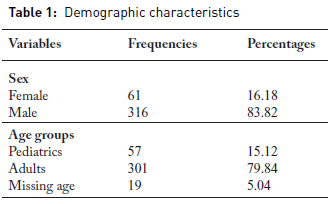
The total number of patients with trauma observed during the study period was 377. As highlighted in Table 1, the majority of patients were adults (n = 301, 79.8%). The median (IQR) age of adult patients was 32 (26-40) years, and 6 (4-15) years in pediatric trauma patients. The majority of patients were males (n = 316, 83.8%).
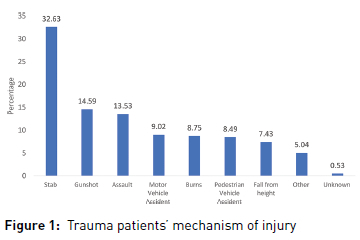
The most common pattern of traumatic events was related to stabbing (n = 123, 32.63%), followed by gunshots (n = 55, 14.59%) and assaults (n = 51, 13.53%). (Figure 1)
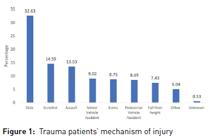
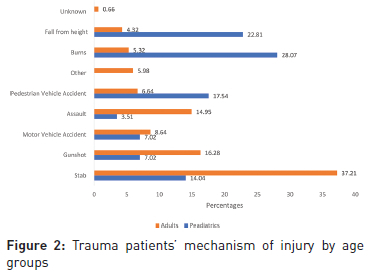
Figure 2 shows the stratification of the trauma events by age group. The most common traumatic events among adults were stabbings (n = 112, 37.21%), followed by gunshots (n = 49, 16.28%) and assaults (n = 45, 14.95%). The most common traumatic event among pediatric patients was burns (n = 16, 28.07%), followed by falls from heights (n = 13, 22.81%) and pedestrian-vehicle accidents (n = 10, 17.84%).
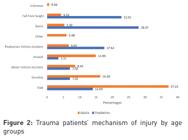
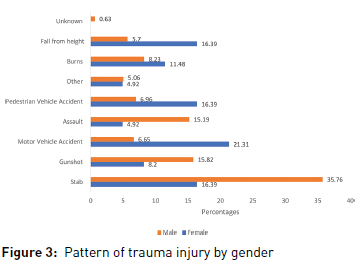
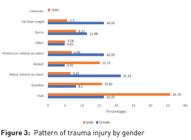
Figure 3 highlights the stratification of traumatic events by gender. The most common traumatic events among females were motor vehicle accidents (n = 13, 21.31%), falls from heights (n = 10, 16.39%), and pedestrian-vehicle accidents (n = 10, 16.39%). The most common traumatic event among males was stabbing (n = 113, 37.21%), gunshots (n = 50, 15.82%), and assault (n = 48, 15.19%).
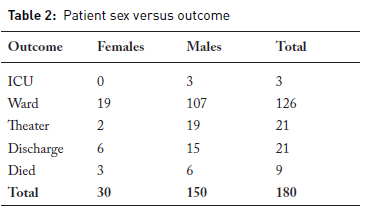
Stratified by sex (Table 2), none of the females assessed in the trauma unit needed ICU admission. In females, the most common outcome after initial assessment was admission to the ward (31.15%), followed by discharge home (9.84%). The most common admission outcome among males was admission to the wards (33.68%), followed by transfer to the theatre for emergency surgery (6.01%). There was no significant association between sex and patient outcome (p = 0.482).
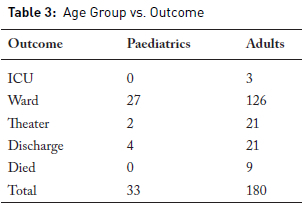
Stratified by age (Table 3), only adults were admitted to ICU. The most common admission outcome among pediatric patients was admission to the ward (47.37%), followed by discharge home (7.02%). The most common admission outcome among the adults was ward admission (30.23%), followed by emergency theater admission (6.01%). There was no significant association between age group and patient outcome (p = 0.814)
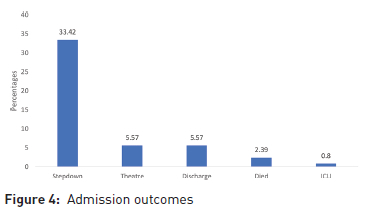
Figure 4 details the results of the admission outcomes. Most trauma patients were admitted to the wards (33.42%), and only 5.57% required emergency surgical intervention.
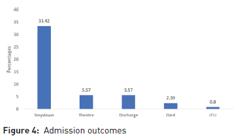
Admission to ICU was very low (0.8%), and 2.39% of the patients died. Only 5.57% of patients with trauma were discharged directly from the trauma emergency unit. Unfortunately, 47.75% (180 patients) did not have a disposition or outcome recorded in the trauma register.
DISCUSSION
This retrospective study provides a valuable snapshot of the epidemiology of trauma patients presenting to one of the largest urban public hospitals in South Africa. The findings confirm the significant burden of trauma in this setting, particularly among young adult males, and highlight the ongoing challenges of violence-related injuries.(1,15)
The demographic profile of trauma patients in this study, with a predominance of adult males, aligns with previous reports from South Africa and other low- and middle-income countries.(1,7) There is substantial evidence indicating that in these settings, young men of working age are disproportionately affected by risk-taking behaviours, occupational hazards, and interpersonal violence.(2-4) The concentration of trauma among this demographic group has significant implications for public health policy and resource allocation, underscoring the need for targeted interventions to address the underlying social and economic determinants of trauma.(1,5,6,9,10)
The most common injury patterns observed in this study were stabbing, followed by gunshot wounds and assaults, indicating a high prevalence of interpersonal violence. This finding is consistent with other studies from South Africa, which have identified violence as a major contributor to the burden of trauma in the country.(1,11,12,15) The high rate of penetrating trauma highlights the need for specialized trauma care services and resources, including surgical expertise, blood transfusion capacity, and rehabilitation services.(7,8,15,16) Public health interventions aimed at preventing violence, such as community-based programs, alcohol control measures, and initiatives to address socioeconomic inequalities, are crucial for reducing the incidence of these injuries.(16-20)
Interestingly, we found no significant association between sex or age and patient outcome. However, these findings should be interpreted cautiously because many patients lack outcome data. There is published data that suggests that older trauma patients, typically older than 60-65 years, have poorer outcomes due to associated comorbidities.(25,27)
The relatively low rates of ICU admission and emergency surgical intervention observed in this study warrant further investigation. These rates are lower than those reported in other trauma centres, which may reflect differences in patient selection criteria, resource availability, or the severity of injuries seen at the respective institutions.(23,24,26,27) It is possible that some patients who would have benefited from ICU care or emergency surgery were not able to receive these interventions due to resource constraints or triage decisions.
LIMITATIONSThis study has several limitations. The retrospective design limits our ability to establish causality and to control for confounding variables. The single-centre nature of the research and short study period limits the generalizability of the findings to other trauma centres in South Africa or other LMICs. The high percentage of patients without recorded outcomes represents a significant limitation of this study. This missing data may be due to various factors, including incomplete documentation, data entry errors, and loss of records. The missing data may introduce bias and limit the generalizability of the findings. We were also unable to collect data on potentially important variables, such as alcohol use, injury severity score, and prehospital care, which may have influenced patient outcomes. Finally, the study period coincided with various stages of the COVID-19 pandemic and associated lockdowns, which may have affected trauma patterns and healthcare utilization.
Despite these limitations, this study provides valuable insights into the epidemiology of trauma at CHBAH and highlights the ongoing challenges of violence-related injuries.
CONCLUSION
This study confirms the significant and persistent burden of trauma in a large urban hospital setting in South Africa, particularly affecting young adult males and driven by a high prevalence of violence-related injuries, primarily stabbings. The high prevalence of violence-related injuries underscores the importance of implementing and strengthening public health interventions aimed at preventing violence. These interventions should address the underlying social and economic determinants of violence, such as poverty, inequality, and alcohol abuse. They should involve a multi-sectoral approach that includes law enforcement, education, and community-based organizations.
Declaration of Conflict of Interests
The authors (s) declare no potential conflicts of interest regarding this manuscript's research, authorship, or publication.
REFERENCES
- 1. Hardcastle TC, Steyn E, Boffard K, et al. Trauma, a preventable burden of disease in South Africa: review of the evidence, with a focus on KwaZulu-Natal. SAHR Trauma. 2016; 15:179-190.
- 2. Harna B, Bahl A. Epidemiology of trauma patients admitted to a trauma center in New Delhi, India. Indian J Crit Care Med. 2020; 24(12):1193-1197.
- 3. Sawe HR, Weber EJ, Wallis LA, et al. The burden of trauma in Tanzania: analysis of prospective trauma registry data at regional hospitals in Tanzania. Injury. 2020; 54:2938-2945.
- 4. John K, Mbengue B, Diop A, et al. A descriptive study of trauma cases encountered in the Grand M'Bour Hospital Emergency Department in Senegal. Pan Afr Med J. 2019; 32(9):1-20.
- 5. Fararoei M, Shamsoddini A, Keshmiri F, et al. Epidemiology of trauma in patients admitted to an emergency ward in Yasuj. Trauma Mon. 2017; 22(3):e30572.
- 6. Norman R, Matzopoulos R, Groenewald P, Bradshaw D. The high burden of injuries in South Africa. Bull World Health Organ. 2007; 85(9):695-702.
- 7. Zaidi AA, Nadasan T, Laher AE, Wallis LA. The burden of trauma at a district hospital in the Western Cape Province of South Africa. Afr J Emerg Med. 2019; 9:14-20.
- 8. World Health Organization. Country Cooperation Strategy at a glance - South Africa. Geneva: WHO; 2018.
- 9. Matzopoulos RG, Prinsloo M, Bradshaw D, Pillay-Van Wyk V. Estimating the South African trauma caseload. Int J Inj Contr Saf Promot. 2006; 13(1):49-51.
- 10. Yao JL, Liu Q, Wang Q, et al. A survey on the epidemiology of trauma and China trauma care training in subtropical regions of Hainan Province. J Acute Dis. 2018; 7(3):108-114.
- 11. Albabtain M, AlDossary M, AlShaalan R, et al. Epidemiology of adult trauma at a tertiary hospital in Riyadh, Saudi Arabia. Int J Med Res Health Sci. 2019; 8(11):101-107.
- 12. Schuurman N, Cinnamon J, Matzopoulos R, et al. Intentional injury and violence in Cape Town, South Africa: an epidemiological analysis of trauma admissions data. Glob Health Action. 2015; 8:27016.
- 13. Lyn-Sue J, Dutton RP, Haider A, et al. Epidemiology of trauma deaths in an urban level-1 trauma center predominantly among African Americans - implications for prevention. J Natl Med Assoc. 2006; 98(12):1940-1944.
- 14. Montoya BK, Downey J, Clark L, et al. Epidemiology of major trauma in New Zealand: a systematic review. N Z Med J. 2022; 135(1550):86-110.
- 15. Hardcastle TC, Steyn E, Boffard K, et al. Guideline for the assessment of trauma centres in South Africa. S Afr Med J. 2011; 101:189-194.
- 16. Bruce JC, de Wet C, Oberholzer M, Laubscher R. Injury surveillance at a level 1 trauma centre in Johannesburg, South Africa. Health SA Gesondheid. 2003; 8(3):1-13.
- 17. Heim C, Weckbach S, Becker C, et al. Is trauma in Switzerland any different? Epidemiology and patterns of injury in major trauma - a 5-year review from a Swiss trauma centre. Swiss Med Wkly. 2014; 144(1314):w13958.
- 18. Iyer S, Bansal R, Jindal M, et al. Study of epidemiology and outcome of chest trauma at an apex tertiary care trauma centre. Int Surg J. 2019; 5(1):3621-3626.
- 19. Difino M, Meroni R, Rottoli A, et al. Epidemiology of trauma admissions in a level 1 trauma center in Northern Italy: a nine-year study. Updates Surg. 2021; 73:1963-1973.
- 20. Osifo OD, Iribhogbe PE, Ugiagbe EE, et al. Epidemiology and pattern of paediatric and adolescent trauma deaths in a level 1 trauma centre in Benin City, Nigeria. Injury. 2012; 43:1861-1864.
- 21. Mbanjumucyo G, George N, Aluisio AR, et al. Epidemiology of injuries and outcomes among trauma patients receiving prehospital care at a tertiary teaching hospital in Kigali, Rwanda. Afr J Emerg Med. 2016; 6(4):191-197.
- 22. Curtis K, Dickson C, Black D, et al. Traumatic injury in Australia and New Zealand. Australas Emerg Nurs J. 2012; 15:45-54.
- 23. Ezra YK, Green J, Haddad L, et al. Operative versus nonoperative management of blunt pancreatic trauma in children: a systematic review. Pancreas. 2017; 46(9):1091-1097.
- 24. Ho VP, Patel NJ, Bokhari F, et al. Management of adult pancreatic injuries: a practice management guideline from the Eastern Association for the Surgery of Trauma. J Trauma Acute Care Surg. 2017; 82(1):185-199.
- 25. Ramachandran A, Salazar-Gonzalez C, Ortega-Rodriguez M, et al. Comparison of epidemiology of the injuries and outcomes in two first-level trauma centers in Colombia using the Pan-American Trauma Registry System. World J Surg. 2017; 41:2224-2230.
- 26. Moore L, Evans D, Hameed SM, et al. Mortality in Canadian trauma systems. Ann Surg. 2017; 265(1):212-217.
- 27. Steyerberg EW, Lingsma HF, Lecky F, et al. Case-mix, care pathways, and outcomes in patients with traumatic brain injury in CENTER-TBI: a European prospective, multicentre, longitudinal, cohort study. Lancet Neurol. 2019; 18(10):923-934.
- 28. Carney N, Totten AM, O'Reilly C, et al. Guidelines for the management of severe traumatic brain injury. Neurosurgery. 2017; 80(1):6-15.
-
29. Matzopoulos R, Bowman B, Butchart A, Mercy JA. The impact of violence on health in low- to middle-income countries. Int J Inj Contr Saf Promot. 2008; 15(4):177-187. doi: 10.1080/17457300802396487.
» https://doi.org/10.1080/17457300802396487