Vanishing bile duct syndrome in a psychiatric patient with severe cannabis use
Abstract
Vanishing bile duct syndrome is a rare hepatic complication with multiple aetiologies that can result in poor patient outcomes if left undiagnosed and untreated. Certain factors are well-researched and understood to increase the risk of developing this syndrome, but other possible causes, such as cannabis, are less well-documented. Patients with psychiatric disorders face compounded risks of liver injury due to polypharmacy, lifestyle choices, and substance use, and thus represent a population at risk of developing such complications. We present the case of a psychiatric patient who developed vanishing bile duct syndrome with a history of severe, prolonged cannabis use.
INTRODUCTION
Vanishing Bile Duct Syndrome (VBDS) is a hepatic disease characterized by the progressive destruction and disappearance of intrahepatic bile ducts, resulting in ductopenia and cholestasis. This can result in the reduction of bile flow and the subsequent accumulation of toxic substances in the liver, which can cause chronic liver disease or liver failure if left untreated.(1) It is often associated with the use of certain drugs, with over 70 agents identified as possible causative agents, including antihypertensives, antibiotics, anticonvulsants, and psychotropic medications. Other possible aetiologies, such as infections, autoimmune diseases, and congenital conditions, are well-documented.(1) Vanishing Bile Duct Syndrome secondary to cannabis use, however, remains poorly understood. The diagnosis of VBDS requires a liver biopsy, as the clinical presentation is nonspecific. Treatment is mainly supportive, with specific emphasis on identifying and removing the causative agent.(1)
CASE PRESENTATION
Mr K, a 24-year-old known mental healthcare user, diagnosed with schizoaffective disorder, bipolar subtype, presented to psychiatric services with his first episode of psychosis in 2019. This was against the background of severe cannabis use, which started in early adolescence and progressively worsened into his early adulthood. He has a history of multiple relapses and readmissions to various healthcare facilities due to non-adherence to treatment and his ongoing substance abuse. In April 2023, he was admitted to a tertiary academic hospital with maniform psychotic symptoms, on the background of non-adherence
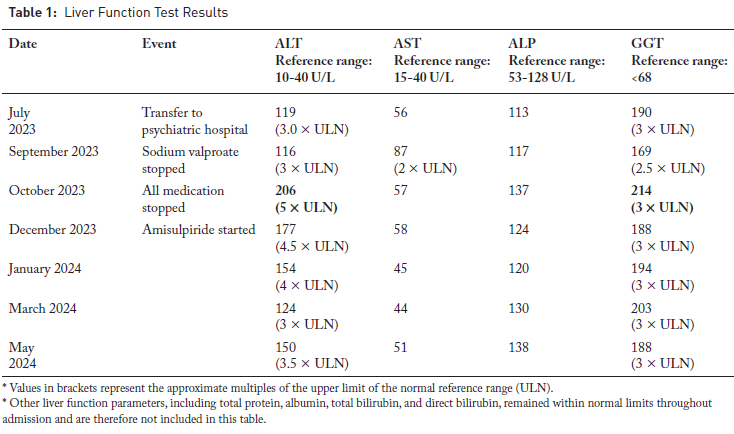
to treatment and ongoing severe cannabis use. He was then transferred to a specialist psychiatric hospital in July 2023 for ongoing management. At the time of transfer, he was on the following medications: quetiapine 400mg po bd, flupentixol decanoate depot 20mg intramuscularly monthly, and sodium valproate CR 800mg po bd, having failed adequate trials of risperidone and olanzapine. On arrival at the specialist psychiatric hospital, Mr K exhibited hepatic dysfunction, with elevations in all of his liver enzymes. He did not have a history of substantial ethanol use and reported a four-pack-year smoking history. He tested HIV negative, and further workup revealed negative hepatitis and autoimmune screenings. As he had no signs of sepsis or noticeable mass on the abdominal sonar, the gastroenterology unit recommended weaning and stopping sodium valproate and monitoring his liver function tests, as a drug-induced liver injury was suspected. The predominant liver enzyme elevations were his alanine transaminase (ALT) and gamma-glutamyl transferase (GGT) levels, which were 3 times the upper limit of normal (ULN) at that time-point (Table 1). Due to ongoing psychotic symptoms and failing an adequate trial of quetiapine, the latter was weaned off, and he was started on clozapine, the gold standard for treatment-resistant psychosis. A computerised tomography (CT) scan of his abdomen was performed in September 2023, revealing no abnormalities. His liver dysfunction, however, continued to worsen, despite discontinuation of his sodium valproate, with ALT peaking at about 5 x ULN. This led to the cessation of all his remaining treatment. While off his medication, Mr K's psychosis and mood symptoms worsened, necessitating the initiation of amisulpiride and slow up-titration to 600mg po bd. He was also initiated on atorvastatin 40mg daily to address new-onset dyslipidaemia. Although his deranged liver function tests stabilised, they did not show significant improvement. ALT decreased to 3-4 x ULN, GGT remained constant at 3 x ULN, with aspartate transaminase (AST) and alkaline phosphatase (ALP) only slightly elevated beyond the upper limit. A liver biopsy was performed in July 2024, which showed a paucity of bile ducts (>50% loss of bile ducts), lobular disarray, cholestasis, mild portal fibrosis with no bridging, and mild lymphocytic portal inflammation with no interface hepatitis. A diagnosis of VBDS was thus made. Although the role of previous medications in the causation of VBDS cannot be conclusively excluded, we believe that the history of severe cannabis use is the most likely aetiology of VBDS in this patient.
DISCUSSION
Globally and within South Africa, cannabis represents one of the most used psychoactive substances. There has been emerging evidence that provides possible links between chronic cannabis use and VBDS. However, direct connections remain undocumented. Cannabidiol (CBD) in cannabis has been shown to elevate liver enzymes in 7.4% of users and results in drug-induced liver injury in nearly 3% of users.(2) This occurs when cannabinoids interact with the endocannabinoid system, affecting bile acid's metabolism and inflammatory and immune modulatory pathways. CB1 cannabinoid receptor activation, specifically, has been implicated in cholestatic conditions wherein bile duct injury occurs through inflammatory and fibrogenic pathways.(3) Additionally, it has been found that cannabis use may exacerbate T-cell-mediated mechanisms that are known to contribute to the destruction of bile ducts, as seen in VBDS.(1)
The risk of hepatic injury is increased in psychiatric patients, where the use of cannabis often coincides with hepatotoxic medications used to treat the patient's psychiatric condition. Psychotropic medications, such as sodium valproate and clozapine, are associated with hepatotoxicity, including direct hepatocellular damage and cholestasis.(4) The psychotropic drugs implicated in drug-induced VBDS include: amitriptyline, imipramine, sertraline, haloperidol, chlorpromazine, cyamemazine, and sulpiride, with commonly used anticonvulsants such as lamotrigine and sodium valproate also being implicated. These medications can result in ductopenia through various mechanisms, including direct toxic effects or immune-mediated damage to the bile ducts.(1) Additionally, chronic states of stress and psychiatric conditions themselves are known to dysregulate the immune system, which potentially worsens hepatic inflammation, making psychiatric patients more vulnerable to hepatotoxicity.(5) Furthermore, cigarette smoking, which is common amongst mental healthcare users, has been shown to accelerate liver fibrosis through various mechanisms. These include oxidative stress, iron accumulation, immune system dysregulation, promotion of chronic inflammatory pathways, and vascular dysfunction leading to tissue hypoxia.(6) This complex interaction between mental health, medication, health-related behaviours, and liver pathology emphasizes the importance of integrated care in patients with psychiatric conditions.
At present, there is limited literature that addresses potential links between cannabis use, psychiatric conditions, and VBDS. While hepatotoxicity due to cannabis use and psychotropic medications is documented, there is no published data with direct evidence implicating cannabis in bile duct damage. Additionally, there is insufficient research into the role of psychiatric conditions and the effects of stress in modulating the progression of liver damage. These gaps highlight the novelty of investigating VBDS in the context of chronic cannabis use and psychiatric disorders, especially given the unpredictability of the clinical course of VBDS. Some cases of VBDS resolve spontaneously, whilst some progress to liver failure. Recommended treatments are mainly supportive, and methods to stimulate bile duct regeneration are not currently established.(1) Thus, there is a need to recognise VBDS in the early course of disease and remove the causative agent to prevent progressive bile duct damage. Whilst routine liver function testing is recommended in patients using sodium valproate, monitoring of otherwise healthy cannabis users has not been recommended. However, in both cases, any findings or related symptomatology of hepatic dysfunction should be promptly investigated to prevent any progressive damage to the liver.
The patient provided informed consent, and ethics clearance was obtained from the University of the Witwatersrand Human Research Ethics Committee.
REFERENCES
-
1. Bessone F, Hernández N, Tanno M, et al. Drug-induced vanishing bile duct syndrome: from pathogenesis to diagnosis and therapeutics. Semin Liver Dis. 2021; 41:331-348. doi:10.1055/s-0041-1729972.
» https://doi.org/10.1055/s-0041-1729972 -
2. Lo LA, Christiansen A, Eadie L, et al. Cannabidiol-associated hepatotoxicity: a systematic review and meta-analysis. J Intern Med. 2023; 293(6):724-752. doi:10.1111/joim.13627.
» https://doi.org/10.1111/joim.13627 -
3. Kennedy L, Alpini G. Cannabinoid receptor 1 antagonism demonstrates high therapeutic potential for the treatment of primary sclerosing cholangitis. Cell Mol Gastroenterol Hepatol. 2022; 13(4):1259-1260. doi:10.1016/j.jcmgh.2022.01.009.
» https://doi.org/10.1016/j.jcmgh.2022.01.009 - 4. Doroudgar S, Chou TI. How to modify psychotropic therapy for patients who have liver dysfunction. Curr Psychiatry. 2014; 13(12):46-49.
-
5. Lv Q, Yi Z. Antipsychotic drugs and liver injury. Shanghai Arch Psychiatry. 2018; 30(1):47-51. doi:10.11919/j.issn.1002-0829.217090.
» https://doi.org/10.11919/j.issn.1002-0829.217090 - 6. Rutledge SM, Asgharpour A. Smoking and liver disease. Gastroenterol Hepatol (N Y). 2020; 16(12):617-625. PMID: 34035697; PMCID: PMC8132692.