Epidemiology, management, and outcomes of dialysis-requiring acute kidney injury
Abstract
BACKGROUND: Dialysis-requiring acute kidney injury (AKI) portends adverse outcomes in the developed world, but it is less well-studied in the developing world. We, therefore, retrospectively reviewed the epidemiology, referral patterns, and outcomes of dialysis-requiring AKI at an academic public hospital in Johannesburg, South Africa METHODS: Patients prescribed dialysis for AKI over 2 years were retrospectively reviewed. The effects of baseline characteristics and the aetiology of AKI on patient survival, hospitalisation duration, and renal function recovery were analysed RESULTS: A cohort of 106 patients was reviewed over the study period. Patients were generally younger (median 44.5 years). Human Immunodeficiency Virus (HIV) infection (38.7%), hypertension (27.4%), and diabetes mellitus (12.3%) were common comorbidities. Community-acquired AKI predominated with significant renal dysfunction at presentation. The leading causes of AKI were sepsis (51.9%) and hypovolaemia (26.4%). Mortality was high at 56.6%. Older age and diabetes increased mortality and reduced renal recovery. There was increased mortality with sepsis (HR 1.48, 95% CI 1.37-1.60, P < 0.001) and cardiorenal syndrome (CRS) type 1 (HR 1.78, 95% CI (1.57-2.01, P < 0.001). HIV infection did not increase mortality risk and showed an increased likelihood of renal recovery (OR 1.71, 95% CI 1.51-1.95, P < 0.001 CONCLUSION: Our findings resemble those of other low- and middle-income countries in that AKI has a high mortality rate in our setting. Sepsis, older age, diabetes, and CRS increase the risk of death. Sepsis-associated AKI and diabetes are associated with reduced odds of renal recovery
INTRODUCTION
Acute kidney injury (AKI) has an annual estimated incidence of 13.3 million cases and contributes to 1.7 million deaths.(1,2) Achieving the goal of the International Society of Nephrology to reduce preventable deaths from AKI by 2025 requires closing regional gaps in knowledge of its epidemiology, aetiology, management, and outcomes.(1) Lack of access to nephrology care in the developing world results in a paucity of data on the outcomes of advanced-stage AKI from low- and middle-income countries (LMIC).(1) This study analyses the aetiology, referral patterns, and outcomes of dialysis-requiring AKI in an urban setting to characterise the effect of risk factors on mortality and renal recovery.
METHODS
A retrospective review was conducted of all patients with dialysis-requiring AKI at an academic public hospital (Helen Joseph Hospital) in Johannesburg, South Africa, over 2 years, between 1 January 2019 and 31 December 2020. This cohort included critically ill patients, some of whom were ventilated, as well as those in the general wards.
The mode of dialysis used was haemodialysis.
The definition of AKI, as defined by the Kidney Disease Improving Global Outcomes (KDIGO) 2012, was retrospectively confirmed. The KDIGO definition includes documented evidence of an absolute increase in serum creatinine of at least 0.3mg/dL (26.5μmol/L) within 48 hours or a 50% increase in serum creatinine from baseline within seven days or a urine volume of less than 0.5mL/kg/h for at least six hours.(3) In cases where the premorbid renal function was not available, the diagnosis of AKI was retrospectively validated by subsequent improvement in glomerular filtration rate (GFR) to > 60mL/min/1.73m2
Anonymised data was extracted from clinical records to a Microsoft Excel (Microsoft Corp, USA)® database and exported for analysis to Stata version 15 (StataCorp 2017, College Station, Texas). Baseline characteristics and AKI aetiology were described. Inpatient survival, duration of hospitalisation, and kidney function recovery outcomes were summarised. The effect of baseline parameters and AKI aetiology categories on these outcomes were analysed using Cox proportional hazards and logistic regression modelling, respectively.
The Human Research Ethics Committee (Medical) of the University of the Witwatersrand (M210221) approved this study.
RESULTS
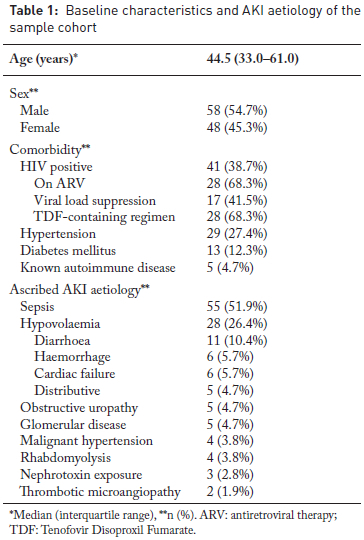
The baseline characteristics and AKI aetiology of the 106 patients included in this study are detailed in Table 1.
Sepsis was the leading cause of AKI in this series, accounting for 51.9% of referrals. Pneumonia (16 cases, 29.1% of sepsis-related cases of AKI) was the most common source of sepsis, followed by intra-abdominal sepsis (14 cases, 25.5%) and urogenital infections (seven cases, 12.7%). Tuberculosis accounted for three cases. Malaria and necrotising infections accounted for one case each. The source of septicaemia was unknown in 13 cases.
Internal medicine (58.5%) and general surgical departments (32.1%) accounted for the majority of the cases of dialysis-requiring AKI, followed by obstetrics and gynaecology (5.7%), urology (2.8%) and orthopaedics (0.9%).
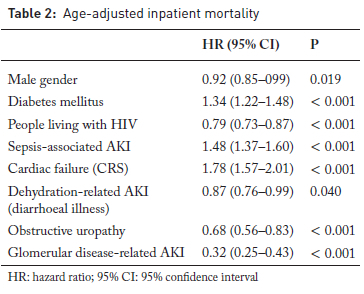
Sixty patients (56.6%) died before discharge at a median of four days (interquartile range, 2-12 days) following dialysis initiation. Patients who died during admission were significantly older than survivors (median age 60 years compared to 46 years in survivors, p < 0.001), and increasing age was independently associated with inpatient death (OR 1.05, 95% CI 1.03-1.08, p<0.001). Age-adjusted Cox proportional hazard modelling revealed poorer survival for people with diabetes, patients with sepsis-associated AKI, and those with the cardiorenal syndrome (CRS). Male gender, obstructive uropathy, glomerular disease-related AKI, AKI secondary to dehydration, and PLWH were associated with a lower risk of inpatient mortality (Table 2).
The median duration of hospitalisation in the 46 inpatient survivors of dialysis-requiring AKI was 21 days. A trend toward a longer median duration of hospitalisation was noted in patients with sepsis-associated AKI (25.5 days).
Amongst the 46 inpatient survivors, 12 (26.1%) had complete recovery of renal function, 29 (63.0%) manifested partial recovery, and 5 (10.9%) still required dialysis at discharge. Age-adjusted logistic regression demonstrated increased odds of recovery in PLWH (OR 1.71, 95%CI 1.51-1.9, P < 0.001), those with dehydration (OR 2.27, 95% CI 1.87-2.76, P,0.001), obstructive uropathy (OR 1.45, 95% CI 1.12-1.89, P < 0.005), or glomerular disease-related AKI (OR 1.61, 95% CI 1.17-2.22, P<0.004).
Diabetes mellitus (OR 0.68, 95% CI 0.57-0.80, P<0.001), advancing age (OR 0.95, 95% CI 0.93-0.98, P < 0.001), sepsis-associated AKI (OR 0.33, 95% CI 0.29-0.37, P < 0.001), and CRS-related AKI (OR 0.45, 95% CI 0.340.60, P < 0.001) were associated with an unfavourable for recovery.
Of the 46 survivors of AKI, 19 (41.3%) defaulted subsequent outpatient follow-up, including two patients who still required haemodialysis on discharge. The mortality outcomes in these patients after discharge are unknown. Twenty-seven patients were followed up after discharge at a median period of 71 days (interquartile range 21-119 days). Nineteen (70.3%) of these patients demonstrated complete renal recovery, five (18.5%) had partial recovery, and three (11.1%) required ongoing dialysis.
DISCUSSION
This study adds to the existing data on AKI outcomes in South Africa. It differs from previous studies in that it examined the outcomes of patients with dialysis-requiring AKI upon follow-up at the renal outpatient department. Parameters, including duration of hospitalisation and recovery of renal function, may assist in better contextualizing treatment costs.
The preponderance of younger patients developing AKI-requiring dialysis in the present report is concerning. Previous South African studies from Chris Hani Baragwanath Academic Hospital in Johannesburg,(4) Groote Schuur Hospital in Cape Town,(5) King Edward VIII Hospital in Durban,(6) and Livingstone Hospital in Port Elizabeth (7) have similarly reported higher proportions of younger patients diagnosed with more severe categories of AKI. Whilst age-related disparities in accessing ICU-based care (8) may partially account for this phenomenon, analysis of the present cohort in whom institutional protocol provides for dialytic support for AKI irrespective of age supports the tendency for more severe forms of AKI to affect younger South Africans as noted by Variava et al. (2019) and Dlamini et al. (2017).(4-7) Global studies revealed disparities in AKI demographics, with older patients affected in higher-income and younger patients affected in LMICs.(9) These disparities reflect differences in causative factors, with dehydration, infection, and pregnancy complications being important AKI aetiologies in LMIC, whilst cardiac failure, surgical complications, and nephrotoxin exposure are more frequent factors in higher-income nations.(9,10) Additionally, the present study and those of Variava et al. (2019) and Aylward et al. (2019) show that PLWH is disproportionately affected by AKI due to increased risk of infections, exposure to nephrotoxic drugs and the presence of HIV-related CKD.(4,7,11)
Sepsis and dehydration due to diarrhoeal illness were the most commonly ascribed aetiologies of AKI in this report, consistent with reports from previous authors and with pooled experience from LMICs.(5-,10)
Consistent with other non-ICU-based AKI reports from South Africa and LMIC experience, most patients in the current series who presented with community-acquired AKI evidenced significant renal dysfunction at presentation.(5,10) This is thought to reflect poorer access to healthcare.(9)Acute kidney injury carries significant mortality, and the risk of death increases with the severity of AKI.(12) Advancing age is known to increase mortality risk in all stages of AKI, and sepsis-associated AKI is known to have poor survival outcomes.(9,13) In the present study, AKI in the context of cardiac failure, equivalent to CRS type 1, carried a poorer prognosis than even sepsis-associated AKI.(14)
Despite the known association of AKI with HIV infection, AKI does not appear to show an increased risk of mortality in PLWH in most local series.(4,5) The association of HIV infection with readily reversible causes of AKI may contribute to the reduced risk of mortality observed for this patient group in our study. This hypothesis is substantiated by the increased odds of renal recovery in PLWH who survive dialysis-requiring AKI observed in this cohort; similar findings have previously been reported for PLWH.(4)
In this study, short-term kidney function recovery outcomes in survivors of dialysis-requiring AKI are satisfactory, with 89.1 % achieving dialysis independence. Similar rates have been reported in other local series.(9,11) Although complete recoveries increased at outpatient follow-up, a substantial proportion (29%) of patients in this cohort continued to manifest residual renal deficits. The propensity of AKI to initiate the progression of CKD to kidney failure is of particular concern in resource-constrained settings such as South Africa.(5) It is estimated that patients with AKI have a ninefold higher risk of CKD than matched patients without AKI.(1)
The 2012 KDIGO Clinical Practice Guideline for AKI has suggested several recommendations for the prevention of patients at risk of AKI or with AKI. This includes the use of isotonic crystalloids as the initial fluid choice for intravascular volume expansion, the use of vasopressors in conjunction with fluids in patients with vasomotor shock, and the use of either iso-osmolar or low osmolar iodinated contrast media together with oral N-Acetyl cysteine (NAC) and intravenous isotonic crystalloids to prevent contrast-induced nephropathy.(3) Aminoglycosides should be avoided in the setting of AKI.(3)
Limitations to this study include the small sample size and restriction to a single centre. We acknowledge the paucity of outpatient follow-up data in this series. The occurrence of the Severe Acute Respiratory Syndrome Coronavirus 2 pandemic during the time this study was conducted may have resulted in the small sample size and poor outpatient follow-up.
CONCLUSIONS
This study demonstrated that dialysis-requiring AKI affects a younger population, with sepsis and dehydration from diarrheal illness as key causes. Most cases of AKI are community-acquired, with late presentation and advanced disease common. AKI has a high mortality rate, especially in sepsis-associated and cardiorenal cases. Sepsis-related AKI and diabetes reduce the odds of dialysis-free recovery. Older patients face a higher mortality and are less likely to regain renal function. Early prevention, diagnosis, and management are key to eliminating preventable deaths from AKI. Treating the underlying cause is as important as ensuring simple interventions such as rehydration, avoiding nephrotoxins, and controlling sepsis.
CONFLICTS OF INTERESTThe authors declare no conflicts of interest. There were no sources of funding.
ACKNOWLEDGMENTS
Dr C Olivier, for assisting with data collection.
REFERENCES
- 1. Mehta RL, Cerdá J, Burdmann EA, et al. International Society of Nephrology's 0by25 initiative for acute kidney injury (zero preventable deaths by 2025): a human rights case for nephrology. Lancet. 2015; 385(9987):2616-2643.
- 2. Macedo E, Hemmila U, Sharma SK, et al. Recognition and management of community-acquired acute kidney injury in low-resource settings in the ISN 0by25 trial: a multi-country feasibility study. PLoS Med. 2021; 18(1):e1003408.
-
3. Kellum JA, Lameire N, Aspelin P, et al. Kidney disease: improving global outcomes (KDIGO) acute kidney injury work group. KDIGO clinical practice guideline for acute kidney injury. Kidney Int Suppl. 2012; 2(1):1-138. https://kdigo.org/wp-content/uploads/2016/10/KDIGO-2012-AKI-Guideline-English.pdf
» https://kdigo.org/wp-content/uploads/2016/10/KDIGO-2012-AKI-Guideline-English.pdf - 4. Variava M, Mashabane M, Bentley A, et al. Epidemiology and outcomes of dialysis-requiring acute kidney injury at Chris Hani Baragwanath Hospital. Wits J Clin Med. 2019; 1(1):31-36.
- 5. Dlamini TAL, Heering PJ, Chivese T, et al. A prospective study of the demographics, management, and outcome of patients with acute kidney injury in Cape Town, South Africa. PLoS One. 2017; 12(6):e0177460.
- 6. Khuweldi MA, Skinner DI, de Vasconcellos K. The incidence and outcomes of patients with acute kidney injury in a multi-disciplinary intensive care unit in Durban, South Africa. South Afr J Crit Care. 2020; 36(2):80-84.
- 7. Aylward RE, van der Merwe E, Pazi S, et al. Risk factors and outcomes of acute kidney injury in South African critically ill patients: a prospective cohort study. BMC Nephrol. 2019; 20(1):460.
- 8. Gordon K, Allorto N, Wise R. Analysis of referrals and triage patterns in a South African metropolitan adult intensive care service. S Afr Med J. 2015; 105(6):491-495.
- 9. Mehta RL, Burdmann EA, Cerda J, et al. Recognition and management of acute kidney injury in the International Society of Nephrology 0by25 Global Snapshot: a multinational cross-sectional study. Lancet. 2016; 387:2017-2025.
- 10. Jha V, Parameswaran S. Community-acquired acute kidney injury in tropical countries. Nat Rev Nephrol. 2013; 9(5):278-290.
- 11. Boswell MT, Rossouw TM. Approach to acute kidney injury in HIV-infected patients in South Africa. South Afr J HIV Med. 2017; 18(1):714.
- 12. Srisawat N, Sileanu FE, Murugan R, et al. Variation in risk and mortality of acute kidney injury in critically ill patients: a multicentre study. Am J Nephrol. 2015; 41(1):81-88.
- 13. Liu J, Xie H, Ye Z, et al. Rates, predictors, and mortality of sepsis-associated acute kidney injury: a systematic review and meta-analysis. BMC Nephrol. 2020; 21:318.
- 14. Rangaswami J, Bhalla V, Blair JEA, et al. Cardiorenal syndrome: classification, pathophysiology, diagnosis, and treatment strategies: a scientific statement from the American Heart Association. Circulation. 2019; 139:840-878.