The Case of the Missing 'K+', Hypertension and Muscle Weakness: Unveiling Conn's Syndrome
Ashwin Luke; Constance Adams; Farzahna Mohamed
Division of Endocrinology, Department of Internal Medicine, Faculty of Health Sciences, University of the Witwatersrand, Johannesburg, South Africa
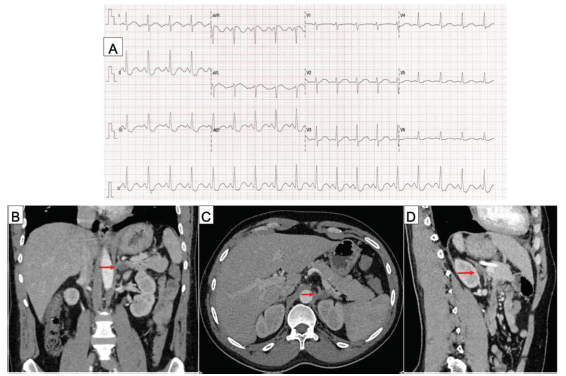
A 30-year-old man presented to the emergency department with a 4-day history of upper and lower limb weakness associated with cramps. He was previously well, with no significant past medical history. On examination, his initial blood pressure was 179/121 mmHg. He appeared clinically well but was bed-bound due to profound weakness. Neurological examination revealed globally reduced power (2/5), decreased tone and hyporeflexia (1/4 reflexes), with no other neurological deficits. A venous blood gas revealed a potassium of 1.6 mmol/L (reference range 3.5-5.3 mmol/L) and a bicarbonate level of 30 mmol/L (reference range 22-28 mmol/L). The electrocardiogram demonstrated U waves and ST-segment depression in the septal and lateral leads, most prominent in lead II (Figure A), in keeping with severe hypokalaemia. Laboratory investigations revealed a direct renin concentration of <0.5 mIU/L (reference range 2.8-39.9 mIU/L), aldosterone of 692 pmol/L (reference range < 443 pmol/L) and an aldosterone renin ratio greater than 70, consistent with a diagnosis of primary hyperaldosteronism. The patient was commenced on oral and intravenous potassium replacement, as well as a mineralocorticoid receptor antagonist, spironolactone. Localisation images included a contrast-enhanced computed tomography of the abdomen and showed a 1 cm left adrenal mass in keeping with an adrenal adenoma (Figure B-D, red arrow). The patient was discharged on three antihypertensive agents, and spironolactone was up-titrated to a maximum dose of 200 mg twice daily, with complete resolution of his weakness and normalisation of serum potassium to 4.3 mmol/L. He was scheduled for a multidisciplinary team discussion regarding a laproscopic left adrenalectomy. This case highlights the importance of screening for primary hyperaldosteronism, as it is one of the most common endocrine causes of secondary hypertension.
Correspondence:
Ashwin Luke