Hypertension and Cardiometabolic Risk in a Young Urban University Population: A May Measurement Month Sub-study from South Africa
Abstract
BACKGROUND: Hypertension (HT) is a major contributor to global morbidity and mortality. Many individuals remain undiagnosed, while others remain uncontrolled despite treatment. May Measurement Month (MMM) is a global initiative by the International Society of Hypertension aimed at improving awareness and detection of elevated blood pressure. South Africa has participated since 2017, with data collected at the University of the Witwatersrand since 2019. AIMS AND OBJECTIVES: To determine the prevalence of HT and related cardiometabolic risk factors in a predominantly educated, urban cohort at the University of the Witwatersrand, Johannesburg, South Africa, and to assess demographic associations and compare risk profiles between younger (<40 years) and older (≥40 years) participants. METHODS: This cross-sectional study was conducted as a sub-study of MMM. Data collected during May 2019, 2021, 2022, and 2023 were analysed. Participants aged ≥18 years were included, while records with missing data of interest were excluded. RESULTS: Among 1749 participants (mean age 29.2 ± 10.6 years), there was a female predominance, and 13.4% had HT, of whom 41.5% were screened as potentially having newly identified HT. Self-reported diabetes mellitus (DM) ranged from 0.8-5.3%, overweight/obesity from 36.3-48.3%, alcohol use peaked at 41.5%, tobacco use at 35.5%, and physical inactivity at 58.5%. HT and DM were more prevalent in older participants, while younger participants demonstrated a high prevalence of modifiable risk factors, including overweight/obesity, smoking, alcohol use, and physical inactivity. Age ≥40 years was the strongest predictor of HT. CONCLUSION: The high prevalence of modifiable risk factors in younger adults highlights the importance of early screening and targeted prevention strategies to reduce future cardiometabolic disease burden.
INTRODUCTION
Non-communicable diseases are rapidly becoming the leading cause of mortality in South Africa (SA).(1) Mortality from communicable diseases such as tuberculosis declined significantly between 2006 and 2018 due to the rollout of antiretroviral therapy and the implementation of integrated tuberculosis care programmes. However, deaths due to non-communicable diseases have steadily increased from 1997 to 2018, with diabetes mellitus (DM), cancer, and cardiovascular disease (CVD) emerging as the three leading causes of mortality. CVD-accounts for approximately one in every six deaths in SA.(1)
According to the World Health Organisation (WHO), stroke, ischaemic heart disease (IHD), hypertensive heart disease, DM, and kidney disease were among the top ten causes of death in women in SA in 2019.(2) Similarly, IHD, stroke, and DM were among the leading causes of death in men.(2) Cardiometabolic diseases and their complications, therefore, remain a major public health concern and an important focus for prevention, screening, and management.
Cardiometabolic risk factors are often preventable and/or manageable and include hypertension (HT), DM, overweight/ obesity, dyslipidaemia, smoking, excessive alcohol use, obesogenic diet, and physical inactivity. According to the WHO, the prevalence of HT in SA is approximately 42.2%.(3) However, the true burden is likely underestimated due to high rates of undiagnosed and uncontrolled disease. The South African Hypertension Society (SAHS) estimates that one in every four men and one in every five women in SA have elevated blood pressure (BP).(4) Data from May Measurement Month (MMM) conducted in SA between 2017-2019 and 2021 demonstrated a HT prevalence of 29.7%, with only 54.3% of hypertensive participants being aware of their diagnosis and only 53.7% achieving BP control despite treatment.(5)
Additional cardiometabolic risk factors are also highly prevalent in SA. Approximately 10.6% of South Africans have elevated blood glucose levels, and 34% have elevated cholesterol.(2) The International Diabetes Federation (IDF) estimated a prevalence of DM of approximately 12% in SA in 2021.(6) Furthermore, nearly half of South Africans are overweight or obese, with a female predominance and the highest prevalence among individuals aged 35-64 years.(7) More than half of South Africans are physically inactive.(2) Smoking prevalence is estimated at 16.2%, with notable tobacco use among younger individuals (12.7%).(2) Among individuals who consume alcohol, the average annual intake is 27.1 litres per person per year.(2) Collectively, these findings highlight a substantial burden of modifiable cardiometabolic risk factors and emphasise the need for screening and preventative strategies in asymptomatic populations.
HT, defined as a BP ≥140/90 mmHg, is one of the leading modifiable risk factors for cardiovascular morbidity and mortality.(3,5,8-13) HT may be classified as primary (essential), accounting for approximately 90% of cases, or secondary.(3) Risk factors for primary HT include increasing age, obesity, sedentary lifestyle, smoking, excessive alcohol intake, and unhealthy diet.(3)
Although HT has traditionally been regarded as a disease of older adults, there is increasing evidence that cardiometabolic risk begins earlier in life. Rising rates of obesity, sedentary behaviour, alcohol use, and smoking among younger populations have contributed to increasing rates of early-onset HT and CVD.(14,15) International data demonstrate that younger adults with HT are significantly less likely to be diagnosed, treated, or controlled, compared to older populations.(14) Importantly, elevated BP in early adulthood is associated with increased long-term risk of coronary artery disease, stroke, left ventricular hypertrophy, and cardiovascular mortality. In South Africa, data on cardiometabolic risk in younger and asymptomatic populations remain limited. However, local MMM studies have consistently demonstrated high rates of undiagnosed HT, particularly among younger individuals and men.(5,8-13) This is particularly important as behavioural risk factors such as smoking, alcohol use, obesity, and physical inactivity often begin during early adulthood and may contribute to cumulative vascular injury over time.(15)
An additional important consideration in younger individuals with HT is the increased likelihood of secondary HT. While primary HT predominates overall, secondary causes are proportionally more common in younger populations.(3,16) These include renal parenchymal disease, renovascular disease, endocrine disorders, and medication-related causes.(16) Early identification of HT in young individuals therefore, provides an opportunity not only for cardiovascular risk reduction but also for further investigation of potentially reversible underlying pathology.
One of the largest international surveillance initiatives aimed at improving HT awareness is MMM, established by the International Society of Hypertension (ISH).(9,10) Initiated in 2017, MMM aims to screen as many individuals as possible during May for undiagnosed and uncontrolled HT while simultaneously improving public awareness and follow-up.(9,10) To date, nearly six million individuals across more than 100 countries have been screened.(10) South Africa has participated in MMM since 2017, with local data consistently demonstrating substantial numbers of undiagnosed and uncontrolled hypertensive participants.(5,8,11,12) While HT may traditionally be considered less prevalent in younger individuals, the increasing burden of modifiable cardiometabolic risk factors in the youth highlights the importance of early screening and prevention strategies. Furthermore, there remains a paucity of local data examining cardiometabolic risk in asymptomatic young adults.
This study aimed to assess South African MMM data collected at a university over four years to assess the burden of HT and associated cardiometabolic risk factors within a predominantly young population of students and staff at the University of the Witwatersrand.
METHODOLOGY
Study design, setting and population
This is a retrospective, observational, cross-sectional study conducted as a sub-study of the international MMM initiative established by the ISH.(8) This study was conducted at the University of the Witwatersrand, Johannesburg, South Africa. This is an urban setting comprising a diverse population of students and staff from different age groups, ethnic backgrounds, and socioeconomic backgrounds. The university environment, therefore, provided a heterogeneous cohort reflective of the broader South African urban population. Convenience sampling was used to recruit voluntary participants during the MMM campaigns conducted in 2019, 2021, 2022, and 2023. The study population included all participants aged ≥18 years who consented to screening. A total of 3911 participants were recruited over the four study years.
-
DEFINITIONS
HT was defined as a BP ≥ 140/90 mmHg.(3,5,8-13) Uncontrolled HT was defined as a BP ≥140/90 mmHg in a participant with self-reported pre-existing HT receiving at least one antihypertensive medication.(5,8-13) Overweight/obesity was defined as a body mass index (BMI) ≥25 kg/m2
DATA COLLECTIONData were collected using a validated standardised questionnaire provided by the ISH (Supplementary data 1). The questionnaire was administered by trained pharmacy students, in a language understood by the participant following informed consent.
Information obtained included demographic characteristics (age, sex, and ethnicity), self-reported previous diagnoses of HT and DM, current antihypertensive treatment, smoking and alcohol use history, physical activity, diet, previous cardiovascular events, medication use, and anthropometric measurements including weight, height, BMI, and BP.
Standardised methods of measurement were used for both BMI and BP assessment to ensure reproducibility of results. Using OMRON automated BP cuffs, calibrated yearly prior to the commencement of data collection, the appropriate cuff size was selected based on the participant's mid-upper arm circumference, with paediatric, regular, large, or extra-large cuffs used where appropriate. Blood pressure measurements were obtained using standardised ISH protocols.(5,8-13) Participants were seated comfortably with their backs supported, legs uncrossed, and feet flat on the floor for five minutes prior to measurement. The arm used for measurement rested at heart level on a table. Participants were instructed not to smoke or speak immediately before or during BP measurements. Three BP readings were recorded at one-minute intervals, and the final systolic and diastolic BP values were calculated as the mean of the final two readings.
DATA MANAGEMENT AND STATISTICAL ANALYSISData were captured using the MMM bespoke electronic application developed by Clarifi Media and securely stored on Amazon Web Services (AWS), with access restricted to authorised users.
Prior to analysis, comprehensive data cleaning was undertaken to ensure accuracy and consistency. Duplicate entries were removed, and participants who did not meet the inclusion criteria, including individuals aged <18 years or those with missing BP data, were excluded. Records with missing data in key variables, including weight, height, ethnicity, sex, prior DM diagnosis, tobacco use, alcohol use, education level, and physical activity, were also excluded from the relevant analyses.
To minimise violation of independence assumptions due to repeat participation across MMM campaigns, analyses were conducted separately for each study year. Identified repeat participants accounted for 20 participants in 2021, 51 in 2022, and 36 in 2023. These participants were retained within the respective annual datasets, as excluding them would have substantially reduced sample size and may have introduced selection bias. HT status was assessed independently within each annual cross-sectional campaign; participants with known HT were not cumulatively reclassified as newly identified HT across study years, and repeat participation could reflect temporal changes in BP control or HT status over time. Participant-level data were therefore not pooled across years for inferential analyses. Instead, year-specific analyses were performed independently and summary estimates synthesised using meta-analytic techniques across study years.
Statistical analysis included both categorical and multivariable techniques. Pearson's Chi-square test was used to assess associations between cardiometabolic risk factors and the presence of HT. A Generalised Linear Model (GLM) with a logit link function was used to evaluate the magnitude and direction of associations between demographic and behavioural risk factors and HT. Data cleaning was performed using Pandas (v2.2.3). Statistical analyses and visualisations were conducted in Python using Matplotlib (v3.10), Seaborn (v0.13.2), SciPy (v1.14.1), Statsmodels (v0.14.4), and Scikit-learn (v1.5.2).
ETHICAL CONSIDERATIONSThe study was approved by the University of the Witwatersrand Human Research Ethics Committee (M2203101).
RESULTS
Study population flow and analytical subset
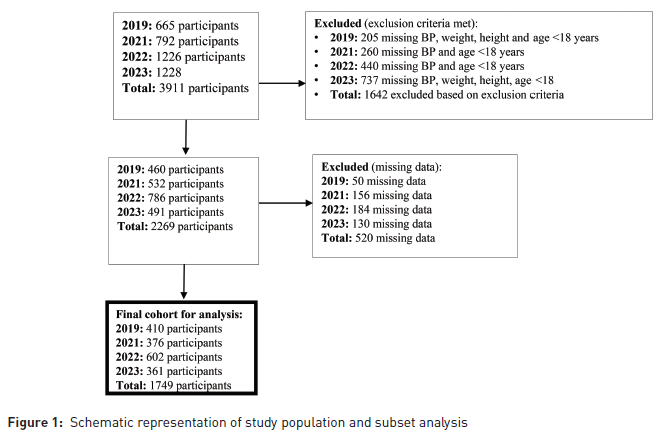
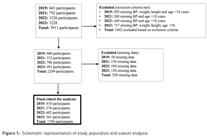
A total of 3911 participants were screened over the four study years and included in the parent studies.(5,8-13) Of these, 1642 participants were excluded due to missing BP records or age <18 years. An additional 520 records were excluded due to missing data relevant to the analysis, including BMI (2019 and 2023), smoking status, alcohol use, self-reported DM, and ethnicity. Ultimately, 1749 participants (44.7% of the initial cohort) were included in the final analysis (Figure 1).
DEMOGRAPHIC DISTRIBUTION OF THE COHORT
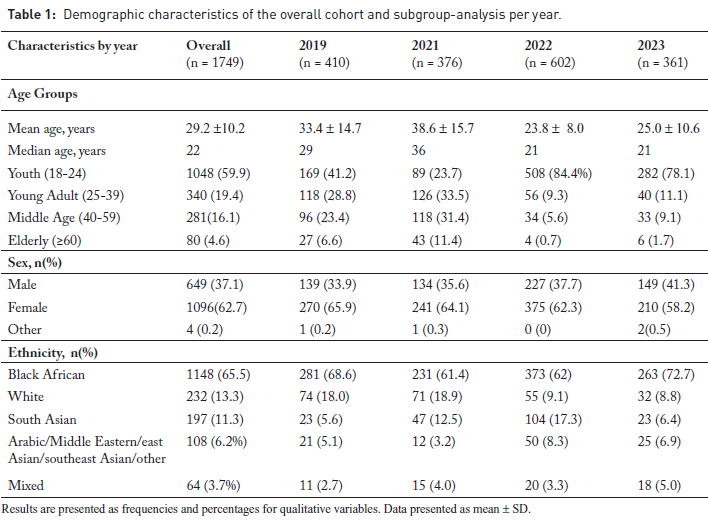
As expected for the study setting, the cohort consisted predominantly of younger participants. Overall, 79.4% of participants were < 40 years, while 20.6% were ≥ 40 years. The mean age across all four years was 29.2 ± 10.6 years. There was a female predominance (62.7%), and most participants identified as Black African (65.5%), followed by White (13.3%) and South Asian (11.3%). The remaining 9.9% comprised mixed ethnicity and other ethnic groups (Table 1). South Asian refers to people from India and Pakistan. Southeast Asian refers to people from Malaysia, Thailand, and Vietnam. East Asian refers to people from China. Other does not have a specific definition; this would have been a participant's choice with multi-ethnicity.
PREVALENCE OF CARDIOMETABOLIC RISK FACTORS
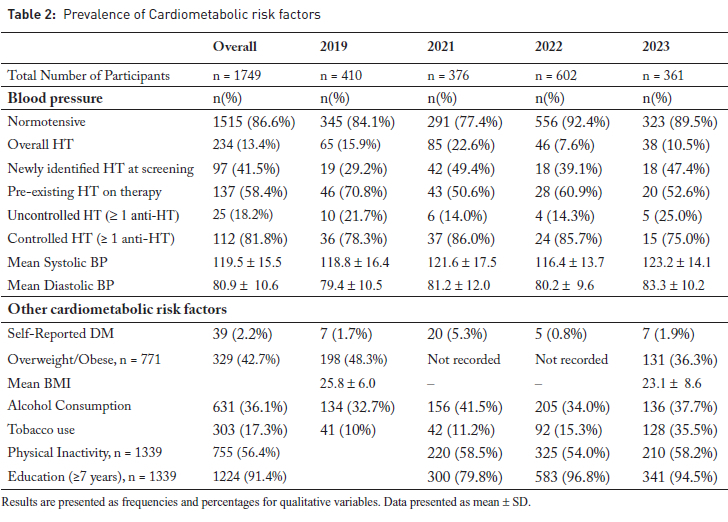
The overall prevalence of HT across the four years was 13.4%, of whom 41.5% classified as newly identified HT at screening. The mean systolic and diastolic BP across the cohort were 119.5 ± 15.5 mmHg and 80.9 ± 10.6 mmHg, respectively. Self-reported DM prevalence ranged from 0.8% to 5.3% across the study years. Overweight/ obesity prevalence ranged from 36.3% to 48.3% in years where BMI data were available. Alcohol consumption ranged from 32.7% to 41.5%, tobacco use from 10.0% to 35.5%, and physical inactivity from 54.0% to 58.5% (Table 2).
Among participants aged < 40 years, HT and self-reported DM prevalence were lower than in older participants. However, modifiable cardiometabolic risk factors remained prevalent in this younger age group, including overweight/ obesity, alcohol use, tobacco use, and physical inactivity (Supplementary Appendix Table S1). Among participants aged ≥40 years, HT, self-reported DM, and overweight/obesity were more prevalent across all study years than among younger participants (Supplementary Appendix Table S2).
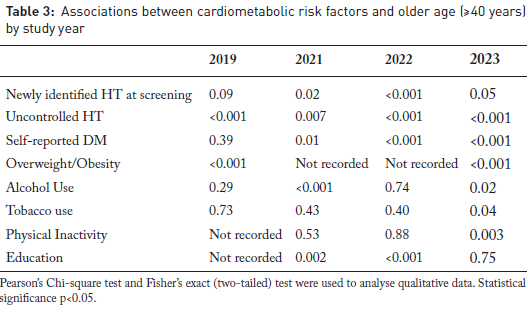
In 2019, uncontrolled HT and overweight/obesity were significantly associated with older age (≥ 40 years) (both p < 0.001). No other cardiometabolic risk factors demonstrated significant associations with age that year. In 2021, newly identified HT at screening (p = 0.02), uncontrolled HT (p = 0.01), alcohol use (p < 0.001), and self-reported DM (p = 0.01) were significantly associated with older age. BMI data were unavailable for 2021. In 2022, both newly identified HT at screening and uncontrolled HT remained significantly associated with older age (both p < 0.001), while BMI data were unavailable (excluded from the screening initiative that year). In 2023, uncontrolled HT, overweight/obesity, alcohol use, tobacco use, and physical inactivity demonstrated significant associations with older age (Table 3).
A generalised linear model (GLM) with binomial distribution and logit link function was used to evaluate factors associated with HT across study years (Supplementary Appendix Table S3). Female sex, Black African ethnicity, and younger age (< 40 years) were used as reference categories. Older age (≥ 40 years) was associated with significantly increased odds of HT across all study years analysed. The strongest association was observed in 2021 (OR = 6.0; 95% CI: 3.3 - 10.9; p < 0.001). Additional factors significantly associated with HT included self-reported DM in 2021 (OR = 7.3; 95% CI: 2.3 - 22.9; p = 0.003) and overweight/obesity in 2019 (OR = 2.3; 95% CI: 1.2 -4.8; p = 0.02). Male sex, physical inactivity, and alcohol use demonstrated increased odds of HT across several study years; however, these associations did not consistently achieve statistical significance. Younger participants (< 40 years) demonstrated lower odds of newly identified HT at screening, uncontrolled HT, and self-reported DM across all study years (Supplementary Appendix Table S4). Significant reductions in odds of HT were observed in 2021 (OR = 0.3; 95% CI: 0.2 - 0.5; p = 0.02) and 2022 (OR = 0.2; 95% CI: 0.1- 0.2; p<0.001). However, younger participants demonstrated increased odds of overweight/ obesity in 2019 (OR = 2.3; 95% CI: 1.2-4.8; p = 0.02). Alcohol use, tobacco use, and physical inactivity also demonstrated increased odds among younger participants, although these associations were not statistically significant.
DISCUSSION
This study evaluated the burden of HT and associated cardiometabolic risk factors in a predominantly young urban cohort at a university environment in Johannesburg, South Africa. Despite a lower prevalence of HT than national estimates, a substantial proportion of cases were newly identified at screening. Older age (≥40 years) was the strongest predictor of HT, while overweight/obesity and alcohol use demonstrated increased associations with HT. Younger participants also demonstrated a considerable burden of modifiable cardiometabolic risk factors.
The majority of participants were aged 18-39 years, consistent with South Africa's predominantly youthful population.(19) The cohort demonstrated a female predominance and ethnic diversity characteristic of urban South African populations, with most participants identifying as Black African.(19) However, as the study was conducted within an urban university setting, the findings may not be fully representative of rural South African populations.
The overall prevalence of HT was lower than national estimates, likely reflecting the cohort's predominantly young age distribution.(3,5,14) However, 41.5% of hypertensive participants were newly identified at screening, highlighting the burden of undiagnosed disease even within a population with presumed access to healthcare services. These findings support evidence that younger adults remain under-screened for HT and reinforce the importance of opportunistic BP screening in asymptomatic populations.(14,16)
The prevalence of overweight/obesity was high despite the relatively young age of the cohort. Although prevalence increased with age, younger participants accounted for a substantial proportion of overweight/obesity. This is concerning, given the established association between obesity and early-onset cardiometabolic disease.(7,20,21) As a major contributor to HT, insulin resistance, dyslipidaemia, and chronic inflammation, overweight/obesity represents an important target for early public health intervention and preventative strategies.(3)
Self-reported DM prevalence was lower than national estimates.(6) This likely reflects both the younger age distribution of the cohort and limitations associated with self-reported screening methods. As type 2 DM may remain asymptomatic for several years prior to diagnosis, reliance on self-report likely underestimates the true prevalence of DM within this cohort.
Both HT and self-reported DM were consistently associated with older age (≥40 years) across the study years analysed. In contrast, younger participants demonstrated a higher prevalence of behavioural risk factors, including alcohol use, physical inactivity, and overweight/obesity, while tobacco use was more evenly distributed between age groups. These findings suggest that although overt cardiometabolic disease remains more prevalent in older adults, younger individuals are already accumulating modifiable risk factors associated with future cardiovascular morbidity.(14,15,22) Early adulthood, therefore, represents an important opportunity for preventative intervention and risk factor modification.
Regression analysis demonstrated that older age (≥40 years) remained the strongest predictor of HT across all study years analysed. Overweight/obesity and alcohol use were associated with increased odds of HT, although these associations were not consistently statistically significant. Tobacco use, physical inactivity, and ethnicity demonstrated variable associations across study years. This likely reflects the multifactorial nature of HT and the complex interaction between genetic, behavioural, environmental, and socioeconomic factors.(3)
An important consideration in younger individuals with HT is the increased likelihood of secondary HT compared with older populations.(16) Persistent elevated BP in younger adults should therefore prompt evaluation for secondary causes, particularly in those with severe, resistant, or atypical presentations. Early identification of HT may therefore provide opportunities not only for cardiovascular risk reduction but also for detecting potentially reversible underlying pathology.
LIMITATIONSSeveral limitations should be acknowledged. The study population consisted predominantly of younger university students, which likely contributed to lower prevalence rates of HT and DM compared with national estimates. Convenience sampling may have introduced selection bias, while the use of self-reported DM may have underestimated the true prevalence of DM. In addition, single-occasion BP measurements may have overestimated HT prevalence due to the white-coat effect or other transient physiological factors. Repeat confirmatory BP measurements and longitudinal follow-up would strengthen future surveillance studies. Finally, the urban university setting may limit generalisability to rural South African populations.
CONCLUSION
This study demonstrates that HT and cardiometabolic risk factors are already present in a predominantly young, urban university population in South Africa. Although the overall prevalence was lower than national estimates, a significant proportion of participants were newly identified through the screening program. This underscores the burden of undiagnosed disease even in an educated cohort. While DM, overweight, and obesity were associated with increased cardiometabolic risk, older age remained the strongest predictor of HT. Overall, these findings highlight the importance of ongoing surveillance and early identification of cardiometabolic risk factors in younger, asymptomatic populations and emphasise the need for a life-course approach to cardiovascular prevention, with interventions targeting modifiable risk factors before the development of established disease. Opportunistic BP screening and early identification of risk factors may provide important opportunities for prevention in urban South African populations.
FUNDINGThe authors declare no specific grant for this research from any funding agency in the public, commercial, or not-for-profit sectors. Servier South Africa is thanked for donating 15 OMRON BP devices to the MMM initiative.
COMPETING INTERESTSDeclaration: This study forms part of the requirements for the degree of Master of Medicine (MMED) undertaken by Dr. Urooge Haq at the University of the Witwatersrand, Johannesburg, SA.
DATA AVAILABILITY STATEMENT
Data are available in a public, open-access repository.
REFERENCES
-
1. Statistics South Africa. Mortality and causes of death in South Africa: findings from death notification, 2019. Statistical release P0309.3 [Internet]. Pretoria: Statistics South Africa; 2024 [cited 2024 Jan 23]. Available from: https://www.statssa.gov.za/?page_id=1856&PPN=P0309.3&SCH=73881
» https://www.statssa.gov.za/?page_id=1856&PPN=P0309.3&SCH=73881 -
2. World Health Organization Regional Office for Africa. South Africa: health topics [Internet]. Brazzaville: World Health Organization Regional Office for Africa; [cited 2024 Jan 15]. Available from: https://www.afro.who.int/countries/south-africa/health-topics
» https://www.afro.who.int/countries/south-africa/health-topics -
3. World Health Organization. Hypertension: South Africa [Internet]. Geneva: World Health Organization; [cited 2024 Jan 15]. Available from: https://data.who.int/indicators/i/7DA4E68/608DE39?m49=710
» https://data.who.int/indicators/i/7DA4E68/608DE39?m49=710 -
4. Southern African Hypertension Society. Statistics [Internet]. Southern African Hypertension Society; 2025 [cited 2025 Apr 1]. Available from: https://www.hypertension.org.za/pages/statistics
» https://www.hypertension.org.za/pages/statistics -
5. Woodiwiss AJ, Orchard A, Mels CMC, et al. High prevalence but lack of awareness of hypertension in South Africa, particularly among men and young adults. J Hum Hypertens. 2025; 39:111-119. doi:10.1038/s41371-023-00873-3.
» https://doi.org/10.1038/s41371-023-00873-3 -
6. International Diabetes Federation. South Africa [Internet]. Brussels: International Diabetes Federation; 2023 [cited 2025 Apr 1]. Available from: https://idf.org/our-network/regions-and-members/africa/members/south-africa/
» https://idf.org/our-network/regions-and-members/africa/members/south-africa/ -
7. Human Sciences Research Council. HSRC study finds that almost 50% of adult South Africans are overweight or obese [Internet]. Pretoria: Human Sciences Research Council; 2024 [cited 2025 Apr 1]. Available from: https://hsrc.ac.za/news/latest-news/almost-50-of-adult-south-africans-are-overweight-or-obese-poverty-and-poor-nutrition-are-largely-to-blame/
» https://hsrc.ac.za/news/latest-news/almost-50-of-adult-south-africans-are-overweight-or-obese-poverty-and-poor-nutrition-are-largely-to-blame/ -
8. Woodiwiss AJ, Gafane-Matemane LF, Norton GR, et al. May Measurement Month 2019: an analysis of blood pressure screening results from South Africa. Eur Heart J Suppl. 2021; 23 Suppl B:B134-B137. doi:10.1093/eurheartj/suab031.
» https://doi.org/10.1093/eurheartj/suab031 -
9. International Society of Hypertension. May Measurement Month [Internet]. International Society of Hypertension; 2023 [cited 24 Jan 2024 ]. Available from: https://ish-world.com/may-measurement-month/
» https://ish-world.com/may-measurement-month/ -
10. May Measurement Month. May Measurement Month [Internet]. May Measurement Month; 2024 [cited 24 Jan 2024]. Available from: https://maymeasure.org/
» https://maymeasure.org/ -
11. Woodiwiss AJ, Kruger R, Norton GR, et al. May Measurement Month 2017: an analysis of blood pressure screening results in South Africa-Sub-Saharan Africa. Eur Heart J Suppl. 2019; 21 Suppl D:D104-D106. doi:10.1093/eurheartj/suz069.
» https://doi.org/10.1093/eurheartj/suz069 -
12. Woodiwiss AJ, Kruger R, Norton GR, et al. May Measurement Month 2018: an analysis of blood pressure screening results in South Africa. Eur Heart J Suppl. 2020; 22 Suppl H:H115-H118. doi:10.1093/eurheartj/suaa043.
» https://doi.org/10.1093/eurheartj/suaa043 -
13. Southern African Hypertension Society. May Measurement Month 2023 is a global campaign led by the International Society of Hypertension to increase awareness of the issues surrounding high blood pressure [Internet]. Southern African Hypertension Society; 2022 [cited 2024 Jan 24]. Available from: https://www.hypertension.org.za/events/2022/my-measure-month-2021-get-involved
» https://www.hypertension.org.za/events/2022/my-measure-month-2021-get-involved -
14. NCD Risk Factor Collaboration (NCD-RisC). Worldwide trends in hypertension prevalence and progress in treatment and control from 1990 to 2019: a pooled analysis of 1201 population-representative studies with 104 million participants. Lancet. 2021; 398(10304):957-980. doi:10.1016/S0140-6736(21)01330-1.
» https://doi.org/10.1016/S0140-6736(21)01330-1 -
15. Gooding HC, Gidding SS, Moran AE, et al. Challenges and opportunities for the prevention and treatment of cardiovascular disease among young adults: report from a National Heart, Lung, and Blood Institute Working Group. J Am Heart Assoc. 2020; 9(19):e016115. doi:10.1161/JAHA.120.016115.
» https://doi.org/10.1161/JAHA.120.016115 -
16. Mancia G, Kreutz R, Brunström M, et al. 2023 ESH Guidelines for the management of arterial hypertension: The Task Force for the Management of Arterial Hypertension of the European Society of Hypertension. J Hypertens. 2023; 41(12):1874-2071. doi:10.1097/HJH.0000000000003480.
» https://doi.org/10.1097/HJH.0000000000003480 -
17. World Health Organization. Obesity and overweight [Internet]. Geneva: World Health Organization; 2021 [cited 2026 Jun 1]. Available from: https://www.who.int/news-room/fact-sheets/detail/obesity-and-overweight
» https://www.who.int/news-room/fact-sheets/detail/obesity-and-overweight -
18. World Health Organization. WHO guidelines on physical activity and sedentary behaviour [Internet]. Geneva: World Health Organization; 2020 [cited 2026 Jun 1]. Available from: https://iris.who.int/handle/10665/336656
» https://iris.who.int/handle/10665/336656 -
19. Statistics South Africa. Is South Africa growing older? The unseen shift in our population [Internet]. Pretoria: Statistics South Africa; 2025 [cited 2025 Apr 4]. Available from: https://www.statssa.gov.za/?p=18056
» https://www.statssa.gov.za/?p=18056 -
20. NCD Risk Factor Collaboration (NCD-RisC). Worldwide trends in underweight and obesity from 1990 to 2022: a pooled analysis of 3663 population-representative studies with 222 million children, adolescents, and adults. Lancet. 2024; 403(10431):1027-1050. doi:10.1016/S0140-6736(23)02750-2.
» https://doi.org/10.1016/S0140-6736(23)02750-2 -
21. Xie J, Wang M, Long Z, et al. Global burden of type 2 diabetes in adolescents and young adults, 1990-2019: systematic analysis of the Global Burden of Disease Study 2019. BMJ. 2022; 379:e072385. doi:10.1136/bmj-2022-072385.
» https://doi.org/10.1136/bmj-2022-072385 -
22. Yano Y, Reis JP, Colangelo LA, et al. Association of blood pressure classification in young adults using the 2017 ACC/AHA guidelines with cardiovascular events later in life. JAMA. 2018; 320(17):1774-1782. doi:10.1001/jama.2018.13551.
» https://doi.org/10.1001/jama.2018.13551