Gods, music and rainmaking in Yorùbáland
Abstract
The salutation to Ṣàngó (Yorùbá god of thunder and lightning) exemplifies the deity through the depiction of his distinguishing volatile personality. His response to ensemble music reflects the possibilities of his influence as a facilitator of musical skills at Ṣàngó festivals and plays in Yorùbáland. The intricacies of African rhythms impact Ṣàngó's emotions through praise singing with a Bàtá ensemble in a distinctive and impulsive way. However, the process that brings about rainfall appears not to have been sufficiently documented. In this study, we investigate the artistic form that causes rainfall whenever the salutation is rendered. Data was gathered through interviews and analysis of the play Ọba kò so by Dúró Ladipọ. The study findings prove the connection between Ṣàngó, and rain through the lens of literature and traditional Yorùbá music and festivals in honour of Ṣàngó. By exploring this intersection of art, music and environmental phenomena, the study offers valuable insight into the complex relationships between humans, culture, and the natural force.
Yorùbá religion; Yorùbá traditional music; rain; Ṣàngó; Yorùbá oral literature
Introduction
In this article we explore the creative potential and ecological nature of the potential of praises and the cultural context in which they are performed and how it relates to Ṣàngó, the Yorùbá god of thunder and lightning. I (AAL) remember when I was a teenager, whenever it rained and thundered my grandmother held her lips firmly together and released them after a while, thus producing a loud outburst in rapid succession to pacify Ṣàngó. It was believed that when thunder strikes indifferent and unconcerned people who fail to appease Ṣàngó are always victims of his terrifying rage. His wrath could kill, paralyze, and destroy properties by cracking walls to mention but a few. If it kills, only Ṣàngó priests are permitted to bury such a corpse, as this is seen as an abominable death.
The gods and man relate through many avenues, one of which is praise singing and drumming. The Yorùbá of Southwest Nigeria are highly devoted to the worship of the gods. This opinion is from a vast traditional legacy of the people's perceptions of these gods, their principles and beliefs in relation to the integrative and innovative role of indigenous music in their worship (Omojola 32). Music in indigenous worship conveys a novel facet to the sustainability and advancement of the relationship between god and the music of man, and recognition of the prominence of conserving as much as possible the Yorùbá pre-modern heritage has become necessary. The emphasis on this relationship is predominantly on the perceptive and pragmatic reinforcements of the musical tradition: How do the gods perceive the music and how do they relate to man? Yorùbá beliefs exemplified the principles, artistic beauty, and ethical merits that are counted as imperative in the interaction between god and man. Praise singing of the gods hinges on the collective expertise of the praise singers to spontaneously construct praises and the resourcefulness of the Bàtá drummers to provide accompaniments in favour of the gods. There are characteristic rhythmic requirement for the Bàtá ensemble that serves as accompaniments to these praises.
The accompaniments are essential to dignify the status of Ṣàngó as a fearsome god, which makes the rhythm vigorous or dynamic. The drumming patterns to some limited extent explicate the viewpoint of the Yorùbá that portrays the deity as volatile. The praises are in recitative and colourful form, with dramatic consciousness. The praises reveal the reference of the singer for the deity and also showcase the creativeness of the performer that is demonstrated throughout the praise duration. The praise is elaborated with word pictures, a demonstration of the embroidering nature of the Yorùbá language. Furthermore, drumming is prominent in the worship of Ṣàngó (Baba Alájẹdé).
African beliefs often claim that man cannot live in isolation from the gods. Remarking on this phenomenon in Nigeria, Ìdòwú (97) observes that the relationship between the gods and human beings is beneficial. There are many gods in Yorùbáland, associated with different ensemble music, but the focus of this article is on the depiction of Ṣàngó in a play by Dúró Ladipọ, Ọba kò so (The king did not hang, 1964) as well as field work research (done principally by Láyadé and supported by Ògúnyẹmí) centred on the Ọba kò so festival in Osogbo, Ilorin and Ibadan.
Dúró Ladipọ (1926-1978) was a Nigerian dramatist, researcher, playwright. He acted the major character of Ṣàngó in his play, Ọba kò so. Dúró was famous for his praise salutation, an indispensable cultural asset in Yorùbáland, as is attested by several oral sources interviewed between 2018 and 2023 in Osogbo, Ilorin and Ibadan. It originated as man's response to the multiplicities and changing aspects of his person's, ancestry and reality. The permanence of this retort is a heritage that intermediates between God and man. Ṣàngó Pípè (Ṣàngó praise singing) a traditional praise compliment of Ṣàngó affects or stimulates the assertiveness, manners, and exploits of this god which leads to rainfall. The procedure responsible for rainmaking by Ṣàngó worshippers in the play is still ambiguous and needs clarification. In this article, we analyse, among other things, Ṣàngó's rapid and frightening response to praise (a temperament that is associated with the suicide that led to his death before he gained his deity status). This research is relevant it opens new frontiers through which the connection between the god and the music of man can be viewed.
The field work entailed the collection of authentic Bàtá ensemble drum music from a master chanter of Ṣàngó attributes and the Ìyáàlù Bàtá master drummer (Bàtá was an exclusive ensemble for Ṣàngó worship but has now been extended to serve other functions in collaboration to the Dundun ensemble even in the church). We came across two groups of Ṣàngó worshippers and two bands of Bàtá ensemble drummers performed in Ìbàdàn, Òṣogbo, Òyó and Ọffà/Ìlọrin. Some of these worshippers served as chanters, dancers, and drummers at those formal and informal meetings, where they performed in context and out of context. This prompted a further investigation of the chanter and street drummers at a festival event that took place in Ìbàdàn, Ọyọ State, Òṣogbo, Ọsun State, and Ọffà/Ìlọrin, Kwara State, between July and September 2018 and 2019 respectively. It was observed that the drummers were passionate about accompanying the praise chants eulogy to Ṣàngó performed as tributes to the deity. They entertain a small group of people at a time because their performance is not amplified electronically. We observed the dexterity of their performance and listened critically to their chant repertoire thus the study focusing on Ọba kò so and the other Ṣàngó festival. Bàbá Alájẹdé (the leader of the first drumming group), Bàbà Akeem, and Àyánwálé, among other leaders of street drumming groups were interviewed.
Firstly, we visited the historical archives at the palace of Ọba Làmídì Adéyẹmí (the Aláàfin of Ọyọ́) to collect data on Ṣàngó as the first King of Ọyọ́ and as a deity). Then we were at the homes of key informants in the same town where traditional chants/songs of Ṣàngó were collected and available songs in the reproducible form were duplicated. Finally, we travelled to Ọyọ́ town in Ọyọ́ State, Nigeria, as observers at the festival.
Praise greetings/salutation to "Sàngó Ọba kò so"
Praise singing is a form of flattering greetings, an enhancement to a man's ego, and recognition of his prominence as a private of communal personality. Praise singing is of different forms and for diverse usages. Idamoyibo ("The Systematic Development of Ìjálá Genre: The Significance of its Function and Substance in Contemporary Usage" 135) categories praise singing into four main individual, family praises, lineage, and community praises. There are even praises for the deities, animals and trees among others.
"Oríkì Òrìṣà Ṣàngó" was collected from the first chanter, Mama Ṣàngódeyi, the listing of the deity praise in order of priority. This is actual praise singing chants or poetry that is associated with the salutation of Ṣàngó. It describes his attributes and rebuff the assertion that the deity died by hanging.
Olùfinràn, ' Ọ ba kò so'.
Ọ ba Asángiri.
Alàgiri.
Olàgirikàkàkà-k ọ̀ m ọ kùnrin-kó.
Ṣà ngó!
Ekuru Gbàgbà l'ójò.
Ìl ẹ̀ gbogbo, àkùr ọ̀ l'ój ọ .
Ènìyàn tí a bú l ẹ́ hìn, t'ó sì m ọ̀
Ogunlabí!
Etí lu ká ra bí ajere.
Má bu u
Má sà á
Má s' òrò r ẹ̀ l ẹ́ hìn
Bàbá Bánk ọ́ lé
N ó kí i l' ọ́ nà ib ẹ̀ hun.
Ṣà ngó o!
Aru òwu r'Òwu
Óru fééféé re If ẹ̀
Óru gúdúgbú tà ní Gúdúgbú
Láì s' ọ m ọ eranko kélébé
Ṣà ngó o!
Dégòkè!
Àr ẹ mú!
Olùfinràn, 'the king did not hang himself'.
The king whose vibration cracks walls;
Who splits the wall asunder?
He who breaks the wall here and there and curls up young men
Ṣàngó!
Dust, dust, dust again in the dry season,
Every inch of ground like marshy farm soil in the wet season;
A man who gets to know who has spoken ill of him behind his back
Ogunlabí!
A man who hears all that is said of him behind his back
Don't abuse him.
Don't hack him.
Don't backbite him.
Father of Bánkọ́lé
I will say good things about him.
Oh Ṣàngó!
The man who carries raw cotton to Owu.
The man who carries feefee yam flour to Ife.
The man who carries gudugbu yam tubers and sold them at Gudugbu
Whereas he is not a small goat
Oh, Ṣàngó!
Dégòkè!
Àrẹmú!
The salutation starts with a name in line 1: Olùfinràn is an image of a tall wavering man, a praise name that is always accompanied by the Bàtá ensemble. The name is unique, it is exclusive to Ṣàngó and it suits the status of a flaming personality and a befitting eulogy that is traditionally associated with the deity in Yorùbáland. The first word of the first line of the praise poetry was the name given to Ṣàngó when he was the Aláàfin of the ancient Ọyọ́ kingdom, before he became a deity (oral interviews with Mama Ṣàngódeyi and Mama Akínsọlá Sangoyemiju, the main chanter and the supporting chanter, respectively), a form of praise name befitting the class of a warrior king.
Burton and Chacksfield write:
Heightened speech, a primary characteristic of praise-singing, involves rhythmic and dynamic elements that are not a part of everyday speech, whose primary function is communication. The poetic or musical qualities of speech that are out of the ordinary are self-conscious and per-formative. The no phonemic accentuation that occurs in such speech, rhythm, and accentuation serve an aesthetic value over communicative and rhythmic impulse (Burton and Chacksfield qtd in Idamoyibo, "Dynamics of African Dance" 67).
The structure of praise singing follows definite poetic formulas. In Yorùbáland, praise poetry is heightened speech with drum accompaniment, highly rhythmic and of great aesthetic value. It reveals the communicative and functionality value of the text-based praise chant structure.
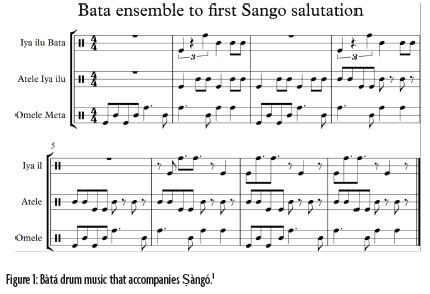
The entrance of Ṣàngó to the theatre of performance is usually at a slow and unregulated pace. This is replicated in the rhythm employs for this purpose. The Iya ilu Bata (Bata Mother Drum) which is the lead drum is characterized with syncopation
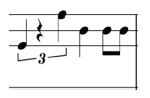
and anticipating the movement of Ṣàngó.
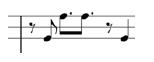
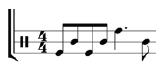
The other two instruments, Atele Iyailu (the accompanying Bata drum) and Omele meta (Three time liner drums) usually accompanies the lead drum by playing a short repetitive rhythmic pattern, ostinato.
"Ọba kò so", "the king did not hang himself", in the same first line is a citation or an insinuation to the saying adopted by Ṣàngó close cult members and followers after the deity's conversion from man to god through suicide. His followers felt so ashamed of this infamous suicide act that they picked up the refrain "Ọba kò so" as a negation of his action. The second line is an assertion of Ṣàngó's linking to thunder and lightning even before his death. It portrays the fact that he had so much power and his anger was so frightening that it could split a wall into two.
Ṣàngó was a pleasantly dreadful king (a paradoxical statement that depicts his nature) powerful, wealthy, and pompous. He was tall and handsome; his attributes were the reasons for his boastful nature and his fall. Lines 3 and 4 represent the inimitability of the dramatic use of words to create a vivid picture of the expression in the minds of the readers. The imagery of the splitting wall in line 4 is so effectively portrayed that one could feel the effect of the wall splitting into two. The incorporation of kàkàkà, an onomatopoetic sound in this line is an indication of a cracking wall that signifies the striking power of the king. Line 6 further emphasizes the terrible nature of Ṣàngó's anger as being capable of raising dust again and again in the dry season.
Line 8 (meaning "a man who gets to know who has spoken ill of him behind his back) validates the invincibility of Ṣàngó that was acclaimed to have the spiritual power to be present at places without actually being seen physically by anyone. Line 9, Ogunlabí (the begotten of Ògún or Ògún has been brought forth) reveals another name of Ṣàngó, this is one of his numerous personal names that negates the traditional lineage history of naming that associate Ṣàngó with Ògún. In line 10, "Éti lu ká ra bí ajere" (literarily meaning "a body that is full of ears like holes in a colander") may be translated to mean "A man who hears all that is said of him behind his back". These further compound the invincible nature of Ṣàngó in line 8 and his supernatural power to hear whatever comments people make about him.
Má bu u
Má sà á
Má s' ọ̀ r ọ̀ r ẹ̀ l ẹ́ hìn
Don't abuse him.
Don't hack him.
Don't backbite him.
Lines 12 to 14 show copious use of alliteration and repetition that enhances memorization and rhythmic recitation in poetry.
Aru òwú r'Òwu (collected from Mama Akínsọlá, the second chanter)
Aru òwú r'Òwu
Óru fééféé re If ẹ̀
Óru gúdúgbú tà ní Gúdúgbú
The man who carries raw cotton to Òwu.
The man who carries fééféé yam flour to Ife
The man who carries gúdúgbú yam tubers and sold them at Gúdúgbú market
These lines also contain examples of alliteration, recurrence in a reconstructive form, and use of onomatopoeia. Gúdúgbú is an onomatopoetic sound that indicates the rolling of a very big yam on the ground.
Below are praise names of Ṣàngó that are not exclusive to the deity; they are general names in Yorùbáland as well as praise names. Though no one bears Ṣàngó in isolation, it is always a part of the surname of Ṣàngó worshipers, names like Ṣàngóṣèyí (Ṣàngó has done this) Ṣàngódìran (Ṣàngó has expanded into a lineage) and Ṣàngówálé (Ṣàngó has come home) among others:
Ṣà ngó o!
Dégòkè!
Àr ẹ̀ mú
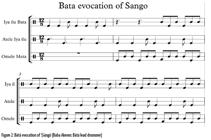
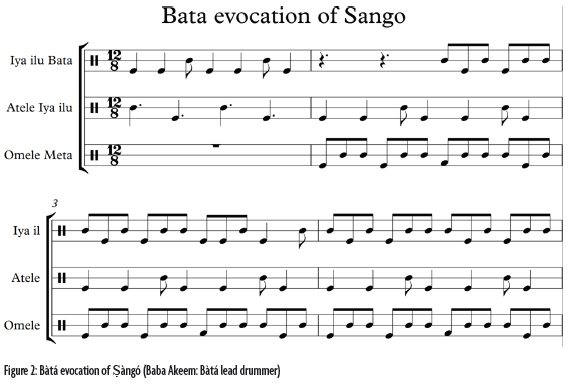
The evocation of Ṣàngó's spirit is at the height of performance when it is believed the spirit will be exorcised. This section is accompanied by a fast tempo to heighten the tension and to condition the atmosphere for the emergence of the spirit after which rain is expected to fall in an integrated bata performance as notated above (Baba Akeem, Iyaalu Bata and Baba Alajede: Atele and Ayanbode).
While the Omele Meta keeps the rhythm at this section with the ostinato pattern the Atele keeps the basic rhythmic pattern- quadruple meter the Omele plays the ostinato. . The essence of these two drums taking over the rhythm role is to allow the lead drummer (Iya ilu Bata) to improvise. Idamoyibo ("Dynamics" 68) affirms that "dundun ensemble drummers as the custodians of Yorùbá oral repertoire in South West Nigeria. Their skills are tramsmitted to the younger generation in simple and articulate style" .

Praise singing in honour of "Sàngó Ọba kò so" and rainmaking
The town of Òṣogbo has very hot and humid weather during what is considered the dry season. Dúró was literarily called "Sàngó Ọba kò so Ladipo" (Dúró who acted in Ọba kò so play). His acting as Ṣàngó was aided by the praise singing art and the mystical rites of rainmaking. Dúró acted as Ṣàngó at the Festspiele Festival in Berlin (1964), the Commonwealth Arts Festival in London (1965) and the Festival portraying Yorùbá Cultural Heritages in Zurich (1973) among others. He so perfectly represented Ṣàngó in the delivery of the play that there were thunderstorms scientists could not explain.
The praise chant presentation in the play is active, directly linked to Ṣàngó, and essential documentation of the person of the god and manipulating the sequence of Ṣàngó's actions in the play. Ṣàngó was a lover of praise in his Earthly sojourn, his wives and followers were full of praises for him when it was discovered that praise-singing calms his temperament and makes him sober. Ọba kò so reveals in several ways momentary rainfall resulting from the praise-singing that got him enchanted.
The performance of Ṣàngó in the play is not the sole effort of Dúró Ladipọ. There are four factors of the performance at the festival. The people within and outside the genre tradition that include Ṣàngó himself, the chanter/dancer, the master drummer, and the medicine man that makes the rain fall or prevents rain from falling These four factors work together to achieve the purpose of the play. The chanter, usually a woman, enjoys high visibility at Ṣàngó festivals as portrayed in the play. She is a versatile orator and cultural library, a chanter with an eloquent voice, and a dancer of a rare quality. She moves Ṣàngó to an active performance that was close to the actuality of the deity's prolific actions while he was on Earth. The master drummer accompanied the chanter in such prolific eloquence that Dúró was lost in trance and was able to accomplish an unparalleled height of a personified Ṣàngó in the play. The medicine man or rain doctor concluded the performance by drawing rain. Ọba kò so is an interrelationship between culture, worship, and nature.
The rain doctor in Ṣàngó festivals
In Yorùbá culture, where oral traditions are transmitted from person to person, scientific explanations for weather related occurrences are limited. According to Solábòmí Akínsọlá, the "Rainmaker", in an oral interview on 25 June 2019 and 16 June 2023, explains the local facts on rainmaking as a mystical exercise with traditional value, focusing on Osogho town in Osun State. He describes rain making at Ṣàngó festivals as a term used in Yorùbáland to define an individual who required the practices of praise singers to Ṣàngó to influence the weather, specifically to bring rain. In Osogbo, Osun State, the rainmaker, a Ṣàngó priest, employs the help of a praise singer for the purpose of producing rain. Though the indigenous perception of rain making is connected with certain technical narratives that may defy the understanding of some, the occurrences are real and functional. The praise singer is conversant with Ṣàngó praises, and sings the praises of Ṣàngó from her inner being to inspire the rainmaker to produce rain. In addition to the above, other rainmakers who are not connected to Ṣàngó practice rain making through the use of spiritual or supernatural means in form of magic, rituals, or incantations to manipulate the weather.
Mama Ṣàngódeyi and Mama Akinsola, Chanter 1 and 2, in oral interviews in September 2018, on 25 June 2019 and 16 June 2023, explain that during the Ṣàngó Praise Singing Festival in Osogbo, Osun State-which is held yearly in appreciation of the contributions of Duro Ladipo to historical Yorùbá plays-there must be synergy between the chanter, master drummer, dancers, and rain doctor. If there is a disagreement, something is likely to go wrong. This is because at the peak of the celebration there is always rainfall which comes after the incessant thundering process that is believed to have been evoked by Ṣàngó. The question of what draws the rain is significant. This is the responsibility of the rain doctor at the festival who knows specifically when to start the rain and when to hold it back. Rainmakers in the traditional Yorùbá system use varied procedures to stimulate rainfall. African belief can trust in rainmakers as possessing an exclusive skill to interconnect with spirits and its fundamentals, allowing them to impact weather conditions or patterns. Idamoyibo and Achieng-Akuno (249) reveal that the sacred intangible object of praise singing influences and inspires possession. They influence the rainmaker also and inspire him to attain a spiritual realm that ushers in the rain. The other method is the use of spiritual linkage to nature through the use of certain rites, observances, and sometimes definite substances to invoke rain.
It rains whenever the chanter eulogizes the attributes of Ṣàngó during the "Ṣàngó Pípè" festival in Oyo, Oyo State, Nigeria. At a point during the festival, the clouds start to gather, and the weather immediately changes to warn the worshippers and participants of inevitable rainfall. Once the clouds are shaped from droplets of water that condensed from a distinctive water vapor the atmospheres change and the master chanter and master drummers become possessed by the spirit of Ṣàngó that is believed to be roaming around the worshippers in preparation for the climate alteration. When the droplets of water condense one unto another, there is water growth that the rain doctors capitalize on to command rain to fall through a traditional means of nailing seven leaves together and turning a bottle down while the rain doctor stays without drinking until the exercise is over serves as facilitators in the festival. At a point when the droplets of water become too weighty to be suspended in the cloud, the rain doctor manipulates his skills to draw rain which begins to fall as under gravity that seems scientific and systematically induced.
The rain doctors in Yorùbáland are mostly non-literate, despite this, they understand climate conditions perfectly to enable their acts. For example, they know that for the rain to fall, moisture must move around each of the three divisions of dimensional zones of heat and humidity distinction known as weather fronts-they may not be able to explain this practice as documented here but scientific analysis by Olubayo (23) has proven the understanding of this rainmaker as significant in the festival. That is why the Ṣàngó festival is held during the rainy season between June and October. They are also aware that for the rain to move from drizzle to a heavy downpour there must be high temperatures because the warm accumulation of water in the cloud leads to a heavy downpour and that the air mass must hold proportionally more humidity for it is a necessary factor for rainfall. By now there are thunderstorms, another confirmation of the presence of the deity at his festival.
According to Sọlábòmí Akínsọlá (interview with the rainmaker, 25 June 2019 and 16 June 2023), thunderstorms develop at the festival when the sky becomes unstable; the rain doctor commences his enchanting act at this point by this occurrence when he notices a deposit of a much colder atmosphere in the cloud, he commences another session of traditional drilling to forecast thunder. The atmosphere is affected when the sun heats the air at this point the doctor waits for the air to raise as this occurs, he starts to cool, and when it is condensed it creates moisture and forms a cloud. The rain doctor then instructs the worshippers to cover their ears in expectation of the thunderstorms; the worshippers quickly drop whatever they are holding on the ground to cover their ears, a means of respect to the god.
It is a belief that praise-singing inspires Ṣàngó to dive into the thunderstorm territory to dignify him because music is a unifying force that repositions and resituates indigenous knowledge to suit contemporary needs for diversified usage Idamoyibo ("Indigenous Music in a New Role" 20) explains that the rain doctor the chant does not only inspire Ṣàngó, it inspires the chanter, the master drummer, the rain doctor, and the worshippers to function efficiently at the festival to avoid the wrath of the deity and to secure his blessings abundantly. She further affirms that there is always skill enhancement during the festival that each of the factors could attest to. According to her, the unity within this circle attracts a positive charge and that when the individual charges ignite together, they will join to discharge their duties with exceptional abilities and accuracy. The rain doctor believes that the inspiration to call rain at Ṣàngó's festival as evident in the play is connected to the deity's love for eulogy which contributes to thunder and lightning.
Dúró's death was greeted with heavy downpours accompanied by thunderstorms.
The festival on Ṣàngó worship is gradually fading away, an outcome of globalization and civilization. Ṣàngó climate predictions at the festival will even be pretentious in the future if the defenselessness of Nigeria against climate change is not addressed. Predicting the weather for the Ṣàngó festival is becoming more difficult; this is because the prediction sometimes slackened in the hands of incompetent rainmakers leading to disappointment when the rain falls before the recession of Ṣàngó during the modern festivals. One can wonder whether Ṣàngó did not support the activities of the rainmakers' leading to the assumption that the grandeur of the festival now lessens.
Conclusion
In this article, we explored aspects of the role played by the deity Ṣàngó (the god of thunder and lightning) in rainmaking, specifically at a performance of Ọba kò so. We analysed the role of the chanters, drummers, and medicine man. Others may not be as visible as Ṣàngó but they all work together to realize the goal of the festival and play. Salutations to Ṣàngó with the vigorous Bàtá ensemble accompaniment captures the mind of the deity in a human form beyond literary expressions and whenever the genre is performed there is rainfall; the play "Ṣàngó Ọba kò so" is an attestation to this assertion.
Works Cited
- Baba Alajede (Atele). Interview with Atinúkẹ́ Adénìkẹ́ Láyadé. Osogbo, Osun State, Nigeria. Sep. 2018, 25 Jun. 2019 and 16 Jun. 2023.
- Baba Ayanbode (Omele Meta). Interview with Atinúkẹ́ Adénìkẹ́ Láyadé. Osogbo, Osun State, Nigeria. Sep. 2018, 25 Jun. 2019 and 16 Jun. 2023.
- Baba Akeem (Iyaalu Bata). Interview with Atinúkẹ́ Adénìkẹ́ Láyadé. Osogbo, Osun State, Nigeria. Sep. 2018, 25 Jun. 2019 and 16 Jun. 2023.
- Solábòmí Akínsọlá (rainmaker). Interview with Atinúkẹ́ Adénìkẹ́ Láyadé. Osogbo, Osun State, Nigeria. Sep. 2018, 25 Jun. 2019 and 16 Jun. 2023.
- Mama Akínsọlá Sangoyemiju (chanter). Interview with Atinúkẹ́ Adénìkẹ́ Láyadé. Osogbo, Osun State, Nigeria. Sep. 2018, 25 Jun. 2019 and 16 Jun. 2023.
-
Idamoyibo, Atinuke Adenike. "Dynamics of African Dance." Humanities Review Journal vol. 3, no. 1, 2003, pp. 67-73. DOI: https://doi.org/10.4314/hrj.v3i1.5941.
» https://doi.org/10.4314/hrj.v3i1.5941 -
_____. "Impact of Dùndún Drummers on the Development of Traditional Music in South West Nigeria." African Musicology Online vol. 7, no. 1, 2017, pp. 1-19. DOI: https://doi.org/10.58721/amo.v7i1.26.
» https://doi.org/10.58721/amo.v7i1.26 -
_____. "Indigenous Music in a New Role." Nordic Journal of African Studies vol. 25, nos. 3-4, 2016, pp. 20-30. https://njas.fi/njas/article/view/108.
» https://njas.fi/njas/article/view/108 - _____. "The Systematic Development of Ìjálá Genre: The Significance of its Function and Substance in Contemporary Usage." Oráfrica: Revista de oralidad africana no. 9, 2013, pp. 133-54.
- Idamoyibo, Atinuke Adenike & Emily Achieng-Akuno. "Systematic Instruction for Musical Arts Education: Towards Skill Development and Cultural Growth". Music Education in Africa, edited by Emily Achieng-Akuno. Routledge, 2019, pp. 249-61.
- Idowu, Bolaji. Olodumare, God in Yorùbá Belief. Longman, 1962.
- Ladipọ, Duro. Ọba kò so (The king did not hang). Dance Drama and Yorùbá Festival Music, Òṣogbo, Cultural Company of Dúró Ladipọ National Theatre, 1972.
-
Olubayo, Stephen. "Rain Making in Africa: The Art and Practice of Controlling the Elements." Oriire. 25 Feb. 2023. https://www.oriire.com/article/rain-makers-in-africa-the-art-and-practice-of-controlling-the-elements.
» https://www.oriire.com/article/rain-makers-in-africa-the-art-and-practice-of-controlling-the-elements -
Omojola, Bode. Rhythms of the Gods: Music, Spiritual and Social Engagement in Yorùbá Cultures. Journal of Pan African Studies vol. 3, no. 9, 2010, pp. 232-50. https://www.jpanafrican.org/archive_issues/vol3no9.htm.
» https://www.jpanafrican.org/archive_issues/vol3no9.htm - Mama Ṣàngódeyi (chanter). Interview with Atinúkẹ́ Adénìkẹ́ Láyadé. Osogbo, Osun State, Nigeria. Sep. 2018, 25 Jun. 2019 and 16 Jun. 2023.
Accepted: 16 August 2025
Published: 1 December 2025