Just urban transitions on trust lands: Bridging informality and formal planning in rural and peri-urban South Africa
Abstract
In many developing economies, rural and peri-urban communities frequently experience exclusion from formal development, raising questions as to pathways to equitable and inclusive municipal transitions. This article examines a 'just urban transition' within informal settlements on the Hlanganani Trust lands in Daggakraal, South Africa, with particular attention to residents' lack of secure tenure. A qualitative research design was adopted, combining focus group interviews with community members and key stakeholders, alongside a review of relevant national statutes and municipal planning documents. Data were analysed thematically to identify patterns in socio-spatial inequalities, planning practices, and participatory gaps. Findings reveal that existing municipal interventions, ranging from limited service provision to delayed formalisation, reinforce marginalisation, reflecting top-down planning approaches that overlook the needs of residents and result in the growth of informal settlements. The study highlights power dynamics in planning and the participatory deficits that impede inclusive development. Based on these insights, a framework is proposed for transforming planning practice through in-situ upgrading, alternative tenure recognition, and meaningful community participation. This approach emphasises social justice and collaborative governance, demonstrating how South Africa's planning institutions can be restructured to facilitate equitable urban transitions in rural and peri-urban contexts.
Informal settlements; land trust; South Africa; land tenure; development planning
Abstract
In baie ontwikkelende ekonomieë ervaar landelike en peri-stedelike gemeenskappe dikwels uitsluiting van formele ontwikkeling, wat vrae laat ontstaan oor paaie na regverdige en inklusiewe munisipale oorgange. Hierdie artikel ondersoek 'n 'regverdige stedelike oorgang' binne informele nedersettings op die Hlanganani Trust-gronde in Daggakraal, Suid-Afrika, met spesiale aandag aan inwoners se gebrek aan veilige grondbesit. 'n Kwalitatiewe navorsingsontwerp is gebruik, wat fokusgroep-onderhoude met gemeenskapslede en sleutelbelanghebbendes gekombineer het, tesame met 'n oorsig van relevante nasionale wette en munisipale beplanningsdokumente. Data is tematies ontleed om patrone van sosio-ruimtelike ongelykhede, beplanningspraktyke en deelname-tekorte te identifiseer. Bevindings toon dat bestaande munisipale ingrypings, van beperkte dienslewering tot vertraagde formalisering, marginalisering versterk en 'n bo-na-onder benadering weerspieël wat inwoners se behoeftes ignoreer en die groei van informele nedersettings bevorder. Die studie beklemtoon magsdinamika in beplanning en die deelname-tekorte wat inklusiewe ontwikkeling belemmer. Op grond van hierdie insigte word 'n raamwerk voorgestel om beplanningspraktyke te transformeer deur middel van in-situ opgradering, alternatiewe erkenning van grondbesit en betekenisvolle gemeenskapsdeelname. Hierdie benadering beklemtoon sosiale geregtigheid en gesamentlike bestuur en toon hoe Suid-Afrika se beplannings-instellings herstruktureer kan word om regverdige stedelike oorgange in landelike en peri-stedelike kontekste te fasiliteer.
Abstract
Linaheng tse ngata tse ntseng li tsoela pele moruong, metse ea mahaeng le e haufi le litoropo hangata e ba le ho qheleloa ka thoko ho nts'etsopele ea semmuso, e leng se hlahisang lipotso mabapi le litsela tse lebisang ho liphetoho tsa 'masepala tse nepahetseng le tse kenyeletsang. Sengoliloeng sena se hlahloba 'phetoho e nepahetseng ea litoropong' meahong ea mekhukhu ea Hlanganani Trust e Daggakraal, Afrika Boroa, ka tlhokomelo e khethehileng ho hlokeng ha baahi mobu o sireletsehileng. Ho ile ha sebelisoa moralo oa lipatlisiso oa boleng, o kopanyang lipuisano tsa lihlopha tse tsepamisitsoeng maikutlo le litho tsa sechaba le ba amehang ba bohlokoa, hammoho le tlhahlobo ea melao e amehang ea naha le litokomane tsa moralo oa masepala. Lintlha li ile tsa hlahlojoa ka mokhoa o hlophisitsoeng ho khetholla mekhoa ea ho se lekane ha sechaba le sebaka, mekhoa ea moralo, le likhaello tsa ho kenya letsoho. Liphuputso li bonts'a hore litseko tse teng tsa 'masepala - ho tloha ho phano ea litsebeletso tse fokolang ho isa ho tieho ea ts'ebetso - li matlafatsa khethollo le ho bonts'a mokhoa oa ho ea holimo o iphapanyetsang litlhoko tsa baahi le ho khothaletsa kholo ea mekhukhu. Phuputso e totobatsa matla a matla moralong le likhaello tsa ho kenya letsoho tse sitisang nts'etsopele e kenyeletsang. Ho ipapisitsoe le lintlha tsena, ho entsoe moralo oa ho fetola mekhoa ea meralo ka ho ntlafatsa sebakeng sa heno, ka kananelo e 'ngoe ea ho ba teng ha mobu le ho kenya letsoho ho nang le morero ha sechaba. Mokhoa ona o totobatsa toka ea sechaba le puso ea kopanelo le ho bontsa kamoo litsi tsa meralo tsa Afrika Boroa li ka hlophisoang bocha ho tsamaisa phetoho ea litoropo libakeng tsa mahaeng le tse haufl le litoropo.
1. INTRODUCTION
Trust lands, often governed outside mainstream land-governance frameworks and typically located in rural and peri-urban areas, are particularly susceptible to the proliferation of informal settlement development. The development of informalities is characteristic of urbanisation, especially in developing economies, which is influenced by factors such as rural-urban migration, and rapid urban population growth, all of which heighten the demand for social amenities and economic opportunities (Jones, 2017; Soliman, 2021; Turok, Scheba & Visagie, 2023). These settlements often exhibit deficiencies in basic services, infrastructure, and legal recognition, presenting significant challenges for both residents and urban planners. Such areas are referred to as informal settlements, or informal housing, which are defined as unplanned residential areas constructed on land lacking legal claim or security of tenure (Durand-Lasserve, 2006; Jones, 2017).
Slum infestation resulting from urbanisation in the Global South is a significant international development concern; hence, the United Nations' initiative for a collaborative Global Action Plan for Slum Transformation, which aims to create inclusive cities where no one is left behind (DHS, 2022). This initiative aims to accelerate the implementation of the Sustainable Development Goals (SDGs) and the New Urban Agenda (NUA) in informal settlements and slums. Encouraged as a slum transformation initiative or informal settlement upgrading, it seeks to make slums an integral part of the city by providing access to inexpensive, safe, and accessible housing and basic services (DHS, 2022).
Informal settlement development on Trust lands poses distinct challenges to equity in urbanisation. The concept of a 'just urban transition' emphasises that integrating informal settlements should enhance, rather than exacerbate, the rights and opportunities of marginalised communities (Cobbinah & Finn, 2023; Hughes & Hoffmann, 2020). However, formal planning and customary governance often operate in parallel, sidelining Trust-land residents (Watson, 2003; Ahene, 2020). Typical of Global South countries and owing to historic spatial inequalities being the effect of the defunct apartheid era, South Africa has a persistent problem of informal settlement development, due to historic spatial disparities, which have left rural communities excluded from formal planning processes. This problem persists, despite government efforts to mitigate it through preventive and alternative strategies. In another dimension, lands outside municipal administrative jurisdiction within urban and peri-urban districts have experienced considerable growth in informal settlements, attributed to their proximity to urban economic opportunities and ambiguous land rights (Todes & Turok, 2018; Alden Wily, 2018).
Informal settlements on lands outside direct government oversight (including Trust, Tribal Trust, and customary lands) emerge from intricate socio-economic and historical factors. In numerous developing nations, especially in sub-Saharan Africa, Trust lands are regulated by either customary or statutory frameworks, frequently overseen by traditional leaders or governmental bodies (Ahene, 2020). The legal status of residents on Trust lands is frequently disputed, with traditional authorities and state institutions presenting conflicting claims regarding land management, thereby complicating the formalisation or upgrading of informal settlements cases.
Addressing these typically requires a balance between tenure security, infrastructure improvements, and adherence to customary land-governance systems. This study examines the government's response to informal settlement developments situated on Hlanganani Trust lands within Daggakraal, a rural precinct in the Dr Pixley Ka Isaka Seme Local Municipality and a peri-urban precinct of Volksrust Town in Mpumalanga province, South Africa. In addition, the study conceptually merges hybrid land governance with just urban transitions perspectives. This was empirically illustrated through operationalising the Hlanganani Land Trust, using generalisable design steps, accountable stakeholders, and metrics. The implementation framework offered mitigates land speculation, while enhancing tenure security, community participation, and access to services.
The investigation of formal municipal approaches to resolving the proliferation of informal settlements on Hlanganani Trust lands in Daggakraal, South Africa, is conducted through four thematic lenses such as land trust administration, tenure security, participatory planning and just transitions that form the framework for analysing the study. The fourth theme draws from the 'just urban transitions' theoretical framework - forming the theoretical basis for the study and most appropriate to investigate nuances of the interactions between formal and non-formal planning systems alongside rural and peri-urban development planning.
2.1 Land Trusts and customary governance
Interactions between European-inspired governance systems and customary governance systems, particularly in the Global South during colonial rule, have impacted long-standing land governance models. There is growing scholarship interest in examining the impact of Western idealist planning models on contemporary urbanity of the Global South. Common findings from these studies highlight how colonial land policies in sub-Saharan Africa disrupted local tenure systems, by imposing Western property tenure and urban forms (Boone, 2019, 2015; Home, 2021). In several African countries, European colonial administrations established 'native reserves' or 'Trust lands', whereby land was kept by the state (or local authority) in 'Trust' for indigenous populations (Boone, 2007; Home & Kabata, 2018). The objective was often to substitute communal tenure with individual freehold titles, based on investment. For instance, Kenya's colonial and post-colonial land legislation established a dual system, namely privately named property and Trust lands managed by county governments for local populations (Towett, 2021). This legacy endured for decades; it was only with Kenya's 2010 Constitution that communal lands were formally acknowledged as a separate tenure category, equivalent in legal status to private or public property, subsequently followed by the Community Land Act of 2016, which has encountered implementation issues. A few of the implementation issues identified by Towett (2021) include insufficient political will, conflicting mandates between the Ministry of Lands and the National Lands Commission, barriers to data access and registry, which are compounded by an inadequately funded registration process by the government.
Similarly, in South Africa, the Ingonyama Trust administers nearly 30% of KwaZulu-Natal's land on behalf of the Zulu people (Faboye, Gumbo & Sebola, 2024), illustrating an effort to protect community land rights. These 'Trust lands' signify community or customary territories that often exist outside conventional urban planning frameworks, leading to legal uncertainties and restricted municipal service provision. Scholars contend that recognising and enhancing communal land ownership via legal reforms is essential for achieving just societies (Home, 2021; Alden Wily, 2018). Conversely, by establishing collective rights on Trust lands, governments can ensure the tenure security of inhabitants while integrating them into formal planning frameworks without outright dispossession or titling that might facilitate external land acquisitions (Cotula, Toulmin & Hesse, 2004; Dieterle, 2022; Alden Wily, 2018). The quest to ensure a just urban transition on Trust lands requires legal and regulatory acknowledgement of customary tenure, with changes that incorporate these areas into contemporary municipal planning frameworks to benefit and safeguard the current communities. This establishes the foundation for addressing tenure security and participatory planning in these areas.
2.2 Tenure security in informal settlements
Land tenure security can be defined as the confidence that land users will retain their rights and the associated economic benefits on land and its related resources (Oladehinde, 2025). UN-Habitat (2008: 4) defines tenure security as "the right of all individuals and groups to effective government protection against forced evictions". This is further elucidated in the identified key characteristics of land tenure elements, including a reasonable duration of rights based on land use and social needs, as well as effective legal protection against eviction and curtailment with enforceable guarantees and remedies (UN-Habitat, 2008). Turok (2014) suggests that the rapid contemporary urbanisation trend in most of the developing countries, without accompanying economic growth, would lead to the proliferation of the 'urbanisation of poverty'.
Implications arise from the demand for land for human settlement without significant initiatives to provide employment opportunities and affordable or subsidised service delivery, which will lead to the growth of informal settlements (Resnick, 2014). This inevitably leads to an uncontrolled expansion of human settlements, resulting in their covering vast territories.
Contemporary urban scholarship highlights an emerging evident characteristic of Global South urbanisation, particularly in African cities, as exhibiting overlapping statutory and customary land tenure systems at their peripheries (Napier et al., 2013; Turok, 2016; Akaateba, 2019; Korah, Matthews & Tomerini, 2019; Aboulnaga, Badran & Barakat, 2021). This urbanisation characteristic is asserted to have been entrenched in the history of colonial dispossession, social control, and segregation, giving rise to the prevalence of informal land management practices. The UN-Habitat asserts that despite hopes for cities as drivers of economic growth and development, urbanisation in Africa has led to a rise in slum populations, poverty, and inequality (UN-Habitat, 2024). As such, urban areas of sub-Saharan Africa are adjudged to comprise 62% slum dwellers, compared to 35% in Southern Asia, 24% in Latin America and the Caribbean, and 13% in North Africa (Amegah, 2021). Lacking planning and regulation, this urban reality is profoundly detrimental, posing significant risks and hindering the potential for establishing stable, efficient, and responsive public institutions, with severity levels surpassing those observed globally.
Tenure insecurity characterises settlements, often situated in urban peripheral areas. Devoid of official ownership or legal acknowledgement, residents confront an incessant risk of eviction, hence deterring investment in housing enhancements and infrastructure development (Ehebrecht, 2014; Nduku, 2017; Uleme, 2021). There has been scholarly interest in the process of formalising land titles in informal settlements. For instance, Bassett (2005) as well as Bassett and Jacobs (1997) examined an informal settlement upgrading project in Voi, Kenya. They found that ,when residents of informal settlements received individual property titles, many promptly sold their plots, not minding the loss of land rights and often returning to slum conditions elsewhere. This market-driven displacement compromised the social goals of upgrading, as the transfer of property to higher income purchasers led to new informal development.
Community Land Trusts (CLTs) and communal tenure alternatives have been suggested as alternatives to enhance tenure security, while avoiding speculation (Bassett, 2005; Bassett & Jacobs, 1997; Payne, 2020). In CLTs scenarios, land is owned by a Community Trust and is not subject to sale, but people own long-term, inheritable leases or usage rights, representing a kind of 'community-based tenure reform' designed to maintain affordability and community governance. In a similar study by Basile and Ehlenz (2020), CLTs were explored as a feasible solution to informality in the Global South. It was contended that CLTs may reconcile individual tenure security via lease agreements with community management of land, thereby averting the complete commercialisation of upgraded informal settlements. In another trend, tenure security may be improved by progressive legal reforms. Namibia's Flexible Land Tenure Act 2012 established new tenure forms - 'starter titles' and 'land hold titles' - granting people of informal settlements a legal right to occupy and develop their plots, which may be upgraded to full freehold over time (Christensen, 2024; Delgado et al., 2020; Weber & Mendelsohn, 2017). This method facilitates a gradual transition: the state maintains fundamental ownership (thus averting speculative transactions), while occupiers get a secure, transferable interest that may subsequently be enhanced as the settlement is officially designed and developed. These examples demonstrate the breadth of tenure arrangements that extend beyond the binary classification of formal vs informal, all designed to enhance residents' stability and involvement in their locality.
2.3 Participation and co-production in planning
A recurring theme in urban scholarship is the importance of participatory planning in linking informal settlements with formal institutions. Traditional top-down planning often overlooks informality, viewing informal settlements as aberrations to be eliminated or ignored (Watson, 2009). Conversely, contemporary development planning methodologies prioritise the involvement of communities as collaborators in the development and enhancement of projects, a strategy rooted in both pragmatic results and ethical obligations to attaining spatial justice (Chimhowu, Hulme & Munro, 2019; Uitermark & Nicholls, 2017).
Collaborative or communicative planning theory originated in the Global North and was asserted by Healey (1997) to promote inclusive interaction among stakeholders. However, this innovation is critiqued as unsuitable in the Global South, characterised by profound socio-economic disparities and informalities; simple consultation might be inadequate (Watson, 2014a). Scholars advocate for co-production, a process in which community groups and authorities together develop urban solutions and services (Galuszka, 2019; Mitlin & Bartlett, 2018; Nesti, 2018; Watson, 2014b). Watson (2014b: 63) contends that co-production in southern cities empowers communities to enhance living circumstances "under conditions in which governments are either unwilling or unable to deliver land and services", thereby addressing essential deficiencies.
Case studies from East Africa demonstrate that communities, often assisted by Non-Governmental Organisations (NGOs) or federations of the urban poor, participate in mapping, household enumeration, and the formulation of upgrading plans negotiated with authorities (Mitlin, 2018; Siame & Watson, 2022). This grassroots engagement may result in more contextually relevant and widely acceptable outputs, including in-situ upgrading with few displacements, the provision of essential services (water, sanitation) that address local needs, and designs that respect existing social networks. Participation is significantly associated with the tenure options previously mentioned; for instance, establishing a community land Trust or a housing cooperative necessitates the mobilisation of inhabitants to collaboratively manage land usage. There are examples of successful participatory planning resulting in significant enhancements, such as the community-driven reblocking of Cape Town's informal settlements to mitigate fire hazards (Fox, Ziervogel & Scheba, 2023) and the renowned Baan Mankong slum upgrading initiative in Thailand, which offered infrastructure loans to communities organised in savings groups (Archer, 2012).
Watson (2014b: 63) refers to this trend as "empowered participatory governance", in which ordinary residents acquire enhanced decision-making authority in urban development. These strategies facilitate the navigation of sociopolitical processes, by encouraging trust between historically marginalised groups and governmental entities. They also rectify power imbalances, by empowering informal settlers to express their perspectives. However, scholars warn that participatory procedures are not a cure-all; they must be authentically inclusive (preventing domination by local elites) and connected to supporting policy frameworks to have enduring influence (Beaumont & Nicholls, 2008; Fieuw, 2015; Mkutu et al., 2019). In all, there is a growing consensus in urban scholarship that participatory planning is essential for equitable urban transitions, offering procedural justice through involvement in decision-making to enhance substantive improvements in services and tenure.
2.4 Just urban transition in planning theory
'Just urban transitions' could be well-suited to contextualise developments and synthesise the understanding of the nuances concerning the incorporation of informal settlements into formal urban development, particularly through the lens of equity and justice (Cobbinah & Finn, 2023; Hughes & Hoffmann, 2020). Just transition in urban settings informs that transformative processes such as settlement upgrading, tenure regularisation, and climate adaptation should not intensify the vulnerabilities of the urban poor, but instead enhance their rights and prospects. This encompasses a focus on both procedural justice (equitable and inclusive procedures) and distributive justice (equitable outcomes).
Lefebvre's discourse on the 'right to the city', Harvey (2015) and Fainstein's (2014) concept of the 'just city' establish normative principles advocating for the essential participation of marginalised groups, including residents of informal settlements, in the formulation of urban futures and the equitable distribution of urban development benefits. Urban theorists such as Roy (2005) and Watson (2009) emphasise that the dichotomy between formal and informal is superficial. Roy (2005) characterises informality as an 'organising logic' of urbanisation, actively shaped by state activities, indicating that informal settlements are not simply accidental occurrences but integral components of the urban fabric that planners must address under new paradigms. Watson (2003) presents the concept of 'conflicting rationalities', highlighting the inherent disparities between the logic and values of formal planners and those of residents of informal settlements, which frequently result in misunderstandings and injustices in traditional planning. A technocratic plan may view a densely populated informal settlement as chaotic and designate it for demolition. Yet, the inhabitants regard it as both a residence and a communal area - an incongruity of rationalities that might lead to violent evictions if not resolved. Recognising these divergent world views is essential for formulating planning strategies that are adaptable and aware of local social dynamics (Watson, 2003). Consequently, urban transition theory advocates for reconciling these disparities through hybrid governance structures and contextually relevant planning methodologies. Scholars emphasise the need for 'hybrid' or 'plural' planning frameworks that enable customary or Trust land governance systems to coexist and interact with professional urban planning entities (Akaateba, Akanbang & Korah, 2025; Toulmin, 2009). Genuinely equitable transitions must address external influences such as climate change and economic fluctuations, which often impact informal urbanity the most severely (Hughes & Hoffmann, 2020; Reckien et al., 2017), as the displacement of the urban poor impoverished, due to climate adaptation or redevelopment projects in urban areas, is an increasing worry (Anguelovski et al., 2016). There is a prevailing establishment in literature that a 'just urban transition' on Trust lands and informal settlements requires a reconfiguration of planning practices and governance, shifting from exclusionary, top-down modernist approaches to more inclusive, adaptable, and rights-based frameworks. This involves legislative changes to acknowledge various tenure forms, community empowerment and engagement, and a commitment to social justice in both processes and outcomes. Only by adopting these reforms can cities reconcile the disparity between informal settlements and formal planning systems in an equitable manner, thereby enhancing living conditions and supporting greater urban inclusion for the millions residing on the periphery of the formal metropolis.
3. STUDY AREA
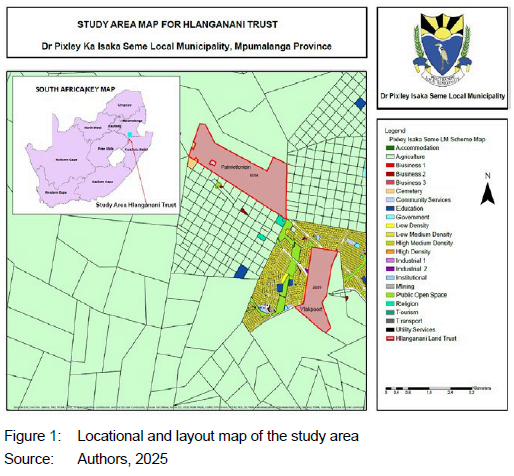
As illustrated in Figure 1, the study area is located in Daggakraal, a town in the Dr Pixley Ka Isaka Seme Local Municipality located within the Gert Sibande District Municipality in Mpumalanga province, South Africa. The municipality comprises 16% of the Gert Sibande District's land area, with Volksrust as its administrative centre. According to the 2022 Community Survey population estimates, the population of Dr Pixley Ka Isaka Seme Local Municipality stands at 115,304, with an increase of 32,069 persons from the 2011 census, amounting to an annual population growth rate of 3.2% per annum (2011-2022) (DPKISLM, 2024). The breakdown reveals the youth population (0-34 years) as 62.6%, while the elderly population (60+ years) accounts for 9.9% of the municipality's population.
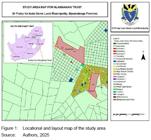
Daggakraal is located in an area characterised by rural communities, agricultural endeavours, and hardly any urban development. The Dr Pixley Ka Isaka Seme Local Municipality Integrated Development Plan (IDP) 2024-2027 indicates that the municipality includes many small towns and rural villages, with Daggakraal designated as a secondary node or rural community (DPKISLM, 2024). The Hlanganani Trust lands are situated in Daggakraal, spanning two noncontiguous areas, as illustrated in Figure 1. The first being Portion 28 of the farm Vlakpoort No. 89-HS, measuring 191 hectares, and the remaining extent of Portion 1 of the farm Palmietfontein No. 64-HS, measuring 379 hectares - giving a combined portion of 570 hectares. Both land parcels are registered in the name of the Landless People of Daggakraal Hlanganani Trust.
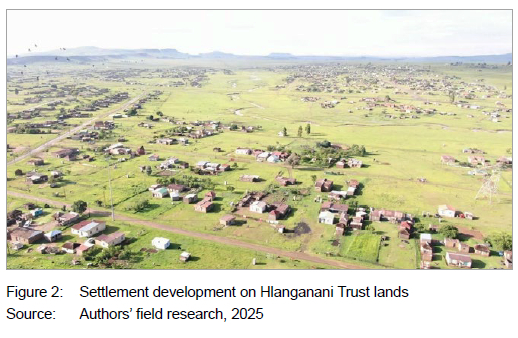
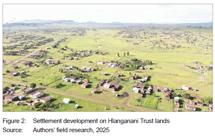
The primary region of settlement development is located in the north-western sections of the main node of the Hlanganani Trust lands, as shown in Figure 2, with informal settlement development also evident.
4. RESEARCH METHODOLOGY
4.1 Research design
The case study research design was employed in this study, using a qualitative research approach to examine municipal responses to informal settlement development on the Hlanganani Land Trust lands. This research design was chosen for its flexibility in capturing the perceptions and experiences of participants regarding governance in these areas. Qualitative methods, including observations, focus group discussions, and in-depth interviews, were used to gather primary data (Tumen Akyildiz & Ahmed, 2021). Interviews provided valuable insights into the historical context of the Hlanganani Trust and its interactions with municipal planning structures, existing policy and legal frameworks, as well as future recommendations from participants. Relevant documents, including the Trust Property Control Act (TPCA), No. 57 of 1988, and the Communal Property Associations Act, No. 28 of 1996 that guide the governance of municipal and land trust administration, were also reviewed. Participatory methods such as community mapping were used to document local knowledge and priorities. Thematic data analysis was employed to analyse the data (Byrne, 2022). The results revealed four key themes, namely land Trust administration, tenure security, participatory planning, and just transitions that frame the understanding of the nexus between development planning and the Hlanganani Trust. These themes formed the basis for proposing a framework that transforms planning practice, by integrating in-situ upgrading and tenure recognition with substantial community participation.
4.2 Sampling and participants
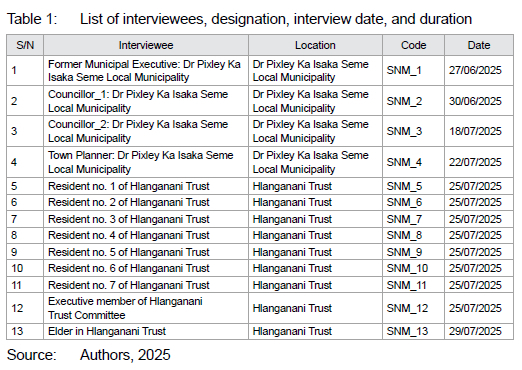
The study did not have a defined population. Instead, it targeted individuals and institutions with experiential (professional and lived) understanding of informal settlement dynamics on the Hlanganani Trust land and municipal actions in Dr Pixley Ka Isaka Seme Local Municipality. As qualitative inquiry seeks depth and variance rather than statistical representativeness, the study population was characterised conceptually (by role and closeness to choices and lived realities) rather than enumeratively (by a predetermined sample frame). This informed the choice of the purposive sampling technique for the study, which, according to Etikan, Musa and Alkassim (2016), relies on the researcher's judgement to recruit research participants optimally positioned to illuminate the subject of the investigation and whose roles and experiences correspond with the study's objectives. As such, the sample frame considered five stakeholder groups, covering policy, politics, technical planning, community governance, and daily life, and was purposefully selected. These, as highlighted in Table 1, comprised: Senior municipal officials (present or past), elected ward councillors representing Daggakraal/Sinqobile constituencies, municipal officials involved in planning, land administration and service delivery, Hlanganani Trust leadership (with specific preference for leadership personnel involved in land governance), and adult residents aged 18+ years residing on Hlanganani Trust land for 12+ months.
4.3 Data collection
The study was conducted in line with the ethical procedure of the University of Johannesburg's Faculty of Engineering and the Built Environment Ethics and Plagiarism Committee (FEPC). Ethics approval was granted after the examination of the research instruments and the institutional permission letters. Field research was conducted at the case study locations between June and July 2025. Interview guides were developed to cover four themes, namely land Trust administration, tenure security, participatory planning, and the just transitions. Due to identifiability risks, the respondents' designation was de-identified through the generalisation of job titles (e.g., 'former senior municipal executive' rather than specific office). Participation was voluntary, and informed consent was obtained before each interview. Codes were assigned to each respondent (SNM_#), used consistently across quotations, and consent forms were stored separately from data in a digitally secured device accessible to only the researchers. After negotiating access through municipal offices and community gatekeepers, interviews were planned in neutral sites in Daggakraal/Sinqobile or at municipal offices to ensure comfort and safety.
4.4 Thematic analysis
Qualitative data from semi-structured interviews and focus-group discussions were audio-recorded and transcribed verbatim. Analysis followed a reflective, inductive thematic approach informed by Braun and Clarke (2006) and Byrne (2022) and carried out manually to ensure close engagement with participants' words. The analytic process progressed through seven integrated stages:
1. Familiarisation. Transcripts were read repeatedly (minimum two full reads) while listening to recordings, as needed. During these readings, researchers annotated manuscripts, wrote initial analytic memos, and noted areas of non-coherence or points requiring clarification. Output: annotated transcripts and memos.
2. Open (inductive) coding. Using a line-by-line, inductive approach, researchers applied descriptive and interpretive codes to relevant units of text (phrases, sentences, short paragraphs). Multiple codes were allowed per unit, where appropriate. Coding was performed manually to preserve contextual nuance (examples of early codes included 'tenure uncertainty', 'lack of water services', and 'trust governance issues'). Output: initial code list.
3. Codebook development and negotiation. Codes were consolidated into a living codebook containing names, operational definitions, inclusion/exclusion criteria, and exemplar quotes. A subsample of transcripts was coded independently by more than one researcher and then compared; discrepancies were discussed until a negotiated agreement was reached. The codebook was versioned and updated (e.g., v1 → v2) with reconciliation notes recorded. Output: versioned codebook (v1 & v2) and reconciliation notes.
4. Axial grouping and mapping linkages. Related codes were clustered into higher order groups according to conceptual similarity and observed cooccurrence (for example, codes about upgrading, tenure equivalency, and co-production were clustered together). Linkages between clusters were mapped to explore relationships, antecedents, and consequences. Output: preliminary thematic map.
5. Theme development. Clusters were elevated into candidate themes, by assessing their prevalence across the dataset and their explanatory power with respect to the study's guiding framework. Candidate themes were named and provisionally defined; researchers remained open to novel themes emerging from the data. For instance, codes such as 'gender inclusion' and 'local power dynamics' were incorporated under the broader theme of 'participatory planning', with sub-discussions focused on gender and power imbalances. Output: candidate themes (names + definitions).
6. Theme review and refinement. Candidate themes were tested for internal coherence, distinctiveness from other themes, and fit with the dataset. Themes were merged, split, or re-labelled as required; negative or deviant cases were deliberately sought and used to refine theme boundaries and strengthen interpretive claims. Theme boundaries were agreed by consensus to mitigate dominance of any single researcher's perspective. Output: final thematic map (themes and clear boundaries).
7. Definition, analytic narrative and reporting. Final themes were given concise analytic descriptions and linked to the theoretical framework. For each theme, short analytic narratives were written and exemplar quotations selected to illustrate central claims; frequency cues and relevant contextual information were reported, where useful. Findings were triangulated across interviews and focus groups to highlight convergences and divergences. Output: thematic narratives and evidence quotes.
To ensure rigour, transparency and ethical soundness, the following safeguards were applied throughout the analytic process:
• Transparency. The codebook was versioned and an audit trail (memos, reconciliation notes, mapping files) was maintained.
• Credibility. Independent coding of a sub-sample and negotiated agreement enhanced credibility; negative cases were actively sought and reported.
• Reflexivity. Positionality notes and analytic memos were kept to surface researcher assumptions and how these may have influenced interpretation.
• Confidentiality. Participants were assigned role-based pseudonyms and transcripts were de-identified prior to coding.
This staged, consensus-driven process produced a set of robust, well-defined themes, aligned with the study's theoretical framework (land trust administration, tenure security, participatory and just transitions), while remaining sensitive to emergent issues (e.g., gender, local power dynamics).
5. FINDINGS AND DISCUSSION
5.1 Origin and legal status
The Hlanganani Trust area is rooted in land purchased for Black associations in the early 20th century, famously Pixley ka Isaka Seme's purchases around Daggakraal/Kwa-Ngema/Driefontein before the 1913 Natives Land Act curtailed Black land acquisition. The Hlanganani Land Trust has a unique history in comparison to Faboye et al.'s (2024) findings on other tribal Trusts and customary administered lands in South Africa, such as the Ingonyama Trust lands of KwaZulu-Natal province, which administers approximately ±2.8 million hectares under a single trustee. Following the institution of democratic governance upon the abolishment of apartheid rule in South Africa, redistributive and restorative land justice were initiated. The Communal Property Associations Act, enacted on 22 May 1996, created Communal Property Associations (CPAs) as legal bodies that allow communities to collectively buy, own, and administer property under a formal constitution (RSA, 1996). This facilitated opportunities for disadvantaged groups to develop suitable legal structures to collectively acquire, keep, and administer property. The Hlanganani Trust is, however, a private institution and does not follow a CPA constitution. The legal framework for its institution comes under the purview of the Trust Property Control Act (TPCA), 57 of 1988. This Act regulates the administration of Trust assets, including land, under the supervision of the Master of the High Court in South Africa. It segregates Trust property from the personal estates of trustees, mandates accurate identification and accounting of Trust assets, and authorises the Master of the High Court to oversee trustees and request documentation (RSA, 1988).
Designated as 'black spot areas,' post-apartheid land reform in Daggakraal through the institution of the Hlanganani Trust emerged as part of efforts to address historical dispossession and secure land for Black farmers and tenants, building on earlier initiatives such as the African Native Farmers Association of Africa (ANFAA) led by Pixley Ka Seme. According to Respondent SNM_1, "In 1997, the Hlanganani Trust, with assistance from the Department of Agriculture, Land Reform and Rural Development, purchased seven farms to resettle approximately 300 households, primarily from Daggakraal No. 3. The goal was to resettle about 500 households in the Sinqobile B/ Hlanganani area, adjacent to the larger Daggakraal region." The resettled areas, including those managed by the Hlanganani Trust, were described as a 'greenfield' (undeveloped land) in 1997, and lacked basic infrastructure. "Full occupation was achieved by 2003, but the absence of initial infrastructure posed administrative challenges for the Trust in coordinating development and contributes to [a reason for] the development of informal settlements in the area" (Respondent SNM_3).
5.1.1 Governance structure and operations
Respondent SNM_2 explained that the Hlanganani Trust operates as a community-driven entity, managing land acquisition and resettlement processes. In the same vein, Respondent SNM_1 expounded further that the Trust was formed by a Landless Committee tasked with liaising with the government, specifically the Department of Agriculture, Land Reform and Rural Development (DALRRD), to acquire adjacent land for resettlement. It is led by a chairperson from the Twala family, who indicated a leadership role in the administration of the Trust. The Trust holds legal title on behalf of the community. It receives planning and services directly from the municipality under the Trust Property Control Act regime. Municipal planning instruments acknowledge the unique Trust-land history of the Daggakraal/Sinqobile area, associated with early 20th-century African land acquisitions (Pixley ka Isaka Seme), which now directly interact with the municipal government instead of a CPA or traditional authority framework, rendering TPCA compliance essential to standard planning administration. By 2006, the Hlanganani Trust had received the title deed for the acquired land, although not all resettled households had individual copies of the legal titles by 2007. This suggests a centralised administration of land ownership, with the Trust acting as the primary titleholder while managing the distribution of tenure rights.
The Hlanganani Trust's concept exemplifies Africa's extensive historical development and hybridisation of Trust-land administration. In the colonial period, governments frequently created "native reserves" or Trust lands -territories held by the state in Trust for indigenous populations - to enforce Western property rules on community systems. These programmes aimed to replace customary tenure with individual freehold titles, profoundly transforming local land governance, as noted by Boone (2007) and Lund and Boone (2013).
5.2 Tenure security
At the initiation of the Trust, there was a synergy with the DALRRD to secure funding and negotiate land purchases, notably from a farmer named Mr Johann Frederick Kennard, who was willing to sell land as early as the 1990s (Respondent SNM_2). According to Respondent SNM_3, while the Trust secured title deeds by 2006, the process of transferring individual titles to resettled households was slow, with some still waiting to date. This delay points to administrative bottlenecks in formalising tenure in the area. Daggakraal has a complex governance system, with freehold titles coexisting alongside an unresolved chieftaincy system and the Committee of Twelve, a community authority established under the apartheid-era Transvaal Provincial Administration. According to Respondent SNM_3, the Hlanganani Trust had to navigate this intricate landscape, potentially complicating its administrative role. The Trust's role in securing land and title deeds demonstrates its effectiveness in mobilising community efforts and government support (Respondent SNM_4).
The Hlanganani Trust, which covers a predominantly rural domain, starkly contrasts with Bassett's (2005) and Bassett and Jacobs' (1997) examination of informal settlement upgrading in the Voi community, Kenya. The proximity of informal settlements to metropolitan regions in the examined cases led to land speculation, where access to title deeds encouraged residents of the informal settlements to engage in speculative sales of land rights. Instead, tiered tenuring can be inferred as exemplary from Namibia's Flexible Land Tenure Act 2012 as 'starter titles' and 'land hold titles', as emanating from Christensen (2024) and Weber & Mendelsohn (2017).
Currently, Hlanganani Trust residents are issued a Permission to Occupy (PTO) document by the Trust, which enables them to invest in housing improvements and provides protection from evictions. However, there is a perceived lack of trust in the full legality of the document when equated with a government-issued title deed (from the State Deed Registries), as Respondent SNM_5 stresses that "[w]e want title deeds to feel safe, but the process is too expensive and slow. Some of us have lived here for years and still have no papers."
The Namibian example of flexible land tenure may be a viable solution to the tenure delays experienced by residents of the Hlanganani Trust, as it involves the codification of the legality of the PTO document. A replication from the Namibian sample will acknowledge the PTO as a registerable and legally enforceable land document, thereby offering a pathway to alleviate tenure delays in the Hlanganani Trust (Christensen, 2024; Weber & Mendelsohn, 2017; Delgado et al., 2020).
5.3 Participatory planning
Notwithstanding the Hlanganani Trust's grassroots origins, the community's current planning and governance systems exhibit considerable participation deficiencies. The Trust, established through a grassroots initiative of dispossessed tenant farmers, initially represented community-driven planning. Nonetheless, its internal decision-making has been criticised over time for lacking inclusivity. Significantly, gender equity has been overlooked. Women's interests were not actively incorporated into the land reform and resettlement process, illustrating persistent gender biases in South Africa's alternative land governance systems. Sentiments against the Trust's management portrayed it as controlled by a select few. Community members expressed concerns that the Trust's land allocation had become 'exclusionary', potentially involving favouritism or illicit payments that favoured insiders. They frequently remain 'uninformed about the decision-making processes' concerning their land. Such perceptions indicate a deficiency in transparent and participatory governance within the Trust's operations, thereby undermining its credibility in the eyes of certain beneficiaries.
There were also expressed resentments with the municipality's participatory framework, which was argued to frequently exclude residents' input. The residents feel that the municipal plans are disconnected from their lived realities, prioritising formalisation over immediate needs such as basic services (water, sanitation, electricity). Snippets of the residents' misgivings at community participation are quoted below.
"The municipality promises development, but we still have no clean water or proper roads. They plan without asking us what we need." (Respondent SNM_6). "The Trust controls the land, but we don't know how decisions are made. We're afraid of losing our homes if they sell to outsiders." (Respondent SNM_11). "They hold meetings, but it's always the same people talking. Our voices don't matter, and nothing changes." (Respondent SNM_8). "We hear about 'better cities', but for whom? We need jobs, schools, and clinics here, not just fancy projects somewhere else." (Respondent SNM_7). "There are barriers to participation, such as a lack of information or exclusion of marginalised groups like women or youth in the process. The municipality holds meetings through IDP consultations, but it's always the same people talking, and our voices don't matter, and nothing changes every year." (Respondent SNM_10). "We demand greater involvement in planning processes, to express our knowledge of local conditions, because those people do not know our community like we do." (Respondent SNM_7).
The above expressed deficiencies in the participation process reflect the relationship between the Hlanganani Trust and residents, and reflect trends identified by Watson (2009). Traditional planning in the Global South has frequently regarded informal settlements as aberrations to be eradicated or overlooked by government agencies. This technocratic, 'we know best' mentality often marginalises local knowledge and priorities, thereby sustaining marginalisation. Urban theorists advocate for strategies that enhance and formalise community participation in planning, which Watson (2014b: 63) calls "empowered participatory governance". Examples cited by Fox et al. (2023) and Archer (2012) illustrate that empowering residents in decision-making yields contextually appropriate enhancements and fosters mutual confidence between communities and the government. This cautionary observation is particularly relevant in Hlanganani, where the current notion of 'participation' is perceived as a mere formality lacking substance. Addressing this necessitates institutional reforms, including the establishment of platforms where a diverse array of residents (including women, youth, and other marginalised groups) can influence decision-making, and ensuring that community representatives in the Trust or municipal committees are accountable and responsive to their constituents.
5.4 Just urban transition
As examined in this study, the case of the Hlanganani Trust illustrates why planning must be equitable and inclusive, in line with the theory of just urban transitions. According to Hughes and Hoffmann (2020), a 'just' urban transition enhances the rights and opportunities of vulnerable people rather than marginalising them. This includes procedural justice (equitable, inclusive decision-making) and distributive justice (equitable outcomes and benefits). In practice, this implies that the Hlanganani Trust residents should be considered rights-bearing citizens who can shape their settlement's destiny and benefit from urban development. Lefebvre's 'right to the city' and Harvey's (2015), and Fainstein's (2014) 'just city' discourses emphasise the need for marginalised urban populations to have a say in urban governance and a fair share of urban benefits. Realising these principles in Hlanganani would mean that the informal community's claims to land, services, and inclusion are recognised as valid rights in planning, not barriers to modernisation.
The deep barrier between formal and informal rationalities must be bridged, in order to achieve such aspirations in rural and peri-urban informal planning. Urban theorists argue that informality is an 'organising logic' of urbanisation, affected by state policies and economic factors (Roy, 2005). Watson (2003) also describes "conflicting rationalities", where planners' technocratic, rules-based reasoning clashes with informal settlers' survivalist logic. Conflict often leads to misinterpretation and unfairness, such as a planner's map labelling a dense, informal neighbourhood a 'slum' to be cleared, while its residents regard it as an essential home and community. This conflict is evident in Hlanganani, where formal authorities focus on surveys, layouts, and title deeds, while residents prioritise immediate needs (water, roads, secure tenure) and the right to stay on their land. Inertia and tension, stemming from limited service delivery and slow formalisation, have frustrated both sides. These perspectives must be reconciled for a just urban transition framework. Scholars stress the need for hybrid governance models that combine customary or community institutions with formal urban planning to operationalise this transition (Watson, 2009; Huchzermeyer, 2011; Mitlin & Bartlett, 2018). This may involve including the Hlanganani Trust in municipal planning and service delivery rather than marginalising it. The Trust's local legitimacy and knowledge can be combined with the municipality's technical and financial resources to create a more contextually suitable development approach. This approach aligns with literary recommendations for flexible, people-centred, and rights-based planning, as opposed to exclusionary, top-down planning. Only by embracing such reforms can Hlanganani's informal reality and the formal urban system be bridged fairly, allowing the community to benefit from urban upgrading without losing its social fabric and agency.
6. RECOMMENDATIONS FOR POLICY AND PRACTICE
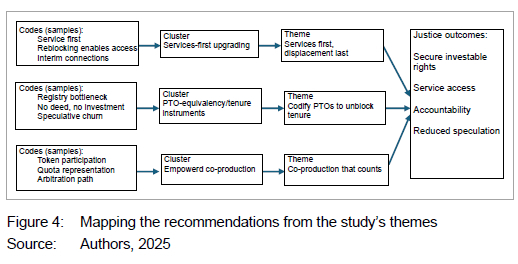
Drawing from the study's thematic findings (summarised in Figure 4), three interdependent policy and practice interventions such as in-situ upgrading, alternative tenure recognition, and deep community participation are recommended to support a just, inclusive transition on Trust lands such as Hlanganani.
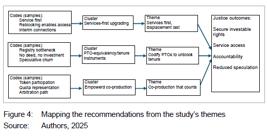
In-situ upgrading should be adopted as the primary planning response, emphasising the provision of essential services, basic infrastructure, and incremental improvements without displacing residents. Enhancing living conditions on site preserves existing social networks, protects livelihoods, and reduces the social and financial costs associated with relocation. This approach aligns with community preferences expressed in the study and supports continuity, while enabling gradual formalisation. Tenure insecurity remains a central challenge on Trust lands. To address this, the study recommends recognising and formalising locally issued land rights. This may involve accelerating the transfer of title deeds, where appropriate, or legally elevating Trust-issued Permissions to Occupy (PTOs) to hold the same status and protection as state-administered tenure instruments. Establishing secure, long-term, and transferable use rights will give residents the confidence to invest in their homes and support progressive upgrading efforts.
Effective planning and implementation require community participation that goes beyond consultation. Decision-making should be co-produced through community forums, joint planning committees, or representative governance structures that give Hlanganani residents real influence over development priorities and processes. Drawing on local knowledge strengthens the relevance of interventions and enhances collective ownership, trust, and accountability.
As illustrated in Figure 4, these recommendations are mutually reinforcing. Inclusive participation ensures that physical and service upgrades are contextually appropriate and widely supported. Secure tenure encourages residents to sustain and build on upgrading investments. In-situ improvements, in turn, provide tangible benefits that build trust in local governance and reinforce collaborative relationships. Together, the three pillars offer a coherent framework for rights-based, community-driven development on Trust lands, contributing to equitable and resilient urban transitions in South Africa.
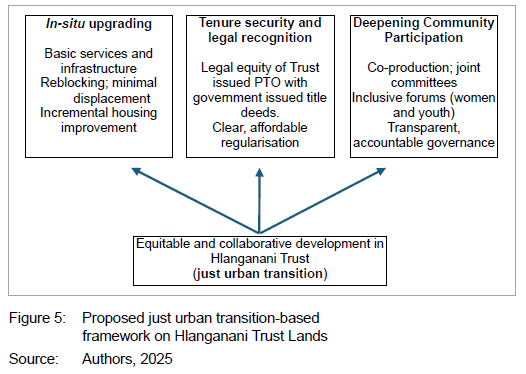
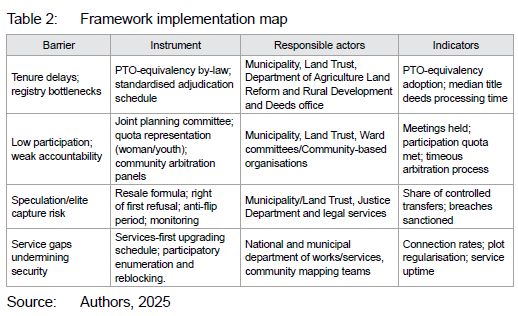
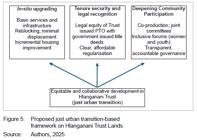
Figure 5 illustrates the proposed framework for a just urban transition on Hlanganani Trust lands, integrating in-situ upgrading, tenure security, and community participation. The diagram illustrates how the three pillars support equitable and collaborative development. This framework shows how peri-urban planning can improve social justice on South Africa's Trust lands, by integrating physical improvements with legal empowerment and inclusive co-governance. Consequently, Table 2 derives an implementation for the framework.
7. CONCLUSION
This study makes three key contributions to peri-urban planning and Trust-land governance. First, it demonstrates that TPCA-governed Trust lands - distinct from communal tenure and municipal freehold - create a hybrid governance environment that remains underexplored in South African planning scholarship. Secondly, it identifies institutional frictions between municipal planning systems and community-based Trust administrations, showing how 'conflicting rationalities' (Watson, 2003) persist in peri-urban contexts. Thirdly, it proposes an integrated pathway for bridging informal and formal planning systems through the Just Urban Transition Framework, which combines in-situ upgrading, PTO-equivalency tenure reform, and inclusive co-production to overcome administrative and legal barriers.
Despite progressive service delivery goals, fragmented governance and slow regularisation processes sustain exclusion. The Hlanganani case illustrates that Trust lands are policy frontiers, where statutory planning actors must collaborate with community institutions under the Trust Property Control Act (1988) and, where relevant, the Communal Property Associations Act (1996).
The study acknowledges limitations. Its focus on Hlanganani constrains generalisability, and the short data-collection period (June-July 2025) may have excluded seasonal migrants. Future research should adopt longer timelines and assess longitudinal impacts of tenure formalisation and upgrading initiatives.
Findings emphasise persistent tenure insecurity and service gaps, driven by costly and protracted regularisation and weak participation. The proposed framework offers three interdependent pillars:
• In-situ upgrading to deliver essential services while preserving social networks.
• Tenure recognition to accelerate regularisation and validate Trust-issued PTOs.
• Inclusive co-production through accountable, participatory governance structures.
Together, these pillars integrate procedural justice (decision-making processes and knowledge use) with distributive justice (equitable benefits and timely delivery), enabling a rights-based approach to rural and peri-urban planning. The framework is relevant to other Global South contexts, where traditional or Trust tenure intersects with statutory systems. Future studies should explore financial feasibility and longterm outcomes for tenure security, livelihoods, and service delivery.
Ultimately, bridging informal and formal systems is not merely a technical challenge but a constitutional commitment to urban justice. Trust lands such as Hlanganani can transition from zones of marginalisation to equitable development models, if planning practices embrace this framework.
REFERENCES
2. LITERATURE REVIEW
-
ABOULNAGA, M.M., BADRAN, M.F. & BARAKAT, M.M. 2021. Global informal settlements and urban slums in cities and the coverage. In: Resilience of Informal areas In megacltles -Magnitude, challenges, and policies. Cham: Springer International Publishing, pp. 1-51. https://doi.org/10.1007/978-3-030-87794-1_1
» https://doi.org/10.1007/978-3-030-87794-1_1 -
AHENE, R.A.N. 2020. Customary tenure trusteeships and land governance reforms: A necessary convergence. African Journal on Land Policy and Geospatial Sciences 3(4), pp. 1-12. https://doi.org/10.48346/IMIST.PRSM/ajlp-gs.v3i3.20126
» https://doi.org/10.48346/IMIST.PRSM/ajlp-gs.v3i3.20126 -
AKAATEBA, M.A. 2019. The politics of customary land rights transformation in peri-urban Ghana: Powers of exclusion in the era of land commodiflcation. Land Use Policy, 88, article 104197. https://doi.org/10.1016/j.landusepol.2019.104197
» https://doi.org/10.1016/j.landusepol.2019.104197 -
AKAATEBA, M.A., AKANBANG, B.A.A. & KORAH, P.I. 2025. Planning public green spaces within customary land tenure contexts: Reflections on the limits to collaborative planning in Tamale, Ghana. Journal of Urban Affairs, 47(3), pp. 856-879. https://doi.org/10.1080/07352166.2023.2198133
» https://doi.org/10.1080/07352166.2023.2198133 -
ALDEN WILY, L. 2018. Collective land ownership in the 21st century: Overview of global trends. Land, 7(2), article 68. https://doi.org/10.3390/land7020068
» https://doi.org/10.3390/land7020068 -
AMEGAH, A.K. 2021. Slum decay in sub-Saharan Africa. Environmental Epidemiology 5, article 158. https://doi.org/10.1097/EE9.0000000000000158
» https://doi.org/10.1097/EE9.0000000000000158 -
ANGUELOVSKI, I., SHI, L., CHU, E., GALLAGHER, D., GOH, K., et al. 2016. Equity impacts of urban land use planning for climate adaptation. Journal of Planning and Education Research 36(3), pp. 333-348. https://doi.org/10.1177/0739456X16645166
» https://doi.org/10.1177/0739456X16645166 -
ARCHER, D. 2012. Baan Mankong participatory slum upgrading in Bangkok, Thailand: Community perceptions of outcomes and security of tenure. Habitat International, 36(1), pp. 178-184. https://doi.org/10.1016/j.habitatint.2011.08.006
» https://doi.org/10.1016/j.habitatint.2011.08.006 -
BASILE, P. & EHLENZ, M.M. 2020. Examining responses to informality in the Global South: A framework for community land trusts and informal settlements. Habitat International, 96(1), article102108. https://doi.org/10.1016/j.habitatint.2019.102108
» https://doi.org/10.1016/j.habitatint.2019.102108 -
BASSETT, E.M. 2005. Tinkering with tenure: The community land trust experiment in Voi, Kenya. Habitat International, 29(3), pp. 375-398. https://doi.org/10.1016/j.habitatint.2003.12.001
» https://doi.org/10.1016/j.habitatint.2003.12.001 -
BASSETT, E.M. & JACOBS, H.M. 1997. Community-based tenure reform in urban Africa: The community land trust experiment in Voi, Kenya. Land Use Policy, 14(3), pp. 215-229. https://doi.org/10.1016/S0264-8377(97)00003-3
» https://doi.org/10.1016/S0264-8377(97)00003-3 -
BEAUMONT, J. & NICHOLLS, W. 2008. Plural governance, participation and democracy in cities. International Journal of Urban and Regional Research, 32(1), pp. 87-94. https://doi.org/10.1111/j.1468-2427.2008.00779.x
» https://doi.org/10.1111/j.1468-2427.2008.00779.x -
BOONE, C. 2007. Property and constitutional order: Land tenure reform and the future of the African state. African Affairs, 106(425), pp. 557-586. https://doi.org/10.1093/afraf/adm059
» https://doi.org/10.1093/afraf/adm059 -
BOONE, C. 2015. Land tenure regimes and state structure in rural Africa: Implications for forms of resistance to large-scale land acquisitions by outsiders. Journal of Contemporary African Studies, 33(2), pp. 171-190. https://doi.org/10.1080/02589001.2015.1065576
» https://doi.org/10.1080/02589001.2015.1065576 -
BOONE, C. 2019. Legal empowerment of the poor through property rights reform: Tensions and trade-offs of land registration and titling in sub-Saharan Africa. The Journal of Development Studies, 55(3), pp. 384-400. https://doi.org/10.1080/00220388.2018.1451633
» https://doi.org/10.1080/00220388.2018.1451633 -
BRAUN, V. & CLARKE, V. 2006. Using thematic analysis in psychology. Qualitative Research in Psychology, 3(2), pp.77-101. https://doi.org/10.1191/1478088706qp063oa
» https://doi.org/10.1191/1478088706qp063oa -
BYRNE, D. 2022. A worked example of Braun and Clarke's approach to reflexive thematic analysis. Quality and Quantity, 56(3), pp. 1391-1412. https://doi.org/10.1007/s11135-021-01182-y
» https://doi.org/10.1007/s11135-021-01182-y -
CHIMHOWU, A.O., HULME, D. & MUNRO, L.T. 2019. The 'New' national development planning and global development goals: Processes and partnerships. World Development, 120, pp. 76-89. https://doi.org/10.1016/j.worlddev.2019.03.013
» https://doi.org/10.1016/j.worlddev.2019.03.013 -
CHRISTENSEN, Λ. 2024. Urban land tenure security in Namibia: A comparative perspective. Aalborg University. https://doi.org/10.54337/aau752404668
» https://doi.org/10.54337/aau752404668 -
COBBINAH, P.B. & FINN, B.M. 2023. Planning and climate change in African cities: Informal urbanisation and 'just' urban transformations. Journal of Planning Literature, 38(3), pp. 361-379. https://doi.org/10.1177/08854122221128762
» https://doi.org/10.1177/08854122221128762 - COTULA, L., TOULMIN, C. & HESSE, C. 2004. Land tenure and administration in Africa: Lessons of experience and emerging Issues. London: International Institute for Environment and Development.
-
DELGADO, G., MULLER, A., MABAKENG, R. & NAMUPALA, M. 2020. Co-producing land for housing through informal settlement upgrading: Lessons from a Namibian municipality. Environment and Urbanisation, 32(1), pp.175-194. https://doi.org/10.1177/0956247820903981
» https://doi.org/10.1177/0956247820903981 -
DHS (DEPARTMENT OF HUMAN SETTLEMENTS). 2022. GLOBAL ACTION PLAN: Accelerating for transforming informal settlements and slums by 2030. dhs.gov.za [Accessed 15 August 2025].
» dhs.gov.za -
DIETERLE, C. 2022. Global governance meets local land tenure: International codes of conduct for responsible land investments in Uganda. The Journal of Development Studies, 58(3), pp. 582-598. https://doi.org/10.1080/00220388.2021.1983165
» https://doi.org/10.1080/00220388.2021.1983165 - DPKISLM (DR PIXLEY KA ISAKA SEME LOCAL MUNICIPALITY). 2024. Amended Integrated Development Plan (IDP) 2024-2027: IDP 2024/25. Volksrust.
- DURAND-LASSERVE, A. 2006. Informal settlements and the millennium development goals: Global policy debates on property ownership and security of tenure. Global Urban Development, 2(1), pp. 1-15.
- EHEBRECHT, D. 2014. The challenge of informal settlement upgrading: Breaking new ground in Hangberg, Cape Town? Universitätsverlag Postdam.
-
ETIKAN, I., MUSA, S.A. & ALKASSIM, R.S. 2016. Comparison of convenience sampling and purposive sampling. American Journal of Theoretical and Applied Statistics, 5(1), pp.1-4. https://doi.org/10.11648/j.ajtas.20160501.11
» https://doi.org/10.11648/j.ajtas.20160501.11 -
FABOYE, S., GUMBO, T. & SEBOLA, J. 2024. Polycentric governance: Evaluating the relevance of traditional authorities in good governance in South Africa. Town and Regional Planning, 85, pp. 1-18. https://doi.org/10.38140/trp.v85i.8425
» https://doi.org/10.38140/trp.v85i.8425 -
FAINSTEIN, S.S. 2014. The just city. International Journal of Urban Sciences, 18(1), pp. 1-18. https://doi.org/10.1080/12265934.2013.834643
» https://doi.org/10.1080/12265934.2013.834643 - FIEUW, W. 2015. Deep rooted knowledge? Assessing the lack of community participation in UISP projects. In: Pursuit of responsible and responsive local governance: Perspectives from civil society on local governance in South Africa. Good Governance Learning Network, Cape Town, pp. 59-73.
-
FOX, A., ZIERVOGEL, G. & SCHEBA, S. 2023. Strengthening community-based adaptation for urban transformation: Managing flood risk in informal settlements in Cape Town. Local Environment, 28(7), pp. 837-851. https://doi.org/10.1080/13549839.2021.1923000
» https://doi.org/10.1080/13549839.2021.1923000 -
GALUSZKA, J. 2019. What makes urban governance co-productive? Contradictions in the current debate on co-production. Planning Theory, 18(1), pp. 143-160. https://doi.org/10.1177/1473095218780535
» https://doi.org/10.1177/1473095218780535 -
HARVEY, D. 2015. The right to the city. In: LeGates, R.T. (Ed.). The city reader. London: Routledge, pp. 314-322. https://doi.org/10.4324/9781315748504-46
» https://doi.org/10.4324/9781315748504-46 -
HEALEY, P. 1997. Traditions of planning thought. In: Collaborative planning: Shaping places in fragmented societies. London: Macmillan Education UK, pp. 7-30. https://doi.org/10.1007/978-1-349-25538-2_1
» https://doi.org/10.1007/978-1-349-25538-2_1 -
HOME, R. 2021. History and prospects for African land governance: Institutions, technology and 'land rights for all.' Land (Basel), 10(3), article 292. https://doi.org/10.3390/land10030292
» https://doi.org/10.3390/land10030292 -
HOME, R. & KABATA, F. 2018. Turning fish soup back into fish: The wicked problem of African community land rights. Journal of Sustainable Development Law and Policy (The) 9(2), pp. 1-22. https://doi.org/10.4314/jsdlp.v9i2.2
» https://doi.org/10.4314/jsdlp.v9i2.2 - HUCHZERMEYER, M. 2011. Cities with 'slums': From informal settlement eradication to a right to the city in Africa. Cape Town: UCT Press.
-
HUGHES, S. & HOFFMANN, M. 2020. Just urban transitions: Toward a research agenda. WIREs Climate Change, 11(3), article 640. https://doi.org/10.1002/wcc.640
» https://doi.org/10.1002/wcc.640 -
JONES, P. 2017. Formalising the informal: Understanding the position of informal settlements and slums in sustainable urbanisation policies and strategies in Bandung, Indonesia. Sustainability, 9(8), article 1436. https://doi.org/10.3390/su9081436
» https://doi.org/10.3390/su9081436 -
KORAH, P.I., MATTHEWS, T. & TOMERINI, D. 2019. Characterising spatial and temporal patterns of urban evolution in sub-Saharan Africa: The case of Accra, Ghana. Land Use Policy, 87, article 104049. https://doi.org/10.1016/j.landusepol.2019.104049
» https://doi.org/10.1016/j.landusepol.2019.104049 -
LUND, C. & BOONE, C. 2013. Introduction: Land politics In Africa - Constituting authority over territory, property and persons. Africa: Journal of the International African Institute, 83(1), pp. 1-13. https://doi.org/10.1017/S000197201200068X
» https://doi.org/10.1017/S000197201200068X -
MITLIN, D. 2018. Beyond contention: Urban social movements and their multiple approaches to secure transformation. Environment and Urbanisation, 30(2), pp. 557-574. https://doi.org/10.1177/0956247818791012
» https://doi.org/10.1177/0956247818791012 -
MITLIN, D. & BARTLETT, S. 2018. Editorial: Co-production - Key ideas. Environment and Urbanisation, 30(2), pp. 355-366. https://doi.org/10.1177/0956247818791931
» https://doi.org/10.1177/0956247818791931 -
MKUTU, K., MKUTU, T., MARANI, M. & EKITELA, A.L. 2019. New oil developments in a remote area: Environmental justice and participation in Turkana, Kenya. Journal of the Environment and Development, 28(3), pp. 223-252. https://doi.org/10.1177/1070496519857776
» https://doi.org/10.1177/1070496519857776 -
NAPIER, M., BERRISFORD, S., KIHATO, C.W., MCGAFFIN, R. & ROYSTON, L. 2013. Trading places: Accessing land in African cities. Somerset West, South Africa: African Minds. https://doi.org/10.47622/9781920489991
» https://doi.org/10.47622/9781920489991 - NDUKU, M.I. 2017. Securing tenure rights in informal settlement. Strathmore University Law School, Nairobi.
-
NESTI, G. 2018. Co-production for innovation: The urban living lab experience. Policy and Society, 37(3), pp. 310-325. https://doi.org/10.1080/14494035.2017.1374692
» https://doi.org/10.1080/14494035.2017.1374692 - OLADEHINDE, G.J. 2025. Relevance of land tenure security to rural land use planning. Journal of Studies in Social Sciences, 24(2), paper 2267.
-
PAYNE, G. 2020. Options for intervention: Increasing tenure security for community development and urban transformation. In: Van den Broeck, P. et al. (Eds.). Communities, land and social innovation. Cheltenham: Edward Elgar Publishing. https://doi.org/10.4337/9781788973779.00008
» https://doi.org/10.4337/9781788973779.00008 -
RECKIEN, D., CREUTZIG, F., FERNANDEZ, B., LWASA, S., TOVAR-RESTREPO, M., MCEVOY, D. & SATTERTHWAITE, D. 2017. Climate change, equity and the Sustainable Development Goals: An urban perspective. Environment and Urbanisation, 29(1), pp. 159-182. https://doi.org/10.1177/0956247816677778
» https://doi.org/10.1177/0956247816677778 -
RESNICK, D. 2014. Urban governance and service delivery in African cities: The role of politics and policies. Development Policy Review 32(s1). https://doi.org/10.1111/dpr.12066
» https://doi.org/10.1111/dpr.12066 -
ROY, A. 2005. Urban informality: Toward an epistemology of planning. Journal of the American Planning Association, 71(2), pp. 147-158. https://doi.org/10.1080/01944360508976689
» https://doi.org/10.1080/01944360508976689 - RSA (REPUBLIC OF SOUTH AFRICA). 1996. Community Property Associations Act, 1996. Parliament of South Africa, Cape Town: Government printer.
- RSA (REPUBLIC OF SOUTH AFRICA). 1988. Trust Property Control Act, 1988. Parliament of South Africa, Cape Town: Government printer.
-
SIAME, G. & WATSON, V. 2022. Co-production and the issue of urban up-scaling and governance change in the Global South: The case of Uganda. Planning Theory, 21(3), pp. 269-290. https://doi.org/10.1177/14730952221076601
» https://doi.org/10.1177/14730952221076601 -
SOLIMAN, A.M. 2021. Urbanisation and urban informality in the era of globalization. In: Urban informality: Experiences and urban sustainability transitions in Middle East cities. Cham: Springer International Publishing, pp. 85-120. https://doi.org/10.1007/978-3-030-68988-9_3
» https://doi.org/10.1007/978-3-030-68988-9_3 -
TODES, A. & TUROK, I. 2018. Spatial inequalities and policies in South Africa: Place-based or people-centred? Progress in Planning, 123, pp. 1-31. https://doi.org/10.1016/j.progress.2017.03.001
» https://doi.org/10.1016/j.progress.2017.03.001 -
TOULMIN, C. 2009. Securing land and property rights in sub-Saharan Africa: The role of local institutions. Land Use Policy, 26(1), pp. 10-19. https://doi.org/10.1016/j.landusepol.2008.07.006
» https://doi.org/10.1016/j.landusepol.2008.07.006 - TOWETT, G. 2021. Changing oplitical regimes and land politics in post-colonial Kenya. Global Journal of Advanced Research, 8(3), pp. 56-67.
-
TUMEN AKYILDIZ, S. & AHMED, K.H. 2021. An overview of qualitative research and focus group discussion. International Journal of Academic Research in Education, 7(1), pp. 1-15. https://doi.org/10.17985/ijare.866762
» https://doi.org/10.17985/ijare.866762 -
TUROK, I. 2014. Linking urbanisation and development in Africa's economic revival. In: Parnell, S. (Ed.). Africa's urban revolution. London: Zed Books, pp. 60-81. https://doi.org/10.5040/9781350218246.ch-004
» https://doi.org/10.5040/9781350218246.ch-004 -
TUROK, I. 2016. Getting urbanisation to work in Africa: The role of the urban land-infrastructure-finance nexus. Area Development and Policy, 1(1), pp. 30-47. https://doi.org/10.1080/23792949.2016.1166444
» https://doi.org/10.1080/23792949.2016.1166444 -
TUROK, I., SCHEBA, A. & VISAGIE, J. 2023. Rethinking urbanisation and economic development: A synopsis. Environment and Urbanisation, 35(2), pp. 297-309. https://doi.org/10.1177/09562478231193829
» https://doi.org/10.1177/09562478231193829 -
UITERMARK, J. & NICHOLLS, W. 2017. Planning for social justice: Strategies, dilemmas, tradeoffs. Planning Theory, 16(1), pp. 32-50. https://doi.org/10.1177/1473095215599027
» https://doi.org/10.1177/1473095215599027 - ULEME, C.M. 2021. Slum upgrading and the rental housing sector: A study of landlord-tenant relationship in a Lagos (Nigeria) slum. University of Northampton.
- UN-HABITAT. 2008. Secure land rights for all. Nairobi: UN-HABITAT.
- UN-HABITAT. 2024. Africa urban forum: Background document. Nairobi: UN-HABITAT.
-
WATSON, V. 2003. Conflicting rationalities: Implications for planning theory and ethics. Planning Theory & Practice, 4(4), pp. 395-407. https://doi.org/10.1080/1464935032000146318
» https://doi.org/10.1080/1464935032000146318 -
WATSON, V. 2009. "The planned city sweeps the poor away...": Urban planning and 21st-century urbanisation. Progress in Planning, 72(3), pp. 151-193. https://doi.org/10.1016/j.progress.2009.06.002
» https://doi.org/10.1016/j.progress.2009.06.002 -
WATSON, V. 2014a. The case for a southern perspective in planning theory. International Journal of E-Planning Research, 3(1), pp. 23-37. https://doi.org/10.4018/ijepr.2014010103
» https://doi.org/10.4018/ijepr.2014010103 -
WATSON, V. 2014b. Co-production and collaboration in planning - The difference. Planning Theory and Practice, 15(1), pp. 62-76. https://doi.org/10.1080/14649357.2013.866266
» https://doi.org/10.1080/14649357.2013.866266 - WEBER, B. & MENDELSOHN, J. 2017. Informal settlements in Namibia: Their nature and growth (No. 1). Windhoek: Development Workshop.
Peer reviewed and revised: November 2025
Published: December 2025