Towards sustainable urban futures: A process for placemaking in South African townships
Abstract
While placemaking has gained global traction, South Africa lacks a locally adapted process to guide planners, policymakers, and communities in harnessing its potential - particularly in historically marginalised township settings. Amidst rapid urbanisation and growing socio-spatial disparities, there is a pressing need for innovative and context-sensitive development approaches. This article explores the potential of placemaking as a strategy for sustainable urban development and community empowerment within South African townships. Adopting a case study approach, the study focuses on Marabastad in Kroonstad (Free State province), a township emblematic of the broader structural and spatial challenges faced by the country. The theoretical foundation draws from placemaking literature in both the Global North and South, mapping a shift from static, product-oriented understandings to more dynamic, iterative, and participatory processes. This shift informs the exploration of placemaking's four core dimensions, namely physical, social, economic, and psychological, prevalent in South African contexts. Empirical data were collected through qualitative methods, including interviews, observations, and participatory approaches, and analysed thematically. The findings reveal opportunities for community engagement, economic activation, cultural recognition, and spatial transformation. Drawing from these insights, the article proposes a five-phase placemaking process specifically adapted to South African townships: community orientation and grounding; contextual analysis and exploration; identification of placemaking interventions; strategic planning and design, as well as implementation, maintenance and evolution. This process emphasises active community participation, local knowledge, and skills development, offering a scalable and adaptable pathway for co-producing vibrant, inclusive, and resilient urban spaces.
Placemaking; township planning; community-led planning; spatial transformation; participatory approaches; sustainable development
Abstract
Plekskepping het wêreldwyd aan momentum gewen, maar in Suid-Afrika ontbreek 'n plaaslik aangepaste proses om beplanners, beleidmakers en ge-meenskappe te help om die potensiaal daarvan te benut, veral in histories gemarginaliseerde dorpsgebiede. Met vinnige verstedeliking en groeiende sosio-ruimtelike ongelykhede is daar 'n dringende behoefte aan innoverende, konteks-sensitiewe ontwikkelingsbena-derings. Hierdie artikel ondersoek plek-skepping as 'n strategie vir volhoubare stedelike ontwikkeling en gemeen-skapsbemagtiging in Suid-Afrikaanse townships, met spesifieke fokus op Marabastad in Kroonstad (Vrystaat). Hierdie gebied is verteenwoordigend van die strukturele en ruimtelike uit-dagings waarmee talle gemeenskappe in die land te kampe het. Die studie is gegrond op plekmaakliteratuur uit beide die Globale Noorde en Suide, wat 'n verskuiwing toon van statiese, produkgebaseerde benaderings na dinamiese, deelnemende prosesse. Hierdie verskuiwing vorm die basis vir die verkenning van vier kerndimensies van plekskepping, naamlik fisies, so-siaal, ekonomies en sielkundig, soos dit in die Suid-Afrikaanse konteks voorkom. Kwalitatiewe data is ingesamel deur onderhoude, waarneming en deelnemende metodes, en tematies ontleed. Die bevindinge dui op duidelike ge-leenthede vir gemeenskapsbetrokken-heid, ekonomiese aktivering, kulturele erkenning en ruimtelike transformasie. Gegrond op hierdie insigte stel die artikel 'n vyffase-plekmaakproses voor wat aangepas is vir township-kontekste: gemeenskapsoriëntasie en -gronding; kontekstuele verkenning; identifisering van intervensies; strategiese beplanning en ontwerp, sowel as implementering en instandhouding. Hierdie proses beklemtoon aktiewe deelname, die waarde van plaaslike kennis en vaardigheidsontwikkeling. Dit bied 'n aanpasbare en herhaalbare raamwerk vir die mede-produksie van inklusiewe, lewendige en veerkragtige stedelike ruimtes.
1. INTRODUCTION
Similar to many postcolonial societies, South Africa grapples with the enduring legacy of apartheid that has profoundly shaped its urban landscapes (Al-Bulushi, 2024). The spatial injustices and economic disparities resulting from apartheid policies have left scars on the fabric of South African townships, creating fragmented, unequal, and often unsustainable urban environments (Bodino, 2022: 9). With urbanisation in South Africa at 67.85% (STATISTA, 2024), rapid population growth has led to severe infrastructure shortages, exacerbated social inequalities, and threatened environmental sustainability (Ingwani et al., 2023; Magidi & Ahmed, 2019). In response to these challenges, the concept of 'placemaking' has emerged as a promising approach to urban development, offering a means to reshape urban identities (Barry & Agyeman, 2020: 31), supporting community empowerment (Duconseille & Saner 2020: 140), and promote sustainable futures (Beza & Hernández-Garcia, 2018; Marsden & Farioli, 2015: 337).
Placemaking, traditionally associated with spatial planners (Hague & Jenkins, 2005: 8), transcends mere physical design to encompass a holistic approach that integrates social, economic, and environmental dimensions of urban life (Abusaada & Elshater, 2021; Lew, 2017; Loh, 2019). It emphasises the active involvement of communities in the process of creating and revitalising public spaces, aiming to make them more inclusive, vibrant, and reflective of local identities and needs (Ellery, Ellery & Borkowsky, 2020: 69; Schneekloth & Shibley, 1995). In the South African context, placemaking takes on added significance to address the historical legacies of apartheid (Bank & Hart, 2020: 4), promote social cohesion (Pastak & Kâhrik, 2021: 824; Schemschat, 2021: 5), and redress spatial inequalities (Madanipour, 2016: 37).
Placemaking offers a holistic, participatory approach that transcends conventional planning paradigms by emphasising community needs, inclusivity, and resilience (Akbar & Edelenbos, 2021: 3; Mateo-Babiano & Lee, 2020: 15). This process has the potential to transform South African urban environments into more liveable, equitable, and resilient spaces (Abbasi, Alalouch & Saleh, 2022; Strydom, Puren, & Drewes, 2018). Despite its significance in global urban development, South Africa lacks procedural guidelines for a placemaking process customised to guide planners, policymakers, and communities in implementing placemaking in township contexts. This absence of a guiding process limits the ability of South African cities and townships to harness placemaking as a means of addressing the challenges posed by ongoing urbanisation, peri-urban expansion, and socio-economic disparities.
Therefore, this research explores the potential value of placemaking practices in South African townships, with the aim of developing a process for placemaking that supports sustainable urban development and empowers communities.
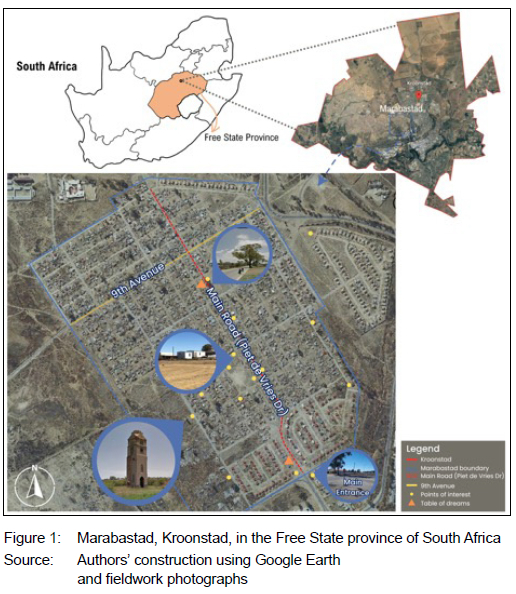
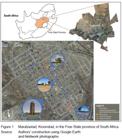
Grounded in both theory and empirical work conducted in Marabastad, Kroonstad (Free State province) - a community that exemplifies many of South Africa's urban challenges (see Figure 1) - the article examines how placemaking can respond to pressing social, economic, and spatial needs. Using a case study approach, it explores two key research questions: What are the core dimensions of placemaking relevant to South African townships, and how can these be mobilised to address their unique social, economic, and spatial development challenges? What phases are essential in a process for placemaking to support resilience, inclusivity, and social cohesion in these contexts?
2.1 Placemaking
The concept of placemaking has evolved over the years, reflecting shifts in urban planning paradigms (Hague & Jenkins 2005: 8) and responding to changing social, economic, and environmental contexts (Burgess, 1979; Wesener, Fox-Kâmper, Sondermann & Münderlein, 2020: 657). In the context of South Africa, placemaking literature has emerged as a response to the spatial injustices and inequalities inherited from the apartheid era, seeking to support more inclusive, vibrant, and sustainable urban environments (Strydom et al., 2018; Strydom & Puren, 2016).
Placemaking originated as a response to the perceived failures of modernist urban planning, which often prioritised functional efficiency (Giedion, 1967) over human-scale design and community engagement (Jacobs, 1958; 1961; Whyte, 1980). Early placemaking efforts focused on creating attractive and functional public spaces that could serve as catalysts for social interaction and community life (Schneekloth & Shibley, 2000: 134; Thomas, Pate & Ranson, 2015: 83). However, these efforts often fell short of their goals, due to top-down planning approaches and limited community involvement (O'Brien, 1985: 59).
In recent decades, placemaking has undergone a paradigm shift towards a more participatory and process-oriented approach (Bilandzic & Johnson, 2013: 259; O'Rourke & Baldwin, 2016: 106). This shift reflects broader trends in urban planning towards more collaborative, bottom-up approaches that prioritise community engagement and empowerment (Strydom et al., 2018). Contemporary placemaking emphasises the active involvement of residents, businesses, and other stakeholders in the design, activation, and management of public spaces (De Vito, Staddon, Zuniga-Teran, Gerlak, Schoeman, Hart & Booth, 2022: 243), aiming to create places that are not only aesthetically pleasing, but also socially and economically vibrant (Pitria & Andari 2023: 178; Rios & Watkins, 2015:217; Shibley, Schneekloth & Hovey, 2003).
2.2 Sustainability in placemaking
Sustainable development is a holistic approach that balances economic growth with environmental concerns (UN, 2024). With nearly 140 developing countries, the UN Brundtland Commission (Brundtland, 1987) defines sustainability as meeting present needs without compromising future generations' ability to meet their own. The UN's New Urban Agenda (NUA) (UN, 2020) and the Sustainable Development Goals (SDGs) (UN SDGs Knowledge Platform, 2024) emphasise the importance of sustainable urban places in the future. Goal 11 focuses on inclusive, safe, resilient, and sustainable cities, and is relevant for placemaking (Strydom et al., 2024: 1). These goals mutually reinforce a process for sustainable urban places, and placemaking, as a tool for sustainability, builds on this foundation (Jelénski, 2018: 783). The NUA and SDGs are crucial in shaping future urban development.
Sustainable placemaking is a recent term in academic scholarship, focusing on social sustainability and community-based participation (Strydom et al., 2024: 2). Karacor's (2014) work explores how public spaces and community involvement can contribute to social cohesion and address urban problems. Beza and Hernández-Garcia's (2018) study on sustainability citizenship in Bogotá, Colombia, found that both placemaking and sustainability citizenship involve active citizen participation in creating environmentally and socially sustainable public spaces. Sustainable placemaking aims to create environmentally responsible (Marsden & Farioli, 2015), socially inclusive (Beza & Hernández-Garcia, 2018; Karacor, 2014), economically viable (Lew, 2017; Sandberg, 2016), and culturally meaningful places (Friedmann, 2007; Puren & Roos, 2016).
2.3 Dimensions of placemaking
Drawing from a wide range of scholarly sources, the review1examined key dimensions of placemaking, including physical, social, economic, and psychological aspects. The physical dimension generally focuses on creating functional (Friedmann, 2007) and aesthetically pleasing (Burgess, 1979) spaces while integrating local culture, sustainability (Wen, 2015), and resilience (Barradas, Águas, & Isidoro, 2007). Placemaking's social dimension incorporates community input, supporting social interaction (Day, 1992; Hou & Rios, 2003), and addressing challenges such as inequality (Friedmann, 2010), aiming to promote social justice and empowerment (Shibley, 1998). The economic dimension of placemaking highlights the potential for economic growth through tourism (Lew, 2017), city branding (Sandberg, 2016), and cost-effective development (Shibley, 1998), while addressing challenges such as unemployment and limited funding (Strydom, 2014). Finally, the psychological dimension of placemaking underscores people's emotional connections (Othman et al., 2013), sense of place (Puren, Drewes & Roos, 2008), and attachment to sites (Puren & Roos, 2016), shaped by history, personal experiences, and cultural significance (Friedmann, 2007).
2.4 Townships in South Africa
To understand the value of placemaking in South African townships, the development of these human settlements needs to be understood. In the South African context, the term 'township' typically refers to urban residential areas that were historically reserved for Black South Africans under apartheid-era policies, particularly the Group Areas Act of 1950 (South Africa, 1950; Davies, 1981: 69; Krige, 1996; Lemon, 1991: 12). While 'township' is also a legal cadastral term for the subdivision of land for development purposes (applicable to all race groups), in this context, it denotes racially segregated, often underdeveloped settlements located on the periphery of cities. These areas were characterised by systemic underdevelopment, townships often lacked essential housing, sanitation, social services, and economic opportunities, creating conditions of deep poverty and deprivation that remain prevalent (Shackleton & Gwedla, 2021: 3).
Post-1994, government interventions such as the Reconstruction and Development Programme (RDP) aimed to improve township living conditions (Maharaj, 2020). However, many of these areas still face significant challenges, including poor infrastructure and inadequate housing, often falling short of internationally accepted standards for decent living (Landman, 2019). These ongoing conditions reflect the lasting impacts of apartheid planning and continue to hinder socio-spatial and economic integration in the democratic era (Strydom & Puren, 2016).
2.5 Value of placemaking for South African townships
While much of the early literature on placemaking originated in the Global North, there is growing recognition of the importance of placemaking in the Global South, where cities and townships face unique challenges related to rapid urbanisation, informal settlement, and social inequality (Landman, 2019; Todes, 2017). In South Africa, placemaking literature has emerged as a response to the country's complex urban realities, including the spatial legacies of apartheid, high levels of poverty and inequality, and the need for inclusive urban development (Jordaan, Puren & Roos, 2008; Strydom & Puren, 2013; 2014; 2016; Van Leynseele, 2013).
Placemaking in South African urban contexts is influenced by a range of factors, including historical legacies, cultural diversity, and socio-economic disparities (Ewing, 2022: 377; Gregory, 2023: 36; Hlengwa, 2021: 3). The spatial injustices of apartheid continue to shape the urban landscape, with many historically marginalised communities still lacking access to quality public spaces and basic services (Van Leynseele, 2013). Placemaking literature in South Africa emphasises the need to redress these inequalities through interventions that prioritise community participation, social inclusion, economic development, and environmental sustainability (Andres, et al., 2019; Moodley & Marks, 2023: 119; Mutero & Govender, 2020: 430; Strydom & Puren, 2014; 2016).
3. CASE STUDY AREA
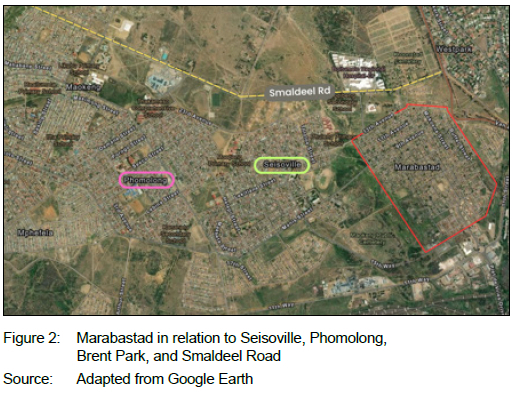
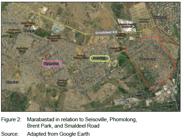
Marabastad, as an intrinsic single case, was selected because of its unique status as a historical site of urban Black political protest and resistance during apartheid. The community's forced relocations and its partial destruction reflect place-unmaking, that significantly contributes to the placemaking discourse in spatial planning. This section provides insights into the geographical, historical, and institutional contexts of Marabastad, Kroonstad (see Figures 1 and 2).
3.1 Geographic context: Understanding Marabastad (Kroonstad)
Marabastad, part of the Moqhaka Local Municipality, serves as the focal point of this case study.
Kroonstad gained municipal status in 1875 and saw the settlement of African families in roughly 1880 (Kentridge, 2013). By the early 1900s, non-White residents were relocated northward, and Marabastad experienced significant growth between 1920 and 1930 (Moloi, 2015). It became home to a diverse population, including Sesotho, Basotho, and isiXhosa groups, as well as Coloured (mixedrace) residents (Moloi, 2012).
The Group Areas Act of 1950 further enforced racial segregation, leading to the forced removal of Coloured (mixed-race) residents from Marabastad in 1957, resulting in the development of new neighbourhoods such as Seisoville, Phomolong, and Brent Park (see Figure 2). By 1968, some Marabastad residents, who relocated to Brent Park, chose to demolish their homes instead of accepting government compensation. The last mixed-race households left Marabastad in the late 1970s, and buildings in the old Marabastad were either partially or demolished by the early 1990s (Moloi, 2012; 2015). Post-democracy, Marabastad faced challenges in redevelopment and formalisation, incorporating re-blocking techniques to reshape its layout (South African SDI Alliance, 2014). The area saw a significant number of returnees during South Africa's transition to democracy, highlighting the potential of sustainable placemaking practices to rebuild a resilient urban community (Botha, 2018).
3.2 Institutional framework: Spatial development in Moqhaka local municipality
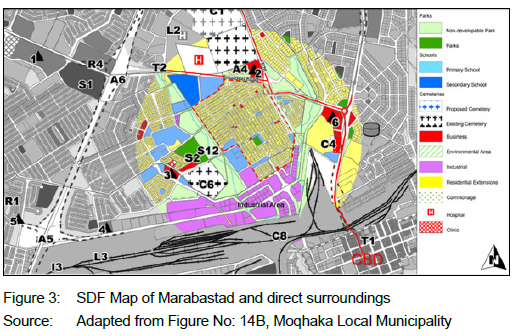
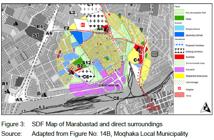
The Moqhaka Spatial Development Framework 2019/2020 outlines the institutional context of Marabastad, reflecting a historical trajectory influenced by apartheid-era laws. Even after the end of apartheid in 1994, Marabastad continues to face administrative challenges such as unlawful fencing and numbering practices. The SDF emphasises ongoing urban planning and infrastructure projects aimed at improving accessibility and managing environmental issues in Marabastad. One significant initiative is the re-alignment of Smaldeel Road (see Figure 3) that aims to enhance connectivity between Maokeng, the industrial sector, and the CBD. Conservation efforts such as restoring wetlands and preserving heritage sites (for example, the Reverend Mahabane House) demonstrate a commitment to maintaining Marabastad's cultural and historical legacy amid urban growth. Land use in Marabastad is primarily residential, with some areas zoned for business and education. An industrial core lies to the south, and there is limited recreational space, with only one property zoned as a park. The SDF map of Marabastad (Figure 3) highlights these land-use types and illustrates the urban fabric of the area.
Through legislative and infrastructural interventions, the institutional context described in the SDF reflects a multifaceted approach to addressing the socio-economic and spatial challenges facing Marabastad within South Africa's broader urban development trajectory.
4. RESEARCH METHODS
4.1 Research design
This study employed a qualitative research design that facilitated an in-depth exploration of Marabastad's sociocultural dynamics and historical context within South Africa's urban landscape (Bloomberg & Volpe, 2016; Leedy, Ormrod & Johnson, 2019). A case study approach was selected to capture the complexity of placemaking in Marabastad, chosen for its potential to provide valuable insights within the spatial and temporal limits of the study (Duminy, Andreasen, Lerise, Odendaal & Watson, 2014; Yin, 2014; Starman, 2013). Qualitative research design allows for thematic data analysis (Vaismoradi, Turunen & Bondas, 2013). In this study, semi-structured and unstructured interviews, as well as field notes coupled with nonparticipant observations provided rich qualitative data on the physical, social (including cultural aspects), economic, and psychological dynamics shaping the area. Thematic analysis of the textual data resulted in four main themes (dimensions) that provided a comprehensive understanding of placemaking within Marabastad. The elements in these dimensions guided the development of a five-phased placemaking process for a South African context.
4.2 Population, sample, and response rate
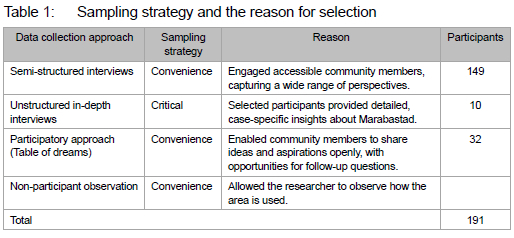
The study formed part of a broader project led by the Department of Urban and Regional Planning at North-West University, Potchefstroom Campus, and used a purposeful sampling approach to gather data from participants uniquely positioned to provide insights into the Marabastad community. Purposeful sampling was particularly effective in capturing both general community impressions and detailed, case-specific knowledge (Flick, 2018; Gupta, Shaheen & Reddy, 2019). The sampling strategy combined both convenience and critical sampling techniques to ensure a comprehensive and nuanced exploration of Marabastad. Convenience sampling was used to access participants in public spaces, thereby providing an exploratory snapshot of the community through semi-structured interviews, nonparticipant observations, and an inclusive participatory method known as the 'table of dreams'. This method enabled the researchers to capture a broad spectrum of views, aspirations, and insights into the cultural and social dynamics of Marabastad. Critical sampling was strategically employed to identify key informants with in-depth knowledge or significant historical ties to Marabastad. These participants, including local officials, planners, and long-standing community members, were selected for unstructured, in-depth interviews. This targeted approach ensured that the study incorporated specialised expertise and a more contextualised understanding of the area, adding depth and richness to the case study. This led to a total sample size of 191 participants (see Table 1), who all provided written consent to be interviewed voluntarily or participate in other research activities.
4.3 Data collection
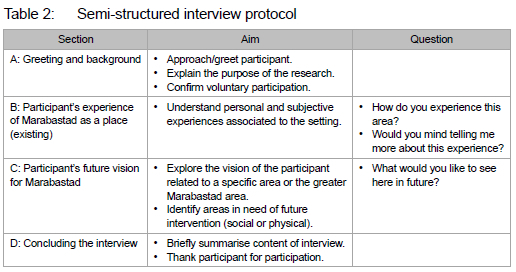
The semi-structured and unstructured interviews, coupled with the participatory 'table of dreams' and non-participant observations, provided rich qualitative data on the physical, social (including cultural aspects), economic, and psychological dynamics shaping the area. Semi-structured interviews followed a flexible guide of questions that may adapt based on the richness of the data and time constraints, with the goal of reaching data saturation (Kallio, et al., 2016; Ruslin, et al., 2022). Trust between the interviewer and the interviewee is essential, allowing for open sharing of experiences, which are recorded through audio, video, and field notes. In this study, fourteen fieldworkers conducted 149 short semi-structured interviews in Marabastad at points of interest previously determined in prior studies (see Figure 1; Botha, 2018). Table 2 elaborates on the interview protocol and the questions that were asked.
Unstructured interviews can be categorised into non-directive, focused, or informal conversational interviews. Non-directive interviews are guided by the interviewee and the subject, while focused interviews require background knowledge (Bernard, 2017: 165; Sommers-Flanagan & Sommers-Flanagan, 2015: 10). Informal conversational interviews are often unrecorded and require informed consent. These interviews share characteristics with semi-structured interviews, trust, and information saturation (Gray, 2014: 387; Roulston & Choi, 2018). In this study, in-depth focused unstructured interviews were conducted, concentrating on placemaking dimensions. Flash cards were used to announce topics related to Marabastad. Topics included social interaction, the Marabastad culture, political aspects, economic environment, personal experience, and physical environment. The interview strategy aims to create a platform for discussing focused topics, with follow-up questions and summarising main points (Green & Thorogood, 2018: 140; Klenke, 2016: 129). The study included ten interviews with community members, government officials, urban and regional planners, as well as key authors on Marabastad's cultural and political background. The interviews were recorded and transcribed verbatim for thematic analysis.
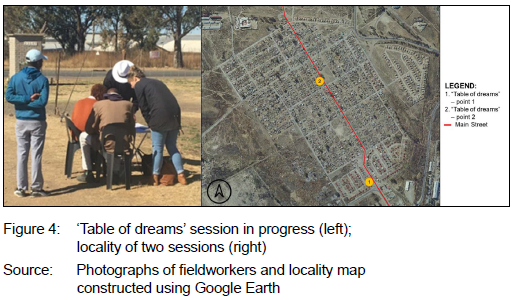
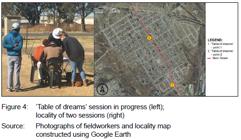
The participatory (table of dreams) strategy, inspired by Chang (2020) and O'Rourke and Baldwin (2016: 106), included two work stations positioned on main pedestrian routes. Each work station comprised a desk and chairs equipped with sheets of paper (A3 paper with wording "My dream for Marabastad is..."), maps for orientational purposes, and coloured pens (see Figure 4). Community members (32 participants) could at random (by means of convenience-based sampling) write or make drawings to project their future ideas/ transformative interventions for Marabastad. The sheets of paper with words and drawings were treated as fleld notes. Researchers/ fleldworkers could ask questions and add descriptions on the participants' drawings and writing to better understand the proposed transformative interventions. This interactive method allowed participants to envision and articulate their aspirations for the improvement of public spaces in Marabastad, facilitating a more inclusive and community-driven approach to urban development.
Non-participant observations were done by fifteen fleldworkers at the same locations as the semi-structured interviews (fifteen points of interest). The aim of the observations was to gain insight into the people-people and people-place interactions at the observation points (Devlin, 2018; Gobo & Molle, 2017).
4.4 Data analysis and interpretation
Thematic analysis (TA) was used to transform the raw data from the semi-structured and unstructured interviews, coupled with the participatory "table of dreams" and non-participant observations, into smaller manageable units (Walters, 2016). TA is a method used to identify and interpret patterns within qualitative data generated in naturalistic environments (Vaismoradi et al., 2013). TA is characterised by its flexibility and independence, making it suitable for exploring data deeply and generating both main themes and subthemes (Braun & Clarke, 2017).
In this study, themes are defined as meaningful entities derived from coded data (Vaismoradi et al., 2013). Coding involves identifying recurring patterns, which can be semantic (manifest) or latent (implicit). The semantic stage focuses on clear patterns, whereas the latent stage captures suggested meanings that may not be explicitly stated. This coding process leads to themes that provide descriptive answers to research questions (Elo, et al., 2014).
The study aligns with the organic TA approach advocated by Braun and Clarke, which emphasises the relevance of themes to the research question rather than their frequency. The six steps of TA outlined by Braun and Clarke (2017) include:
1. Familiarising: Immersing in the data through transcription and repeated reading.
2. Coding: Developing initial codes from significant features of the data, both semantic and latent.
3. Theme development: Interpreting and sorting codes to identify relationships among them.
4. Theme reviewing: Evaluating and refining themes to ensure coherence and relevance.
5. Theme refining and defining: Naming and defining final themes and subthemes for clarity.
6. Reporting: Presenting the analysis in an interpretable report, supported by data extracts.
This structured approach enabled the transformation of the raw data into four well-defined themes. All four data sets were integrated to generate themes and subthemes that provided a nuanced understanding of Marabastad's diverse dimensions, encompassing:
• Physical dimension: Examines the structural and environmental elements that shape the spatial landscape.
• Social dimension: Addresses cultural and political aspects, including the community's resilience and shared identity.
• Economic dimension: Considers economic forces that affect local development and livelihoods.
• Psychological dimension: Explores the psychological attachment and community perceptions tied to Marabastad's history and spaces.
These dimensions provide comprehensive understanding of placemaking within Marabastad and guide the development of a placemaking process relevant to South Africa's township context.
4.5 Ethical considerations
Ethical considerations were paramount throughout the research process, with informed consent obtained from all participants, and their confidentiality and privacy ensured. In addition, efforts were made to engage with the community in a respectful and culturally sensitive manner, acknowledging their perspectives and experiences. The PhD study, from which this paper was written, was submitted for ethical risk classification and approval by the Ethics Committee of the Faculty of Natural and Agricultural Sciences (FNASREC) at North-West University (NWU). The assessment confirmed a minimal associated risk, leading to approval from the North-West University Senate Committee for Research Ethics (NWU-SCRE) under ethics reference no. NWU - 01553-20-A9.
5. FINDINGS
5.1 Participant profile
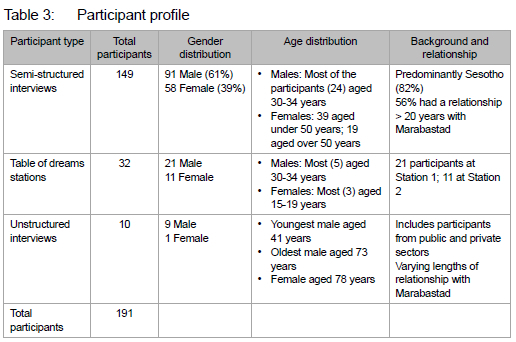
Semi-structured interviews were conducted with 149 participants, with a majority of male respondents (91 males and 58 females), representing a diverse age range and contributing a foundational understanding of the community's experiences and views. The 'table of dreams' sessions saw 32 community members participate, sharing their visions and ideas for Marabastad's future. The vast majority of the participants (56%) in the research reported a longterm relationship with Marabastad, with some having ties to the community for over twenty years.
The unstructured interviews included ten participants (nine male and one female) who were selected for their connections or expertise. These participants included local government officials, community developers, urban planners, and residents who had either lived in or worked closely with the Marabastad community for many years. This group offered rich perspectives on the area's historical, cultural, and planning-related challenges and opportunities, helping to shape the study's conclusions and recommendations on placemaking interventions.
Across all methods employed to collect data, the participant demographics highlighted Marabastad's cultural and linguistic diversity, with 82% identifying Sesotho as their mother tongue, followed by smaller groups of Afrikaans, Xhosa, English, Tswana, and Zulu speakers.
5.2 Physical dimensions of placemaking
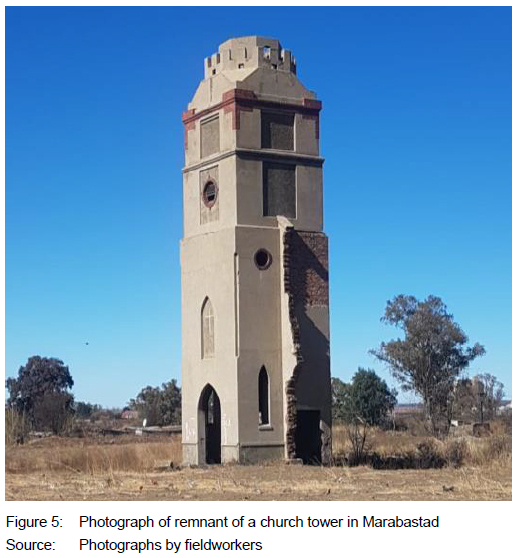
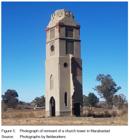
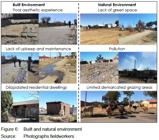
The analysis of data that best aligned with the physical dimension revealed that Marabastad, like many South African urban areas, suffers from the residual spatial fragmentation imposed by apartheid-era planning ("The greater part of Maokeng, the Black residential area, is very inaccessible. Which was again, a function of apartheid planning" - Participant 10, and "We're still working on apartheid type of arrangement in terms of infrastructure" - Participant 17, Station 1). Public spaces in Marabastad are underused and often neglected, lacking basic amenities and aesthetic qualities ("It is seriously ugly here, it is not pretty here, this place." - Participant 15, and "We don't have the gardens" - Participant 4). This lack of public spaces can also be attributed to forced removals, subsequent demolitions, and lack of maintenance of previously important places ("... the areas which were once eh, popular areas and known areas, they were dilapidated. I mean, if you go to the Methodist Church, it's no longer there, it's just that eh, tall wall that is still standing." -Participant 9, and Figure 5 captured by a fieldworker). Figures 5 and 6 are photographs taken by non-participant observation fieldworkers. Jotted notes confirmed the dilapidated state of the built and natural environment.
The findings indicated that spatial justice could be enhanced through interventions that aim to (re)develop vibrant, multifunctional public spaces ("I want to see this place getting better" - Participant 6). Interventions such as the creation of multi-use areas ("Something like an entertainment centre. When people, they don't have something to do, where they can go" - Participant, Point 4, and "Establish spaces that is green and open ... a market or a community-focused centre, something like an open-air theatre that may be utilised multi-functionally." - Participant 10), landscaping with indigenous vegetation ("... at the back of their yard we have to give them a seed, whereby ourselves are the one who going to put that seed at the back of their yard" - Participant 7), and the installation of public art emerged as pivotal in transforming neglected spaces into vibrant community hubs let the place be beautiful - Participant, Point 10, and "I think this place needs more renovations" -Participant, Point 6).
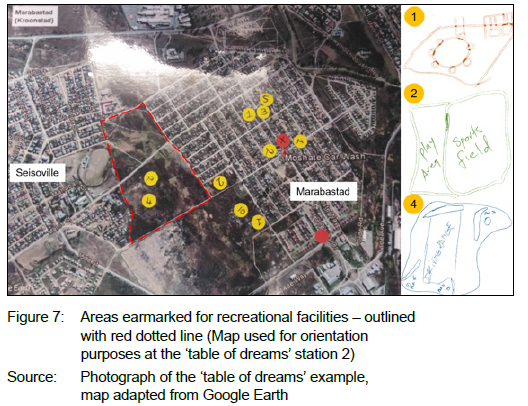
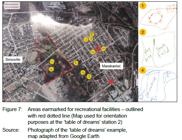
The proposed initiatives for Marabastad included safe parks and sporting facilities ("Safe park for the children" - Point 15, and "This can be a park, a community park or something like that. For recreational purposes." - Participant 2, Station 2), informal markets, and educational play apparatus ("... we need those playing facilities, like open grounds for little generation to play" - Point 9), which collectively aimed to support community interaction and enhance the area's aesthetic appeal. The participants echoed this need for recreational facilities at the 'table of dreams' station 2 (see Figure 7 for an example of suggested interventions and their locations).
These spaces should prioritise inclusivity, sustainability and accessibility, thereby restoring the socio-spatial fabric torn apart by historical injustices ("I want my community to be clean and healthy, so some can [have] a better life"
- Participant 5, Station 1, and "So even if we can do that, so let us not, even though it is development, let us not destroy everything and bring new things ..." - Participant 2).
5.3 Social dimensions of placemaking
Analysed data highlighted the profound impact of the social dimension of placemaking on unlocking of community cohesion and identity. Interviews and participatory sessions revealed a strong desire among residents for spaces that support social interactions and communal activities: ("Maybe a strong community market, where everyone can come together"
- Participant 10). The findings underscored the community's aspirations for places that reflect their cultural heritage ("Because this place, really for us, it's got history, because as well our mothers and our grandfathers started to stay here" - Participant at Point 9), and social values ("We have our togetherness - Participant 2). This cultural heritage mainly revolves around politics ("... most of the people here were politically conscious" - Participant 9, and "[Reverend] Mahabane was also an ANC leader ... he was a child of Kroonstad. Now his house still stands in Main Street" - Participant 5), education ("..., education is the foundation." - Participant 2), sport ("When I grew up, there was a lot of sports." - Participant 12), and religion ("That big tower there was a church." - Participant 3). Participants further recalled historical connection routes that connected mixed-race families during forced removals as highlighted by participants 10 ("Ninth Avenue.strong connection route.cultural-historically it can be very valuable. Main Street itself, the old buildings. discuss with the community: 'Let's make this a memorial lane'" - Participant 10) and ("[In Ninth Avenue] . while you are dressing up . you move here. Slowly, up until to the end of this, because it was something like a showing off who we are. Yes, the loving dovies were taking place at that street. So it was a main street down to Seisoville" - Participant 7).
Key social interventions included the celebration of local heritage through murals, commemorative walls, and the revitalisation of historically significant sites. For instance, the remains of the Methodist Church tower, Reverend Mahabane's house, and Ninth Avenue were identified as some iconic features that, if appropriately commemorated, could reinforce a sense of historical continuity and communal pride. In addition, the enhancement of social gathering spots such as Sefateng ("When there is soccer activities, we go to Sefateng. When there is dance activities, we go to Sefateng." - Participant 7), with paved areas and fixed seating, was viewed as vital for supporting social bonds and community resilience ("If each of us can only do something small to create a liveable area for them, you know, liveable and safe" - Participant 5).
5.4 Economic dimensions of placemaking
Economically, the research findings underscored the potential of placemaking to stimulate local economies. By creating spaces that attract visitors and support local businesses, placemaking can catalyse economic revitalisation. The presence of the Moshate Car Wash ("A car wash, and shisanyama [meat prepared over open fire]" -Participant 5, and "Then we have this large one which is a large attraction, it is the car wash, the Moshante Car Wash" - Participant 6) illustrates how existing informal economic activities can be integrated into broader placemaking initiatives to create multifunctional areas that support both recreation and commerce.
The development of informal markets for local entrepreneurs ("We're selling our people those beers, sorghum beers" - Participant 7, and "We're selling fruits" - Participant 2), tourism ("If you have tourists coming to the townships, you'll need people with vehicles who'll take people around. You'll need tour guides who'll talk to the history of the area" - Participant 9), and dropand-go areas for public transport at key locations were recommended to enhance economic opportunities. These interventions aimed to create economic nodes that not only serve the local community but also attract visitors from surrounding areas, thereby boosting the local economy.
5.5 Psychological dimensions of placemaking
The research reveals that public spaces can significantly impact the mental well-being of residents. Neglected and poorly maintained areas often evoke feelings of neglect and disempowerment ("I don't see the life of tomorrow here" - Participant 4, and "I'm broken inside when I'm walking in the street" - Participant 6), while spaces filled with meaning support pride, belonging, and well-being ("You are living in Marabastad, you are born here in Marabastad, your teenagehood, your manhood and your oldhood is here" - Participant 1, and "You can still feel it or you can see it. It is still there", "It's a feeling of caring for each other and a feeling of loving each other, a feeling of seeing the harmony" - Participant 2).
Participants in the study expressed optimism for change and appreciation towards the research, expressing interest in Marabastad and the expectation of new developments ("I like one thing you people: you come now, you are trying to rekindle that idea of Marabastad" - Participant 4; "I'm just glad that someone is expressing interest in Marabastad through studies" - Participant 6, and "The expectation that something new might come, or something different" - Participant 10). The psychological dimension can be advanced through interventions related to safety ("I would love to see Marabastad as a crime-free area with lots of facilities to help the community" - Participant 2) and aesthetic experience ("I want to see this place getting better" - Participant 6, and ". let the place be beautiful ." - Participant 10) such as street lighting, safe pedestrian crossings, as well as public art and landscaping.
The emphasis on active community participation in the design and maintenance of these spaces was also considered crucial in supporting a sense of ownership, pride, and empowerment. The study suggests that the focus should be on bringing the community together, cleaning the environment up, and teaching them to take care of the place ("We cannot build Marabastad in a second, then we turn it into a classy location. Yes, it can be classy" - Participant 7; "People must ... bring community together, clean this environment up" - Participant 4, and "... teaching our community to take care of this place" - Participant 9). Overall, the study highlights the importance of public spaces in supporting a sense of belonging and well-being among residents.
6. PROPOSED INTEGRATED PLACEMAKING PROCESS FOR SUSTAINABLE URBAN DEVELOPMENT
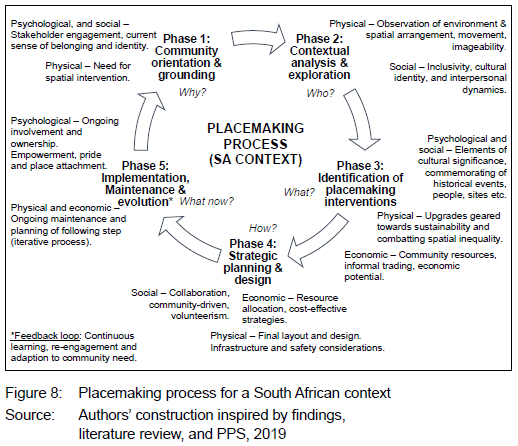
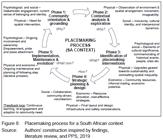
South Africa's urban landscapes are heavily shaped by historical socio-spatial inequalities, as demonstrated in Marabastad, a township marked by residual spatial fragmentation, due to apartheid-era planning. In this instance, issues including underutilised and neglected public spaces, fragmented infrastructure, and the erasure of cultural landmarks highlight the need for an inclusive process for placemaking. Addressing these structural challenges requires a guiding process that is grounded in local realities and adaptable to diverse socio-spatial contexts. This study thus posits a five-phase process for placemaking that incorporates the physical, social, economic, and cultural-psychological dimensions identified through qualitative research in Marabastad. Figure 8 schematically shows the flexible process that is designed to support sustainable development and community empowerment by engaging residents in every phase.
6.1 Five-phase placemaking process
Phase 1: Introduction to urban area and orientation
This foundational phase orientates the process toward relevance, by posing the critical question: Why here? In Marabastad, this phase revealed a strong emotional connection to historical landmarks such as the Methodist Church tower and Ninth Avenue that revealed important anchors for community identity and memory. These insights emphasise the importance of Friedmann's (2007) assertion that urban planning should be grounded in a community's historical and cultural context. Establishing this 'why' sets the tone for the entire placemaking process - positioning place not as an abstract location, but as a living narrative.
Phase 2: Explorative action to understand context
This phase moves from the why to the who - who lives, shapes, and belongs here? It is characterised by immersive, exploratory action to understand the lived realities of local inhabitants through qualitative, participatory tools. Building on the foundation of initial community engagement, this phase involves detailed assessments of the physical, social, economic, and psychological dimensions of the area, as evidenced by the study's data. In Marabastad, residents emphasised the urgent need for inclusive, flexible, and multifunctional spaces, alongside safer pedestrian infrastructure and improved amenities that support social interaction. Participatory methods, including mapping exercises, in-depth interviews, and site observations, were used to identify underutilised spaces and assess risks and opportunities for transformation. These processes enabled the co-identification of key areas for intervention, ensuring that resulting proposals are not only contextually appropriate, but also reflect the spatial needs and aspirations of the community. This approach supports Day's (1992) advocacy for socially responsive and context-sensitive planning and aligns with placemaking principles that centre the communities' lived experience in shaping urban space.
Phase 3: Identification of interventions
With the why and who established in earlier phases, the third phase centres on the what. What actions can meaningfully respond to the place-specific needs and opportunities identified by communities and practitioners alike. This phase focuses on the co-design of targeted placemaking interventions that address the physical, social, economic, and psychological dimensions of the urban environment. In Marabastad, physical interventions such as safe parks, improved pedestrian crossings, sporting facilities, and green public spaces directly responded to the community's repeated call for safe, inclusive, and multifunctional areas. These spaces are envisioned not only as infrastructure, but also as platforms for connection and creativity. Equally important is the economic dimension: local entrepreneurship, informal trade, and creative industries offer tangible pathways for community upliftment. The informal economy around the Moshate Carwash, for instance, was identified as a key opportunity zone. In this instance, placemaking serves not only to beautify or enhance public space, but also to stimulate social and economic revitalisation through context-sensitive development. Creative expressions also emerged as anchors of memory, pride, and identity. Examples include the proposed 'loving dovies' mural on Ninth Avenue, green pocket interventions, and heritage-linked public art. These interventions underscore the role of place attachment and cultural continuity in shaping public space. This phase mirrors broader literature calling for adaptive, flexible, and community-based placemaking, capable of addressing South Africa's complex socio-spatial realities (Lew, 2017; Sandberg, 2016; Moodley & Marks, 2023: 119; Mutero & Govender, 2020: 430; Strydom & Puren, 2014; 2016).
Although the first three phases were the exclusive focus of Marabastad's primary data collection, Phase 4: Planning towards implementation and Phase 5: Ongoing maintenance, upkeep, and development are inspired by global placemaking literature and previous research in similar settings. Feedback from the community, however, strongly suggested a desire to stay involved beyond identification. The eagerness of the participants to take part in next design workshops, implementation exercises, and continuing stewardship initiatives was evident. This is consistent with previous research that supports integrated, phased placemaking processes that progress from involvement to empowered citizenry and points to a latent capacity for long-term collaboration within the community.
Phase 4: Planning towards implementation
Vision meets structure in this phase that addresses the how in this process. This includes detailed design, budgeting, and stakeholder mobilisation. Findings from Marabastad stressed the importance of community-driven planning to ensure long-term resource sustainability and empowerment. Suggested practical interventions included using recycled materials for landscaping and enlisting local artists, aligning with literature on cost-effective, inclusive, and resilient urban development. In this phase, community-driven design is essential, aligning with Wen's (2015) view that local ownership, capability, and acceptance are necessary for long-term resilience.
Phase 5: Ongoing development and maintenance
Placemaking as a process is not an end-product; it should rather be viewed as evolving - What now? Volunteering, skills development, empowerment, and ongoing engagement all contribute to longterm sustainability. Community members in Marabastad indicated that they would like to continue the process, by maintaining green areas (vegetable patches and greening), helping with place branding initiatives (local unofficial beautification), and using murals to tell historical stories. This helps the more general objectives of adaptive governance and resilience and is consistent with Strydom and Puren's (2013; 2014; 2016) work on participatory urban transformation.
By linking the research findings with each phase, Figure 8 shows how a contextually grounded placemaking process can support social cohesion, economic opportunity, and community resilience.
6.2
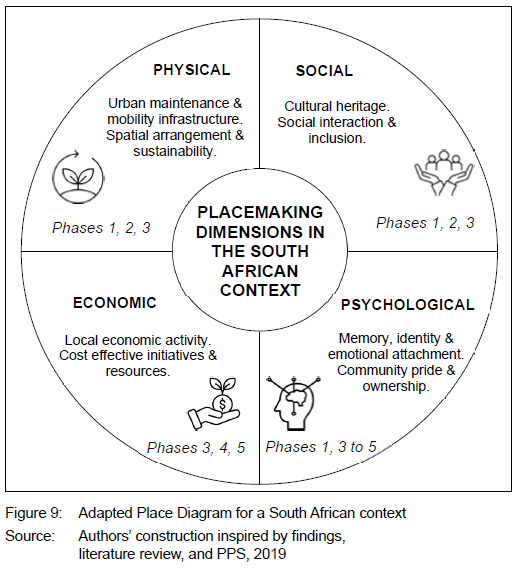
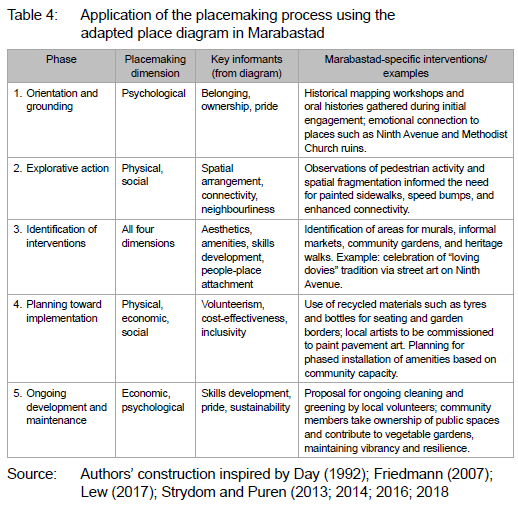
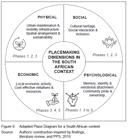
An integrated approach to the placemaking processThe findings from Marabastad align well with established dimensions of placemaking, namely physical, social, economic, and cultural, that are reflected in each phase of the process. These dimensions provide both analytical clarity and practical value in the process of translating community needs into context-sensitive interventions. Figure 8 illustrates the overall process, while the adapted Place Diagram (Figure 9) and application table (Section 6.3 and Table 4) provide further detail on how these dimensions inform each phase.
6.3
Operationalising the placemaking process: The adapted Place DiagramTo support implementation, this study also adapted the Place Diagram by the Project for Public Spaces (PPS, 2019) to reflect South African township realities. The revised diagram organises placemaking into four interrelated dimensions (physical, social, psychological, and economic), each aligned to specific phases of the framework (Figure 9). These dimensions help translate community insights into targeted, context-responsive interventions grounded in local experience and needs.
• Physical (Phases 1 to 3): This dimension supports shared visioning and contextual spatial analysis, by focusing on the tangible aspects of place, namely layout, accessibility, safety, cleanliness, aesthetics, and environmental sustainability. In Marabastad, these insights revealed critical infrastructure gaps and shaped low-cost, context-sensitive recommendations such as using recycled materials and enhancing pedestrian safety.
• Social (Phases 1 to 3): Framing participatory engagement and inclusivity, the social dimension centres on cultural identity, neighbourliness, inclusivity, and equitable access to public amenities. These informants highlighted key community assets such as heritage sites and social gathering nodes that could be leveraged to support cohesion and inclusive placemaking.
• Economic (Phases 3 to 5): Aligned with sustainable, livelihood-enhancing interventions, this dimension focuses on employing volunteerism, local skills development, informal trade, cost efficiency, and site appeal. These informants guided the design of feasible placemaking strategies in Marabastad such as partnering with local entrepreneurs and incorporating flexible, market-friendly spaces near existing landmarks such as the Moshate Carwash.
• Psychological (Phases 1, 3 to 5): Reinforcing identity, memory, and long-term community ownership, this dimension captures intangible aspects of place, namely belonging, pride, attachment, and shared values. Emotional connections to spaces such as Ninth Avenue inspired commemorative interventions including storytelling murals, identity-based installations, and the proposed "Wall of Remembrance".
Each dimension is thus both analytically distinct and practically interconnected, shaping placemaking strategies that are place-specific, community-informed, and adaptable to similar township contexts.
The findings (see section 5) together with the proposed integrated process description reinforce the transformative potential of placemaking for sustainable urban development, particularly in historically marginalised areas such as townships. By leveraging locally relevant interventions across physical, social, economic, and cultural dimensions, this process provides a pathway to address spatial inequalities while empowering communities. For example, the incorporation of green spaces, cultural commemorations, and multi-use markets support both environmental sustainability and economic inclusivity. This approach not only supports community cohesion, but also catalyses local economic development, reducing unemployment and enhancing the quality of life.
In addition, the participatory nature of the process empowers residents to actively shape their environment, supporting a sense of pride and ownership. This aligns with Othman et al.'s (2013) emphasis on community-centred planning, which stresses the need for inclusive processes that give voice to marginalised communities. By embedding sustainability and empowerment within each phase, the process promotes a holistic approach to urban development that can be adapted to other South African townships with similar socio-spatial legacies.
6.4 Align the placemaking process within South Africa's spatial planning system
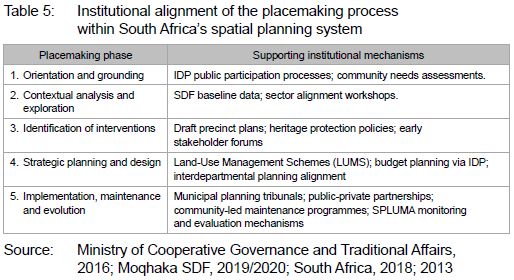
The implementation of the placemaking process in South African townships must align with national spatial planning systems. The Spatial Planning and Land Use Management Act (SPLUMA) (South Africa, 2013), along with Integrated Development Plans (IDPs) and Spatial Development Frameworks (SDFs), provides the legal and policy foundation for enabling community-led spatial transformation. In Marabastad, the Moqhaka SDF (2019/2020) outlines interventions that support placemaking, including improved connectivity, heritage conservation, and land-use management. These priorities echo the national Integrated Urban Development Framework (IUDF) (Ministry of Cooperative Governance and Traditional Affairs, 2016) and the National Spatial Development Framework (NSDF) (South Africa, 2018), which promote inclusivity, resilience, and spatial justice. The proposed five-phase placemaking process aligns with key institutional mechanisms at municipal level:
• Community orientation and contextual exploration (Phases 1, 2): Supported through public participation processes embedded in IDPs and SDF development.
• Identification and strategic planning (Phases 3, 4): Enabled via Land-Use Management Schemes (LUMS), municipal planning tribunals, and inter-sectoral collaboration.
• Implementation and ongoing involvement/sense of ownership (Phase 5): Operationalised through community-based maintenance, ward committee partnerships, and SPLUMA's ongoing monitoring and evaluation systems.
Table 5 illustrates how the proposed five-phase placemaking process can be embedded within existing planning instruments, guided by SPLUMA, IDPs, and SDFs at local government level. It demonstrates how formal governance structures can support community participation and implementation in township contexts.
7. CONCLUDING REMARKS
This study highlighted the importance of placemaking as a dynamic and contextually sensitive process for promoting sustainable urban development and community empowerment in South African townships. Rooted in the realities of Marabastad, the research responds directly to the spatial injustices inherited from apartheid-era planning, highlighting the need for inclusive, participatory alternatives to conventional top-down urban development models.
In addressing the enduring socio-spatial impacts of apartheid and the challenges brought about by rapid urbanisation, the research demonstrated that placemaking, when adapted to local contexts, could serve as a powerful mechanism for redressing spatial inequalities, supporting social cohesion, and building resilience. By developing a process that integrates the physical, social, economic, and cultural dimensions of placemaking, this study offered a pathway for creating inclusive, vibrant, and sustainable urban spaces that respond to both community needs and broader urban development objectives.
The process' phased approach highlighted the importance of community engagement and collaborative planning at each stage - from orientation to ongoing maintenance. The findings showed that each phase, when grounded in participatory methods, supports a strong sense of ownership and agency among residents, thereby enhancing the sustainability and resilience of placemaking interventions. This approach not only aligned with international literature on placemaking, but also addressed the unique historical and socio-economic conditions of South African townships, suggesting a process adaptable to diverse township settings across the country.
By addressing a critical gap in the literature on placemaking within South African urban contexts, this study contributed an integrated process that could guide planners, policymakers, and community members in collaboratively transforming township environments. Ultimately, the findings affirmed that a tailored placemaking approach held great promise for reshaping South African urban landscapes, promoting social equity, and empowering communities to build more liveable and sustainable futures.
8. LIMITATIONS AND FUTURE RESEARCH
The study acknowledges several limitations, including the qualitative nature of the research, the potential for data bias, and the focus on Marabastad and Kroonstad as a single case study community. While this provided an in-depth understanding of placemaking in this specific context, the findings may not be generalisable to other South African townships, cities or regions. Marabastad's unique socio-economic and historical context, shaped by apartheid-era spatial policies, means that the specific interventions and strategies identified may not be directly applicable elsewhere without adaptation. However, it is argued that the lessons learnt and the experiences gained are phronetic knowledge (the practice of thinking and acting with practical wisdom and good judgement) that are transferable to other contexts, as referred to by Braun & Clarke (2017) as transferable knowledge. This in-depth knowledge and understanding that was gained may well serve as informative for placemaking processes in other similar (township) contexts in South Africa.
Future studies could benefit from longer and more in-depth participatory activities to gain a deeper understanding of community aspirations and to ultimately develop a comprehensive framework for placemaking in South Africa. Incorporating mixed methods approaches that include both qualitative and quantitative data would also provide a more robust analysis, addressing some of the limitations related to the depth and breadth of qualitative data.
REFERENCES
2. LITERATURE REVIEW
-
ABBASI, A., ALALOUCH, C. & SALEH, M.S. 2022. Toward resilient and socially sustainable places: A pedagogical experiment on the use of placemaking in design studios. In: Abadalla, H. (Ed.). Resilient and responsible smart cities. Advances in science, technology and innovation. Cham, Switzerland: Springer, pp. 237-247. https://doi.org/10.1007/978-3-030-86499-6_21
» https://doi.org/10.1007/978-3-030-86499-6_21 -
ABUSAADA, H. & ELSHATER, A. 2021. Revealing distinguishing factors between space and place in urban design literature. Journal of Urban Design, 26(3), pp. 319-340. https://doi.org/10.1080/13574809.2020.1832887
» https://doi.org/10.1080/13574809.2020.1832887 -
AKBAR, P.N.G. & EDELENBOS, J. 2021. Positioning place-making as a social process: A systematic literature review. Cogent Social Sciences, 7(1), article 1905920. https://doi.org/10.1080/23311886.2021.1905920
» https://doi.org/10.1080/23311886.2021.1905920 -
AL-BULUSHI, Y. 2024. Ruptures in the afterlife of the apartheid city. London, UK: Palgrave Macmillan. https://doi.org/10.1007/978-3-031-42433-5
» https://doi.org/10.1007/978-3-031-42433-5 -
ANDRES, L., BAKARE, H., BRYSON, J.R., KHAEMBA, W., MELGAÇO, L. & MWANIKI, G.R. 2019. Planning, temporary urbanism and citizen-led alternative-substitute place-making in the Global South. Regional Studies, 55(1), pp. 29-39. http://doi.org/10.1080/00343404.2019.1665645
» http://doi.org/10.1080/00343404.2019.1665645 -
BANK, L.J. & HART, T.G.B. 2020. Land reform and belonging in South Africa: A place-making perspective. In: Steyn Kotze, J. & Bohler-Muller, N. (Eds.). Reflections on the 2019 South African general elections: Quo vadis? London, UK: Routledge, pp. 47-62. https://doi.org/10.4324/9781003031345-4
» https://doi.org/10.4324/9781003031345-4 -
BARRADAS, S., ÁGUAS, S. & ISIDORO, S. 2007. Historic designs in place making: Poetics and politics of street furniture, 1755-1938. on the w@terfront, 9, pp. 9-19. https://raco.cat/index.php/Waterfront/article/view/218349
» https://raco.cat/index.php/Waterfront/article/view/218349 -
BARRY, J. & AGYEMAN, J. 2020. On belonging and becoming in the settler-colonial city: Co-produced futurities, placemaking, and urban planning in the United States. Journal of Race, Ethnicity and the City, 1(1-2), pp. 22-41. https://doi.org/10.1080/26884674.2020.1793703
» https://doi.org/10.1080/26884674.2020.1793703 - BERNARD, H.R. 2017. Research methods in anthropology: Qualitative and quantitative approaches. 6th edition. Lanham, Maryland, U.S.A.: Rowman and Littlefleld.
-
BEZA, B.B. & HERNÁNDEZ-GARCIA, J. 2018. From placemaking to sustainability citizenship: An evolution in the understanding of community-realised public spaces in Bogota's informal settlements. Journal of Place Management and Development, 11(2), pp. 192-207. https://doi.org/10.1080/14649357.2016.1156730
» https://doi.org/10.1080/14649357.2016.1156730 -
BILANDZIC, M. & JOHNSON, D. 2013. Hybrid placemaking in the library: Designing digital technology to enhance users' on-site experience. The Australian Library Journal, 62(4), pp. 258-271. https://doi.org/10.1080/00049670.2013.845073
» https://doi.org/10.1080/00049670.2013.845073 - BLOOMBERG, L.D. & VOLPE, M. 2016. Completing your qualitative dissertation: A road map from beginning to end. 3rd edition. Thousand Oaks, CA: SAGE.
-
BODINO, M. 2022. Reframing the role of public open space: The case of Cape Town. Cham, Switzerland: Springer Nature. https://doi.org/10.1007/978-3-030-94323-3
» https://doi.org/10.1007/978-3-030-94323-3 - BOTHA, M. 2018. Exploring sense of place as a restorative urban planning tool: Marabastad, Kroonstad as a case study. Unpublished Masters dissertation, North-West University, South Africa.
-
BRAUN, V. & CLARKE, V. 2017. Thematic analysis. The Journal of Positive Psychology, 12(3), pp. 297-298. https://doi.org/10.1080/17439760.2016.1262613
» https://doi.org/10.1080/17439760.2016.1262613 - BRUNDTLAND, G. 1987. Report of the World Commission on Environment and Development: Our common future. United Nations General Assembly Document A/42/427.
-
BURGESS, J.A. 1979. Place-making: The contribution of environmental perception studies in planning. Geography, 64(4), pp. 317-326. https://www.jstor.org/stable/40569988. https://doi.org/10.1080/20436564.1979.12219563
» https://www.jstor.org/stable/40569988. https://doi.org/10.1080/20436564.1979.12219563 -
CHANG, C. 2020. Projects. [Online]. Available at: <http://candychang.com> [Accessed: 22 September 2020].
» http://candychang.com -
DAVIES, R.J. 1981. The spatial formation of the South African city. GeoJournal, 2(2), pp. 59-72. https://doi.org/10.1007/BF00196325
» https://doi.org/10.1007/BF00196325 -
DAY, L.L. 1992. Placemaking by design: Fitting a large new building into a historic district. Environment and Behavior, 24(3), pp. 326-346. https://doi.org/10.1177/0013916592243003
» https://doi.org/10.1177/0013916592243003 -
DE VITO, L., STADDON, C., ZUNIGA-TERAN, A.A., GERLAK, A.K., SCHOEMAN, Y., HART, A. & BOOTH, G. 2022. Aligning green infrastructure to sustainable development: A geographical contribution to an ongoing debate. Area, 54(2), pp. 242-251. https://doi.org/10.1111/area.12764
» https://doi.org/10.1111/area.12764 - DEVLIN, A.S. 2018. The research experience: Planning, conducting and reporting research. Thousand Oaks, CA: SAGE.
-
DUCONSEILLE, F. & SANER, R. 2020. Creative placemaking for inclusive urban landscapes. The Journal of Arts Management, Law, and Society, 50(3), pp. 137-154. https://doi.org/10.1080/10632921.2020.1754985
» https://doi.org/10.1080/10632921.2020.1754985 -
DUMINY, J., ANDREASEN, J., LERISE, F., ODENDAAL, N. & WATSON, V. (Eds). 2014. Planning and the case study method in Africa: The planner in dirty shoes. Hampshire: Palgrave Macmillan. https://doi.org/10.1057/9781137307958
» https://doi.org/10.1057/9781137307958 -
ELLERY, P.J., ELLERY, J. & BORKOWSKY, M. 2020.Toward a theoretical understanding of placemaking. International Journal of Community Well-Being, 4, pp. 55-76. https://doi.org/10.1007/s42413-020-00078-3
» https://doi.org/10.1007/s42413-020-00078-3 -
ELO, S., KÄÄRIÄINEN, M., KANSTE, O., PÖLKKI, T., UTRIAINEN, K. & KYNGÃS, H. 2014. Qualitative content analysis: A focus on trustworthiness. SAGE open, 4(1), pp. 1-10. https://doi.org/10.1177/2158244014522633
» https://doi.org/10.1177/2158244014522633 -
EWING, K. 2022. Public space and everyday culture: Photo-stories of fractional place-making in urban South Africa. The Journal of Public Space, 7(1), pp. 369-378. https://doi.org/10.32891/jps.v7i1.1522
» https://doi.org/10.32891/jps.v7i1.1522 - FLICK, U. 2018. An introduction to qualitative research. 6th edition. Thousand Oaks, CA: SAGE.
-
FRIEDMANN, J. 2007. Reflections on place and place-making in the cities of China. International Journal of Urban and Regional Research, 31(2), pp. 257-279. https://doi.org/10.1111/j.1468-2427.2007.00726.x
» https://doi.org/10.1111/j.1468-2427.2007.00726.x -
FRIEDMANN, J. 2010. Place and place-making in cities: A global perspective. Planning Theory & Practice, 11(2), pp. 149-165. https://doi.org/10.1080/14649351003759573
» https://doi.org/10.1080/14649351003759573 - GIEDION, S. 1967. Space, time and architecture: The growth of a new tradition. 5th edition. Cambridge, MA: Harvard University Press.
-
GOBO, G. & MOLLE, A. 2017. Doing ethnography. 2nd edition. London, UK: SAGE. https://doi.org/10.4135/9781529682847
» https://doi.org/10.4135/9781529682847 - GRAY, D.E. 2014. Doing research in the real world. 3rd edition. London, UK: SAGE.
- GREEN, J. & THOROGOOD, N. 2018. Qualitative methods for health research. 4th edition. London, UK: SAGE.
-
GREGORY, J.J. 2023. Taming the wilds: Tactical urbanism and creative placemaking in the revitalisation of a nature reserve in Johannesburg, South Africa. Bulletin of Geography. Socio-Economic Series, (60), pp. 33-45. https://doi.org/10.12775/bgss-2023-0014
» https://doi.org/10.12775/bgss-2023-0014 -
GUPTA, M., SHAHEEN, M. & REDDY, K.P. (Eds). 2019. Qualitative techniques for workplace data analysis. Hershey, PA: IGI Global. https://doi.org/10.4018/978-1-5225-5366-3
» https://doi.org/10.4018/978-1-5225-5366-3 -
HAGUE, C. & JENKINS, P. 2005. Background to place identity, participation and planning in Europe: Place identity, participation and planning. London, UK: Routledge. https://doi.org/10.4324/9780203646755
» https://doi.org/10.4324/9780203646755 -
HLENGWA, D.C. 2021. Placemaking and visitors' reviews of the Golden Mile of Durban. Acta Commercii, 21(1), article 921. https://doi.org/10.4102/ac.v21i1.921.
» https://doi.org/10.4102/ac.v21i1.921 -
HOU, J. & RIOS, M. 2003. Community-driven place making: The social practice of participatory design in the making of Union Point Park. Journal of Architectural Education, 57(1), pp.19-27. https://doi.org/10.1162/104648803322336557
» https://doi.org/10.1162/104648803322336557 -
INGWANI, E., THYNELL, M., GURURE, L., EKELUND, N.G.A., GUMBO, T., SCHUBERT, P. & NEL, V. 2023. The impacts of peri-urban expansion on municipal and ecosystem services: Experiences from Makhado Biaba Town, South Africa. Urban Forum 35(2), pp. 297-327. https://doi.org/10.1007/s12132-023-09499-7
» https://doi.org/10.1007/s12132-023-09499-7 - JACOBS, J. 1958. Downtown is for people. In: Whyte, W.H. (Ed.). The exploding metropolis. Los Angeles, cA: University of California Press, pp. 157-184.
- JACOBS, J. 1961. The death and life of great American cities. New York, NY Vintage Books.
-
JELÉNSKI, T. 2018. Inclusive placemaking: Building future on local heritage. In: Amoruso, G. (Ed.). Proceedings of the 5th INTBAU International Annual Event. Putting tradition into practice: Heritage, place and design. Vol. 3. Cham: Springer, pp. 783-793. https://doi.org/10.1007/978-3-319-57937-5_81
» https://doi.org/10.1007/978-3-319-57937-5_81 -
JORDAAN, T., PUREN, K. & ROOS, V. 2008. The meaning of place-making in planning: Historical overview and implications for urban and regional planning. Acta Structilia, 15(1), pp. 91-117. https://doi.org/10.38140/as.v15i1.190
» https://doi.org/10.38140/as.v15i1.190 -
KALLIO, H., PIETILÃ, A.M., JOHNSON, M. & KANGASNIEMI, M. 2016. Systematic methodological review: Developing a framework for a qualitative semi-structured interview guide. Journal of Advanced Nursing, 72(12), pp. 2954-2965. http://doi.org/10.1111/jan.13031
» http://doi.org/10.1111/jan.13031 -
KARACOR, E.K. 2014. Placemaking approachment to accomplish social sustainability. European Journal of Sustainable Development, 3(4), pp. 253-262. https://doi.org/10.14207/ejsd.2014.v3n4p253
» https://doi.org/10.14207/ejsd.2014.v3n4p253 -
KENTRIDGE, I. 2013. 'And so they moved one by one': Forced removals in a Free State town (1956-1977). Journal of Southern African Studies, 39(1), pp. 135-150. https://doi.org/10.1080/03057070.2012.763209.
» https://doi.org/10.1080/03057070.2012.763209 -
KLENKE, K. 2016. Qualitative Interviewing in leadership research. In: Klenke, K. Qualitative research in the study of leadership. Bingley, UK: Emerald, pp. 123-150. https://doi.org/10.1108/978-1-78560-651-920152007
» https://doi.org/10.1108/978-1-78560-651-920152007 - KRIGE, S. 1996. Botshabelo: Former fastest-growing urban area in South Africa approaching zero population growth. Urban and Regional Planning Occasional Paper, 20. Bloemfontein: University of the Orange Free State.
-
LANDMAN, K. 2019. Evolving public space in South Africa: Towards regenerative space in the post-apartheid city. New York, NY: Routledge. https://doi.org/10.4324/9781351129442
» https://doi.org/10.4324/9781351129442 - LEEDY, P.D., ORMROD, J.E. & JOHNSON, L.R. 2019. Practical research: Planning and design. 12th edition. New York, NY: Pearson.
- LEMON, A. 1991. Homes apart: South Africa's segregated cities. Indianapolis, IN: Indiana University Press.
-
LEW, A.A. 2017. Tourism planning and place making: Place-making or placemaking? Tourism Geographies, 19(3), pp. 448-466. https://doi.org/10.1080/14616688.2017.1282007
» https://doi.org/10.1080/14616688.2017.1282007 -
LOH, C.G. 2019. Placemaking and implementation: Revisiting the performance principle. Land Use Policy, 81, pp. 68-75. https://doi.org/10.1016/j.landusepol.2018.10.024
» https://doi.org/10.1016/j.landusepol.2018.10.024 -
MADANIPOUR, A. 2016. Culture and tolerance in public space. In: Moroni, S. & Weberman, D. (Eds). Space and pluralism: Can contemporary cities be places of tolerance? Budapest, Hungary: Central European University Press, pp. 35-54. https://doi.org/10.1515/9789633861264-004
» https://doi.org/10.1515/9789633861264-004 -
MAGIDI, J. & AHMED, F. 2019. Assessing urban sprawl using remote sensing and landscape metrics: A case study of City of Tshwane, South Africa (1984-2015). The Egyptian Journal of Remote Sensing and Space Science, 22(3), pp. 335-346. https://doi.org/10.1016/j.ejrs.2018.07.003
» https://doi.org/10.1016/j.ejrs.2018.07.003 -
MAHARAJ, B. 2020. The apartheid city. In: Massey, R. & Gunter, A. (Eds.). Urban geography in South Africa: Perspectives and theories. Cham: Springer, pp. 39-54. https://doi.org/10.1007/978-3-030-25369-1_3
» https://doi.org/10.1007/978-3-030-25369-1_3 -
MARSDEN, T. & FARIOLI, F. 2015. Natural powers: from the bio-economy to the eco-economy and sustainable place-making. Sustainability Science, 10, pp. 331-344. https://doi.org/10.1007/s11625-014-0287-z
» https://doi.org/10.1007/s11625-014-0287-z -
MATEO-BABIANO, I. & LEE, G. 2020. People in flace: Placemaking Fundamentals. In: Hes, D. (Ed.). Placemaking fundamentals for the built environment. Singapore: Palgrave Macmillan, pp. 15-38. https://doi.org/10.1007/978-981-32-9624-4_2
» https://doi.org/10.1007/978-981-32-9624-4_2 - MINISTRY OF COOPERATIVE GOVERNANCE AND TRADITIONAL AFFAIRS. 2016. Integrated Urban Development Framework (IUDF). Pretoria, South Africa: GOGTA.
- MOLOI, T.C. 2012. Black politics in Kroonstad: Political mobilisation, protests, local government, and generational struggles, 1976-1995. Unpublished Ph.D. dissertation, University of Witwatersrand, South Africa.
-
MOLOI, T.C. 2015. Place of thorns: Black political protests in Kroonstad since 1976. Johannesburg, South Africa: WITS. https://doi.org/10.18772/12015066871
» https://doi.org/10.18772/12015066871 -
MOODLEY, S. & MARKS, M. 2023. 'Welbedacht is a beautiful place': Community insights on placemaking and social transformation in a state resettlement programme in eThekwini, Durban, South Africa. Transformation: Critical Perspectives on Southern Africa, 112(1), pp.119-149. https://doi.org/10.1353/trn.2023.a926452
» https://doi.org/10.1353/trn.2023.a926452 -
MOQHAKA LOCAL MUNICIPALITY. 2018. Moqhaka Spatial Development Framework, 2019/2020. [Online]. Available at: <https://www.moqhaka.gov.za/wp-content/uploads/2020/02/Moqhaka_SDRpdf> [Accessed: 13 September 2019].
» https://www.moqhaka.gov.za/wp-content/uploads/2020/02/Moqhaka_SDRpdf -
MUTERO, I.T. & GOVENDER, I.G. 2020. Advancing the exploration of engaged creative-placemaking amongst universities and communities for social cohesion in South Africa. Journal of Asian and African Studies, 55(3), pp. 429-445. https://doi.org/10.1177/0021909619882718
» https://doi.org/10.1177/0021909619882718 - O'BRIEN, D.F. 1985. Artstreet: Taking place and making news. Places, 2(3), pp. 59-66.
-
O'ROURKE, V. & BALDWIN, C. 2016. Student engagement in placemaking at an Australian university campus. Australian Planner, 53(2), pp. 103-116. https://doi.org/10.1080/07293682.2015.1135810
» https://doi.org/10.1080/07293682.2015.1135810 -
OTHMAN, S., NISHIMURA, Y. & KUBOTA, A. 2013. Memory association in place making: A review. Procedia Social and Behavioral Sciences, 85, pp. 554-563. https://doi.org/10.1016/j.sbspro.2013.08.384
» https://doi.org/10.1016/j.sbspro.2013.08.384 -
PASTAK, I. & KÄHRIK, A. 2021. Symbolic displacement revisited: Place-making narratives in gentrifying neighbourhoods of Tallinn. International Journal of Urban and Regional Research, 45(5), pp. 814-834. https://doi.org/10.1111/1468-2427.13054
» https://doi.org/10.1111/1468-2427.13054 -
PITRIA, M. & ANDARI, Y. 2023. The economic and social impacts of rural placemaking. Economics Development Analysis Journal, 12(2), pp. 168-181. https://doi.org/10.15294/edaj.v12i2.62833
» https://doi.org/10.15294/edaj.v12i2.62833 -
PUREN, K. & ROOS, V. 2016. Using the Mmogo method to explore important places and their meaning in two communities: The importance of context. In: Roos V. (Ed.). Understanding relational and group experiences through the Mmogo method. Cham, Switzerland: Springer, pp. 195-212. https://doi.org/10.1007/978-3-319-31224-8_10
» https://doi.org/10.1007/978-3-319-31224-8_10 -
PUREN, K., DREWES, E. & ROOS, V. 2008. A sense of place and spatial planning in the Vredefort Dome, South Africa. South African Geographical Journal, 90(2), pp. 134-146. https://doi.org/10.1080/03736245.2008.9725320
» https://doi.org/10.1080/03736245.2008.9725320 -
PROJECT FOR PUBLIC SPACES. 2019. What makes a successful place? [Online]. Available at: <http://www.pps.org/topics/gps/gr_place_feat> [Accessed: 14 April 2025].
» http://www.pps.org/topics/gps/gr_place_feat -
RIOS, M. & WATKINS, J. 2015. Beyond 'place': Translocal placemaking of the hmong diaspora. Journal of Planning Education and Research, 35(2), pp. 209-219. https://doi.org/10.1177/0739456X14568023
» https://doi.org/10.1177/0739456X14568023 -
ROULSTON, K. & CHOI, M. 2018. Qualitative interviews. The SAGE handbook of qualitative data collection, pp. 233-249. Thousand Oaks, CA: SAGE. https://doi.org/10.4135/9781526416070.n15
» https://doi.org/10.4135/9781526416070.n15 -
RUSLIN, R., MASHURI, S., RASAK, M.S.A., ALHABSYI, F. & SYAM, H. 2022. Semi-structured interview: A methodological reflection on the development of a qualitative research instrument in educational studies. lOSR Journal of Research & Method in Education, 12(1), pp. 22-29. http://doi.org/10.9790/7388-1201052229
» http://doi.org/10.9790/7388-1201052229 -
SANDBERG, M. 2016. Restructuring locality: Practice, identity and place-making on the German-Polish border. Identities, 23(1), pp. 66-83. https://doi.org/10.1080/1070289X.2015.1016523
» https://doi.org/10.1080/1070289X.2015.1016523 -
SCHEMSCHAT, N. 2021. Refugee arrival under conditions of urban decline: From territorial stigma and othering to collective place-making in diverse shrinking cities? Sustainability, 13(23), pp. 13301. https://doi.org/10.3390/su132313301
» https://doi.org/10.3390/su132313301 - SCHNEEKLOTH, L.H. & SHIBLEY, R.G. 1995. Placemaking: The art and practice of building communities. Chichester, UK: Wiley.
-
SCHNEEKLOTH, L. & SHIBLEY, R. 2000. Implacing architecture into the practice of placemaking. Journal of Architectural Education (1984), 53(3), pp. 130-140. https://doi.org/10.1162/104648800564527
» https://doi.org/10.1162/104648800564527 -
SHACKLETON C.M. & GWEDLA, N. 2021. The legacy effects of colonial and apartheid imprints on urban greening in South Africa: Spaces, species, and suitability. Frontiers in Ecology and Evolution, 8, article 579813. https://doi.org/10.3389/fevo.2020.579813
» https://doi.org/10.3389/fevo.2020.579813 -
SHIBLEY, R.G. 1998. The complete new urbanism and the partial practices of placemaking. Utopian Studies, 9(1), pp. 80-102. https://www.jstor.org/stable/20719744
» https://www.jstor.org/stable/20719744 -
SHIBLEY, R.G., SCHNEEKLOTH, L.H. & HOVEY, B. 2003. Constituting the public realm of a region: Placemaking in the bi-national Niagaras. Journal of Architectural Education, 57(1), pp. 28-42. https://doi.org/10.1162/104648803322336566
» https://doi.org/10.1162/104648803322336566 - SOMMERS-FLANAGAN, J. & SOMMERS-FLANAGAN, R. 2015. Clinical interviewing. 5th edition. London, UK: John Wiley & Sons, Inc.
- SOUTH AFRICA. 2018. National Spatial Development Framework. Department of Rural Development and Land Reform, and Department of Planning, Monitoring and Evaluation. Pretoria: Government Printer.
- SOUTH AFRICA. 2013. Spatial Planning and Land-Use Management Act, Act no. 16 of 2013. (SPLUMA). Pretoria: Government Printer.
- SOUTH AFRICA. 1950. The Apartheid Group Areas Act, Act no. 41 of 1950. Pretoria: Government Printer.
-
SOUTH AFRICAN SDI ALLIANCE. 2014. Re-blocking Kuku Town informal settlement. [Online]. Available at: <http://sasdialliance.org.za/re-blocking-kuku-town-informal-settlement/> [Accessed: 23 April 2020].
» http://sasdialliance.org.za/re-blocking-kuku-town-informal-settlement/ - STARMAN, A.B. 2013. The case study as a type of qualitative research. Journal of Contemporary Educational Studies, 64(1), pp. 28-43.
-
STATISTA. 2024. Urbanization rate in Africa in 2021, by country. [Online]. Available at: <https://www.statista.com/statistics/1223543/urbanization-rate-in-africa-by-country/> [Accessed: 13 March 2024].
» https://www.statista.com/statistics/1223543/urbanization-rate-in-africa-by-country/ - STRYDOM, W.J. 2014. Towards place-making in urban planning through participatory action research. Unpublished MSc dissertation, North-West University, South Africa.
- STRYDOM, W.J. & PUREN, K. 2013. A participatory approach to public space design as informative for place-making. Challenges of Modern Technology, 4, pp. 33-40.
-
STRYDOM, W.J. & PUREN, K. 2014. From space to place in urban planning: Facilitating change through participatory action research. In: Marchettini, N. (Ed.). The sustainable city IX: Urban regeneration and sustainability, 2(191), pp. 209-220. https://doi.org/10.2495/SC140391
» https://doi.org/10.2495/SC140391 -
STRYDOM, W.J. & PUREN, K. 2016. An exploration of the dimensions of place-making: A South African case study. World Academy of Science, Engineering and Technology. International Journal of Urban and Civil Engineering, 10(10), pp. 1324-1332. https://waset.org/Publication/10005621
» https://waset.org/Publication/10005621 -
STRYDOM, W.J., PUREN, K. & DREWES, E. 2018. Exploring theoretical trends in placemaking: Towards new perspectives in spatial planning. Journal of Place Management and Development, 11(2), pp. 165-180. https://doi.org/10.1108/JPMD-11-2017-0113
» https://doi.org/10.1108/JPMD-11-2017-0113 -
STRYDOM, W.J., PUREN, K. & DREWES, E. 2024. Defining sustainable placemaking in spatial planning: Lessons from a South African case study. Sustainability, 16, article 5378. https://doi.org/10.3390/su16135378
» https://doi.org/10.3390/su16135378 -
THOMAS, E., PATE, S. & RANSON, A. 2015. The crosstown initiative: Art, community, and placemaking in Memphis. American Journal of Community Psychology, 55(1-2), pp. 74-88. https://doi.org/10.1007/s10464-014-9691-x
» https://doi.org/10.1007/s10464-014-9691-x -
TODES, A. 2017. Shaping peripheral growth? Strategic spatial planning in a South African city-region. Habitat International, 67, pp. 129-136. https://doi.org/10.1016/j.habitatint.2017.07.008
» https://doi.org/10.1016/j.habitatint.2017.07.008 -
UN (UNITED NATIONS). 2020. New urban agenda; UN: Quito, Ecuador. [Online]. Available at: <https://habitat3.org/the-new-urban-agenda/> [Accessed: 13 March 2024].
» https://habitat3.org/the-new-urban-agenda/ -
UN (UNITED NATIONS). 2024. Sustainability. [Online]. Available at: <https://www.un.org/en/academic-impact/sustainability> [Accessed: 30 October 2024].
» https://www.un.org/en/academic-impact/sustainability -
UN SDGS KNOWLEDGE PLATFORM. 2024. Sustainable Development Goal 11. [Online]. Available at: <https://sdgs.un.org/goals/goal11> [Accessed: 13 March 2024].
» https://sdgs.un.org/goals/goal11 -
VAISMORADI, M., TURUNEN, H. & BONDAS, T. 2013. Content analysis and thematic analysis: Implications for conducting a qualitative descriptive study. Nursing & Health Sciences, 15(3), pp. 398-405. https://doi.org/10.1111/nhs.12048
» https://doi.org/10.1111/nhs.12048 - VAN LEYNSEELE, Y.P.B. 2013. Landscapes of deracialization: Power, brokerage and place-making on a South African frontier. Unpublished PhD dissertation, Wageningen University, The Netherlands.
-
WALTERS, T. 2016. Using thematic analysis in tourism research. Tourism Analysis, 21(1), pp. 107-116. https://doi.org/10.3727/108354216X14537459509017
» https://doi.org/10.3727/108354216X14537459509017 -
WEN, Y. 2015. Combined material recycling study with aesthetic of entropy and place making. The Scientific World Journal, article 8342, pp. 1-12. https://doi.org/10.1155/2015/208342
» https://doi.org/10.1155/2015/208342 -
WESENER, A., FOX-KAMPER, R., SONDERMANN, M. & MÜNDERLEIN, D. 2020. Placemaking in action: Factors that support or obstruct the development of urban community gardens. Sustainability, 12(2), article 657. https://doi.org/10.3390/su12020657
» https://doi.org/10.3390/su12020657 - WHYTE, W.H. 1980. The social life of small urban spaces. Washington, DC: Conservation Foundation.
- YIN, R.K. 2014. Case study research: Design and methods. Thousand Oaks, CA: SAGE.
Peer reviewed and revised: April 2025
Published: June 2025
1 Further reading: For a detail report on the review findings refer to Strydom, Puren and Drewes (2018) and Strydom (2021).