Where did you hear that? Narrative Competition and Societal Instability in Burkina Faso
Abstract
Coups do not occur randomly. They are the result of significant shocks, or triggers, to a societal system, which is especially catastrophic in societies with high levels of vulnerability. It is often in this context of high vulnerability that global powers act to gain influence throughout the world. Narrative competitions, or information campaigns, are becoming increasingly important as an approach to projecting influence at international scale. Socio-cultural and economic triggers of societal instability are critical spaces where narrative and indirect competitions occur. Explaining how competitors manipulate these country-specific triggers as part of an influence campaign is essential to understanding modern geopolitics. The study on which this article reports, used the Modeling Dense Urban Networks analytical model to explain the influence of economic, geographical, and political changes on the opinion of the local population on crucial societal tipping points in Burkina Faso. Burkina Faso is a region with intense societal vulnerability due to economic inequalities, regional instability brought on by the ongoing conflict in the Sahel, significant environmental security issues, and a distrust of the government and the former colonial power, France. These internal factors of instability strongly influenced the two military coups in 2022. In addition to the internal factors of instability, Burkina Faso is an area of powerful competition between several global powers, each providing a narrative to manipulate societal opinion around these local issues of vulnerability to promote their influence in Burkina Faso at the expense of their adversaries.
Societal Vulnerability; Coup-d'état; Burkina Faso; Geopolitics
Introduction
Coups do not occur randomly. They are the result of a series of societal triggers that increase vulnerability in a country. One of the major influences on societal vulnerability is narrative competitions, or information campaigns, in which competitors, both domestic and international, seek to control the triggers of societal instability. Explaining how competitors manipulate these country-specific triggers as part of an influence campaign is essential to understand modern geopolitics and political development within a country.
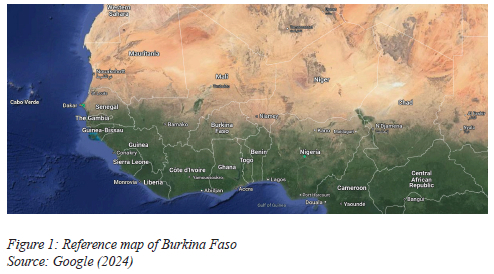
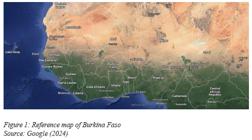
The current study used the Modeling Dense Urban Networks (MDUN) analytical model to explain the influence of economic, geographical, and political changes on the opinion of the local population on crucial societal tipping points in Burkina Faso. Burkina Faso (Figure 1) is a state in a region of Africa with deep societal vulnerability due to economic inequalities, regional instability brought on by the ongoing conflict in the Sahel, significant environmental security issues, and a distrust of the government and the former colonial power, France. These internal factors of instability strongly influenced the two military coups in 2022 (Africa Center for Strategic Studies, 2022). In addition to the internal factors of instability, Burkina Faso is an area of formidable competition between several local, regional, and global powers, each providing a narrative to manipulate societal opinion around these local issues of vulnerability to promote their influence in Burkina Faso at the expense of their adversaries. It was against this context of narrative competition that societal vulnerability increased in Burkina Faso leading to the coups of 2022.
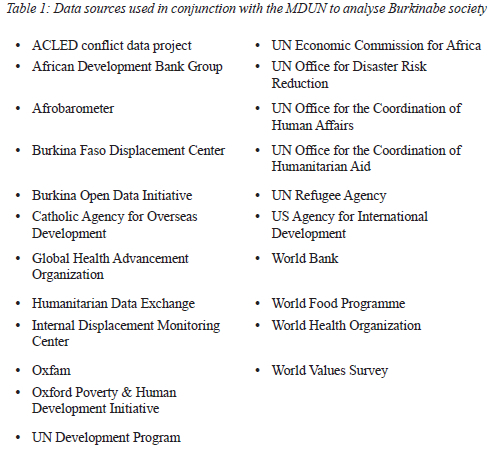
By linking the input of the MDUN to the human geography of Burkina Faso, one can gain a complete picture of the rising level of vulnerability in Burkinabe society that led to the coups of 2022. The MDUN initially identified a desire for increased income distribution as a trigger of vulnerability in the country. As the second coup approached, the MDUN began to detect increased levels of instability surrounding issues of xenophobia, a need for safer communities, a need for more national sovereignty, and a lack of confidence in government. All of these MDUN dimensions can be explained by the growing conflict against violent extremist organisations (VEOs) in the Sahel region, along with a growing anti-French sentiment brought on by a growing dissatisfaction over the foreign control of the mining industry and increased Russian and Chinese information campaigns influencing public sentiment.
Societal Vulnerability and Change
Traditionally, most studies of societal vulnerability and resilience focus on environmental stressors, ineffective governance, and episodic environmental disasters. This is due to the dramatic nature of these and the instantaneous strain they put on a society. Societal vulnerability is crucial for risk management; however, there are different definitions and frameworks that assess societal vulnerability, and nuanced approaches are important to comprehend the dynamic and context-specific nature of vulnerability. Urban specialists focus on people's livelihoods and coping capacity, while disaster specialists focus on the vulnerability of individuals and critical institutions to disasters (Bull-Kamagna et al., 2003:194). With increased susceptibility, vulnerable societies are more prone than less vulnerable societies to the negative impacts of natural disasters because of inadequate infrastructure and overall preparedness leading to higher rates of damage and casualties. While vulnerability analysis has become widespread, scholars, such as Adger (2006) and Turner et al. (2003), point out shortcomings in its reliance on generic quantitative methods that often fail to capture the complexity and context-specific experiences of diverse groups within a society (Adger, 2006; Turner et al., 2003). Vulnerability is not equally distributed, and the social impacts of hazard exposure often fall disproportionately on the most vulnerable people in society (Cutter, Boruff & Shirley, 2003; Tapsell, McCarthy, Faulkner & Alexander, 2003:13). Vulnerability is not static but a dynamic concept that changes over time and space. This necessitates considering social-ecological interactions, such as how environmental stresses and socio-economic factors interact and exacerbate one another. For example, climate change can worsen existing economic inequalities, further increasing vulnerability for marginalised groups. Additionally, weak governance can amplify existing vulnerabilities by failing to provide adequate resources and support mechanisms (Blaikie, Cannon, Davis & Wisner, 2014).
In recent years, some scholars have started to apply the concepts of resilience and vulnerability to explain dramatic societal change. Aguirre sees vulnerability and resilience in societies as a 'dialectical duality' (Aguirre, 2007:39). These are two extremes in societal development, which takes place continuously without end, as societies are complex, evolving open systems. As a society experiences shock and bounces back, it evolves and develops new resiliency strategies. As this development occurs, new influences on vulnerability however develop that are not always visible or assessed by society. As emphasised by Frerks, Warner and Weijs (2011:116), resilience does not always return to a previous state of equilibrium.
The challenge of explaining complex social systems is to develop frameworks to assess the impact of stressors on societal vulnerability or resilience. Many scholars have used varying approaches to construct a framework, emphasising different aspects of society. Wilches-Chaux (1989) identifies several influences on vulnerability to include environmental, political, cultural, and economic consequences. Weichselgartner (2001:88) takes a slightly different approach, viewing the characteristics of vulnerability, considering pre-existing vulnerability, vulnerabilities that affect different social groups differently, and impacts of vulnerabilities at specific sites. This is built on by Christmann and Ibert (2012:2) in their identification of 'structurally induced vulnerability' in which vulnerability affects people based on their socio-economic situation. With the impacts identified, Christmann and Ibert (2012:2) go on to emphasise that members are able to identify and acknowledge vulnerabilities in an effort to develop resilience.
Some scholars began to focus on social and economic aspects of vulnerability and resilience in society. Tanner and Williams (1981) identify five key aspects of societies to include economic aspects, such as production, technology, and adapting to change through education and science. Researchers also address political aspects in their framework, looking at supporting relationships among citizens, maintaining stability of social relationships, and managing conflict and pursuing goals in a society. This is echoed by Frerks et al. (2011:107) who define vulnerability as the result of bad governance, bad development schemes, and political or military destabilisation with a focus on political development.
This economic approach is contrasted with an environmental explanation. The authors While, Jonas and Gibbs (2004) agree that economic frameworks tend to be dominant in the discourse. They also emphasise the significance of environmental issues. From "river clean-ups" through redeveloping industrial sites for gentrification, to land use change as an influence on drinking water vulnerability (Mirhosseini, Farshchi, Noroozi, Shariat & Aalesheikh 2018), environmental aspects have a major influence on societal development. Richmond, Malcomb and Ringler's (2018:386) focus on household-level vulnerability, and the authors and identify six main key areas: food, water, energy, environment, livelihood, and health. These interconnected factors can significantly increase vulnerability, especially in poorly managed urban settings.
Putting economic and environmental qualities together is a defining aspect for studies that emphasise sustainability. Shen, Ochoa, Shah and Zhang's (2011:19) studied sustainable development plans for nine cities. In their subsequent analysis, they attempted to create a manageable model of sustainable development in cities by reducing the number of sustainable development dimensions to four, namely environmental, economic, social and governance elements. Once the authors had defined the dimensions, they applied the dimensions to the nine cities under study to look for areas of commonality and areas of departure. The result was what they view as a method to implement sustainable development programmes in cities at various levels of development.
Research on development that emphasises economic or environmental aspects of change, briefly mentions political, cultural, and social factors. Typically, the discussions of sociocultural factors are framed within the discussion of economic development or environmental reactions to economic development. These studies tend to minimise the importance of identity, political legitimacy, social networks, political penetration by government, and other factors that also strongly influence urban development. This gap in the literature was addressed in the current study through the construction of a model that emphasises sociocultural variables through the lens of a political development model.
Binder's (1964:625) approach to political development provides a basic model of political development that subdivides political development into five categories or networks (production, identity, legitimacy, participation, and penetration). Scholars, including LaPalombara (1971) and Fierman (1991), who have worked with Binder's model have added a sixth category known as "allocation". Framed within the discussion of societal development, the impact of events that demonstrate the vulnerability and resilience of a society is the result of the continuous interaction of networks within the region and the continuous evolution of these networks and their interactions both within a society and to the larger global political-economic system. While influenced by external forces, these networks and interactions are strongly influenced by the local population (both residents and non-residents). As Giddens (1979) emphasises in his duality of structure, people change the societal networks and are changed as a result of interacting with the various networks. This duality needs to be at the heart of any analysis focusing on societal resilience and vulnerability. The six categories, defined by Binder (1964), all provide insight into urban development and work to organise the vast complexity that influences urbanisation.
Coups as an Example of Societal Vulnerability
One of the most dramatic examples of human-induced vulnerability is military coups. Coups represent a breakdown of governance in a country. Wang emphasises that coups are likely to happen in countries with a strong tradition of the military dominating society (Wang, 1998:662). The importance of the military in society sets the stage for a coup, but the local conditions are the triggers that typically set the coup in motion. Hansen (2024:1) identifies four main triggers of coups in West Africa. She classifies the first two - political instability and economic problems - as traditional determinants that have been well studied in previous research. Economic factors are also echoed by Londregan and Poole (1990:177-178) in their conclusion that poverty is the one characteristic coups share. In addition to the two traditional triggers, the author (2024:1) adds climate change and external impacts as two new triggers of coups in the modern political environment. Hansen (2024:5) concludes that the frequency of coups in West Africa is the result of ineffective democratic governance and the inability of governments to promote liberty, safety, and progress. The deficiencies of governments lead to a legitimacy and allocation gap that juntas exploit to overthrow governments in the region.
Hansen (2024:7) mentions external influences as a major influence on the prevalence of coups in West Africa. International powers have vied for influence in Africa throughout the Cold War (1945-1991) and are now returning to compete for influence throughout the region primarily to access raw materials. Hansen (2024:7) mentions that West Africa saw a reduction in the number of coups d'état after the end of the Cold War. Within the past few years, corresponding to the rise of Russian influence in the region, the number of coups is once again rising (Ferragamo, 2023). This reflects the possible influence of foreign actors and information campaigns on political stability in West Africa.
Burkina Faso: Vulnerability and Societal Change
The history of Burkina Faso is riddled with strife for power, protests, and revolutions. In the late nineteenth century, the French arrived in a region of minor kingdoms and decentralised empires, and colonised what is now Burkina Faso as part of French West Africa. The French established a colonial administration focused on the resources in the country and relied on the labour of the Burkinabe people in agriculture and mining. Post-World War II calls for independence grew, and in 1960, the country gained its independence from France. Despite gaining independence, Burkina Faso continued to face the same challenges as the rest of the region, such as economic underdevelopment, social inequality, and political instability (Engels, 2018:363). The economic underdevelopment stemmed from inheriting an economy geared towards the production of cotton for export to other countries and with few other industries to diversify the economy (Bourdet & Persson, 2001). The lack of human capital and technical expertise limited the ability of the country to develop and manage its own industries. This was compounded by the lack of financial resources making it difficult to invest in infrastructure and other areas of the economy.
In response to these challenges, the government of Burkina Faso implemented policies aimed at promoting economic growth and development through investments of infrastructure, promoting education and technical training, and diversifying the economy (Bourdet & Persson, 2001; International Monetary Fund [IMF], 2012). These policies were centred on the idea of national self-sufficiency, with the goal of reducing dependence of the country on external forces, promoting internal development, reducing poverty, and improving access to basic services. Policies aimed at improving infrastructure development were promoted through investments in roads, bridges, and other infrastructure projects intended to improve transportation and communication across the country (Engels. 2018). One of the key economic policies during this period was the establishment of state-owned enterprises in key sectors of the economy. The government invested in industries, such as agriculture, mining, and energy, with the goal of promoting rural development, stimulating local production, and reducing imports (Bourdet & Persson, 2001; IMF, 2000). Another important policy was the promotion of education and training through government investment in the building of schools and universities. This investment created expanded access to education and training programmes aimed at development of technical skills, with the goal of developing a skilled workforce that could support economic growth and development of industries (IMF, 2005). While these policies were intended to promote economic growth and development, their effectiveness was limited by a range of factors, including limited financial resources and inadequate technical expertise.
The poor economic development of Burkina Faso is exacerbated by the social inequalities faced by its citizens. There is a wide gap between the rich and the poor, and unequal access to education, healthcare, and other essential services. Poverty remains a major issue in Burkina Faso, with around 40 per cent of the population living below the poverty line (World Bank Group, 2023). Women are confronted by many challenges in terms of social (in)equality. Despite constitutional guarantees of gender equality, women in Burkina Faso face widespread discrimination and violence (Kazianga & Wahhaj, 2013:541). They often have limited access to education, healthcare, and economic opportunities, and they are frequently subjected to early marriage, female genital mutilation, and other harmful practices. According to the United Nations, the literacy rate for women ages 15 and older in Burkina Faso is only 32 per cent, compared to 50 per cent for men (UNESCO, 2021). Another inequality is between those who live in rural areas compared to those in urban areas. Rural communities face greater poverty, limited access to education and healthcare, and limited infrastructure compared to urban areas. The literacy rate in urban areas tends to be higher than in rural areas due to limited access to educational opportunities, lack of resources, poverty, and a shortage of qualified teachers in the latter (Rupley Bangali & Diamitani, 2013:9). The government has adopted policies aimed at promoting social development, such as investments in education, to include addressing gender inequality, and implemented programmes in rural areas aimed at increasing enrolment, providing access to educational materials and resources, and training teachers. Progress has been slow, however, and social inequality remains a significant challenge for Burkina Faso. The Gini coefficient for Burkina Faso remains among the lowest fifteen countries in the world at 45,2 (World Economics, n.d.). The economic instability feeds into the growing political instability.
The country has experienced political instability and violence throughout its history. From its independence from France in 1960 to the present day, Burkina Faso has experienced several coups and military regimes with coup and coup attempts occurring in 1966, 1980, 1982, 1983, 1987, 2014, 2015, and 2022). Burkina Faso continues to face challenges today, including the rise of violent extremist groups (VEOs) and ethnic conflicts, particularly in the north and east of the country (Bado, 2015). The threat of terrorism is linked to several factors, including poverty, political instability, weak governance, and the influence of extremist groups in the region. The terrorist groups operating in Burkina Faso include the Group for the Support of Islam and Muslims (GSIM), Jama'at Nasr al-Islam wal Muslimin (JNIM), which is affiliated with Al-Qaeda, and the Islamic State in the Greater Sahara (ISGS) (Bureau of Counterterrorism, 2021). These VEOs have carried out numerous attacks on civilians and security forces, leading to a humanitarian crisis and displacement of thousands of people (Bado, 2015; Bureau of Counterterrorism, 2021). The internally displaced population increased from 50 000 in December 2018 to 270 000 in August 2019 (International Commission of the Red Cross [ICRC], 2019). Burkina Faso 'is experiencing one of the fastest-growing displacement crises in the world, marked by violence, poverty, food shortages and the growing impact of the climate crisis' (UN High Commissioner for Refugees [UNHCR], 2022:n.p.). In addition to internal displacement, the regional instability due to ongoing periods of political unrest or armed conflict in the countries near Burkina Faso, such as Mali and Niger, has led to an influx of over 90 000 Malian and Nigerien refugees into Burkina Faso. The attacks have also had a significant impact on the economy and development of the country, as religious sites, businesses, and infrastructure have been targeted, and foreign investment has been discouraged. The government of Burkina Faso has implemented a range of measures to address the threat of terrorism, including increasing security forces and working with international partners to strengthen border security and intelligence sharing (Bado, 2015).
Violence and instability have continued to escalate as GSIM blocked access to several cities in northern and eastern Burkina Faso by attacking and destroying infrastructure, further affecting access to food, water, health, and education (Ochieng, 2022). In January 2022, Damiba led a military coup based on the ineffective handling of the ISGS and GSIM militants in the country. Continued dissatisfaction, as ISGS and GSIM militants continued to launch deadly attacks against civilians, led to a second military coup commanded by Captain Ibrahim Traeré, which ended in September 2022 with the resignation of Damiba and declaration of Traoré as the new president (Booty, 2022). Since November 2022, the rising violence targeting civilians based on ethnic and religious identity, led by non-state armed groups, in Burkina Faso has driven over 60 000 Burkinabe people to neighbouring countries (Sy, 2023). Most of those fleeing were women and children who had also been subjected to gender-based violence stating, 'when the armed groups came, everything changed' (Sy, 2023, n.p.). These challenges have increased the fragility of an already destabilised region struggling with security challenges and food insecurity.
The MDUN Sociological Situational Awareness Modeling Tool
The Modeling Dense Urban Networks (MDUN) tool was developed by Perceptronics Solutions to enhance situational awareness by visualising and explaining societal vulnerability (Grannis, 2023). Unlike a mere incident tracker, the MDUN goes beyond merely identifying such events; instead, the MDUN expects that inciting incidents will happen regularly, and instead evaluates and forecasts the probable impact they would have when they inevitably do.
Given the focus of the IMDUN on sociological situational awareness, the inputs of IMDUN comprise geo-tagged and time-stamped sociocultural, socioeconomic, and socio-political data about the perceptions, beliefs, values, and experiences of the population. To measure societal resilience, the MDUN computes an entropy index, extracting micro-information about emergent disorder, where a low entropy value suggests a more stable situation while a value near the maximum suggests that the societal system is vulnerable to being triggered and collapse, and needs to be reconstituted (Liang, Hu, Chen & Zhou, 2017; Liu, Stanley & Gao, 2016). The MDUN uses these multiple measures as inputs to an artificial intelligence routine, which learns the best weightings for each input by training against 320 known events worldwide. This allows the MDUN to understand a population's sentiment and resulting behaviour.
The MDUN conveys this understanding of societal dynamics across 12 sociocultural, economic, and political dimensions, which together offer a nuanced understanding of societal vulnerability. These dimensions were conceived using a factor analysis model on data from dozens of countries across all geographic regions of the world (Grannis, 2023). Notably, the 12 MDUN dimensions complement the six dimensions identified by Verba (2015:7), Fierman (1991), and Wolfel, Richmond and Grazaitis (2017:40), providing quantitative metrics to the analytical framework of political development. The MDUN displays the 12 dimensions in a radar chart in which each of the 12 dimensions originates from a central point separated from each other by equivalent angles. A terminal circular edge, equidistant from the central point, connects all axes. The central point represents complete stability while the terminal edge represents a critical phase transition being transgressed, indicating an event triggering a social catastrophe. A polyline connects each dimensional axis at a point indicating the current state of the societal area on that dimension.
Using the MDUN to Model Burkinabe Society
Beginning in May 2022, the current authors, along with the Perceptronics team, used the MDUN to analyse Burkina Faso and to explore the sociocultural fabric of the country and potentially determine the major factors, which influenced the societal vulnerability, which led to the January 2022 coup. Using the MDUN, over 20 different sets of data (see Table 1) - ranging from local groups collecting sentiment data to large international organisations - were considered.
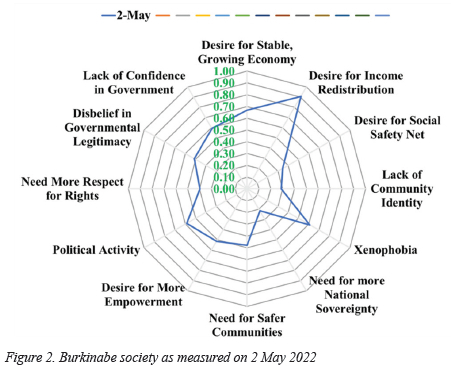
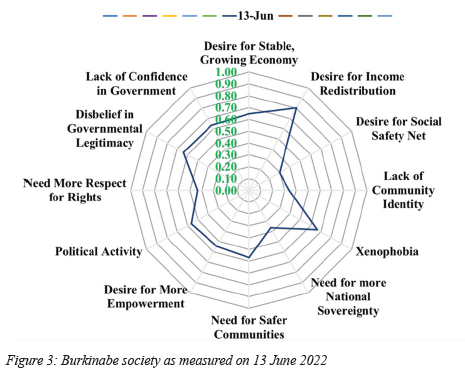
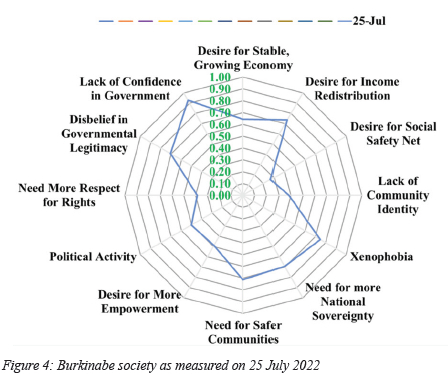
From 2 May to 25 July 2022, weekly assessments of the sociological situational awareness in Burkina Faso were made using these observed data. Figures 2, 3 and 4 display the assessments for 2 May (the beginning), 13 June (halfway), and 25 July (the end).
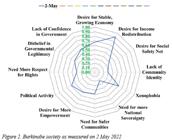
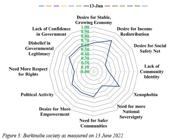
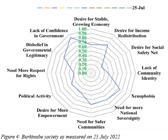
Figure 2 shows that, in early May, four months before the second coup, Burkinabe society was very concerned about income redistribution, so much so that this concern was approaching criticality at the time. Local citizens were desiring better income distribution, and the xenophobia score was possibly influenced by discontent over mining operations being controlled primarily by foreign companies (Trade Commissioner Service, 2022). In addition, the presence of 400 French Special Operations Forces in Burkina Faso even after Operation Barkhane had officially ended might also have contributed to the 2022 xenophobia score. The Burkinabe government finally asked them to leave in January 2023. Three of the Sahelian countries involved in Barkhane (Mali, Niger, Burkina Faso) used pointed anti-French rhetoric during the time the xenophobia score was increasing. If the level of this concern transgressed the criticality threshold, this would have suggested that the population would act to deal with this, acting with sufficient resolve to destabilise Burkinabe society. This could have included civil unrest and riots, land occupation and seizures, or insurgencies and wholesale revolution. At the same time, however, most other factors were no more than moderate, with some higher than others but none approaching the key criticality edge.
Figure 3 shows that, in mid-June 2022, the picture appeared to be stabilising somewhat. The desire for income redistribution, while still high, was moving away from criticality. By large-scale appearances, Burkinabe society was moving towards stability.
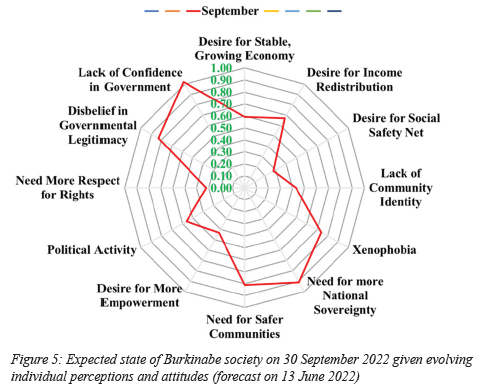
As 2022 progressed, the results from the July (Figure 4) and September (Figure 5) radar plots show the impact of a declining security situation in the country and the beginnings of a crisis of allocation (security) and legitimacy. Due to this decline in personal security, local citizens began to lose trust in the government (legitimacy), resulting in higher vulnerability scores for "Lack of confidence in government", and "Want more national sovereignty". As these scores approached critical, societal change became more likely.
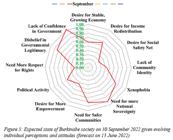
Figure 4, however, shows that by the end of July, new threats emerged. While the desire for income redistribution continued to recede slowly, the population's lack of confidence in their government was nearing criticality, and several other factors were becoming increasingly concerning as well.
Using the MDUN to Forecast Future States of Burkinabe Society Successfully
The above figures show the analysis by the MDUN of observed data at the time. Beyond merely evaluating the current situational awareness, on 13 June 2022, the research team used the MDUN to make seven month-by-month predictions (from July 2022 to January 2023) showing deteriorating conditions in Burkina Faso. These predictions were all made by projecting current trends, not at the macro-societal level, but at the micro-level, which generated them. The MDUN projected what would happen if individuals' perceptions, attitudes, and behaviours continued to evolve unchecked in their current fashion.
Figure 5 illustrates the result for 30 September 2022. It is at once apparent that a lack of confidence in government had crossed the criticality threshold. Other concerning factors include disbelief in governmental legitimacy, the need for national sovereignty, the need for safer communities, and xenophobia. Together, these factors suggest that, by September of that year, the government would have lost people's support due to a palpable loss of confidence in its ability to protect the population from outsiders, both nationally and locally. Five months earlier all these factors had been no more than moderate, and the need for national sovereignty was very low.
This was the MDUN's projection done on 13 June 2022 (Figure 3). Fast forward to the predicted month, and on 30 September 2022 (Figure 5), Burkina Faso found itself in the throes of a military coup that forcibly ousted the established government, exactly as the MDUN had predicted three and a half months earlier. At the time the MDUN made these predictions on 13 June 2022, the large-scale scenario looked completely different. In three months, the lack of confidence in government had risen about 40 per cent from a moderate level to destabilising. Even more surprising, the need for national sovereignty, arguably the driving factor, transitioned in that same period from being relatively stable to critical.
These patterns were already present in the perceptions, beliefs, and attitudes of the population on the ground. The MDUN did not assess inciting incidents or actions taken by leaders but rather evaluated the evolving perceptions and attitudes of the general population, what they perceived and experienced, and how these perceptions and experiences would likely affect their decisions to act. The MDUN discovered the micro-level signs of entropy, emergent disorder, already present in the population (Figures 2-4) and projected them forward, showing when they would become so great that the state could not survive (Figure 5). The actual incident itself - which formally ignited the coup - was less relevant than the fact that the population had reached a point at which they would react to any inciting incident.
Interestingly, all the predictions made on 13 June 2022 were done on the assumption that the situation for individuals on the ground would continue evolving as it was, at a time when the situation appeared to be stabilising. If leaders had taken appropriate actions, they would probably have been able to alter the course but, by only being aware of the macro-level and not the individual-level perceptions and attitude, they did not perceive the evolving crisis.
Societal Change in Burkina Faso
In 2022, the Burkinabe military conducted two coups. The MDUN analytical model visualised the societal factors that created societal acceptance of the September coup. To explain the context of rising societal vulnerability leading to the September coup, we used Binder's 1964 model of political development as an explanatory framework (see Verba, 2015:7). Several scholars (see Fierman, 1991; Wolfel et al., 2017) have used Binder's model as a framework to explain societal political development. Binder's model comprises six dimensions of political development: political presence (political penetration) (see Verba, 2015), identity, political legitimacy, political participation, production, and allocation, as discussed below.
Political Presence
"Political presence" refers to the ability of a government to disseminate its messages and actions to the local population. (Binder, 1964). Political presence has been low in Burkina Faso for the past several years. Haavik Bøas and locchi (2022) characterise the Burkinabe government as weak since 2014 (Haavik et al., 2022:318). In addition, Hansen (2024:34) believes that local strongmen, religious organisations, and the state have used militias, rebel groups, jihadists, and the military as their private armies to settle disputes over resource access and to promote their influence, or political presence. Most of this projection of power was for personal gain, and provided the local population little communication of their goals as agents of influence in the country.
Recently, the coup leaders have started to push an agenda for their government. Initially, Engels (2022:315) noted that coup occurred to 'put the country back on track' and 'restore the territorial integrity and sovereignty'. The focus of this message of restoring territorial integrity and sovereignty was directed at the insurgencies in the north of the country, and would resonate with the local population who have expressed concerns about security for the past several years, i.e. since 2019
At international scale, the Burkinabe government has reoriented its geopolitical alignment away from France, and towards China and Russia. In 2018, Burkina Faso switched its diplomatic recognition from Taiwan to the People's Republic of China (PRC). This was accompanied by a large investment by the PRC into Burkina Faso. Even after the coup, the Burkinabe government has maintained a close relationship with China.
In recent years, the Traoré government has grown its relationship with Russia. This includes humanitarian aid, an agreement to build a nuclear power plant in Burkina Faso, cultural exchanges, and most recently, security forces to support the Burkinabe government. On 16 January 2024, Africa Development Forum (2024b) reported the creation of a paramilitary Africa Corps that would replace the now defunct Wagner Group as Russia's main armed presence on the continent. Two weeks later, a report by Poland's Center for Eastern Studies (see Bartosiewicz & Zochowski, 2024) reported that 100 members of the Africa Corps landed in Burkina Faso in late January, with an additional 200 to arrive later. This roughly equals the number of French Special Operations forces that were present until asked to depart in January 2023.
The departure of the French, the removal of diplomatic relations with Taiwan, and the increased cooperation with China and Russia demonstrate a new geopolitical orientation for Burkina Faso. While these actions have garnered attention outside of the country as a geopolitical reorientation, the influence of these new relationships is seen in the country as a tangible action to separate Burkina Faso from French influence. For several years, the governments of the country have struggled to promote a coherent message and follow through with actions to help improve the security conditions in the north. The current government however seems to be out of touch with the population, especially in the north.
Identity
Identity, as measured by "Lack of community identity" in the MDUN, is not a significant factor on societal vulnerability in Burkina Faso. While not significant, the influence of identity however increased throughout 2022. Two main aspects of Burkinabe societal development help explain the influence of identity on societal vulnerability. Both aspects are influenced by growing xenophobia as seen in the MDUN measures from 2022.
First, there is a strong anti-French sentiment in West Africa in general. This anti-French sentiment is growing in Burkina Faso. Historically, according to Hansen (2024:35), the French government traditionally used soft power activities, such as cultural exchanges, referred to as diplomatie culturelle by the French government, as an instrument of foreign policy. This benefits the French long-term political and economic objectives by attempting to create a shared identity between the French and their colonies through a shared language and culture, two critical elements of identity. In modern Burkina Faso, the local population is beginning to challenge the supremacy of French culture and chart their own course of development.
Into the void that is created by the decline in a French-African identity is a renaissance of Pan-Africanism. Pan-Africanism started in the early twentieth century to strengthen unity across all people of African descent throughout the world, and promote self-reliance and self-government, especially in Africa. During the 1990s, the movement included a move towards an Afrocentric, more aggressive, anti-European version of Pan-Africanism, which looked to push out traditional European influences from the region (Hellem, 2021). In recent years, the movement has been co-opted to shift political influence away from traditional colonial powers to new suitors for influence in the region, particularly Russia.
The Russians have used their social media influence campaign to promote their interests in the region and discredit other potential influencers they see as competitors. Pan-Africanism is one of the key narratives being pushed by Russia to break traditional colonial linkages (Afrocentrism) and allow Russian companies to fill the void. The Russians turned their large social media influencing campaign on Africa, through Yevgeny Prigozhin's Internet Research Agency (Stanford Cyber Policy Center, 2019; US Department of State, 2022). In Burkina Faso, Eckles (2024) chronicles how Russian social media used legitimate concerns of the Burkinabe population to build a campaign to blame France and present Russia as a saviour. They also promoted the authoritarian coup leaders, such as Traoré, who look to collaborate with Russia.
In addition to social media, Russia has funded and supported modern Pan-African leaders to promote Pan-African and Afrocentric identities to weaken European influence further. One example is Kemi Seba. Kemi Seba is a French-Beninese writer and political activist who focuses his attention on anti-colonialism in West Africa and the reliance on the West African CFA franc (Le Cam, 2023). Seba's connections to Russia have been well documented to include funding from Prigozhin and invitations to several Russian-African summits in Russia (Coakley & Vetch, 2022; Roger, 2023). In the wake of the departure of Burkina Faso, Mali and Niger from the Community of West African States, there are hints that all three states are considering dropping the CFA franc. Jeune Afrique quoted Nigerien Transitional President Tiani, 'There is no longer any question of our states being France's milk cow. Money is a sign of sovereignty. We are in the process of recovering our complete sovereignty' (Jeune Afrique, 2024, n.p.).
The decline of French cultural influence in the region created an identity void and increased vulnerability in the region. Various actors are stepping in to promote anti-French sentiment through modern interpretations of Pan-Africanism and Afrocentrism. Russia seized the opportunity to exert its influence by supporting leaders in the Pan-African movement and pushing disinformation through social media. This led to increased vulnerability in Burkina Faso evidenced in increased vulnerability as seen in xenophobia.
Political Legitimacy
"Political legitimacy" refers to the local population's belief that the government legitimately represents their interests and deserves their loyalty. As the coup approached, political legitimacy became one of the most critical dimensions of vulnerability as measured by the MDUN. By the time of the coup, the "Lack of confidence in government" reached criticality in terms of vulnerability. This followed the inability of the Burkinabe government to control the insurgency in the north.
The perpetrators of the coup took advantage of two major grievances within Burkinabe society. First, the coup leaders made the most of anti-French sentiment to gain legitimacy with the local population. According to Hansen (2024:35), 'young people all over West Africa have animosity for France which the coup makers have taken advantage of in their quest for power. The population blames France for involvement in government deficits'. By ending French operations in 2023, the Burkinabe government hoped to gain support in the country and increase their legitimacy.
Second, the inability of the former president to deal with the insurgency in the north and to provide security for the population was a major influence on the success of the coups. According to Engels (2022:316), the "putschists"9 used the government's inability to deal with the deteriorating security situation in the north as justification to overthrow the government. Similarly, Hansen (2024:2) notes that surveys of the local population showed that most Africans still support democratic institutions, but public trust has declined to their government's inability to 'live up to democratic expectations'. Hansen (2024:2) goes on to note that the government's inability to combat poverty and insurgencies led to a 'democratic crisis', or a crisis of legitimacy, in the country. Finally, Hagberg et al (2023:108) contrasted the success of the 2022 coups to the resistance to the September 2015 coup. They attribute the differing levels of support and legitimacy to the exhaustion of the population suffering from insecurity, and the hope of the local population that an "unconstitutional change" (i.e. a coup) would help solve the security situation. This demonstrates the connection between allocation and legitimacy in Burkina Faso. The lack of security led to a crisis of legitimacy in the government in 2022 creating an environment of support, or at least ambivalence, towards the coups.
Political Participation
Traditional approaches of political participation do not seem to be significant factors of vulnerability in Burkina Faso. The MDUN score for political activity was around 0,5, and declined to 0,4 after the coup in 2022 This, however, does not completely explain political participation in the region where the score for "Need for more national sovereignty" moved from 0,4 to 1,0 (critical). This increase could imply a focus on international aspects of national sovereignty as opposed to local feelings of sovereignty. Given that the number of Burkinabe killed by extremists has tripled since Traoré took power (in 2022), it is in the interest of the regime to divert focus away from internal security to issues of international and regional sovereignty (Africa Development Forum, 2024a). The Russian disinformation campaign in this respect has been an important enabler for the Traoré regime.
Burkina Faso does not have a long history of robust political participation. The country has seen at least ten coups since 1966, and at least another six attempted coups. The country also conducted eight elections since independence in 1960, most of which were not considered free or fair. In fact, only one election, 2015, was considered free and fair, although the results of the election were in doubt (Africa Research Bulletin, 2016). The 2015 election was only the second time in the history of the country that a civilian was elected president.
Prior to the coups in 2022, there was optimism for increased opportunities for political participation. Freedom House (2023) believes the elections in 2015 and 2020 laid the foundation for continued development of democratic institutions in the country. In 2021, the main political participation concern was security during the 2020 election (Freedom House, 2023). Due to the ongoing insurgency, several regions were not able to participate in the 2020 election. This is cited by Freedom House (2023) as a major reason for the lower global freedom score. The optimism was lost in 2022 when two coups occurred in rapid succession.
It is against this backdrop of limited fair elections that a low wanting to be politically active score can be explained. With more coups than elections, the average population does not seem to value their role in the political process. Hagberg et al. (2023:108) note the lack of strong popular resistance to the coup. Most people hoped that rapid unconstitutional changes would bring a solution to the security concerns in the country (Hagberg et al., 2024:108). As in the past, people stood by, and hoped coups would bring about improvements in Burkinabe society.
While there seems to be little desire for political participation in the local political process, the Burkinabe population seems to be quite passionate about promoting national sovereignty. Most of the discussion on national sovereignty focuses on the role of France in the region. Russia has exploited this desire for national sovereignty to promote their geopolitical interests in the region. Hansen (2024:34) notes the rise in pro-Russian sentiment, specifically Wagner Group-related, social media sites after the first coup. Hansen (2024:34) states that, as a form of political participation, the Russian flag has become a symbol of the declining influence of France in its former African colonies. Hansen (2024:34) further observes that, following the coup, numerous Russian flags were raised, by the Burkinabe population in the capital, demonstrating the significant role of the local population in the political process. While Burkinabe citizens do not typically participate formally in the electoral process due to a history of being isolated from political change in the country, they have a strong anti-French sentiment that was exploited by Russian influencers to gain geopolitical influence in the region.
Production
Prior to the coup, production was the most important influence on societal vulnerability in Burkina Faso (see Figure 2). A strong desire for income redistribution and a desire for a stable, growing economy are two of the highest scoring variables in Figure 2. Two of the main factors that influence the importance of production on societal vulnerability are employment status and foreign control of the mining sector. This foreign control of the mining sector could also explain the slightly elevated nature of the xenophobia vulnerability score prior to the coup. Unemployment was officially reported at 5,1 per cent in 2020, 5,4 per cent in 2021, and 5,1 per cent in 2022 (Trading Economics, 2023). While "official" data sources should always be treated with scepticism, the trends in the data show that the three-year period of unemployment data from 2020-2022 was the highest during the preceding eight years. In addition to rising unemployment, self-employment is extremely high in the country. Hansen (2024:30), for instance, reported that 85 per cent of workers are self-employed. In addition, it is estimated that 70 per cent or the Burkinabe labour force is employed in the informal sector (International Organisation of Employers, 2023:2). While the specific numbers can be debated, the fact that a large proportion of Burkinabe production comes from self-employed or informal sources cannot be debated. Both self-employment and informal activities are notoriously unreliable sources of employment, leading to increased negative public sentiment and societal instability and vulnerability.
In addition to the employment structure, the mining industry is one of the largest influences on the economic development in Burkina Faso. Burkina Faso is one of the major producers of gold, manganese, and zinc in the region Some sources list Burkina Faso as the fifth largest gold producer in Africa (Trade Commissioner Service, 2022). While this has the potential to be a positive influence on societal production and resiliency, the lack of government oversight, foreign influence, and corruption makes it a source of negative sentiment and vulnerability rather than an influence of resiliency. The seven largest mining companies in Burkina Faso are all foreign owned (four Canadian, one British, one Australian, and one Russian). This leads to minimal local control of the resources and very little wealth distribution throughout the country. The lack of local control could be an influence on the increased sense of xenophobia as seen in the public sentiment before the January coup (Figures 2, 3 and 4). In addition, most of the relationships and contracts between the Burkinabe government and mining companies are opaque and lack oversight. Those contracts are also being terminated as governments change, causing significant problems with political and economic development in Burkina Faso. In addition, the mines tend to operate outside the authority of Burkinabe law. The Bureau of International Labor Affairs (2022) reported that up to 50 per cent of the labour in the gold mines are under the age of 15, working as forced labour in hazardous conditions. In addition, when the junta closed the borders of the country after the coup in 2022, this order did not apply to the mining companies (Africa Intelligence, 2022).
Environmental degradation also has a major impact on economic production in Burkina Faso, especially on agricultural production. Examples of human activities that lead to the deterioration of the environment include soil erosion and climate change. These processes reduce agricultural productivity and threaten food security. Environmental degradation is a multi-faceted issue in Burkina Faso, leading to increased social vulnerability throughout the country. Societal vulnerability often increases due to inequalities in access to resources. The Burkinabe economy is primarily based on agriculture, with sorghum, millet, maize, and rice being the main crops produced for local consumption (Adger, 2006). Cotton alone accounts for around 73 per cent of Burkinabe export revenues, making it one of the top five cotton producers in Africa. Livestock is also a significant contributor to exports (Simonsson, 2005). All forms of agriculture and livestock production are mostly dependent on rainfall and, therefore, extremely vulnerable to droughts.
Cotton production is a significant contributor to soil degradation, exacerbated by overgrazing and deforestation. Soil degradation ultimately leads to decreased agricultural productivity, which in turn jeopardises food security and livelihoods for a predominantly agrarian population. Environmental factors, such as climate change and environmental degradation, contribute to societal vulnerability by disrupting livelihoods. Vulnerable communities are often located in hazard-prone areas, and lack the resources and infrastructure to cope with and adapt to environmental risks; however, wealthier farmers can often mitigate environmental degradation with the use of fertiliser (Cutter et al., 2008:601). Poor farmers, on the other hand, may have a smaller negative environmental impact on the land, but do so at the expense of their economic development and well-being.
As the amount of fertile land decreases, the competition for scarce resources in Burkina Faso intensifies. Furthermore, climate trends and variability are contributing to the rise in environmental degradation. This leads to increased social tensions and displacement as the migration of displaced farmers could lead to increased competition for formal and informal employment opportunities. In addition, in rural regions, climate change is leading to conflicts between farmers and herders for land use and access to water (Climate Diplomacy, n.d.). This conflict has been exacerbated due to drought and livestock encroachment onto cultivated lands.
Being in a semi-arid region, Burkina Faso is highly vulnerable to climatic stressors, such as droughts. While there is an established wet and dry season in the north and south, there is an extreme variability in the amount and timing of the rainfall each year (Simonsson, 2005). Being prone to recurrent droughts, this poses challenges to agriculture, food security, and water resources. In the case of agriculture, the droughts exacerbate the soil degradation of the overused land leading to reduced crop yields. In terms of food security, the reduced crop yield affects food availability and scarcity, leading to an increase in food prices and a reduction of demand for labour creating a job shortage (Simonsson, 2005). It is the most vulnerable population, the poor, who will face the greatest impacts of climate change due to their already limited access to resources.
Allocation
Prior to the coups, allocation was the primary influence on societal vulnerability. In the MDUN model, this is displayed as "Desire for income redistribution". According to Hansen (2024:27), while Burkina Faso experienced steady economic development from 1990 to 2013, this development did not trickle down to the average citizen. Most of the wealth was concentrated in the hands of the native elites and foreign companies. Along with food insecurity brought on by global supply chain disruptions, this led to increased societal instability as local citizens were generally frustrated with the lack of income distribution leading up to the coups.
As the coups approached in 2022, the allocation of security became a more significant factor of societal vulnerability. Along with global supply chain issues, local terrorist activities increased global food insecurity (Hansen, 2024:27). The International Rescue Committee (IRC) (2023) reported that, at the time, an estimated 3,3 million citizens in Burkina Faso were suffering from hunger. In addition to food insecurity, safety also declined in several regions. Hansen (2024:31-32) reported that Burkina Faso had a doubling of organised political violent incidents between 2020 and 2021, and an 80 per cent increase in fatalities related to political violence to close to 2 600 deaths in 2022. In addition, up to 1,5 million people have been internally displaced because of the violence in the county.
In addition, the educational system was collapsing. Engels (2022:316) reported that over 120 attacks on schools were reported, and 2 500 schools were closed due to the security situation in 2022. This number continues to rise after the coup, with a 44 per cent increase reported in 2023 (Africa Center for Strategic Studies [ACSS], 2023). The ACSS (2023) estimates that, at the time, 25 per cent of the schools in the country were not operating. This has given rise to a significant decline in the allocation of education for the youth, and also shows the lack of security provided by the local government. All of these imply a significant rise in the "need for safer communities" dimension on the MDUN, almost rising to a level of criticality.
The security situation did not improve after the coups. According to the ACSS (2023), the number of people killed by militant Islamic violence has tripled since the coups. In 2023, the ACSS (2023) estimated that 8 600 people were killed in violence linked to militant Islamic groups, representing a 137 per cent increase in violence compared to the previous year. Not only is the amount of violence increasing, but the spatial extent of the violence is also increasing. The ACSS (2023) estimated that the violence occurred on 6 975 square kilometres of land in Burkina Faso, an increase of 46 per cent from 2022 estimates.
To provide security at local level, locally organised self-defence groups have taken up security roles typically provided by government. Several groups, including the Dozos, Ruggas and the Koglweogo ("bush guardians") (now known as Volontaires pour la défense de la patrie [VDP] or Volunteers for the Defense of the Homeland) have transformed from local farmer and herder groups into self-defence organisations (Hagberg et al., 2023:110-111). The rise of local organisations demonstrates the vacuum of security created by the Burkinabe government, and begins to explain the rising discontent among the Burkinabe population that led to the collapse of the government.
In addition to local groups stepping into the security vacuum, Russia and China also continue to provide support for security in Burkina Faso. In January 2024, Russia deployed 100 people to provide security to the president and the population (Lechner & Eledinov, 2024). These are likely members of the new paramilitary Africa Corps that will perform the functions of the disbanded Wagner Group (Bartosiewicz & Zochowski, 2024). China also provided 900 security cameras in the country (Agence France Press, 2021). In addition, China provided 400 000 doses of the Sinopharm Covid-19 vaccines to Burkina Faso (National Library of Medicine, 2021).
Conclusion
Societal vulnerability is a complex process that sits at the nexus of several socio-cultural, economic, and environmental factors. To understand vulnerability, one needs to understand the triggers of instability and how those triggers are manipulated by local and global actors to increase their interests at the expense of their competitors. The reliance on information campaigns and narrative competitions is becoming an increasingly significant aspect of modern geopolitics and multidomain operations throughout the world. Countries generally prefer to project power in a non-kinetic manner, and information campaigns are one of the preferred methods of promoting influence throughout the world.
In the case of Burkina Faso, economic, security, and identity triggers led to a crisis of political legitimacy in which the local population accepted regime change brought on by the coups. The MDUN provides an example of how to assess the impact of specific categories of triggers on societal vulnerability. When the MDUN is paired with a human geographic analysis of specific conditions in a region, a more complete picture of vulnerability is achieved, and specific issues of vulnerability are identified, assessed and explained. As the new coup leaders transition from seizing power to governing, they have to start disseminating their message to both the local population and the global community. An important part of this message is addressing the triggers of vulnerability that provided the conditions that allowed them to seize power in the first place. The failure to address and resolve these triggers will lead to another crisis of legitimacy, as seen in the second coup of 2022, and a continuation of high levels of societal vulnerability.
Coups, like other methods of regime change, do not occur randomly or in isolation from local conditions. They are a reaction to societal vulnerability brought on by triggers of societal instability. Both internal and external actors utilise triggers of vulnerability as part of a larger information or narrative campaign to promote their interests at the expense of competitors. To understand modern political development - both internal and geopolitical - one must understand the local conditions of a society, and how vulnerability is affected by conditions in a specific place.
REFERENCES
- Adger, W.N. 2006. Vulnerability. Global Environmental Change, 16(3):268-281.
-
Africa Center for Strategic Studies. 2022. Understanding Burkina Faso's latest coup. Retrieved from https://africacenter.org/spotlight/understanding-burkina-faso-latest-coup/ [Accessed 11 September 2024].
» https://africacenter.org/spotlight/understanding-burkina-faso-latest-coup/ -
Africa Center for Strategic Studies. 2023. Burkina Faso crisis continues to spiral. Retrieved from https://africacenter.org/spotlight/burkina-faso-crisis-continues-to-spiral [Accessed 12 March 2024].
» https://africacenter.org/spotlight/burkina-faso-crisis-continues-to-spiral -
Africa Development Forum. 2024a. Russia flooding Burkina Faso with disinformation. Retrieved from https://adf-magazine.com/2024/02/russia-flooding-burkina-faso-with-disinformation/ [Accessed 11 September 2024].
» https://adf-magazine.com/2024/02/russia-flooding-burkina-faso-with-disinformation/ -
Africa Development Forum. 2024b. With new name, same Russian mercenaries plague Africa. Retrieved from https://adf-magazine.com/2024/01/with-new-name-same-russian-mercenaries-plague-africa/ [Accessed 11 September 2024].
» https://adf-magazine.com/2024/01/with-new-name-same-russian-mercenaries-plague-africa/ -
Africa Intelligence. 2022. Burkina Faso coup leader Damiba reassures endeavour's local head over gold mines. Retrieved from https://www.africaintelligence.com/west-africa/2022/01/31/coup-leader-damiba-reassures-endeavour-s-local-head-over-gold-mines,109730265-bre [Accessed 26 February 2024].
» https://www.africaintelligence.com/west-africa/2022/01/31/coup-leader-damiba-reassures-endeavour-s-local-head-over-gold-mines,109730265-bre - Africa Research Bulletin. 2016. Burkina Faso: Presidential election. Africa Research Bulletin: Political, Social and Cultural Series, 52(12):20816B-20817C.
-
Agence France Presse. 2021. Jihadist-hit Burkina to install 900 surveillance cameras. Retrieved from https://www.barrons.com/news/jihadist-hit-burkina-to-install-900-surveillance-cameras-01625833807 [Accessed 11 March 2024].
» https://www.barrons.com/news/jihadist-hit-burkina-to-install-900-surveillance-cameras-01625833807 - Aguirre, B. 2007. Dialectics of vulnerability and resilience. Georgetown Journal on Poverty Law and Policy, 14(1):39-60.
-
Bado, A. 2015. The paradox at the heart of Burkina Faso 's failed coup. Wilson Center. Retrieved from https://www.wilsoncenter.org/blog-post/the-paradox-at-the-heart-of-burkinas-failed-coup [Accessed 27 September 2024].
» https://www.wilsoncenter.org/blog-post/the-paradox-at-the-heart-of-burkinas-failed-coup -
Bartosiewicz, M. & Zochowski, P. 2024. The Wagner forces under a new flag: Russia's Africa Corps in Burkina Faso. OSW. Retrieved from https://www.osw.waw.pl/en/publikacie/analyses/2024-01-31/wagner-forces-under-a-new-flag-russias-africa-corps-burkina-faso [Accessed 11 September 2024].
» https://www.osw.waw.pl/en/publikacie/analyses/2024-01-31/wagner-forces-under-a-new-flag-russias-africa-corps-burkina-faso - Binder, L. 1964. National integration and political development. American Political Science Review, 58(3):622-631.
- Blaikie, P., Cannon, T., Davis, I. & Wisner, B. 2014. At risk: Natural hazards, people's vulnerability and disasters. London: Routledge.
-
Booty, N. 2022. Burkina Faso coup: Ousted military ruler Damiba in Togo. BBC, 3 October. Retrieved from https://www.bbc.com/news/world-africa-63111763 [Accessed 27 September 2024].
» https://www.bbc.com/news/world-africa-63111763 - Bourdet, Y. & Persson, I. 2001. Burkina Faso: Out of the poverty trap? Lund: Swedish International Development Agency.
- Bull-Kamanga, L., Diagne, K., Lavell, A., Leon, E., Lerise, F., MacGregor, H., Maskrey, A., Meshack, M., Pelling, M., Reid, H. & Satterthwaite, D. 2003. From everyday hazards to disasters: The accumulation of risk in urban areas. Environment and Urbanization, 15(1):193-204.
-
Bureau of Counterterrorism. 2021. Country reports on terrorism 2021: Burkina Faso. Retrieved from https://www.state.gov/reports/countrv-reports-on-terrorism-2021/burkina-faso/ [Accessed 3 February 2024].
» https://www.state.gov/reports/countrv-reports-on-terrorism-2021/burkina-faso/ -
Bureau of International Labor Affairs. 2022. List of goods produced by child labor or forced labor. Retrieved from https://www.dol.gov/agencies/ilab/reports/child-labor/list-of-goods [Accessed 26 February 2024].
» https://www.dol.gov/agencies/ilab/reports/child-labor/list-of-goods - Christmann, G.B. & Ibert, O. 2012. Vulnerability and resilience in a socio-spatial perspective. Raumforschung und Raumordnung / Spatial Research and Planning, 70(4):259-272.
-
Climate Diplomacy. N.d. Pastoralist and farmer-herder conflicts in the Sahel. Retrieved from https://climate-diplomacv.org/case-studies/pastoralist-and-farmer-herder-conflicts-sahel [Accessed 13 February 2024].
» https://climate-diplomacv.org/case-studies/pastoralist-and-farmer-herder-conflicts-sahel -
Coakley, A. & Vetch, F. 2022. Russia is using African influencers to spread its lies on Twitter. Coda Media. Retrieved from https://www.codastorv.com/disinformation/wagner-africa-disinformation-ukraine/ [Accessed 6 February 2024].
» https://www.codastorv.com/disinformation/wagner-africa-disinformation-ukraine/ - Cutter, S.L., Barnes, L., Berry, M., Burton, C., Evans, E., Tate, E. & Webb, J. 2008. A place-based model for understanding community resilience to natural disasters. Global Environmental Change, 18(4):598-606.
- Cutter, S.L., Boruff, B.J. & Shirley, W.L. 2003. Social vulnerability to environmental hazards. Social Science Quarterly, 84(2):242-261.
-
Eckles, T. 2024. The consequences of Russian disinformation: Examples in Burkina Faso. Wilson Center. Retrieved from https://www.wilsoncenter.org/blog-post/consequences-russian-disinformation-examples-burkina-faso [Accessed 26 February 2024].
» https://www.wilsoncenter.org/blog-post/consequences-russian-disinformation-examples-burkina-faso - Engels, B. 2018. Burkina Faso: A history of power, protest and revolution. Review of African Political Economy, 45(156):363-364.
- Engels, B. 2022. Transition now? Another coup d'état in Burkina Faso. Review of African Political Economy, 49(172):315-326.
-
Ferragamo, M. 2023. Russia's growing footprint in Africa. Council on Foreign Relations. Retrieved from https://www.cfr.org/backgrounder/russias-growing-footprint-africa [Accessed 6 November 2024].
» https://www.cfr.org/backgrounder/russias-growing-footprint-africa - Fierman, W. 1991. Language planning and national development: The Uzbek experience. Berlin: Mouton de Gruyter.
-
Freedom House. 2023. Freedom in the world: Burkina Faso. Retrieved from https://freedomhouse.org/country/burkina-faso/freedom-world/2023 [Accessed 1 March 2024].
» https://freedomhouse.org/country/burkina-faso/freedom-world/2023 - Frerks, G., Warner, J. & Weijs, B. 2011. The politics of vulnerability and resilience. Ambiente & Sociedade, 14:105-122.
- Giddens, A. 1979. Central problems in social theory: Action, structure, and contradiction in social analysis (Vol. 241). Berkley, CA: University of California Press.
-
Google. N.d. Google Maps reference map of Burkina Faso. Retrieved from https://www.google.com/maps/@.14.2257643,1.1256477,2662002m/data=!3m1!1e3!5m1!1e1?entrv=ttu&g_ep=EgovMDI0MDkwOC4wIKXMDSoASAFOAw%3D%3D [Accessed 11 September 2024].
» https://www.google.com/maps/@.14.2257643,1.1256477,2662002m/data=!3m1!1e3!5m1!1e1?entrv=ttu&g_ep=EgovMDI0MDkwOC4wIKXMDSoASAFOAw%3D%3D - Grannis, R. 2023. Modeling of Dense Urban Networks (MDUN): Winning multi-domain warfare's competition phase while avoiding kinetic action. Aberdeen, MD: US Army Development Capabilities Command White Paper.
- Haavik, V., Beâs, M. & locchi, A. 2022. The end of stability: How Burkina Faso fell apart. African Security, 15(4):317-339.
- Hagberg, S., Kibora, L.O., Barry, S., Cissao, Y., Gnessi, S., Kaboré, A., Koné, B. & Zongo, M. 2023. Security from below in Burkina Faso: Citizen perceptions and perspectives. Uppsala: Uppsala University.
- Hansen, J. 2024. The West African coup trap: A qualitative case study of military coups d'état in Mali, Niger, Burkina Faso, and Guinea. Bachelor thesis, Linnaeus University.
-
Hellem, F. 2021. How Russia is hijacking Pan-Africanism to drive France out of Africa. Grey Dynamics. Retrieved from https://greydynamics.com/how-russia-is-hiiacking-pan-africanism-to-drive-france-out-of-africa/ [Accessed 26 January 2024].
» https://greydynamics.com/how-russia-is-hiiacking-pan-africanism-to-drive-france-out-of-africa/ -
ICRC (International Commission of the Red Cross). 2019. Burkina Faso: Increased armed violence means loss of health care for half a million people. Retrieved from https://www.icrc.org/en/document/burkina-faso-increased-armed-violence-means-loss-health-care-half-million-people [Accessed 28 January 2024].
» https://www.icrc.org/en/document/burkina-faso-increased-armed-violence-means-loss-health-care-half-million-people -
IMF (International Monetary Fund). 2000. Burkina Faso: Poverty reduction strategy paper. Retrieved from https://www.imf.org/extemal/np/prsp/2000/bfa/01/ [Accessed 23 August 2023].
» https://www.imf.org/extemal/np/prsp/2000/bfa/01/ -
IMF (International Monetary Fund). 2005. Burkina Faso: Poverty reduction strategy paper. Retrieved from https://www.imf.org/en/Publications/CR/Issues/2016/12/31/Burkina-Faso-Poverty-Reduction-Strategy-Paper-18568 [Accessed 27 September 2024].
» https://www.imf.org/en/Publications/CR/Issues/2016/12/31/Burkina-Faso-Poverty-Reduction-Strategy-Paper-18568 -
IMF (International Monetary Fund). 2012. Press release: IMF concludes staff mission to Burkina Faso. Retrieved from https://www.imf.org/en/News/Articles/2015/09/14/01/49/pr12380 [Accessed 27 September 2024].
» https://www.imf.org/en/News/Articles/2015/09/14/01/49/pr12380 -
International Organisation of Employers. 2023. Analysis of the business environment in least developed countries: Burkina Faso. Retrieved from https://www.ioeemp.org/index.php?eID=dumpFile&t=f&f=157919&token=a19f7af8b325919b837afbf6b1ae784214238e65 [Accessed 27 September 2024].
» https://www.ioeemp.org/index.php?eID=dumpFile&t=f&f=157919&token=a19f7af8b325919b837afbf6b1ae784214238e65 -
IRC (International Rescue Committee). 2023. Food security in Burkina Faso is worsening amid continued conflict, warns IRC. Retrieved from https://www.rescue.org/press-release/food-security-burkina-faso-worsening-amid-continued-conflict-warns-irc [Accessed 11 September 2024].
» https://www.rescue.org/press-release/food-security-burkina-faso-worsening-amid-continued-conflict-warns-irc -
Jeune Afrique. 2024. Sortir du franc CFA? Le pari risqué du Burkina Faso, du Niger et du Mali [Getting out of the CFA franc? The risky bet of Burkina Faso, Niger and Mali]. Retrieved from https://www.jeuneafrique.com/1537263/economie-entreprises/sortir-du-franc-cfa-le-pari-risque-du-burkina-faso-du-niger-et-du-mali/ [Accessed 11 September 2024].
» https://www.jeuneafrique.com/1537263/economie-entreprises/sortir-du-franc-cfa-le-pari-risque-du-burkina-faso-du-niger-et-du-mali/ - Kazianga, H. & Wahhaj, Z. 2013. Gender, social norms, and household production in Burkina Faso. Economic Development and Cultural Change, 61(3):539-576.
- LaPalombara, J. 1971. Distribution: A crisis of resource management. In L. Binder, J.S. Coleman, J. LaPalombara, L.W. Pye, S. Verba & M. Weiner (eds.) Crises and sequences in political development. Princeton, NJ: Princeton University Press, 233-282.
-
Le Cam, M. 2023. The faces of Russia's influence across the African continent. LeMonde. Retrieved from https://www.lemonde.fr/en/le-monde-africa/article/2023/08/06/the-faces-of-russia-s-influence-across-the-african-continent_6082513_124.html [Accessed 27 September 2024].
» https://www.lemonde.fr/en/le-monde-africa/article/2023/08/06/the-faces-of-russia-s-influence-across-the-african-continent_6082513_124.html -
Lechner, J.A. & Eledinov, S. 2024. Is Africa corps a rebranded Wagner Group? Foreign Policy. Retrieved from https://foreignpolicy.com/2024/02/07/africa-corps-wagner-group-russia-africa-burkina-faso/ [Accessed 27 September 2024].
» https://foreignpolicy.com/2024/02/07/africa-corps-wagner-group-russia-africa-burkina-faso/ - Liang, J., Hu, Y., Chen, G. & Zhou, T. 2017. A universal indicator of critical state transitions in noisy complex networked systems. Scientific Reports, 7(1): art. 42857.
- Liu, X., Stanley, H.E. & Gao, J. 2016. Breakdown of interdependent directed networks. Proceedings of the National Academy of Sciences, 113(5):1138-1143.
- Londregan, J.B. & Poole, K.T. 1990. Poverty, the coup trap, and the seizure of executive power. World Politics, 42(2):151-183.
- Mirhosseini, M., Farshchi, P., Noroozi, A.A., Shariat, M. & Aalesheikh, A.A. 2018. Changing land use a threat to surface water quality: A vulnerability assessment approach in Zanjanroud Watershed, Central Iran. Water Resources, 45:268-279.
-
National Library of Medicine. 2021. International Covid-19 responses. Retrieved from https://www.ncbi.nlm.nih.gov/pmc/articles/PMC8667643/ [Accessed 11 March 2024].
» https://www.ncbi.nlm.nih.gov/pmc/articles/PMC8667643/ -
Ochieng, B. 2022. Burkina Faso coup: Why soldiers have overthrown President Kaboré. BBC, 25 January. Retrieved from https://www.bbc.com/news/world-africa-60112043 [Accessed 16 February 2024].
» https://www.bbc.com/news/world-africa-60112043 - Richmond, A.K., Malcomb, D. & Ringler, K. 2015. Household vulnerability mapping in Africa's Rift Valley. Applied Geography, 63:380-395.
-
Roger, B. 2023. How Yevgeny Prigozhin funded Kemi Seba to serve his own African ambitions. The Africa Report, 11 April. Retrieved from https://www.theafricareport.com/296849/russia-how-yevgeny-prigozhin-funded-kemi-seba-to-serve-his-own-african-ambitions/ [Accessed 26 January 2024].
» https://www.theafricareport.com/296849/russia-how-yevgeny-prigozhin-funded-kemi-seba-to-serve-his-own-african-ambitions/ - Rupley, L., Bangali, L. & Diamitani, B. 2013. Historical dictionary of Burkina Faso. Lanham, MD: Scarecrow Press.
- Shen, L.Y., Ochoa, J.J., Shah, M.N. & Zhang, X. 2011. The application of urban sustainability indicators: A comparison between various practices. Habitat International, 35(1):17-29.
- Simonsson, L. 2005. Vulnerability profile of Burkina Faso. Stockholm: Stockholm Environment Institute.
-
Stanford Cyber Policy Center. 2019. Evidence of Russia-linked influence operations in Africa. Retrieved from https://fsi.stanford.edu/publication/evidence-russia-linked-influence-operations-africa [Accessed 26 January 2024].
» https://fsi.stanford.edu/publication/evidence-russia-linked-influence-operations-africa -
Sy, L. 2023. Rising violence drives refugees from Burkina Faso to neighbouring countries. UNHCR. Retrieved from https://www.unhcr.org/us/news/stories/rising-violence-drives-refugees-burkina-faso-neighbouring-countries [Accessed 23 August 2024].
» https://www.unhcr.org/us/news/stories/rising-violence-drives-refugees-burkina-faso-neighbouring-countries - Tanner, C. & Williams, E. 1981. Educational planning and decision-making: A view through the organizational process. Lexington, MA: DC Heath.
-
Tapsell, S., McCarthy, S., Faulkner, H. & Alexander, M. 2010. Social vulnerability to natural hazards. CapHaz-Net WP4 report. Flood Hazard Research Centre. Retrieved from http://caphaz-net.org/outcomes-results/CapHazNet_WP4_Social-Vulnerability [Accessed 26 January 2024].
» http://caphaz-net.org/outcomes-results/CapHazNet_WP4_Social-Vulnerability -
Trade Commissioner Service. 2022. Mining market in Burkina Faso. Retrieved from https://www.tradecommissioner.gc.ca/burkina-faso/market-reports-etudes-de-marches/0006573.aspx?lang=eng [Accessed 26 February 2024].
» https://www.tradecommissioner.gc.ca/burkina-faso/market-reports-etudes-de-marches/0006573.aspx?lang=eng -
Trading Economics. 2023. Burkina Faso unemployment rate. Retrieved from https://tradingeconomics.com/burkina-faso/unemployment-rate [Accessed 1 March 2024].
» https://tradingeconomics.com/burkina-faso/unemployment-rate - Turner, B.L., Kasperson, R.E., Matson, P.A., McCarthy, J.J., Corell, R.W., Christensen, L., Eckley, N., Kasperson, J.X., Luers, A., Martello, M.L. & Polsky, C. 2003. A framework for vulnerability analysis in sustainability science. Proceedings of the National Academy of Sciences, 100(14):8074-8079.
-
UNESCO. 2021. GAL country profiles: Burkina Faso. Retrieved from https://www.uil.unesco.org/sites/default/files/medias/files/2022/03/GAL%20Country%20profile%20-%20Burkina%20Faso.pdf [Accessed 23 August 2023].
» https://www.uil.unesco.org/sites/default/files/medias/files/2022/03/GAL%20Country%20profile%20-%20Burkina%20Faso.pdf -
UNHCR (UN High Commissioner for Refugees). 2022. UNHCR urges greater support as violence continues unabated in Burkina Faso. Retrieved from https://www.unhcr.org/us/news/briefing-notes/unhcr-urges-greater-support-violence-continues-unabated-burkina-faso [Accessed 23 August 2023].
» https://www.unhcr.org/us/news/briefing-notes/unhcr-urges-greater-support-violence-continues-unabated-burkina-faso -
US Department of State. 2022. Wagner Group, Yevgeniy Prigozhin, and Russia S disinformation in Africa. Retrieved from https://www.state.gov/disarming-disinformation/wagner-group-yevgeniy-prigozhin-and-russias-disinformation-in-africa/ [Accessed 26 January 2024].
» https://www.state.gov/disarming-disinformation/wagner-group-yevgeniy-prigozhin-and-russias-disinformation-in-africa/ - Verba, S. 2015. Sequences and development. In L. Binder & J. la Palombara (eds.). Crises and sequences in political development. (SPD-7). Princeton, NJ: Princeton Legacy Library.
- Wang, T.Y. 1998. Arms transfers and coups d'état: A study on sub-Saharan Africa. Journal of Peace Research, 35(6):659-675.
- Weichselgartner, J. 2001. Disaster mitigation: The concept of vulnerability revisited. Disaster Prevention and Management: An International Journal, 10(2):85-95.
- While, A., Jonas, A.E. & Gibbs, D. 2004. The environment and the entrepreneurial city: Searching for the urban 'sustainability fix' in Manchester and Leeds. International Journal of Urban and Regional Research, 28(3):549-569.
- Wilches-Chaux, G. 1989. Desastres, ecologismo y formación profesional [Disasters, environmentalism and vocational training]. Bogota: SENA.
- Wolfel, R.L., Richmond, A. & Grazaitis, P. 2017. Seeing the forest through the trees: Sociocultural factors of dense urban spaces. Urban Science, 1(4): art. 40.
-
World Bank Group. 2023. The World Bank in Burkina Faso. Retrieved from https://www.worldbank.org/en/country/burkinafaso/overview [Accessed 23 August 2024].
» https://www.worldbank.org/en/country/burkinafaso/overview -
World Economics. 2024. BurkinaFaso's Gini coefficient. Retrieved from https://www.worldeconomics.com/Inequality/Gini-Coefficient/Burkina%20Faso.aspx [Accessed 18 September 2024].
» https://www.worldeconomics.com/Inequality/Gini-Coefficient/Burkina%20Faso.aspx
2 Christiana Fairfield is a Captain serving in the U.S. Army. She currently serves as a Senior Instructor in the Department of Geography and Environmental Engineering at the United States Military Academy (USMA). She earned an M.A. in Geography from the University of Denver and a B.S. in Human Geography from USMA.
3 Amy Richmond is a Professor at the United States Military Academy, with a passion for investigating the correlation between environmental resources and human well-being. She adopts an interdisciplinary approach to develop frameworks that can be applied across various geographic locations. Amy utilises open-source data, conducts interviews, and leverages Geographic Information Systems to explore household-level vulnerability drivers that are often overlooked in regional and global indices. Her academic work includes publications on models for environmental security and household vulnerability in both rural and urban areas of Sub-Saharan Africa. Amy holds a Ph.D. in Geography and an M.A. in Energy and Environmental Studies, both from Boston University, as well as a B.S. in Systems Ecology from the State University of New York (SUNY) College of Environmental Science and Forestry. Her research interests focus on the role of environmental resources in economic development, the impact of ecological resources on vulnerability, environmental security, resource scarcity, and human-environment interactions in areas such as water, food, and energy vulnerability. A dedicated researcher, Amy is committed to creating meaningful and positive change through her work.
4 Dr. Rick Grannis is a Research Professor at the University of California, Irvine and has previously served at UCLA, Cornell, and the RAND Corporation. He is an expert in applying mathematical and computational models in both military and civilian applications. He has published one book and 39 articles applying complexity theory, sampling methodology, and social network analysis to social scientific applications. He pioneered the study of the relationship between the design of street geography, neighbor networks, and emergent neighborhood community. Dr. Grannis received his Ph.D. from UC Irvine in Mathematical Behavioral Sciences and has masters in Engineering and Data Science.
5 Lt. Col. (ret.) Scott Womack is a veteran of the U.S. Army and an educator. He served as the U.S. Defense Attaché to Cape Verde, the Central African Republic, Chad, the Democratic Republic of the Congo, the Gambia, Guinea-Bissau, the Republic of Congo, and Senegal. He was also an Assistant Professor of French and Deputy Director of the Center for Languages, Cultures, and Regional Studies at West Point. He earned a Doctorate at Seton Hall University, an M.A. from the Naval Postgraduate School, and a B.S. in History from West Point. He wrote a chapter for the 2022 FAOA book Culture Shock.
6 Major Daniel Moriarty serves as an instructor in the Department of Geography and Environmental Engineering at the United States Military Academy, at West Point, New York. Daniel graduated from West Point in 2013, earning Bachelor of Science degrees - one in Human Geography and another in Defence Studies. In 2023, he obtained a master's degree in Geography from the University of Texas at Austin, studying the role of social media in organising Uganda's People Power movement. He has completed multiple deployments to the Middle East, and continues to focus his research on civil resistance and the role of nonviolent means of support to irregular warfare campaigns.
7 Pete Grazaitis is member of the US Army Combat Capabilities Development Command's Analysis Center.
8 Originally from Bethesda, Maryland, and lived in Beijing for ten years, Elizabeth Wu is a Chinese major at West Point. Elizabeth is passionate about exploring the People's Republic of China (PRC)'s relation with the US and its expansion of geopolitical influence through the Belt and Road Initiative (BRI) in Africa. As a junior, she is studying abroad at the National Taiwan University, researching Taiwan-China military relations. She hopes to become a Military Intelligence officer and continue learning about the PRC's geopolitical influence in Africa.
9 Putschists are the leaders of the coup.