Bilateral clavicle fractures: a case report and review of the literature
Bilateral clavicle fractures are rare and are seldom reported on. Based on the literature review the incidence of bilateral clavicle fractures is 0.43% of clavicle fractures with an overall incidence of between 0.011 and 0.017%. The common mechanism of injury is one of a compressive force across both shoulder girdles and is different from that causing unilateral clavicle fractures. Bilateral clavicle fractures are usually associated with high-energy impact injuries and are commonly associated with other severe injuries. These injuries are not always evident and should be actively sought for and excluded. Bilateral clavicle fractures are not commonly mentioned as an indication for operative intervention. It is suggested that bilateral clavicle fractures should be surgically managed to limit the duration of functional disability. Furthermore the use of low profile locking plates provides the ideal fixation method allowing for an earlier functional outcome.
Bilateral clavicle fractures - a case report and review of the literature
HET van den BoutI; CH SnyckersII
IMBChB, LLB. Senior Registrar, Department of Orthopaedics, University of Pretoria
IIMBChB,Dip.PEC(SA),MMed(Orth), FCSA(Orth). Consultant, Department of Orthopaedics, University of Pretoria
Bilateral clavicle fractures are rare and are seldom reported on. Based on the literature review the incidence of bilateral clavicle fractures is 0.43% of clavicle fractures with an overall incidence of between 0.011 and 0.017%. The common mechanism of injury is one of a compressive force across both shoulder girdles and is different from that causing unilateral clavicle fractures. Bilateral clavicle fractures are usually associated with high-energy impact injuries and are commonly associated with other severe injuries. These injuries are not always evident and should be actively sought for and excluded.
Bilateral clavicle fractures are not commonly mentioned as an indication for operative intervention. It is suggested that bilateral clavicle fractures should be surgically managed to limit the duration of functional disability. Furthermore the use of low profile locking plates provides the ideal fixation method allowing for an earlier functional outcome.
Case report
A 27-year-old male presented to our hospital on 22 October 2010. He was involved in a motor vehicle accident after he fell asleep behind the steering wheel and subsequently rolled his vehicle. The incident occurred six days prior to consultation. Immediately after the accident he had pain over both clavicles and his right shoulder. He was initially transported to a local hospital but due to a perceived delay in his definitive treatment he decided to seek treatment at our institution.
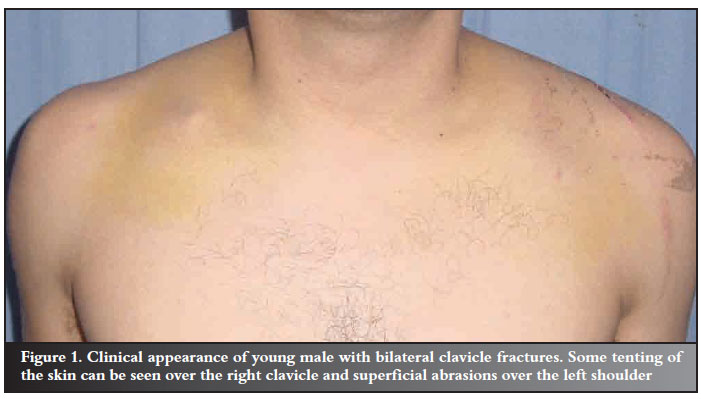
On examination the patient was haemodynamically stable. He had sustained a blunt injury to his left shoulder with a contusion and some superficial abrasions (Figure 1). He also presented with pain, tenderness, bruising and bony instability bilaterally over his clavicles. The clinical diagnosis was made of bilateral clavicle fractures.
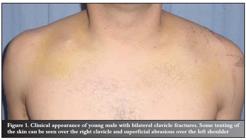
Although the patient had marked bruising and abrasions over the left shoulder, he presented with increased pain over the lateral aspect of the right shoulder and was tender on palpation along the right scapular spine.
His shoulder movements on the right were more markedly decreased than on the left. He had no neurovascular injuries.
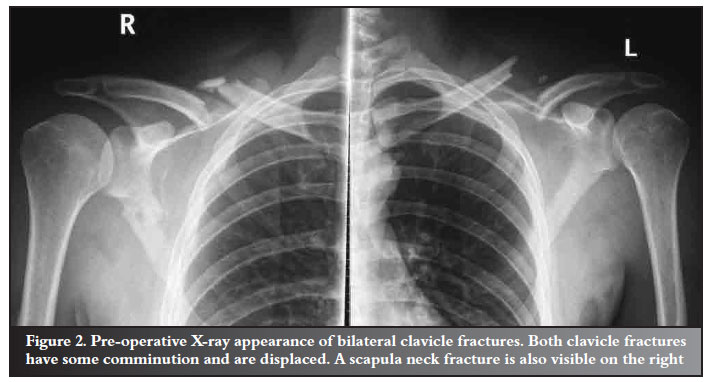
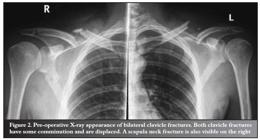
X-rays (Figure 2) revealed a left clavicle fracture, which was 300% displaced, a right clavicle fracture with mild comminution and 200% displacement and a right scapula neck fracture, which was minimally displaced. Both clavicle fractures were type 1C Allman fractures and type 2B1 Robinson fractures according to the relevant classification systems.1
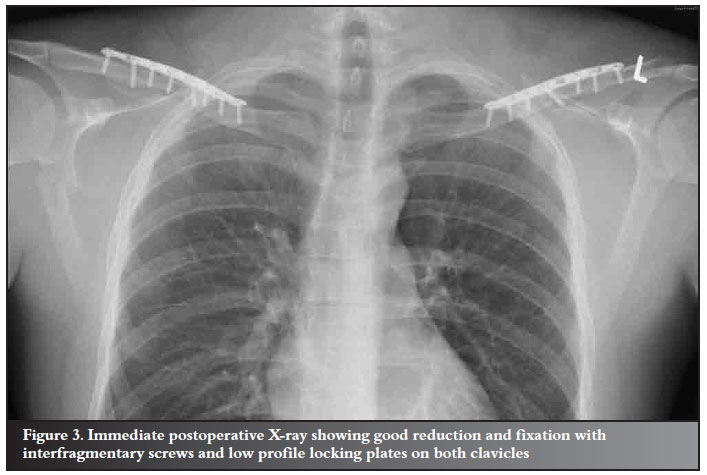
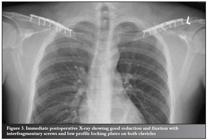
For mobilisation purposes and due to the displacement of the individual fractures the patient subsequently underwent open reduction internal fixation (ORIF) of both clavicles. Both surgeries were performed through the classic superior incision and the fragments were fixed with interfragmentary screws and held with anatomical locking plates (Figure 3). The operation was uneventful and the patient was discharged on the second postoperative day.
The patient was given a Barford-Jones-type arm sling for the right upper limb and a broad arm sling for the left upper limb. He was instructed to keep his right shoulder immobilised for 6 weeks due to the associated scapula fracture, and to use his left hand for activities of daily living.
The patient was reviewed 2 weeks, 6 weeks and 12 weeks postoperatively.
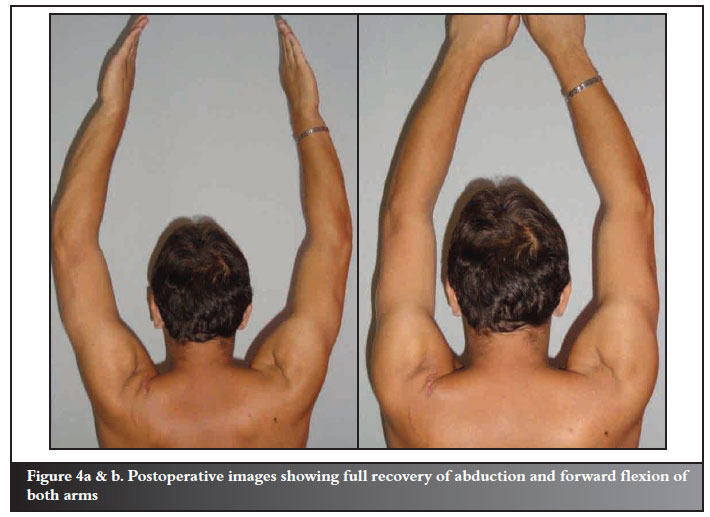
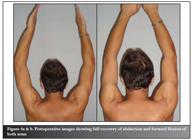
On review of the patient at 6 weeks he was doing well. He had full, pain-free range of motion of both shoulders (Figure 4). The X-rays showed good alignment of the fractures with early signs of union.
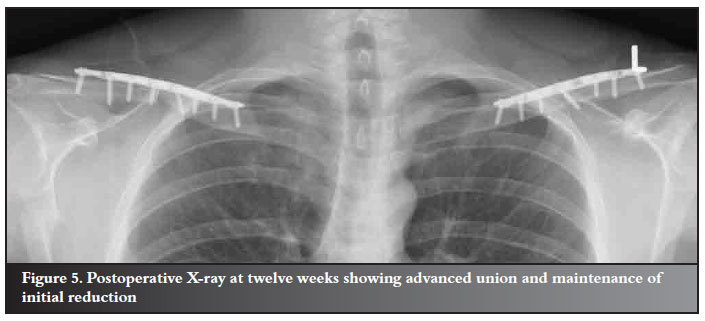
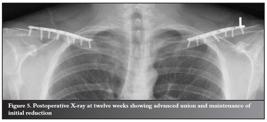
At 12 weeks postoperatively the X-rays (Figure 5) revealed maintenance of initial reduction and advanced union. The patient was satisfied with the result and he was discharged.
Clavicle fractures are common injuries. Isolated clavicle fractures have a reported incidence of 2.6%23133,4
Although clavicle fractures are often seen, bilateral clavicle fractures are rare and are seldom reported on.
An electronic search of the English literature from 1887-2010 was completed. Inclusion criteria were articles that report on patients with bilateral clavicle fractures as well as articles that investigated bilateral clavicle non-union and epidemiological studies on clavicles.
Several series of clavicle fractures have been published and the incidence of bilateral clavicle fractures is as follows:
• Nordqvist3
• Nowak4
• Throckmorton5
• Daab6
• Rowe7
• Malgaigne8
• Robinson1
• Postacchini2
Based on above studies, excluding those by Robinson and Postacchini, the incidence appears to be around 0.43% of clavicle fractures.
There are however several case reports in the literature. These case reports vary from bilateral non-traumatic clavicle fractures,98-25 and bilateral clavicle fracture non-unions.29,32,40
Marya18
The first few cases of bilateral clavicle fractures found are documented and summarised in three articles in The Lancet of July 1890.8,23,24 In these three articles reference is made to 41 cases of bilateral clavicle fractures with Gurlt having seen 18 of them.
Including the two cases presented, there was a total of 29 males and 11 females with bilateral clavicle fractures, and 65 patients in which the gender was unknown (Graph I).

The different age groups of patients with bilateral clavicle fractures reviewed are illustrated in Graph II. In 74 cases the age is not stated.
Regarding the mechanism of injury in unilateral clavicle fractures, it has been shown that several mechanisms can cause a unilateral clavicle fracture2626,27 causing clavicle fractures in up to 94%.
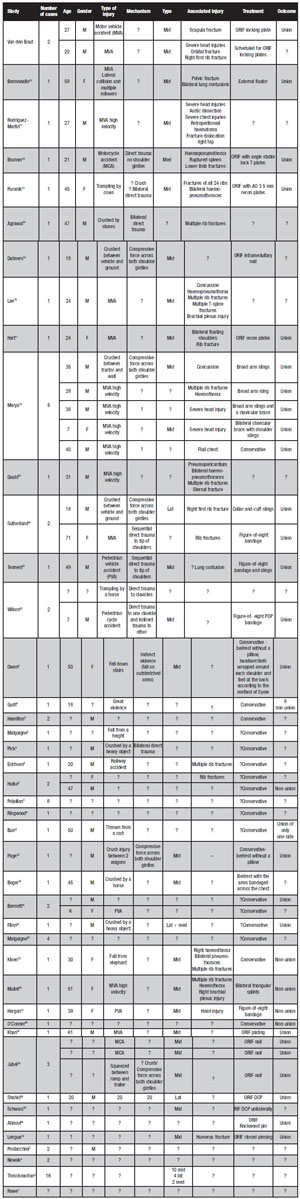
Mechanisms for causing bilateral clavicle fractures include a compressive force across both shoulder girdles,14,17,19,23,28 direct trauma to both clavicles,8,12,14,22 direct trauma on one side and indirect violence in a subsequent fall on the other2220,21 Only one case is reported where indirect violence (fall on outstretched arms) caused bilateral clavicle fractures.8
Bilateral clavicle fractures are usually caused by a high energy impact incident such as a motor vehicle accidents,10,11,16-20,29,30 motorcycle accidents,12,28 pedestrian-vehicle accidents,21,25,31 pedestrian-cycle accident,228,14,15,18,20,23-25,28 trampling by an animal,13,22 fall from a height8,32 and railway accident.8
All 18 cases seen by Gurlt8
Associated injuries are seen much more frequently with bilateral clavicle fractures than with unilateral fractures and the associated injuries are often more severe. Robinson14
In contrast, bilateral clavicle fractures are usually described in the setting of polytrauma.
Associated injuries reported8,10-14,16-21,29,31-33 includes severe head injuries, severe chest injuries (multiple rib fractures, flail chest, sternal fractures, haemopneumothoraces, pneumopericardium, lung contusion, aortic dissection), brachial plexus injury, associated scapula fractures (as in our presented case), humerus fracture, intra-abdominal injuries (ruptured spleen), spinal fractures, pelvic fractures and lower extremity fractures. Bilateral fractures of the medial third of the clavicle are most commonly associated with multisystem trauma and have a high associated mortality rate. In Throckmorton's study5
Similar to unilateral clavicle fractures the treatment of bilateral clavicle fractures has evolved over the years from conservative measures to operative measures. In the first few cases described, the patients were instructed to rest in bed, in an unsupported supine position.8,23 Other conservative treatment methods employed in the reviewed articles include bed rest with the arms bandaged across the chest,24820,31 figure-of-eight plaster of Paris bandage,22212018,29 and others.
Operative measures used for bilateral clavicle fractures include external fixators1013,17 ORIF with angle stable locking T-plates,1234,35 and ORIF with intramedullary devices.15,28,33,36
In our case described we used interfragmentary screws with low profile locking plates (see discussion).
Indications for ORIF specific to bilateral clavicle fractures are to improve ventilatory function301310
Non-union rates of clavicle fractures depend on several factors including age, gender, fracture comminution and displacement of the fracture.37,38
Early studies reported low non-union rates for conservatively treated clavicle fractures. Neer39
Literature analysis
These early studies however did not look specifically at the non-union rate for displaced midshaft clavicle fractures in the adult. There are however recent studies showing that non-union rates for clavicle fractures treated conservatively are much higher than initially reported.
A systematic review by Zlowodzki of 2 144 clavicle fractures found a non-union rate of 15.1% for non-operatively treated displaced fractures of the middle third of the clavicle.38
In the studies reviewed in this article there were no non-unions reported where ORIF was used to treat bilateral clavicle fractures. There are however several examples where non-operative treatment has led to non-union.8,29,31,32,40 Of the 18 cases seen by Gurlt, eight ended up with non-union. It is however not clear from the literature review how many of these fractures were displaced midshaft clavicle fractures.

Discussion
Bilateral clavicle fractures are uncommon and seldom reported on. The mechanism of sustaining bilateral clavicle fractures is different from the mechanism for unilateral clavicle fracture. While a fall or a blow on the point of the shoulder usually causes unilateral clavicle fractures, bilateral clavicle fractures are often caused by a compressive force across both shoulder girdles. Bilateral clavicle fractures are usually associated with high-energy transfer and therefore are associated with other concomitant injuries.
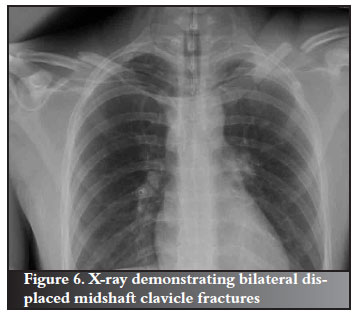
This point was well demonstrated with a subsequent admission. A 20-year-old male was admitted to our institution on 13 January 2011 after he was involved in a motor vehicle accident. He sustained bilateral midshaft clavicle fractures (Figure 6). He had been involved in a high-energy transfer incident and had also sustained an orbital fracture, severe diffuse axonal brain injury, a right first rib fracture and significant lung contusion. His clavicle fractures were type 1B fractures according to the Allman classification and type 2B1 fractures according to the Robinson classification.
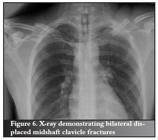
The treating surgeons should thus have a high index of suspicion for associated injuries and actively exclude any such injury. This requires careful examination of the involved areas (i. e spine, thorax, scapula, plexus and others) as well as the necessary special investigations. This becomes especially important in the polytraumatised patient,185
While a single clavicle fracture is usually a simple injury, bilateral clavicle fractures are much more serious as they greatly incapacitate the patient, who can do little for himself.
Furthermore the inspiratory capacity of the thorax is greatly limited and the patients are prone to develop respiratory complications.21
The clavicle fracture can also form part of a more complex disruption of the shoulder girdle and stability of the shoulder complex can often be achieved by stabilisation of the clavicle.41
Open reduction and internal fixation should form the mainstay of treatment of bilateral clavicle fractures. In contrast to unilateral injuries, where each fracture is assessed individually for possible operative intervention, bilateral clavicle fractures are per se an indication for surgical stabilisation.
Anatomic angle stable fixation devices are becoming popular in the treatment of varying fractures, especially in osteoporotic bone where the pull-out strength of conventional systems is often overcome.42,43 Although clavicle fractures more commonly occur in normal bone in patients below the age of 50 years, the weight of the arm creates a cantilever force that increases screw pull-out, especially on the lateral aspect. Therefore screw pull-out strength can be improved with the use of locking plates.42,43
Furthermore peri-articular fractures that require early mobilisation are also increasingly being stabilised with angle-specific locking plates.44
Key notes on bilateral clavicle fractures
• Rare injuries but might be more common than previously reported
• Associated with high energy transfer
• Often caused by a compressive force across both shoulders
• More common in the polytrauma setting
• Actively exclude associated injuries of the head, thorax, spine, and shoulder girdle.
• Bilateral medial clavicle fractures have a high mortality
• Surgical stabilisation indicated:
to improve ventilatory function of severe associated chest injuries
• Fixed angle fixation devices indicated
• Anatomic locking plates recommended
References
Literature review
- 1. Robinson CM. Fractures of the clavicle in the adult. Epidemiology and classification. JBJS Br. 1998;80-B:476-84.
- 2. Postacchini F, Gumina S, De Santis P, Albo F. Epidemiology of clavicle fractures. J Shoulder Elbow Surg 2002 Sep-Oct;11(5):452-56.
- 3. Nordqvist A, Petersson C. The incidence of fractures of the clavicle. Clin Orthop 1994;300:127-32.
- 4. Nowak J, Mallmin H, Larsson S. The aetiology and epidemiology of clavicular fractures. A prospective study during a two-year period in Uppsala, Sweden. Injury, Int. J. Care Injured 2000;31:353-58.
- 5. Throckmorton T, Kuhn JE. Fractures of the medial end of the clavicle. J Shoulder Elbow Surg 2007;16:49-54.
- 6. Daab J, Król P, Sonecki LO. Mechanizmie rzadkich, obustronnych, jednoczasowych uszkodzN obojczyków. Chir Narzadow Ruchu Ortop Pol 1965;30(5):497-500.
- 7. Rowe CR. An atlas of anatomy and treatment of midclavicular fractures. Clin Orthop Relat Res. 1968;58:29-42.
- 8. Owen E. St. Mary's hospital: a case of simultaneous fracture of both clavicles; remarks. The Lancet 1890;136(3488):19-20.
- 9. Quinn RH, Drenga J. Case reports: concurrent bilateral non-traumatic fractures of the clavicle. Clin Orthop Relat Res. 2006 Jun;447:252-55.
- 10. Bonnevialle N, Delannis Y, Mansat P, Peter O, Chemama B, Bonnevialle P. Bilateral clavicle fracture external fixation. Orthopaedics & Traumatology: Surgery & Research 2010;96:821-24.
- 11. Rodriguez-Martin J, Pretell-Mazzini J, Porras-Moreno MA, Hernanz-Gonzalez Y, Resines-Erasun C. A polytrauma patient with an unusual posterior fracture-dislocation of the femoral head: a case report. Strat Traum Limb Recon 2010;5:47-51.
- 12. Brunner A, Wedi E, Hoffmann A, Babst R. Bilateral fracture of the medial clavicles treated by open reduction and internal fixation using angle stable locking T-plates. InjuryExtra 2008;39(8):276-78.
- 13. Puranik G, Gillham N. Bilateral fractured clavicles with multiple rib fractures. Emerg Med J. 2007 Sep;24(9):675.
- 14. Agrawal A, Pratap A, Kumar A, Thapa A, Sinha A. Multiple fractures upper body fractures associated with extradural hematomas. Pak J Neurol Sci 2007;2(1):11-13.
- 15. Dahners LE. Opinion: Antegrade clavicle nailing. J Orthop Trauma. 2005;19(7):501-503.
- 16. Lee Y, Park S, Hamm I. Cerebral fat embolism with multiple rib and thoracic spinal fractures. J Korean Neurosurg Soc 2004;36:408-11.
- 17. Hart R, Janecek M, Bucek P, Chaker A. Bilateral clavicular and scapular neck fractures. Scripta Medica (BRNO) 2004;77(1):3-10.
- 18. Marya KM, Yadav V, Kochar H. Bilateral clavicle fractures. Hong Kong Journal of Orthopaedic surgery 2002;6(1):39-41.
- 19. Gould JC, Schurr MA. Tension pneumopericardium after blunt chest trauma. Ann Thorac Surg 2001;72:1728-30.
- 20. Sutherland AG, Knight DJ. Bilateral fractured clavicles - a pair of cases. Acta Orthop Belg. 2000 Jun;66(3):306-307.
- 21. Tennent W. Bilateral fractures of the clavicles. Br. J Radiol 1942;15:211.
- 22. Wilson MJ. Bilateral fracture of the clavicle: report of an atypical case. JBJS Am. 1931;13:564-65.
- 23. Page HW. Simultaneous fracture of both clavicles. The Lancet 1890;136(3489):72.
- 24. Boger WH. Simultaneous fracture of both clavicles. The Lancet 1890;136(3491):175-76.
- 25. The Lancet 1887;1:178.
- 26. Stanley D, Trowbridge EA, Norris SH. The mechanism of clavicular fracture. A clinical and biochemical analysis. JBJS Br. 1988;70B:461-64.
- 27 .Sankarankutty M, Turner BW. Fractures of the clavicle. Injury 1975;7:101-106.
- 28. Jubel A, Andermahr J, Schiffer G, Tsironis K, Rehm KE. Elastic stable intramedullary nailing of midclavicular fractures with a titanium nail. Clin Orthop Relat Res. 2003;408:279-85.
- 29. Mullett H, Laing A, Curtin W. Successful operative treatment of bilateral clavicle non-union. Injury. Int. J. Care Injured 2001 Jan;32(1):69-70.
- 30. Khan MA, Lucas HK. Plating of fractures of the middle third of the clavicle. Injury: British Journal of Accident Surgery 1978;9:263-67.
- 31. Hargan B, Macafee AL. Bilateral pseudoarthrosis of the clavicles. Injury 1981;12(4):316-18.
- 32. Kloen P. Bilateral clavicle non-unions treated with anteroinferior locking compression plating (LCP): a case report. Acta Orthop Belg. 2004 Dec;70(6):609-11.
- 33. Lengua F, Nuss J-M, Lechner R, Baruthio J, Veillon F. The treatment of fractures of the clavicle by closed medio-lateral pinning. The French Journal of Orthopaedic Surgery 1987;1(3):279-82.
- 34. Shahid R, Mushtaq A, Maqsood M. Plate fixation of clavicle fractures: a comparative study between reconstruction plate and dynamic compression plate. Acta Orthop. Belg 2007;73:170-74.
- 35. Schwarz N, Hocker K. Osteosynthesis of irreducible fractures of the clavicle with 2.7mm ASIF plates. The Journal of Trauma 1992;33(2):179-83.
- 36. Ahmad S, Jahraja H, Sunderamoorthy D, Barnes K, Sanz L, Waseem M. Rockwood pin fixation of clavicle fractures. JBJS Br. 2009;91-B supp 1:10-11.
- 37. Robinson CM, Court-Brown CM, McQueen MM, Wakefield AE. Estimating the risk of non-union following non-operative treatment of a clavicular fracture. JBJS Am. 2004;86:1359-65.
- 38. Zlowodzki M, Zelle BA, Cole PA. Treatment of acute midshaft clavicle fractures: systematic review of 2144 fractures. On behalf of the Evidence-Based Orthopaedic Trauma Working Group. J Orthop Trauma 2005;19(7):504-507.
- 39. Neer CS. Non-union of the clavicle. JAMA 1972;1960:1006-11.
- 40. O'Conner D, Kutty S, McCabe JP. Long-term functional outcome assessment of plate fixation and autogenous bone grafting for clavicular non-union. Injury, Int. J. Care Injured 2004;35:575-79.
- 41. Goss TP. Double disruptions of the superior shoulder suspensory complex. Journal of Orthopaedic Trauma, 1993;7(2):99-106.
- 42. Egol KA, Kubiak EN, Fulkerson E, Kummer FJ, Koval KJ. Biomechanics of locked plates and screws. Journal of Orthopaedic Trauma, September 2004;18(8):488-93.
- 43. Perren SM. Evolution of the internal fixation of long bone fractures. The scientific basis of biological internal fixation: choosing a new balance between stability and biology. JBJS Br. 2002;84-B:1093-110.
- 44. Smith WR, Ziran BH, Anglen JO, Stahel PF. Locking plates: tips and tricks. JBJS Am. 2007;89-A(10):2298-307.
Dr CH Snyckers Wilgers
Hospital Suite 108
Wilgers
Pretoria 0041
Tel: (012) 807-5696 Fax: (012) 807-5694
No benefits of any form have been or are to be received from a commercial party related directly or indirectly to the subject of the article.