
 A new approach in the treatment of hip osteoarthritis: ultrasound-guided 3-in-1 injection
Burak T DedeI, ; Muhammed OğuzII; Bülent AlyanakIII; Fatih BağcıerIV; Mustafa T YıldızgörenV
IDepartment of Physical Medicine and Rehabilitation, Prof. Dr Cemil Tascioglu City Hospital, Istanbul, Turkey
IIDepartment of Physical Medicine and Rehabilitation, Istanbul Training and Research Hospital, Istanbul, Turkey
IIIDepartment of Physical Medicine and Rehabilitation, Kocaeli University Faculty of Medicine, Kocaeli, Turkey
IVDepartment of Physical Medicine and Rehabilitation, Basaksehir Cam and Sakura City Hospital, Istanbul, Turkey
VDepartment of Physical Medicine and Rehabilitation, Konya City Hospital, Konya, Turkey
Osteoarthritis (OA) of the hip is a very common chronic condition characterised by progressive erosion of the articular hyaline cartilage, inflammation of the synovial membrane, and degeneration of the joint capsule and musculotendinous structures, resulting in structural damage to the entire joint. The treatment approach for hip OA is multifaceted, focusing on pain reduction and improvement in function. There are many treatment modalities, and non-surgical treatment options remain popular, especially in the younger population. Among non-surgical treatments, intra-articular injections, treatments for trigger points in myofascial pain syndrome, and nerve blocks are frequently used.1-3
Pericapsular nerve group (PENG) block is one of the nerve block treatment options for hip OA. PENG block is an interfascial plane block targeting the articular branches of the femoral, obturator and axial obturator nerves in the anterior hip capsule. Studies have shown that PENG block reduces pain and improves function in hip OA. However, even though this blockade is known as a motor protective blockade, quadriceps weakness was observed in 25% of cases. This may be because local anaesthetics during blockade affect the femoral nerve through the plane between the pectineus and psoas major.44
The ultrasound probe is placed on the anterior superior iliac spine (ASIS) and slid distal medially. The iliopsoas muscle and femoral head are visualised. The IP between the iliopsoas muscle and the capsular ligament at the femoral head is a potential space for IP block. Once this image is obtained, the femoral neck is included in the image by shifting the probe laterally, slightly distally. The sartorius muscle is visualised superolateral to the iliopsoas muscle, and the rectus femoris muscle is visualised laterally.5
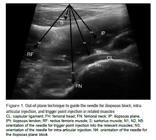
As a result, a new technique in the treatment of hip OA has been described in this letter, and it is stated that more than one point can be treated with the same needle.
ReplyThank you for your correspondence regarding this innovative approach to the management of hip osteoarthritis (OA) using an ultrasound-guided 3-in-1 injection technique. The concept of simultaneously performing an iliopsoas plane (IP) block, an intra-articular hip injection and a trigger point injection using a single needle is compelling. It represents a novel and patient-centred approach to a problem of significant global concern.
Fu et al., in 2022, highlighted the dramatic and escalating universal burden of hip OA. They reported that the disability-adjusted life years (DALYs) attributable to the condition increased from 0.46 million in 1990 to 1.04 million in 2019, representing a noteworthy 127% rise over less than three decades.12
An obvious and elegant anatomical rationale for this approach exists. The IP block seemingly precludes the quadriceps weakness intermittently occurring with pericapsular nerve group (PENG) blocks, which may affect the femoral nerve due to anaesthetic spread into the fascial plane between psoas and pectineus. The choice of the IP block and greater accuracy of targeting of the articular branches to the anterior hip capsule aligns with recent endorsements by Yeoh et al. and Nielsen et al. They argued that the IP block is indeed a motor-sparing alternative to PENG.3,4
Additionally, your technical description which promotes the visualisation of the IP, femoral head and adjacent musculature with subsequent needle repositioning for intra-articular and trigger point injections indicates a rational use of ultrasonography. In patients with needle phobia or those requiring economic outpatient management, this 'three birds with one stone' approach is attractive.
Nevertheless, further consideration of certain issues is imperative.
First, while the technique may provide short-term analgesia, the issue of concerted, long-term efficacy remains. Large randomised controlled trials and meta-analyses56
Secondly, the use of intra-articular local anaesthetics must be approached with some trepidation. A 2022 review75,8 has regularly reported that its clinical effect on hip OA pain is negligible. Worryingly, it has also been reported to have an increased risk of grave adverse events (odds ratio 1.86; 95% CI 1.2-3.1).
Appropriate patient selection is essential. This technique may be best suited to patients with mild-to-moderate radiological pathology or in incidences where the pain generated is primarily by the anterior capsule or myofascial sources, or when synovitis or an effusion is sonographically apparent. In more destructive joint degeneration, where subchondral collapse, osteophyte burden or complete joint space obliteration is present, the clinical gains may be nominal and may delay surgical referral. As Sato et al.9
The feasibility of subsequent global implementation requires sober consideration. This 3-in1-technique, while technically elegant, demands a clinician familiar with musculoskeletal ultrasonography and well informed on pelvic anatomy to be involved. This could limit its applicability outside of tertiary centres. Training pathways would be required to address this potential restriction. Moreover, the inferred risk of bursal rupture, chondral damage, high injection pressures or misplacement in less experienced clinicians' hands warrant caution.
Finally, we must frame the potential implantation of this technique within the broader management framework for hip OA. Evidence from Sweden10
In conclusion, the proposed 3-in-1 injection method is a thoughtful response to a mounting clinical demand. It is elegantly rooted in anatomical and procedural precision, it attacks multiple sources of hip pain in a single sitting, and may offer a short-term solution while awaiting more definitive management. Nonetheless, we concur that the technique warrants further evaluation potentially through prospective studies. This would better elucidate its durability, safety profile and bearing on surgical timelines. We would encourage you to consider a pilot case series or feasibility study and to evaluate the subsequent objective and patient-reported outcomes over a consequential time period.
We look forward to future updates as this technique evolves.
Yours faithfully
Jurek Pietrzak
Department of Orthopaedic Surgery, University of the Witwatersrand, Johannesburg, South Africa
References
- 1. Choueiri M, Chevalier X, Eymard F. Intraarticular corticosteroids for hip osteoarthritis: a review. Cartilage. 2021;13:122S-131S.
- 2. Ceballos-Laita L, Jiménez-Del-Barrio S, Marín-Zurdo J, et al. Effects of dry needling on pain, pressure pain threshold and psychological distress in patients with mild to moderate hip osteoarthritis: Secondary analysis of a randomized controlled trial. Complement Ther Med. 2020;51:102443.
- 3. Kose SG, Kose HC, Celikel F, et al. Ultrasound-guided PENG block versus intraarticular corticosteroid injection in hip osteoarthritis: a randomised controlled study. Korean J Pain. 2023;36:195-207.
- 4. Yeoh SR, Chou Y, Chan SM, et al. Pericapsular nerve group block and iliopsoas plane block: a scoping review of quadriceps weakness after two proclaimed motor-sparing hip blocks. Healthcare (Basel). 2022;10:1565.
- 5. Nielsen ND, Madsen MN, Østergaard HK, et al. An iliopsoas plane block does not cause motor blockade - a blinded randomized volunteer trial. Acta Anaesthesiol Scand. 2020;64:368-77.
-
6. Fu Z, Liu Y, Meng Y, et al. Global, regional and national burden of hip osteoarthritis from 1990 to 2019: results from the Global Burden of Disease study. Arthritis Res Ther. 2022;24(1):8. https://doi.org/10.1186/s13075-021-02705-6
» https://doi.org/10.1186/s13075-021-02705-6 -
7. Pereira TV, Saadat P, Bobos P, et al. Effectiveness and safety of intra-articular interventions for knee and hip osteoarthritis based on large randomized trials: a systematic review and network meta-analysis. Osteoarthr Cartil. 2025;33:207-17. https://doi.org/10.1016/j.joca.2024.08.014
» https://doi.org/10.1016/j.joca.2024.08.014 -
8. Yeoh SR, Chou Y, Chan SM, et al. Pericapsular nerve group block and iliopsoas plane block: a scoping review of quadriceps weakness after two proclaimed motor-sparing hip blocks. Healthcare (Basel). 2022;10(8):1565. https://doi.org/10.3390/healthcare10081565
» https://doi.org/10.3390/healthcare10081565 -
9. Nielsen ND, Madsen MN, 0stergaard HK, et al. An iliopsoas plane block does not cause motor blockade: a blinded randomized volunteer trial. Acta Anaesthesiol Scand. 2020;64(3):368-77. https://doi.org/10.1111/aas.13498. Epub 2019 Nov 13.
» https://doi.org/10.1111/aas.13498 -
10. Pereira TV, Saadat P, Bobos P, Iskander SM, Bodmer NS, Rudnicki M, Kiyomoto HD, Montezuma T, Almeida MO, Bansal R, Cheng P-S, Busse JW, Sutton AJ, Tugwell P. Effectiveness and safety of intra-articular interventions for knee and hip osteoarthritis based on large randomized trials: a systematic review and network meta-analysis. Osteoarthr Cartil. 2025;33(6):207-17. https://doi.org/10.1016/jjoca.2024.11.001.
» https://doi.org/10.1016/jjoca.2024.11.001 - 11. Paskins Z, Bromley K, Lewis M, et al. Clinical effectiveness of one ultrasound guided intra-articular corticosteroid and local anaesthetic injection in addition to advice and education for hip osteoarthritis (HIT trial): single blind, parallel group, three arm, randomised controlled trial. BMJ. 2022;377:e068446.
-
12. Rampal S, Jaiman A, Tokgöz MA, et al. A review of the efficacy of intraarticular hip injection for patients with hip osteoarthritis: To inject or not to inject in hip osteoarthritis? Jt Dis Relat Surg. 2022;33(1):255-62. doi:10.52312/jdrs.2022.402
» https://doi.org/10.52312/jdrs.2022.402 -
13. Migliorini F, Pilone M, Mazzoleni MG, et al. Intra-articular hyaluronic acid injections for hip osteoarthritis: a level I systematic review. Eur J Orthop Surg Traumatol. 2025;35:180. https://doi.org/10.1007/s00590-025-04292-7
» https://doi.org/10.1007/s00590-025-04292-7 -
14. Sato M, Kato R, So M, et al. PENG block for chronic hip pain in OA: a case report and technical considerations. JA Clin Reports. 2023;9(78). https://doi.org/10.1186/s40981-023-00673
» https://doi.org/10.1186/s40981-023-00673 -
15. Gustafsson K, Cronström A, Rolfson O, et al. Responders to first-line OA treatment had reduced frequency of hip and knee joint replacements within 5 years: an observational register-based study of 44 311 patients. Acta Orthop. 2024 Jul15;95:373-79. https://doi.org/10.2340/17453674.2024.41011
» https://doi.org/10.2340/17453674.2024.41011
