Deep infection rate resulting in reoperation in minor hand surgery with wide-awake local anaesthesia no tourniquet (WALANT) under field sterility in an outpatient setting
Abstract
BACKGROUND: The study aims to determine the incidence of surgical site infection (SSI) leading to reoperation following minor hand procedures performed outside the main operating room using field sterility. METHODS: The investigators retrospectively reviewed clinical records of 504 cases in 440 patients who underwent wide-awake local anaesthesia no tourniquet (WALANT) minor hand surgery in a field sterility setting over a four-year period between March 2019 and June 2023. The data was collected at a tertiary institution which serves members of the South African Military Service via a wide catchment area. SSI was defined according to the Centers for Disease Control and Prevention (CDC) occurring within four weeks postoperatively. Cases included were elective WALANT minor hand procedures in patients above 18 years. RESULTS: The deep SSI rate within four weeks postoperatively resulting in reoperation was 1% (95% confidence interval [CI] 0.01-0.02); infection rate for carpal tunnel release (CTR) was 2%, (95% CI 0.74-5.20). The majority of procedures performed were carpal tunnel and trigger finger releases, with a female predominance at 57% and the average age of patients being 57 years (SD ± 13 years. CONCLUSION: The study's infection rate is comparable to international infection rates for similar surgeries performed using field sterility in an outpatient setting. Minor hand procedures performed under field sterility using WALANT have a low SSI rate with acceptable morbidity. This implies that WALANT under field sterility is a safe clinical practice. Level of evidence: 4
WALANT; hand surgery; carpal tunnel release; trigger finger
Introduction
Wide-awake local anaesthetic no tourniquet (WALANT) surgery has effectively introduced a new era of worldwide clinical practice in hand surgery throughout the past two decades. In recent years, the utilisation and efficacy of WALANT have increased substantially in South Africa.
WALANT appeals to low socioeconomic countries with limited resources, lengthy elective surgery waiting lists, and restricted theatre time.1-5 WALANT surgery has expanded during resource-scarce periods, such as during the COVID-19 pandemic, as it averts the need for main operating rooms or hospital operations.6-9
The Centers for Disease Control and Prevention (CDC) defines surgical site infection (SSI) as an infection of the skin or subcutaneous tissue at the incision site within 30 days.10-11 According to the CDC's definition, neither the diagnosis nor treatment of cellulitis or stitch abscess alone are considered adequate criteria for SSI. Depending on the definition of SSI used, the rate of SSI in the field sterility setting in carpal tunnel release (CTR) performed under WALANT in the outpatient context might range from 0.28 to 6.4%, according to a recent global publication.12
Effective preventative measures taken before, during and after surgery can improve the prevention and control of infection. Infection control practices in the operating room where complete sterility is practised, have surgeons gowned and capped, and the patients fully draped, as international guidelines recommend.13-14 In contrast, with field sterility, surgeons use masks and sterile gloves when moving procedures to the outpatient setting but are not gowned and capped. The surgical site is prepared with a cleaning solution of iodine or chlorhexidine, a single drape, and a set of sterile instruments. Patients receive no prophylactic antibiotic therapy, as literature has shown it does not add any clinically significant protection in elective hand surgery.15-16 Unlike in a theatre room, there is no defined airflow within the procedure rooms, and the setup requires fewer staff members, limits disposable items, and reduces waste, cost and preparation time. Additionally, WALANT surgery allows mitigated use of opioids for postoperative pain management.1718-23 and South African hand surgeons are cautious about transferring minor hand procedures from the operating room to an outpatient setting due to the presumed risk of infection.
Avoricani et al. studied 217 patients who underwent 265 upper extremity procedures. They reported 0% 14-day and 0.37% 30-day SSI rates for hand/upper extremity procedures done in a minor procedure room using field sterility. These rates were comparable to SSI rates for similar operations in a primary theatre setting with standard sterilisation procedures.242526
Several studies have been conducted on South African patients' viewpoints on pain and patient preferences regarding WALANT in the context of government healthcare facilities. However, more information on the local SSI rate related to field sterility is needed. Health institutions need infection surveillance to manage SSI. Each facility should create systems to monitor changes in SSI incidence over time.14
In this study, the authors sought to determine the SSI deep infection rate necessitating reoperation in minor hand surgeries performed under WALANT in an outpatient field sterility setting. Given the increasing utilisation of WALANT in South Africa, this study aimed to contribute to the body of evidence on SSI in the outpatient setting. We hypothesised that the infection rate would be comparable to those reported in international literature and similar to rates observed in the main operating room setting.
Methods
A retrospective, longitudinal study was conducted at a single facility to ascertain the incidence of deep SSI necessitating reoperation in elective minor hand surgery patients who underwent the procedure under WALANT and field sterility. The research team examined all minor hand surgery cases performed between March 2019 and June 2023. The authors obtained research, ethical authorisation, and hospital approval before the study's commencement.
A deep SSI infection was diagnosed if purulent drainage of pus was found involving the skin and subcutaneous tissues, or if infection was noted to be progressing beyond a stitch abscess on clinical examination, organisms identified on specimen cultures, and occurring within the 30-day period post-surgery according to the CDC's guidance. Inclusion criteria included patients older than 18 years who underwent minor hand surgery performed under WALANT in a field sterility setting with complete medical records and at least four weeks of follow-up post-surgery. Acute trauma-related operations, surgeries performed in a traditional operating room adhering to standard surgical sterility protocols, and cases with incomplete clinical records were excluded. Data essential to the study, including sex, age, patient diagnosis, surgical procedure performed, and setting of operative environment, was sought and, if absent, these records were excluded from the study.
The study was conducted at a tertiary institution that treats military personnel, their families, and war veterans. The facility's patients receive postoperative follow-up care at the institution or local sick bay facilities, all equipped with electronic record-keeping systems. Should the patient require additional surgery for sepsis, it must be performed exclusively at the institution. A thorough follow-up of all participants reduced the likelihood of missed outcomes.
The institution's orthopaedic outpatient clinic has a dedicated WALANT procedure room, which accommodates five to eight cases per day, once weekly. All cases are minor hand procedures performed as a day case operation, with minimal risk of inducing permanent impairment of physical or physiological function. The central sterile services department supplies the facility with the required sterile sets. Patients were not given prophylactic antibiotics. The WALANT mixture administered to patients was at a concentration of 1:100 000 adrenaline, 0.85% sodium bicarbonate, and pH value between 7.38 and 7.62. In all patients, lignocaine dosing was below 7 mg per kg. Procedures were performed under a field sterility set-up which included skin preparation with chlorhexidine and alcohol solution, and minimal draping (two draping towels and one rolled-up towel as a positioner). The surgeons wore only sterile gloves and masks without donning sterile gowns.
The authors analysed the institution's computerised data system, outpatient registry, theatre, WALANT procedure lists, and clinical records. The captured data includes patient characteristics, diagnosis, coexisting medical conditions, and surgical procedures. Postoperative infections requiring reoperation for infection were identified through examination of the follow-up notes and theatre notes within four weeks of the WALANT surgical procedure. The electronically gathered data was manually cross-checked with the physical patient records.
Statistical analysis
Data was recorded using Microsoft Excel 2019, then exported to Stata 18 format for analysis using Stata 18 software. The descriptive statistics provide the continuous characteristics' means, standard deviation, and 95% confidence interval. A frequency summary provided percentages for discrete variables (such as definite diagnosis for the WALANT technique). In addition, contingency table analyses using the chi-square test were conducted to assess the relationship between infection and sex and side. Furthermore, a t-test was utilised to compare the means and proportions of specific characteristics between sexes.
Results
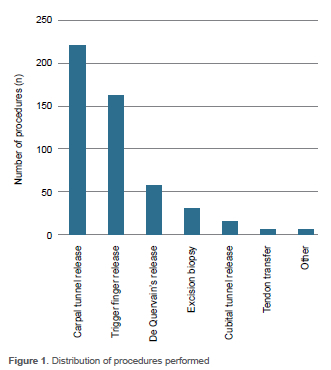
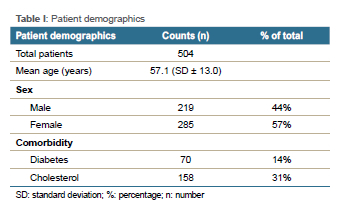
During the four-year investigation, a total of 525 WALANT procedures were identified. Twenty-one cases were excluded for incomplete clinical records, resulting in 504 cases for analysis. The average age of the patients was 57 years (SD ± 13 years); and females accounted for most patients, being 285 of 504 (57%). CTR accounted for the most significant proportion of the procedures conducted, at 221 of 504 (44%). Patient demographics are outlined in Table I, and a breakdown of procedures performed is shown in Figure 1.
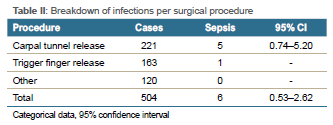
Six patients with single procedures performed developed deep SSI that required reoperation within 30 days of the surgery. The infection rate was 1% (95% CI 0.53-2.62). Further sub-analysis revealed that the infection rate for CTR was 2% (95% CI 0.74-5.20). Table II shows details of the deep infection rate per procedure. Three of the six cases with deep infection had negative cultures, while the remaining three showed minimal growth of Gram-positive cocci. All six cases were readmitted and underwent a single debridement in the main theatre setting, followed by a period of intravenous and oral antibiotics (co-amoxiclav in all cases); the six cases presented within 14 days of the index procedure. Due to the low number of infection cases, the investigators could not identify any critical contributing factors to SSI. An attempt was made to examine any association between the infection and sex on one hand, and infection and side on the other; however, the Fisher's exact and chi-square tests showed no association.
One patient, an 87-year-old gunsmith with a history of ischaemic heart disease, hypertension, hypercholesterolaemia, and benign prostatic hypertrophy required surgery after developing septic tenosynovitis from a trigger finger release. Notably, he had used gun oil in an attempt to heal his wound. He showed signs and symptoms of a deep infection in the flexor tendon sheath ten days after the index operation. After undergoing debridement in the operating room, the patient recovered without further complications.
Another case involved a 56-year-old male paraplegic patient with lung cancer and hypertension, who experienced an acute infection nine days after undergoing CTR. He exerted pressure on his wound during transfers leading to wound breakdown and eventual SSI. Following the debridement in the operating room, he was cared for in the ward for eight days until his wound healed.
Discussion
The results of the present investigation reveal that the deep SSI rate of 1% for WALANT surgery performed under field sterility necessitating reoperation is consistent with rates documented in existing literature.25,27,28 Avoricani et al., reported a 30-day SSI rate of 0.37% for a variety of surgeries involving the upper extremity. Given the similar variation in procedures and comparable follow-up times, the infection rate of 1% observed aligns well with these findings. The marginal difference in infection rate can be attributed to the slightly larger population is this study.2429
The sub-analysis of CTR infection rates under field sterility was 3%. The literature reports a wide range of variability of CTR infection rates, from 0-8.9%. Sandefur et al. reported on the infection rate in 748 CTR procedures performed under field sterility; their results showed a variable infection rate of 8.9%, 2.3% and 0.4%. The heterogeneity noted resulted from variable definitions used for SSI.121330
Local surgeons are cautious about outpatient procedures in the field sterility setting for minor hand cases due to the possible infection risk. However, Oakes et al.'s findings in transitioning hand procedures from main theatre to field sterility shows acceptable outcomes. They observed a higher infection rate of 2.78% in the operating theatre compared to the office-based setting of 1.24% during a WALANT transition period. The difference was not statistically significant. These findings suggest that the field sterility infection rate may be comparable to the operating theatre for WALANT surgery.31
Diabetes, sex and age are risk factors linked to postoperative infection in CTR; other additional risk factors reported include local steroid injection, surgical drain use and obesity.32,33 Coffman et al. reviewed 1 228 office-based procedures performed with WALANT, encompassing a broad range of surgeries. They reported an infection rate of 2.77% and found patients known to have autoimmune disorders and who were active smokers to have a significant risk of complications.34
Schank et al. give a lengthy list of WALANT procedures recommended for the main operating theatre setting, especially in cases where infection would prove more devastating and lead to severe morbidity.3518
Limitations in this paper include the retrospective nature of the study, which may result in selection bias. The exclusion of incomplete records reduced the population size. Multivariant analysis of individual risk factors could not be determined due to low infection rates. Comorbidities such as HIV, diabetes and anaemia, which can influence infection risk, were documented from patient records and not tested to determine the level of severity. Additionally, patient body mass index (BMI) and smoking status were not consistently captured and thus could not be analysed, and these factors may have highlighted possible associations to deep SSI. Patients treated at the institution are active or former members of the South African National Defence Force (their dependants are also included). They can be classified as a middle-income socioeconomic demographic, and this may differ from populations served at other government institutions, limiting generalisability of results to lower socioeconomic classes. The current study is a retrospective case series with no comparison group. Prospective, higher-powered, multicentre studies comparing the incidence of SSI in field sterility versus theatre settings would more effectively identify factors associated with SSI and provide clearer insights into the comparative safety standards of the two environments.
Conclusion
The low infection rate reported in this paper is consistent with findings in international literature, suggesting that field sterility in the procedure room can accommodate various procedures, yielding low and acceptable infections with minimal morbidity. This suggests that WALANT surgery under field sterility is a safe clinical practice. Given the results, WALANT under field sterility could be expanded to smaller district hospitals. Implementing in-service training programmes for these facilities could increase access to elective hand surgeries, thereby reducing the burden on tertiary hospitals and reaching more patients in need.
Ethics statement
The authors declare that this submission is in accordance with the principles laid down by the Responsible Research Publication Position Statements as developed at the 2nd World Conference on Research Integrity in Singapore, 2010.
The study complies with the South African Department of Health ethics guidelines (2015), and research ethics policy of University of Pretoria. Before the commencement of this research, the appropriate ethical approval was obtained from the Faculty of Health Sciences Research Ethics Committee of the University of Pretoria (320/2023).
All procedures were in accordance with the ethical standards of the responsible committee on human experimentation (institutional and national) and with the Helsinki Declaration of 1975, as revised in 2008. Informed written consent was not obtained nor necessary as the study was retrospective, utilising data that had been collected in standard clinical practice.
Declaration
The authors declare authorship of this article and that they have followed sound scientific research practice. This research is original and does not transgress plagiarism policies.
Author contributions
LLS: study conceptualisation and design, data collection, data analysis and manuscript preparation
OK: study conceptualisation and design, data collection, data analysis and manuscript preparation
SO: data analysis and interpretation, and final approval of version to be published LR: data collection and data analysis
TlR: study conceptualisation and design, and liaising between the 1 Military Hospital Research Ethics Committee and the investigators
ORCID
Skosana LL https://orcid.org/0009-0002-9121-7047
Koch O https://orcid.org/0000-0003-1871-9569
Olorunju S https://orcid.org/0000-0002-5598-8090
Rademan L https://orcid.org/0009-0009-1672-7013
le Roux T https://orcid.org/0000-0001-7450-6459
References
-
1. Holoyda KA, Farhat B, Lalonde DH, et al. Creating an outpatient, local anesthetic hand operating room in a resource-constrained Ghanaian hospital builds surgical capacity and financial stability. Ann Plast Surg. 2020; 84(4):385-89. https://doi.org/10.1097/SAP.0000000000002196
» https://doi.org/10.1097/SAP.0000000000002196 -
2. Rocher AGL OCM, Koch O. Wide awake local anaesthesia no tourniquet: A review of current concepts. SA Orthop J. 2021; 21(3):172-79. https://doi.org/10.17159/2309-8309/2022/v21n3a6
» https://doi.org/10.17159/2309-8309/2022/v21n3a6 -
3. de Buys M, Tsama M, Aden AA. Patient satisfaction following wide awake local anaesthetic no tourniquet hand surgery. SA Orthop J. 2022; 21(1). https://doi.org/10.17159/2309-8309/2022/v21n1a6
» https://doi.org/10.17159/2309-8309/2022/v21n1a6 -
4. Naude JJ, Koch O, Schmidt LW, le Roux TLB. Positive patient experience of wide awake local anaesthesia no tourniquet (WALANT) hand surgery in the government setting: A prospective descriptive study. SA Orthop J. 2021; 20(3). https://doi.org/10.17159/2309-8309/2021/v20n3a1
» https://doi.org/10.17159/2309-8309/2021/v20n3a1 -
5. Pires Neto PJ, Ribak S, Sardenberg T. Wide awake hand surgery under local anesthesia no tourniquet in South America. Hand Clin. 2019; 35(1):51-58. https://doi.org/10.1016/j.hcl.2018.08.005
» https://doi.org/10.1016/j.hcl.2018.08.005 -
6. Koch O. How to start walant practice in South Africa: 'Service with a smile if you are willing to wait awhile'. J Hand Surg Glob Online. 2022; Jun 22;4(6):e467-470. https://doi.org/10.1016/j.jhsg.2022.05.010
» https://doi.org/10.1016/j.jhsg.2022.05.010 -
7. Hobday D, Welman T, O'Neill N, Pahal GS. A protocol for wide awake local anaesthetic no tourniquet (WALANT) hand surgery in the context of the coronavirus disease 2019 (Covid-19) pandemic. Surgeon. 2020; 18(6):e67-e71. https://doi.org/10.1016/j.surge.2020.06.015
» https://doi.org/10.1016/j.surge.2020.06.015 -
8. Kurtzman JS, Etcheson JI, Koehler SM. Wide-awake local anesthesia with no tourniquet: An updated review. Plast Reconstr Surg Glob Open. 2021;9(3):e3507. https://doi.org/10.1097/GOX.0000000000003507
» https://doi.org/10.1097/GOX.0000000000003507 -
9. Turcotte JJ, Petre BM, Jones CM, Gelfand JM. Maintaining access to orthopaedic surgery during periods of operating room resource constraint: Expanded use of wide-awake surgery during the covid-19 pandemic. J Am Acad Orthop Surg Glob Res Rev. 2020;4(12):e20 00100. https://doi.org/10.5435/JAAOSGlobal-D-20-00100
» https://doi.org/10.5435/JAAOSGlobal-D-20-00100 -
10. Berrios-Torres SI, Umscheid CA, Bratzler DW, et al. Centers for Disease Control and Prevention guideline for the prevention of surgical site infection, 2017. JAMA Surg. 2017; 152(8):784-91. https://doi.org/10.1001/jamasurg.2017.0904
» https://doi.org/10.1001/jamasurg.2017.0904 -
11. National Healthcare Safety Network Centers for Disease Control and Prevention [Internet]. Surgical site infection (ssi) event.: CDC.gov; 2025 [cited 2025 10/06/2025]. Available from: http://www.cdc.gov/nhsn/pdfs/pscmanual/9pscssicurrent.pdf.
» http://www.cdc.gov/nhsn/pdfs/pscmanual/9pscssicurrent.pdf -
12. Sandefur EP, Beck JH, Vest MO, et al. What is a surgical site infection after carpal tunnel release? J Hand Surg Am. 2024;49(8):766-71. https://doi.org/10.1016/jjhsa.2023.12.014
» https://doi.org/10.1016/jjhsa.2023.12.014 -
13. Halvorson AJ, Sechriest VF, 2nd, Gravely A, DeVries AS. Risk of surgical site infection after carpal tunnel release performed in an operating room versus a clinic-based procedure room within a Veterans Affairs medical center. Am J Infect Control. 2020; 48(2):173-77. https://doi.org/10.1016/j.ajic.2019.08.004
» https://doi.org/10.1016/j.ajic.2019.08.004 -
14. Castella A, Charrier L, di Legami V, et al. Surgical site infection surveillance: Analysis of adherence to recommendations for routine infection control practices. Infect Control Hosp Epidemiol. 2006;27(8):835-40. https://doi.org/10.1086/506396
» https://doi.org/10.1086/506396 -
15. Tosti R, Fowler J, Dwyer J, et al. Is antibiotic prophylaxis necessaryln elective soft tissue hand surgery? Orthopedics. 2012; 35(6):e829-33. https://doi.org/10.3928/01477447-20120525-20
» https://doi.org/10.3928/01477447-20120525-20 -
16. Rizvi M, Bille B, Holtom P, Schnall SB. The role of prophylactic antibiotics in elective hand surgery. J Hand Surg Am. 2008;33(3):413-20. https://doi.org/10.1016/j.jhsa.2007.12.017
» https://doi.org/10.1016/j.jhsa.2007.12.017 -
17. Tan E, Bamberger HB, Saucedo J. Incorporating office-based surgery into your practice with walant. J Hand Surg Am. 2020;45(10):977-81. https://doi.org/10.1016/jjhsa.2020.07.003
» https://doi.org/10.1016/jjhsa.2020.07.003 -
18. Yu J, Ji TA, Craig M, et al. Evidence-based sterility: The evolving role of field sterility in skin and minor hand surgery. Plast Reconstr Surg Glob Open. 2019;7(11):e2481. https://doi.org/10.1097/GOX.0000000000002481
» https://doi.org/10.1097/GOX.0000000000002481 - 19. van Demark RE Jr, Becker HA, Anderson MC, Smith VJS. Wide-awake-anesthesia-in-the-in-office-procedure-room-lessons-learned. J Hand Surg Am. 2018;13(4):481-85.
-
20. Leblanc MR, Lalonde J, Lalonde DH. A detailed cost and efficiency analysis of performing carpal tunnel surgery in the main operating room versus the ambulatory setting in Canada. Hand (NY). 2007;2(4):173-78. https://doi.org/10.1007/s11552-007-9043-5
» https://doi.org/10.1007/s11552-007-9043-5 -
21. Lalonde DH. Latest advances in wide awake hand surgery. Hand Clin. 2019;35(1):1-6. https://doi.org/10.1016/j.hcl.2018.08.002
» https://doi.org/10.1016/j.hcl.2018.08.002 -
22. Connors KM, Guerra SM, Koehler SM. Current evidence involving WALANT surgery. J Hand Surg Glob Online. 2022;4(6):452-55. https://doi.org/10.1016/jjhsg.2022.01.009
» https://doi.org/10.1016/jjhsg.2022.01.009 -
23. Dar QA, Avoricani A, Rompala A, et al. WALANT hand surgery does not require postoperative opioid pain management. Plast Reconstr Surg. 2021;148(1):121-30. https://doi.org/10.1097/PRS.0000000000008053
» https://doi.org/10.1097/PRS.0000000000008053 -
24. Avoricani A, Dar Q-A, Levy KH, et al. WALANT hand and upper extremity procedures performed with minor field sterility are associated with low infection rates. Plastic Surg (Oakv). 2022 May;30(2):122-29. https://doi.org/10.1177/22925503211003840
» https://doi.org/10.1177/22925503211003840 -
25. Leblanc MR, Lalonde DH, Thoma A, et al. Is main operating room sterility really necessary in carpal tunnel surgery? A multicenter prospective study of minor procedure room field sterility surgery. Hand (NY). 2011;6(1):60-63. https://doi.org/10.1007/s11552-010-9301-9
» https://doi.org/10.1007/s11552-010-9301-9 -
26. Tang JB, Gong KT, Xing SG, et al. Wide-awake hand surgery in two centers in China: Experience in Nantong and Tianjin with 12,000 patients. Hand Clin. 2019;35(1):7-12. https://doi.org/10.1016pcl.2018.08.011
» https://doi.org/10.1016pcl.2018.08.011 -
27. Rhee PC, Fischer MM, Rhee LS, et al. Cost savings and patient experiences of a clinic-based, wide-awake hand surgery program at a military medical center: A critical analysis of the first 100 procedures. J Hand Surg Am. 2017;42(3):e139-e47. https://doi.org/10.1016/j.jhsa.2016.11.019
» https://doi.org/10.1016/j.jhsa.2016.11.019 -
28. Jagodzinski NA, Ibish S, Furniss D. Surgical site infection after hand surgery outside the operating theatre a systematic review. J Hand Surg Eur Vol. 2017;42(3):289-94. https://doi.org/1//0d.o1i.1o7rg7/107.15137179/1374513616973461460687
» https://doi.org/1//0d.o1i.1o7rg7/107.15137179/1374513616973461460687 -
29. Lawand J, Hantouly A, Bouri F, et al. Complications and side effects of wide-awake local anaesthesia no tourniquet (WALANT) in upper limb surgery: a systematic review and meta-analysis. Int Orthop. 2024;48(5):1257-69. https://doi.org/10.1007/s00264-024-06104-9
» https://doi.org/10.1007/s00264-024-06104-9 - 30. Rellán I, Bronenberg VP, Kohan FFSV, et al. What is the infection rate of carpal tunnel syndrome and trigger finger release performed under wide-awake anesthesia? Hand. 2023;18(2):198-202.
-
31. Oakes TC, Wong KC, Schank KJ, et al. Infection rate comparison during transition from hospital to office WALANT enabled by virtual reality. Plast Reconstr Surg Glob Open. 2022;10(5):e4285. https://doi.org/10.1097/GOX.0000000000004285
» https://doi.org/10.1097/GOX.0000000000004285 -
32. Werner BC, Teran VA, Deal DN. Patient-related risk factors for infection following open carpal tunnel release: An analysis of over 450,000 Medicare patients. J Hand Surg Am. 2018;43(3):214-19. https://doi.org/10.1016/jjhsa.2017.09.017
» https://doi.org/10.1016/jjhsa.2017.09.017 -
33. Harness NG, Inacio MC, Pfeil FF, Paxton LW. Rate of infection after carpal tunnel release surgery and effect of antibiotic prophylaxis. J Hand Surg Am. 2010;35(2):189-96. https://doi.org/10.1016/j.jhsa.2009.11.012
» https://doi.org/10.1016/j.jhsa.2009.11.012 -
34. Coffman JR, Dela Cruz JA, Stein BA, et al. A review of 1228 in-office hand surgery procedures with wide awake local anaesthesia no tourniquet (WALANT) at a single private practice. Hand (NY). 2024 Mar 15:15589447241235251. https://doi.org/10.1177/15589447241235251
» https://doi.org/10.1177/15589447241235251 -
35. Schank KJ, Engwall AJ, Kuhns BW, et al. Guidelines for wide-awake local anesthesia surgery with no tourniquet in the office setting using field preparation sterility. Plast Reconstr Surg. 2023;151(2):267e-73e. https://doi.org/10.1097/PRS.0000000000009850
» https://doi.org/10.1097/PRS.0000000000009850
Accepted: February 2025
Published: August 2025
Editor: Prof. Duncan McGuire, University of Cape Town, Cape Town, South Africa
Funding: No funding was received for this study.
Conflict of interest: The authors declare they have no conflicts of interest that are directly or indirectly related to the research.