Risk factors for complication requiring reintervention following reverse shoulder arthroplasty: a retrospective study 2011-2021
Abstract
BACKGROUND: Degenerative disease of the shoulder is successfully managed with arthroplasty. In the presence of a deficient rotator cuff, the non-anatomic reverse shoulder arthroplasty (RSA) is advantageous. High rates of complication following RSA have been reported in previous international investigations. We aimed to determine the local complication requiring reintervention rate, and identify any associated risk factors. METHODS: We conducted a retrospective electronic medical record review of all patients that underwent RSA between January 2011 and December 2021. Basic demographic details including type and number of comorbidities were captured, and follow-up notes reviewed for the documentation of complications. The data was summarised, the complication requiring reintervention rate calculated, and logistic regression performed to identify any factors associated with an increased risk of complication. RESULTS: A total of 93 patients met inclusion criteria, including six patients with bilateral pathology accounting for 99 cases, with a median follow-up of 1 121 days. The cohort comprised predominantly female patients (65%) with a median age of 72 years, and 55% required RSA for rotator cuff arthropathy. A total of 24% of cases complicated and required reintervention; 20% required additional surgery. Ten cases complicated with sepsis, 12 cases with instability, and one each with a haematoma and mechanical failure. Ninety-three per cent of patients had comorbid disease, and renal pathology was associated with a 5.9 times increased risk of complication. CONCLUSION: In a ten-year review of patients undergoing RSA for degenerative disease, we report a 24% complication requiring reintervention rate. The most common complications included instability and sepsis. Patients with renal pathology were found to be at greater risk of complications requiring reintervention. Future prospective evaluation of RSA outcomes is needed to identify all factors contributary to complications. Level of evidence: 4
reverse shoulder arthroplasty; complication rate; sepsis; dislocation
Introduction
The advent of shoulder arthroplasty at the end of the 19th century marked a new era in the management of shoulder joint pathology. In the late 20th century, the standard total and hemi-shoulder arthroplasty evolved, through advances in technology and the applied knowledge of biomechanics, to include the treatment of shoulder arthropathy by reverse shoulder arthroplasty (RSA).1 Despite four decades of, and ongoing adjustments to, the original Grammont RSA design to address postoperative challenges, complications still remain a concern.2-5 Complications often require subsequent surgery and affect patient satisfaction.6
Dislocations, infections, periprosthetic fractures, and aseptic loosening of prostheses (intraoperative or postoperative) are complications which have the potential to negatively affect the outcome of RSA surgery.6,7 Kim et al. distinguish complications from minor problems.6 Minor problems are deemed unlikely to affect surgical outcomes.6 Complication rates between 9 and 25% have been reported.6 Kim et al. suggest that this wide range may be attributed to the assortment of implant designs (representative of design adjustments and the evolution of RSA prostheses), variability in surgical skill, and differing definitions of complications.6 Barco et al. additionally proposed that high complication rates may reflect the absolute increase in utility of reverse prostheses for expanding indications.6,8
Various complications have been investigated in detail.912 Relationships have been established between the initial operative indication, the patient baseline characteristics, individual complications, and their chronicity.13,14 Kohan et al. defined early complications as those presenting within the first three months postoperatively, after which time complications are considered to be late.9 Early and late complications described include instability or dislocation, infection, aseptic glenoid or humeral loosening, peri-prosthetic fractures, disassembly, and neurologic complications. Instability is common, with an incidence of between 3 and 5%.7 Cited risk factors include RSA performed through a deltopectoral approach, cemented humeral stem, subscapularis deficiency, implant retroversion, and a body mass index (BMI) of more than 30 kg/m2.11-13,15,16 Infection is another predominant complication, with reported rates of between 1.1% and 4.1%.6,17 Male patients younger than 65 years of age who have had prior ipsilateral shoulder surgery appear to have increased risk of postoperative infection.18 Furthermore, infection is a common cause of implant failure requiring revision surgery in international investigation.6,15 This is consistent with a local cohort investigated by du Plessis et al. who reported a high reintervention rate in RSA cases that complicated with sepsis.19
Although previous investigation has been conducted for complications requiring reintervention following RSA in international cohorts, these are largely from high-income countries with differing disease burdens, healthcare resources and healthcare access.20,21 These factors have a potential to affect complication rates.22 In the South African (SA) context, no prior investigation has elucidated the incidence of complications requiring reintervention following RSA. This study aims primarily to describe the complications requiring reintervention, and associated incidence, following primary RSA for degenerative disease in a single cohort. Second, it aims to delineate the patient demographics and potential risk factors for complication.
Methods
This analytical, retrospective cohort study was performed using the 'STrengthening the Reporting of OBservational studies in Epidemiology' (STROBE) statement as a guideline.23 During the period January 2011 to December 2021, all patients who had an RSA performed at our hospital, utilising a single implant and implant manufacturer, were identified. Following appropriate ethical approval, the records of these patients were obtained from the manufacturer. This patient information was used to source the associated electronic medical data for each patient held at the hospital, which were reviewed for inclusion in the study. All adult patients that received a primary RSA for degenerative disease (RSA for tumours and fractures or fracture-dislocations were not eligible for inclusion), performed through a superolateral approach, were eligible for inclusion. Patients with less than six months of follow-up were excluded.
For this investigation, degenerative disease included all cases of glenohumeral osteoarthritis (OA) described by Ibounig et al. as 'degenerative joint disease affecting the cartilage, and associated bony counterparts presenting with joint pain, stiffness, and decrease in the range of movement'.24 The preferred surgical approach in this institution is a superolateral Mackenzie approach.25,26 As there is presently no gold standard approach, inclusion based on approach was used in order to eliminate the potential confounder of utilising assorted surgical approaches.27-29 Similarly, while it was the surgical team's preference to use a single implant manufacturer and design (cemented inlay humeral stem with a neck shaft angle of 145°), this coincidentally eliminated the potential confounding effect of using varying implants. All surgeries were performed by one of two senior specialists. All patients received a single dose of prophylactic antibiotics (cefazolin 2g intravenously) prior to skin incision, and the prophylactic antibiotics were continued for 24 hours postoperatively (cefazolin 1 g administered every eight hours for three further doses). A delayed shoulder range of motion rehabilitation protocol was exercised. The arm was held in a sling for six weeks, and no active or passive shoulder range of motion was permitted. Elbow range of motion was encouraged.30,31
A retrospective review was conducted of each patient's medical records. Patients' demographic details, including age at surgery, sex, operated side, and comorbidities were captured. Follow-up notes were reviewed to assess for the presence of complications requiring reintervention. The nature and timing of each complication were documented, as well as the number and nature of reinterventions required.
A complication was defined as any unanticipated event that had the potential to negatively affect the patient's outcome, as previously defined by Kim and Zumstein et al.6,7 Complications that occurred up to three months post-surgery were defined as early complications, and those that occurred at three months or later were termed late complications.9,32 The complications encountered in this cohort included instability, sepsis, mechanical failure and haematoma formation. Instability referred to a prosthetic dislocation. The principles as outlined by Parvizi et al. for the diagnosis of periprosthetic joint infection (PJI) of the hip and knee were applied for the determination of the presence of sepsis.33-36 These principles include clinical, histopathological and haematological examination findings organised into major and minor criteria according to the likelihood of their representing an infection. The major criteria include serial positive cultures of the same organism or a sinus tract to the joint. Minor criteria include elevated blood C-reactive protein (CRP) and erythrocyte sedimentation rate (ESR), elevated synovial fluid white blood cell (WBC) count or a change of more than two on a leukocyte esterase test strip, elevated synovial fluid polymorphonuclear neutrophil percentage (PMN%), positive histological analysis of periprosthetic tissue, and a single positive culture. A joint was deemed infected if one major or three minor criteria were present.36 Mechanical failure in this cohort was loosening or wear of either the humeral component, polyethylene insert, or glenoid components, without evidence of an infection or dislocation.37,38 A haematoma was diagnosed as a complication when a tense effusion was noted within 21 days following the primary surgery or when a postoperative wound continued draining for longer than Ave days.39,40 The term 'revision surgery' denoted cases that returned to theatre and had implant components revised; repeat surgery or reoperation included formal surgical debridement and open or closed reduction under general anaesthesia; and the term 'reintervention' was used to denote closed reduction or aspiration under sedation in a minor procedure room or admission for intravenous antibiotic administration.7 For patients who received bilateral shoulder RSA (in all instances these were performed on separate occasions), each shoulder was analysed as a separate case.
Summary statistics of patient demographics and clinical data were represented as counts and percentages for all categorical variables. Mean values with standard deviations (SD) and ranges were used to summarise normally distributed continuous variables and medians with an interquartile range (IQR) and range used for non-parametric data. The overall complication rate was calculated. Binomial logistic regression was performed using jamovi statistical software (version 1.6.23.0), to test for association between various demographic details and the presence of a complication.41 These results are represented with odds ratios (OR) and 95% confidence intervals (95% CI). Significance was set at a p-value of less than 0.05.
Results
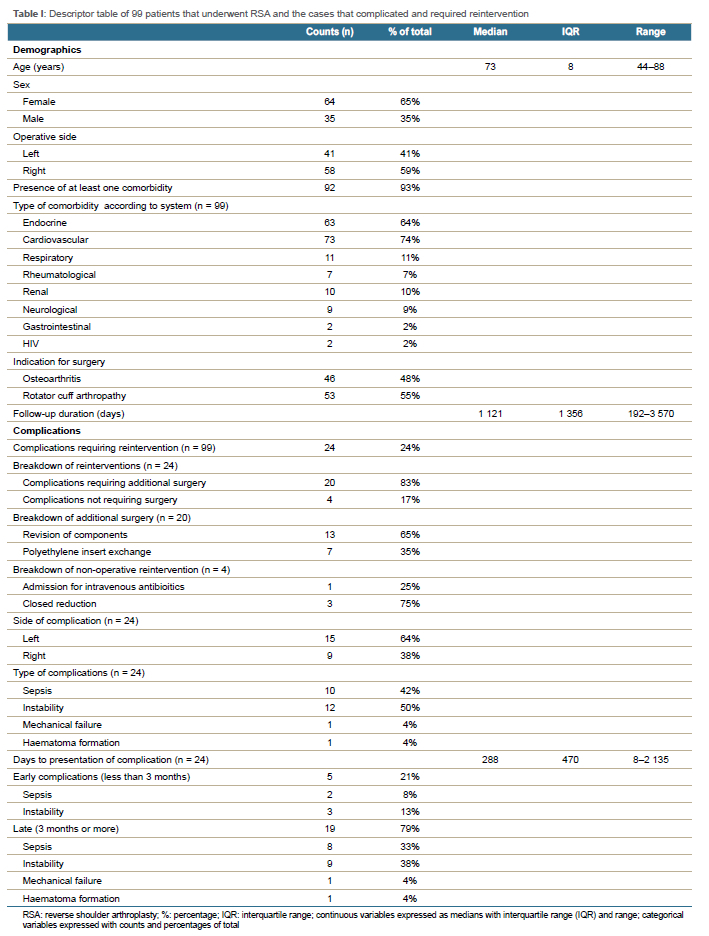
A total of 93 patients underwent primary RSA and met inclusion criteria over the period January 2011 to December 2021 (Table I). Six patients had bilateral primary RSA, accounting for a total of 99 cases. All patients followed up for a minimum of six months, and no cases were excluded. The median follow-up duration was 1 121 days (IQR 1 356, range 192-3 570). Thirty-five per cent of cases were performed in male patients (35 of 99) and 65% in females (64 of 99). The median age at time of surgery was 73 years (IQR 8, range 44-88). Most RSAs were conducted on the right shoulder (58%, 58 of 99). Forty-eight per cent (46 of 99) of cases were for primary OA, and 55% (53 of 99) of cases were for rotator cuff arthropathy. Most patients (93%, 92 of 99) had at least one comorbidity; the most common systems affected were the cardiovascular system (74%, 73 of 99) and endocrine system (64%, 63 of 99). Regarding individual comorbidities, hypertension 72% (71 of 99), hypercholesterolaemia 43% (43 of 99), gout 15% (15 of 99), and diabetes mellitus 15% (15 of 99) were the most common.
Twenty-four cases developed complications requiring reintervention in 22 patients; two patients complicated bilaterally. The median number of days following surgery until complication was 288 (IQR 470, range 8-2 135). Five cases (21%, 5 of 24) complicated early, and the majority complicated late (79%, 19 of 24). Table I shows the breakdown of complication type according to time of presentation. Ten cases (42%, 10 of 24) complicated with sepsis; 12 cases (50%, 12 of 24) complicated with instability; there was one case of a haematoma (4%, 1 of 24); and one case of mechanical failure (4%, 1 of 24). Twenty of the cases that complicated (83%, 20 of 24) required at least one additional surgery, accounting for an overall additional surgery rate of 20% (20 of 99). Of the four patients that did not require further surgery, three underwent a closed reduction of a dislocation (75%, 3 of 4) and one was admitted for intravenous antibiotics for a haematoma (25%, 1 of 4).
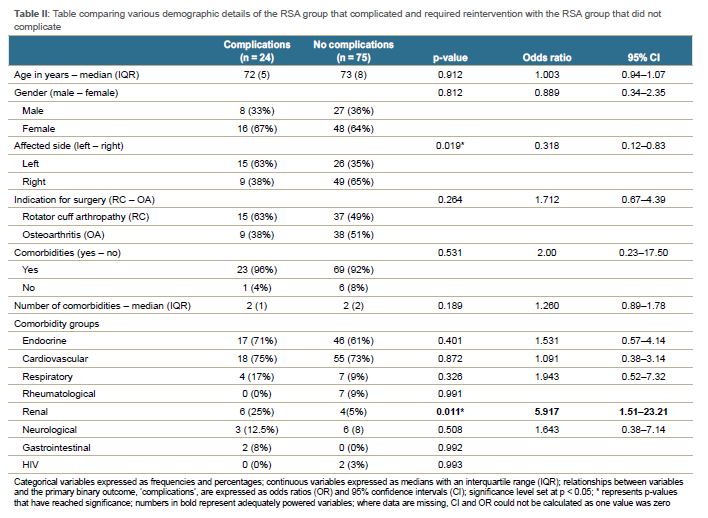
The overall complication requiring reintervention rate was 24% (24 of 99). Table II summarises the comparative details of complicated and uncomplicated cases. The demographic details of the patients that complicated were not dissimilar to those that did not complicate. The median age in cases that complicated was 72 years (IQR 5, range 51-88) as compared to 73 (IQR 8, range 44-86) in the uncomplicated group. Age was not found to increase the risk of complication (OR 1.00, 95% CI 0.94-1.07, p = 0.912). Neither the presence of comorbidities (OR 2.00, 95% CI 0.23-17.5, p = 0.531) nor number of comorbidities per case (OR 1.26, 95% CI 0.89-1.78, p = 0.189) increased the risk of complication requiring reintervention. The presence of renal system comorbidity (acute or chronic renal failure, urinary tract infection or renal stones) was associated with an increased risk of a complication requiring reintervention (OR 5.92, 95% CI 1.51-23.21, p = 0.011). To reiterate, patients with a renal comorbidity were 5.92 times more likely to develop a complication that required reintervention.
Discussion
This study aimed to determine the rate of complications requiring reintervention for primary RSA of a single cohort, and assess if any demographic factors placed patients in the cohort at greater risk of complications requiring reintervention. We report an overall complication rate of 24%, with additional surgery required in 20% of cases. Direct comparison of these rates is limited, due to the variability of prosthesis designs, definitions of complication, and approaches used. However, this complication rate is comparable to that of cohorts with similar patient profiles, indications, and in which the majority report use of an inlay humeral prosthesis. Inagaki et al. retrospectively reviewed six years of RSA cases (the majority uncemented, inlay humeral components) and found a similar complication rate of 18%, but an additional surgery rate of only 7%.42 Most similar to the present investigation, Tashjian et al. reported in 2020 the complications found in a retrospective review of RSA cases conducted over a ten-year period by a single surgeon. They report a 20% complication or reoperation rate. Tashjian et al. used inlay prostheses exclusively, and the major indication was degenerative disease (comparable to the present series); however, no description regarding cementing was reported.43 While comparative to our investigation, these rates all exceed the rates found in a recent meta-analysis by Galvin et al. (of 52 studies where 71% of cases used a Grammont-style prosthesis) where an average complication rate of 9.4% and revision rate of 2.6% was reported.42,44 With expanded indications and increased utilisation of RSA, we would expect increased complications in the initial learning curve, which will taper off with surgical experience and standardisation of indications.44 This may be the effect observed by the more recent investigation of Galvin (2005-2020) as compared to that our cohort (while a similar date span to that of Galvin et al. represents the first ten years of performing RSA at the institution).7,27,42,44,45
The most common shoulder complications in two reviews (and our cohort) were instability (between 0.7 and 12%) and sepsis (between 1 and 10%).7,44 We report a higher than average instability rate (12%) compared to previous investigations (1-5%).10,11,17,27,32,42 This may be partly attributable to implant design. A recent review and meta-analysis by Shah et al. highlighted the move towards onlay humeral prostheses, a change which has impacted the rates of instability following RSA.46 This meta-analysis found a statistically significant 2.7% absolute reduction in instability rates favouring the onlay prosthesis design. Georgoulas et al.'s literature review suggests that surgical approach may also affect instability rates.47 However, they reported a tendency towards a higher occurrence of instability following RSA through a deltopectoral approach and suggested the difficulty of the subscapularis repair through this approach as a potential contributor.29,47 In the present investigation, while there was no record of subscapularis handling, the superolateral approach was used exclusively. Consequently, a reduced complication rate would be expected; however, this was not the finding. This suggests that there are likely additional factors contributing to instability rates following RSA that have not been identified or investigated in this cohort. An interesting and contrasting finding compared to other investigations of instability following RSA, where instability typically presents within three months of surgery, was the finding that 75% of our instability cases (nine of 12) presented after three months.11,48 Boileau et al. proposed that deltoid over-tensioning was the reason for late presenting instability.32 Over-tensioning and fatigue is not typically attributed to inlay prosthesis, but present literature describes 'deltoid dysfunction' and 'deltoid fatigue' with ambiguity.49 This suggests the need for further investigation of these concepts to better understand this cause of late instability.32,42,50-52 Alternatively, late instability is attributed to movement of components such as subsidence and aseptic loosening, which may have been the contributing factor for several of the instability cases in this series.6
Recent literature suggests that postoperative sepsis is surpassing instability as the most common complication, due to modern implant design decreasing dislocation rates.6 This was not the case in our cohort, with a PJI rate of 10% (as compared to the 12% instability rate). Two of the septic cases occurred within three months (early), but beyond six weeks, when debridement and exchange of modular implants is advocated.6 As a comparison, Kim et al. reported similar infection rates in their review of between 1 and 10%, but this is a slightly greater rate than Contreras et al. who report a range between 0.5 and 6.7%.6,14 Again, the sepsis rate in the present series falls on the higher end of reported rates.6,14 Many factors could account for this finding. It is now understood that antibiotic prophylaxis for shoulder surgery with a first-generation cephalosporin (as was used in the present investigation) will not eradicate the most common organism cultured in shoulder arthroplasty infection cases internationally.6 Additional preventative measures need to be taken to reduce this bacterial burden.6 Antibiotic-loaded cement, which has been found to decrease RSA infection rates, was also not utilised in the present series.6 Additionally, the high rate of comorbidities (93% of patients had at least one comorbidity) reported in our investigation could have contributed to the number of cases that complicated with sepsis. A Korean meta-analysis has previously established risk factors for septic complications following RSA to include male sex, diabetes mellitus, liver disease, alcohol overuse, iron-deficiency anaemia, and rheumatoid arthritis.53
The remaining complications requiring reintervention in this cohort were a case of mechanical failure and a haematoma (each accounting for 4%, one of 24 complications). Nabergoj et al. attributed mechanical failure to the large forces across the glenoid, the knowledge of which has been incorporated into more contemporary RSA designs than the prostheses used in the present series.37,44,46,54 Haematoma formation is inconsistently reported in the literature. In the present investigation, a single case (4%, one of 24) of haematoma formation required intervention (admission for intravenous antibiotics) and was therefore deemed a complication. Werner reported haematoma to be their commonest complication (21%), most of which resolved following aspiration.55 While Zumstein et al. did document cases of haematoma formation, they did not deem them to be complications.7 Discrepancies such as these could contribute to the wide range of documented complication rates (1-21%).56 Irrespective of haematoma complication rates, it has been positively determined that haematoma formation does not typically result in adverse clinical outcomes.7
Considering all complication cases, the baseline age and sex of patients in our investigation are in keeping with that of previous investigations.44 Comparing the patients in our cohort who complicated to those who did not, there was no statistical difference between the groups regarding sex and age. Ninety-three per cent (93 of 99) of the cases had one or more comorbidities documented. No individual comorbidity was associated with an increased risk of complication. When grouping comorbidities, the renal group (comprising cases with acute or chronic renal failure, kidney stones or urinary tract infection) were at increased risk of complication (OR 5.91, 95% CI 1.5-23.2, p = 0.011). While not a direct comparison to the present cohort, Hsiue et al. reported similar findings in their database investigation of elective shoulder arthroplasty patients comparing patients with and without renal disease.57 They found patients with end-stage disease were almost eight times more likely to dislocate and 19 times more likely to sustain a surgical site infection than patients with no chronic renal disease.57 With these significant increases in shoulder arthroplasty complications in patients with renal disease, surgeons offering patients RSA should seek a renal disease history from patients, be cognisant of the increased risk of complications, and counsel patients accordingly.
This study had several limitations. Patients undergoing RSA in this institution were not entered on a database, necessitating the identification of patients from the records of the implant manufacturer. While all the identified patients' records were located, they were incomplete regarding certain data relevant to complication risk. This included anthropometric measurements, handling of subscapularis, and previous surgery to the ipsilateral shoulder, among others. Numerous studies report increased risk for complication, specifically instability and sepsis, for patients with increased BMI and previous ipsilateral shoulder surgery, for which we could not provide comparative data.11-13,15,58 Finally, although our cohort represented 99 cases, only 24 cases complicated. This limited the analysis of risk factors for complication.
Conclusion
In a ten-year review of patients undergoing RSA for degenerative disease, we report a 24% complication requiring reintervention rate. The most common complications included instability and sepsis. Patients with renal pathology were found to be at greater risk of complications requiring reintervention. Future prospective evaluation of RSA outcomes is needed to identify all factors contributing to complications.
Acknowledgements
Many thanks to Lelánie Rademan for assisting with data collection and first draft language revision.
Ethics statement
The authors declare that this submission is in accordance with the principles laid down by the Responsible Research Publication Position Statements as developed at the 2nd World Conference on Research Integrity in Singapore, 2010.
The study complied with the South African Department of Health ethics guidelines (2015), and the University of Pretoria's policy on research ethics. Before the commencement of this research, the appropriate ethical approval was obtained from the Faculty of Health Sciences Research Ethics Committee of the University of Pretoria (67/2023).
All procedures were in accordance with the ethical standards of the responsible committee on human experimentation (institutional and national) and with the Helsinki Declaration of 1975, as revised in 2008. As the investigation comprised a retrospective chart review, informed written consent was not obtained from included patients.
Declaration
The authors declare authorship of this article and that they have followed sound scientific research practice. This research is original and does not transgress plagiarism policies.
Author contributions
JGdP: study conceptualisation, data capture, first draft preparation, and revision
MOC: study design, data analysis, first draft preparation, and revision
OK: study conceptualisation and manuscript draft revision
TlR: manuscript draft review, expert insight, and manuscript revision
ORCID
du Plessis JG https://orcid.org/0009-0000-3535-0770
O'Connor M https://orcid.org/0000-0001-8864-4916
Koch O https://orcid.org/0000-0003-1871-9569
le Roux T https://orcid.org/0000-0001-7450-6459
References
- 1. Hyun YS, Huri G, Garbis NG, McFarland EG. Uncommon indications for reverse total shoulder arthroplasty. Clin Orthop Surg. 2013;5:243-55.
- 2. Sirveaux F, Molé D, Kempf JF, et al. Shoulder concepts: Reverse shoulder arthroplasty. Montpellier: Sauramps medical; 2016.
-
3. Willems WJ. History of shoulder arthroplasty. J Arthrosc Jt Surg. 2020;8(5). https://doi.org/10.1016/j.jajs.2020.12.001
» https://doi.org/10.1016/j.jajs.2020.12.001 -
4. Grammont PM, Baulot E. Delta shoulder prosthesis for rotator cuff rupture. Orthopedics [Internet]. 1993 Jan 1;16(1):65-68. https://doi.org/10.3928/0147-7447-19930101-11
» https://doi.org/10.3928/0147-7447-19930101-11 - 5. Frank JK, Siegert P, Plachel F, et al. The evolution of reverse total shoulder arthroplasty. From the first steps to novel implant designs and surgical techniques. J Clin Med. 2022 Mar 10;11(6):1512.
- 6. Kim SC, Kim IS, Jang MC, Yoo JC. Complications of reverse shoulder arthroplasty: A concise review. Clin Shoulder Elb. 2021 Mar 1;24(1):42-52.
- 7. Zumstein MA, Pinedo M, Old J, Boileau P. Problems, complications, reoperations, and revisions in reverse total shoulder arthroplasty: A systematic review. J Shoulder Elbow Surg. 2011;20:146-57.
- 8. Barco R, Savvidou OD, Sperling JW, et al. Complications in reverse shoulder arthroplasty. EFORT Open Rev. 2016 Mar 1;1(3):72-80.
- 9. Kohan EM, Chalmers PN, Salazar D, et al. Dislocation following reverse total shoulder arthroplasty. J Shoulder Elbow Surg. 2017 Jul 1;26(7):1238-45.
- 10. Olson JJ, Galetta MD, Keller RE, et al. Systematic review of prevalence, risk factors, and management of instability following reverse shoulder arthroplasty. JSES Rev Rep Tech. 2022;2:261-68.
- 11. Chalmers BP, Wagner ER, Sperling JW, et al. Treatment and outcomes of reverse shoulder arthroplasty dislocations. J Shoulder Elb Arthroplast. 2017 Jan;1:247154921769526.
- 12. Chalmers PN, Rahman Z, Romeo AA, Nicholson GP. Early dislocation after reverse total shoulder arthroplasty. J Shoulder Elbow Surg. 2014;23(5):737-44.
- 13. Kozak T, Bauer S, Walch G, et al. An update on reverse total shoulder arthroplasty: current indications, new designs, same old problems. EFORT Open Rev. 2021 Mar 1;6(3):189-201.
- 14. Contreras ES, Frantz TL, Bishop JY, Cvetanovich GL. Periprosthetic infection after reverse shoulder arthroplasty: a review. Curr Rev Musculoskelet Med. 2020;13:757-68.
- 15. Gallo RA, Gamradt SC, Mattern CJ, et al. Instability after reverse total shoulder replacement. J Shoulder Elbow Surg. 2011 Jun;20(4):584-90.
- 16. Le J, Roche CP, Fan W, et al. Risk factors for instability after reverse shoulder arthroplasty. Semin Arthroplast. 2022 Sep 1;32(3):613-22.
- 17. Ascione F, Domos P, Guarrella V, et al. Long-term humeral complications after Grammont-style reverse shoulder arthroplasty. J Shoulder Elbow Surg. 2018 Jun 1;27(6):1065-71.
- 18. Markes AR, Bigham J, Ma CB, et al. Preventing and treating infection in reverse total shoulder arthroplasty. Curr Rev Musculoskelet Med. 2023 May 25;16(8):371-80.
- 19. du Plessis C, Koch O, Le Roux T, Janse van Rensburg C. Indications for surgical reintervention following reverse shoulder arthroplasty: a retrospective audit from 2006 to 2015. SA Orthop J. 2017;16(4).
- 20. Achoki T, Sartorius B, Watkins D, et al. Health trends, inequalities and opportunities in South Africa's provinces, 1990-2019: findings from the Global Burden of Disease 2019 Study. J Epidemiol Community Health (1978). 2022 May;76(5):471-81.
- 21. Ataguba JE, Akazili J, McIntyre D. Socioeconomic-related health inequality in South Africa: evidence from General Household Surveys. Int J Equity Health. 2011;10(1):48.
- 22. Khlopas A, Wright LT, Hao KA, et al. The effect of socioeconomic status on clinical outcomes and implant survivorship after primary anatomic and reverse total shoulder arthroplasty. J Shoulder Elbow Surg. 2025 Jan;34(1):390-400.
- 23. von Elm E, Altman DG, Egger M, et al. Strengthening the reporting of observational studies in epidemiology (STROBE) statement: guidelines for reporting observational studies. BMJ. 2007 Oct 20;335(7624):806-808.
- 24. Ibounig T, Simons T, Launonen A, Paavola M. Glenohumeral osteoarthritis: an overview of etiology and diagnostics. Scand J Surg. 2021;110:441-51.
-
25. Mackenzie DB. The antero-superior exposure for total shoulder replacement. Orthop Traumatol [Internet]. 1993;2(2):71-77. https://doi.org/10.1007/BF02620461
» https://doi.org/10.1007/BF02620461 - 26. Sager BW, Khazzam M. Surgical approaches in shoulder arthroplasty. In: Advances in Shoulder Surgery. InTech; 2018.
- 27. Franceschi F, Giovannetti de Sanctis E, Gupta A, et al. Reverse shoulder arthroplasty: State-of-the-art. J ISAKOS. 2023 Oct 1;8(5):306-17.
- 28. Molé D, Wein F, Dézaly C, et al. Surgical technique: The anterosuperior approach for reverse shoulder arthroplasty. Clin Orthop Relat Res. 2011 Sep;469(9):2461-68.
- 29. Seok HG, Park JJ, Park SG. Anterosuperior approach versus deltopectoral approach for reverse total shoulder arthroplasty: a systematic review and meta-analysis. J Orthop Surg Res. 2022 Dec 1;17(1).
- 30. Kirsch JM, Namdari S. Rehabilitation after anatomic and reverse total shoulder arthroplasty: a critical analysis review. JBJS Rev. 2020 Feb 14;8(2).
- 31. Hagen MS, Allahabadi S, Zhang AL, et al. A randomized single-blinded trial of early rehabilitation versus immobilization after reverse total shoulder arthroplasty. J Shoulder Elbow Surg. 2020 Mar 1;29(3):442-50.
- 32. Boileau P. Complications and revision of reverse total shoulder arthroplasty. Orthop Traumatol Surg Res. 2016 Feb 1;102(1):S33-43.
-
33. Fink B, Sevelda F. Periprosthetic joint infection of shoulder arthroplasties: Diagnostic and treatment options. Biomed Res Int [Internet]. 2017;2017:1-10. https://www.hindawi.com/journals/bmri/2017/4582756/
» https://www.hindawi.com/journals/bmri/2017/4582756/ - 34. Aggarwal VK, Rasouli MR, Parvizi J. Periprosthetic joint infection: Current concept. Indian J Orthop. 2013;47:10-17.
- 35. Markes AR, Bigham J, Ma CB, et al. Preventing and treating infection in reverse total shoulder arthroplasty. Curr Rev Musculoskelet Med. 2023 Aug 1;16(8):371-80.
- 36. Parvizi J, Gehrke T. Definition of periprosthetic joint infection. J Arthroplasty. 2014 Jul;29(7):1331.
- 37. Nabergoj M, Denard PJ, Collin P, et al. Mechanical complications and fractures after reverse shoulder arthroplasty related to different design types and their rates: Part I. EFORT Open Rev. 2021 Nov 1;6(11):1097-108.
- 38. Shah SS, Gaal BT, Roche AM, et al. The modern reverse shoulder arthroplasty and an updated systematic review for each complication: part I. JSES Int. 2020 Dec;4(4):929-93.
- 39. Hendy BA, Zmistowski B, Sheth M, et al. Hematoma following shoulder arthroplasty: Incidence, management, and outcomes. Arch Bone Jt Surg. 2023;102(2).
- 40. Cheung EV, Sperling JW, Cofield RH. Infection associated with hematoma formation after shoulder arthroplasty. Clin Orthop Relat Res. 2008 Jun;466(6):1363-67.
-
41. jamovi. The jamovi project [Internet]. https://www.jamovi.org; 2021 [cited 2024 May 28]. Available from: https://www.jamovi.org.
» https://www.jamovi.org - 42. Inagaki K, Ochiai N, Hashimoto E, et al. Postoperative complications of reverse total shoulder arthroplasty: a multicenter study in Japan. JSES Int. 2023 Jul 1;7(4):642-67.
- 43. Tashjian RZ, Hillyard B, Childress V, et al. Outcomes after a Grammont-style reverse total shoulder arthroplasty? J Shoulder Elbow Surg. 2021 Jan;30(1):e10-17.
- 44. Galvin JW, Kim R, Ment A, et al. Outcomes and complications of primary reverse shoulder arthroplasty with minimum of 2 years' follow-up: a systematic review and meta-analysis. J Shoulder Elbow Surg. 2022 Nov 1;31(11):e534-44.
- 45. Acevedo DC, Mann T, Abboud JA, et al. Reverse total shoulder arthroplasty for the treatment of proximal humeral fractures: patterns of use among newly trained orthopedic surgeons. J Shoulder Elbow Surg. 2014 Sep;23(9):1363-77.
- 46. Shah SS, Roche AM, Sullivan SW, et al. The modern reverse shoulder arthroplasty and an updated systematic review for each complication: part II. JSES Int. 2021 Jan;5(1):121-37.
- 47. Georgoulas P, Fiska A, Ververidis A, et al. Reverse shoulder arthroplasty, deltopectoral approach vs. anterosuperior approach: An overview of the literature. Front Surg. 2021 Nov 18;8.
- 48. Guarrella V, Chelli M, Domos P, et al. Risk factors for instability after reverse shoulder arthroplasty. Shoulder Elbow. 2021 Feb 1;13(1):51-57.
- 49. Zitnay JL, Tashjian RZ, Walch G, et al. Inlay vs. onlay humeral components in reverse total shoulder arthroplasty: a biorobotic shoulder simulator study. J Shoulder Elbow Surg. 2024 Jun;33(6):1377-86.
- 50. Markes AR, Cheung E, Ma CB. Failed reverse shoulder arthroplasty and recommendations for revision. Curr Rev Musculoskelet Med. 2020 Feb 1;13(1).
- 51. Erickson BJ. Failed reverse total shoulder arthroplasty: What are our bailouts? Curr Rev Musculoskelet Med. 2021 Oct 18;14(5):291-96.
- 52. Schoch BS, Vigan M, Roche CP, et al. Deltoid fatigue part 2: a longitudinal assessment of anatomic total shoulder arthroplasty over time. J Shoulder Elbow Surg. 2022 Feb;31(2):e37-47.
- 53. Seok HG, Park JJ, Park SG. Risk factors for periprosthetic Joint infection after shoulder arthroplasty: Systematic review and meta-analysis. J Clin Med. 2022 Jul 1;11(14).
- 54. Gohlke F, Abdelkawi AA, Eltair H, et al. Revision of failed reverse shoulder arthroplasty-a point of no return. Obere Extrem. 2020 Sep 19;15(3):187-98.
- 55. Werner CML. Treatment of painful pseudoparesis due to irreparable rotator cuff dysfunction with the delta III reverse-ball-and-socket total shoulder prosthesis. J Bone Joint Surg. 2005 Jul 1;87(7):1476.
- 56. Doyle TR, Downey S, Hurley ET, et al. Midterm outcomes of primary reverse shoulder arthroplasty: a systematic review of studies with minimum 5-year follow-up. JSES Rev. 2024 Feb 1;4(1):1-7.
- 57. Hsiue PP, Sekimura T, Ocampo A, et al. Impact of renal disease on elective shoulder arthroplasty outcomes for glenohumeral osteoarthritis. Semin Arthroplasty. 2022 Jun 1;32(2):297-304.
- 58. Theodoulou A, Krishnan J, Aromataris E. Risk of poor outcomes in patients who are obese following total shoulder arthroplasty and reverse total shoulder arthroplasty: a systematic review and meta-analysis. J Shoulder Elbow Surg. 2019 Nov 1;28(11):e359-76.
Accepted: March 2025
Published: August 2025
Editor: Dr Cameron Anley, Stellenbosch University, Cape Town, South Africa
Funding: No funding was received for this study.
Conflict of interest: The authors declare they have no conflicts of interest that are directly or indirectly related to the research.