The impact of the COVID-19 pandemic on maternal mortality in a South African metropole (2020 - 2021): A retrospective cohort study
BACKGROUND: During the COVID-19 pandemic, there was a notable increase in maternal deaths across South Africa (SA). Pre pandemic, the Western Cape Province, SA, had made significant strides towards reducing maternal mortality, including HIV-related deaths. However, this progress was reversed in the pandemic period despite a relative protection of maternity services. The direct biological impact of SARS-CoV-2 may not be the sole reason for the increase in mortality. OBJECTIVE: To evaluate the relative change in the maternal death rate (MDR) for non-SARS-CoV-2-related deaths during the pandemic v. pre pandemic in 2019. METHODS: We conducted a retrospective cohort study including all pregnant women with a pregnancy outcome enumerated in the Provincial Health Data Centre in the Metro West region of Cape Town from 1 January 2019 to 31 January 2022. Cause of in-facility maternal death and relationship to SARS-CoV-2 infection was determined by folder review. We used interrupted time series (ITS) analysis to assess the impact of the pandemic period on non-SARS-CoV-2 causes of maternal mortality. RESULTS: Over 98 000 women were included, with 68 deaths reviewed. The ITS model demonstrated no statistically significant change in the MDR for non-SARS-CoV-2-related deaths during the pandemic, with confidence intervals (CIs) that crossed the null for both a step change at the start of the pandemic (3.12/10 000 pregnancy outcomes; 95% CI -1.66 - 7.90) and a subsequent attenuation in the pre-pandemic downward gradient in MDR (slope change 0.47/10 000 pregnancy outcomes per month (95% CI -0.02 - 0.96). Folder review of deaths demonstrated an increase in opportunistic infections as a cause of death relative to the pre-pandemic period, mainly in women with HIV. CONCLUSION: Maternal healthcare services were largely protected from service disruptions during the COVID-19 pandemic. However, the increase in HIV-related opportunistic infections suggests that optimising maternal health requires an all-encompassing, functional healthcare ecosystem that can robustly maintain services for all health conditions.
maternal mortality; COVID-19; maternal deaths
The impact of the COVID-19 pandemic on maternal mortality in a South African metropole (2020 - 2021): A retrospective cohort study
M HunterI, II; L HannanIII; A BoulleIV, V, VI; M MatjilaVII; M IsmailVIII, IX; J EuvrardX, XI, XII; M-A DaviesXIII, XIV, XV; E KalkXVI
IMB ChB, MMed (PHM); Division of Public Health Medicine, School of Public Health, Faculty of Health Sciences, University of Cape Town, South Africa
IIMB ChB, MMed (PHM); Health Intelligence Directorate, Department of Health and Wellness, Western Cape Government, Cape Town, South Africa
IIIBSc, MPH; Division of Epidemiology and Biostatistics, School of Public Health, Faculty of Health Sciences, University of Cape Town, South Africa
IVMB ChB, PhD; Division of Public Health Medicine, School of Public Health, Faculty of Health Sciences, University of Cape Town, South Africa
VMB ChB, PhD; Health Intelligence Directorate, Department of Health and Wellness, Western Cape Government, Cape Town, South Africa
VIMB ChB, PhD; Centre for Integrated Data and Epidemiological Research, School of Public Health, Faculty of Health Sciences, University of Cape Town, South Africa
VIIMB ChB, PhD; Department of Obstetrics and Gynaecology, Faculty of Health Sciences, University of Cape Town, South Africa
VIIIMB ChB, MMed (PHM); Division of Public Health Medicine, School of Public Health, Faculty of Health Sciences, University of Cape Town, South Africa
IXMB ChB, MMed (PHM); Health Intelligence Directorate, Department of Health and Wellness, Western Cape Government, Cape Town, South Africa
XMA, MPH; Division of Public Health Medicine, School of Public Health, Faculty of Health Sciences, University of Cape Town, South Africa
XIMA, MPH; Health Intelligence Directorate, Department of Health and Wellness, Western Cape Government, Cape Town, South Africa
XIIMA, MPH; Centre for Integrated Data and Epidemiological Research, School of Public Health, Faculty of Health Sciences, University of Cape Town, South Africa
XIIIMB ChB, PhD; Division of Public Health Medicine, School of Public Health, Faculty of Health Sciences, University of Cape Town, South Africa
XIVMB ChB, PhD; Health Intelligence Directorate, Department of Health and Wellness, Western Cape Government, Cape Town, South Africa
XVMB ChB, PhD; Centre for Integrated Data and Epidemiological Research, School of Public Health, Faculty of Health Sciences, University of Cape Town, South Africa
XVIMB BCh, PhD; Centre for Integrated Data and Epidemiological Research, School of Public Health, Faculty of Health Sciences, University of Cape Town, South Africa
BACKGROUND: During the COVID-19 pandemic, there was a notable increase in maternal deaths across South Africa (SA). Pre pandemic, the Western Cape Province, SA, had made significant strides towards reducing maternal mortality, including HIV-related deaths. However, this progress was reversed in the pandemic period despite a relative protection of maternity services. The direct biological impact of SARS-CoV-2 may not be the sole reason for the increase in mortality.
OBJECTIVE: To evaluate the relative change in the maternal death rate (MDR) for non-SARS-CoV-2-related deaths during the pandemic v. pre pandemic in 2019.
METHODS: We conducted a retrospective cohort study including all pregnant women with a pregnancy outcome enumerated in the Provincial Health Data Centre in the Metro West region of Cape Town from 1 January 2019 to 31 January 2022. Cause of in-facility maternal death and relationship to SARS-CoV-2 infection was determined by folder review. We used interrupted time series (ITS) analysis to assess the impact of the pandemic period on non-SARS-CoV-2 causes of maternal mortality.
RESULTS: Over 98 000 women were included, with 68 deaths reviewed. The ITS model demonstrated no statistically significant change in the MDR for non-SARS-CoV-2-related deaths during the pandemic, with confidence intervals (CIs) that crossed the null for both a step change at the start of the pandemic (3.12/10 000 pregnancy outcomes; 95% CI -1.66 - 7.90) and a subsequent attenuation in the pre-pandemic downward gradient in MDR (slope change 0.47/10 000 pregnancy outcomes per month (95% CI -0.02 - 0.96). Folder review of deaths demonstrated an increase in opportunistic infections as a cause of death relative to the pre-pandemic period, mainly in women with HIV.
CONCLUSION: Maternal healthcare services were largely protected from service disruptions during the COVID-19 pandemic. However, the increase in HIV-related opportunistic infections suggests that optimising maternal health requires an all-encompassing, functional healthcare ecosystem that can robustly maintain services for all health conditions.
Keywords: maternal mortality, COVID-19, maternal deaths
Maternal and child health is a global and national priority.[1] In 1998, South Africa (SA) inaugurated the National Committee on the Confidential Enquiries into Maternal Deaths (NCCEMD), a ministerial committee of key individuals involved in maintaining women's health,[2] as a means of reducing maternal mortality. The committee's mandate involves reviewing all maternal deaths within the country, with the aim of providing recommendations towards improving maternal outcomes.[2] In 2015, SA committed to the Agenda for Sustainable Development,[3] including Sustainable Development Goal (SDG) 3.1, which aims to decrease the global maternal mortality ratio to <70/100 000 live births.[4] However, despite progress in lowering maternal mortality over the last 20 years, largely due to the efforts of the NCCEMD, SA healthcare systems and maternal care remain vulnerable to health threats.[5]
Maternal deaths in SA increased notably during the first 2 years of the COVID-19 pandemic (2020 - 2021).[6] Data published by the NCCEMD showed that the Western Cape Province (WC) had achieved the SDG 3.1 target in 2019, with an institutional maternal mortality ratio (iMMR) of 50.8/100 000 live births.[6] However, this achievement was undermined during the pandemic, with the WC iMMR increasing to 93.3/100 000 and 102.3/100 000 in 2020 and 2021, respectively.[6] While pregnant women were not more likely to acquire SARS-CoV-2 infection than the general population, it is believed that they were at risk of severe COVID-19 illness due to the immunosuppressive and cardiorespiratory changes of pregnancy.[7,8]
During the pandemic, SA underwent several 'lockdown' periods of varying severity to curb SARS-CoV-2 spread. Lockdown measures included closure of schools and businesses, and stay-at-home directives. There was also intentional de-escalation of some healthcare services to divert health responses to the growing burden of COVID-19. A study conducted in Gauteng Province outlined the impact of the disruption of essential services and service utilisation due to non-pharmacological measures employed during the pandemic.[9] Although maternal and child services were intended to be excluded from service de-escalation in WC,[10] maternal mortality rose during the pandemic.[6] The direct impact of SARS-CoV-2 on maternal health was evident, with an increase in respiratory and other systemic manifestations in pregnancy. However, the contribution of the indirect effects of the pandemic (lockdown, service disruption, fear) on maternal health was less clear. Most current studies investigating the effects of COVID-19 on SA healthcare stem from evaluations of aggregate data from the District Health Information System (DHIS).[6,11,12] The WC Provincial Health Data Centre (PHDC) uses a unique identifier to link multiple sources of public-sector electronic data, providing a virtual cohort of individual-level data, including institutional maternal deaths.[13] Using the PHDC, we investigated the impact of the COVID-19 pandemic on in-facility non-SARS-CoV-2-related maternal mortality using a quasi-experimental interrupted time series methodology.
Methods
Study design
This was a retrospective cohort study using the PHDC data to include all pregnant women in the Metro West region of Cape Town, SA, from 1 January 2019 to 31 January 2022. A folder review of all in-facility maternal deaths during this period was performed to determine the causes of maternal mortality.
Setting and study population
WC is one of nine provinces in SA. In the 2017 - 2019 triennium, the most common causes of maternal death in WC were non-pregnancy-related infections (16.6%), medical and surgical disorders (11.8%) and hypertensive disorders of pregnancy (8.4%).[14]
WC is divided into five districts and one metropolitan municipality.[15] The Cape Town Metropolitan Municipality is comprised of eight health subdistricts: Western, Southern, Klipfontein, Mitchells Plain, Northern, Eastern, Khayelitsha and Tygerberg. For the purposes of referral pathways and health service delivery, the first four subdistricts comprise the Metro West region, while the latter four comprise the Metro East region. Although some overlap exists, for the purposes of this study, only pregnancies that had both their first antenatal visit and pregnancy outcome within the Metro West region were included. Based on population estimates published in 2020, the population of the Metro West drainage area in that year was 2.25 million.[16]
Data sources and collection
The PHDC was used to identify all high-confidence pregnancies with an outcome during the study period, which included the periods of the first four waves of COVID-19 in WC. Pregnancy confidence scores are used to reflect the degree of certainty with which the evidence used to infer pregnancy episodes by the PHDC reflect a true pregnancy.[17]
Maternal death was defined as an in-facility death during pregnancy up to 42 days postpartum.[18] For the folder review, two independent medical practitioners extracted data from the folders and/or electronic medical records using a standardised data abstraction form. Deaths were classified according to the categories of COVID-19 relatedness[19] developed by members of the Western Cape Department of Health and Wellness to understand changes in the COVID-19 death profile over time. Additionally, deaths were classified by the NCCEMD categories of maternal death.[20] Any disputes were resolved through consensus.
Outcomes
The primary outcome was the in-facility maternal death rate (MDR) per month for non-SARS-CoV-2-related deaths. The secondary outcome was cause of maternal death.
Statistical analysis
The statistical software RStudio version 2023.12.1+402 (R Foundation for Statistical Computing, Austria) was used to analyse the data. A significance level of p<0.05 was used. Frequency, proportion, median and interquartile range (IQR) measurements were used for descriptive statistical analyses. A χ2[21] Where the expected frequency was <1, Fisher's exact test was used.
An interrupted time series (ITS) analysis was performed to analyse the rate of maternal deaths per 10 000 pregnancy outcomes during the period 1 January 2019 - 31 January 2022, with an interruption in March 2020 when the COVID-19 pandemic and lockdown responses started in SA. While only one interruption was included in this analysis (the start of the pandemic), the pandemic period included four distinct waves: wave 1: 3 May 2020 - 16 August 2020; wave 2: 8 November 2020 - 7 February 2021; wave 3: 23 May 2021 - 19 September 2021; wave 4: 21 November 2021 - 30 January 2022. To ascertain the impact of the pandemic on non-SARS-CoV-2-related deaths, all deaths attributed to SARS-CoV-2 were removed from the dataset for this part of the analysis. Segmented linear regression models were fitted to the data, and ordinary least squares were used to estimate the model parameters.[22] A Durbin-Watson test was performed to test for autocorrelation in the residuals. We used these models to determine the impact of the pandemic on maternal mortality through both immediate and a sustained effects. Immediate effects were evaluated as a step change in observed rate from the pre-pandemic period to the rate immediately following the interruption. The sustained impact of the interruption on the outcome was assessed by comparing the gradient of the observed mortality rate over time against the pre-pandemic gradient.
Ethical approval
Ethical approval was obtained from the University of Cape Town's Faculty of Health Sciences Human Research Ethics Committee (ref. no. 215/2022) and from the relevant facilities within the Metro West region of Cape Town. Approval was provided by the WC Provincial Department of Health to access data from the PHDC. A waiver of informed consent was granted as the study posed minimal risk to participants, their welfare interests were unlikely to be adversely affected, the data used were drawn from a retrospective, routine health data source and the scope of this study rendered the research impractical to conduct without the waiver.[23]
Results
Descriptive characteristics of included patients
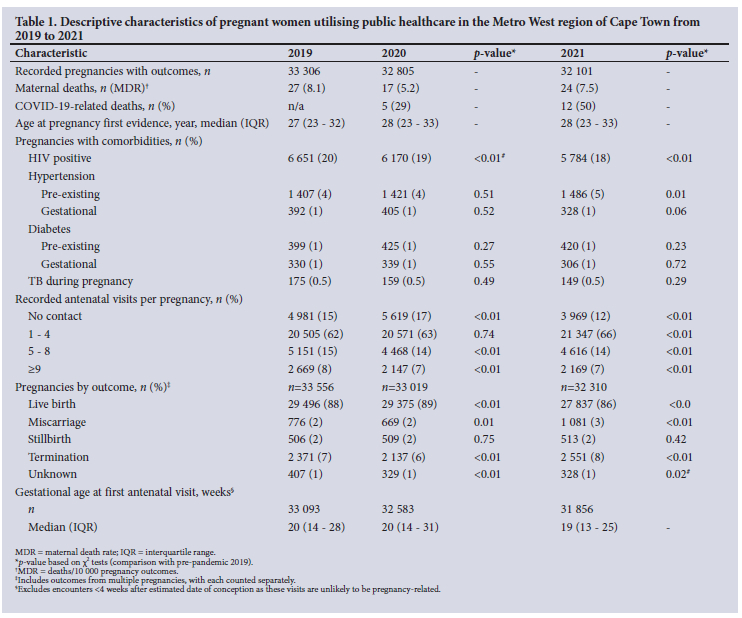
This cohort consisted of 98 212 pregnant women and 68 maternal deaths (Table 1). There was a slight decrease in recorded pregnancies with outcomes during the pandemic, in comparison with the period before, with some notable differences in pregnancy characteristics across the years. The number of pregnant women who had no recorded antenatal visits during their pregnancy differed from 2019 to 2021 (p<0.001), with an increase from 15% pre pandemic to 17% in 2020, followed by a drop to 12% by 2021. The prevalence of HIV in this population differed across the years, decreasing from 20% in 2019 to 18% by 2021 (p<0.001).
Causes of maternal death
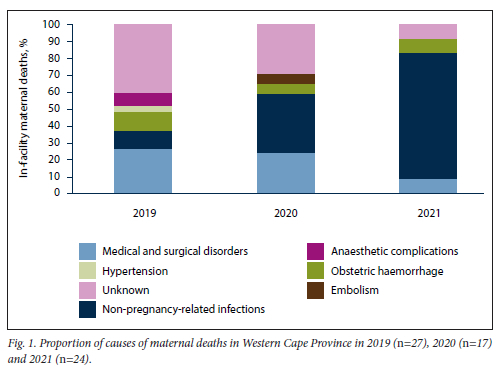
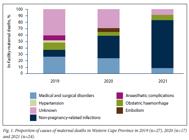
The proportion of all maternal deaths (SARS-CoV-2 and non-SARS-CoV-2-related; Fig. 1; Table 2) due to non-pregnancy-related infections (NPIs) increased from 11% pre pandemic in 2019 to 35% (p=0.07) and 75% (p=<0.01) of all-cause mortality in 2020 and 2021, respectively, and was the most common cause of maternal mortality during the pandemic. In contrast, the most common cause of maternal mortality in 2019 was medical and surgical disorders (26%).
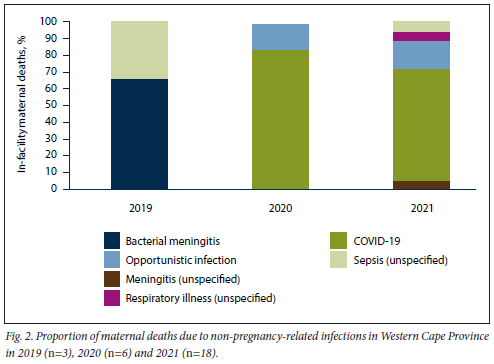
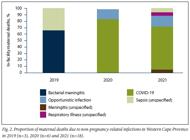
There were 17 SARS-CoV-2-related deaths in our cohort in 2020 and 2021, all classified as 'severe COVID-19',[19] with deaths attributable to COVID-19 pneumonia. Although infection with SARS-CoV-2 accounted for most NPI deaths during the pandemic (83% in 2020 and 67% in 2021), Fig. 2 highlights an increase in OIs as causes for maternal mortality in 2020 (17%) and 2021 (17%), in contrast to 2019 (0%). The absolute numbers of OIs across the years were small (≤3 per year), limiting the ability to evaluate statistical support for these differences. The OIs were cryptococcal meningitis, Pneumocystis jiroveci, pneumonia and tuberculosis. Of those with death due to OIs in 2020 and 2021, respectively, 100% and 67% of individuals were known to be living with HIV antenatally. All OI deaths in those not known to be living with HIV (33% of OI deaths in 2021) were attributable to tuberculosis.
Maternal mortality
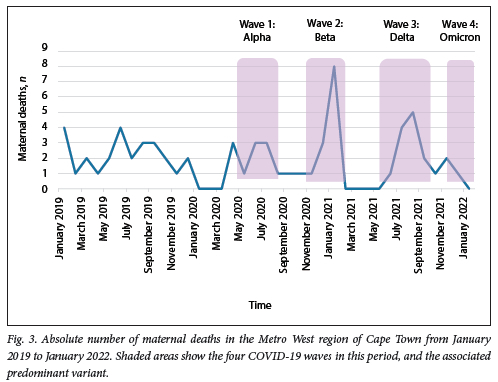
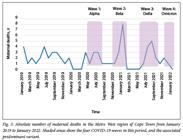
There was an increase in the number of maternal deaths in Metro West during the second and third COVID-19 waves (Fig. 3).
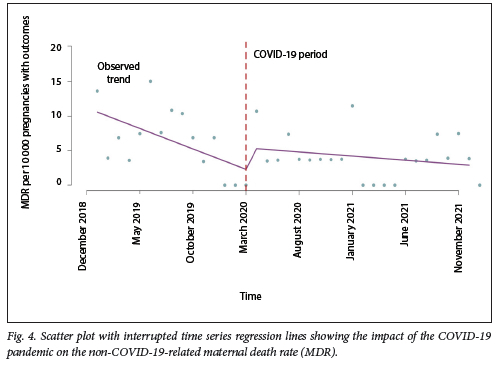
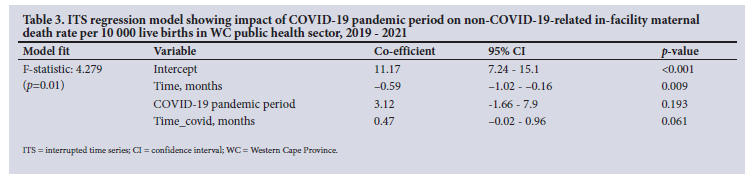
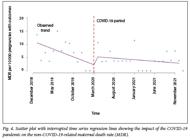
To determine the impact of the pandemic period on non-SARS-CoV-2-related causes of death, all deaths attributed to SARS-CoV-2 were removed from the subsequent analysis (n=51/68 deaths remained). There was no statistically significant evidence of a step change in MDR for non-SARS-CoV-2-related deaths following the start of the pandemic (3.12/10 000 pregnancy outcomes; 95% confidence interval (CI) -1.66 - 7.90). Although the ITS analysis indicated that the downward gradient in the MDR pre pandemic of -0.59/10 000 pregnancy outcomes per month (95% CI -1.02 - 0.16) flattened by 0.47 (95% CI -0.02 - 0.96), the CI for this slope change includes the null (Table 3). The Durbin-Watson test, a statistical test for autocorrelation in different time series, revealed a value of 1.755 (p=0.099), which supports the assumption that the values in these data are independent.
Discussion
In this large population-based study, evidence of a step change in non-SARS-CoV-2-related MDR at the start of the pandemic period, and attenuation of the MDR decline during the pandemic, did not reach statistical significance. Based on the number of maternal deaths and pregnancies in 2019, we had 80% power to detect an 80% increase in MDR post the start of the pandemic, and so we were under-powered to detect smaller increases in non-SARS-CoV-2 deaths, and cannot exclude that a small increase occurred. Despite low numbers, granular examination of maternal deaths revealed a worrying increase in deaths due to OIs during the pandemic period, especially in women living with HIV (WLHIV), despite WLHIV comprising a lower proportion of pregnancies in the post-pandemic period relative to the pre-pandemic 2019 study population.
According to the NCCEMD, the iMMR in both SA and WC increased in the intra-pandemic period relative to 2019.[6] By the end of 2021, the iMMR in WC was more than double pre-pandemic 2019 figures.[6] Our review of 68 maternal deaths (17 of which were attributed to SARS-CoV-2 infection) in the Metro West referral area demonstrated a sizable increase in the contribution of NPI to mortality, accounting for 11% of deaths in 2019 v. 35% and 75% in 2020 and 2021, respectively. Although deaths from COVID-19 pneumonia accounted for most NPI deaths, the increase of opportunistic and AIDS-related infections reversed progress documented in the 2014 - 2016 Saving Mothers' Report,[24] which showed that maternal deaths due to HIV were declining as a result of the roll-out of antiretroviral treatment.
While maternal health services were relatively protected during the pandemic period, challenges in the optimal management of chronic conditions, including HIV, and service de-escalations[25] to combat the burden of the pandemic, may have resulted in these findings, particularly as they were more marked at longer durations after the pandemic disruptions in 2021.
While overall provincial figures showed an increase in absolute number of in-facility maternal deaths in 2020/2021 v. 2019, our data for the Metro West region showed a decrease in the absolute number of in-facility maternal deaths. The introduction of the lockdown in March 2020 led to a movement of people from the urban areas back to rural areas of origin,[12] and it is possible that pregnant women left Cape Town during this time. Additionally, as this study only captured pregnancies that had both their first antenatal visit and pregnancy outcome occur in the Metro West region, those pregnancies that did not follow this referral pathway would not have been included. These factors may have played a role in the observed decrease in both pregnancies and absolute number of deaths in Metro West, despite an overall provincial increase in maternal deaths and iMMR.[6]
A third observation was the correlation of an increased number of deaths during each wave of COVID-19. This was particularly evident during the second and third waves, in which the Beta and Delta variants dominated, respectively. A combination of natural immunity, vaccine-acquired immunity, immune escape and changes in virulence of subsequent SARS-CoV-2 variants could account for the tapering of deaths during the fourth COVID-19 wave, which was dominated by the Omicron variant. There may be various reasons for the absence of increased maternal deaths in wave 1, including timing, and the fact that knock-on systemic effects of reduced healthcare access had not yet demonstrated a significant impact on deaths.
Lastly, the proportion of pregnant women using antenatal care increased in 2021 relative to both 2019 and 2020. The reasons for this are likely multifactorial, and could include improvement of information systems over time and better data capture, the relaxing of lockdown restrictions in the later months of the pandemic, and growing evidence outlining the increased risk pregnant women faced in light of SARS-CoV-2 infection.[8] Vaccination became available for pregnant women in late 2021,[6] and this may have contributed to more women attending healthcare facilities. In contrast, the decrease in antenatal care access in 2020 could be linked to lockdown restrictions, fear and the linked patient migration patterns previously discussed.
While the study was under-powered to robustly explore trends in non-COVID-19-related maternal deaths, a notable finding in this study was the increase in the number and proportion of deaths due to OIs, especially in WLHIV. This may be a consequence of health system strains in terms of chronic disease management, and the unintended impacts of mitigation and containment strategies, as has been demonstrated in other studies. It has been shown than tuberculosis detection reduced during the pandemic, with more severe outcomes in those hospitalised, and a worsening of viral load suppression in those with HIV.[26,27] However, as the absolute numbers encountered in this study were small, further exploration will need to be conducted with a larger population. Studies using similar methodologies in Chile[28] and Brazil[29] also found increases in MDR during the pandemic v. the projected values, but did not exclude deaths related to SARS-CoV-2. Excluding these deaths in our analysis allowed for a more direct interpretation of the non-biological impact of SARS-CoV-2 on maternal deaths.
Study strengths and limitations
A major strength of the study was the inclusion of nearly 100 000 pregnancies, with access to electronic data on individual-level characteristics. Granular examination and classification of maternal deaths allowed for an in-depth review of the indirect impact of the pandemic period on maternal mortality.
Our study had several limitations. Only part of the Cape Town Metropolitan area was included. The numbers of evaluated maternal deaths were consequently low, resulting in our study being under-powered to show statistically significant differences in the non-SARS-CoV-2-related MDR. We included pregnancies from 2019 to 2021, meaning that the pre-pandemic period used to predict the trend of maternal deaths was narrow, affecting the reliability of the gradient. In addition, the slope of decline in pre-pandemic MDR is strongly influenced by there being no maternal deaths in the 3 months immediately preceding the pandemic, attributing to the impression of a step change in mortality at the start of the pandemic. However, the wide CI around the step change indicates that it could have been due to chance, with similar month-to-month changes seen in previous and subsequent periods.
As the burden of disease and patient profiles are not symmetrical across the metropole, the results of this study may not be generalisable outside the Metro West region. The use of the PHDC limited our population to those individuals using healthcare services in the public sector only, further impacting on generalisability. The use of routine data meant that we could not control for data quality or account for missing data, which carries the risk of misclassification. Due to the limited population under review and challenges in the use of routine data, the calculation of the iMMR may have been unreliable. Routine data sources rely on adequate documentation of information, and some outcomes remained unclassified, affecting the reliability of the live birth figures. Mortality rates per 10 000 pregnancy outcomes were therefore used in this study, rather than per 100 000 live births, which is used when calculating iMMR. As the folder reviews were done retrospectively using clinical notes taken for operational purposes, the documentation of information may not have been exhaustive. Inconsistencies and gaps in the data were present, which made the evaluation of some individual risk factors challenging, and affected our ability to adequately determine the cause of death in several patients, resulting in several categorised as 'unknown'.
Lastly, SARS-CoV-2 infection was a competing risk for other causes of death. This means that the total number of deaths due to other causes and the full impact of service de-escalation may have been masked, as some deaths that would have otherwise occurred as a result of different aetiologies may have occurred due to SARS-CoV-2 infection.
Conclusion
Maternal health outcomes are dependent on the adequate co-ordination of a functional, sustainable and contextually appropriate healthcare system. The COVID-19 pandemic resulted in a notable increase of maternal deaths due to OIs, especially in WLHIV. While our study found no evidence that reached statistical significance of an increase in non-SARS-CoV-2-related maternal mortality during the pandemic period, the study was under-powered to detect small increases. Although maternal health services were largely protected from intentional de-escalation, all facets of a health system are interlinked, and disruptions in one area have a knock-on effect on other services on the platform. Responses to future health threats should consider the indirect impact that such responses may have on patients, particularly on vulnerable population groups and those with comorbidities.
Data availability. The de-identified datasets used for analysis in this study can be requested from the Western Cape Government Department of Health and Wellness following standard procedures.
Declaration. This study was conducted in partial fulfilment of MH's MMed in Public Health Medicine at the University of Cape Town.
Acknowledgements. We would like to acknowledge the Western Cape Department of Health and Wellness Provincial Health Data Centre, and the healthcare institutions in the Cape Town Metro West ecosystem, for their assistance.
Author contributions. MH conceptualised the study, developed the data collection tool, collected, cleaned and analysed the data, interpreted the data and drafted the manuscript. LH assisted with cleaning and analysis of the data as well as review of the manuscript. MM assisted with refining the focus of the study and editing and review of the manuscript. MI assisted with the analysis and review of the manuscript. JE assisted with the data analysis and review of the manuscript. MD provided academic support and editing and review of the manuscript. EK provided academic supervision, refined the focus of the study, assisted with data collection and participated in editing and review of the manuscript.
Funding. None.
Conflicts of interest. None.
AI contribution. No artificial intelligence (AI)-assisted technologies were used in the production of this work.
References
-
1. Western Cape Department of Health. Strategic Plan 2020 - 2025. Cape Town: WCDoH, 2020. https://d7.westerncape.gov.za/assets/departments/health/strategic_plan.pdf (accessed 14 June 2024).
» https://d7.westerncape.gov.za/assets/departments/health/strategic_plan.pdf -
2. Moodley J, Pattinson RC, Fawcus S, Schoon MG, Moran N, Shweni PM. The Confidential Enquiry into Maternal Deaths in South Africa: A case study. BJOG 2014;121(Suppl 4):53-60. https://doi.org/10.1111/1471-0528.12869
» https://doi.org/10.1111/1471-0528.12869 -
3. Sustainable Development Solutions Network. South Africa. SDSN, 2026. https://sdgs.un.org/2030agenda. https://southafrica.unsdsn.org/sdgs/#:~:text=In%202015%2C%20the%202030%20Agenda,at%20the%20Sustainable%20Development%20Summit (accessed 21 June 2024).
» https://sdgs.un.org/2030agenda. https://southafrica.unsdsn.org/sdgs/#:~:text=In%202015%2C%20the%202030%20Agenda,at%20the%20Sustainable%20Development%20Summit -
4. United Nations South Africa. Sustainable Development Goal 3: Good Health and Wellbeing. UN, 2026. https://southafrica.un.org/en/sdgs/3 (accessed 21 June 2024).
» https://southafrica.un.org/en/sdgs/3 - 5. National Department of Health, South Africa. Annexure 3: Challenges for Maternal Perinatal and Neonatal Services in South Africa (Addendum to the The South African Maternal, Perinatal and Neonatal Health Policy). Pretoria: NDoH, 2021.
-
6. Fawcus S, Gebhardt S, Niit R, Pattinson R. Resilience in the time of crisis: A review of the maternal, perinatal and reproductive health effects of COVID-19 in South Africa. S Afr Med J 2024;114(5):e1757. https://doi.org/10.7196/samj.2024.v114i5.1757
» https://doi.org/10.7196/samj.2024.v114i5.1757 -
7. Hunter M, Moodley J, Moran N. Perspectives on COVID-19 vaccination for pregnant women in South Africa. Afr J Pirm Health Care Fam Med 2021;13(1):a2998. https://doi.org/10.4102/phcfm.v13i1.2998
» https://doi.org/10.4102/phcfm.v13i1.2998 -
8. Royal College of Obstetricians and Gynaecologists. Coronavirus (COVID-19) infection in pregnancy. London: RCOG, 2021. https://www.rcog.org.uk/globalassets/documents/guidelines/2021-08-25-coronavirus-covid-19-infection-in-pregnancy-v14.pdf (accessed 6 October 2021).
» https://www.rcog.org.uk/globalassets/documents/guidelines/2021-08-25-coronavirus-covid-19-infection-in-pregnancy-v14.pdf -
9. Fonka CB, Khamisa N, Worku E, Blaauw D. Impact of the COVID-19 pandemic on maternal, neonatal and child health service utilisation, delivery and health outcomes in Gauteng province, South Africa: An interrupted time series (ITS) analysis. BMJ Open 2024;14(10):e090645. https://doi.org/10.1136/bmjopen-2024-090645
» https://doi.org/10.1136/bmjopen-2024-090645 -
10. Western Cape Department of Health. Circular 107 of 2020: Maternal and child health response plan for COVID-19. Cape Town: WCDoH, 2020. https://www.westerncape.gov.za/assets/h1072020_covid19_maternal_child_health_response_plan_for_covid-19.pdf (accessed 14 June 2024).
» https://www.westerncape.gov.za/assets/h1072020_covid19_maternal_child_health_response_plan_for_covid-19.pdf -
11. Pillay Y, Pienaar S, Barron P, Zondi T. Impact of COVID-19 on routine primary healthcare services in South Africa 2021. S Afr Med J 2021;111(8):714-719. https://doi.org/10.7196/SAMJ.2021.v111i8.15786
» https://doi.org/10.7196/SAMJ.2021.v111i8.15786 -
12. Pattinson R, Fawcus S, Gebhardt S, Niit R, Soma-Pillay P, Moodley J. The effect of the first wave of Covid-19 on use of maternal and reproductive health services and maternal deaths in South Africa. Obstetr Gynaecol For 2020;30(4):36-44. http://hdl.handle.net/2263/82228 (accessed 28 May 2026).
» http://hdl.handle.net/2263/82228 -
13. Boulle A, de Vega I, Moodley M, et al. Data centre profiles The Provincial Health Data Centre of the Western Cape Province, South Africa. Int J Population Data Sci 2019;4(2). https://doi.org/10.23889/ijpds.v4i2.1143
» https://doi.org/10.23889/ijpds.v4i2.1143 -
14. National Department of Health, South Africa. Saving Mothers and Babies 2017 - 2019: Executive summary. Pretoria: NDoH, 2019. https://www.health.gov.za/wp-content/uploads/2023/05/SAVING-MOTHERS-SAVING-BABIES-REPORT-2017-2019.pdf (accessed 21 June 2024).
» https://www.health.gov.za/wp-content/uploads/2023/05/SAVING-MOTHERS-SAVING-BABIES-REPORT-2017-2019.pdf -
15. Municipalities of South Africa. Western Cape municipalities. Municipalities of South Africa, 2026. https://municipalities.co.za/provinces/view/9/western-cape (accessed 21 June 2024).
» https://municipalities.co.za/provinces/view/9/western-cape -
16. National Department of Health, South Africa. Circular H102/2020. Population data. Pretoria: NDoH, 2020. https://www.westerncape.gov.za/assets/departments/health/h_102_2020_covid-19_population_data.pdf (accessed 14 June 2024).
» https://www.westerncape.gov.za/assets/departments/health/h_102_2020_covid-19_population_data.pdf - 17. Johnson LF, Mutemaringa T, Heekes A, Boulle A. Effect of HIV infection and antiretroviral treatment on pregnancy rates in the Western Cape Province of South Africa. J Infect Dis 2020;221(12):1953-1962.
-
18. World Health Organization. The Global Health Observatory. Maternal Deaths. Geneva: WHO, 2026. https://www.who.int/data/gho/indicator-metadata-registry/imr-details/4622 (accessed 21 June 2024).
» https://www.who.int/data/gho/indicator-metadata-registry/imr-details/4622 -
19. Paleker M, Davies M-A, Raubenheimer P, Naude J, Boulle A, Hussey H. Change in profile of COVID-19 deaths in the Western Cape during the fourth wave. S Afr Med J 2022;112(3):(June 2026, Vol. 116, No. 5). https://doi.org/10.7196/SAMJ.2022.v112i2.16384
» https://doi.org/10.7196/SAMJ.2022.v112i2.16384 -
20. National Department of Health, South Africa. National Committee for Confidential Enquiry into Maternal Deaths (NCCEMD) Saving Mothers fact sheet 2022. Pretoria: NDoH, 2022. https://www.health.gov.za/wp-content/uploads/2023/09/Fact-sheet-Saving-Mothers-2022.pdf (accessed 7 May 2025).
» https://www.health.gov.za/wp-content/uploads/2023/09/Fact-sheet-Saving-Mothers-2022.pdf -
21. Campbell I. Chi-squared and Fisher-Irwin tests of two-by-two tables with small sample recommendations. Statistics Med 2007;26(19):3661-3675. https://doi.org/10.1002/sim.2832
» https://doi.org/10.1002/sim.2832 -
22. XLSTAT. Ordinary Least Squares Regression (OLS). Lumivero, 2026. https://www.xlstat.com/en/solutions/features/ordinary-least-squares-regression-ols#:~:text=Intuitively%20speaking%2C%20the%20aim%20of,the%20sum%20of%20errors%20directly (accessed 14 June 2024).
» https://www.xlstat.com/en/solutions/features/ordinary-least-squares-regression-ols#:~:text=Intuitively%20speaking%2C%20the%20aim%20of,the%20sum%20of%20errors%20directly -
23. National Department of Health, South Africa. Ethics in Health Research. Second ed. Pretoria: NDoH, 2015. https://www.health.gov.za/wp-content/uploads/2022/05/NHREC-DoH-2015-Ethics-in-Health-Research-Guidelines-1.pdf (accessed 13 May 2026).
» https://www.health.gov.za/wp-content/uploads/2022/05/NHREC-DoH-2015-Ethics-in-Health-Research-Guidelines-1.pdf -
24. National Committee on the Confidential Enquiry into Maternal Deaths. Saving Mothers 2014 - 2016: Seventh triennial report on confidential enquiries into maternal deaths in South Africa: Short Report. Pretoria: NCCEMD, 2016. https://anaesthetics.ukzn.ac.za/Libraries/Obstets3_2019/Saving_Mothers.pdf (accessed 28 November 2024).
» https://anaesthetics.ukzn.ac.za/Libraries/Obstets3_2019/Saving_Mothers.pdf -
25. Mboweni SH, Risenga PR. The impact of The COVID-19 pandemic on the management of chronic disease in South Africa: A systematic review. Open Pub Health J 2022;15:e187494452206140. https://doi.org/10.2174/18749445-v15-e2206140
» https://doi.org/10.2174/18749445-v15-e2206140 -
26. Jacobs T, Morden E, Smith M, et al. Severe outcomes among adults with TB during COVID-19. IJTLD Open 2024;1(7):292-298. https://doi.org/10.5588/ijtldopen.24.0220
» https://doi.org/10.5588/ijtldopen.24.0220 -
27. Kassanjee R, Davies MA, Ngwenya O, et al. COVID-19 among adults living with HIV: Correlates of mortality among public sector healthcare users in Western Cape, South Africa. J Int AIDS Soc 2023;26(6):e26104. https://doi.org/10.1002/jia2.26104
» https://doi.org/10.1002/jia2.26104 -
28. Enriquez Y, Critto ME, Weinberg R, de Janon Quevedo L, Galleguillos A, Koch E. Effects of emerging SARS-CoV-2 on total and cause-specific maternal mortality: A natural experiment in Chile during the peak of the outbreak, 2020 - 2021. PLoS Glob Public Health 2024;4(7):e0002882. https://doi.org/10.1371/journal.pgph.0002882
» https://doi.org/10.1371/journal.pgph.0002882 -
29. De Carvalho-Sauer RCO, Costa M, Teixeira MG, et al. Impact of COVID-19 pandemic on time series of maternal mortality ratio in Bahia, Brazil: Analysis of period 2011 - 2020. BMC Pregnancy Childbirth 2021;21(1):423. https://doi.org/10.1371/journal.pgph.000288210.1186/s12884-021-03899-y
» https://doi.org/10.1371/journal.pgph.000288210.1186/s12884-021-03899-y

Accepted 26 September 2025