Doxorubicin-induced early-onset chronic progressive cardiotoxicity, pharmacogenetics and survival among breast cancer patients in Zimbabwe
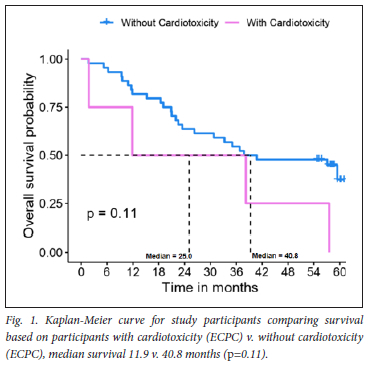
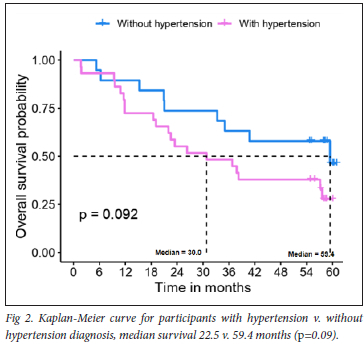
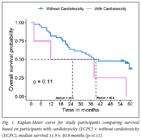
BACKGROUND: Early-onset chronic progressive cardiotoxicity (ECPC) is a significant cause of morbidity and mortality among patients who receive doxorubicin-based chemotherapy for breast cancer. OBJECTIVE: To establish incidence of ECPC in black Zimbabwean women with breast cancer treated with doxorubicin and the resultant survival, and to describe the pharmacogenomic biomarkers' association with prognosis. METHOD: A prospective observational study was conducted in Zimbabwe with 50 participants who received doxorubicin-based treatment and were actively followed up to 12 months, with 3-monthly echocardiography and vital status determined at 60 months for all-cause mortality analysis. RESULTS: ECPC was observed in 10% of participants. Median survival for participants who developed ECPC and those without was 11.9 v. 40.8 months. Participants with ECPC had 5-year overall survival (OS) of 0% v. 42% (hazard ratio (HR) 4.19, 95% confidence interval (CI) 1.27 - 13.79; p=0.018) for participants with no ECPC recorded. Median survival was significantly shorter for patients on calcium channel blockers (p=0.01). Cardiotoxicity, pre-existing hypertension and histological grade showed no significant association. Using multivariate analysis, poor OS was observed with ECPC (HR 4.19, 95% CI 1.27 - 13.79; p=0.018) and calcium channel blocker use (HR 2.38, 95% CI 1.07 - 5.32; p=0.034); no association was observed with pharmacogenomic biomarker risk categorisation based on SLC28A3, UGT1A6 and RARG (HR 1.39, 95% CI 0.46 - 4.25; p=0.561). CONCLUSION: Breast cancer patients with doxorubicin-induced ECPC had poorer OS. The risk of doxorubicin cardiotoxicity and poor survival could not be explained using SLC28A3-scoring pharmacogenomic profile. Breast cancer therapies with lower cardiotoxicity are needed in Zimbabwe and other low-resource settings.
pharmacogenomics; anthracycline-induced cardiotoxicity; breast cancer survival; gene polymorphism
 Thumbnail
 Thumbnail
 Thumbnail
 Thumbnail
 Thumbnail
 Thumbnail