Lp(a) and coronary disease: rules of engagement - when to measure and how to treat
Background
Lp(a) was first described in 1963 as a genetic variant of β-lipoproteins.1234
Coronary risk association
The plasma levels of oxidised phospholipids present in Lp(a) have been implicated in contributing to the atherogenicity of Lp(a),56
Lp(a) has a significant and well-described genetic heterogeneity. Its risk associations with vascular disease demonstrate racial and ethnic variations. Higher plasma concentrations are seen in blacks, postmenopausal women and people with hypercholesterolaemia. However, the strongest association with high Lp(a) levels and coronary disease is observed in middle-aged white men. High Lp(a) levels are associated with a high risk of stroke in blacks and in white women, but not in white men.7
Not all studies associate Lp(a) with increased coronary risk. The Physician's Health Study found no association between Lp(a) level and the risk of future ischaemic events,8
Measurement
Studies are sometimes controversial, as it is difficult to standardise the measurement of Lp(a) due to its heterogeneity. Recognition of the biological importance of apolipoprotein (a) (apo(a)) is also reflected by the International Standardization Committee, which recommends that the previous practice of reporting Lp(a) as a total mass be superseded by the measurement of Lp(a) protein either in terms of apo(a) or as apo(a) linked to apoB100.9
Investigation
'In whom should we measure Lp(a)?' remains to be the main question to be answered.
Serum levels of Lp(a) are genetically determined, with environmental factors having a negligible impact.1011
Management
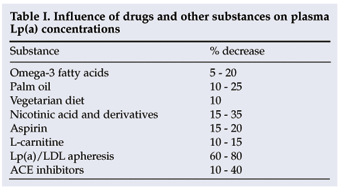
HMG-CoA (3-hydroxy-3-methyl-glutaryl-CoA) reductase inhibitors (statins) have no demonstrable efficacy in modifying Lp(a) levels. There are few means whereby plasma Lp(a) can be reduced, the most efficient therapeutic modalities known to selectively reduce plasma Lp(a) being Lp(a)-apheresis and nicotinic acid (Table I).
Nicotinic acid and its derivatives can reduce Lp(a) levels by up to 35%.212et al., unpublished data).
The most effective therapy for lowering Lp(a) is extracorporeal elimination of Lp(a) with apheresis. LDL-apheresis and selective Lp(a)-apheresis using antibody-coupled columns, precipitation and complex formation at low pH, double filtration and direct absorption have been demonstrated to lower plasma Lp(a) to the same extent as LDL cholesterol (up to 80%).13
Conclusion
Measurement of Lp(a) provides useful additional information about cardiovascular risk in patients with premature vascular disease and intermediate risk profiles. Aggressive LDL reduction and global coronary risk factor modulation are recommended in patients with elevated Lp(a). Coronary disease is an emerging major health challenge in Africa, with CAD projected to be the leading cause of death in Africa by 2030.14
References
- 1. Berg K. A new serum type system in man: the Lp system. Acta Pathol Microbiol Scand 1963; 59: 362-362.
- 2. Kostner KM, Kostner GM. Lipoprotein (a): Still an enigma? Curr Opin Lipidol 2002; 13(4): 391-396.
- 3. Danesh J, Collins R, Peto R. Lipoprotein(a) and coronary artery disease: meta-analysis of prospective studies. Circulation 2000; 102: 1082-1085.
- 4. Enas EA, Senthilkumar A. Coronary artery disease in Asian Indians: An update and review. Int J Cardiol 2001; 1: 2.
- 5. Tsimikas S, Brilakis ES, Miller ER, et al. Oxidized phospholipids, Lp(a) lipoprotein, and coronary artery disease. N Engl J Med 2005; 353(1): 46-57.
- 6. Sandholzer C, Halman D, Saha N, et al. Effect of apolipoprotein (a) polymorphism on the lipoprotein (a) concentration in seven ethnic groups. Human Genet 1991; 86: 607 - 614.
- 7. Ohira T, Schreiner PJ, Morrisett JD, et al. Lipoprotein(a) and incident ischemic stroke: The Atherosclerosis Risk in Communities (ARIC) Study. Stroke 2006; 37(6): 1407-1412.
- 8. Ridker PM, Hennekens CA, Stampfer MJ. A prospective study of Lp(a) and the risk of myocardial infarction. JAMA 1993; 270: 2195-2199.
- 9. Marcovina S, Koschinsky ML, Albers J, et al. Report of the National Heart Lung and Blood Institute workshop on lipoprotein(a) and cardiovascular disease. Recent advances and future directions, Clin Chem 2003; 49: 1788-1796.
- 10. Dahlen CG. Lipoprotein(a) in cardiovascular disease: Review article and viewpoint. Atherosclerosis 1994; 108: 111-126.
- 11. Enas EA. Risk of primary and recurrent acute myocardial infarction from lipoprotein (a). J Am Coll Cardiol 1997; 29: 887-889.
- 12. Schlueter W, Keilani T, Batlle DC. Metabolic effects of ACE inhibitors: focus on the reduction of cholesterol and lipoprotein (a) by fosinopril. Am J Cardiol 1993; 72(20): 37-44.
- 13. Hoffmann U, Derfler K, Haas M, et al. Effects of combined low-density lipoprotein apheresis and aggressive statin therapy on coronary calcified plaque as measured by computed tomography. Am J Cardiol 2003; 91: 461-464.
- 14. Mensah GA. Ischaemic heart disease in Africa. Heart 2008; 94: 836-884.