Paediatric pancreatic trauma: a review of the literature and results of a multicentre survey on patient management
BACKGROUND: It is generally accepted that paediatric solid organ injury should be treated conservatively, unless there is haemodynamic instability unresponsive to resuscitation. When it comes to pancreatic trauma, there is much debate about appropriate management OBJECTIVES: To review the literature and determine how pancreatic trauma is managed in South African (SA) tertiary institutions and compares with international standards METHOD: A survey was emailed to 45 paediatric surgical consultants working in various paediatric surgical units in SA, Italy, England and Australia. The questionnaire comprised two scenarios of isolated pancreatic trauma (grade III), the main difference between them being the time interval between initial injury and presentation. In the first scenario, the patient presented 6 hours post injury whereas in the second scenario, the patient presented 6 days post initial injury. The survey enquired about diagnosis and subsequent work-up (including preferred imaging techniques), supportive management (including nutrition), the various options of definitive intervention and follow-up procedure RESULTS: There were 21 responders from four different countries. In the first scenario, 10 surgeons would operate, 8 would treat conservatively and 3 would perform an endoscopic retrograde cholangiopancreatogram (ERCP) and stent. In the second scenario, 4 surgeons would operate, 13 would treat conservatively and 4 would undertake ERCP with stent. There was no difference in management between the SA surgeons and their international counterparts CONCLUSION: Management of blunt pancreatic trauma in SA is consistent with that reported in the literature. There is still controversy regarding the optimal management of pancreatic injury involving ducts. No absolute algorithm can be used to treat these patients. All patients should be treated individually and managed with an approach and techniques that are feasible
PAEDIATRIC HEPATOBILIARY
Paediatric pancreatic trauma: a review of the literature and results of a multicentre survey on patient management
C Westgarth-TaylorI; J LovelandII
IBSc, BSc (Med) Hons, MB ChB, MRCS (Eng), FC Paed Surg (SA); Department of Paediatric Surgery, Chris Hani Baragwanath Academic Hospital and Faculty of Health Sciences, University of the Witwatersrand, Johannesburg, South Africa
IIMB ChB, FCS (SA), Cert Paed Surg; Department of Paediatric Surgery, Chris Hani Baragwanath Academic Hospital and Faculty of Health Sciences, University of the Witwatersrand, Johannesburg, South Africa
Correspondence
ABSTRACTBACKGROUND: It is generally accepted that paediatric solid organ injury should be treated conservatively, unless there is haemodynamic instability unresponsive to resuscitation. When it comes to pancreatic trauma, there is much debate about appropriate management
OBJECTIVES: To review the literature and determine how pancreatic trauma is managed in South African (SA) tertiary institutions and compares with international standards
METHOD: A survey was emailed to 45 paediatric surgical consultants working in various paediatric surgical units in SA, Italy, England and Australia. The questionnaire comprised two scenarios of isolated pancreatic trauma (grade III), the main difference between them being the time interval between initial injury and presentation. In the first scenario, the patient presented 6 hours post injury whereas in the second scenario, the patient presented 6 days post initial injury. The survey enquired about diagnosis and subsequent work-up (including preferred imaging techniques), supportive management (including nutrition), the various options of definitive intervention and follow-up procedure
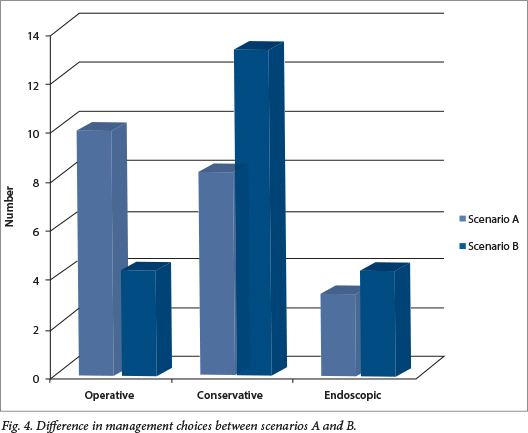
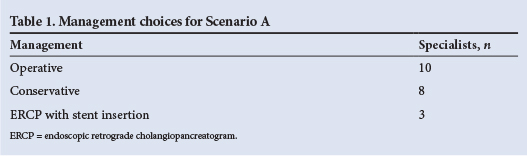
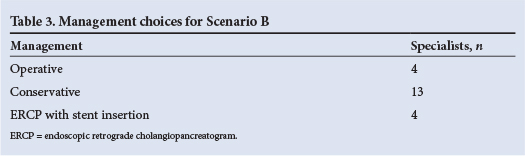
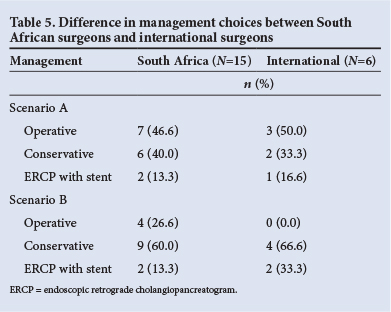
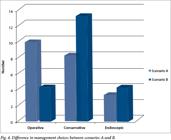
RESULTS: There were 21 responders from four different countries. In the first scenario, 10 surgeons would operate, 8 would treat conservatively and 3 would perform an endoscopic retrograde cholangiopancreatogram (ERCP) and stent. In the second scenario, 4 surgeons would operate, 13 would treat conservatively and 4 would undertake ERCP with stent. There was no difference in management between the SA surgeons and their international counterparts
CONCLUSION: Management of blunt pancreatic trauma in SA is consistent with that reported in the literature. There is still controversy regarding the optimal management of pancreatic injury involving ducts. No absolute algorithm can be used to treat these patients. All patients should be treated individually and managed with an approach and techniques that are feasible
Trauma is one of the leading causes of morbidity and mortality in the paediatric population worldwide, with blunt abdominal trauma being the principal cause of abdominal injury in children.1 , 2 The pancreas is the fourth most common solid organ injured after the spleen, liver and kidneys. In the absence of haemodynamic instability unresponsive to resuscitation or associated hollow visceral injuries, non-operative management of these injuries is well documented and widely accepted by paediatric surgeons. However, the same cannot be said for blunt pancreatic injuries, as there is still much debate about the optimal management of affected patients.3-6
The pancreas is a retroperitoneal organ, draped over the bony vertebral column. Injury in children is usually due to compression against the underlying lumbar vertebrae, thus explaining the predilection for laceration or contusion at the pancreatic neck. Traumatic pancreatic injury is more common in children owing to their flatter diaphragm, thinner abdominal wall and higher costal margin.77 , 8 This makes it difficult for individual centres to research management protocols owing to the limited number of cases, and the largest series are based on retrospective multicentre data collection and review.3 , 4 , 9
Owing to the frequently relatively benign presentation of the patient, many of these injuries are initially overlooked and presentation is therefore delayed, potentially causing severe morbidity and even mortality in some cases.10
Methods
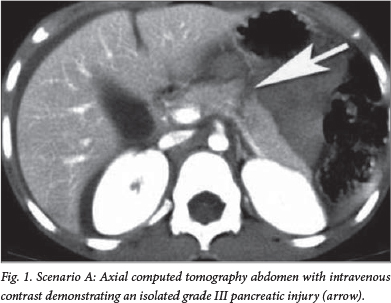
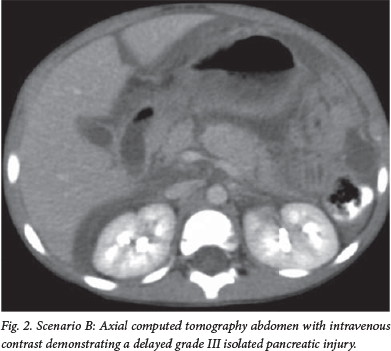
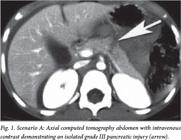
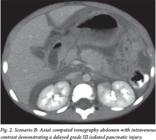
A survey was emailed to 45 paediatric surgical consultants working in various paediatric surgical units in SA, Italy, England and Australia. The questionnaire comprised two scenarios of isolated pancreatic trauma (grade III), the main difference between the two scenarios being the time interval between initial injury and presentation. In the first scenario (A), the patient presented 6 hours post injury (Fig. 1) whereas in the second scenario (B), the patient presented 6 days post initial injury (Fig. 2). The survey, in a tick box format to facilitate analysis, enquired about diagnosis and subsequent work-up (including preferred imaging techniques), supportive management (including nutrition), the various options of definitive intervention and follow-up procedure.
Results
Twenty-one surgeons responded to the questionnaire from four countries consisting of 12 paediatric surgical units. In six of the units, more than one specialist returned the questionnaire.
Scenario A
Acute presentation of a ductal injury between the body and neck of the pancreas. Presentation was within 6 hours of incident, with no associated injuries (Fig. 1; Table 1).
Management of this injury varied between individuals and units, including individuals in the same unit. Of the 21 surgeons who responded:
1. Ten opted for surgical management:
- 5 for open distal spleen-sparing pancreatectomy
- 1 for open ductal repair
- 4 for laparoscopic distal spleen-sparing pancreatectomy.
2. A total of 8 opted for conservative management, namely pancreatic rest with total parenteral nutrition (TPN) until pain resolved, analgesia, and serial abdominal examinations. Of these, 7 would use octreotide to decrease pancreatic exocrine secretions.
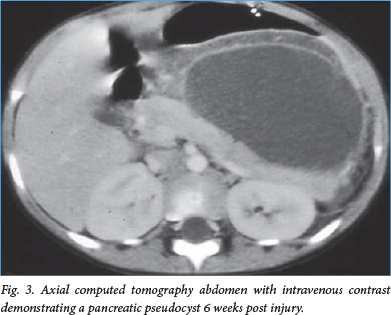
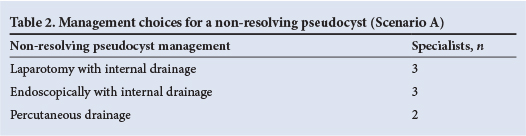
If a pancreatic pseudocyst developed (Fig. 3; Table 2):
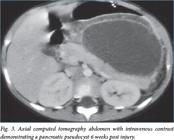
- 3 opted for open internal drainage
- 3 would do an endoscopic internal drainage procedure
- 2 would do percutaneous drainage.
3. Three opted for an ERCP and stent insertion.
Scenario B
Delayed presentation of a ductal injury between the body and neck of the pancreas. Presentation was 6 days post incident with no associated injuries (Fig. 2; Table 3).
1. Four surgeons would do an open distal spleen-sparing pancreatectomy despite the possibility of splenic injury.
2. A total of 13 opted for conservative management, of whom 9 would use octreotide.
If a pseudocyst developed:
- 7 opted for open internal drainage
- 4 would do an endoscopic internal drainage procedure
- 2 would do percutaneous drainage.
3. Four surgeons elected for an ERCP and transpapillary stent that would be left in situ:
- 2 would leave in situ for 1 month
- 1 would leave in situ for 2 months
- 1 would leave in situ for 3 months.
Nine would treat scenarios A and B in the same manner. Out of the 6 units that had multiple replies, 4 units had specialists with different management strategies.
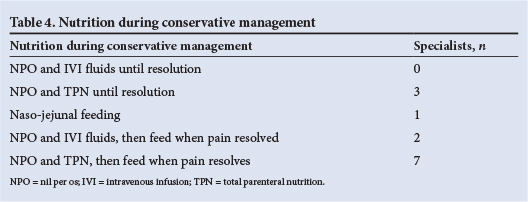
Nutritional management during conservative management is summarised in Table 4. Fig. 4 graphically illustrates the difference in management choices between the two scenarios. Table 5 illustrates the differences between SA surgeons and their international colleagues.
Discussion
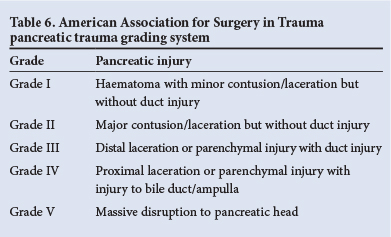
The severity of pancreatic trauma has been graded by the American Association for Surgery in Trauma (Table 6). The management of grade I and II injuries is less controversial, and conservative management is agreed as the standard of care.1 , 3 , 7 , 8 , 10 Treatment becomes less clear and more controversial when ductal injury is suspected (grades III - V). Some authors advocate conservative management irrespective of the grade of the injury,1 , 5 , 6 ,11 while others opt for an aggressive surgical approach if the diagnosis is made early on, preferring distal pancreatectomy with splenic preservation.7 , 10 , 12 , 13 This has been described via both laparotomy and laparoscopy.138 , 14 , 15Other less commonly described techniques include creation of a Roux-en-Y jejunal onlay, primary ductal repair and drainage, oversew of proximal pancreatic stump and distal Roux-en-Y pancreaticojejunostomy.16
The two scenarios were designed in response to numerous factors. Owing to the nonspecific nature of the signs and symptoms of isolated pancreatic trauma, it is uncommon for patients to present in the first 48 hours post injury, particularly in SA where access to healthcare is not always immediately available.5
There is considerable debate about the best imaging modality for blunt pancreatic trauma. Contrast computed tomography (CT) is considered the gold standard to diagnose pancreatic injuries, but its sensitivity and specificity change depending on the delay from the time of injury. In the first 12 - 24 hours post injury, pancreatic contusion or laceration can be missed owing to the evolving nature of the injury process. Furthermore, injuries can also be overlooked owing to the relative lack of visible retroperitoneal fat planes in children as well as the initial lack of reactive oedema.8 , 17 Canty and Weinman15n=11/16), whereas Houban et al.8n=10/11) diagnostic rate with contrast CT. The improved accuracy in the second study could be due to the late referral of the cohort of patients, with the CT scans being performed more than 24 hours after injury.8 , 18 If the initial CT is negative and there is a high index of suspicion of a pancreatic injury, a repeat CT scan may need to be performed after 24 hours.
There is no specific role for ultrasound in diagnosing acute pancreatic injury; however, ultrasound is well established with respect to follow-up of previously documented injuries.8et al.8
Diagnostic ERCP is also controversial, with some authors believing that it should be undertaken in every patient with equivocal CT evidence of pancreatic trauma.14 , 17 , 19 Others feel that there is little benefit, considering the relatively high complication rates that include the possibility of introducing infection into a peripancreatic fluid collection, the development of post-ERCP pancreatitis and the conversion of a partial to complete ductal disruption. The risk of these complications has been estimated to be about 6%.8
Serum amylase level is part of the blood investigation that is requested on any blunt abdominal trauma patient. There is no correlation between serum amylase level and severity of pancreatic injury, with the sensitivity of serum amylase to predict a pancreatic injury being ~70%. Jobst et al.7et al.517
Once an injury has been documented and a conservative approach adopted, management comprises nasogastric tube placement, TPN, serial clinical examination and monitoring of amylase levels. This has been shown to be a safe approach to managing paediatric pancreatic trauma patients.1 , 5 , 6 , 20 , 21 It is accepted that there will be a higher incidence of pseudocyst formation, but proponents of this technique do not consider pseudocyst formation a complication. According to the latest Atlanta Classification for pancreatitis, a fluid collection around the pancreas in the first 4 weeks post injury is called an acute peripancreatic fluid collection. After 4 weeks, it is termed a pancreatic pseudocyst. Fifty to sixty per cent of acute peripancreatic fluid collections that develop secondary to pancreatic injury undergo spontaneous resolution within 6 weeks of injury.12 , 21 Those that persist and form pseudocysts that remain symptomatic, require some sort of definitive intervention. Cigdem et al.20et al.211 , 5 , 20 , 21 As can be seen in the results section from this survey, the majority of conservatively treated patients would have their parenteral nutrition stopped on resolution of pain.
Octreotide acetate infusion is used frequently in the conservative management of pancreatic trauma; its use is extrapolated from randomised trials in adults using octreotide in the treatment of pancreatic fistulas post pancreatic resection. Octreotide use results in reduced splanchnic blood flow and diminished pancreatic secretion of amylase, trypsin and lipase which intuitively should lead to enhanced recovery.2223
The advantage of conservative management is that the patient may avoid surgical intervention, on the basis that 50% of acute peripancreatic fluid collections may resolve spontaneously. In addition, the theoretical danger of decreased pancreatic endocrine and exocrine function later in life due to pancreatic resection may be averted.6
The technique of draining a non-resolving pseudocyst is also controversial. Most of the earlier literature describes percutaneous drainage. This seems to work in the majority of cases, but the risk of creating a pancreatic fistula is increased.24et al.25et al.26et al.278 , 9 , 28 It would seem more logical to do an internal drainage technique if a true ductal injury is present, owing to the higher failure rate of percutaneous drainage. If these techniques do not resolve the pseudocyst, or if recurrence occurs, a more invasive open cystogastrostomy or Roux-en-Y is indicated.
Early surgical management of pancreatic trauma with ductal disruption (grade III) has also been given a lot of attention in the literature. It is usually performed in the first 48 hours after injury, minimising the risk of iatrogenic injury to the splenic vessels and need for splenectomy, which has an increased incidence thereafter. Proponents of early spleen-sparing pancreatectomy cite decreased length of hospital stay, decreased times on TPN, more rapid resumption of enteral feeds, lower morbidity and fewer repeat interventions as their reasons.9 , 10 Iqbal et al.9et al. Meier et al.10operated on nine patients, with morbidities including one pancreatic leak, one prolonged ileus and one postoperative bowel obstruction. In another study, a pseudocyst developed in 21% of the operated group, suggesting pancreatic leak that required surgical intervention.19
The concern about performing a pancreatic resection is that there are no long-term studies documenting the impact on long-term endocrine or exocrine function. It is known that a 65% loss of β-cells in adults causes impairment of glucose tolerance. It is therefore theoretically possible that children with substantial pancreatic loss could be at risk of endocrine deficiency later in life.29629
As paediatric gastroenterologists are gaining more experience in performing ERCPs on children, endoscopic techniques are becoming more popular in the management of these patients. The concerns regarding ERCP on children are related to the technical difficulty of cannulating a smaller ampulla, and its possible complications as discussed earlier. There is also the problem of migrating stents requiring multiple reinsertions and the possibility of stricture formation after stent removal at the site of injury.2015et al.8
SA paediatric surgeons' management of pancreatic injury with ductal involvement mimics that reported in the literature. The only real difference in management is that the operative approach in the international cohort is more likely to be laparoscopic. This could be due to a lower theatre burden and more cosmetically sensitive population group in the First World. One pitfall of this type of review is that financial incentives pertaining to the different management techniques are not accounted for when reviewing the decisions made by treating physicians.
Conclusion
There is still no clear ideal management of grade III paediatric pancreatic injuries. It is accepted that grade I and II patients should be treated conservatively. If a pseudocyst develops and becomes symptomatic or does not resolve spontaneously, there are a multitude of ways to drain it either internally or externally. The controversy arises in grade III injuries. SA paediatric surgeons, much like their overseas counterparts, follow the international published guidelines with a vast array of management protocols as a result. From both the literature and the results of the survey, there seems to be no ideal way of managing these patients when there is an associated ductal injury. Proponents of each technique (operative, conservative or endoscopic) claim that their technique is superior and safer than the other. Fortunately, all techniques are effective, with a relatively low morbidity. Mortality is usually due to associated injuries. No absolute algorithm can be used to treat these patients. All patients should be treated individually and managed with an approach and techniques that are feasible in keeping with facilities available in each individual unit. Factors that should be taken into account include associated injuries, length of time since injury, facilities available, grade of injury and capability of the paediatric surgical team.
REFERENCES
- 1. Keller MS, Stafford PW, Vane DW. Conservative management of pancreatic trauma in children. J Trauma 1997;42(6):1097-1100.
- 2. Jacombs AS, Wines M, Holland AJA, Ross FI, Shun A, Cass DT. Pancreatic trauma in children. J Pediatr Surg 2004;39:96-99.
-
3. Paul MD, Mooney DP. The management of pancreatic injuries in children: Operate or observe. J Pediatr Surg 2011;46(6);1140-1143. [http://dx.doi.org/10.1016/j.jpedsurg.2011.03.041]
» http://dx.doi.org/10.1016/j.jpedsurg.2011.03.041 -
4. Mattix KD, Tataria M, Holmes J, et al. Pediatric pancreatic trauma: Predictors of nonoperative management failure and associated outcomes. J Pediatr Surg 2007;42(2):340-344. [http://dx.doi.org/10.1016/j.jpedsurg.2006.10.006]
» http://dx.doi.org/10.1016/j.jpedsurg.2006.10.006 - 5. Shilyansky J, Sena LM, Kreller M, et al. Nonoperative management of pancreatic injuries in children. J Pediatr Surg 1998;33(2):343-349.
-
6. Wales PW, Shuckett B, Kim PCW. Long-term outcome after nonoperative management of complete traumatic pancreatic transection in children. J Pediatr Surg 2001;36(5):823-827. [http://dx.doi.org/10.1053/jpsu.2001.22970]
» http://dx.doi.org/10.1053/jpsu.2001.22970 - 7. Jobst MA, Canty TG Sr, Lynch FP. Management of pancreatic injury in pediatric blunt abdominal trauma. J Pediatr Surg 1999;34(5):818-824.
-
8. Houben CH, Ade-Ajayi N, Patel S, et al. Traumatic pancreatic duct injury in children: Minimally invasive approach to management. J Pediatr Surg 2007;42(4):629-635. [http://dx.doi.org/10.1016/j.jpedsurg.2006.12.025]
» http://dx.doi.org/10.1016/j.jpedsurg.2006.12.025 -
9. Iqbal CW, St Peter SD, Tsao K, et al. Operative vs nonoperative management for blunt pancreatic transection in children: Multi-institutional outcomes. J Am Coll Surg 2014;218(2):157-162. [http://dx.doi.org/10.1016/j.jamcollsurg.2013.10.012]
» http://dx.doi.org/10.1016/j.jamcollsurg.2013.10.012 -
10. Meier DE, Coln CD, Hicks BA, Guzzetta PC. Early operation in children with pancreas transection. J Pediatr Surg 2001;36(2):341-344. [http://dx.doi.org/10.1053/jpsu.2001.20711]
» http://dx.doi.org/10.1053/jpsu.2001.20711 -
11. Kouchi K, Tanabe M, Yoshida H, et al. Nonoperative management of blunt pancreatic injury in childhood. J Pediatr Surg 1999;34(11):1736-1739. [http://dx.doi.org/10.1016/S0022-3468(99)90657-7]
» http://dx.doi.org/10.1016/S0022-3468(99)90657-7 -
12. Beres AL, Wales PW, Christison-Lagay ER, McClure ME, Fallat ME, Brindle ME. Non-operative management of high-grade pancreatic trauma: Is it worth the wait? J Pediatr Surg 2013;48(5):1060-1064. [http://dx.doi.org/10.1016/j.jpedsurg.2013.02.027]
» http://dx.doi.org/10.1016/j.jpedsurg.2013.02.027 -
13. Iqbal CW, Levy SM, Tsao K, et al. Laparoscopic versus open distal pancreatectomy in the management of traumatic pancreatic disruption. J Laparoendosc Adv Surg Tech A 2012;22(6):595-598. [http://dx.doi.org/10.1089/lap.2012.0002]
» http://dx.doi.org/10.1089/lap.2012.0002 - 14. Rescorla FJ, Plumley DA, Sherman S, Scherer LR 3rd, West KW, Grosfeld JL. The efficacy of early ERCP in pediatric pancreatic trauma. J Pediatr Surg 1995;30(2):336-340.
-
15. Canty TG, Weinman D. Treatment of pancreatic duct disruption in children by an endoscopically placed stent. J Pediatr Surg 2001;36(2):345-348. [http://dx.doi.org/10.1053/jpsu.2001.20712]
» http://dx.doi.org/10.1053/jpsu.2001.20712 -
16. Stringer MD. Pancreatitis and pancreatic trauma. Semin Pediatr Surg 2005;14(4):239-246. [http://dx.doi.org/10.1053/j.sempedsurg.2005.06.007]
» http://dx.doi.org/10.1053/j.sempedsurg.2005.06.007 -
17. Maeda K, Ono S, Baba K, Kawahara I. Management of blunt pancreatic trauma in children. Pediatr Surg Int 2013;29:1019-1022. [http://dx.doi.org/10.1007/s00383-013-3402-9]
» http://dx.doi.org/10.1007/s00383-013-3402-9 - 18. Canty TG Sr, Weinman D. Management of major pancreatic duct injuries in children. J Trauma 2001;50(6):1001-1007.
-
19. Wood JH, Partrick DA, Bruny JL, Sauaia A, Moulton SL. Operative vs nonoperative management of blunt pancreatic trauma in children. J Pediatr Surg 2010;45(2):401-406. [http://dx.doi.org/10.1016/j.jpedsurg.2009.10.095]
» http://dx.doi.org/10.1016/j.jpedsurg.2009.10.095 -
20. Cigdem MK, Senturk S, Onen A, Siga M, Akay H, Otcu S. Nonoperative management of pancreatic injuries in pediatric patients. Surg Today 2011;41(5):655-659. [http://dx.doi.org/10.1007/s00595-010-4339-4]
» http://dx.doi.org/10.1007/s00595-010-4339-4 -
21. De Blaauw I, Winkelhorst JT, Rieu PN, et al. Pancreatic injury in children: Good outcome of nonoperative treatment. J Pediatr Surg 2008;43(9):1640-1643. [http://dx.doi.org/10.1016/j.jpedsurg.2008.03.061]
» http://dx.doi.org/10.1016/j.jpedsurg.2008.03.061 - 22. Nwariaku FE, Terracina A, Mileski WJ, Minei JP, Carrico CJ. Is octreotide beneficial following pancreatic injury? Am J Surg 1995;170(6):582-585.
-
23. Wensil AM, Balasubramanian SA, Bell TL. Resolution of a posttraumatic pancreatic pseudocyst with octreotide acetate in a pediatric patient. Pharmacother J Pharmacotherapy 2011;31(9):924. [http://dx.doi.org/10.1592/phco.31.9.924]
» http://dx.doi.org/10.1592/phco.31.9.924 - 24. Bass J, Lorenzo MD, Desjardins JG, Grignon A, Ouimet A. Blunt pancreatic injuries in children: The role of percutaneous external drainage in the treatment of pancreatic pseudocysts. J Pediatr Surg 1988;23(8):721-724.
- 25. Rescorla FJ, Cory D, Vane DW, Wes KW, Grosfeld JL. Failure of percutaneous drainage in children with traumatic pancreatic pseudocysts. J Pediatr Surg 1990;25(10):1038-1042.
-
26. Stringer MD. Pancreatic trauma in children. Br J Surg 2005;92(4):467-470. [http://dx.doi.org/10.1002/bjs.4876]
» http://dx.doi.org/10.1002/bjs.4876 - 27. Millar AJW, Rode H, Stunden RJ, Cywes S. Management of pancreatic pseudocysts in children. J Pediatr Surg 1988;23(2):122-127.
-
28. Abbo O, Lemandat A, Reina N, et al. Conservative management of blunt pancreatic trauma in children: A single center experience. Eur J Pediatr Surg 2013;23(6):470-473. [http://dx.doi.org/10.1055/s-0033-1333642]
» http://dx.doi.org/10.1055/s-0033-1333642 -
29. Edwards MJ, Crudo DF, Carlson TL, Pedersen AM, Keller L. Pancreatic atrophy and diabetes mellitus following blunt abdominal trauma. J Pediatr Surg 2013;48(2):432-435. [http://dx.doi.org/10.1016/j.jpedsurg.2012.11.030]
» http://dx.doi.org/10.1016/j.jpedsurg.2012.11.030