Evaluation of choices and time spent on an open online elective course by undergraduate medical students during the COVID-19 pandemic
Abstract
BACKGROUND. The COVID-19 pandemic highlighted the weakness of relying on in-person tuition in higher education. Massive open online courses (MOOCs) have been a successful addition to higher education. In this study, educators had to replace a planned elective in the medical curriculum with an online option during the pandemic. The roles of the competency framework of the Health Professions Council of South Africa (HPCSA) (Leader and Manager, Health Advocate, Professional, Communicator, Collaborator, Scholar, and Healthcare Practitioner) were used to guide its development. This elective emphasised the non-clinical roles of medical practitioners and was offered in 2020 and 2021. OBJECTIVES. To describe the choices of third-year medical students and time spent participating in a modified online elective in 2020 and 2021. METHODS. A descriptive cross-sectional study design was used, involving the participation of 629 medical students. Data were collected and analysed from three primary sources: registration data from LinkedIn Learning, data from the Foundation for Professional Development, and self-reported estimates by students of the average time spent on selected courses. Data included identification of the associated competency acquired. Data analysis was conducted using Python, version 3.10.11. RESULTS. The course choices of 629 students were analysed. In 2020 there were 300 participants and in 2021 there were 329. All the students had one compulsory inclusion in the elective (Management and Leadership Short Course for Undergraduate Healthcare Students). Students in both years reported spending the most average time on courses related to clinical knowledge (Healthcare Practitioner), followed by financial literacy and management (Professional), diversity management (Collaborator), and priority actions to identify and/or respond to (Health Advocate). The most popular courses related to the Leader and Manager role were around decision-making in human resources, problem-solving, and managing healthcare teams. Based on the top 10 LinkedIn Learning course selections of both cohorts, there appeared to be a preference for courses that were consistent with the role of medical professionals in practice. The most popular LinkedIn Learning course was The Six Morning Habits of High Performers. CONCLUSION. Students gravitated toward courses aligned with their role as professional doctors within the HPCSA competency framework. More studies are needed to understand how medical students develop the six non-clinical roles in the HPCSA framework and the effectiveness of MOOCs in a medical curriculum.
Overview of choices and average time spent by the 2020 and 2021 student groups
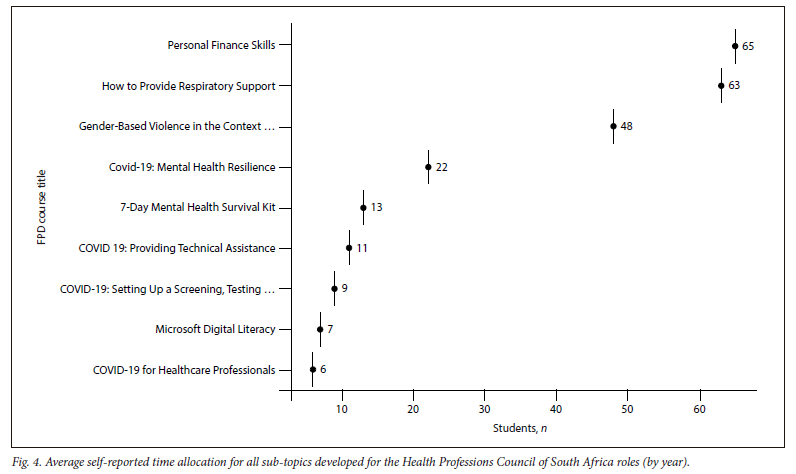
Sub-topics related to the different HPCSA roles were developed for the self-reporting template that students had to complete. The subtopics took into consideration the available courses that students were offered, as well as the key and enabling competencies described under the HPCSA roles in the competency framework. Students had to estimate the average time spent on the courses under the sub-topics. The details of their choices are presented in Fig. 4. Students in both years reported spending the most time on courses related to clinical knowledge (Healthcare Practitioner), financial literacy and management (Professional), diversity management (Collaborator), and priority actions to identify and/or respond to (Health Advocate).
The most popular courses related to the Leader and Manager role were around decision-making in human resources, problem-solving, and managing healthcare teams.
Discussion
This study describes third-year medical students' choices in an online elective rotation (GNK 488) at UP in 2020 and 2021.
Both the 2020 and 2021 students demonstrated a preference for courses related to the Healthcare Practitioner role, followed by the Professional role as described in the HPCSA competency framework. The popular choice of courses related to financial management (besides that which was already included in the compulsory course) suggests that students are eager to enhance their financial literacy and management. Improved financial literacy among medical students helps them in making informed decisions such as contract negotiation and deciding which specialty to choose.[21] Moreover, student debt among medical students is increasing significantly, and financial management can help them manage their loans effectively and plan for repayment. Previous studies have shown low financial literacy among medical students.[22]
Gaps in training for the Health Advocate role have been acknowledged despite studies that have shown that SA medical students understand the importance of health promotion, disease prevention, and empowering patients with knowledge to improve their conditions.[23] It is the duty of medical professionals to treat every patient equally, irrespective of their age, gender, race, religion, social standing or financial status. In addition to helping medical students see patients as unique people whose lives are influenced by their age, gender and cultural background, diversity management courses in medical education also help students feel respected and acknowledged as unique people whose experiences are closely tied to their socioeconomic status, sexual orientation and ethnicity.[24] Medical students are interested in diversity management courses to improve their chances of promotion or leadership positions.[25]
The course related to GBV for doctors in the context of the COVID-19 pandemic was also a popular choice in the 2020 group. GBV is widespread in southern Africa and is a significant contributor to the burden of disease. Sexual assault and other forms of GBV have wide-ranging current and future effects on individuals as well as communities. For example, children who experienced sexual abuse are more likely to test positive for HIV and engage in high-risk behaviours as adults.[26] Healthcare practitioners and medical students can play a vital role in research by collecting data on GBV prevalence, risk factors and outcomes, which can inform prevention strategies and interventions.[27] Healthcare workers can offer medical care, psychological support and referrals to other services such as counselling and social work.[27] Therefore, any additional training that medical students are able to access should consolidate skills to enable them to recognise signs and symptoms of GBV, facilitating early identification and intervention.[28]
The top 10 course selections from the LinkedIn Learning platform gravitated towards the Professional role. Courses on financial literacy, developing confidence and communication skills reflect the personal self-improvement needs of students and possible recognition on their part that these would not be met in the medical curriculum with its emphasis on clinical training. This finding reflects the known benefits of having access to diverse perspectives and materials that are not traditionally included in a curriculum,[8] and perhaps if not broadening participants' social connections as reported by Rowe et al.,[8] at least exploring social and personal development topics.
The study had several limitations. The unavailability of sponsored courses in 2021 and data related to the global health online platform in 2020 limits detailed comparisons between the choices of the two cohorts. As the self-reporting of time estimates was not verified - it was based on the honesty principle - the data may not be a true reflection of the students' experiences. Lastly, the reasons behind the choices, where a choice was possible, could not be determined. These limitations suggest that the results of this study should be viewed as suggested, rather than confirmed, preferences.
More studies are needed to understand how medical students develop the six non-clinical roles in the HPCSA framework. More guidelines are needed in national frameworks on the practicalities of addressing professional, management and advocacy competencies required by graduates in a medical curriculum. Discussion and consensus among educators involved in medical curriculum design are needed. Furthermore, educators who choose to include MOOCs in their curriculum should be mindful of the known strengths and limitations, especially regarding assessment.
Conclusion
Third-year medical students were found to be interested in topics related to financial management, communication and development of personal confidence during the online replacement courses presented during the COVID-19 pandemic in 2020 and 2021. Currently, the undergraduate medical curriculum does not include topics on financial management or personal development. It is suggested that these topics should be considered for inclusion in this curriculum and in other health sciences curricula that might have similar gaps. The forced choices required by the pandemic resulted in an appreciation of the possible benefits of MOOCs. This research confirmed that MOOCs are a viable alternative to full personal attendance at lectures, and as such they could be potentially valuable additions to or substitutions for any residential programme.
Declaration. The research for this study was done in partial fulfilment of the requirements for ZM's MPH degree at UP.
Acknowledgements. The authors thank the Education Innovation consultant and Deanery at the Faculty of Health Sciences, UP; the School of Health Systems and Public Health, UP, for administrative and academic support; the International Elective and Education Office, UP; the Learning and Development staff in the Department of Human Resources, UP, for LinkedIn Learning support; the Foundation for Professional Development; and finally, the academic co-ordinators in the School of Medicine, UP.
Author contributions. AT planned the elective project. AT and JEW secured permission to use the MOOCs and designed and submitted the study for ethical approval. The data were collated from the various sources by AT. DM performed the statistical analysis. ZM interpreted the findings and wrote the first draft. AT and JEW edited the manuscript. All authors read and approved the final manuscript.
Funding. None.
Conflicts of interest. None.
References
-
1. Liyanagunawardena TR, Adams AA, Williams SA. MOOCs: A systematic study of the published literature 2008-2012. Int Rev Res Open Distrib Learn 2013;14(3):202-227. https://doi.org/10.19173/irrodl.v14i3.1455
» https://doi.org/10.19173/irrodl.v14i3.1455 -
2. King M, Pegrum M, Forsey M. MOOCs and OER in the Global South: Problems and potential. Int Rev Res Open Distrib Learn 2018;19(5). https://doi.org/10.19173/irrodl.v19i5.3742
» https://doi.org/10.19173/irrodl.v19i5.3742 -
3. Maxwell WD, Fabel PH, Diaz V, et al. Massive open online courses in US healthcare education: Practical considerations and lessons learned from implementation. Curr Pharm Teach Learn 2018;10(6):736-743. https://doi.org/10.1016/j.cptl.2018.03.013
» https://doi.org/10.1016/j.cptl.2018.03.013 -
4. White L. Medical MOOCs: Lessons learned from the trenches of medical education. The EvoLLLution, 8 July 2015. https://evolllution.com/opinions/medical-moocs-lessons-learned-trenches-medical-education/ (accessed 4 August 2023).
» https://evolllution.com/opinions/medical-moocs-lessons-learned-trenches-medical-education/ -
5. Mehta NB, Hull AL, Young JB, Stoller JK. Just imagine: New paradigms for medical education. Acad Med 2013;88(10):1418-423. https://doi.org/10.1097/ACM.0b013e3182a36a07
» https://doi.org/10.1097/ACM.0b013e3182a36a07 -
6. Hendriks RA, de Jong PGM, Admiraal WF, Reinders MEJ. Instructional design quality in medical massive open online courses for integration into campus education. Med Teach 2020;42(2):156-163. https://doi.org/10.1080/0142159X.2019.1665634
» https://doi.org/10.1080/0142159X.2019.1665634 -
7. Sharma N, Doherty I, Harbutt D. MOOCs and SMOCs: Changing the face of medical education; Perspect Med 2014;3(6):508-509. https://doi.org/10.1007/s40037-013-0103-y
» https://doi.org/10.1007/s40037-013-0103-y -
8. Rowe M, Osadnik CR, Pritchard S, Maloney S. These may not be the courses you are seeking: A systematic review of open online courses in health professions education. BMC Med Educ 2019;19(1):356. https://doi.org/10.1186/s12909-019-1774-9
» https://doi.org/10.1186/s12909-019-1774-9 -
9. Harder B. Are MOOCs the future of medical education? BMJ 2013;346:f2666. https://doi.org/10.1136/bmj.f2666
» https://doi.org/10.1136/bmj.f2666 -
10. Wong J, Baars M, Davis D, van der Zee T, Houben G-J, Paas F. Supporting self-regulated learning in online learning environments and MOOCs: A systematic review. Int J Hum Comput Interact 2019;35(4-5):356-373. https://doi.org/10.1080/10447318.2018.1543084
» https://doi.org/10.1080/10447318.2018.1543084 -
11. Jia M, Gong D, Luo J, Zhao J, Zheng J, Li K. Who can benefit more from massive open online courses? A prospective cohort study. Nurse Educ Today 2019;76:96-102. https://doi.org/10.1016/j.nedt.2019.02.004
» https://doi.org/10.1016/j.nedt.2019.02.004 -
12. De Jong PGM, Pickering JD, Hendriks RA, Swinnerton BJ, Goshtasbpour F, Reinders MEJ. Twelve tips for integrating massive open online course content into classroom teaching. Med Teach 2020;42(4):393-397. https://doi.org/10.1080/0142159X.2019.1571569
» https://doi.org/10.1080/0142159X.2019.1571569 -
13. Health Professions Council of South Africa. Core competencies for undergraduate students in clinical associate, dentistry and medical teaching and learning programmes in South Africa. February 2024 version. Pretoria: HPCSA, 2017. https://www.hpcsa-blogs.co.za/wp-content/uploads/2017/04/MDB-Core-Competencies-ENGLISH-FINAL-2014.pdf (accessed 4 August 2023).
» https://www.hpcsa-blogs.co.za/wp-content/uploads/2017/04/MDB-Core-Competencies-ENGLISH-FINAL-2014.pdf -
14. Turner A, Lubbe IJ, Ross W. A ray of sunshine in the COVID-19 environment, with a virtual sunburst elective. Afr J Health Prof Educ 2021;13(3):189-190. https://doi.org/10.7196/AJHPE.2021.v13i3.1509
» https://doi.org/10.7196/AJHPE.2021.v13i3.1509 -
15. Wolvaardt G, du Toit PH. Action research-driven professional development: Developing transformational health care managers and creating learning organisations. S Afr J High Educ 2012;26(6):1249-1264. https://doi.org/10.20853/26-6-222
» https://doi.org/10.20853/26-6-222 -
16. Kennedy MR. Linkedin Learning product review. J Can Health Libr Assoc 2019;40(3):142-143. https://doi.org/10.29173/jchla29424
» https://doi.org/10.29173/jchla29424 -
17. McKinney W. Data structures for statistical computing in Python. In: van der Walt S, Millman J, eds. Proceedings of the 9th Python in Science Conference, pp. 56-61. Austin, Texas, 3 July-28 June 2010. http://conference.scipy.org.s3-website-us-east-1.amazonaws.com/proceedings/scipy2010/ (accessed 9 September 2022).
» http://conference.scipy.org.s3-website-us-east-1.amazonaws.com/proceedings/scipy2010/ -
18. Caswell TA, Lofgren E, Hunter JD. Matplotlib: Publication quality plotting package with Python. 2022. https://matplotlib.org/ (accessed 9 September 2022).
» https://matplotlib.org/ -
19. Hunter JD. Matplotlib: A 2D graphics environment. Comput Sci Eng 2007;9(3):90-95. https://doi.org/10.1109/MCSE.2007.55
» https://doi.org/10.1109/MCSE.2007.55 -
20. Swales L. The Protection of Personal Information Act and data de-identification. S Afr J Sci 2021;117(7-8). https://doi.org/10.17159/sajs.2021/10808
» https://doi.org/10.17159/sajs.2021/10808 -
21. Clithero-Eridon A, Crandall C, Ross A. Future medical student practice intentions: The South Africa experience. BMC Med Educ 2020;20:434. https://doi.org/10.1186/s12909-020-02361-5
» https://doi.org/10.1186/s12909-020-02361-5 -
22. Millen A, Stacey A. Financial literacy in South African healthcare professionals: An unmet need in health professions education. S Afr J High Educ 2022;36(3):123-142. https://doi.org/10.20853/36-3-4647
» https://doi.org/10.20853/36-3-4647 -
23. Mabuza LH, Moshabela M. What do medical students and their clinical preceptors understand by primary health care in South Africa? A qualitative study. BMC Med Educ 2023;23(1):785. https://doi.org/10.1186/s12909-023-04751-x
» https://doi.org/10.1186/s12909-023-04751-x -
24. Davis DL, Tran-Taylor D, Imbert E, Wong JO, Chou CL. Start the way you want to finish: An intensive diversity, equity, inclusion orientation curriculum in undergraduate medical education. J Med Educ Curric Dev 2021;8:23821205211000352. https://doi.org/10.1177/23821205211000352
» https://doi.org/10.1177/23821205211000352 -
25. Piano M, Diemer K, Hall M, et al. A rapid review of challenges and opportunities related to diversity and inclusion as experienced by early and mid-career academics in the medicine, dentistry and health sciences fields. BMC Med Educ 2023;23:288. https://doi.org/10.1186/s12909-023-04252-x
» https://doi.org/10.1186/s12909-023-04252-x -
26. Andersson N, Cockcroft A, Shea B. Gender-based violence and HIV: Relevance for HIV prevention in hyperendemic countries of southern Africa. AIDS 2008;22(Suppl 4):S73-S86. https://doi.org/10.1097/01.aids.0000341778.73038.86
» https://doi.org/10.1097/01.aids.0000341778.73038.86 -
27. Leddy AM, Weiss E, Yam E, Pulerwitz J. Gender-based violence and engagement in biomedical HIV prevention, care and treatment: A scoping review. BMC Public Health 2019;19(1):897. https://doi.org/10.1186/s12889-019-7192-4
» https://doi.org/10.1186/s12889-019-7192-4 -
28. Mutinta G. Gender-based violence among female students and implications for health intervention programmes in public universities in Eastern Cape, South Africa. Cogent Soc Sci 2022;8(1):2079212. https://doi.org/10.1080/23311886.2022.2079212
» https://doi.org/10.1080/23311886.2022.2079212