Should routine serological screening for HCV be mandatory in HIV/AIDS patients enrolling for HAART in South Africa?
Maemu P GededzhaI; M Jeffrey MphahleleII; Azwidowi LukhwareniII; Selokela G SelabeII
IMSc (Med). HIV and Hepatitis Research Unit, Department of Virology, University of Limpopo and National Health Laboratory Service, Pretoria
IIPhD. HIV and Hepatitis Research Unit, Department of Virology, University of Limpopo and National Health Laboratory Service, Pretoria
To the Editor: Globally, an estimated 170 million people (about 3% of the world's population) have been infected with hepatitis C virus (HCV). HCV, a member of the Hepacivirus genus in the Flaviviridae family, possesses a single stranded, positive-sense RNA genome of approximately 9.6 kilobase (kb), and is the major cause of chronic hepatitis, cirrhosis and hepatocellular carcinoma.1 2-5 but this is higher in high-risk individuals, e.g. 39.4% in haemophiliacs and 4.8% in chronic dialysis patients.2
Some 4 -5 million people globally are co-infected with HCV and human immunodeficiency virus (HIV).6 7 8 9
South Africa has scaled up HAART for treatment of HIV/AIDS in the public health sector since April 2003. However, research programmes to monitor the efficacy of HAART in HIV/AIDS patients co-infected with HBV and HCV do not exist. We have shown that 63% of HIV-positive South African patients initiating HAART have past or present HBV infection.10 11 12
Methods
We investigated the burden of HCV co-infection in HIV-positive patients enrolling for HAART at a tertiary hospital in Pretoria. The study population comprised 653 serum samples stored at -70ºC from adult HIV/AIDS patients who were candidates for HAART at Tshepang Clinic, Dr George Mukhari Hospital (DGMH), Pretoria, from 2004 to 2006. The Research, Ethics and Publication Committee of the University of Limpopo, Medunsa Campus, approved the study. All sera were screened for anti-HCV marker using the AxSYM assays version 3.0 (Abbott Laboratories, North Chicago) following the manufacturer's instructions.
Owing to limited serum volumes to confirm the initial screening results with a second serological assay, all anti-HCV positives (samples with S/CO, i.e. ratio of the sample rate (S) to the cut-off rate (CO) for each sample and control) above 5.23 and preliminary positives (samples with S/CO between 1.00 and 5.00) were subjected to in-house qualitative reverse transcription-polymerase chain reaction (RT-PCR) assay. Viral RNA was extracted from serum with the QIAmp viral mini RNA kits (Qiagen Gmbh, Germany), followed by PCR targeting of the highly conserved 5'-untranslated region (UTR) as previously described with slight modifications.13
Results
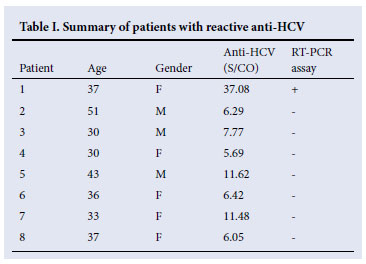
Only 1.2% (8/653) of samples were positive for anti-HCV, with S/CO values ranging from 5.69 to 37.8. Of these 8 samples, HCV RNA was detected in only one, which had the highest anti-HCV titre of 37.8 (Table I). Sequencing confirmed that the RT-PCR product is HCV-specific. In contrast, 20.7% (135/653) of preliminary positive samples had S/CO values ranging from 1.02 to 4.48. None of these samples tested positive for HCV by RT-PCR.
Discussion
Laboratory diagnosis of HCV has major limitations as most available serological assays do not distinguish between acute, chronic and past infections. HCV RNA positive is regarded to be a marker of replication, whereas HCV RNA negative in anti-HCV positive patients indicates either resolved infection or very low viraemia with HCV RNA levels below the detection limit of the RT-PCR assay.
South Africa has one of the highest number of people living with HIV.14 15 16 17
Our study shows that most HIV/AIDS patients initiating HAART at DGMH have low exposure to, or active, HCV infection. In contrast to high rates of HBV and HIV co-infection in similar patients at DGMH, it appears that HIV/AIDS is not a risk factor for increased detection of HCV co-infection. While our findings do not support mandatory HCV screening in HIV/AIDS patients initiating HAART in South Africa, consideration should be given to patients who may be at an increased risk, such as HIV-positive haemophiliacs, injection drug users and diabetics. HCV antiviral therapy that may benefit such high-risk patients is increasingly becoming available in South African tertiary public hospitals through public-private partnerships.
We thank staff members of Tshepang HIV Outpatient Clinic, DGMH and the National Health Laboratory Service at DGMH Tertiary Laboratory, University of Limpopo, Medunsa Campus, for technical assistance. This study was supported in part by grants from the South African National Research Foundation and the Poliomyelitis Research Foundation.
References
- 1. Sulkowski MS, Mast EE, Seeff LB, Thomas DL. Hepatitis C virus infection as an opportunistic disease in persons infected with human immunodeficiency virus. Clin Infect Dis 2000;30(1):s77-s84.
- 2. Soni PN, Tait DR, Kenoyer DG, et al. Hepatitis C virus antibodies among risk groups in a South African area endemic for hepatitis B virus. J Med Virol 1993;40(1):65-68.
- 3. Basetse H, Peenze I, Aspinall S. Hepatitis C virus antibodies in the black population of Garankuwa. SMLTSA 1993;6(5):88-89.
- 4. Ellis L, Brown D, Conradie J, et al. Prevalence of hepatitis C in South Africa: detection of anti-HCV in recent and stored serum. J Med Virol 1990;32(4):249-251.
- 5. Vardas E, Ross M, Sharp G, Mc Anerney J, Sim J. Viral hepatitis in South African healthcare workers at increased risk of occupational exposure to blood-borne viruses. J Hosp Infect 2002;50:6-12.
- 6. Alter M. Epidemiology of viral hepatitis and HIV co-infection. J Hepatol 2006;44:S6-S9.
- 7. Newcomb-Fernandez J. Co-infection with HIV and hepatitis C: An overview. RITA 2004;10(2):5-16.
- 8. Miller MF, Haley C, Koziel MJ, Rowley CF. Impact of hepatitis C virus on immune restoration in HIV-infected patients who start highly active antiretroviral therapy: a meta-analysis. Clin Infect Dis 2005;41(5):713-720.
- 9. Sulkowski MS, Thomas DL, Chaisson RE, Moore RD. Hepatotoxicity associated with antiretroviral therapy in adults infected with human immunodeficiency virus and the role of hepatitis C or B virus infection. J Am Med Assoc 2000;283(1):74-80.
- 10. Lukhwareni A, Burnett RJ, Selabe SG, Mzileni MO, Mphahlele MJ. Increased detection of HBV DNA in HBsAg-positive and HBsAg-negative South African HIV/AIDS patients enrolling for highly active antiretroviral therapy at a tertiary hospital. J Med Virol 2009;81(3):406-412.
- 11. Amin J, Kaye M, Skidmore S, Pillay D, Cooper DA, Dore GJ. HIV and hepatitis C co-infection within CAESAR study. HIV Medicine 2004;5(3):174-179.
- 12. Parboosing R, Paruk I, Lalloo UG. Hepatitis C virus seropositivity in a South African cohort of HIV co-infected, ARV naïve patients is associated with renal insufficiency and increased mortality. J Med Virol 2008;80:1530-1536.
- 13. Sithebe NP, Aspinall S, Smuts H. Molecular epidemiology of hepatitis C virus infection at Garankuwa hospital. S Afr Med J 1996;86(12):1543-1545.
-
14. South African Department of Health. 2008 National Antenatal Sentinel HIV & Syphilis Prevalence Survey. http://www.doh.gov.za/docs/reports/2009/nassps/index.html (accessed 17 March 2010).
» http://www.doh.gov.za/docs/reports/2009/nassps/index.html - 15. Ndong-Atome G, Makuwa M, Njouom R, et al. Hepatitis C virus prevalence and genetic diversity among pregnant women in Gabon, central Africa. BMC Infect Dis 2008;8(82):1471-2334.
- 16. Kohara M, Stuver S, Tsubouchi H. Spontaneous elimination of hepatitis C virus RNA in individuals with persistent infection in a hyperendemic area of Japan. Hepatol Res 2006;34(1):28-34.
- 17. Sorbi D, Shen D, Lake-Bakaar G. Influence of HIV disease on serum anti-HCV antibody titers: a study of intravenous drug users. J Acquir Immune Defic Syndr Hum Retrovirol 1996;13:295-296.