Cryptococcosis in Gauteng: Implications for monitoring of HIV treatment programmes
Kerrigan M McCarthyI; Cheryl CohenII; Helen SchneiderIII; Susan M GouldIV; Mary E BrandtV; Rana A HajjehVI; Gauteng Cryptococcal Surveillance Initiative Group
IMB BCh, DTM&H, FCPath (SA) Micro. Reproductive Health and HIV Research Unit, Department of Obstetrics and Gynaecology, University of the Witwatersrand, Johannesburg
IIMB BCh, DTM&H, MSc (Epi), FCPath (SA) Micro. Epidemiology and Surveillance Unit, National Institute for Communicable Diseases of the National Health Laboratory Service, and School of Public Health, University of the Witwatersrand
IIIMB ChB, MMed (Public Health). Centre for Health Policy, School of Public Health, University of the Witwatersrand
IVBSc Hons, DipMedTech. Mycology Reference Unit, National Institute for Communicable Diseases of the National Health Laboratory Service, and Division of Virology and Communicable Diseases Surveillance, University of the Witwatersrand
VPhD. Mycotic Diseases Branch, Coordinating Center for Infectious Diseases, Centers for Disease Control and Prevention, Atlanta, USA
VIMD. Division of Bacterial Diseases, Coordinating Center for Infectious Diseases, Centers for Disease Control and Prevention
Correspondence
To the Editor: In South Africa, for reasons of confidentiality, difficulties with case definition and surveillance logistics, AIDS and AIDS-defining opportunistic infections are not notifiable. South African government authorities and nongovernmental organisations have difficulty measuring the burden of disease due to HIV/AIDS, or obtaining objective evidence for effectiveness of interventions such as antiretroviral therapy (ART) to mitigate its impacts. Numbers of AIDS cases are inferred from mathematical models and population death rates. Data from a surveillance project for cryptococcosis (CC) in Gauteng,12
Methods
Population-based surveillance for CC was conducted in Gauteng province, South Africa, from 1 March 2002 to 29 February 2004,134
Estimates of the number of deaths due to AIDS were obtained from the MRC report.5
Results
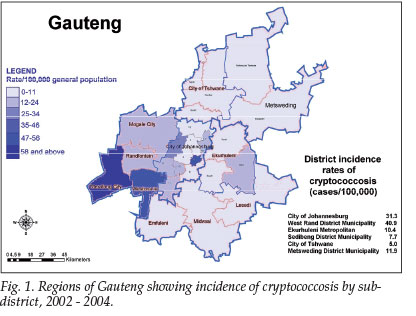
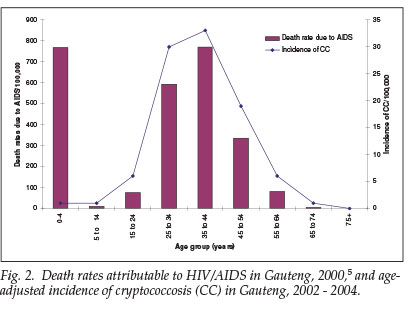
From 1 March 2002 to 29 February 2004, 2 753 incident cases of CC were identified. The incidence rate was 15.6/100 000 per annum (males 15.2/100 000, females 15.8/100 000) (Fig. 1). Using mathematically modelled data to obtain population sizes of people living with HIV and sick with AIDS, the incidence rate was 95/100 000 HIV-infected persons, and 14/1 000 people living with AIDS. Given the number of assumptions being made, these rates represent estimates of disease burden. During this period 4 - 17% of patients with CC resident in each district were admitted to a Gauteng hospital situated outside their district of residence, with the exception of Metsweding District Municipality, which has no public hospital capable of managing inpatients with CC. Death rates attributable to HIV/AIDS in Gauteng for 2000 and the age-adjusted incidence of CC peak in the same age category (35 - 44 years) (Fig. 2). The West Rand District Municipality had the highest HIV seroprevalence rate among antenatal clinic attendees in 1999, 2000 and 2003 (27.2%, 35.8% and 38.8%, respectively), as well as the highest incidence of CC during 2002 - 2004 (40.9%). Among men and women living with HIV, the incidence rates of CC differ by gender in the same way that HIV seroprevalence does, with the highest gender-related incidence in males (age category 35 - 39 years; incidence 39 cases/100 000 general population) occurring at an older age than females (peak at age category 30 - 34 years; incidence 36 cases/100 000 general population).
Discussion
We have demonstrated that the demographics of patients with CC match the demographics of South Africans living with HIV and dying from AIDS with respect to age, gender and geographical location within Gauteng. We propose that CC has the characteristics of an ideal opportunistic infection for monitoring the effectiveness of HIV testing and treatment programmes in South Africa, for the following reasons.
Firstly, laboratory-based surveillance programmes are likely to identify a substantial proportion of patients with CC because the predominant manifestation of meningoencephalitis is severe headache, which makes health-seeking behaviour by patients inevitable; the diagnosis of CC cannot be made clinically and lumbar puncture with laboratory testing is required; incident cases of cryptococcal meningitis are not treated empirically, unlike bacterial meningitis; and the inexpensive India ink test is readily available in all laboratories in South Africa and has excellent sensitivity in national surveillance compared with culture to identify cases of cryptococcal meningitis.
Secondly, in the context of the HIV/AIDS epidemic, there is sufficient burden of disease due to CC to ensure that surveillance is worth while and meaningful. CC has been observed to be the third most common cause of death in South African ART treatment programmes (personal communication, Dr Andrew Boulle, University of Cape Town, 3rd PACT Conference, Johannesburg, 16 - 18 October 2007).
Finally, population-based studies have demonstrated a significant reduction in the incidence of CC in the post-ART era,62
In the context of providing comprehensive HIV/AIDS care and treatment, continued occurrence of CC points to patient failure or inability to access medical care for HIV, or inadequate monitoring of its progress and failure to initiate ART.62
We anticipate substantial reductions in the incidence of CC in South Africa over the next decade. The Group for Enteric, Respiratory and Meningitis Surveillance of South Africa (GERMS-SA) of the National Institute for Communicable Diseases performs national laboratory-based surveillance for CC throughout South Africa (commenced January 2005), and is ideally placed to monitor changes in incidence of CC as the provision of HIV services expand.
The findings and conclusions in this article are those of the authors and do not necessarily represent the views of the CDC.
The study was funded by a CDC contract with the NHLS, South Africa.
References
- 1. McCarthy KM, Morgan J, Wannemuehler KA et al. Population-based surveillance for cryptococcosis in an antiretroviral-naive South African province with a high HIV seroprevalence. AIDS 2006; 20(17): 2199-2206.
- 2. Mirza SA, Phelan M, Rimland D, et al. The changing epidemiology of cryptococcosis: an update from population-based active surveillance in 2 large metropolitan areas, 1992-2000. Clin Infect Dis 2003; 36(6): 789-794.
-
3. Dorrington R, Bradshaw D, Budlender D. HIV/AIDS Profile of the Provinces of South Africa: Indicators for 2002. Cape Town: Actuarial Society of Southern Africa, 2002. http://www.mrc. ac.za/bod/AIDSindicators2002.pdf (accessed 19 April 2008).
» http://www.mrc. ac.za/bod/AIDSindicators2002.pdf - 4. Shisana O, Simbayi L. Nelson Mandela HSRC Study of HIV/AIDS: Full Report. Cape Town: Human Sciences Research Council, 2007.
- 5. Bradshaw D, Groenewald P, Laubscher R, et al. Initial burden of disease estimates for South Africa, 2000. S Afr Med J 2003; 93(9): 682-688.
- 6. Dromer F, Mathoulin-Pelissier S, Fontanet A, Ronin O, Dupont B, Lortholary O. Epidemiology of HIV-associated cryptococcosis in France (1985-2001): comparison of the pre-and post-HAART eras. AIDS 2004; 18(3): 555-562.
 Correspondence:
K McCarthy
(