Hydatid disease masquerading as an incisional hernia
SAMJ FORUM
CLINICAL IMAGES
Hydatid disease masquerading as an incisional hernia
A MaharajI; L AllopiII; B SinghIII, *
IFCS (SA), surgical registrar at King Edward VIII Hospital, Durban, at the time of writing, is now a paediatric surgeon at Inkosi Albert Luthuli Central Hospital
IIFCS (SA), surgical consultant at King Edward VIII Hospital
IIIFCS (SA), MD, surgical consultant at King Edward VIII Hospital
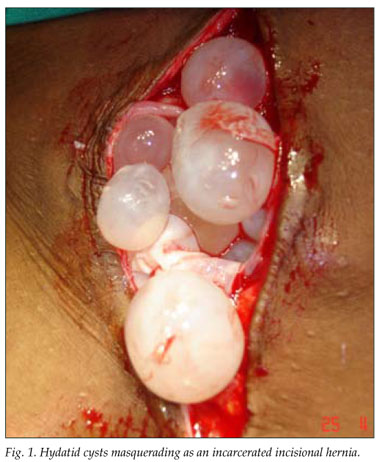
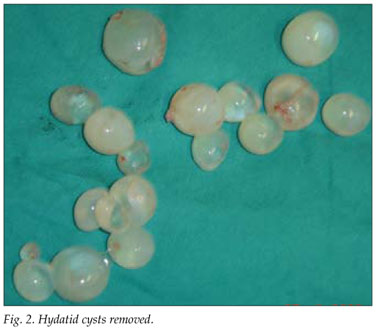
A female patient presented with a tender abdominal mass. She had had abdominal surgery 2 years previously but could not recall the details. An incarcerated incisional hernia was diagnosed. At surgery, numerous compressed cysts ballooned through the incision (Fig. 1); 17 cysts with granular contents were removed (Fig. 2). The underlying abdominal wall had no hernial defect. Hydatid cysts were confirmed histopathologically. Subsequent enquiry confirmed the previous excision of multiple hepatic hydatid cysts.
Hydatid disease (cystic echinococcosis) is endemic in sheep farming countries such as Australasia, Turkey, Greece, the Middle East, India, South America, Canada and South Africa.1Echinococcus granulosus, the commonest form, causes cystic echinococcosis. E. multilocularis, the most virulent species, causes alveolar echinococcosis. E. vogeli is very rare and causes polycystic echinococcosis.2
The definitive host of the helminth is usually the dog or other canines. The usual intermediate hosts (sheep or goat) contract the infection when ingested eggs liberate their larvae in their duodenum. Humans are accidental intermediate hosts following consumption of unwashed and uncooked vegetables or close contact with dogs. The larvae cross the intestinal wall and cysts develop in the hepatic sinusoids. Dissemination of daughter cysts from the liver may occur to the lung (in up to 75% of cases), less common sites being the bone, heart, central nervous system, spleen and muscles.
Medical treatment is largely ineffective in curing the disease, although it may stabilise it. Albendazole and praziquantel combined are reported to be more effective than either agent alone.34
Conservative surgical techniques such as marsupialisation, total cystectomy, and partial pericystectomy with omentoplasty are usually effective. Laparoscopic approaches have been described.56
References
- 1. Goldsmith R. Infectious diseases: protozoal and helminthic. In: Tierney LM, McPhee SJ, Papadakis MA, eds. Current Medical Diagnosis and Treatment. 40th ed. Stanford, Conn.: Appleton & Lange, 2001: 1330-1331.
- 2. King C. In: Mandell G, Bennett J, Dolin R, eds. Principles and Practice of Infectious Diseases. 5th ed. New York: Churchill Livingstone, 2000: 633-640.
- 3. Mohammed AE, Yasawy MI, Karawi MA. Combined albendazole and praziquantel versus albendazole alone in the treatment of hydatid disease. Gastroenterology 1998; 45: 1690-1694.
- 4. Chautems R, Buhler LH, Gold B, et al. Surgical management and long-term outcome of complicated liver hydatid cysts caused by Echinococcus granulosus. Surgery 2005; 137(3): 312-316.
- 5. Palanivelu C, Jani K, Malladi V, et al. Laparoscopic management of hepatic hydatid disease. Journal of the Society of Laparoendoscopic Surgeons 2006; 10: 56-62.
- 6. Filice C, Bruneti E, Bruno R, Crippa FG. WHO Informal Working Group on Echinococcosis – PAIR Network. Percutaneous drainage of echinococcal cysts (PAIR – puncture, aspiration, injection, reaspiration): results of a worldwide survey for assessment of its safety and efficacy. Gut 2000; 47: 156-157.