Performance data of screening mammography at a dedicated breast health centre
BACKGROUND: Mammographic screening has become part of routine health care. We present a first analysis of screening mammography in a dedicated breast health centre in Africa. OBJECTIVE: To establish a performance benchmark and provide data for health care policy and funding decisions on screening mammography.Method. All mammography performed between January 2003 and August 2008 was entered into a prospective database. Mammography was performed exclusively by certified mammographers and double-read by experienced readers. RESULTS: Outcomes were classified in a simplified classification system based on the Breast Imaging Reporting and Data System (BIRADS). In 40 - 49-year-old women, 3 192 mammograms led to a recall rate of 4.7%, a biopsy rate of 1.9% and a cancer diagnosis rate of 3.8 per 1 000 examinations; for women of 50 years and older, the corresponding figures were 4 446, 5.4%, 2.6% and 9.7 per 1 000. Of the cancers detected, 31% were in situ and, of the invasive cancers, 81% were node-negative. These figures were established by a dedicated surgeon-led team and fall within the range expected in organised screening programmes in resource-rich environments, providing a first benchmark for screening mammography in Africa.
Performance data of screening mammography at a dedicated breast health centre
J P ApffelstaedtI; V SteenkampII; K BaatjesIII
IMMed (Chir), FCS (SA). Department of Surgery, Stellenbosch University, W Cape
IIMMed (Chir), FCS (SA). Department of Surgery, Stellenbosch University, W Cape
IIIMB ChB. Panorama, W Cape
Correspondence
ABSTRACTBACKGROUND: Mammographic screening has become part of routine health care. We present a first analysis of screening mammography in a dedicated breast health centre in Africa.
OBJECTIVE: To establish a performance benchmark and provide data for health care policy and funding decisions on screening mammography.Method. All mammography performed between January 2003 and August 2008 was entered into a prospective database. Mammography was performed exclusively by certified mammographers and double-read by experienced readers.
RESULTS: Outcomes were classified in a simplified classification system based on the Breast Imaging Reporting and Data System (BIRADS). In 40 - 49-year-old women, 3 192 mammograms led to a recall rate of 4.7%, a biopsy rate of 1.9% and a cancer diagnosis rate of 3.8 per 1 000 examinations; for women of 50 years and older, the corresponding figures were 4 446, 5.4%, 2.6% and 9.7 per 1 000. Of the cancers detected, 31% were in situ and, of the invasive cancers, 81% were node-negative. These figures were established by a dedicated surgeon-led team and fall within the range expected in organised screening programmes in resource-rich environments, providing a first benchmark for screening mammography in Africa.
In Western societies, mammographic screening is part of routine health care and has been instrumental in reducing the mortality of this dreaded disease.12
Methods
All mammograms performed between January 2003 and August 2008 at a dedicated breast centre were entered into a prospective database, with permission of the patients. Mammography was performed exclusively by certified mammographers on state-of-the-art equipment, initially film-screen and, from July 2006, full-field digital equipment (GE Healthcare, Chalfont St Giles, UK). Double reading by experienced readers was performed with consensus after the second reading. Readers were practising clinicians with a special interest in breast health, or certified mammographers who had completed an internationally recognised course in mammography interpretation, had read at least 2 000 mammograms annually, and had a minimum of 50 hours annually of continued professional development in clinico-pathological and imaging correlation in breast health.
Data recorded were: age and gender, indications for mammography and outcomes. Indications for screening mammography as published by the American Cancer Society34
Data were entered into and analysed with a commercially available software package (MS Office XP Pro, Microsoft Corporation, Washington, USA).
Results
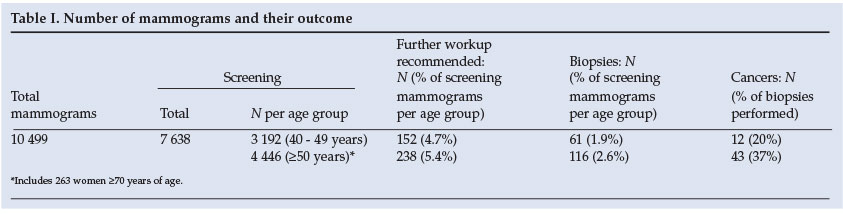
The number of mammograms and their outcome is shown in Table I.
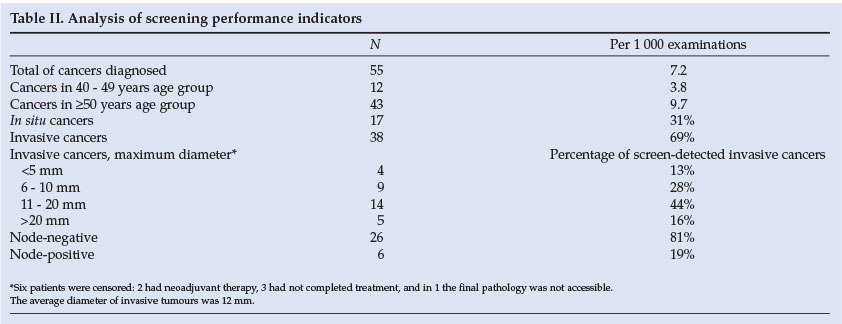
The analysis of screening performance indicators is shown in Table II.
Discussion
Breast cancer screening in women is well researched, with well-known early studies and later in-service experience establishing the benefits of mammographic screening in defined populations.15,6 If benchmarking for screening is undertaken, the prevalence and incidence of the screened condition in the population should ideally be known; however, in many resource-limited countries, this is not the case. In South Africa, the accuracy of figures in the National Cancer Registry reports for different population groups has been questioned. Available data indicate that the breast cancer incidence in whites is comparable with that of England; in other population groups, the incidence is much lower but still comparable with other countries that have instituted a population screening programme, such as Singapore789
The availability of the service attracts individuals who wish to be screened. Consequently, most examinations at our centre are screening examinations. In opportunistic screening, less emphasis is placed on quality controls than on organised screening programmes.10
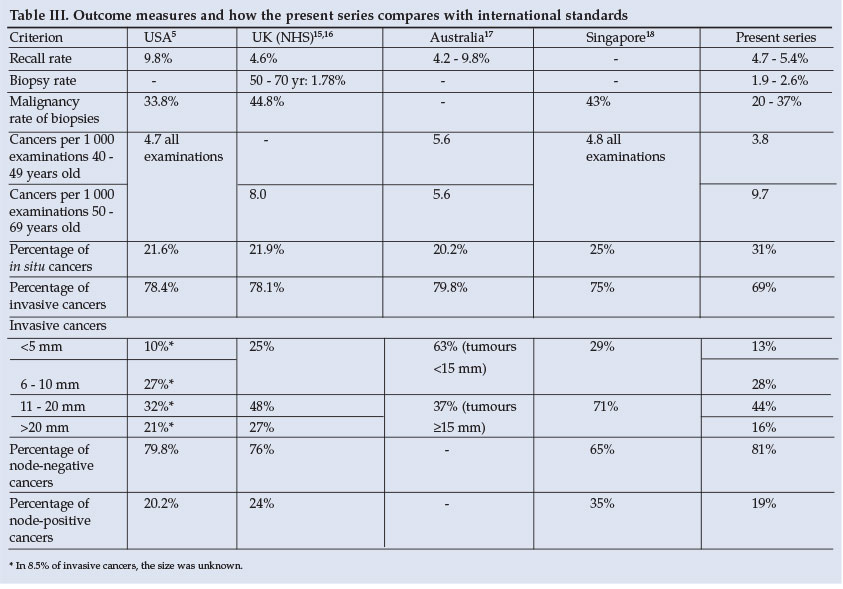
A decade-long effort to improve the mammographic quality in Michigan11121314Table III details these outcome measures and how the present series compares with international standards.
The caseload/quality relationship is well documented in mammography, with specialised readers with caseloads of more than 2 000 mammograms per year working in dedicated breast units, detecting more cancers and generating less false-positives than general readers.
Africa, in common with much of the developing world, has a lamentable shortage of radiologists and educational resources, specifically in mammography.192021-25 Indeed, performance of these interventions by surgeons was found to be less inconvenient and more cost-effective.23265
The authors thank Ms Karlien La Douce, Ms Norah Mabota and Ms Jolanta Mlodawski for the excellent mammography, which formed the basis of this paper, that they provided.
References
- 1. Dixon JM. Screening for breast cancer. BMJ 2006; 332(7540): 499-500.
- 2. Dent DM, Panieri E. Screening for breast cancer - finding a place between common sense and the evidence base. S Afr Med J 2004; 94(5): 354-355.
-
3. American Cancer Society. Can breast cancer be detected early? http://www.cancer.org (accessed 8 Aug 2008).
» http://www.cancer.org - 4. American College of Radiology. ACR Breast Imaging Reporting and Data System. 4th ed. Reston, VA, USA: American College of Radiology, 2003.
- 5. Rosenberg RD, Yankaskas BC, Abraham LA, et al. Performance benchmarks for screening mammography. Radiology 2006; 241(1): 55-66.
- 6. Smith RA, Duffy SW, Gabe R, Tabar L, Yen AMF, Chen THH. The randomized trials of breast cancer screening: what have we learned? Radiol Clin North Am 2004; 42(5): 793.
- 7. Tan PH. Breast screening in Singapore: implications for pathology. Ann Acad Med Singapore 2007; 36(10): 827-833.
- 8. Ncayiyana DJ. Racial profiling in medical research: what are we measuring? S Afr Med J 2007; 97(12): 1225-1226.
- 9. Chia KS, Reilly M, Tan CS, et al. Profound changes in breast cancer incidence may reflect changes into a Westernized lifestyle: a comparative population-based study in Singapore and Sweden. Int J Cancer 2005; 113(2): 302-306.
- 10. Miles A, Cockburn J, Smith RA, Wardle J. A perspective from countries using organized screening programs. Cancer 2004; 101(5 Suppl): 1201-1213.
- 11. Osuch JR, Camburn JF, Sienko DG, Potchen EJ. The history and the effect of the mammography quality assurance legislation in Michigan. Cancer 1994;74(1 Suppl): 263-270.
- 12. Monsees BS. The Mammography Quality Standards Act: An overview of the regulations and guidance. Radiol Clin North Am 2000; 38: 759-772.
- 13. Perry N, Broeders M, de Wolf C, et al. European Guidelines for Quality Assurance in Breast Cancer Screening and Diagnosis. 4th ed. Luxembourg: Office for Official Publications of the European Communities, 2006.
- 14. Giles GG, Amos A. Evaluation of the organised mammographic screening programme in Australia. Ann Oncol 2003; 14(8): 1209-1211.
- 15. NHS Breast Screening Programme and Associations of Breast Surgeons at BASO. An Audit of Screen Detected Breast Cancers for the Year of Screening April 2006 to March 2007. Birmingham, UK: West Midlands Cancer Intelligence Unit, 2008.
- 16. The Information Centre. 2006-2007 Breast Screening Tables. Government Statistical Service. Sheffield, UK: NHS.
- 17. BreastScreen Australia Monitoring Report 2004-2005. 2008 ed. Canberra: Australian Institute of Health and Welfare, 2008.
- 18. Tan PH, Chiang GS, Ng EH, Low SC, Ng FC. Screen detected breast cancer in an Asian population: pathological findings of the Singapore breast screening project. Breast 1999; 8(3): 120-125.
- 19. Rabinowitz DA, Pretorius ES. Postgraduate radiology training in sub-Saharan Africa: a review of current educational resources. Acad Radiol 2005; 12(2):224-231.
- 20. Vidya R, Dixon JM. Should surgeons as well as radiologists report mammograms in symptomatic patients? Breast 2001; 10(2): 140-142.
- 21. Burns RP, Brown JP, Roe SM, Sprouse LR, Yancey AE, Witherspoon LE. Stereotactic core-needle breast biopsy by surgeons: minimum 2-year follow-up of benign lesions. Ann Surg 2000; 232(4): 542-548.
- 22. Dowlatshahi K, Snider H, Lerner AG. Who should perform image-guided breast biopsy and treatment? Am J Surg 2007; 194(3): 275-277.
- 23. Roe SM, Mathews JA, Burns RP, Sumida MP, Craft P Jr, Greer MS. Stereotactic and ultrasound core needle breast biopsy performed by surgeons. Am J Surg 1997; 174(6): 699-703.
- 24. Staren ED. Ultrasound-guided biopsy of nonpalpable breast masses by surgeons. Ann Surg Oncol 1996; 3(5): 476-482.
- 25. Stolier AJ. Stereotactic breast biopsy: a surgical series. J Am Coll Surg 1997; 185(3): 224-228.
- 26. Elmore JG, Nakano CY, Koepsell TD, Desnick LM, D'Orsi CJ, Ransohoff DF. International variation in screening mammography interpretations in community-based programs. J Natl Cancer Inst 2003; 95(18): 1384-1393.
 Correspondence:
J Apffelstaedt
(