
 Australian surgeon's tenacity more than skin deep
Bateman Chris
The generosity of a brilliant, indefatigable plastic surgeon in Australia who developed 'spray-on skin' has saved over a dozen lives at Cape Town's Red Cross Children's Hospital, where local colleagues deal with southern Africa's worst paediatric burn cases.
Royal Perth Hospital's Fiona Wood was named Australian of the Year in 2005 for leading a team working to save 28 patients suffering from between 2% and 92% body burns, deadly infections and delayed shock after the 2002 Bali bombings.
Her patented intervention, called cultured epithelial autographs (CEA), a solution of epithelial cells harvested from the patient's own skin and grown in an accelerated 5-day laboratory process (reduced from 3 weeks), played a central role in the healing and recovery, with hugely reduced scarring, of the Bali bomb survivors.
In South Africa burns are the leading cause of trauma-related death for children under the age of 4 and the third greatest cause of trauma-related death for people under 18.
The CEAs are sprayed, fan-like from a nozzled syringe onto severely burnt areas, prepared (ideally) with a patchwork of grafted skin. About half of the cells fall face down and grow because of the enzymes they secrete (being non-confluent), thus adhering to the recipient bed to proliferate. The beauty of Wood's 'spray-on skin' (besides the speed of intervention so crucial for burns treatment), is that procuring epithelial cells from just 1 cm2 of a patient's skin enables an area 500 cm2 to be covered.
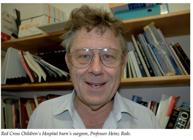
Local burns surgeon Professor Heinz Rode, who worked closely with Woods to set up the local capacity, said she readily agreed for her tool to be exclusively used to alleviate the plight of hundreds of southern African children, mostly from low-income families treated annually for often disfiguring burns at Red Cross.
Burns top cause of trauma-related under-4 mortality in SA
In South Africa burns are the leading cause of trauma-related death for children under the age of 4 and the third greatest cause of trauma-related death for people under 18. Red Cross Children's Hospital is the only southern African facility using CEAs, although other hospitals can purchase the technology from Australia, including a dramatically improved more expensive CEA process that takes just 20 minutes to prepare.
A 6-year-old girl left by a gas bottle explosion with insufficient donor skin for grafts (94% burns) had the skin solution sprayed on her face, enabling full recovery with barely noticeable facial scarring.
While not new (Rode and his chief microbiological technician Peter de Wet, now retired, criss-crossed the Indian Ocean to learn the process 10 years ago), the spray-on skin is used sparingly for the most clinically appropriate cases - it has amazing results.
'The crux is to get the wound healing as quickly as possible. If it's a full-thickness burn or a deep partial-thickness skin burn you'll excise it and cover either with an allograph or synthetic skin (both temporary) or the patient's own skin (permanent),' said Rode.
If there is sufficient donor site, surgeons stretch the skin up to six times to create the mesh and then fill the gaps with spray-on skin. The meshed skin acts as an effective protective template, as the proliferating cells on their own are prone to mechanical trauma.
