Persistent hypertension, albuminuria and low glomerular filtration rate in schoolchildren in Kano metropolis, Nigeria
BACKGROUND: Screening for persistent hypertension, albuminuria and low estimated glomerular filtration rate (eGFR) in children may allow for early detection of kidney disease, paving the way for early intervention to slow disease progression OBJECTIVE: To determine the prevalence of persistent hypertension, albuminuria and low eGFR and their associated factors in schoolchildren METHOD: The study screened 228 schoolchildren (aged 5 - 15 years) from February 2020 to February 2021. Information about participants' sociodemographic profile and medical history was obtained through questioning. Participants' height, weight and blood pressure (BP) were measured. Their spot urine was assessed for albumin creatinine ratio (ACR), and blood for serum creatinine and eGFR. Participants with abnormal findings had a repeat assessment after a minimum of 3 months for BP, ACR and eGFR RESULTS: The median (range) age was 13.0 (11.1 - 14.0) years, with 117 males and 111 females. Seventy-eight of the children (34%) had at least one abnormality (hypertension 1.8%, albuminuria 28% and low eGFR 9%) at recruitment. At follow-up, 33 (42%) of the 78 children had persistent abnormal findings (hypertension 1.3%, albuminuria 10.1%, low eGFR 6%). Persistent albuminuria was seen more commonly in girls and in children with low eGFR. Older children (>10 years) were more likely to have low eGFR CONCLUSION: A two-point, multiparameter screening of children may reveal high-risk groups for kidney disease that would require further evaluation and long-term follow-up. Such screenings can be integrated into school entry health assessment programmes to allow for early detection of kidney disease
hypertension; albuminuria; low GFR; screening; children
Persistent hypertension, albuminuria and low glomerular filtration rate in schoolchildren in Kano metropolis, Nigeria
A MudiI; A AbduII
IMBBS, PhD; Department of Paediatrics, College of Health Sciences, Bayero University and Aminu Kano Teaching Hospital, Kano, Nigeria
IIMBBS, PhD; Department of Medicine, College of Health Sciences, Bayero University and Aminu Kano Teaching Hospital, Kano, Nigeria
BACKGROUND: Screening for persistent hypertension, albuminuria and low estimated glomerular filtration rate (eGFR) in children may allow for early detection of kidney disease, paving the way for early intervention to slow disease progression
OBJECTIVE: To determine the prevalence of persistent hypertension, albuminuria and low eGFR and their associated factors in schoolchildren
METHOD: The study screened 228 schoolchildren (aged 5 - 15 years) from February 2020 to February 2021. Information about participants' sociodemographic profile and medical history was obtained through questioning. Participants' height, weight and blood pressure (BP) were measured. Their spot urine was assessed for albumin creatinine ratio (ACR), and blood for serum creatinine and eGFR. Participants with abnormal findings had a repeat assessment after a minimum of 3 months for BP, ACR and eGFR
RESULTS: The median (range) age was 13.0 (11.1 - 14.0) years, with 117 males and 111 females. Seventy-eight of the children (34%) had at least one abnormality (hypertension 1.8%, albuminuria 28% and low eGFR 9%) at recruitment. At follow-up, 33 (42%) of the 78 children had persistent abnormal findings (hypertension 1.3%, albuminuria 10.1%, low eGFR 6%). Persistent albuminuria was seen more commonly in girls and in children with low eGFR. Older children (>10 years) were more likely to have low eGFR
CONCLUSION: A two-point, multiparameter screening of children may reveal high-risk groups for kidney disease that would require further evaluation and long-term follow-up. Such screenings can be integrated into school entry health assessment programmes to allow for early detection of kidney disease
Keywords: hypertension, albuminuria, low GFR, screening, children
Generally, screening programmes allow for early detection of kidney disease.[1] Many children who had abnormal urinary abnormalities during screening programmes in Korea and Taiwan were demonstrated to have asymptomatic chronic kidney disease (CKD) following further evaluation and long-term follow-up.[2,3] In spite of these findings, there are concerns about the relevance and cost-effectiveness of CKD screening.[4,5]
The cost of care for advanced CKD, especially for those with chronic kidney failure requiring kidney replacement therapy, is very high, and not readily available in many low- and middle-income countries (LMICs).[6] Considering that early diagnosis and intervention play a vital role in mitigating disease severity, screening for kidney disease in schoolchildren may have a significant impact, especially in LMICs. Any effort that will bring about a reduction in the burden of CKD should be seriously considered, thus making the case for the importance of screening for CKD, especially in LMICs.
Persistent abnormal findings such as hypertension, albuminuria and low estimated glomerular filtration rate (eGFR) are suggestive of kidney disease.[7] Screening for these abnormalities can be integrated into school entry health-screening programmes to allow for early detection of underlying disease, especially kidney disease. Furthermore, there is limited information regarding the prevalence of persistent hypertension, albuminuria and low eGFR among healthy schoolchildren, especially in resource-limited settings.
The objective of this study was to determine the prevalence of persistent hypertension, albuminuria and low eGFR and their associated factors in schoolchildren.
Methods
The study screened children (aged 5 - 15 years) attending both public and private schools within Kano metropolis, Nigeria, from February 2020 to February 2021. Children with established hypertension or kidney disease or those whose guardians declined consent were excluded from the study. Information about participants' sociodemographic profile and medical history was obtained through questioning. Participants' height, weight and blood pressure (BP) were measured, and their BP interpreted for sex, age and height. They also had their spot urine assessed for albuminuria (HemoCue microcuvette technique) and albumin creatinine ratio (ACR), and blood for serum creatinine (using the Roche enzymatic creatinine method) and eGFR (using the modified Schwartz formula).[8] In menstruating adolescents, urine sampling was delayed until 1 week after the end of menstruation. Participants with abnormal findings had a repeat assessment after 3 months for hypertension, albuminuria and low eGFR. All screening procedures were conducted on the school premises.
All BP measurements were carried out by a trained research assistant and researcher using an automated machine with an appropriate-sized cuff, and abnormal BP findings were confirmed by using a manual manometer. The interpreted BP results were categorised into normal BP, high normal BP, stage 1 hypertension and stage 2 hypertension. All these procedures were carried out based on the 'Clinical practice guideline for screening and management of high blood pressure in children and adolescents'.[9]
Significant albuminuria was defined as ACR >30 mg/g, and eGFR determined using the modified Schwartz equation was classified into different stages based on the KDIGO (Kidney Disease: Improving Global Outcomes) '2024 clinical practice guideline for the evaluation and management of CKD'.[7,8]
Data analysis
Categorical data are presented as proportions, and continuous data as means and medians. Student's t-test and Wilcoxon signed-rank tests were used to determine the difference between means, while the χ2
Ethical approval
Ethical approval to conduct the study was obtained from the Vanderbilt Institutional Review Board (ref. no. 191735) and the Research Ethics Committee of Aminu Kano Teaching Hospital (ref. no. AKTH/MAC/SUB/12A/P-3/VI/2652). All study procedures were conducted in line with the Declaration of Helsinki. Written consent was obtained from the guardians of the participants. Data were anonymised to ensure confidentiality in line with the IRB recommendations.
Results
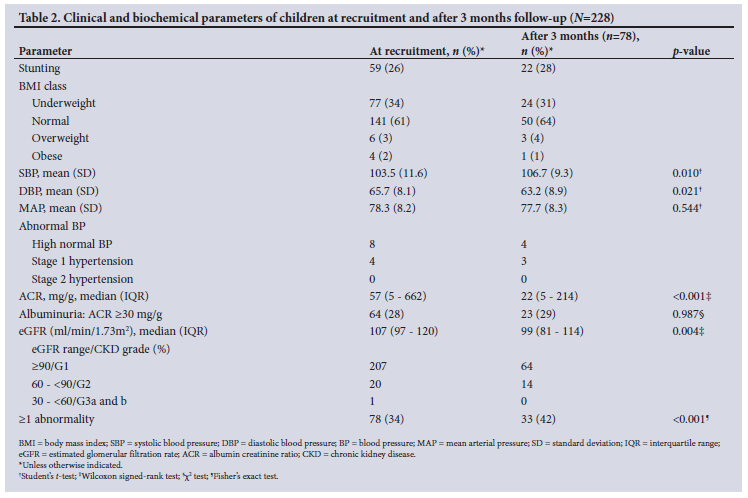
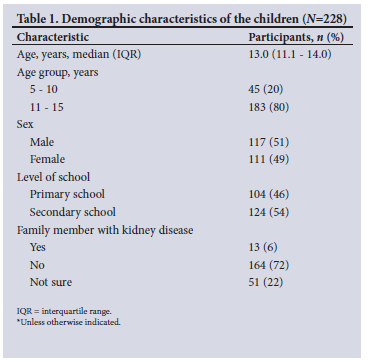
Two hundred and seventy-three children were enrolled for the study, but 45 were lost to follow-up due to circumstances associated with the COVID pandemic, and therefore excluded from the analysis. The majority (80%) of the children were within the age group of 11 - 15 years, and the median (range) age was 13.0 (11.1 - 14.0) years. There were slightly more males (117; 51%) than females (111; 49%) (Table 1). A positive family history of kidney disease was reported in only a small fraction (13; 6%) of the children. At recruitment, a significant number of the 228 children were stunted (59; 26%) and underweight (77; 34%) (Table 2). At recruitment, 78 children (34%) had at least one abnormality in the form of hypertension, albuminuria and low eGFR (Table 2). At the end of the follow-up period for the children with abnormalities, 33 (42%) of the 78 children had at least one persistent abnormal finding.
Hypertension
At first screening, eight (3.5%) children had high normal BP and four (1.8%) had stage 1 hypertension (Table 2). At the end of the follow-up period, the number of children with high normal BP had decreased to four, and the number of children with stage 1 hypertension had decreased to three. Although not significant, persistent hypertension was seen more often in females and older children (>10 years): p=0.675 and p=0.681, respectively. We found no independent association between persistent hypertension and age group, sex or persistent albuminuria.
Albuminuria
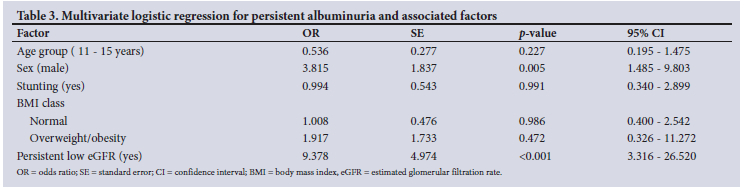
Albuminuria (ACR >30 mg/g) was the most common abnormality detected at recruitment, which was seen in 64 (28%) of 228 children. Of these 64 children, only 23 (23/228; 10%) had persistent albuminuria after a minimum follow-up of 3 months. There was a significant decrease in the median albuminuria at follow-up when compared with the median level at recruitment: 22 (5 - 214) and 57 (5 - 662), p<0.001. Persistent albuminuria was seen more commonly in girls (16/228; 7%) than in boys (7/228; 3.1%), p=0.006. Although not significant, persistent albuminuria was seen more in children >10 years (17/228; 7.5%), in those of normal height (18/228; 7.9%) and normal BMI (13/228; 5.7%) and those with no family history of kidney disease (17/228; 7.5%). Sex and persistent low eGFR (<90 mL/min/1.73m22Table 3). It is important to note the wide CIs for these associations.
Low eGFR
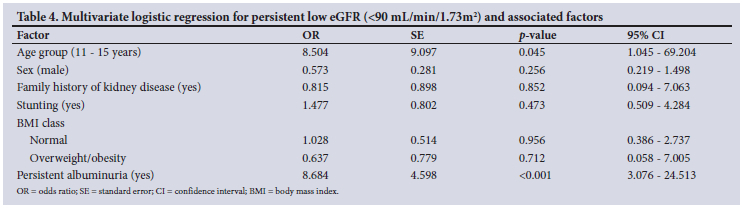
Low eGFR(<90 mL/min/1.73m2Table 2). There was a significant reduction in the median eGFR at recruitment (107 (97 - 120) mL/min/1.73 m222Table 4). It is important to note the wide CIs for these associations.
Combined abnormality
At the end of the follow-up period for the children with abnormalities, there were two patients with a combination of persistent hypertension and albuminuria, one patient with persistent hypertension and low eGFR and 10 patients with persistent albuminuria and low eGFR. No patient had a combination of all three abnormalities.
Discussion
Single screening for abnormalities that may suggest kidney disease are more convenient but may likely overestimate the true prevalence of abnormal findings. Changes seen in a single screening often occur due to transient factors, and a follow-up or repeat test for persistent abnormal findings tends to confirm those with high risk for kidney disease. Our study demonstrates that the number of children with at least one abnormal finding decreased between recruitment and the follow-up period (34% v. 14.5%). These changes were not unexpected, and this confirms the need to re-evaluate patients with abnormal findings for confirmation. The same pattern was reported in studies that conducted repeated kidney disease screening to rule out transient abnormal findings.[10-12]
Hypertension has been reported as one of the major contributors to the progression of CKD, and adequate control of BP slows the progression of kidney disease in children.[13,14] In our study, hypertension was the least common finding in the children. Stage 1 hypertension and high normal BP were seen in four and eight patients, respectively, at the beginning of the study. At the end of the follow-up period, only three of the four children with stage 1 hypertension (3/228, 1.3%) and four of the eight children with high normal BP had persistent findings. This result is lower than the reported prevalence of >3% in similar studies in schoolchildren and a meta-analysis on the global prevalence of hypertension.[15-17] Our study was not able to detect any factors associated with hypertension.
Albuminuria was the most common abnormal finding in our study, detected with a prevalence of 28% at recruitment, which is higher than reports from studies that conducted single screening for albuminuria in children.[18-20] The difference in prevalence can be explained by the semi-quantitative dipstick method employed in these studies, which is not as sensitive as the quantitative determination method for ACR used in the present study. Persistent albuminuria is a strong indicator for kidney disease, as reported from a large retrospective review of children with persistent proteinuria in Taiwan who later developed CKD.[10] In addition, lowering of proteinuria has been associated with long-term preservation of renal function in children with CKD.[21] All these points stress the importance of persistent albuminuria in kidney disease. In the present study, we noted that the prevalence of persistent albuminuria was 10% (23/228). Previous studies have reported much lower prevalences of persistent proteinuria, ranging from 0.3 to 2.3%, using the dipstick method.[10-12,22] Another factor that may have contributed to the higher prevalence in our study is that we used spot urine samples and not early-morning urine, making it difficult to exclude those with orthostatic proteinuria. Persistent albuminuria was seen significantly more frequently in girls, consistent with previous reports.[10,11] Girls were four times more likely to develop persistent albuminuria, and children with low eGFR were nine times more likely to develop persistent albuminuria. The connection between low eGFR and albuminuria can be explained by the pathophysiology of CKD.[23] We did not find any association between albuminuria, stunting, BMI and family history of kidney disease.
There were fewer children with low eGFR at the end of the follow-up period when compared with the number of children with low eGFR at recruitment. These changes can be attributed to perhaps a transient illness that caused the decline in eGFR in some of the children at recruitment, which subsequently improved at the time of the follow-up period. Low eGFR was seen more frequently in children >10 years old, and they were eight times more likely to have persistent low eGFR than younger children. Perhaps this is due to greater muscle mass in older children, giving rise to a higher serum creatinine. Similarly, those with persistent albuminuria were almost nine times more likely to develop low eGFR. We did not find any association between low eGFR, sex, stunting, BMI and family history of kidney disease.
The findings of persistent individual abnormalities are significant and warrant further evaluation. However, a combination of these abnormalities maybe a more important pointer to subclinical kidney disease. An important finding in our study was that 10 patients had a combination of persistent albuminuria and low eGFR. The coexistence of these two abnormal parameters is of significant clinical importance, and warrants further evaluation and close monitoring as recommended in the KDIGO guideline.[7] Hypertension was seen only in two patients with persistent albuminuria, and in one patient with persistent low eGFR. None of the patients had a combination of all three abnormalities.
Study strengths and limitations
The major strength of our study is that it was able to follow up children with initial abnormalities for re-evaluation, and this proved to be very useful, as not all children with an abnormality at the first screening had persistent abnormalities. An important limitation of the study is the use of spot urine samples instead of early-morning urine samples, to reduce the risk of missing samples and non-compliance to the study protocol. Hence the use of ACR rather than albumin alone to define albuminuria. Another limitation of the study is that the children were not further investigated for underlying kidney disease. This would have added more strength to the study and helped in evaluating the efficacy of two-point multiparameter screening. Other limitations of the study include the small number of the participants and the significant loss to follow-up, which were linked to the COVID-19 pandemic and restrictions.
Conclusion
The outcome of this study indicates that a significant number of schoolchildren had persistent albuminuria and low eGFR, which makes them a high-risk group for kidney disease, who will require further re-assessment. This is particularly important in those children with combined albuminuria and low eGFR. Our findings therefore suggest that two-point multiparameter screening of children is preferable, and may reveal high-risk groups for kidney disease that require further evaluation and long-term follow-up. Such screenings can be integrated into school entry health-assessment programmes to allow for early detection of kidney disease.
Data availability. The data used for this study are available from the authors upon request.
Declaration. None.
Acknowledgements. None.
Author contributions. AM contributed to (¿) conception and design, acquisition of data, analysis and interpretation of data; (ii) drafting the article and revising it critically for important intellectual content; and (iii) final approval of the version to be published. AA contributed to (i) conception and design, analysis and interpretation of data; (i) revising the article critically for important intellectual content; and (iii) final approval of the version to be published.
Funding. AM was supported by a VECD Global Health Fellowship, funded by the National Institute of Diabetes and Digestive and Kidney Diseases and the Fogarty International Center of the National Institutes of Health (NIH) (D43 TW009337). The views expressed are solely those of the authors and do not necessarily represent the views of the NIH.
Conflicts of interest. The authors declare no conflict of interest.
References
- 1. Yap HK, Quek CM, Shen Q, Joshi V, Chia KS. Role of urinary screening programmes in children in the prevention of chronic kidney disease. Ann Acad Med Singap 2005;34(1):3-7.
-
2. Cho BS, Kim SD, Choi YM, Kang HH. School urinalysis screening in Korea: Prevalence of chronic renal disease. Pediatr Nephrol 2001;16(12):1126-1128. https://doi.org/10.1007/s004670100043
» https://doi.org/10.1007/s004670100043 -
3. Lin CY, Huang SM. Childhood albuminuria and chronic kidney disease is associated with mortality and end-stage renal disease. Pediatr Neonatol 2016;57(4):280-287. https://doi.org/10.1016/j.pedneo.2015.09.013
» https://doi.org/10.1016/j.pedneo.2015.09.013 -
4. Hogg RJ. Screening for CKD in children: A global controversy. Clin J Am Soc Nephrol 2009;4(2):509-515. https://doi.org/10.2215/CJN.01210308
» https://doi.org/10.2215/CJN.01210308 - 5. Hsu C-N, Lu P-C, Liao W-T, Tain Y-L. Pediatric chronic kidney disease: Mind the gap between reality and expectations. Children 2025;12(5):614.
-
6. Naicker S. End-stage renal disease in Sub-Saharan Africa. Kidney Int Suppl 2013;3(2):161-163. https://doi.org/10.1038/kisup.2013.4
» https://doi.org/10.1038/kisup.2013.4 -
7. KDIGO CKD Work Group. KDIGO (Kidney Disease: Improving Global Outcomes) 2024 Clinical practice guideline for the evaluation and management of chronic kidney disease. Kidney Int 2024;105(4S):S117-S314. https://doi.org/10.1016/j.kint.2023.10.018
» https://doi.org/10.1016/j.kint.2023.10.018 -
8. Schwartz GJ, Munoz A, Schneider MF, et al. New equations to estimate GFR in children with CKD. J Am Soc Nephrol 2009;20(3):629-637. https://doi.org/10.1681/ASN.2008030287
» https://doi.org/10.1681/ASN.2008030287 -
9. Flynn JT, Kaelber DC, Baker-Smith CM, et al. Clinical practice guideline for screening and management of high blood pressure in children and adolescents. Pediatrics 2017;140(3): e20171904. https://doi.org/10.1542/peds.2017-1904
» https://doi.org/10.1542/peds.2017-1904 -
10. Chang-Chien C, Chuang GT, Tsai IJ, Chiang BL, Yang YH. A large retrospective review of persistent proteinuria in children. J Formos Med Assoc 2018;117(8):711-719. https://doi.org/10.1016/j.jfma.2017.09.004
» https://doi.org/10.1016/j.jfma.2017.09.004 -
11. Al-kaabi A, Almaslamani T, Toaimah FH, et al. Urinary screening for renal disease among apparently healthy schoolchildren in Qatar. J Trop Pediatr 2012;58(1):81-84. https://doi.org/10.1093/tropej/fmr037
» https://doi.org/10.1093/tropej/fmr037 -
12. Malla HA, Bhat AM, Shazia B, Rather FA, Najar SM, Wani IA. Prevalence of proteinuria in schoolchildren (aged 12 - 14 years) in Kashmir valley, India, using dipstick method. Saudi J Kidney Dis Transpl 2016;27(5):1006-1010. https://doi.org/10.4103/1319-2442.190877
» https://doi.org/10.4103/1319-2442.190877 -
13. Wuhl E, Schaefer F. Therapeutic strategies to slow chronic kidney disease progression. Pediatr Nephrol 2008;23(5):705-716. https://doi.org/10.100789-y
» https://doi.org/10.100789-y -
14. Flynn JT, Carroll MK, Ng DK, Furth SL, Warady BA. Achieved clinic blood pressure level and chronic kidney disease progression in children: A report from the Chronic Kidney Disease in Children cohort. Pediatric Nephrol 2021;36(6):1551-1559. https://doi.org/10.1007/s00467-020-04833-8
» https://doi.org/10.1007/s00467-020-04833-8 -
15. Barletta GM, Flynn J, Mitsnefes M, et al. Heart rate and blood pressure variability in children with chronic kidney disease: A report from the CKiD study. Pediatr Nephrol 2014;29(6):1059-1065. https://doi.org/10.1007/s00467-013-2737-8
» https://doi.org/10.1007/s00467-013-2737-8 -
16. Rahman AJ, Qamar FN, Ashraf S, Khowaja ZA, Tariq SB, Naeem H. Prevalence of hypertension in healthy schoolchildren in Pakistan and its relationship with body mass index, proteinuria and hematuria. Saudi J Kidney Dis Transpl 2013;24(2):408-412. https://doi.org/10.4103/1319-2442.109619
» https://doi.org/10.4103/1319-2442.109619 -
17. Song P, Zhang Y, Yu J, et al. Global prevalence of hypertension in children: A systematic review and meta- analysis. JAMA Pediatr 2019;173(12):1154-1163. https://doi.org/10.1001/jamapediatrics.2019.3310
» https://doi.org/10.1001/jamapediatrics.2019.3310 -
18. Rai PK, Rai P, Bedi S. Prevalence patterns of chronic kidney disease among schoolchildren and adolescents in a school in Varanasi, India. Open Acc J Urol Nephrol 2019;4(1):000154. https://doi.org/10.23880/oajun-16000154
» https://doi.org/10.23880/oajun-16000154 - 19. Bazie EA, Ali MMA, Hamza HB, Ismail AM, Salih MSM, Haroun BE. Screening of proteinuria and hematuria in asymptomatic children in basic school Kosti City in White Nile (Kosti City). J Med Biological Sci Res 2015;1(9):118-123.
-
20. Alao MA, Asinobi OA, Ibrahim OR, Lagunju IA. Spot urine protein-to-creatinine ratio compared with dipstick proteinuria as a primary screening tool for renal disease in a community setting. Saudi J Kidney Dis Transpl 2021;32(6):1655-1665. https://doi.org/10.4103/1319-2442.352426
» https://doi.org/10.4103/1319-2442.352426 -
21. Van den Belt SM, Heerspink HJL, Gracchi V, et al. Early proteinuria lowering by angiotensin-converting enzyme inhibition predicts renal survival in children with CKD. J Am Soc Nephrol 2018;29(8):2225-2233. https://doi.org/10.1681/ASN.2018010036
» https://doi.org/10.1681/ASN.2018010036 -
22. Odetunde OI, Odetunde OA, Neboh EE, Okafor HU, Njeze NR, Azubuike JC. Urinary screening for asymptomatic renal disorders in pre-school children in Enugu Metropolis, South-East Nigeria: Useful or useless. Saudi J Kidney Dis Transplant 2015;26(6):1241-1245. https://doi.org/10.4103/1319-2442.168656
» https://doi.org/10.4103/1319-2442.168656 -
23. Butt L, Unnersjo-Jess D, Hohne M, et al. A molecular mechanism explaining albuminuria in kidney disease. Nat Metab 2020;2(5):461-474. https://doi.org/10.1038/s42255-020-0204-y
» https://doi.org/10.1038/s42255-020-0204-y

Accepted 9 September 2025