The burden of deliberate self-harm on the critical care unit of a peri-urban referral hospital in the Eastern Cape: A 5-year review of 419 patients
BACKGROUND: Buffalo City Municipality (BCM) in the Eastern Cape (EC) has the highest susceptibility to deliberate self-harm (DSH) of any South African city. The EC also has a shortage of critical care beds. OBJECTIVE: This study reviewed DSH admissions over 5 years to the critical care unit (CCU) of Cecilia Makiwane Hospital (CMH), a large peri-urban hospital in the EC. It also examined the financial burden that DSH exerts on public-sector critical care. METHODS: DSH cases admitted to CMH's CCU between January 2006 and December 2010 were retrospectively reviewed. Patients under 13 years of age were excluded. Age, gender, admission duration, agent used, outcome and toxicology results were recorded. Cost was estimated using the Department of Health 2012 fee schedule. RESULTS: A total of 419 patients, comprising 17% of total CCU admissions, were included in the study. Cholinesterase inhibitors (CIs) were the most common agents ingested (55%). Compared with non-CI groups, CI patients where admitted for twice as long from admission to discharge (p<0.0001), but had a lower mortality rate (p=0.0344). No significant difference was found between gender and survival (p=0.5725) and between the yearly DSH CCU admission means (p=0.052). CI cases cost a minimum of R15 966.29 per admission and DSH CCU cases cost over R1 million per annum. CONCLUSION: DSH imposes an appreciable burden on the CCU services in the EC. There is a need to better control the unregulated availability of CIs (and related public education) as well as to improve psychiatric and psychological services in the EC rural areas.
The burden of deliberate self-harm on the critical care unit of a peri-urban referral hospital in the Eastern Cape: A 5-year review of 419 patients
D M Favara
East London Hospital Complex, Eastern Cape. MB ChB, community service medical officer
Corresponding author
ABSTRACTBACKGROUND: Buffalo City Municipality (BCM) in the Eastern Cape (EC) has the highest susceptibility to deliberate self-harm (DSH) of any South African city. The EC also has a shortage of critical care beds.
OBJECTIVE: This study reviewed DSH admissions over 5 years to the critical care unit (CCU) of Cecilia Makiwane Hospital (CMH), a large peri-urban hospital in the EC. It also examined the financial burden that DSH exerts on public-sector critical care.
METHODS: DSH cases admitted to CMH's CCU between January 2006 and December 2010 were retrospectively reviewed. Patients under 13 years of age were excluded. Age, gender, admission duration, agent used, outcome and toxicology results were recorded. Cost was estimated using the Department of Health 2012 fee schedule.
RESULTS: A total of 419 patients, comprising 17% of total CCU admissions, were included in the study. Cholinesterase inhibitors (CIs) were the most common agents ingested (55%). Compared with non-CI groups, CI patients where admitted for twice as long from admission to discharge (p<0.0001), but had a lower mortality rate (p=0.0344). No significant difference was found between gender and survival (p=0.5725) and between the yearly DSH CCU admission means (p=0.052). CI cases cost a minimum of R15 966.29 per admission and DSH CCU cases cost over R1 million per annum.
CONCLUSION: DSH imposes an appreciable burden on the CCU services in the EC. There is a need to better control the unregulated availability of CIs (and related public education) as well as to improve psychiatric and psychological services in the EC rural areas.
According to the World Health Organization, nearly 1 million people die by suicide annually, ranking it amongst the top 20 causes of death for all ages globally.123-6 Reasons for this include poor statistical record keeping on injury and death during the apartheid years, especially for the black population; changes to the Birth and Death Registrations Act of 1992 which allow the omission of the specific manner of death from death certificate records; and until recently, a lack of systematic national data collection.37777
Within the EC, Buffalo City Municipality (BCM) consists of the towns of East London, King William's Town and Bhisho. Of its population of some 700 000 people, 64% earn less than the household subsistence level of R1 500 per month and 41% are under 20 years of age.83
This audit involves all cases of DSH admitted to the critical care facilities of Cecilia Makiwane Hospital (CMH) in BCM over a 5-year period. CMH is a large peri-urban hospital that, with its sister institution Frere Hospital, serves a third of the EC's population of 6 million inhabitants. CMH's critical care unit (CCU) combines 6 IC beds and 6 HC beds in one unit. This is the first SA study exploring the financial burden that DSH cases exert on a limited public-sector critical care service.
Methods
The study was a retrospective review of the 5-year period from 1 January 2006 to 31 December 2010. Approval was obtained from the institutional ethics review body. Patients were recruited to the study if they were admitted to the CCU following DSH and were 13 years of age or older. All admission data were extracted from the CCU admission and discharge files. Age, gender, duration of stay, aetiology, mortality and site of residence were recorded.
The patients' toxicology investigations were reviewed using the local National Health Laboratory Service database. Admission costs were calculated using the facility fees listed in the current costing tables of the SA Department of Health.9
Results
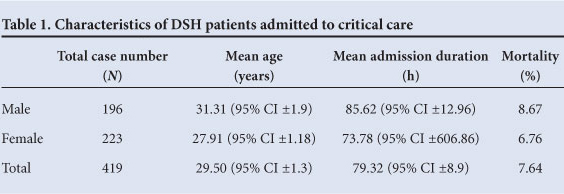
During the study period 419 DSH cases where admitted to CMH's critical care facility. Table 1 lists their characteristics.
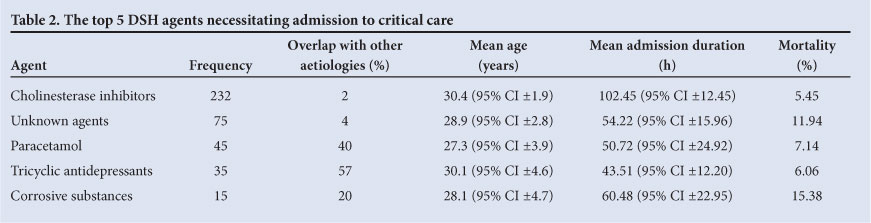
Cholinesterase inhibitor (CI) toxicity led to 55% of all admissions. Patients poisoned with CIs were unlikely to have taken other agents as well. The second most common group had ingested agents not identified by history, examination or standard laboratory testing.
Table 2 lists the top 5 agents used by admitted DSH patients. CI toxicity was caused by patients ingesting organophosphates or carbamates. These agents are commonly used as regulated agricultural insecticides, and cause cholinergic excess by inhibiting cholinesterase function. As direct assay of these two agents is not available at CMH, a surrogate marker (decreased serum cholinesterase levels) was used to verify clinical diagnosis. All patients with CI intoxication received aggressive standardised atropinisation therapy.
The mean admission duration was 79.32 hours (95% CI ±8.9 hours). Compared with those poisoned with other agents, patients ingesting CIs were admitted in the CCU for more than twice as long (102.45 hours, 95% CI ±12.5 hours/, v. 50.63 hours, 95% CI ±7.8 hours, p<0.0001). Only one trauma-related DSH case, a survivor of a self-inflicted hanging, was admitted to the CCU during the 5-year review period.
The overall percentage mortality was 7.64%. Mortality was significantly lower in the CI group compared with the other groups (5.20% v. 10.70%, p=0.0344) There were no statistically significant differences in survival between men and women (p=0.5725).
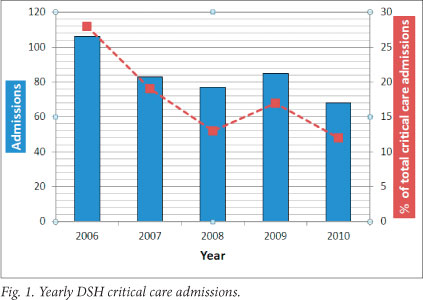
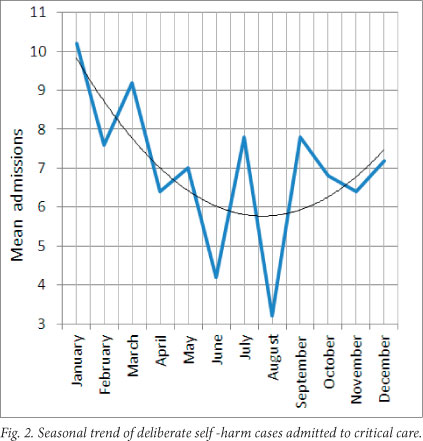
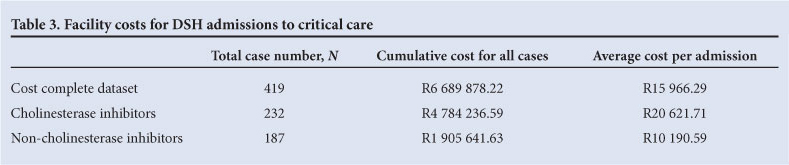
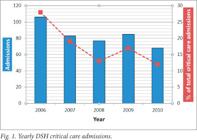
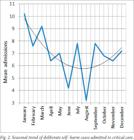
The annual burden of DSH cases per year at the CCU is shown in Fig. 1. DSH admissions to critical care peaked in summer and dipped during winter (Fig. 2). Although admissions appear to be decreasing, since a peak incidence in 2006 (Table 3), analysis of variance (ANOVA) testing revealed no statistically significant difference in the yearly means (p=0.052).
Facility costs for DSH admissions to critical care are presented in Table 3. Because the CCU at CMH combines its intensive care and high care units, it proved impossible to retrospectively determine when patients were moved from the ICU to the HCU facility, or vice versa. Therefore an averaged costing model was created to achieve a minimum average cost for each critical care admission. The daily rate of R4 831 was calculated by averaging the ICU (R6 634/day) and HCU (R3 028/day) facility costs. On the basis of clinical observation, most CI admissions spent the majority of their critical care time in the ICU and not in the lower-cost HCU.
Discussion
In 2008, DSH in SA accounted for 10% of non-natural deaths, of which the majority of patients were under 29 years of age.10
Nationally, fatal DSH rates for males and females are estimated to be 25.3/100 000 and 5.6/100 000 respectively.114
BCM's residents have the highest probability of fatal DSH compared with other SA cities.33,12
This study reveals that CI toxicity accounts for over half of all DSH admissions to critical care and that these patients remain in the CCU for twice as long as non-CI DSH admissions. This has significant cost implications, especially for a health service struggling with a large burden of infectious disease and trauma.
It is notable that only one trauma-related DSH case was admitted to the CCU during the 5-year review period. Reasons for this scarcity include the typically fatal nature of such cases, as well as the possibility that such cases are admitted to the CCU but are erroneously documented as standard trauma cases.
Although not statistically significant, this study found that the number of DSH admissions to critical care had been slowly decreasing since a peak incidence in 2006 (Fig. 1). Possible reasons include doctors being more judicious about admitting patients to the overburdened CCU; patients not presenting to hospital; and delays in patients procuring transport to hospital, resulting in their either presenting to casualty dead on arrival or dying soon after arrival (the mean duration of transport from hospital to hospital in the Eastern Cape is 6.5 hours - the longest in the country!).13
DSH admissions to critical care peaked in the summer months and dipped during the winter months (Fig. 2), a trend that is mirrored worldwide.14
National facility costs retrieved from the Department of Health were used to calculate the financial implications of the DSH burden on critical care.9
It will be difficult to contain costs in the treatment of DSH patients. Proposals for reducing hospital admissions for DSH argue that many inpatients labelled 'suicidal' are hospitalised unnecessarily and are in fact low-lethality risk DSH cases.15
A more effective model for decreasing DSH activity in the EC would be to address the root causes of the despair these patients feel. These problems are multi-factorial and linked to high unemployment and poverty. In the EC, psychological and psychiatric services are mostly clustered around the 3 major cities of Port Elizabeth, East London and Mthatha. Given the poorly functioning referral system, and a primary clinic environment burdened with infectious diseases, patients with psychological or psychiatric problems and vulnerability to DSH risk being turned away, inadequately managed, or lost in the system.
Additionally, there is need for investigation into the production and distribution of organophosphate and carbamate agents, typically sold by street vendors as unregulated combination 'cockroach, rat and insect killer' powders in unmarked bags. DSH patients usually ingest these after mixing them with water. As this study was retrospective, it was not possible to determine whether poisoning in some patients was accidental. In this regard, there are anecdotal reports of criminal use of organophosphates and carbamates to poison meat, which is then used to kill watchdogs during robberies,16,17 and of unscrupulous home brewers allegedly adding them to traditional beer (umqombothi) to add 'punch'.
Limitations
This study is limited by its retrospective nature. During data collection it was found that 4 weeks of information was missing from the critical care admission and discharge files (15 March 2006 - 31 March 2006 and 5 April 2008 - 31 April 2008) as pages had been torn out.
In addition, it was found that the time of discharge from critical care was not stated for 129 patients. In these cases it was decided to allocate a set discharge time of midday, which corresponds to the time after the medical rounds and is the usual time that patients are discharged from CMH's CCU.
Conclusion
DSH imposes an appreciable burden on the Eastern Cape's limited critical care service. As the majority of admissions are due to CI toxicity, there is urgent need for the control of unregulated organophosphate and carbamate distribution, as well as for public health education on the dangers of ingesting these substances. Lastly, there is need for improved psychiatric and psychological services in the rural areas of the Eastern Cape.
Acknowledgements. DMF thanks Professor A Parrish (Department of Internal Medicine, ELHC); Professor A Leiman (Department of Economics, UCT); Dr H Uys (Department of Psychiatry, ELHC); Mr A Hawkes (NHLS Lab, CMH); and CMH critical care nursing staff.
References
-
1. World Health Organization. Suicide Prevention and special programmes. Geneva: World Health Organization, 2012. http://www.who.int/mental_health/prevention/suicide/suicideprevent/en/ (accessed 7 June 2012).
» http://www.who.int/mental_health/prevention/suicide/suicideprevent/en/ -
2. World Health Organization. Public health action for the prevention of suicide. Geneva: World Health Organization, 2012. http://www.who.int/mental_health/publications/prevention_suicide_2012/en/index.html (accessed August 2012).
» http://www.who.int/mental_health/publications/prevention_suicide_2012/en/index.html -
3. Burrows S, Vaez M, Laflamme L. Sex-specific suicide mortality in the South African urban context: the role of age, race, and geographical location. Scand J Public Health 2007;35(2):133-139. [http://dx.doi.org/10.1080/14034940600975773]
» http://dx.doi.org/10.1192/bjp.bp.107.037697 -
4. Joe S, Stein DJ, Seedat S, Herman A, Williams DR. Non-fatal suicidal behavior among South Africans: results from the South Africa Stress and Health Study. Soc Psychiatry Psychiatr Epidemiol 2008;43(6):454-461. [http://dx.doi.org/10.1007/s00127-008-0348-7]
» http://dx.doi.org/10.1007/s00127-008-0348-7 - 6. Flisher AJ, Liang H, Laubscher R, Lombard CF. Suicide trends in South Africa, 1968-90. Scand J Public Health 2004;32(6):411-418.
- 7. Bhagwanjee S, Scribante J. National audit of critical care resources in South Africa: unit and bed distribution. S Afr Med J 2007;97:1311-1315.
-
8. Buffalo City Municipality Annual Report 2010-2011. Part 1: Overview of the Municipality. http://www.buffalocity.gov.za/municipality/annual_report10-11/final/prt1_overview.pdf (accessed 7 June 2011).
» http://www.buffalocity.gov.za/municipality/annual_report10-11/final/prt1_overview.pdf -
9. South African National Department of Health. Uniform patient fee schedule 2012.. http://www.doh.gov.za/docs/programmes/2012/appendix1A.pdf (accessed 7 June 2012).
» http://www.doh.gov.za/docs/programmes/2012/appendix1A.pdf -
10. The National Injury Mortality Surveillance System (NIMSS). NIMSS Annual Reports: A profile of fatal injuries in South Africa 2008 - 10th Annual Report of the National Injury Mortality Surveillance System. http://www.mrc.ac.za/crime/nimss2008.pdf (accessed 5 June 2011).
» http://www.mrc.ac.za/crime/nimss2008.pdf - 11. Burrows S, Laflamme L. Suicide mortality in South Africa: a city-level comparison across socio-demographic groups. Soc Psychiatry Psychiatr Epidemiol 2006;41(2):108-114.
- 12. Meehan SA, Broom Y. Analysis of a national toll free suicide crisis line in South Africa. Suicide Life Threat Behav 2007;37(1):66-78. [http://dx.doi.org/10.1521/suli.2007.37.L66]
- 13. Scribante J, Bhagwanjee S. National audit of critical care resources in South Africa - transfer of critically ill patients. S Afr Med J 2007;97(12 Pt 3):1323-1326.
- 14. Flisher AJ, Parry CD, Bradshaw D, Juritz JM. Seasonal variation of suicide in South Africa. Psychiatry Res 1997 Jan 15;66(1):13-22.
- 15. Rissmiller DJ, Steer R, Ranieri WF, Rissmiller F, Hogate P. Factors complicating cost containment in the treatment of suicidal patients. Hosp Community Psychiatry 1994;45(8):782-788.
-
16. Webb D. Temik Killer on the loose. Health24, 15 June 2010. http://www.health24.com/medical/Focus_centres/777-2268-2552-2590,31989.asp (accessed 7 June 2012).
» http://www.health24.com/medical/Focus_centres/777-2268-2552-2590,31989.asp - 17. Arnot LF, Veale DJ, Steyl JC, Myburgh JG. Treatment rationale for dogs poisoned with aldicarb (carbamate pesticide). J S Afr Vet Assoc 2011;82(4):232-238.
 Corresponding author:
D M Favara (