Prehospital paediatric and neonatal ventilatory support by a South African public emergency medical service: A retrospective descriptive study
BACKGROUND: Paediatric respiratory emergencies constitute a significant healthcare burden in low- and middle-income countries, yet prehospital ventilatory support practices remain poorly reported in these settings. OBJECTIVE: To describe ventilatory support practices during interfacility transport and emergency responses by a public emergency medical service (EMS) for paediatric and neonatal patients in the Western Cape Province, South Africa (SA). METHODS: This was a retrospective analysis of <5-year-old paediatric and neonatal patients receiving ventilatory support during transport by a public EMS in the Western Cape Province between January 2023 and December 2023. Electronic records were analysed for demographic information, clinical presentations, ventilation modalities, interventions and disposition using descriptive statistics, following STROBE reporting guidelines. RESULTS: Among the 61 775 paediatric and neonatal EMS activations, 1 548 (2.5%) required ventilatory support. Interfacility transfers accounted for 1 539 (99.4%) cases, predominantly for respiratory distress (n=1 138, 73.5%). Non-invasive ventilation accounted for 1 255 (81.1%) cases, with nasal continuous positive airway pressure (nCPAP) the most used modality (n=1 030, 66.5%), followed by high-flow nasal cannula (n=225, 14.5%). Invasive ventilation was used in 293 (18.9%) cases. Infants aged 29 days - 12 months formed the largest age group (n=584, 37.7%), with neonates under 24 hours representing 26.0% (n=403). Vascular access was documented in 551 (35.6%) cases. Notably, a high FiO2 (>0.6) was documented in 119 (11.6%) nCPAP cases. A summary of the key findings is shown in Fig. 1. CONCLUSION: The study provides an important baseline description of ventilatory support practices for paediatric and neonatal patients transported by a public EMS system in SA. Nasal CPAP was the most frequently documented modality, and the findings mainly reflect interfacility transport practice. Opportunities for quality improvement include documentation, monitoring, vascular access and optimisation of transport ventilatory support. Future prospective studies should evaluate patient outcomes and ventilation practices in greater detail.
ventilatory support; invasive ventilation; non-invasive ventilation; paediatric respiratory emergencies; prehospital care; emergency medical services; low- and middle-income countries
Prehospital paediatric and neonatal ventilatory support by a South African public emergency medical service: A retrospective descriptive study
N AbdullahI, II; N MajietIII; J BrownIV, V; S SobuwaVI
IMPhil, PhD; Emergency Medical Services, Western Cape Government Health and Wellness, Cape Town, South Africa
IIMPhil, PhD; Department of Emergency Medical Care and Rescue, Faculty of Health Sciences, Durban University of Technology, South Africa
IIIBEMC; Emergency Medical Services, Western Cape Government Health and Wellness, Cape Town, South Africa
IVBEMC; Emergency Medical Services, Western Cape Government Health and Wellness, Cape Town, South Africa
VBEMC; Department of Emergency Medical Sciences, Faculty of Health and Wellness Sciences, Cape Peninsula University of Technology, Cape Town, South Africa
VIMSc, PhD; Department of Emergency Medical Sciences, Faculty of Health and Wellness Sciences, Cape Peninsula University of Technology, Cape Town, South Africa
BACKGROUND: Paediatric respiratory emergencies constitute a significant healthcare burden in low- and middle-income countries, yet prehospital ventilatory support practices remain poorly reported in these settings.
OBJECTIVE: To describe ventilatory support practices during interfacility transport and emergency responses by a public emergency medical service (EMS) for paediatric and neonatal patients in the Western Cape Province, South Africa (SA).
METHODS: This was a retrospective analysis of <5-year-old paediatric and neonatal patients receiving ventilatory support during transport by a public EMS in the Western Cape Province between January 2023 and December 2023. Electronic records were analysed for demographic information, clinical presentations, ventilation modalities, interventions and disposition using descriptive statistics, following STROBE reporting guidelines.
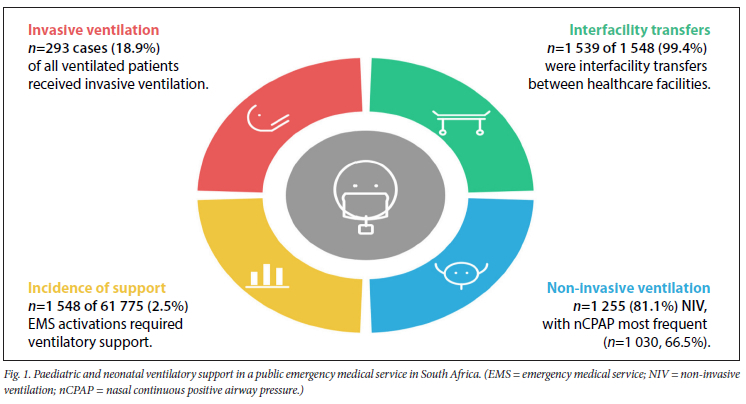
RESULTS: Among the 61 775 paediatric and neonatal EMS activations, 1 548 (2.5%) required ventilatory support. Interfacility transfers accounted for 1 539 (99.4%) cases, predominantly for respiratory distress (n=1 138, 73.5%). Non-invasive ventilation accounted for 1 255 (81.1%) cases, with nasal continuous positive airway pressure (nCPAP) the most used modality (n=1 030, 66.5%), followed by high-flow nasal cannula (n=225, 14.5%). Invasive ventilation was used in 293 (18.9%) cases. Infants aged 29 days - 12 months formed the largest age group (n=584, 37.7%), with neonates under 24 hours representing 26.0% (n=403). Vascular access was documented in 551 (35.6%) cases. Notably, a high FiO2 (>0.6) was documented in 119 (11.6%) nCPAP cases. A summary of the key findings is shown in Fig. 1.
CONCLUSION: The study provides an important baseline description of ventilatory support practices for paediatric and neonatal patients transported by a public EMS system in SA. Nasal CPAP was the most frequently documented modality, and the findings mainly reflect interfacility transport practice. Opportunities for quality improvement include documentation, monitoring, vascular access and optimisation of transport ventilatory support. Future prospective studies should evaluate patient outcomes and ventilation practices in greater detail.
Keywords: ventilatory support, invasive ventilation, non-invasive ventilation, paediatric respiratory emergencies, prehospital care, emergency medical services, low- and middle-income countries
Respiratory emergencies are the leading cause of morbidity and mortality in children <5 years of age worldwide.[1,2] This burden falls disproportionately on low- and middle-income countries (LMICs), where limited access to timely and effective emergency care exacerbates its impact.[3,4] In South Africa (SA), severe resource constraints in paediatric and neonatal emergency care contribute to an under-5 mortality rate of 34.5 per 1 000 live births - higher than in high-income countries (HICs), where rates range from 4.3 to 6.1 deaths per 1 000 live births, yet substantially lower than the sub-Saharan African average of 71.4 deaths per 1 000 live births.[5,6] Children in these regions face a 12-fold greater risk of mortality than their HIC counterparts.[6]
Within this context, emergency medical services (EMS) serve as a critical entry point into the healthcare system for paediatric patients in acute respiratory distress,[7-9] both for primary emergency responses and, more commonly in tiered healthcare systems, for interfacility transfers between healthcare facilities.[7,10] Respiratory emergencies are the predominant cause of paediatric EMS activations in LMICs,[7,8] while respiratory failure remains the principal cause of paediatric intensive care unit (ICU) admissions, and is associated with substantial morbidity and mortality.[11,12]
Given EMS' central role in early intervention, selecting an appropriate ventilatory support modality is critical to shaping outcomes. EMS may employ invasive mechanical ventilation following endotracheal intubation.[13,14] Advanced non-invasive respiratory support modalities, including continuous positive airway pressure delivered via a nasal interface (nCPAP) and high-flow nasal cannula (HFNC), are increasingly used in paediatric and neonatal cases of acute and impending respiratory failure.[15,16] These modalities have emerged as the preferred first-line therapeutic option for paediatric respiratory failure,[16-18] particularly when advanced airway management is not immediately required.
Nasal CPAP delivers continuous airway pressure throughout the respiratory cycle via a tight-fitting interface, while HFNC provides heated, humidified oxygen at high flow through a nasal cannula.[16,19] While both modalities offer respiratory support without invasive airway management, their mechanisms and reliability of pressure differ substantially.[19,20] Consistent with the broader literature, the term non-invasive ventilation (NIV) in this study is used to encompass both nCPAP and HFNC. NIV in the form of nCPAP has demonstrated superiority over low-flow oxygen therapy in reducing both mortality and treatment failure, while HFNC is gaining increasing support as an effective alternative.[16,17,21,22]
By delivering ventilatory support through an external interface, NIV circumvents the need for endotracheal intubation and reduces the complications associated with intubation and invasive mechanical ventilation.[15] A growing body of evidence supports these modalities as a preferred first-line strategy, particularly in resource-limited environments.[23] Early NIV use has been associated with reduced hospital and ICU length of stay, shorter duration of ventilator support and increased ventilator-free days compared with invasive ventilation.[24] These advantages are especially relevant to resource-limited settings where bed capacity, invasive ventilatory modalities and ICU capacity remain largely restricted.[21] While hospital-based evidence for NIV use in paediatrics and neonates is robust, comparatively little is known about its application in the prehospital context, particularly within LMICs.[16,21]
To address this evidence gap, the present study aimed to characterise ventilatory support practices during interfacility transport and prehospital emergency responses by a public EMS for critically ill paediatric and neonatal patients in the Western Cape Province, SA. These findings provide essential baseline evidence for understanding and strengthening prehospital paediatric emergency care in LMICs.[8]
Methods
Study design and setting
We conducted a retrospective review of <5-year-old paediatric and neonatal patients who received invasive and/or non-invasive ventilation during interfacility transport and prehospital emergency responses by a public EMS in the Western Cape Province between 1 January 2023 and 31 December 2023.
SA is one of the few African countries with a structured EMS, staffed by trained prehospital providers, where the majority of its citizens utilise the public healthcare system.[25] The Western Cape Government Health and Wellness (WCGHW) EMS is a state-funded service that provides unrestricted emergency care to a population of 7.4 million citizens in an area spanning 129 449 km2[27] The SA National Department of Health has adopted a three-tiered Emergency Care Qualification framework comprising entry-level, mid-level and professional qualifications.[28] The current SA prehospital clinical practice guidelines restrict the use of NIV to mid-level and professional qualification holders, who collectively represent only 4% of the national prehospital workforce.[29,30] Within the WCGHW EMS context, ventilatory support, whether NIV or invasive, may be initiated by prehospital providers on the scene of an emergency, or by physicians at the referring healthcare facility before EMS arrival, and subsequently continued and monitored by EMS providers during transport. This study did not capture which provider in our sample originally initiated ventilatory support, a limitation discussed further below.
Study population and sample
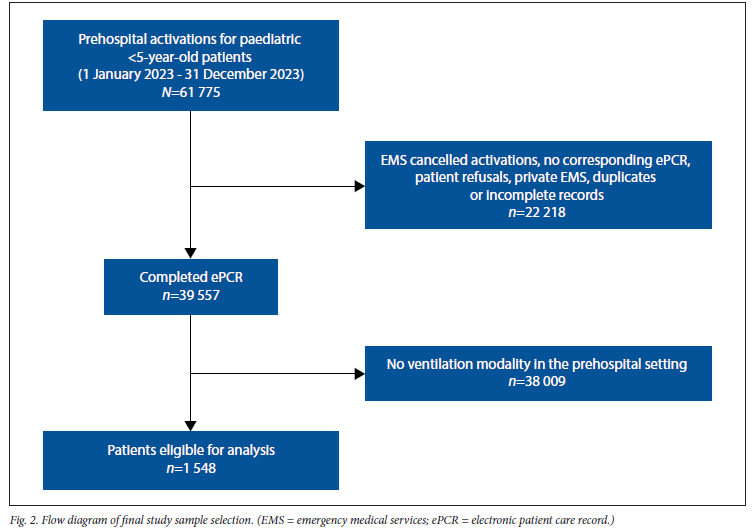
This study screened electronic patient care records (ePCRs) of all children <5 years old who received ventilatory support while managed by the WCGHW EMS. Only patients who received non-invasive (nCPAP and HFNC) or invasive ventilation were included; those receiving other respiratory support modalities (oxygen administration, rescue breathing) were excluded (Fig. 2). The study population, therefore, represents only those children who received advanced ventilatory support, and should not be interpreted as representative of the broader paediatric prehospital respiratory emergency burden. The WCGHW EMS maintains a case registry with computer-aided dispatch (CAD) and ePCR. CAD registry encompasses non-clinical data - resource allocation and event markers for each case - whereas corresponding ePCR records contain clinical-related data documented by the prehospital provider. For this analysis, de-identified data were extracted from the CAD and corresponding ePCR registries. The data included all cases (i) classified as <5 years old upon EMS activation; (ii) with complete CAD data and corresponding ePCR records; and (iii) in which invasive ventilation or NIV was employed as respiratory support in the prehospital setting. Cases without a corresponding ePCR record, incomplete or missing data, cancelled EMS activations, and attended to by private EMS providers were excluded from this analysis. The analytical dataset encompassed patient demographics, nature of emergencies, patient acuity levels, dispatch priorities, level of definitive care, clinical presentations and prehospital emergency care interventions.

Data variables
Patient demographics and emergency conditions were classified in accordance with World Health Organization guidelines.[6,31] Age data were obtained from ePCRs completed by prehospital providers in the field. EMS activation types were defined as primary emergency response or interfacility transfers (IFTs). Location was classified as urban if the case was managed within the City of Cape Town metropolitan district. All other locations, characterised by geographically dispersed populations, prolonged time to emergency care and limited access to specialised healthcare services, were designated as rural for the purposes of this study.[32,33]
Patient acuity levels were established by prehospital providers following clinical assessments using the South African Triage Scale (SATS) classification system.[34] Acuity was denoted by colour-coded categorisation, including life-threatening (red), very urgent (orange), urgent (yellow), routine (green) and deceased (blue).[35] Dispatch priorities were stratified into priority 1, for which the WCGHW EMS targets a prehospital provider at the scene within 15 minutes, and priority 2, targeting arrival within 60 minutes. On-scene time was defined as the interval between ambulance arrival on scene and departure; transportation time was defined as the interval from scene departure to hospital arrival.
Patient disposition was categorised as primary, secondary or tertiary. Primary healthcare facilities encompass community clinics, while secondary facilities comprise regional and district-level facilities, and tertiary facilities include specialised tertiary and quaternary institutions. Emergency clinical interventions, vital signs and medications documented during transport were categorised according to the Health Professions Council of South Africa's Clinical Practice Guidelines and scope of practice for the SA prehospital setting.[30]
Data analysis
Data were processed and analysed using IBM SPSS version 29 (IBM, USA). Descriptive statistics were used to summarise variables, with frequencies and proportions for categorical data. This study adhered to the STROBE (Strengthening the Reporting of Observational Studies in Epidemiology) reporting guidelines for cross-sectional research.
Ethical considerations
The findings, views, and conclusions presented are those of the authors and do not represent the official policy or position of the WCGHW EMS. Ethical approval was obtained from the Institutional Research Ethics Committee of Cape Peninsula University of Technology (ref. no. CPUT/HWS-REC 2024/H8) and the WCGHW EMS (ref. no. WC-202405-040). This study involved the retrospective analysis of de-identified secondary data, routinely captured and stored on the WCGHW EMS patient record database. As such, the ethics committee waived the requirement for informed consent. All procedures were conducted in accordance with the ethical standards of the Declaration of Helsinki of 1975 and its subsequent amendments.
Results
During the study period, the WCGHW EMS recorded 1 514 361 activations, of which 61 775 (4.1%) involved <5-year-old paediatric and neonatal patients. Following the application of systematic exclusion criteria (Fig. 2), 22 218 (36.0%) were excluded due to EMS cancellations, absent corresponding ePCR, patient refusals, transport by private EMS, duplications, and incomplete records. Of the remaining 39 557 prehospital records, 38 009 (96.1%) represented EMS activations in which no advanced ventilation modality was employed in the prehospital setting, and were therefore also excluded from the analysis. The final analytical cohort comprised 1 548 cases that met all inclusion criteria, representing a prevalence of 25 per 1 000 paediatric and neonatal activations (1 in 40 cases) requiring advanced ventilatory support. Among the 39 557 records that met the inclusion criteria, the proportion was 3.9% (1 in 26 cases).
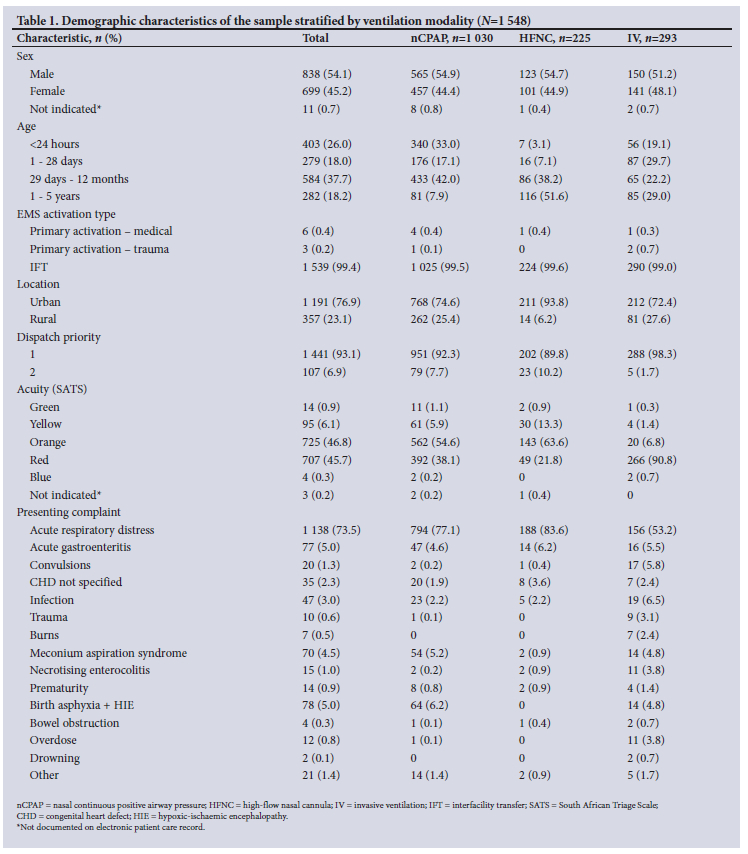
Table 1 summarises the demographic and clinical characteristics of the cohort. The majority were male (n=838, 54.1%), and infants aged 29 days to 12 months represented the largest age group: neonates <24 hours old and children aged 1 - <5 years together accounted for a further 44.2% of cases.
The majority of EMS activations (n=1 539, 99.4%) were IFTs, with only nine cases (0.6%) involving primary emergency responses requiring advanced ventilatory support. This near-exclusive dominance of IFTs is a defining characteristic of this cohort, and is an important context for interpreting all subsequent findings.
As detailed in Table 1, 14 patients (0.9%) were triaged as routine (green) and 95 (6.1%) as urgent (yellow) despite receiving advanced ventilatory support. NIV was the most frequently documented modality (n=1 255, 81.1%), comprising nCPAP (n=1 030, 66.5%) and HFNC (n=225, 14.5%). HFNC was predominantly used in urban settings (93.8% of HFNC cases v. 74.6% for nCPAP and 72.4% for invasive ventilation), whereas a larger share of nCPAP (25.4%) and invasive ventilation (27.6%) cases occurred in rural settings. Invasive ventilation via endotracheal intubation was employed in 18.9% of cases (n=293).
Respiratory distress was the most frequent presenting complaint (n=1 138, 73.5%), followed by birth asphyxia with hypoxic ischaemic encephalopathy (n=78, 5.0%) and acute gastroenteritis (n=77, 5.0%). While NIV was the predominant modality across most conditions, invasive ventilation was more frequently employed in cases involving trauma, necrotising enterocolitis, or toxicological emergencies (e.g. overdose).
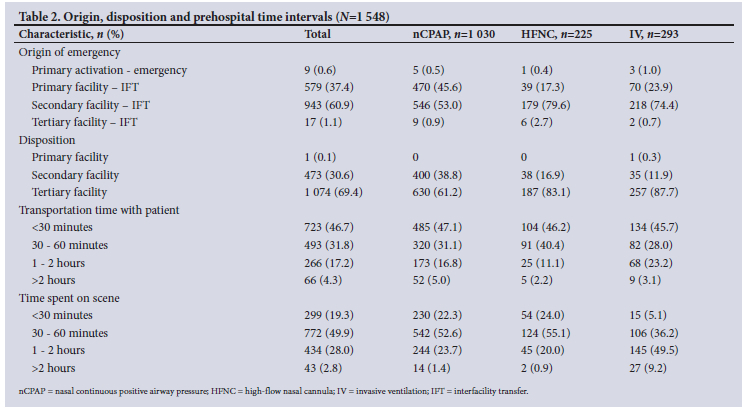
Table 2 details the origin, disposition and prehospital time intervals. Most IFTs originated from secondary facilities (n=943, 60.9%), followed by primary care centres (n=579, 37.4%); only 1.1% (n=17) of cases were transferred from tertiary hospitals. Among patients referred from primary and secondary facilities, nCPAP was the most common ventilatory support modality, with 81.2% (n=470) and 57.9% (n=546), respectively. Tertiary-level hospitals were the most frequent receiving facilities, accepting 69.4% (n=1 074) of all patients. Secondary-level hospitals received 30.6% (n=473) of cases. This pattern was consistent across ventilation modality subgroups, with tertiary hospitals receiving the majority of patients in each subgroup. Invasively ventilated patients were less often referred from primary facilities than the cohort overall (n=70, 23.9%).
On-scene time ranged between 30 and 60 minutes for 49.9% (n=772) of cases, while 30.8% (n=477) exceeded 1 hour. Invasively ventilated patients had markedly longer on-scene times, with 58.7% (n=172) remaining on scene for >60 minutes, compared with 24.3% (n=305) among NIV patients, consistent with the greater procedural complexity of intubation and airway management. Transport time was <30 minutes in 46.7% (n=723) of cases, and between 30 and 60 minutes in 31.8% (n=493).
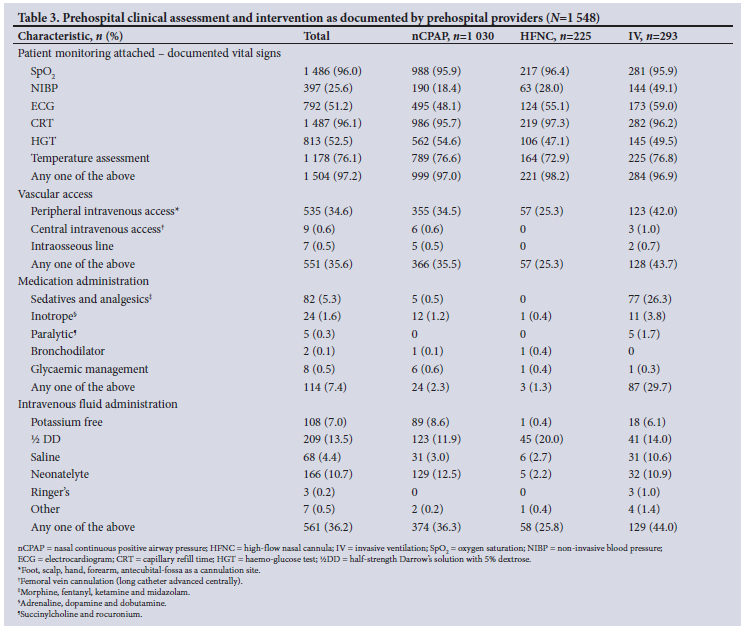
Table 3 presents clinical assessment and prehospital interventions as documented by EMS providers during transport. SpO2 was documented in 96% (n=1 486) of cases; however, a complete vital-sign data set, comprising SpO2, non-invasive blood pressure, electrocardiogram, capillary refill time and point-of-care glucose, was documented in only 32.0% of cases. Blood pressure and glucose were recorded in 25.6% and 52.5% of cases, respectively.
Peripheral intravenous access was documented in 34.6% (n=535) of cases overall, rising to 42.0% among invasively ventilated patients; central venous or intraosseous access was rarely established (<1%). Notably, intravenous fluid administration was documented in 36.2% of cases (n=561), slightly exceeding the proportion with any vascular access documented (n=551, 35.6%). This discrepancy most likely reflects documentation inconsistencies in the ePCR rather than fluid administration without established access, and is acknowledged as a limitation.
Medication administration by EMS providers was uncommon overall, documented in 7.4% (n=114) of cases. Sedatives, analgesics and neuromuscular blocking agents were almost exclusively administered in the invasively ventilated cohort (pain medications 18.4%; benzodiazepines 7.9%; paralytics 1.7%). Half-strength Darrow's solution with 5% dextrose and neonatal maintenance fluids accounted for most crystalloid use, and almost two-thirds of transports were conducted without any documentation of intravenous fluid administration. Medication administration was documented in only 2.3% (n=24) of nCPAP patients, a finding that should be interpreted in the context that 99.4% of included cases were IFTs from healthcare facilities where medications may already have been administered before EMS arrival.
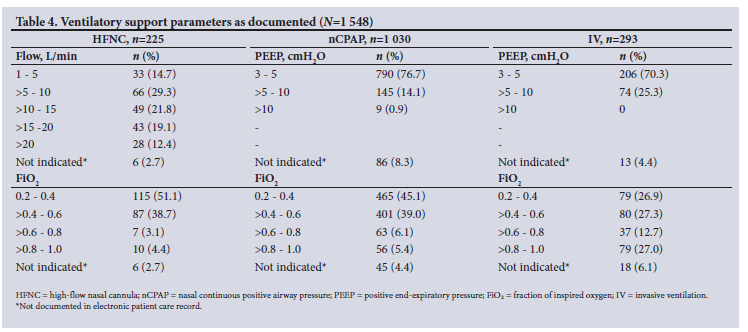
Table 4 summarises the ventilatory support parameters. For HFNC, the most frequently recorded flow range was >5 - 10 L/min (29.3%), with just over half of patients (51.1%) receiving >5 - 15 L/min, whereas nCPAP was typically delivered at 3 - 5 cmH2O positive end-expiratory pressure (PEEP) (n=790, 76.7%) and a fraction of inspired oxygen (FiO2) of 0.2 - 0.4 (n=465, 45.1%). Among invasively ventilated patients, providers favoured a low PEEP strategy (3 - 5 cmH2O) 70.3% (n=206) of the cases. FiO2 0.2 - 0.4 was used in 46.2% (n=580) of NIV cases, contrasting with FiO2 ≥0.6 in 39.6% (n=116) of intubated children.
Of particular interest, 11.6% (n=119) of nCPAP cases had a documented FiO2 >0.6. Assessment of available data suggests that almost half (n=57, 47.9%) of these high-FiO2 nCPAP cases also had documented low PEEP settings (3 - 5 cmH2O), consistent with a pattern of suboptimal ventilatory parameter optimisation. However, given the absence of FiO2 titration records in the ePCR, it cannot be determined whether elevated FiO2 was maintained for transport safety purposes or reflected genuine treatment inadequacy. This observation should be considered hypothesis-generating rather than constituting evidence of nCPAP failure.
Discussion
This study provides the first comprehensive characterisation of ventilatory support practices for <5-year-old paediatric and neonatal patients managed by a public EMS system in SA. Prior studies have largely examined NIV in the in-hospital context, leaving a significant gap in our understanding of how EMS deploy ventilatory support modalities in young children during critical care transfers and emergency response.[17,21,23]
The prevalence of advanced ventilatory support, affecting ~1 in 40 of all paediatric and neonatal EMS activations, establishes the clinical relevance of this intervention capability within prehospital emergency care systems. The dominance of IFTs (99.4%) is a defining feature of this data set. It highlights the critical role of EMS providers in maintaining continuity of critical care within tiered healthcare systems, particularly in LMICs, where geographical barriers and resource limitations necessitate complex patient movement patterns.[8,23] This pattern is consistent with the tiered structure of the SA public healthcare system, where district and primary facilities stabilise patients before referral to higher levels of care. It also suggests that in most cases, ventilatory support was initiated at a referring facility and subsequently maintained during transport by EMS providers.
The preponderance of nCPAP, used in 66.5% of all cases, aligns with international trends favouring NIV respiratory support as a first-line approach for paediatric and neonatal respiratory failure, where nCPAP and HFNC have shown benefits in reducing complications and ICU stay durations.[15,18,22,24] Our findings are also consistent with research emerging from LMICs that reports increasing reliance on NIV during the critical care of neonatal and paediatric patients.[16,21,22] However, our results expand this evidence base by demonstrating that public EMS systems, even with resource limitations, can deliver non-invasive support at scale.[8]
A recent study by Lourens et al.[36] described respiratory support during neonatal and infant aeromedical interfacility transfers in the Western Cape between 2017 and 2019. They found similar patterns of NIV use in neonatal and infant transport. The present study complements their aeromedical findings and extends this evidence base to road transport across a broader age range (<5 years) and a more recent time period, reinforcing the relevance of NIV support during paediatric and neonatal interfacility transfer in the Western Cape context.
Clinical assessment and monitoring were inconsistent across the cohort. While SpO2 monitoring was near-universal, blood pressure was documented in only one-quarter of patients, and vascular access was established in approximately one-third. These represent clinically significant gaps in the assessment and preparation of critically ill paediatric and neonatal patients for transport.
The relatively low rate of invasive ventilation (18.9%) likely reflects a combination of clinical decision-making favouring NIV and systemic factors, including a limited proportion of the workforce credentialled to perform advanced airway management.[21] Invasive ventilation was preferentially used for trauma, toxicology and necrotising enterocolitis cases, where airway protection or haemodynamic instability may preclude non-invasive approaches.[37,38]
The subgroup of nCPAP patients with documented FiO2 >0.6 in the context of predominantly low PEEP strategies (11.6% of nCPAP cases) may represent early indicators of impending nCPAP failure or, alternatively, suggest suboptimal optimisation of nCPAP parameters within the prehospital setting. These observations highlight a critical gap in prehospital provider education regarding nCPAP implementation, criteria for recognising nCPAP failure and appropriate escalation protocols.[39-41] The clinical implications of these findings are further contextualised by the operational reality that mid-level and professional providers, who are permitted to provide NIV, make up only 4% of the SA prehospital workforce, and fewer still are credentialled to perform advanced airway interventions, potentially creating a treatment capability-demand mismatch that may compromise patient outcomes.[29,42] Future studies should include FiO2 titration data and physiological deterioration markers to permit more robust conclusions.
Study limitations
Several limitations must be acknowledged. First, as a retrospective review, this study relied on the accuracy and completeness of ePCRs, which were often missing full vital signs or outcome data. The discrepancy between documented intravenous fluid administration (36.2%) and documented vascular access (35.6%) further illustrates this data quality limitation.[42] Second, we were unable to assess in-hospital outcomes, such as survival, escalation to invasive ventilation, or ICU admission, limiting conclusions about NIV effectiveness. In particular, we lacked documentation of mortality and survival during transport and after, which is essential because the benefit of NIV/nCPAP can only be confirmed if survival to discharge is comparable with or better than that of invasive ventilation. Third, the contextual specificity of the Western Cape EMS system, including short transport times and urban concentration, limits direct extrapolation to other provinces or EMS systems in SA and beyond. FiO2 >0.6 should not be over-interpreted as evidence of nCPAP 'failure'; it is an indirect, unvalidated marker that cannot account for deliberate high-FiO2 settings maintained for transport safety, and the absence of titration data precludes a reliable assessment of treatment adequacy.[41] Finally, the study does not capture whether ventilatory support was initiated at the referring facility or by EMS providers, nor whether specialised retrieval teams were involved in case management, which limits conclusions about the full patient pathway.
Conclusion
This study presents the first comprehensive description of ventilatory support practices for <5-year-old paediatric and neonatal patients managed by a public EMS system in SA. The findings primarily characterise IFT practice, with 99.4% of included cases being IFTs. nCPAP was the most frequently documented ventilatory modality, consistent with international trends towards non-invasive respiratory support in paediatric and neonatal care.
Key observations warranting quality improvement attention include inconsistent documentation, and a subgroup of nCPAP cases with high FiO2 requirements that warrant prospective evaluation. Prospective studies with patient outcome data and a more detailed evaluation of transport-specific ventilatory practices are needed to confirm clinical effectiveness and inform quality improvement.
Data availability. Public access to the dataset is closed. The datasets included and/or analysed during the current study are available from the corresponding author upon reasonable request.
Declaration. None.
Acknowledgements. We extend our gratitude to the prehospital providers of the WCGHW EMS who managed the paediatric and neonate patients analysed in this study.
Author contributions. NA: writing original draft, review and editing, data curation, conceptualisation, formal analysis, methodology, project administration. NM: writing original draft, review and editing. JB: writing original draft, review and editing. SS: writing original draft, review and editing, supervision.
Funding. None.
Conflicts of interest. None.
AI contribution. Artificial intelligence-assisted technologies were used to produce the infographic in Fig. 1 (edited by SAMJ).

References
-
1. Relan P, Garbern SC, O'Reilly G, et al. Emergency care interventions for paediatric severe acute respiratory infections in low- and middle-income countries: A systematic review and narrative synthesis. J Glob Health 2023;13:04065. https://doi.org/10.7189/jogh.13.04065
» https://doi.org/10.7189/jogh.13.04065 -
2. Institute for Health Metrics and Evaluation. Global burden of disease. Seattle: Institute for Health Metrics and Evaluation, 2024. https://www.healthdata.org/research-analysis/library/global-burden-disease-2021-findings-gbd-2021-study (accessed 29 April 2025).
» https://www.healthdata.org/research-analysis/library/global-burden-disease-2021-findings-gbd-2021-study -
3. Rodriguez-Martinez CE, Sossa-Briceño MP. Disparities in prevalence and outcomes of respiratory disease in low- and middle-income countries. Pediatr Pulmonol 2024;59(12):3819-3826. https://doi.org/10.1002/ppul.26573
» https://doi.org/10.1002/ppul.26573 -
4. Frigati L, Greybe L, Andronikou S, Eber E, Sunder B Venkatakrishna S, Goussard P. Respiratory infections in low and middle-income countries. Paediatr Respir Rev 2024;54:43-51. https://doi.org/10.1016/j.prrv.2024.08.002
» https://doi.org/10.1016/j.prrv.2024.08.002 -
5. Lai King L, Cheema B, van Hoving DJ. A cross sectional study of the availability of paediatric emergency equipment in South African emergency units. Afr J Emerg Med 2020;10(4):197-202. https://doi.org/10.1016/j.afjem.2020.06.008
» https://doi.org/10.1016/j.afjem.2020.06.008 -
6. United Nations Children's Fund. South Africa (ZAF) - demographics, health & infant mortality. New York: UNICEF, 2024. https://data.unicef.org/country/zaf/ (accessed 20 June 2024).
» https://data.unicef.org/country/zaf/ -
7. Ward C, Simpson J. Improving prehospital management of children with respiratory distress. Clin Pediatr Emerg Med 2018;19(1):4-10. https://doi.org/10.1016/j.cpem.2018.02.005
» https://doi.org/10.1016/j.cpem.2018.02.005 -
8. Abdullah N, Majiet N, Sobuwa S. The prehospital paediatric emergency care burden managed by a public ambulance service in the Western Cape, South Africa. BMC Emerg Med 2024;24(1):234. https://doi.org/10.1186/s12873-024-01146-z
» https://doi.org/10.1186/s12873-024-01146-z -
9. Anest T, Stewart de Ramirez S, Balhara KS, Hodkinson P, Wallis L, Hansoti B. Defining and improving the role of emergency medical services in Cape Town, South Africa. Emerg Med J 2016;33(8):557-561. https://doi.org/10.1136/emermed-2015-205177
» https://doi.org/10.1136/emermed-2015-205177 -
10. Harris M, Lyng JW, Mandt M, et al. Prehospital pediatric respiratory distress and airway management interventions: An NAEMSP position statement and resource document. Prehosp Emerg Care 2022;26(Suppl 1):118-128. https://doi.org/10.1080/10903127.2021.1994675
» https://doi.org/10.1080/10903127.2021.1994675 -
11. Divecha C, Tullu MS, Chaudhary S. Burden of respiratory illnesses in pediatric intensive care unit and predictors of mortality: Experience from a low resource country. Pediatr Pulmonol 2019;54(8):1234-1241. https://doi.org/10.1002/ppul.24351
» https://doi.org/10.1002/ppul.24351 -
12. Ijaz N, Strehlow M, Ewen Wang N, et al. Epidemiology of patients presenting to a pediatric emergency department in Karachi, Pakistan. BMC Emerg Med 2018;18(1):22. https://doi.org/10.1186/s12873-018-0175-4
» https://doi.org/10.1186/s12873-018-0175-4 -
13. Weihing VK, Crowe EH, Wang HE, Ugalde IT. Prehospital airway management in the pediatric patient: A systematic review. Acad Emerg Med 2022;29(6):765-771. https://doi.org/10.1111/acem.14410
» https://doi.org/10.1111/acem.14410 -
14. Kollisch-Singule M, Ramcharran H, Satalin J, et al. Mechanical ventilation in pediatric and neonatal patients. Front Physiol 2022;12:805620. https://doi.org/10.3389/fphys.2021.805620
» https://doi.org/10.3389/fphys.2021.805620 -
15. Pacheco GS. Emergency pediatric noninvasive ventilation and invasive mechanical ventilation. In: Rose E, ed. Pediatric Emergencies: A Practical Clinical Guide. New York: Oxford University Press, 2020:51-63. https://doi.org/10.1093/med/9780190073879.003.0006
» https://doi.org/10.1093/med/9780190073879.003.0006 -
16. Cheema B, Welzel T, Rossouw B. Noninvasive ventilation during pediatric and neonatal critical care transport: A systematic review. Pediatr Crit Care Med 2019;20(1):9-18. https://doi.org/10.1097/PCC.0000000000001781
» https://doi.org/10.1097/PCC.0000000000001781 -
17. Al-Mukhaini KS, Al-Rahbi NM. Noninvasive ventilation and high-flow nasal cannulae therapy for children with acute respiratory Failure. Sultan Qaboos Univ Med J 2018;18(3):e278-285. https://doi.org/10.18295/squmj.2018.18.03.003
» https://doi.org/10.18295/squmj.2018.18.03.003 -
18. Lins ARB da S, Duarte M do CMB, de Andrade LB. Noninvasive ventilation as the first choice of ventilatory support in children. Rev Bras Ter Intensiva 2019;31(3):333-339. https://doi.org/10.5935/0103-507X.20190045
» https://doi.org/10.5935/0103-507X.20190045 -
19. Petkar S, Wanjari D, Priya V. A comprehensive review on high-flow nasal cannula oxygen therapy in critical care: Evidence-based insights and future directions. Cureus 2024;16(8):e66264. https://doi.org/10.7759/cureus.66264
» https://doi.org/10.7759/cureus.66264 -
20. Wang Q, Peng Y, Xu S, Lin L, Chen L, Lin Y. The efficacy of high-flow nasal cannula (HFNC) versus non-invasive ventilation (NIV) in patients at high risk of extubation failure: A systematic review and meta-analysis. Eur J Med Res 2023;28(1):120. https://doi.org/10.1186/s40001-023-01076-9
» https://doi.org/10.1186/s40001-023-01076-9 -
21. Buys H, Kerbelker T, Naidoo S, Mukuddem-Sablay Z, Nxumalo Z, Muloiwa R. Doing more with less: The use of non-invasive ventilatory support in a resource-limited setting. PloS ONE 2023;18(2):e0281552. https://doi.org/10.1371/journal.pone.0281552
» https://doi.org/10.1371/journal.pone.0281552 -
22. Browde K, Morrow BM. Non-invasive continuous positive airway pressure ventilation and high-flow nasal cannula oxygen therapy use in children without primary lung pathology: A prospective observational study. S Afr J Child Health 2019;13(2):84-88. https://doi.org/10.7196/sajch.2019.v13i2.1572
» https://doi.org/10.7196/sajch.2019.v13i2.1572 -
23. Head J, Redfern A, Hoole J, et al. Characteristics and outcomes of children initiated on high flow nasal cannula and continuous positive airway pressure at the emergency centre of a district hospital in South Africa. Afr J Emerg Med 2025;15(3):100884. https://doi.org/10.1016/j.afjem.2025.100884
» https://doi.org/10.1016/j.afjem.2025.100884 -
24. Morris JV, Ramnarayan P, Parslow RC, Fleming SJ. Outcomes for children receiving noninvasive ventilation as the first-line mode of mechanical ventilation at intensive care admission: A propensity score-matched cohort study. Crit Care Med 2017;45(6):1045. https://doi.org/10.1097/CCM.0000000000002369
» https://doi.org/10.1097/CCM.0000000000002369 -
25. Mould-Millman NK, Dixon JM, Sefa N, et al. The state of emergency medical services (EMS) systems in Africa. Prehospital Disaster Med 2017;32(3):273-283. https://doi.org/10.1017/S1049023X17000061
» https://doi.org/10.1017/S1049023X17000061 -
26. Statistics South Africa. Provincial profile: Western Cape 2022 Census. Census 2022. Census 2022 nos: 03-01-70. Pretoria: Stats SA, 2024. https://www.statssa.gov.za/publications/Report-03-01-70/Report-03-01-702022.pdf (accessed 12 August 2024).
» https://www.statssa.gov.za/publications/Report-03-01-70/Report-03-01-702022.pdf -
27. Western Cape Government. Medical emergency transport and rescue. Cape Town: Western Cape Government, 2022. https://www.westerncape.gov.za/service/medical-emergency-transport-and-rescue-metro (accessed 26 September 2024).
» https://www.westerncape.gov.za/service/medical-emergency-transport-and-rescue-metro -
28. Sobuwa S, Christopher L. Emergency care education in South Africa: Past, present and future. Australas J Paramed 2019;16:1-5. https://doi.org/10.3351/ajp.16.647
» https://doi.org/10.3351/ajp.16.647 -
29. Tiwari R, Naidoo R, English R, Chikte U. Estimating the emergency care workforce in South Africa. Afr J Prim Health Care Fam Med 2021;13(1):1-9. https://doi.org/10.4102/phcfm.v13i1.3174
» https://doi.org/10.4102/phcfm.v13i1.3174 -
30. Health Professions Council of South Africa. FAQs clinical practice guidelines. Pretoria: HPCSA, 2019. https://www.hpcsa.co.za/Uploads/editor/UserFiles/downloads/emergency_care/FAQ_CLINICAL_PRACTICE_GUIDELINES_CPGs.pdf (accessed 26 September 2024).
» https://www.hpcsa.co.za/Uploads/editor/UserFiles/downloads/emergency_care/FAQ_CLINICAL_PRACTICE_GUIDELINES_CPGs.pdf -
31. World Health Organization. Child mortality (under 5 years). Geneva: WHO, 2022. https://www.who.int/news-room/fact-sheets/detail/levels-and-trends-in-child-under-5-mortality-in-2020 (accessed 19 July 2025).
» https://www.who.int/news-room/fact-sheets/detail/levels-and-trends-in-child-under-5-mortality-in-2020 -
32. Gizaw Z, Astale T, Kassie GM. What improves access to primary healthcare services in rural communities? A systematic review. BMC Prim Care 2022;23(1):313. https://doi.org/10.1186/s12875-022-01919-0
» https://doi.org/10.1186/s12875-022-01919-0 -
33. Mubangizi B. What is 'rural' in South Africa, and why does it matter? Afr J Gov Dev 2023;12(2):1-6. https://doi.org/10.36369/2616-9045/2023/v12i2a1
» https://doi.org/10.36369/2616-9045/2023/v12i2a1 -
34. Mould-Millman NK, Dixon JM, Burkholder T, et al. Validity and reliability of the South African Triage Scale in prehospital providers. BMC Emerg Med 2021;21(1):8. https://doi.org/10.1186/s12873-021-00406-6
» https://doi.org/10.1186/s12873-021-00406-6 -
35. Dixon J, Burkholder T, Pigoga J, et al. Using the South African Triage Scale for prehospital triage: A qualitative study. BMC Emerg Med 2021;21(1):125. https://doi.org/10.1186/s12873-021-00522-3
» https://doi.org/10.1186/s12873-021-00522-3 -
36. Lourens A, Botha JC, Moys G, et al. Respiratory support during neonatal and infant aeromedical interfacility transfers in the Western Cape, South Africa: A retrospective review. BMC Emerg Med 2025;25(1):258. https://doi.org/10.1186/s12873-025-01403-9
» https://doi.org/10.1186/s12873-025-01403-9 -
37. Popat B, Jones AT. Invasive and non-invasive mechanical ventilation. Medicine 2016;44(6):346-350. https://doi.org/10.1016/j.mpmed.2016.03.008
» https://doi.org/10.1016/j.mpmed.2016.03.008 -
38. Ide N, Allen G, Ashworth HC, Dada S. Critical breaths in transit: A review of non-invasive ventilation (NIV) for neonatal and pediatric patients during transportation. Front Pediatr 2021;9:667404. https://doi.org/10.3389/fped.2021.667404
» https://doi.org/10.3389/fped.2021.667404 -
39. Dargaville PA, Gerber A, Johansson S, et al. Incidence and outcome of CPAP failure in preterm infants. Pediatrics 2016;138(1):e20153985. https://doi.org/10.1542/peds.2015-3985
» https://doi.org/10.1542/peds.2015-3985 -
40. Kakkilaya VB, Weydig HM, Smithhart WE, et al. Decreasing continuous positive airway pressure failure in preterm infants. Pediatrics 2021;148(4):e2020014191. https://doi.org/10.1542/peds.2020-014191
» https://doi.org/10.1542/peds.2020-014191 -
41. Amaddeo A, Khirani S, Griffon L, Teng T, Lanzeray A, Fauroux B. Non-invasive ventilation and CPAP failure in children and indications for invasive ventilation. Front Pediatr 2020;8:544921. https://doi.org/10.3389/fped.2020.544921
» https://doi.org/10.3389/fped.2020.544921 -
42. Abdullah N, Young J, Stassen W, et al. Opportunities to expand delivery of prehospital tranexamic acid to bleeding trauma patients - findings from a prospective multicentre trauma study in the Western Cape Province, South Africa. S Afr Med J 2026;116(4)e3787. https://doi.org/10.7196/SAMJ.2026.v116i4.3787
» https://doi.org/10.7196/SAMJ.2026.v116i4.3787

Accepted 29 September 2026