Improving data to reduce the burden of disease: lessons from the Western Cape
Improving data to reduce the burden of disease — lessons from the Western Cape
Tracey NalediI; Keith C HousehamI; Pam GroenewaldII,*; Debbie BradshawII; Jonny E MyersIII
IDepartment of Health Provincial Government of the Western Cape
IIBurden of Disease Research Unit South African Medical Research Council Tygerberg, W Cape
IIISchool of Public Health and Family Medicine University of Cape Town
The Western Cape Provincial Government initiated the collaborative Burden of Disease (BOD) Reduction Project to reduce its burden of disease and promote equity in health.12
Mortality surveillance is an important foundation for monitoring health status and the impact of interventions to improve population health. While considerable progress has recently been made in the production of cause of death statistics by the South African vital registration system, there are concerns about quality, and the system has not been able to provide district and sub-district level information, which is crucial for monitoring inequities. The Western Cape BOD Reduction Project identified strengthening mortality surveillance at sub-provincial level as essential for building the district health system.
The City of Cape Town has reported cause of death statistics for more than 100 years and has tried to improve the quality of the data collection and to provide public health-orientated reports. This system was extended to the Boland/Overberg health region in 2004.3
The Western Cape experience with mortality surveillance, notwithstanding concerns about the quality of death certification,4
Identifying the major health priorities. Cape Town's four leading causes of premature mortality, HIV/AIDS, tuberculosis, homicides and road traffic injuries, account for nearly half of premature mortality.
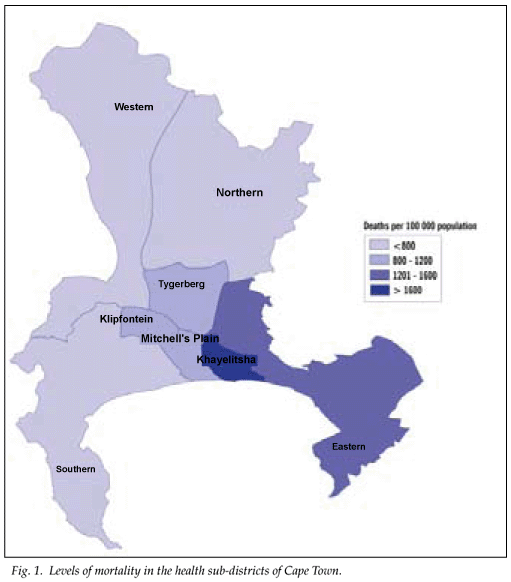
Identifying inequities. In line with the recommendations of the WHO Commission on Social Determinants of Health to monitor health inequities, the Cape Town data illustrate the importance of this. There are some sub-districts with substantially higher mortality; Khayelitsha in particular has mortality levels comparable with the high rates in other provinces (Fig. 1). 5
Evaluating priority health programmes. These data have been used to evaluate the impact of national and provincial priority programmes. For example, the Cape Town data show a reduction and levelling off in child and adult AIDS mortality respectively in 2006, indicating that the prevention of mother-to-child transmission and antiretroviral treatment programmes may be starting to have an impact. In addition, high mortality rates due to cervical cancer in Khayelitsha suggest a need to strengthen their screening and treatment programmes, taking into account the mobility of the population.
Providing accessible information for policy makers. Wide and persistent dissemination of accessible information plays an important role in engaging other sectors and empowering senior government leaders to advocate for policy formulation or change.
Advocating for an intersectoral response. The role of other sectors was highlighted by a better understanding of the province burden of disease profile. For example, the health sector can do little to prevent injuries without involving other sectors. Similarly, improving living conditions (reducing the multiple deprivation index) requires involvement from other sectors such as housing, water and sanitation.
Stepping into the data quality cycle. Involving district health authorities in mortality surveillance data processing has identified data quality concerns and opportunities for improvement. These include limited information provided on the manner of death for injuries and common death certification errors made by doctors. The need for reliable population estimates for sub-districts and the accurate allocation of deaths to geographical areas has also been identified, which is improved by local knowledge of the region.
Mortality surveillance for deaths from injury in the Western Cape is being upgraded to incorporate electronic transfer of cause of death data from all provincial mortuaries. This is an expansion of the National Injury Mortality Surveillance System (NIMSS) established at sentinel mortuaries that will fill the gap on details about the manner of death.6
In this issue of SAMJ another study reports concerns about the quality of death certification748
We urge other provinces to take note of this mortality surveillance project, which could assist national efforts to improve the domain of health status measurement. However, revamping mortality surveillance requires leadership, strategic planning and resources. In the context of competing priorities for limited resources, the importance of good data in making informed decisions cannot be overstated.
References
-
1. Myers J, Naledi T. Western Cape Burden of Disease Reduction Project: Final Report 2007 Overview and Executive Summaries . Vol 1. Cape Town: Western Cape Department of Health, 2008. http://www.capegateway.gov.za/eng/pubs/reports_research/W/157844?(accessed 29 October 2008).
» http://www.capegateway.gov.za/eng/pubs/reports_research/W/157844? - 2. Commission on Social Determinants of Health. Closing the Gap in a Generation: Health Equity Through Action on the Social Determinants of Health . Final Report of the Commission on Social Determinants of Health. Geneva: World Health Organization, 2008.
-
3. Groenewald P, Bradshaw D, van Niekerk M, Jeffries D, van der Merwe W. Cause of Death and Premature Mortality in Boland Overberg Region, 2004-2005 . Cape Town: South African Medical Research Council. http://www.mrc.ac.za/bod/reports.htm (accessed 29 October 2008).
» http://www.mrc.ac.za/bod/reports.htm - 4. Burger EHB, van der Merwe L, Volminck J. Errors in the completion of the death notification form. S Afr Med J 2007; 97: 1077-1081.
- 5. Bradshaw D, Nannan N, Groenewald P, et al. Provincial mortality in South Africa, 2000: Priority-setting for now and a benchmark for the future. S Afr Med J 2005; 95(7): 496-503.
- 6. Matzopoulos R, ed. A Profile of Fatal Injuries in South Africa: 6th Annual Report of the National Injury Mortality Surveillance System, 2004 . Cape Town: Crime, Violence and Injury Lead Programme, Medical Research Council/University of South Africa, 2005.
- 7. Nojilana B, Groenewald P, Bradshaw D, Reagon G. Quality of cause of death certification at an academic hospital in Cape Town, South Africa. S Afr Med J 2009; 99: 648-652 (this issue).
- 8. Pieterse D, Groenewald P, Bradshaw D, Burger L, Reagon G, Rodhe J. Death certificates: Let's get it right! S Afr Med J 2009; 99: 643-644 (this issue).