Eating disorders in South Africa: An inter-ethnic comparison of admission data
I DelportI; C P SzaboII
IMA. Department of Psychology, North-West University, Mafikeng Campus
IIMB BCh, FCPsych (SA), MMed Psych, PhD. Division of Psychiatry, University of the Witwatersrand, Johannesburg
Correspondence
Eating disorders among black South African females were first reported in 1995, having been documented among white South African females since the 1970s.123et al.1
Method
The study used a convenience, and limited, sample comprising 10 black females (anorexia nervosa: N=5, bulimia nervosa: N=5) and 10 age- and diagnosis-matched white females admitted to the eating disorders unit of Tara Hospital, during the period 1998 - 2004. Of the 13 black patients admitted to the unit during 1998 - 2004, 7 were diagnosed with anorexia nervosa and 6 with bulimia nervosa, according to the Diagnostic and Statistical Manual of Mental Disorders (4th edition) (DSM-IV) criteria.45672,8 The EDI comprises a range of both eating disorder-related and psychological dimensions, whereas the BITE is specifically designed to assess the presence and severity of symptoms of bulimia nervosa. The BDI provides a measure of depressive symptoms.
Results
Demographic data (combined anorexia and bulimia nervosa patients)
All patients were female. In both racial groups the majority of patients were scholars (6/10 per group) and aged 13 - 19, the remainder being aged 20 - 29 (4/10 per group). Of those who were not scholars, 3 of the white patients were unemployed versus 2 of the black patients, with 1 of the white patients being employed versus 2 of the black patients. The majority of patients in both racial groups were resident in Gauteng Province (white 9/10; black 7/10).
Home language for the white patients was predominantly English (8/10), with a range of languages spoken at home by the black patients: Tswana=1, Xhosa=2, Zulu=2, Sotho=3, Venda=1, and English=1. During the period of study (1998 -2004), there was a total of 435 admissions to the eating disorders unit (anorexia nervosa 245; bulimia nervosa 190), hence black females accounted for 3% of such admissions (13 out of 435 admissions).
Clinical/psychometric data
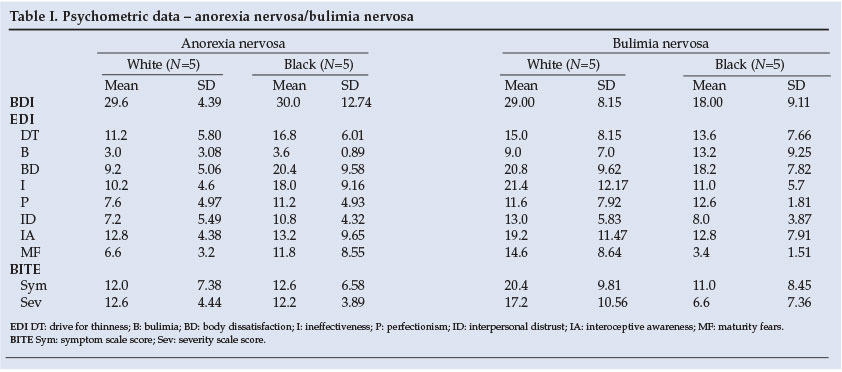
All patients fulfilled criteria for a diagnosis of either anorexia nervosa or bulimia nervosa, with no distinguishing clinical features in terms of race.4Table I). The small sample size dictated the use of a non-parametric test.
Discussion
No statistically significant differences on psychometric measures, comparing black and white eating disorder (anorexia nervosa, bulimia nervosa) sufferers hospitalised for their condition, were established. Sample size may explain the lack of statistically significant differences; with a larger sample size, significant differences may exist. While there were differences between the groups in terms of individual dimensions measured by the questionnaires, the absence of significant findings cautions against attempts to interpret such differences. As with all self-report questionnaires, concerns related to valid responses to the questions of each instrument are a consideration. Notwithstanding these data issues, the absence of significant differences is in keeping with the earliest clinical descriptions of black South African females with eating disorders, which found no specific characteristics distinguishing black sufferers from white.1982
References
- 1. Szabo CP, Berk M, Tlou E, Allwood CW. Eating disorders in black South African females, a series of cases. S Afr Med J 1995; 85: 588-590.
- 2. Szabo CP. Youth at risk - dieting and eating disorders: a South African perspective. S Afr Med J 2002; 92(4): 282-283.
- 3. Dolan B. Cross-cultural aspects of anorexia nervosa and bulimia: A review. Int J Eat Disord 1991; 10: 67-78.
- 4. Diagnostic and Statistical Manual of Mental Disorders. 4th ed. Washington, DC: American Psychiatric Association, 1994.
- 5. Garner DM, Olmstead MP, Polivy J. Development and validation of a multidimensional eating disorder inventory for anorexia nervosa and bulimia. Int J Eat Disord 1983; 2(1): 15-34.
- 6. Henderson M, Freeman CPL. A self-rating scale for bulimia. The "BITE". Br J Psychiatry 1987; 150: 18-24.
- 7. Beck At, Ward CH, Mendelson M, Mock R, Erbaugh J. An inventory for measuring depression. Arch Gen Psychiatry 1961; 4: 53-63.
- 8. Szabo CP, Terre Blanche MJ. Hospitalised anorexics - a preliminary evaluation of an inpatient programme. S Afr Med J 1998; 88(3): 312-318.
- 9. Hoste RR, Hewell K, le Grange D. Family interaction among white and ethnic minority adolescents with bulimia nervosa and their parents. Eur Eat Disord Rev 2007; 15(2): 152-158.
 Correspondence:
C P Szabo
(