Serum lipids and outcomes of COVID-19 patients admitted to a tertiary hospital in Johannesburg, South Africa
BACKGROUND. Cardiometabolic disorders contribute significantly to global cardiovascular disease risk. COVID-19 can exacerbate underlying vascular and metabolic disturbances through immune and inflammatory pathways. Lipoprotein abnormalities may influence disease susceptibility and outcomes, as lipoproteins play key roles in viral entry, inflammation and immune regulation. These markers may therefore serve as potential biomarkers for predicting outcomes, yet data from African populations remain limited. OBJECTIVE. To determine the association between admission lipid profiles and adverse clinical outcomes in hospitalised COVID-19 patients within a resource-constrained setting, in a predominantly black African population. METHODS. This retrospective observational study was conducted at Charlotte Maxeke Johannesburg Academic Hospital between 6 March and 31 August 2020. Adults aged >18 years with confirmed SARS-CoV-2 infection who had admission lipid profiles were included. The association between lipid parameters and adverse clinical outcomes, including intensive care unit (ICU) admission, mechanical ventilation and in-hospital mortality, were determined by multivariable logistic regression analysis. Correlation analyses examined associations between lipids and inflammatory markers. RESULTS. Among 305 patients (mean (standard deviation) age 53 (13.8) years; 77% black ethnicity), non-survivors had significantly lower low-density lipoprotein cholesterol (LDL-C) and total cholesterol (TC), and higher fasting plasma glucose and inflammatory markers. Both LDL-C and TC were inversely correlated with procalcitonin (ρ=-0.44, 95% confidence interval (CI) -0.65 - -0.23, p=0.001; (ρ=-0.28, CI -0.52 -0.05), p=0.03, respectively). Triglyceride (TG) levels were higher in ICU patients (p=0.01), and significantly correlated with an increasing white cell count (ρ=0.31, CI 0.09 - 0.53, p=0.01), neutrophil-to-lymphocyte ratio (ρ=0.27, CI 0.01 - 0.54, p=0.04) and fasting plasma glucose (ρ=0.39, CI 0.14 - 0.64, p=0.03), but were not independently predictive of mortality. High-density lipoprotein cholesterol was lower in ICU-admitted patients and inversely correlated with ferritin, but it was also not significantly associated with mortality. Lower LDL-C was an independent predictor of ICU admission (odds ratio (OR) 0.69, CI 0.50 - 0.96, p=0.03 ), mechanical ventilation (OR 0.55, CI 0.35 - 0.86, p=0.009) and mortality (OR 0.66, CI 0.48 - 0.91, p=0.01), with an LDL-C <2.2 mmol/L associated with increased mortality (area under curve 0.62, CI 0.55 - 0.69), as shown in receiver operating characteristic analysis. CONCLUSION. Non-survivors had significantly higher inflammatory markers compared with survivors, and low LDL-C and TC were independently associated with adverse outcomes. LDL-C also predicted ICU admission, mechanical ventilation and mortality, highlighting the link between lipid metabolism and immune response. These findings emphasise the need for further prospective studies to evaluate the utility of these markers as accessible prognostic tools in low- and middle-income countries.
SARS-CoV-2; COVID-19; LDL-C; lipids; inflammation; mortality
Serum lipids and outcomes of COVID-19 patients admitted to a tertiary hospital in Johannesburg, South Africa
F MohamedI; A M E MillenII; C DickensIII; F J RaaiIV, ; I S KallaV,
IMB BCh, MMed (Internal Medicine); Division of Endocrinology and Metabolism, Department of Internal Medicine, School of Clinical Medicine, Faculty of Health Sciences, University of the Witwatersrand, Johannesburg, South Africa
IIMBA, PhD; Wits Integrated Molecular Physiology Research Initiative, Department of Physiology, School of Biomedical Sciences, Faculty of Health Sciences, University of the Witwatersrand, Johannesburg, South Africa
IIIPhD; Department of Internal Medicine, School of Clinical Medicine, Faculty of Health Sciences, University of the Witwatersrand, Johannesburg, South Africa
IVPhD, DSc; Department of Internal Medicine, School of Clinical Medicine, Faculty of Health Sciences, University of the Witwatersrand, Johannesburg, South Africa
VMB BCh, PhD; Department of Internal Medicine, School of Clinical Medicine, Faculty of Health Sciences, University of the Witwatersrand, Johannesburg, South Africa
BACKGROUND. Cardiometabolic disorders contribute significantly to global cardiovascular disease risk. COVID-19 can exacerbate underlying vascular and metabolic disturbances through immune and inflammatory pathways. Lipoprotein abnormalities may influence disease susceptibility and outcomes, as lipoproteins play key roles in viral entry, inflammation and immune regulation. These markers may therefore serve as potential biomarkers for predicting outcomes, yet data from African populations remain limited.
OBJECTIVE. To determine the association between admission lipid profiles and adverse clinical outcomes in hospitalised COVID-19 patients within a resource-constrained setting, in a predominantly black African population.
METHODS. This retrospective observational study was conducted at Charlotte Maxeke Johannesburg Academic Hospital between 6 March and 31 August 2020. Adults aged >18 years with confirmed SARS-CoV-2 infection who had admission lipid profiles were included. The association between lipid parameters and adverse clinical outcomes, including intensive care unit (ICU) admission, mechanical ventilation and in-hospital mortality, were determined by multivariable logistic regression analysis. Correlation analyses examined associations between lipids and inflammatory markers.
RESULTS. Among 305 patients (mean (standard deviation) age 53 (13.8) years; 77% black ethnicity), non-survivors had significantly lower low-density lipoprotein cholesterol (LDL-C) and total cholesterol (TC), and higher fasting plasma glucose and inflammatory markers. Both LDL-C and TC were inversely correlated with procalcitonin (ρ=-0.44, 95% confidence interval (CI) -0.65 - -0.23, p=0.001; (ρ=-0.28, CI -0.52 -0.05), p=0.03, respectively). Triglyceride (TG) levels were higher in ICU patients (p=0.01), and significantly correlated with an increasing white cell count (ρ=0.31, CI 0.09 - 0.53, p=0.01), neutrophil-to-lymphocyte ratio (ρ=0.27, CI 0.01 - 0.54, p=0.04) and fasting plasma glucose (ρ=0.39, CI 0.14 - 0.64, p=0.03), but were not independently predictive of mortality. High-density lipoprotein cholesterol was lower in ICU-admitted patients and inversely correlated with ferritin, but it was also not significantly associated with mortality. Lower LDL-C was an independent predictor of ICU admission (odds ratio (OR) 0.69, CI 0.50 - 0.96, p=0.03 ), mechanical ventilation (OR 0.55, CI 0.35 - 0.86, p=0.009) and mortality (OR 0.66, CI 0.48 - 0.91, p=0.01), with an LDL-C <2.2 mmol/L associated with increased mortality (area under curve 0.62, CI 0.55 - 0.69), as shown in receiver operating characteristic analysis.
CONCLUSION. Non-survivors had significantly higher inflammatory markers compared with survivors, and low LDL-C and TC were independently associated with adverse outcomes. LDL-C also predicted ICU admission, mechanical ventilation and mortality, highlighting the link between lipid metabolism and immune response. These findings emphasise the need for further prospective studies to evaluate the utility of these markers as accessible prognostic tools in low- and middle-income countries.
Keywords: SARS-CoV-2, COVID-19, LDL-C, lipids, inflammation, mortality
The global burden of COVID-19 and its long-term complications, including post-acute sequelae of SARS-CoV-2 infection ('long-COVID'), has placed significant strain on healthcare systems, particularly in low- and middle-income countries (LMICs). Understanding the biological effects of SARS-CoV-2 infection and identifying cost-effective biomarkers that predict disease severity are essential, not only for improving current care but also in preparation for future viral outbreaks. Such markers could enhance triage, guide resource allocation and inform therapeutic strategies, not only for COVID-19 but also for other viral illnesses. Serum lipids and lipoproteins, including low-density lipoprotein cholesterol (LDL-C) and high-density lipoprotein cholesterol (HDL-C), play a central role in viral entry, immune modulation and inflammation by serving as structural components of cell membranes and mediating viral fusion and immune signalling via lipid raft interactions. Serum lipids and lipoproteins, including LDL-C and HDL-C, contribute to cell membrane structure and stability, influencing membrane fluidity, lipid raft formation and receptor-mediated viral fusion.[1-4] While lipoproteins do not directly mediate viral entry, membrane lipid composition and integrity can affect host-virus interactions and downstream immune signalling.[1-4] The acute phase response alters lipoprotein metabolism, and therefore, changes in lipid parameters may reflect underlying immune and inflammatory activity. Hence, abnormalities in lipid profiles in patients with severe COVID-19 may have potential prognostic utility as surrogate markers of host inflammatory response.
During acute illness, the acute phase response triggers a co-ordinated alteration in plasma proteins, characterised by an increase in positive reactants such as C-reactive protein (CRP), ferritin and fibrinogen, and a reduction in negative reactants, including albumin, transferrin and apolipoproteins. Procalcitonin (PCT), while relatively more specific for bacterial infection, may also provide prognostic insight into disease progression, and contrasts with nonspecific inflammatory markers such as CRP and ferritin, which are frequently elevated in viral infections such as COVID-19.[5-8] Studies have consistently reported altered lipid profiles in patients with severe COVID-19, including reductions in total cholesterol (TC), LDL-C and HDL-C, and elevations in triglycerides (TG).[9-12] These changes are thought to reflect a systemic inflammatory response, compounded by hepatic dysfunction and cytokine-mediated suppression of lipid metabolism.[13,14] Inflammatory markers such as neutrophil-to-lymphocyte ratio (NLR), CRP and pro-inflammatory cytokines, including interleukin-6 (IL-6), have shown promise as biomarkers for predicting COVID-19 severity.[1,15] However, their variability and modulation by external factors such as glucocorticoid use can affect reliability. Importantly, systemic inflammation may drive hypolipidaemia through suppressed hepatic apolipoprotein synthesis and capillary leakage of lipoproteins.[1,16] Liver dysfunction may further contribute, given the liver's central role in lipid metabolism. While aminotransferases are commonly used to assess hepatic injury, they are also elevated in systemic illness, and thus may lack specificity in COVID-19.[2,12,17] These overlapping mechanisms highlight the need to interpret serum lipid alterations in the broader context of inflammation and hepatic involvement.
In particular, LDL-C and HDL-C have been shown to decrease significantly in patients with poor outcomes, while low HDL-C has been linked to impaired anti-inflammatory function and endothelial injury.[1,11] Although lipids have been evaluated in other infectious diseases such as HIV and tuberculosis, and in critically ill patients with sepsis, the scale and severity of abnormalities in lipid profiles in COVID-19 appear more pronounced, reinforcing their potential prognostic value.[1,2,13,18]
However, data from LMICs remain limited, especially in African populations with high cardiometabolic risk and limited access to advanced diagnostics. In previous work at our centre, we reported a high prevalence of hyperglycaemia and undiagnosed diabetes mellitus among patients admitted with COVID-19, which was associated with poor outcomes.[6] Expanding on this, the current study investigates the association of lipid parameters, LDL-C, HDL-C, TC and TG with severity outcomes, including intensive care unit (ICU) admission, mechanical ventilation and mortality. This study explores whether such lipid alterations can be used as a low-cost, independent predictor of poor outcomes in hospitalised COVID-19 patients, while our ongoing longitudinal study conducted during the Delta variant wave further examines these associations alongside detailed cytokine profiling (IL-6, Th1, Th2 and Th17) and glycaemic indices.[19] Conducted in a predominantly black African cohort within a high-burden tertiary public hospital, our findings offer valuable insights into the prognostic relevance of lipid markers in a real-world LMIC context. This work also contributes to a growing body of evidence supporting the utility of routine biochemical markers in guiding clinical care and advancing our understanding of immunometabolic dysregulation during viral illness.[5]
Methods
Study design, setting and sample population
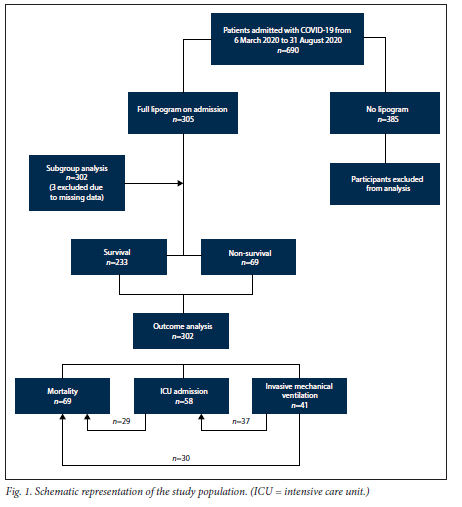
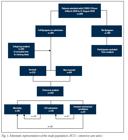
A retrospective, single-centre observational study was conducted to evaluate patients hospitalised with moderate to severe COVID-19 at Charlotte Maxeke Johannesburg Academic Hospital between 6 March and 31 August 2020. Data were captured and analysed from an electronic registry. Patients aged >18 years were included if they had confirmed COVID-19 infection via reverse-transcriptase polymerase chain reaction, with an amplification run of 40 cycles. Pregnant patients and those with incomplete records or missing lipid profiles on admission were excluded from the analysis. Lipid and glucose measurements were obtained on admission as part of the hospital's COVID-19 admission standard operating procedure for metabolic and inflammatory assessment, typically following 6 - 8 hours of fasting; however, fasting status was not fully standardised, given the acute care setting. A schematic representation of the patients included in the study is shown in Fig. 1.
Outcome measures
The primary outcome measure was in-hospital mortality. Secondary outcome measures included admission to ICU, need for respiratory support using non-invasive measures (non-rebreather mask, high-flow nasal cannula, or non-invasive ventilation) and need for invasive mechanical ventilation.
Lipid profile determination
Lipid profiles, including TC, HDL-C, LDL-C and TG, were measured as standard of care, using a colorimetric enzymatic assay on the Roche Cobas automated analyser. Lipoprotein cholesterol concentrations were reported in mmol/L. For reference, conversion to mg/dL can be performed using the following factors: cholesterol values × 38.6; triglyceride values × 88.4.
Glycated haemoglobin (HbA1c)
HbA1c was analysed using the Bio-Rad Variant II system, which employs ion-exchange high-performance liquid chromatography. This method is standardised according to both the National Glycohemoglobin Standardization Program and the reference protocols of the International Federation of Clinical Chemistry.
Fasting plasma glucose
Fasting plasma glucose (FPG) was measured using an enzymatic hexokinase method on the Cobas c-702 analyser (Roche Diagnostics, Germany), following the manufacturer's protocol.
Statistical analysis
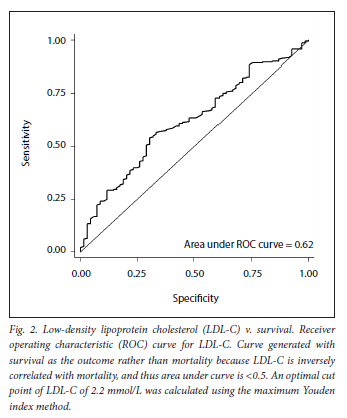
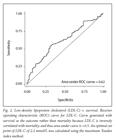
Statistical analysis was conducted using Stata (version 14.2, StataCorp, USA). Continuous data were tested for normality using the Shapiro-Wilks test, and reported as means (standard deviations (SDs)) or medians (interquartile ranges (IQRs)), as appropriate, while categorical data were presented as proportions. An unpaired t-test (for normally distributed variables) or Mann-Whitney U test (for non-normally distributed variables) was used to compare continuous variables between two groups, and the Kruskal-Wallis test was applied for comparisons among three groups. Chi-squared analysis was used to analyse categorical data, with Fisher's exact test (two-tailed) applied when expected frequencies were <5. Spearman's correlation analysis was performed to evaluate the relationship between lipid profiles, inflammatory markers and glycaemic parameters in patients who did not survive. Associations between demographic factors, lipid profiles and mortality were assessed using univariate and multivariate logistic regression analysis. Multivariate models were adjusted for age and gender. The performance of LDL-C in predicting survival was evaluated using receiver operating characteristic (ROC) curve analysis, with optimal cut points determined by the maximum Youden index method. The ROC curve was generated with survival as the outcome rather than mortality, given the inverse correlation between LDL-C and mortality in our cohort, which resulted in an area under the curve (AUC) <0.5. P<0.05 was considered statistically significant.
Ethical approval
Ethical clearance was obtained from the University of the Witwatersrand Human Research Ethics Committee (ref. no. M2008110) and the Charlotte Maxeke Johannesburg Academic Hospital Ethics Committee.
Results
Baseline characteristics of the overall cohort based on survival status
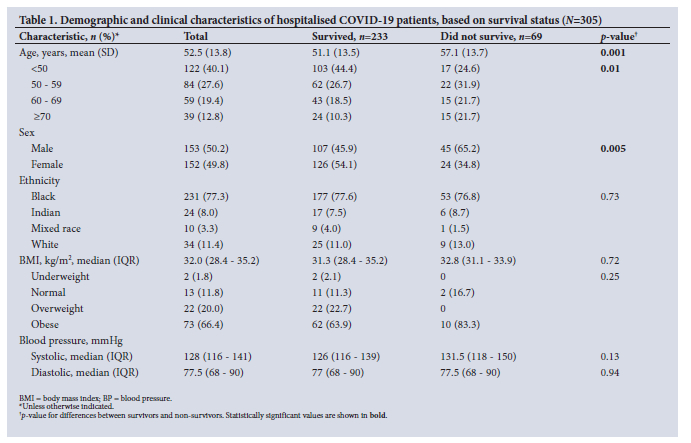
Of the 305 patients included, there was an equal distribution of men and women, with a mean (SD) age of 53 years (13.8). More than 75% of the cohort were of black African ancestry (Table 1). The median (IQR) body mass index (BMI) of the overall cohort was in the obese range at 32 (28.4 - 35.2) kg/m2(p>0.05).
Lipid and glycaemic parameters based on survival status
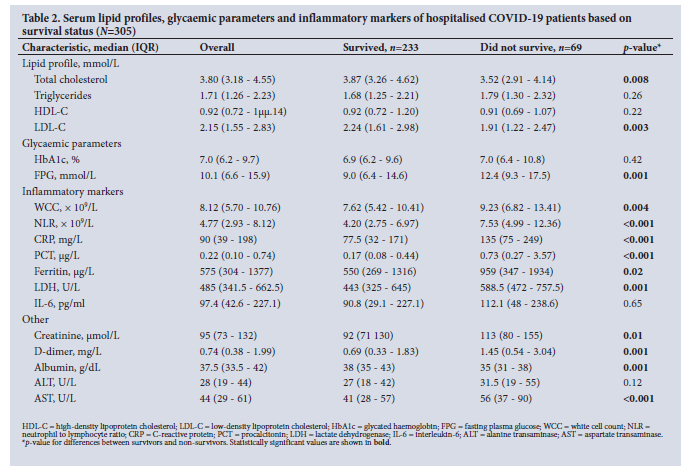
Patients who died had significantly lower concentrations of TC and LDL-C (Table 2). Inflammatory markers, including NLR, CRP, ferritin and lactate dehydrogenase (LDH), were significantly increased in non-survivors. There was no significant difference in IL-6 concentration between those who survived compared with non-survivors. The overall cohort of COVID-19 patients exhibited elevated FPG, with a median (IQR) of 10.1 (6.6 - 15.9) mmol/L, and FPG was significantly higher among those who died (Table 2).
Correlation of lipid parameters with inflammatory markers
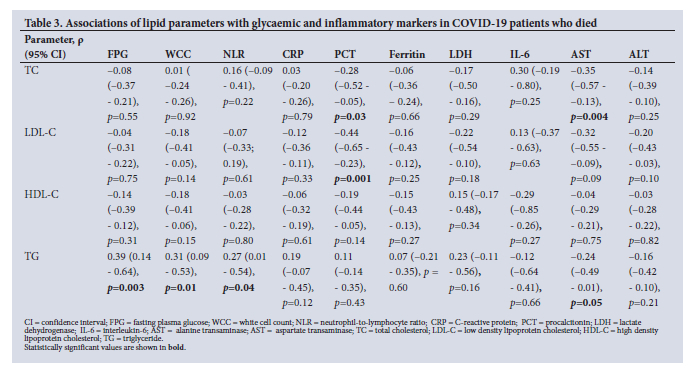
In patients who died, a lower LDL-C concentration was associated with higher PCT and aspartate transaminase (AST) concentrations (Table 3). Similarly, a lower TC concentration was associated with an increased procalcitonin and AST concentration. There was also a weak positive correlation between TG and FPG, white cell count (WCC) and NLR, although an inverse relationship was noted with AST. No significant correlations were observed between IL-6 concentration and any of the lipid parameters (Table 3).
Lipid parameters stratified according to outcome status
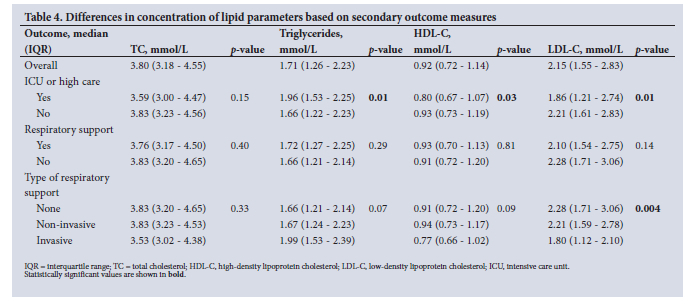
Median lipid levels in relation to clinical outcomes are presented in Table 4. TC and LDL-C were consistently lower across all adverse outcome groups. Notably, LDL-C levels were significantly lower in patients admitted to ICU, those requiring mechanical ventilation and non-survivors. TC was also significantly reduced in patients who died from COVID-19, while HDL-C was significantly lower in those requiring ICU admission. In contrast, TG levels were higher across all adverse outcome groups, with a significantly higher level observed in ICU-admitted patients.
Outcome predictors and LDL-C performance in inhospital mortality
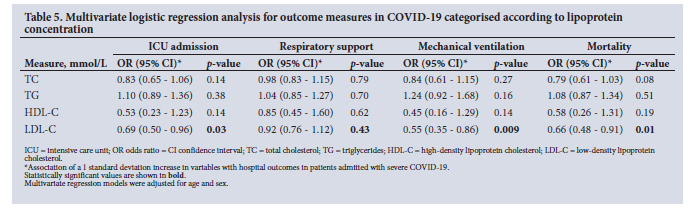
Univariate and multivariate logistic regression analyses for ICU admission, respiratory support, mechanical ventilation and mortality are presented in Appendix Table S1 and Table 5, respectively. In univariate analysis, increasing age, particularly >70 years, was associated with lower odds of ICU admission and mechanical ventilation, but higher odds of requiring respiratory support and mortality (Appendix Table S1). Female sex was associated with a reduced likelihood of ICU admission and death. Elevated TG levels were associated with increased odds of requiring mechanical ventilation. In multivariate analysis, after adjusting for age and sex, low LDL-C emerged as the only independent predictor significantly associated with increased odds of ICU admission, mechanical ventilation and mortality (Table 5). In those admitted with COVID-19, an admission LDL-C <2.2 mmol/L was independently associated with higher odds of ICU admission, mechanical ventilation and in-hospital mortality. Given the inverse correlation between LDL-C and mortality, ROC curve analysis using survival as the outcome yielded an AUC of 0.62 (95% CI 0.55 - 0.69), with a sensitivity of 54%, specificity of 70%, negative predictive value of 0.31 and positive predictive value of 0.86 (Fig. 2).
Discussion
This study highlights the prognostic value of lipid profiles in hospitalised COVID-19 patients, demonstrating that specific lipid abnormalities reflect both disease severity and inflammatory status. Key findings are that lower LDL-C and TC levels were consistently associated with adverse outcomes, including ICU admission, need for mechanical ventilation and mortality. In contrast, elevated TG levels were linked to more severe disease presentations. These lipid abnormalities occurred in the context of increased inflammatory responses, as evidenced by elevated CRP, NLR, ferritin and LDH in non-survivors. Importantly, LDL-C emerged as an independent predictor of poor outcomes, even after adjusting for confounders, with an LDL-C <2.2 mmol/L significantly increasing the odds of in-hospital mortality. Correlation analyses further revealed that reductions in LDL-C and TC were significantly associated wit PCT, a marker of systemic inflammation, highlighting the potential role of immune-driven hypolipidaemia in COVID-19 pathogenesis. The findings of our study suggest that lipid profiles, particularly LDL-C, may offer valuable prognostic insights and serve as cost-effective, accessible markers for risk stratification in resource-limited settings.
When stratifying by age, race and access to intensive care, distinct patterns of disease severity and lipid alteration emerged within our cohort. In this cohort of predominantly black African patients hospitalised with COVID-19, no racial differences were observed in the outcome analysis. Interestingly, while older age is typically associated with worse outcomes in COVID-19, our study found that patients aged >70 years had a significantly lower likelihood of ICU admission and mechanical ventilation. This counterintuitive finding likely reflects predefined medical triage protocols in our resource-limited public healthcare setting, where ICU access may be prioritised for patients with a higher likelihood of benefit. However, we observed a distinct lipid profile associated with adverse clinical outcomes.
LDL-C showed the strongest and most consistent association with adverse clinical outcomes, highlighting its role as a potential prognostic biomarker. Low LDL-C and TC levels were significantly associated with disease severity and in-hospital mortality, with LDL-C consistently lower in patients admitted to ICU, those requiring mechanical ventilation and non-survivors. The inverse relationship between LDL-C and primary outcomes remained robust in multivariate analysis, with a low LDL-C independently predicting ICU admission, mechanical ventilation and death. Although modest, this predictive capacity reinforces findings from other studies, which demonstrated that the extent of LDL-C reduction strongly correlated with COVID-19 severity and mortality.[9,11,14,20-22] Several mechanisms have been proposed for this association, including viral-induced hepatic dysfunction that impairs lipid biosynthesis, as well as the action of inflammatory cytokines and reactive oxygen species that promote LDL oxidation and clearance, thereby contributing to hypolipidaemia.[14,23-26] Inflammatory-driven vascular permeability may also lead to protein- and lipid-rich exudation, further depleting circulating lipoproteins.[14] LDL-C's known roles in neutralising bacterial endotoxins and modulating immune responses suggest a potentially protective function that is diminished at critically low levels.[11,24,27] These data are supportive of LDL-C as a prognostic biomarker in COVID-19, and highlight the need for future studies exploring its immunometabolic role in severe infections.
HDL-C exhibits dynamic changes during acute infection, reflecting its dual anti-inflammatory and endothelial protective roles. In our study, significantly lower HDL-C levels and elevated TGs were observed in patients requiring ICU admission. TG levels showed weak but positive correlations with FPG and inflammatory markers, suggesting a shared pathophysiological axis involving metabolic stress and inflammation, potentially reflective of underlying insulin resistance, cytokine-driven hepatic TG synthesis, or direct viral effects on lipid metabolism.[11,28] However, these lipid parameters did not emerge as independent predictors of ICU admission, mortality, or the need for mechanical ventilation. Studies have associated low HDL-C with impaired anti-inflammatory and antioxidant functions, potentially exacerbating endothelial injury during severe infections.[18,26] HDL-C has been shown to scavenge pro-inflammatory mediators, and its depletion may reduce immune modulation during acute illness.[18,20] Lipoprotein levels, particularly low HDL-C, have been shown to be predictive of poor sepsis outcomes, and to help identify a hypolipoprotein phenotype associated with endothelial dysfunction, organ failure and increased mortality.[29] While our study did not find these associations to be statistically significant, evidence from a large retrospective study suggests that higher antecedent HDL-C levels are linked to a lower risk of SARS-CoV-2 infection, whereas low HDL-C is associated with higher morbidity and mortality.[1]
Similarly, triglyceride elevations appeared to track systemic inflammation and metabolic stress. An increase in TGs was associated with elevated WCC and NLR, while low HDL-C levels inversely correlated with ferritin. This is consistent with other studies demonstrating that both pre-infection and in-hospital low HDL-C and high TG levels are associated with severe COVID-19 outcomes and inflammatory markers such as ferritin.[28] Mechanistically, these lipid abnormalities may result from decreased lipoprotein lipase activity, inhibition of apolipoprotein A1 synthesis, altered cholesteryl ester transfer protein activity, and increased HDL clearance through inflammatory mediators such as serum amyloid A.[11,28,30] Collectively, these findings support the potential utility of HDL-C and TG as markers of systemic inflammation and disease severity, although they did not emerge as independent predictors in our multivariate analysis.
Observational data suggest a U-shaped relationship between LDL-C levels and COVID-19 outcomes, where very low LDL-C may impair host defense, while markedly elevated LDL-C increases cardiovascular risk.[24,27] Despite this, statins remain beneficial due to their anti-inflammatory, antithrombotic and antioxidant effects, and continuation of lipid-lowering therapy during acute infection is recommended to reduce morbidity and mortality.[27] With recovery, lipoprotein levels tend to normalise; however, post-acute phase studies demonstrate an increased risk of dyslipidaemia and greater reliance on lipid-lowering therapy, particularly among those with severe disease.[31-33] These patterns emphasise the importance of lipid follow-up and secondary prevention strategies after COVID-19. Further prospective longitudinal research in our centre is focused on evaluating pre-existing and post-COVID-19 dyslipidaemias and their association with adverse cardiometabolic outcomes.
The observed correlations between inflammatory markers and lipid parameters provide mechanistic insight into the immune-metabolic interplay in COVID-19. Our study also demonstrated a weak inverse correlation between AST and lipid parameters, and a moderate inverse correlation between PCT and both LDL-C and TC. These findings may reflect hepatic dysfunction and systemic inflammation associated with COVID-19. SARS-CoV-2 can infect hepatocytes and cholangiocytes, disrupting lipid metabolism, given the liver's central role in lipoprotein synthesis and clearance.[2] Elevated AST may indicate nonspecific systemic injury rather than isolated hepatic damage.[2] Furthermore, inflammation-driven suppression of lipoproteins and changes in lipid-modifying enzymes contribute to altered lipid profiles in COVID-19.[2] PCT, an acute-phase reactant and marker of systemic inflammation, has been shown to predict poor outcomes in COVID-19, with elevated levels associated with disease severity and mortality even in the absence of bacterial co-infection, with concentrations >0.5 μg/L typically suggestive of bacterial infection.[34,35] Studies have shown that patients with severe COVID-19 and higher PCT levels exhibit increased tumour necrosis factor-alpha (TNF-α) and prolonged ICU stays, despite no differences in CRP or confirmed bacterial superinfection.[35] In our study, PCT was measured at admission, with most values below the sepsis threshold, indicating that its elevation likely reflected cytokine-mediated inflammation rather than bacterial co-infection. Mild PCT elevations reflect cytokine-driven inflammation, and have been associated with early clinical deterioration.[34] In our cohort, the moderate inverse correlation between PCT and LDL-C supports a model in which cytokine-mediated inflammation exacerbates hypolipidaemia, highlighting the value of combining PCT with lipid markers such as LDL-C for early risk stratification in COVID-19. Additionally, we observed no significant differences in IL-6 levels when stratified by survival status. This could be explained by the routine use of corticosteroids in patients with hypoxaemia, which may have attenuated IL-6 expression. These findings emphasise the need for further prospective evaluation of IL-6 and other inflammatory markers at the time of admission, before the influence of therapeutic interventions.
Study strengths and limitations
This study offers locally relevant data from an LMIC context, but acknowledges several methodological and contextual limitations that inform future research. A key strength of the study lies in its exploration of lipid abnormalities in the context of COVID-19 within a resource-constrained LMIC setting. The use of LDL-C as a low-cost lipid marker for risk stratification in a high-burden tertiary centre highlights its potential utility in settings with limited access to advanced diagnostics.
However, the study's retrospective design, modest sample size, absence of pre-infection lipid data and lack of information on antecedent statin use limit the ability to draw causal inferences. Additionally, the lack of adjustment for potential confounders, including glucocorticoid use in the acute setting and antecedent statin therapy, further limits the interpretability of the observed lipid-outcome associations. Glucocorticoid treatment can attenuate the sepsis- and inflammation-induced decline in LDL-C, leading to comparatively higher levels among treated, severely ill patients, while chronic statin therapy may have lowered baseline LDL-C values prior to admission. In addition to glucocorticoid effects, catecholamine surges during acute stress may further alter lipid and glucose metabolism, contributing to transient hyperglycaemia.[5,6,19] However, HbA1c concentrations are unlikely to change over the short course of acute illness, as they reflect long-term glycaemic control rather than acute metabolic shifts.[6] As lipid profiles were measured only at admission, without serial assessments or follow-up, the temporal evolution of lipoprotein changes during the course of illness could not be evaluated. While LDL-C emerged as an independent predictor of mortality, the ROC AUC of 0.62 indicates modest discriminative ability. This finding highlights that LDL-C alone has limited prognostic accuracy, and should rather be viewed as one component of a broader metabolic and inflammatory profile. Its potential additive role alongside glycaemic and immune variables warrants further exploration in predictive models of COVID-19 severity and outcomes.
A further limitation was the large proportion of missing BMI data, available for only 36% of participants. As international studies have shown a positive correlation between higher BMI and severe COVID-19 outcomes, this limited data availability prevented inclusion of BMI in the multivariate logistic regression model, and may have influenced the interpretation of metabolic risk relationships in this cohort. The absence of longitudinal follow-up and the exclusion of mild or asymptomatic cases may further restrict generalisability. Additionally, as the study predates widespread COVID-19 vaccination, it does not account for vaccine-related effects on lipid and inflammatory profiles. Another limitation is the absence of apolipoprotein measurements, such as ApoB and ApoA1, which are important in characterising lipoprotein-related risk and immune-lipid interactions. To address these gaps, our ongoing prospective study, conducted during the third wave dominated by the Delta variant, includes a comprehensive assessment of glycaemic, lipid and metabolic parameters, including BMI, waist circumference and lipoprotein(a), and is currently completed and pending publication. Importantly, that study also includes participants who were glucocorticoid-naive on admission, enabling a clearer understanding of the intrinsic metabolic alterations associated with severe COVID-19. Furthermore, correlations of lipids with Th1, Th2 and Th17 cytokine profiles were evaluated.
Future research should be aimed at developing multivariable biomarker-driven clinical models to predict the severity of viral pneumonias, incorporating long-term follow-up to assess post-infection metabolic trajectories. Emerging evidence from long-COVID suggests a sustained hyperlipidaemic and pro-inflammatory phenotype, associated with increased cardiovascular risk, which warrants continued monitoring in COVID-19 survivors.[36,37]
Importantly, while lower LDL-C and HDL-C levels in the acute phase reflect inflammatory responses, long-term lipid-lowering therapy remains safe and cardioprotective, and should not be viewed as detrimental to infectious outcomes. Individuals with untreated severe dyslipidaemia may be particularly vulnerable, highlighting the importance of baseline lipid profiling in healthy adults to enable accurate interpretation of lipid changes during acute illness, and to guide equitable clinical management.
Conclusion
This study highlights the association between lipid abnormalities, particularly low LDL-C and TC, and poor outcomes in hospitalised COVID-19 patients, suggesting their potential as accessible prognostic markers in resource-limited settings. While TG and HDL-C were associated with inflammatory markers, they did not independently predict outcomes. Ongoing studies in our unit are exploring lipid-immune interactions and the integration of metabolic markers into clinical risk models for viral infections.
Data availability. The data used in this study are available upon reasonable request from the authors.
Declaration. This study was conducted as partial requirement for FM's PhD in Medicine at the University of the Witwatersrand.
Acknowledgements. We acknowledge the staff of the Internal Medicine and ICU Departments at Charlotte Maxeke Johannesburg Academic Hospital for their ongoing commitment to the care of patients admitted with COVID-19.
Author contributions. FM conceptualised the research project. FM, FJR and ISK collectively designed the study. FM collected data. FM and CD conducted data analysis. FM was responsible for the writing and editing of the manuscript. FJR, AM, CD, FJR and ISK were responsible for editing the manuscript. The final article was approved by all authors. FM had full access to all the data in the study, and takes responsibility for the integrity of the data and the accuracy of the data analysis.
Funding. FM was funded by the South African Medical Research Council (SAMRC) Self-Initiated Research (SIR) grant (grant/award number: not applicable), the National Research Foundation (NRF) Thuthuka grant (TTK2204214124) and the L'Oréal-UNESCO For Women in Science Programme (grant/award number: not applicable). Any opinion, finding and conclusion or recommendation expressed in this material is that of the authors, and the SAMRC and NRF do not accept any liability in this regard.
Conflicts of interest. None.
References
-
1. Chidambaram V, Shanmugavel Geetha H, Kumar A, et al. Association of lipid levels with COVID-19 infection, disease severity and mortality: A systematic review and meta-analysis. Front Cardiovasc Med 2022;9:862999. https://doi.org/10.3389/fcvm.2022.862999
» https://doi.org/10.3389/fcvm.2022.862999 -
2. Grewal T, Nguyen MKL, Buechler C. Cholesterol and cholesterol-lowering medications in COVID-19 - an unresolved matter. Int J Molecular Scie 2024;25(19):10489. https://doi.org/10.3390/ijms251910489
» https://doi.org/10.3390/ijms251910489 -
3. Roccaforte V, Daves M, Lippi G, Spreafico M, Bonato C. Altered lipid profile in patients with COVID-19 infection. J Lab Precision Med 2021;6:25. https://doi.org/10.21037/jlpm-20-98
» https://doi.org/10.21037/jlpm-20-98 -
4. Theken KN, Tang SY, Sengupta S, FitzGerald GA. The roles of lipids in SARS-CoV-2 viral replication and the host immune response. J Lipid Res 2021;62:100129. https://doi.org/10.1016/j.jlr.2021.100129
» https://doi.org/10.1016/j.jlr.2021.100129 -
5. Mohamed F, Prim BA, Zamparini J, Millen A, Raal F, Kalla IS. Evaluating the CURB-65 score for in-hospital mortality prediction in COVID-19 patients: Insights into dysglycaemia. BMJ Pub Health 2024;2(2):e001291. https://doi.org/10.1136/bmjph-2024-001291
» https://doi.org/10.1136/bmjph-2024-001291 -
6. Mohamed F, Raal FJ, Mbelle M, et al. Glycaemic characteristics and outcomes of COVID-19 patients admitted to a tertiary hospital in Johannesburg. Wits J Clin Med 2020;2(3):123-136. https://doi.org/10.18772/26180197.2020.v2n3a1
» https://doi.org/10.18772/26180197.2020.v2n3a1 -
7. Martha JW, Wibowo A, Pranata R. Prognostic value of elevated lactate dehydrogenase in patients with COVID-19: A systematic review and meta-analysis. Postgrad Med J 2022;98(1160):422-427. https://doi.org/10.1136/postgradmedj-2020-139542
» https://doi.org/10.1136/postgradmedj-2020-139542 -
8. Lippi G, Plebani M. Procalcitonin in patients with severe coronavirus disease 2019 (COVID-19): A meta-analysis. Clinica Chimica Acta 2020;505:190-191. https://doi.org/10.1016/j.cca.2020.03.004
» https://doi.org/10.1016/j.cca.2020.03.004 -
9. Mahat RK, Rathore V, Singh N, Singh N, Singh SK, Shah RK, et al. Lipid profile as an indicator of COVID-19 severity: A systematic review and meta-analysis. Clin Nutr ESPEN 2021;45:91-101. https://doi.org/10.1016/j.clnesp.2021.07.023
» https://doi.org/10.1016/j.clnesp.2021.07.023 -
10. Ochoa-Ramírez LA, De la Herrán Arita AK, Sanchez-Zazueta JG, et al. Association between lipid profile and clinical outcomes in COVID-19 patients. Sci Rep 2024;14:12139. https://doi.org/10.1038/s41598-024-62899-y
» https://doi.org/10.1038/s41598-024-62899-y -
11. Usenko T, Miroshnikova V, Bezrukova A, et al. Fraction of plasma exomeres and low-density lipoprotein cholesterol as a predictor of fatal outcome of COVID-19. PLoS ONE 2023;18(2):e0278083. https://doi.org/10.1371/journal.pone.0278083
» https://doi.org/10.1371/journal.pone.0278083 -
12. Zhao M, Luo Z, He H, et al. Decreased low-density lipoprotein cholesterol level indicates poor prognosis of severe and critical COVID-19 patients: A retrospective, single-center study. Front Med 2021;8:585851. https://doi.org/10.3389/fmed.2021.585851
» https://doi.org/10.3389/fmed.2021.585851 -
13. Hofmaenner DA, Arina P, Kleyman A, et al. Association between hypocholesterolemia and mortality in critically ill patients with sepsis: A systematic review and meta-analysis. Crit Care Explor 2023;5(2):e0860. https://doi.org/10.1097/CCE.0000000000000860
» https://doi.org/10.1097/CCE.0000000000000860 -
14. Wei X, Zeng W, Su J, et al Hypolipidemia is associated with the severity of COVID-19. J Clin Lipidol 2020;14(3):297-304. https://doi.org/10.1016/j.jacl.2020.04.008
» https://doi.org/10.1016/j.jacl.2020.04.008 -
15. Lo Presti E, Nuzzo D, Al Mahmeed W, et al. Molecular and pro-inflammatory aspects of COVID-19: The impact on cardiometabolic health. Biochimica et Biophysica Acta 2022;1868(12):166559. https://doi.org/10.1016/j.bbadis.2022.166559
» https://doi.org/10.1016/j.bbadis.2022.166559 -
16. Kermali M, Khalsa RK, Pillai K, Ismail Z, Harky A. The role of biomarkers in diagnosis of COVID-19 - a systematic review. Life Sci 2020;254:117788. https://doi.org/10.1016/j.lfs.2020.117788
» https://doi.org/10.1016/j.lfs.2020.117788 -
17. Helou M, Nasr J, El Osta N, Jabbour E, Husni R. Liver manifestations in COVID-19 patients: A review article. World J Clin Cases 2023;11(10):2189-2200. https://doi.org/10.12998/wjcc.v11.i10.2189
» https://doi.org/10.12998/wjcc.v11.i10.2189 -
18. Nain M, Gupta A, Malhotra S, Sharma A. High-density lipoproteins may play a crucial role in COVID-19. Virol J 2022;19(1):135. https://doi.org/10.1186/s12985-022-01865-4
» https://doi.org/10.1186/s12985-022-01865-4 -
19. Mohamed F, Gunter S, Yirdaw BE, Raal FJ, Millen AME, Kalla IS. Predictive diagnostic models for newly diagnosed diabetes mellitus in moderate to severe COVID-19: The role of TyG Index, BMI, and inflammatory markers. BMC Endocrine Dis 2025;25(1):245. https://doi.org/10.1186/s12902-025-02056-2
» https://doi.org/10.1186/s12902-025-02056-2 -
20. Fan J, Wang H, Ye G, et al. Letter to the editor: Low-density lipoprotein is a potential predictor of poor prognosis in patients with coronavirus disease 2019. Metabolism 2020;107:154243. https://doi.org/10.1016/j.metabol.2020.154243
» https://doi.org/10.1016/j.metabol.2020.154243 -
21. Feingold KR. The bidirectional interaction of COVID-19 infections and lipoproteins. Best Pract Res Clin Endocrinol Metab 2023;37(4):101751. https://doi.org/10.1016/j.beem.2023.101751
» https://doi.org/10.1016/j.beem.2023.101751 -
22. Aparisi Á, Iglesias-Echeverría C, Ybarra-Falcón C, et al. Low-density lipoprotein cholesterol levels are associated with poor clinical outcomes in COVID-19. Nutr Metab Cardiovasc Dis 2021;31(9):2619-2627. https://doi.org/10.1016/j.numecd.2021.06.016
» https://doi.org/10.1016/j.numecd.2021.06.016 -
23. Durrington P. Blood lipids after COVID-19 infection. Lancet Diabetes Endocrinol 2023;11(2):68-69. https://doi.org/10.1016/S2213-8587(22)00389-8
» https://doi.org/10.1016/S2213-8587(22)00389-8 -
24. Gong J, Chen Y, Jie Y, et al. U-shaped relationship of low-density lipoprotein cholesterol with risk of severe COVID-19 From a multicenter pooled analysis. Front Cardiovasc Med 2021;8:604736. https://doi.org/10.3389/fcvm.2021.604736
» https://doi.org/10.3389/fcvm.2021.604736 -
25. Sorokin AV, Karathanasis SK, Yang Z, Freeman L, Kotani K, Remaley AT. COVID-19-associated dyslipidemia: Implications for mechanism of impaired resolution and novel therapeutic approaches. FASEB J 2020;34(8):9843-9853. https://doi.org/10.1096/fj.202001451
» https://doi.org/10.1096/fj.202001451 -
26. Hu X, Chen D, Wu L, He G, Ye W. Declined serum high density lipoprotein cholesterol is associated with the severity of COVID-19 infection. Clin Chim Acta 2020;510:105-110. https://doi.org/10.1016/j.cca.2020.07.015
» https://doi.org/10.1016/j.cca.2020.07.015 -
27. Ozcan M, Zhu X, Zhang H, Javaheri A. Editorial: Lipids, lipoproteins and COVID-19. Front Cardiovasc Med 2023;10:1293249. https://doi.org/10.3389/fcvm.2023.1293249
» https://doi.org/10.3389/fcvm.2023.1293249 -
28. Masana L, Correig E, Ibarretxe D, et al. Low HDL and high triglycerides predict COVID-19 severity. Sci Rep 2021;11:7217. https://doi.org/10.1038/s41598-021-86747-5
» https://doi.org/10.1038/s41598-021-86747-5 -
29. Guirgis FW, Black LP, Henson M, et al. A hypolipoprotein sepsis phenotype indicates reduced lipoprotein antioxidant capacity, increased endothelial dysfunction and organ failuwre, and worse clinical outcomes. Crit Care 2021;25(1):341. https://doi.org/10.1186/s13054-021-03757-5
» https://doi.org/10.1186/s13054-021-03757-5 -
30. Tall AR, Yvan-Charvet L. Cholesterol, inflammation and innate immunity. Nat Rev Immunol 2015;15(2):104-116. https://doi.org/10.1038/nri3793
» https://doi.org/10.1038/nri3793 -
31. Xie Y, Al-Aly Z. Risks and burdens of incident diabetes in long COVID: A cohort study. Lancet Diabetes Endocrinol 2022;10(5):311-321. https://doi.org/10.1016/S2213-8587(22)00044-4
» https://doi.org/10.1016/S2213-8587(22)00044-4 -
32. Pawlos A, Gorzelak-Pabis P, Staciwa M, Broncel M. Elevated Lp(a) and course of COVID-19: Is there a relationship? PLoS ONE 2022;17(6):e0266814. https://doi.org/10.1371/journal.pone.0266814
» https://doi.org/10.1371/journal.pone.0266814 -
33. Xie Y, Xu E, Bowe B, Al-Aly Z. Long-term cardiovascular outcomes of COVID-19. Nat Med 2022;28(3):583-590. https://doi.org/10.1038/s41591-022-01689-3
» https://doi.org/10.1038/s41591-022-01689-3 -
34. Kumar A, Karn E, Trivedi K, et al. Procalcitonin as a predictive marker in COVID-19: A systematic review and meta-analysis. PLoS ONE 2022;17(9): e0272840. https://doi.org/10.1371/journal.pone.0272840
» https://doi.org/10.1371/journal.pone.0272840 -
35. Mazaheri T, Ranasinghe R, Al-Hasani W, et al. A cytokine panel and procalcitonin in COVID-19, a comparison between intensive care and non-intensive care patients. PLOS ONE 2022;17(5):e0266652. https://doi.org/10.1371/journal.pone.0266652
» https://doi.org/10.1371/journal.pone.0266652 -
36. Bae G, Yang Z, Bucci D, et al. Longitudinal lipoprotein and inflammatory mediators' analysis uncover persisting inflammation and hyperlipidemia following SARS-CoV-2 infection in long COVID-19. Metabolomics 2025;21(3):65. https://doi.org/10.1007/s11306-025-02262-y
» https://doi.org/10.1007/s11306-025-02262-y -
37. Zhang T, Li Z, Mei Q, et al. Cardiovascular outcomes in long COVID-19: A systematic review and meta-analysis. Front Cardiovasc Med 2025;12:1450470. https://doi.org/10.3389/fcvm.2025.1450470
» https://doi.org/10.3389/fcvm.2025.1450470

Accepted 12 November 2025