Case report: First reported case of spondylodiscitis caused by Gemella morbillorum in South Africa
Pyogenic spondylodiscitis is an uncommon but important clinical condition that often requires medical and/or surgical management. We report a case of spondylodiscitis caused by a rare pathogen, Gemella morbillorum. To date, worldwide, only six such cases of confirmed spondylodiscitis infection with this rare pathogen have been documented, and this is the first reported case in South Africa. The patient was a 55-year-old female who presented to us with a 1-month history of severe back pain radiating to her left leg. She reported to us that she visited the dentist around the time of onset of the symptoms. A workup showed raised inflammatory markers, and a positron emission tomography scan indicated features of discitis at level L2/L3. Tissue cultures from a biopsy identified G. morbillorum species infection, and she was treated successfully with antibiotics for 6 weeks. It is important to have a high index of suspicion when a patient has a history of dental work, and to rule out associated infection such as endocarditis. Treatment with culture-driven antibiotics yields good results.
spondylodiscitis; Gemella morbillorum; discitis; verterbral osteomyelitis
Case report: First reported case of spondylodiscitis caused by Gemella morbillorum in South Africa
J PillayI, II; N M van der LindenIII
IMB ChB, FC Orth (SA); Mediclinic Kloof Hospital, Erasmuskloof, South Africa
IIMB ChB, FC Orth (SA); Department of Orthopaedics, Steve Biko Academic Hospital, Pretoria, South Africa
IIIBCMP; Department of Orthopaedics, Steve Biko Academic Hospital, Pretoria, South Africa
Pyogenic spondylodiscitis is an uncommon but important clinical condition that often requires medical and/or surgical management. We report a case of spondylodiscitis caused by a rare pathogen, Gemella morbillorum. To date, worldwide, only six such cases of confirmed spondylodiscitis infection with this rare pathogen have been documented, and this is the first reported case in South Africa. The patient was a 55-year-old female who presented to us with a 1-month history of severe back pain radiating to her left leg. She reported to us that she visited the dentist around the time of onset of the symptoms. A workup showed raised inflammatory markers, and a positron emission tomography scan indicated features of discitis at level L2/L3. Tissue cultures from a biopsy identified G. morbillorum species infection, and she was treated successfully with antibiotics for 6 weeks. It is important to have a high index of suspicion when a patient has a history of dental work, and to rule out associated infection such as endocarditis. Treatment with culture-driven antibiotics yields good results.
Keywords: spondylodiscitis, Gemella morbillorum, discitis, verterbral osteomyelitis
Pyogenic spondylodiscitis is an uncommon but important clinical condition that often requires medical and/or surgical management.[1,2] The most common causative organisms are Staphylococcus aureus, Streptococcus species, Escherichia coli and Proteus.[3] Antibiotic therapy is often guided by identification of the causative organism.[1] We report a case of spondylodiscitis caused by a rare pathogen, Gemella morbillorum. To date, worldwide, only six such cases of confirmed spondylodiscitis infection with this rare pathogen have been documented,[4] and this is the first reported case in South Africa (SA).
Case presentation
The patient was a 55-year-old female who presented to us with a 1-month history of severe back pain radiating to her left leg. She gave a history of having had a previous lumbar fusion and decompression L3 - S1 3 years prior to this, without any perioperative complications. At the time of presentation, the patient was in severe pain, with a Visual Analogue Scale of 8/10, and a claudication distance of <50 metres. She was clinically stable without any fever, and neurological examination was normal.
A workup was done for her that included a full blood count, erythrocyte sedimentation rate (ESR), C-reactive protein (CRP), X-rays and a magnetic resonance imaging (MRI) scan of her lumbar spine. The blood workup revealed a CRP count of 134 mg/L, ESR of 75 mm/hr and a mild lymphocytosis. X-rays showed a lumbar fusion from L3 - S1 without any signs of hardware loosening. The MRI scan showed L2/L3 disc herniation with impression of increased signal on T2 and STIR images.
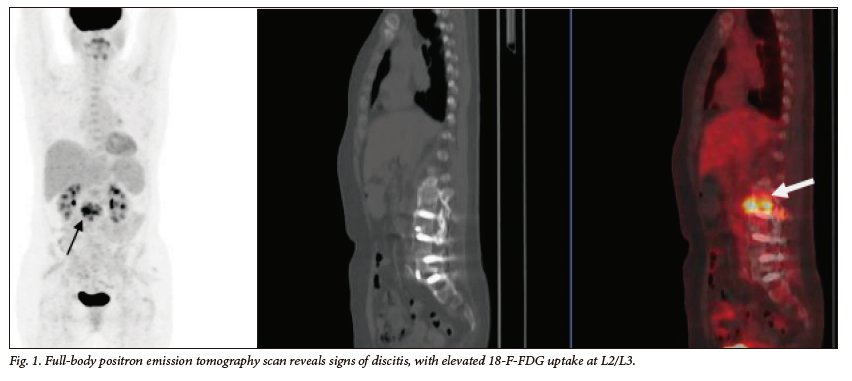
A further sepsis workup was then performed. A full body positron emission tomography scan (Fig. 1) showed features suggestive of a discitis, with increased 18-F-fluorodeoxyglucose uptake at level L2/L3, which was above the levels of the previous surgery. There were no signs of infection or loosening of the existing hardware.
As part of the workup and to identify any possible aetiology, blood cultures, an echocardiogram and abdominal sonar were also done. However, all of these were normal and there was no growth on blood cultures.
The patient was taken to theatre for a discectomy and biopsy of the L2/L3 disc space. Several tissue samples were sent to the lab for processing. After 5 days, a positive culture of G. morbillorum on disc material was isolated and found to be sensitive to beta-lactams and vancomycin.
The patient was treated with 1-week intravenous infusion Augmentin. The CRP came down to 11 mg/L, and the ESR down to 29 mm/hr. She was then discharged on oral Augmentin for a period of 5 weeks. The blood markers were both within normal limits after this time, and the patient no longer had any back or leg pain.
Ethical approval for this case study to be used was granted by the University of Pretoria (ref. no. 62/2024).
Discussion
G. morbillorum is a Gram-positive, catalase-negative anaerobic coccus that is part of a spectrum of the Gimella species. It can be found as part of normal flora in mucous membranes, such as the gastrointestinal (GI) tract, the upper respiratory tract and the oral cavity.[5] Although infection with G. morbillorum is rare, there has been an association with infective endocarditis, brain abscesses, liver abscesses and pharyngeal abscesses.[5-7]
In a recent review of osteoarticular infection caused by G. morbillorum by Saad et al.,[4] the authors reported only six confirmed G. morbillorum spondylodiscitis cases, and to our knowledge this is the first reported case in SA.
Infections with G. morbillorum have been identified in all age groups.[8] In most cases of G. morbillorum infection, there seem to be underlying risk factors that predispose to the infection, and since the species exists in normal flora, the most common risk factors are recent dental procedures/infections, poor oral health, recent endoscopic or colonoscopic examinations, host immune suppression and recent blunt trauma.[4,9] Although in some cases there can be no underlying factor, or none that can be identified,[4] our patient reported that she did have toothache and had visited her dentist around the same time as the onset of the pain. This was consistent with Saad et al.'s[4] finding that two of the six cases reported dental infections, and that in contrast to arthritis, a possible source was identified in 75% of spondylodiscitis cases.[4]
Several predisposing factors can increase the risk of developing spondylodiscitis. These include diabetes mellitus, which is the most commonly identified risk factor;[10] immunosuppression, encompassing individuals with compromised immune systems such as those with HIV/AIDS;[11,12] and other factors such as advanced age, intravenous drug use, smoking and hepatic cirrhosis.[13,14] The patient in this study, however, had no identifiable predisposing factors for spondylodiscitis.
As part of the initial management, an assessment of a potential source is advised, together with a focused workup that could include an echocardiogram or gastroscopy or colonoscopy for GI sources.[4] Blood cultures are also recommended, and can be positive in up to 50% of cases. However, this was not the case in our patient.[4] Laboratory investigations such as a white blood cell count, CRP and ESR levels can help in the initial work and follow-up to assess treatment progression.[9] Tissue diagnosis of the disc material after a biopsy or discectomy for culture is the most appropriate method to identify the species.[9]
Treatment for G. morbillorum is focused on appropriate antibiotic use, with or without surgery.[3] The species is generally susceptible to a range of antimicrobial agents, including penicillin, ampicillin, clindamycin and vancomycin, and resistance is very rare.[5] The antibiotic treatment should, however, be culture driven, and the recommended guideline is 6 weeks of antibiotics, which can be extended in patients with poor immune status.[5]
Surgery is focused on source control, and a tissue biopsy can be done at the same time.[5] Absolute indications for surgery are patients with progressive neurological deficits due to spinal cord compression, while relative indications include failed conservative management, ongoing significant pain or biomechanical instability.[3] If none of these symptoms is present, antibiotic treatment alone is generally appropriate.
Patients treated with appropriate culture-based antibiotics and surgery, if necessary, have complete recovery and are back to functional status within 6 weeks to a few months.[4]
In a systemic review article published by Herren et al.,[15] the consensus regarding spondylodiscitis was that antibiotic therapy should only be initiated once the pathogen has been identified, and that surgical treatment is reserved for patients with neurological deficits, sepsis, and intraspinal or paravertebral abscess with significant chord compressions. The guidelines on antibiotic treatment by the Infectious Disease Society of America (IDSA) are useful in determining the first-line and alternative treatment for specific identifiable pathogens.[15]
Risk factors for infections caused by G. morbillorum include recent dental procedures/infections, poor oral health, recent endoscopic or colonoscopic examinations, host immune suppression and recent blunt trauma. Given these risk factors, one might consider that prophylactic antibiotic use during minor dental procedures/infections or other minor procedures such us endoscopic/colonoscopic examinations could potentially reduce the risk of G. morbillorum infections.[16]
For patients at high risk for infective endocarditis or those who are immunocompromised, prophylactic antibiotics are recommended to prevent infections. This includes antibiotics effective against oral flora, including G. morbillorum. For patients at lower risk, routine prophylaxis is not generally recommended, but specific cases might warrant it based on individual risk factors.[16]
Therefore, evaluating individual risk factors and consulting current guidelines are essential steps for determining the need for prophylaxis to prevent infections by G. morbillorum and other pathogens.
Conclusion
In conclusion, we reported a rare case of G. morbillorum spondylodiscitis in SA. It is important to have a high index of suspicion when a patient has a history of dental work, and to rule out associated infection such as endocarditis. Treatment with culture-driven antibiotics yields good results.
Data availability. N/a.
Declaration. None.
Acknowledgements. None.
Author contributions. Equal contributions.
Funding. None.
Conflicts of interest. None.
References
-
1. Cheung WY, Luk KD. Pyogenic spondylitis. Int Orthop 2012;36(2):397-404. https://doi.org/10.1007/s00264-011-1384-6
» https://doi.org/10.1007/s00264-011-1384-6 -
2. Skaf GS, Domloj NT, Fehlings MG, et al. Pyogenic spondylodiscitis: An overview. J Infect Public Health 2010;3(1):5-16. https://doi.org/10.1016/j.jiph.2010.01.001
» https://doi.org/10.1016/j.jiph.2010.01.001 -
3. Sono T, Takemoto M, Shinohara K, Tsuchido Y. An uncommon case ofpyogenic spondylodiscitis caused by Gemella morbillorum. Case Rep Orthop 2018;2018:3127613. https://doi.org/10.1155/2018/3127613
» https://doi.org/10.1155/2018/3127613 -
4. Saad E, Faris ME, Abdalla MS, Prasai P, Ali E, Stake J. A rare pathogen of bones and joints: A systematic review of osteoarticular infections caused by Gemella morbillorum. J Clin Med Res 2023;15(4):187-199. https://doi.org/10.14740/jocmr4891
» https://doi.org/10.14740/jocmr4891 -
5. Selçuk N, Esma C, Ahmet Rıza Ş, Selma A. Evaluation of cases with Gemella infection: Cross-sectional study. J Infect Dis Epidemiol 2018;4(4):063 https://doi.org/10.23937/2474-3658/1510063
» https://doi.org/10.23937/2474-3658/1510063 -
6. Benedetti P, Rassu M, Branscombe M, Sefton A, Pellizzer G. Gemella morbillorum: An underestimated aetiology of central nervous system infection? J Med Microbiol 2009;58(Pt 12):1652-1656. https://doi.org/10.1099/jmm.0.013367-0
» https://doi.org/10.1099/jmm.0.013367-0 -
7. Hsu CY, Su YC, Wang TL, Chong CF, Chen CC. Gemella morbillorum liver abscess. Scand J Infect Dis 2007;39(6-7):637-638. https://doi.org/10.1080/00365540601169737
» https://doi.org/10.1080/00365540601169737 -
8. Pardo-Pol A, Perez-Prieto D, Alier A, et al. Acute hematogenous periprosthetic hip infection by Gemella morbillorum, successfully treated with debridement, antibiotics and implant retention: A case report and literature review of osteoarticular Gemella morbillorum infections. Trop Med Infect Dis 2022;7(8):191 https://doi.org/10.3390/tropicalmed7080191
» //doi.org/10.3390/tropicalmed7080191 - 9. Withanage ND, Athiththan LV, Perera S, Pathirage S, Peiris H. Isolation of Gemella morbillorum in herniated intervertebral disc tissue in a lumbar discectomy patient: A case report. J Biosciences Med 2017;05(03):99-104. https://doi.org/10.4236/jbm.2017.53010
-
10. Krogsgaard MR, Wagn P, Bengtsson J. Epidemiology of acute vertebral osteomyelitis in Denmark: 137 cases in Denmark 1978-1982, compared to cases reported to the National Patient Register 1991 - 1993. Acta Orthop Scand 1998;69(5):513-517. https://doi.org/10.3109/17453679808997789
» https://doi.org/10.3109/17453679808997789 -
11. Rezai AR, Woo HH, Errico TJ, Cooper PR. Contemporary management of spinal osteomyelitis. Neurosurgery 1999;44(5):1018-1025. https://doi.org/10.1097/00006123-199905000-00047
» https://doi.org/10.1097/00006123-199905000-00047 -
12. Weinstein MA, Eismont FJ. Infections of the spine in patients with human immunodeficiency virus. J Bone Joint Surg Am 2005;87(3):604-609. https://doi.org/10.2106/jbjs.c01062
» https://doi.org/10.2106/jbjs.c01062 -
13. Friedman JA, Maher CO, Quast LM, McClelland RL, Ebersold MJ. Spontaneous disc space infections in adults. Surg Neurol 2002;57(2):81-86. https://doi.org/10.1016/S0090-3019(01)00681-4
» https://doi.org/10.1016/S0090-3019(01)00681-4 -
14. Lee JH, Kim J, Kim TH. Clinical outcomes in older patients aged over 75 years who underwent early surgical treatment for pyogenic vertebral osteomyelitis. J Clin Med 2021;10(22):5451. https://doi.org/10.3390/jcm10225451
» https://doi.org/10.3390/jcm10225451 -
15. Herren C, Jung N, Pishnamaz M, Breuninger M, Siewe J, Sobottke R. Spondylodiscitis: Diagnosis and treatment options. Dtsch Arztebl Int 2017;114(51-52):875-882. https://doi.org/10.3238/arztebl.2017.0875
» https://doi.org/10.3238/arztebl.2017.0875 -
16. Gouliouris T, Aliyu SH, Brown NM. Spondylodiscitis: Update on diagnosis and management. J Antimicrob Chemother 2010;65(Suppl 3):iii11-24. https://doi.org/10.1093/jac/dkq303
» https://doi.org/10.1093/jac/dkq303

Accepted 11 September 2024