The health of mine(r)s
J P de V van Niekerk
Managing Editor.
South Africa is a developing country reliant on selling resources. Its financial health and the health of its citizens are massively dependent on and influenced by its mines. The importance of the mining industry can be gauged from a look at some figures - for example, in 2009 the South African mining industry had over 1 000 mines and 483 212 employees; 168 888 were in platinum, 148 832 in gold, 68 006 in coal, and the rest in other commodities.1
Before Marikana
'A general strike it was ... The anger of the men rose against the "scabs". They beat them up, burnt their belongings and made life hell for their families until even the non-union men who wanted only to keep their jobs were terrified.' Was this the run-up to Marikana? No - this quote describes the general strike of 1913!2
An initially much better organised mining strike in 1922 led to the trade unions losing control to the Council of Action and the Communist Party, who wanted a revolt against the government. Hundreds of skirmishes took place in what had become a civil war. Over 200 lives were lost.2
Marikana and its historical predecessors had complex and differing reasons for their occurrence. In 1913 a significant factor was the threat to jobs by imported Chinese miners. However, a common denominator was the drop in prices of commodities and the need for marginal mines to make tough calls on job losses and remuneration.
Miners' health
From the start of the South African goldmining boom the health of the miners has been an important issue. In the early 1900s the death rate from pneumonia among recruits from the tropical regions was 26.3 per thousand and from the sub-tropical areas 8 per thousand.3
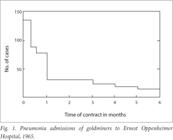
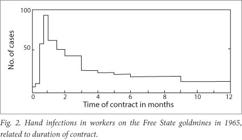
In the 1960s I worked at Ernest Oppenheimer Hospital, Welkom, which serviced the six Anglo American goldmines in the region. The rate of admissions for pneumonia was 26 per thousand workers annually (JPdeV van Niekerk - 'Lobar pneumonia', Ernest Oppenheimer Hospital internal communication, 1965). The rate was highest in the first month of workers' contracts (Fig. 1) and during the colder months, and miners from the 'tropics', comprising 47% of the total complement of African miners at the time, were more than twice as likely to develop pneumonia. Another major cause of disability was hand infections,4Fig. 2) and were largely related to the physical effort required.
Wyndham and colleagues, in their study on black miners living in hostels, also found that pneumonia was more prevalent seasonally and was related to fluctuations in recruitment to the mines.5
Spreading disease
Today, apart from general health issues including trauma and silicosis, the key diseases on the mines that are of critical importance to South Africa are HIV/AIDS and tuberculosis (TB).
TB incidence rates in the South African goldmines have historically been three times higher than the national average.11
The mining industry has reasonably good TB programmes in place.188
Trauma
Although the mining industry aims at zero occupational deaths, the very nature of the deep mines in particular makes it inevitable that injuries and deaths will occur. Miners work in cramped spaces under extreme environmental conditions and surrounded by powerful machines and other equipment. Despite sufficient safety precautions there is the ever-present possibility of major rock falls. The likelihood of injury or death must be considerably increased by the migratory labour system. Novice motor vehicle drivers are much more likely to have accidents than expeienced ones, and in medicine it is well known that the first hundred procedures done by a doctor have many more complications than the succeeding hundred - we can extrapolate the same principle to workers on the mines.9
With this understanding, the rationale of closing down these massive industrial operations to investigate mining accident deaths seems to be the equivalent of closing down all traffic in a major city to investigate a traffic accident fatality.
The problems and solutions in a nutshell
The Marikana massacre and subsequent events have forced South Africans to take an urgent look at ourselves. Firstly, the gap between the rich and the poor has the potential for fomenting increasing unrest. Secondly, policy and political uncertainties have recently led to the credit downgrading of South Africa by Moody's and
Standard and Poor's, a view echoed by International Monetary Fund reports.10

References
-
1. Review of the tuberculosis programme in the gold-producing mining companies registered with the Chamber of Mines of South Africa. 2012 Report prepared for the Chamber of Mines of South Africa. http://www.bullion.org.za/documents/Final%20TB%20Program%20in%20Gold%20Mines%20Review%20Report%20July%202012%20Aggregated%20amended.docx (accessed 27 November 2011).
» http://www.bullion.org.za/documents/Final%20TB%20Program%20in%20Gold%20Mines%20Review%20Report%20July%202012%20Aggregated%20amended.docx - 2. Cartwright AP. The Gold Miners. Cape Town: Purnell & Sons, 1962.
- 3. Cartwright AP. Golden Age. Cape Town: Purnell & Sons, 1968.
- 4. Van Niekerk JP de V. Pyogenic infections of the hand: An industrial and clinical investigation in the African miner. MD thesis, University of Cape Town, 1966.
- 5. Wyndham CH, Gonin R, Reid RDW. Seasonal variation in acute respiratory diseases and meningitis in black miners living in hostels. S Afr Med J 1978;54:353-358.
- 6. Diamond J. Guns, Germs, and Steel: The Fate of Human Societies. London: WW Norton & Co., 1997.
- 7. Phillips H. Plague, Pox and Pandemics: A Jacana Pocket History of Epidemics in South Africa. Jacana, 2012.
-
8. Financial Mail. Mine strikes worsen TB infections. http://www.fm.co.za/economy/local/2012/10/29/mine-strikes-worsen-tb-infections (accessed 15 November 2012).
» http://www.fm.co.za/economy/local/2012/10/29/mine-strikes-worsen-tb-infections - 9. Chokotho LC, Matzopoulos R, Myers JE. Drivers' risk profile indicates the need for a graduated driving license in South Africa. S Afr Med J 2012;102:749-751.
-
10. International Monetary Fund. Distress in Europe slows down South Africa's economic recovery. http://www.imf.org/external/pubs/ft/survey/so/2012/car090612a.htm (accessed 15 November 2012).
» http://www.imf.org/external/pubs/ft/survey/so/2012/car090612a.htm