Surgery in South Africa - the attitudes toward mentorship in facilitating general surgical training
Abstract
BACKGROUND: There are many barriers to pursuing a surgical career in South Africa, some of which are unique to females. Mentorship has been proposed as a solution to mitigate these barriers. The value of mentorship has not been formally assessed among South African general surgeons and traineesMETHODS: The study was part of a larger study designed to assess barriers to pursuing a career in surgery, including the value of mentorship. A 15-item questionnaire was designed and distributed via the Research Electronic Database Capture from 1 February 2020-3 April 2020. Data were analysed using Stata 15 SE. All responses were anonymisedRESULTS: One hundred and twenty-nine (13.5%) of 955 potential participants responded to the survey of which 26% (33/129) were female. Sixty-seven per cent of respondents were specialist surgeons (87/129). Seventy per cent (90/129) of participants reported having a role model in surgery, however, 66% (86/129) reported they had no mentor in surgery. 107/129 (83%) participants reported the importance of mentorship. The need for a formalised mentorship programme to facilitate surgical training was recorded by 60% (78/129) of participants, while 18% (23/129) reported the need for a mentorship group specifically for femalesCONCLUSION: Eighty-three per cent of participants reported the importance of mentorship however two-thirds lacked a mentor. Most participants advocated for a mentorship group to facilitate surgical training. Establishing formalised mentorship programmes could mitigate the barriers to pursuing a surgical career
surgery; training; barriers; mentorship
Introduction
Surgery is a highly competitive specialty and a particularly challenging learning environment.11,2 Challenges in the surgical workplace have led to burnout, physical and emotional exhaustion, and even attrition of surgeons. Some of these challenges are unique to female surgeons, such as limited time to plan a family and gender discrimination in the workplace.345,6
Mentorship has been gaining traction in the field of surgery and can be an important way to mitigate challenges
of and barriers to pursuing a surgical career. Mentorship has been defined as a "two-way relationship and type of human development in which one individual invests personal knowledge, energy and time in order to help another individual grow and develop and improve to become the best and most successful they can be."789
While evaluation of mentorship in surgery has been increasingly reported in the literature from high-income countries, such as the United States, there is a paucity of literature on the value or perceptions of mentorship in low-and middle-income settings, such as South Africa.1,9
The primary objective of this survey was to determine the value of mentorship among South African general surgeons. The secondary objectives of this study were to determine the proportion of participants that felt a formalised mentorship programme for surgical trainees in general and women in particular was needed.
Methods
This was a cross-sectional survey conducted using a 15-item questionnaire (Appendix 1) which was designed and distributed via the Research Electronic Database Capture (REDCap) software (version 8.1.13, Vanderbilt University). The survey was developed by both authors, the senior author being a surgical sub-specialist, and included questions on challenges and barriers to pursuing a career in surgery, as well as the attitudes and perceptions of mentorship in facilitating surgical training. These questions were adapted from previously published studies.1-3,9 Questions on the value of mentorship were single-answer choice questions except for the question on methods to facilitate surgical training, where participants were allowed to select multiple answers. The questions on the value of mentorship were analysed using Stata 15 SE. The survey was circulated to qualified general surgeons who are members of the Association of Surgeons South Africa (ASSA) or Surgicom, as well as to general surgical trainees through their heads of department. The survey was conducted over a two-month period from 1 February 2020 to 3 April 2020. All responses were anonymous, and no identifying data were included. Descriptive analysis of the data was performed using measures of dispersion (means and median).
Results
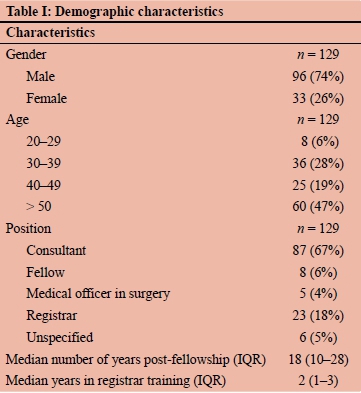
One hundred and twenty-nine (13.5%) out of 955 general surgeons and trainees approached to participate, responded to the survey. Seventy-four per cent (96/129) were male and 47% (60/129) were older than 50 years of age (Table I). Sixty-seven per cent (87/129) of participants were consultant surgeons with a median of 18 years (IQR 10-28) post-fellowship experience. Twenty-three (18%) of the participants were registrars in surgical training and the median number of years in training was two years (IQR 1-3).
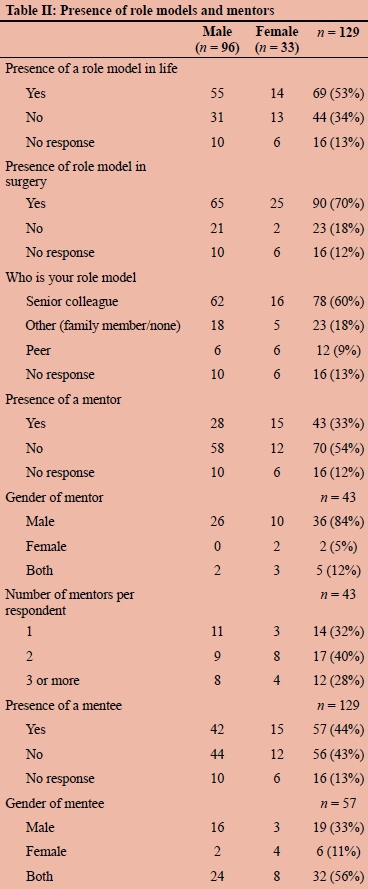
Fifty-three per cent of participants (69/129) reported having a role model in their lives and 70% (90/129) reported the presence of a role model in surgery (Table II). This role model in surgery was a senior colleague in 60% (78/129) of cases.
Fifty-four per cent (70/129) did not have a mentor; of these 61% (43/70) felt they lacked mentorship and would have liked to have had a mentor for their career development. Eighty-four per cent (36/43) of the mentees had a male mentor and 68% (29/43) had two or more mentors. Forty-four per cent (57/129) reported having a mentee with 56% (32/57) having both male and female mentees.
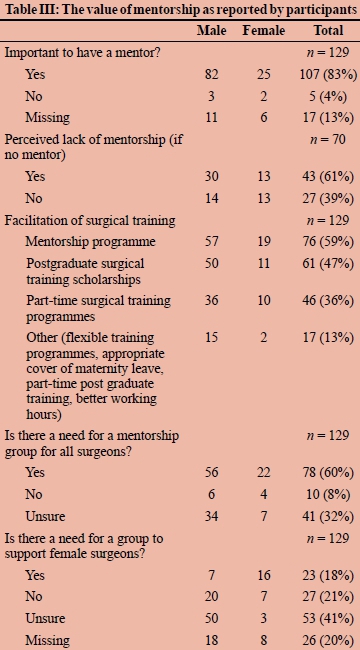
Eighty-three per cent of the participants (107/129) reported that they felt it was important to have a mentor (Table III).
The need for a formal mentorship group for all surgeons was recommended by 60% (78/129) of the participants, whereas 18% (23/129) reported the need for a group to specifically support female surgeons; 16 out of the 23 (70%) respondents were female.
Discussion
Our survey shows that South African general surgeons and trainees perceive the need for mentorship in surgery. Eighty-three per cent of participants regarded the presence of a mentor as important, yet two-thirds did not have a mentor in surgery. Sixty per cent of participants reported that a mentorship programme would facilitate surgical training and a similar amount further reported the need for a formalised mentorship group for all surgeons.
Mentors can play a role in aiding retention of surgeons and increasing career satisfaction by creating a supportive environment that cultivates learning, advice on how to mitigate stress and decrease barriers to pursuing surgical careers, particularly for female doctors.101188,12 Formalised mentorship programmes are becoming increasingly important globally for their ability to address mentor time constraints, increase confidence and interest in surgical careers among medical students,13 11149
Numerous organisations, including the College of Surgeons of East, Central, and Southern Africa, have established formalised mentorship groups specifically for female surgeons in all specialties.1515,16 A 2017 study reported that same-sex mentorship was preferred among females and could positively influence career choice and address barriers to pursuing surgery, advocating for the development of national mentorship programmes in the United States.17
Nearly two-thirds of participants in the current study reported the need for a mentorship group for all surgeons and 70% of female respondents reported the need for a dedicated group to support female surgeons. Despite this, there is no published data as to whether South African academic institutions have formal mentorship programmes in general or for females specifically and if they are effective. Even in institutions that have established these programmes, there is no data on their effectiveness. We believe it should be a priority to establish formalised mentorship programmes in surgical training programmes whilst at the same time devising metrics to assess their value.
It is recognised that there are several inherent limitations and challenges associated with surveys. There was a relatively low response rate, and the study sample was not representative of all regions and academic institutions in South Africa despite constant communication and reminders to encourage survey completion. Being embedded in a larger questionnaire meant that for simplicity of completion mostly single-answer responses were used. As a result, we were unable to do a more qualitative assessment of some responses; for example, reasons why respondents felt it is important to have a mentor or what aspects the respondents felt they lacked in their training that could be improved by being mentored.
Conclusion
Despite these limitations, over 80% of the South African general surgeons and surgical trainees who participated in the study valued mentorship and 60% felt there was a need for a formal mentorship programme to facilitate surgical training.
Conflict of interest
The authors declare no conflict of interest.
Funding source
No funding was required.
Disclaimer
This survey was initiated by and conducted under the auspices of the Association of Surgeons of South Africa (ASSA).
Ethical approval
Ethical approval for this study was obtained from the University of KwaZulu-Natal Biomedical Research Ethics Committee (protocol number: BREC/00002259/2020).
ORCID
P Naidu https://orcid.org/0000-0002-1112-9606
I Buccimazza https://orcid.org/0000-0002-5399-3101
REFERENCES
- 1. Mahoney ST, Strassle PD, Schroen AT, et al. Survey of the US surgeon workforce - practice characteristics, job satisfaction, and reasons for leaving surgery. J Am Coll Surg. 2020;230(3):283-93.e1.
- 2. Hu Y-Y, Ellis RJ, Hewitt DB, et al. Discrimination, abuse, harassment, and burnout in surgical residency training. N Engl J Med. 2019;381(18):1741-52.
- 3. Roodt L. Female general surgeons - current status, perceptions and challenges in South Africa. A pilot study at a single academic complex. University of Cape Town; 2016.
- 4. Boffard K. SA trauma expert to head world body. S Afr Med J. 2010;100:144-5.
- 5. Cochran A, Elder WB, Crandall M, et al. Barriers to advancement in academic surgery - views of senior residents and early career faculty. Am J Surg. 2013;206(5):661-6.
- 6. Cochran A, Hauschild T, Elder WB, et al. Perceived gender-based barriers to careers in academic surgery. Am J Surg. 2013;206(2):263-8.
- 7. Flaherty J. Coaching - evoking excellence in others. 2nd ed. Development and Learning in Organizations. Taylor & Francis Ltd; 2006.
- 8. Entezami P, Franzblau LE, Chung KC. Mentorship in surgical training - a systematic review. Hand. 2012;7(1):30-6.
- 9. Kibbe MR, Pellegrini CA, Townsend CM, Helenowski IB, Patti MG. Characterisation of mentorship programmes in departments of surgery in the United States. JAMA Surg. 2016;151(10):900-6.
- 10. Welch JL, Jimenez HL, Walthall J, Allen SE. The women in emergency medicine mentoring programme - an innovative approach to mentoring. J Grad Med Educ. 2012;4(3):362.
- 11. Flint JH, Jahangir AA, Browner BD, Mehta S. The value of mentorship in orthopaedic surgery resident education - the residents' perspective. JBJS. 2009;91(4):1017-22.
- 12. Holt GR. Idealised mentoring and role modeling in facial plastic and reconstructive surgery training. Arch Facial Plast Surg. 2008;10(6):421-6.
- 13. Drolet BC, Sangisetty S, Mulvaney PM, Ryder BA, Cioffi WG. A mentorship-based preclinical elective increases exposure, confidence, and interest in surgery. Am J Surg. 2014;207(2):179-86.
- 14. Sinclair P, Fitzgerald J, Hornby S, Shalhoub J. Mentorship in surgical training - current status and a needs assessment for future mentoring programmes in surgery. World J Surg. 2015;39(2):303-13.
- 15. McCarthy MC. The Association of Women Surgeons - a historical perspective 1981 to 1992. Arch Surg. 1993;128(6):633-6.
- 16. Odera A, Tierney S, Mangaoang D, Mugwe R, Sanfey H. Women in surgery Africa and research. Lancet. 2019;393(10186):2120.
- 17. Faucett EA, McCrary HC, Milinic T, et al. The role of same-sex mentorship and organisational support in encouraging women to pursue surgery. Am J Surg. 2017;214(4):640-4.