Use of the OVESCO OTSC® Proctology Clip for closure of fistula-in-ano at Wits Donald Gordon Medical Centre - a single centre experience
Abstract
BACKGROUND: Definitive closure of fistula-in-ano poses an ongoing surgical challenge. The OVESCO OTSC® Proctology Clip (proctology clip) purports to offer improved preservation of the anal sphincter whilst at the same time curing the fistula by closureMETHODS: A retrospective record review was conducted for patients who received the proctology clip as part of the management of fistula-in-ano in the Colorectal Unit at Wits Donald Gordon Medical Centre (WDGMCRESULTS: There were 19 cases of fistula-in-ano treated with the proctology clip. All were cryptoglandular in origin. The median age was 50 years (IQR 44-56 years) and post-procedure, the median follow-up duration was 145 days (IQR 63-298 days). Overall, 9 procedures were successful (47%). Success rates were higher for simple (66.7%) as opposed to complex (38.5%) fistula-in-ano. For patients who underwent placement of the proctology clip as a primary procedure, the success rate (50%) was slightly better than those who received the clip as a secondary procedure (44.4%CONCLUSION: This preliminary data presents our initial experience using the proctology clip. While these data may serve as a "proof of concept", a multi-centre controlled trial comparing this method to the rectal mucosal advancement flap (RMAF) is needed to determine the role of the proctology clip in the management of fistula-in-ano
anal fistula; OVESCO OTSC® Proctology Clip
Introduction
Definitive closure of fistula-in-ano poses an on-going surgical challenge. The goal of fistula management is permanent closure of the fistula while simultaneously preserving anal sphincter function.1234
Other sphincter preserving techniques have been described which promise lower complication rates but are associated with varying degrees of success. Examples include fistulotomy with primary sphincter reconstruction,56786TM).9
Fistulotomy with primary sphincter reconstruction has a reported recurrence rate of 8.6% with minor incontinence noted in 16.6% of patients.51011 12 TM with no reported cases of incontinence.9
A new surgical method for closure of fistula-in-ano is the OVESCO OTSC® Proctology Clip (proctology clip) which purports to offer improved preservation of the anal sphincter whilst at the same time curing the fistula by closure. The clip is nitinol-based and dynamic, allowing constant pressure to be maintained on the internal fistula orifice during the healing process.1314-18 This preliminary report aims to describe our experience, as a specialist referral Colorectal Unit, using the proctology clip for the primary and secondary management of simple and complex fistula-in-ano.
Methods
A retrospective record review was conducted for all patients who received the proctology clip as part of management of fistula-in-ano in the Colorectal Unit at Wits Donald Gordon Medical Centre (WDGMC) between 1 April 2016 and 31 May 2018. Records from patients older than 18 years with simple or complex fistula of cryptoglandular aetiology and who were treated with the proctology clip as a primary or secondary procedure where included. Records from patients with malignant, traumatic, iatrogenic, Crohn's fistulae or rectovaginal fistulae and records from patients with active perianal sepsis were excluded.
Simple fistulae are intersphincteric or low transphincteric (involving less than 30% of the sphincter muscle complex). Complex fistulae include (i) high transphincteric (involving more than 30% of the sphincter complex); (ii) extrasphincteric; (iii) suprasphincteric (iv) those presenting anteriorly in female patients; (v) those associated with inflammatory bowel disease, malignancy or radiotherapy.2
Management of all simple and complex fistula-in-ano included in this record review started with an initial drainage procedure (insertion of a seton suture) to allow sepsis to settle. The first definitive procedure was termed the 'primary' procedure and the next procedure was termed the 'secondary' procedure. All procedures were performed by trained colorectal surgeons who had further training on the use of the proctology clip by Professor Thomas Gottwald, who designed it.
For the procedure no bowel preparation was administered. Prophylactic antibiotics were given either intravenously or per rectum, depending on the individual surgeon's preference.
General anaesthesia was used. The patient was then placed in the lithotomy position. The external fistula orifice was then opened to assist with drainage. The internal fistula opening was identified via the seton suture and the fistula brush was then 'railroaded' through the tract to allow vigorous brushing of the tract. A disc of mucosa was then excised from the internal opening exposing the sphincter muscle surrounding the internal opening. Two vicryl stay sutures were then inserted through the sphincter muscle, one proximal and one distal to the internal fistula orifice. The OVESCO OTSC® Proctology Clip, using the deployment device, was then 'railroaded' over the stay sutures onto the mucosa; the clip was then deployed. As the clip was deployed tension was applied to the stay sutures, ensuring the internal opening was securely included within the clip's grasp. The stay sutures were then removed. Postoperatively the patient was sent back to the ward and usually discharged the same day on analgesia and stool softeners.
Success was determined by the attending surgeon based on their evaluation and expertise, and included closure of both the internal and external fistula orifices with no inflammation or signs of drainage from the fistula. Similarly, the attending surgeon defined failure as the presence of persistent pain, drainage, and/or failure of the internal and/ or external fistula orifices to close. After placement of the proctology clip, patients were followed for 3 to 4 weeks, and as needed thereafter. There was no standardised long term follow-up protocol. Descriptive statistics were performed using Microsoft Excel 2010.
Results
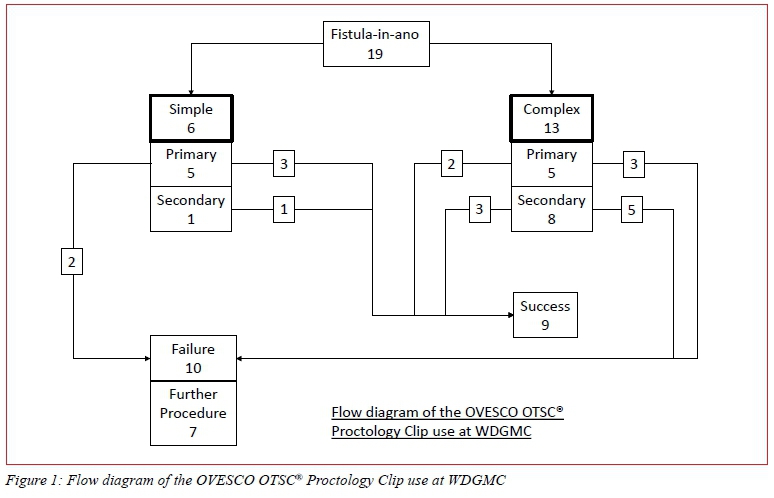
There were 19 cases of fistula-in-ano treated with the proctology clip at WDGMC during the review period (Figure 1). The median age of those presenting for care was 50 years (interquartile range (IQR) 44-56 years) and the median follow-up duration was 145 days (IQR 63-298 days). All 19 cases were cryptoglandular in origin. Thirteen were complex fistula-in-ano and 10 were primary procedures.
Nine of the nineteen procedures were successful (47%). As expected, overall success rates were higher for simple (66.7%) as opposed to complex (38.5%) fistula-in-ano. For patients who underwent placement of the proctology clip as a primary procedure, the success rate (50%) was slightly better than those who received the clip as a secondary procedure - four out of nine (44.4%). Eight patients underwent a secondary procedure after the initial clip insertion. Of these, 7 had clip failure and 1 patient had an examination under anaesthesia during which an anal fissure was identified and treated, and the clip was successfully left in-situ. For the 7 patients who had failed the clip, 6 underwent seton insertion after which 2 patients had an anal fistula plug inserted and 1 patient underwent resection of the fistula tract. The seventh patient initially had a small pencil drain inserted after which a seton was inserted.
Of the remaining three patients with clip failure, two were planned for reintervention but this had not occurred during the time period of the study and one patient with clip failure declined another procedure.
Discussion
Despite surgical advances, fistula-in-ano remains a difficult condition to manage and there is no consensus regarding the optimal surgical treatment. To our knowledge, this is the first report from South Africa on the use of the proctology clip for management of fistula-in-ano. Our overall success rate of 47% was lower than the average success rate reported from other published data of 61%.14,16-18 A small number of studies have reported success rates of up to 90%, however the patients in these studies were all highly selected, with fistulae of cryptoglandular aetiology.13,19 One study reported a success rate of only 18% but the cases in that study were complex and unfavourable.153
Conclusion
This preliminary data presents our initial experience using the proctology clip in a South African centre. While these data may serve as a 'proof of concept', a multi-centre randomised controlled trial comparing this method to the RMAF is needed to determine the role for the proctology clip in the management of fistula-in-ano in terms of fistula origin, complexity and its use for both primary and secondary fistula closure.
Funding source
No sources of funding were received for this study.
Disclosures
There are no financial disclosures for any of the authors.
Ethical approval
Approval for this study was obtained from the Human Research Ethics Committee (Medical), University of Witwatersrand (M180609).
ORCID
SJGrossberg https://orcid.org/0000-0002-2648-8783
REFERENCES
-
1. Williams G, Williams A, Tozer P, et al. The treatment of anal fistula: second ACPGBI Position Statement - 2018. Color Dis. 2018;20:5-31. https://doi.org/10.1111/j.1463-1318.2007.01372.x.
» https://doi.org/10.1111/j.1463-1318.2007.01372.x -
2. Vogel JD, Johnson EK, Morris AM, et al. Clinical practice guideline for the management of anorectal abscess, fistula-in-ano, and rectovaginal fistula. Dis Colon Rectum. 2016;59(12):1117-33. https://doi.org/10.1097/DCR.0000000000000733.
» https://doi.org/10.1097/DCR.0000000000000733 -
3. Dubois A, Carrier G, Pereira B, et al. Therapeutic management of complex anal fistulas by installing a nitinol closure clip: Study protocol of a multicentric randomised controlled trial - FISCLOSE. BMJ Open. 2015;5(12):1-6. https://doi.org/10.1136/bmjopen-2015-009884.
» https://doi.org/10.1136/bmjopen-2015-009884 -
4. Balciscueta Z, Uribe N, Balciscueta I, Andreu-Ballester JC, García-Granero E. Rectal advancement flap for the treatment of complex cryptoglandular anal fistulas: a systematic review and meta-analysis. Int J Colorectal Dis. 2017;32(5):599-609. https://doi.org/10.1007/s00384-017-2779-7.
» https://doi.org/10.1007/s00384-017-2779-7 -
5. Arroyo A, Pérez-Legaz J, Moya P, et al. Fistulotomy and sphincter reconstruction in the treatment of complex fistula-in-ano: Long-term clinical and manometric results. Ann Surg. 2012;255(5):9359. https://doi.org/10.1097/SLA.0b013e31824e9112.
» https://doi.org/10.1097/SLA.0b013e31824e9112 -
6. Limura E, Giordano P. Modern management of anal fistula. World J Gastroenterol. 2015;21(1):12-20. https://doi.org/10.3748/wjg.v21.i1.12.
» https://doi.org/10.3748/wjg.v21.i1.12 -
7. Van Koperen PJ, Bemelman WA, Bossuyt PMM, et al. The anal fistula plug versus the mucosal advancement flap for the treatment of anorectal fistula ( PLUG trial ). BMC Surg. 2008;5:1-5. https://doi.org/10.1186/1471-2482-8-11.
» https://doi.org/10.1186/1471-2482-8-11 -
8. Anaraki F, Bagherzade G, Behboo R, Etemad O. Long-term results of ligation of intersphincteric fistula tract (LIFT) for management of anal fistula. J Coloproctology. 2016;36(4):227-30. https://doi.org/10.1016/jjcol.2016.04.012.
» https://doi.org/10.1016/jjcol.2016.04.012 -
9. Giamundo P, Esercizio L, Geraci M, Tibaldi L, Valente M. Fistula-tract Laser Closure (FiLaCTM): long-term results and new operative strategies. Tech Coloproctol. 2015;19(8):449-53. https://doi.org/10.1007/s10151-015-1282-9.
» https://doi.org/10.1007/s10151-015-1282-9 -
10. Hong KD, Kang S, Kalaskar S, Wexner SD. Ligation of intersphincteric fistula tract (LIFT) to treat anal fistula: Systematic review and meta-analysis. Tech Coloproctol. 2014;18(8):685-91. https://doi.org/10.1007/s10151-014-1183-3.
» https://doi.org/10.1007/s10151-014-1183-3 -
11. Garg P, Singh P. Video-Assisted Anal Fistula Treatment (VAAFT) in Cryptoglandular fistula-in-ano : A systematic review and proportional meta-analysis. Int J Surg. 2017;46:85-91. https://doi.org/10.1016/j.ijsu.2017.08.582.
» https://doi.org/10.1016/j.ijsu.2017.08.582 -
12. Köckerling F, Alam NN, Narang SK, Daniels IR, Smart NJ. Treatment of fistula-in-ano with fistula plug - a review under special consideration of the technique. Front Surg. 2015 Oct 16;2:55. https://doi.org/10.3389/fsurg.2015.00055.
» https://doi.org/10.3389/fsurg.2015.00055 -
13. Prosst RL, Ehni W, Joos AK. The OTSC® Proctology clip system for anal fistula closure: First prospective clinical data. Minim Invasive Ther Allied Technol. 2013;22(5):255-9. https://doi.org/10.3109/13645706.2013.826675.
» https://doi.org/10.3109/13645706.2013.826675 -
14. Prosst RL, Joos AK. Short-term outcomes of a novel endoscopic clipping device for closure of the internal opening in 100 anorectal fistulas. Tech Coloproctol. 2016;20(11):753-8. https://doi.org/10.1007/s10151-016-1537-0.
» https://doi.org/10.1007/s10151-016-1537-0 -
15. Gautier M, Godeberge P, Ganansia R, et al. Easy clip to treat anal fistula tracts: a word of caution. Int J Colorectal Dis. 2015;30(5):621-4. https://doi.org/10.1007/s00384-015-2146-5.
» https://doi.org/10.1007/s00384-015-2146-5 -
16. Dango S, Antonakis F, Schrader D, et al. Long-term efficacy and safety of a nitinol closure clip system for anal fistula treatment. Minim Invasive Ther Allied Technol [Internet]. 2017;26(4):227-31. https://doi.org/10.1080/13645706.2017.1282521.
» https://doi.org/10.1080/13645706.2017.1282521 -
17. Nordholm-Carstensen A, Krarup PM, Hagen K. Treatment of complex fistula-in-ano with a nitinol proctology clip. Dis Colon Rectum. 2017;60(7):723-8. https://doi.org/10.1097/DCR.0000000000000831.
» https://doi.org/10.1097/DCR.0000000000000831 -
18. Mennigen R, Laukötter M, Senninger N, Rijcken E. The OTSC® proctology clip system for the closure of refractory anal fistulas. Tech Coloproctol. 2015;19(4):241-6. https://doi.org/10.1007/s10151-015-1284-7.
» https://doi.org/10.1007/s10151-015-1284-7 -
19. Prosst RL, Joos AK, Ehni W, Bussen D, Herold A. Prospective pilot study of anorectal fistula closure with the OTSC Proctology. Color Dis. 2015;17(1):81-6. https://doi.org/10.1111/codi.12762.
» https://doi.org/10.1111/codi.12762