Frailty: what the South African surgeon needs to know
Abstract
Frailty is a state characterised by diminished physiological reserve that leaves one vulnerable to external stressors such as surgery and delays recovery thereof. Frailty assessments are proving to be more valuable in predicting poor perioperative outcomes than other well-known perioperative risk assessment tools. Frailty and comorbidity are interlinked as increased number of comorbidities are associated with higher levels of frailty but are distinct entities as frailty can exist without multiple comorbidity. It is therefore important that screening tools that allow for quick identification of frail individuals become commonplace in the perioperative environment. Identification of these frail individuals should lead to vigilance in preventing perioperative complications and allow for interventions that will reduce morbidity and lead to better outcomes.
frailty; surgery; elderly; assessments; clinical frailty scale; intraoperative complications
Introduction
In 2010, two thirds of the world's population above the age of 60 lived in developing countries.123456 7
An estimated 6.4 million South Africans are living with HIV.89,10 South Africa additionally has a high burden of trauma which has implications related to surgery, critical care services and disability.11
Worldwide, the prevalence of frailty is quoted between 4-59.1% depending on the population sampled and the tool used.1213
Most studies using any of the validated frailty measuring tools have been conducted in developed countries with few published studies in the developing world and fewer still in Africa.12,14
Pathophysiology of factors associated with frailty
The pathophysiology of ageing involves complex multiple mechanisms at a molecular and cellular level. These include cellular senescence, genomic instability, stem cell exhaustion, altered intercellular communication and decline of mitochondrial function and DNA copy number.14,15 The result is a reduction in energy production and reserves, increased free radical production and increased rates of apoptosis.15
Age related changes to the cardiovascular system can lead to orthostatic hypotension which predisposes to falls, a reduction in respiratory reserve can lead to atelectasis and pneumonia. Autonomic dysfunction and impaired autoregulation of cerebral perfusion leads to increased risk of postoperative cognitive disorders, stroke and injury. A decline in renal blood flow and increased occurrence of prostatic hypertrophy increases the risk of renal dysfunction and urinary tract infections. Reduced muscle and strength predispose to falls, immobility, venous thromboembolism and pressure injury which may lead to increased hospital length of stay and disability.16
Functional reserve allows the body to compensate and adapt to environmental stressors thus restoring homeostasis, the loss thereof impedes homeostasis and slows recovery from physiological stressors. Frailty increases with the number of impaired systems rather than the number of impairments in any one particular system.14
When reserve capacity is diminished the ability to respond and recover from stressors such as surgery, severe illness or injury may be prolonged or not occur at all.14
The dysregulation of immune and endocrine systems have also been implicated as well as the maldistribution and dysregulation of immune cells leading to higher levels of cytokines in the body.4,14
Sarcopenia and cachexia are closely related to frailty. Sarcopenia, a progressive loss of muscle mass in combination with loss of strength and/or physical performance is considered a hallmark of frailty.55,9 Loss of skeletal function and mass are a result of age-related inflammation and hormonal changes which include decreased growth hormone, insulin-like growth factor-1, dehydroepiandrosterone, sex steroids and increased cortisol levels. Low levels of Vitamin D have also been implicated.4
Frail patients are said to be in a constant state of chronic inflammation.341734143
Frailty and Comorbidity
Frailty and comorbidity although related are distinct entities. Frailty can be present without comorbidity but there is overlap that becomes more evident with multiple comorbidities.14
Frail women were more likely to have had a prior diagnosis of coronary heart disease, stroke, diabetes mellitus, hypertension, arthritis, cancer and COPD in one study.18 1920
Polypharmacy, which is common in the geriatric population is a possible contributor to frailty secondary to side effects experienced such as postural hypotension and myopathy but may also be a marker of multimorbidity.20,21
Frailty has shown strong associations with clinical and subclinical cardiovascular disease such as ischemia, left ventricular hypertrophy and reduced global left ventricular function.171722
Preoperative frailty was shown to have a positive correlation with postoperative delirium.2318
Being underweight and overweight are both risk factors for frailty, as evidenced by a U-shaped relationship between body mass index and frailty, showing that extremes of body fat can be associated with lower muscle mass and strength.1818
Social Factors Associated with Frailty
Frailty has been reported to be higher in women. Notably elderly men have been found to be more likely to die than women at similar levels of frailty.2418,24
A low family income, low level of education and being of African American descent was strongly associated with frailty.1812,17 More studies are needed to further validate whether the prevalence is truly higher in other racial groups or whether this is a function of low socioeconomic status.424
Cigarette smoke contains various chemicals which cause chronic inflammation leading to muscle wasting and the acceleration of ageing. In the WHI-OS smokers were 2.9 times as likely to become frail.1824
Frailty and Disability
Frailty is a potential cause and consequence of disability, but not all disabled persons are frail.202018
The main distinguishing point between frailty and disability is that frailty is dynamic and can be reversible whereas disability tends to be permanent.9
Risk estimation in surgical patients
The preoperative assessment provides a means of recognising those at risk in order to identify factors that can be optimised.19
Older surgical patients tend to have a high comorbidity burden and are at an increased risk of poor surgical outcomes, anaesthesia-related complications and death.430
The American Society of Anaesthesiologists Physical Status (ASA-PS) classification system has been found to predict outcomes in surgical patients but mainly younger patients and with higher predictive value in those that score 3 or more. Frailty assessments have been shown to be a better indicator of overall health and physiological status as well as better predictors of postoperative complications, mortality and morbidity in the aged than other preoperative assessments such as the ASA-PS and the Revised Cardiac Risk Index (RCRI).26-28
Debate remains as to which frailty assessment tool is best to use in clinical practice to predict outcomes among surgical patients.
Correct assessment will identify the most vulnerable and may help facilitate discussions about realistic treatment goals, improve clinical risk prediction and inform health resource utilization practice.
Assessing frailty
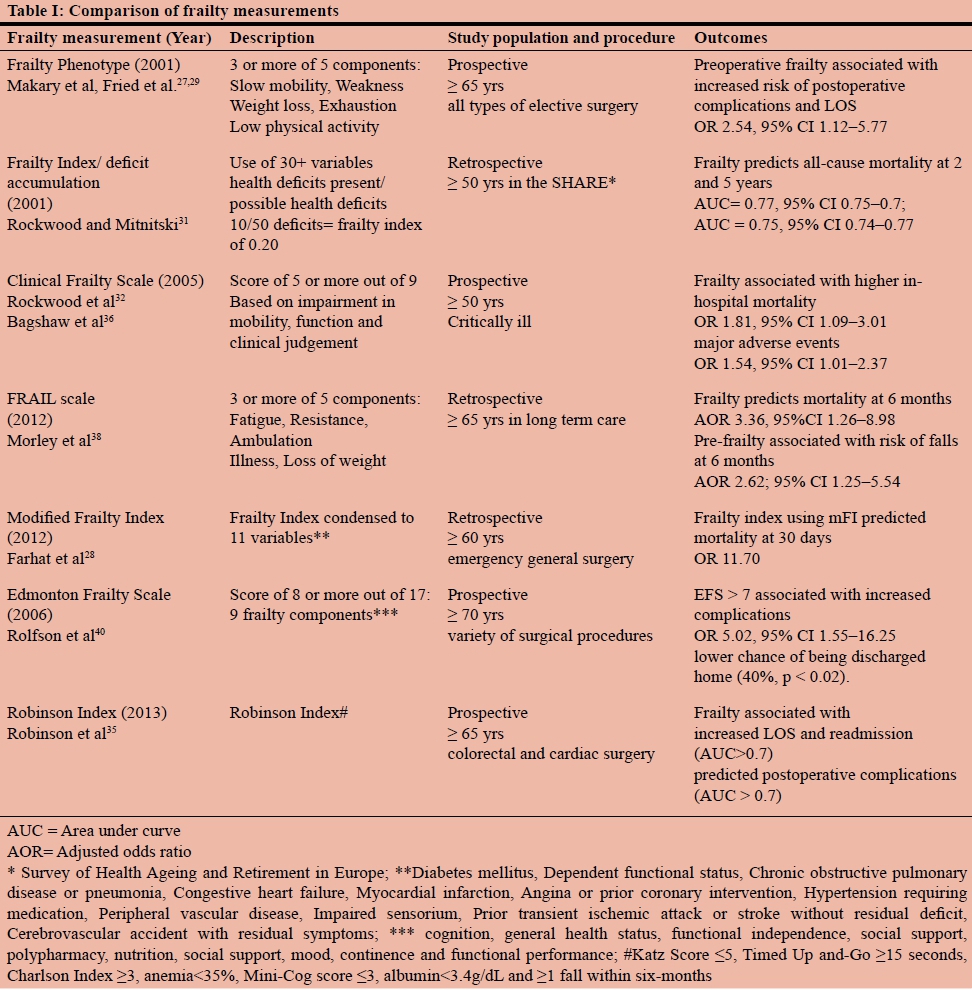
Multiple models have been used to measure frailty. The two most popularised models are the frailty phenotype 2930
The frailty phenotype is defined as a syndrome based on phenotypic features which are unintentional weight loss, exhaustion, weakness (low grip strength), slow walking speed and low physical activity. Three or more out of the five features would make the diagnosis of frailty likely296
The deficit accumulation model views frailty as a state of vulnerability resulting from the accumulation of an individual's health deficits. The number of health deficits or impairments in an individual are added and divided by a predetermined number of possible health deficits to create a frailty index.31 3233
The addition of laboratory markers of chronic disease to increase the predictive value of preoperative frailty assessments has been suggested.3435
Screening tools have also been developed and validated to allow physicians to rapidly identify frailty. Some of these include the Clinical Frailty Scale, the Cardiovascular Health Study Frailty Screening Measure and the Gérontopôle Frailty Screening Tool.20
The Clinical Frailty Scale (CFS) was developed with the aim to address the need for a clinician friendly screening tool.32323637
The FRAIL scale has 5 components: fatigue, resistance, ambulation (slow walking speed), illness, loss of weight with 3 or more components needed to classify frailty.38
Performance based tests such as gait speed, timed up and go test (TUGT)39393
Comprehensive geriatric assessment (CGA) is the established gold standard to evaluate older people which assesses medical, psychosocial, nutritional and functional ability.39
There is call for a standard measurement for consistent recognition of frailty worldwide, however the ideal frailty assessment tool is nnot yet determined.3434
Management
Frailty is generally a progressive disease but can improve with appropriate interventions.38,41 Preventative measures appear to be the most effective. Exercise has been shown to increase functional performance, walking speed and balance.42 434344
Enhanced recovery after surgery is a multimodal perioperative approach that aims to hasten recovery and improve outcomes in patients undergoing major surgery through components that begin preoperatively through to the postoperative period.45
Preoperative interventions could include patient and caretaker education, prehabilitation and optimisation of comorbidities. Management of preoperative anaemia with iron supplementation is recommended to improve surgical outcome.4645
Frailty assessments used preoperatively should identify those most vulnerable that could benefit from such interventions.
REFERENCES
-
1. Nguyen TN, Cumming RG, Hilmer SN. A Review of Frailty in Developing Countries. J Nutr Health Aging. 2015;19(9):941-6. Available at: https://doi.org/10.1007/s12603-015-0503-2
» https://doi.org/10.1007/s12603-015-0503-2 -
2. Organization WH. World report on ageing and health. Geneva: World Health Organization. 2015 [accessed 12 Aug 2018]. Available at: http://www.who.int/ageing/events/world-report-2015-launch/en
» http://www.who.int/ageing/events/world-report-2015-launch/en -
3. Barnett SR. Perioperative Frailty. Advances in Anesthesia. 2014;1(32):119-31. Available at: https://doi.org/10.1016/j.aan.2014.08.012
» https://doi.org/10.1016/j.aan.2014.08.012 -
4. Amrock LG, Deiner S. Perioperative frailty. Int Anesthesiol Clin. 2014;52(4):26-41. Available at: https://dx.doi.org/10.1097/AIA.0000000000000026
» https://dx.doi.org/10.1097/AIA.0000000000000026 -
5. Tavani C. Public policy and the frail elderly: Dept. of Health, Education, and Welfare, Office of Human Development Service, Federal Council on Aging; 1978 [accessed 12 Aug 2018]. Available at: https://catalog.hathitrust.org/Record/007402032
» https://catalog.hathitrust.org/Record/007402032 -
6. Moorhouse P, Rockwood K. Frailty and its quantitative clinical evaluation. J R Coll Physicians Edinb. 2012;42(4):333-40. Available at: https://dx.doi.org/10.4997/JRCPE/.2012.412
» https://dx.doi.org/10.4997/JRCPE/.2012.412 -
7. Beggs T, Sepehri A, Szwajcer A, Tangri N, Arora RC. Frailty and perioperative outcomes: a narrative review. Can J Anaesth. 2015;62(2):143-57. Available at: https://doi.org/10.1007/s12630-014-0273-z
» https://doi.org/10.1007/s12630-014-0273-z -
8. Shisana O, Rehle T, Simbayi L, Zuma K, Jooste S, Zungu N, et al. South African national HIV prevalence, incidence and behaviour survey, 2012. Available at: http://hdl.handle.net/20.500.11910/2490
» http://hdl.handle.net/20.500.11910/2490 -
9. Thurn M, Gustafson DR. Faces of Frailty in Aging with HIV Infection. Curr HIV/AIDS Rep. 2017;14(1):31-7. Available at: https://doi.org/10.1007/s11904-017-0348-x
» https://doi.org/10.1007/s11904-017-0348-x -
10. Pathai S, Gilbert C, Weiss HA, Cook C, Wood R, Bekker LG, et al. Frailty in HIV-infected adults in South Africa. J Acquir Immune Defic Syndr. 2013;62(1):43-51. Available at: https://dx.doi.org/10.1097%2FQAI.0b013e318273b631
» https://dx.doi.org/10.1097%2FQAI.0b013e318273b631 - 11. Norman R, Matzopoulos R, Groenewald P, Bradshaw D. The high burden of injuries in South Africa. Bulletin of the World Health Organization. 2007;85(9):695-702.
-
12. Cesari M, Prince M, Thiyagarajan JA, De Carvalho IA, Bernabei R, Chan P, et al. Frailty: An Emerging Public Health Priority. J Am Med Dir Assoc. 2016;17(3):188-92. Available at: https://doi.org/10.1016/jjamda.2015.12.016
» https://doi.org/10.1016/jjamda.2015.12.016 -
13. Partridge JS, Harari D, Dhesi JK. Frailty in the older surgical patient: a review. Age Ageing. 2012;41(2):142-7. Available at: https://doi.org/10.1093/ageing/afr182
» https://doi.org/10.1093/ageing/afr182 -
14. Clegg A, Young J, Iliffe S, Rikkert MO, Rockwood K. Frailty in elderly people. Lancet. 2013;381(9868):752-62. Available at: https://doi.org/10.1016/S0140-6736(12)62167-9
» https://doi.org/10.1016/S0140-6736(12)62167-9 -
15. Ashar FN, Moes A, Moore AZ, Grove ML, Chaves PH, Coresh J, et al. Association of mitochondrial DNA levels with frailty and all-cause mortality. J Mol Med (Berl). 2015;93(2):177-86. Available at: https://doi.org/10.1007/s00109-014-1233-3
» https://doi.org/10.1007/s00109-014-1233-3 -
16. Dodds C, Murray D. Preoperative assessment of the elderly. Bja Cepd Reviews. 2001;1(6):181-4. Available at: https://doi.org/10.1093/bjaceaccp/mkh052
» https://doi.org/10.1093/bjaceaccp/mkh052 -
17. Newman AB, Gottdiener JS, McBurnie MA, Hirsch CH, Kop WJ, Tracy R, et al. Associations of subclinical cardiovascular disease with frailty. J Gerontol A Biol Sci Med Sci. 2001;56(3):M158-66. Available at: https://doi.org/10.1093/gerona/56.3.M158
» https://doi.org/10.1093/gerona/56.3.M158 -
18. Woods NF, LaCroix AZ, Gray SL, Aragaki A, Cochrane BB, Brunner RL, et al. Frailty: emergence and consequences in women aged 65 and older in the Women's Health Initiative Observational Study. J Am Geriatr Soc. 2005;53(8):1321-30. Available at: https://doi.org/10.1111/j.1532-5415.2005.53405.x
» https://doi.org/10.1111/j.1532-5415.2005.53405.x -
19. Desquilbet L, Jacobson LP, Fried LP, Phair JP, Jamieson BD, Holloway M, et al. A frailty-related phenotype before HAART initiation as an independent risk factor for AIDS or death after HAART among HIV-infected men. J Gerontol A Biol Sci Med Sci. 2011;66(9):1030-8. Available at: https://doi.org/10.1093/gerona/glr097
» https://doi.org/10.1093/gerona/glr097 -
20. Morley JE, Vellas B, van Kan GA, Anker SD, Bauer JM, Bernabei R, et al. Frailty consensus: a call to action. J Am Med Dir Assoc. 2013;14(6):392-7. Available at: https://doi.org/10.1016/j.jamda.2013.03.022
» https://doi.org/10.1016/j.jamda.2013.03.022 -
21. Herr M, Robine JM, Pinot J, Arvieu JJ, Ankri J. Polypharmacy and frailty: prevalence, relationship, and impact on mortality in a French sample of 2350 old people. Pharmacoepidemiol Drug Saf. 2015;24(6):637-46. Available at: https://doi.org/10.1002/pds.3772
» https://doi.org/10.1002/pds.3772 -
22. Lee DH, Buth KJ, Martin BJ, Yip AM, Hirsch GM. Frail patients are at increased risk for mortality and prolonged institutional care after cardiac surgery. Circulation. 2010;121(8):973-8. Available at: https://doi.org/10.1161/CIRCULATIONAHA.108.841437
» https://doi.org/10.1161/CIRCULATIONAHA.108.841437 -
23. Leung JM, Tsai TL, Sands LP. Brief report: preoperative frailty in older surgical patients is associated with early postoperative delirium. Anesth Analg. 2011;112(5):1199-201. Available at: https://dx.doi.org/10.1213%2FANE.0b013e31820c7c06
» https://dx.doi.org/10.1213%2FANE.0b013e31820c7c06 -
24. Gu D, Dupre ME, Sautter J, Zhu H, Liu Y, Yi Z. Frailty and mortality among Chinese at advanced ages. J Gerontol B Psychol Sci Soc Sci. 2009;64(2):279-89. Available at: https://doi.org/10.1093/geronb/gbn009
» https://doi.org/10.1093/geronb/gbn009 -
25. Hubbard RE, Fallah N, Searle SD, Mitnitski A, Rockwood K. Impact of exercise in community-dwelling older adults. PLoS One. 2009;4(7):e6174. Available at: https://doi.org/10.1371/journal.pone.0006174
» https://doi.org/10.1371/journal.pone.0006174 -
26. Joseph B, Zangbar B, Pandit V, Fain M, Mohler MJ, Kulvatunyou N, et al. Emergency General Surgery in the Elderly: Too Old or Too Frail? J Am Coll Surg. 2016;222(5):805-13. Available at: https://doi.org/10.1016/jjamcollsurg.2016.01.063
» https://doi.org/10.1016/jjamcollsurg.2016.01.063 -
27. Makary MA, Segev DL, Pronovost PJ, Syin D, Bandeen-Roche K, Patel P, et al. Frailty as a predictor of surgical outcomes in older patients. J Am Coll Surg. 2010;210(6):901-8. Available at: https://doi.org/10.1016/jjamcollsurg.2010.01.028
» https://doi.org/10.1016/jjamcollsurg.2010.01.028 -
28. Farhat JS, Velanovich V, Falvo AJ, Horst HM, Swartz A, Patton JH, Jr., et al. Are the frail destined to fail? Frailty index as predictor of surgical morbidity and mortality in the elderly. J Trauma Acute Care Surg. 2012;72(6):1526-30; discussion 30-1. Available at: https://doi.org/10.1097/TA.0b013e3182542fab
» https://doi.org/10.1097/TA.0b013e3182542fab -
29. Fried LP, Tangen CM, Walston J, Newman AB, Hirsch C, Gottdiener J, et al. Frailty in older adults: evidence for a phenotype. J Gerontol A Biol Sci Med Sci. 2001;56(3):M146-56. Available at: https://doi.org/10.1093/gerona/56.3.M146
» https://doi.org/10.1093/gerona/56.3.M146 -
30. Mitnitski AB, Mogilner AJ, Rockwood K. Accumulation of deficits as a proxy measure of aging. ScientificWorldJournal. 2001;1:323-36. Available at: http://dx.doi.org/10.1100/tsw.2001.58
» http://dx.doi.org/10.1100/tsw.2001.58 -
31. Rockwood K, Mitnitski A. Frailty defined by deficit accumulation and geriatric medicine defined by frailty. Clin Geriatr Med. 2011;27(1):17-26. Available at: https://doi.org/10.1016/j.cger.2010.08.008
» https://doi.org/10.1016/j.cger.2010.08.008 -
32. Rockwood K, Song X, MacKnight C, Bergman H, Hogan DB, McDowell I, et al. A global clinical measure of fitness and frailty in elderly people. CMAJ. 2005;173(5):489-95. Available at: https://doi.org/10.1503/cmaj.050051
» https://doi.org/10.1503/cmaj.050051 -
33. Searle SD, Mitnitski A, Gahbauer EA, Gill TM, Rockwood K. A standard procedure for creating a frailty index. BMC Geriatr. 2008;8:24. Available at: https://doi.org/10.1186/1471-2318-8-24
» https://doi.org/10.1186/1471-2318-8-24 -
34. Hubbard RE, Story DA. Patient frailty: the elephant in the operating room. Anaesthesia. 2014;69 Suppl 1:26-34. Available at: https://doi.org/10.1111/anae.12490
» https://doi.org/10.1111/anae.12490 -
35. Robinson TN, Wu DS, Pointer L, Dunn CL, Cleveland JC, Jr., Moss M. Simple frailty score predicts postoperative complications across surgical specialties. Am J Surg. 2013;206(4):544-50. Available at: https://doi.org/10.1016/j.amjsurg.2013.03.012
» https://doi.org/10.1016/j.amjsurg.2013.03.012 -
36. Bagshaw SM, Stelfox HT, McDermid RC, Rolfson DB, Tsuyuki RT, Baig N, et al. Association between frailty and short- and long-term outcomes among critically ill patients: a multicentre prospective cohort study. CMAJ. 2014;186(2):E95-102. Available at: https://doi.org/10.1503/cmaj.130639
» https://doi.org/10.1503/cmaj.130639 -
37. Gregorevic KJ, Hubbard RE, Lim WK, Katz B. The clinical frailty scale predicts functional decline and mortality when used by junior medical staff: a prospective cohort study. BMC Geriatr. 2016;16:117. Available at: https://doi.org/10.1186/s12877-016-0292-4
» https://doi.org/10.1186/s12877-016-0292-4 -
38. Morley JE, Malmstrom TK, Miller DK. A simple frailty questionnaire (FRAIL) predicts outcomes in middle aged African Americans. J Nutr Health Aging. 2012;16(7):601-8. Available at: https://doi.org/10.1007/s12603-012-0084-2
» https://doi.org/10.1007/s12603-012-0084-2 -
39. Kristjansson SR, Nesbakken A, Jordhay MS, Skovlund E, Audisio RA, Johannessen H-O, et al. Comprehensive geriatric assessment can predict complications in elderly patients after elective surgery for colorectal cancer: a prospective observational cohort study. Critical reviews in oncology/hematology. 2010;76(3):208-17. Available at: https://doi.org/10.1016/j.critrevonc.2009.11.002
» https://doi.org/10.1016/j.critrevonc.2009.11.002 -
40. Rolfson DB, Majumdar SR, Tsuyuki RT, Tahir A, Rockwood K. Validity and reliability of the Edmonton Frail Scale. Age Ageing. 2006;35(5):526-9. Available at: https://doi.org/10.1093/ageing/afl041
» https://doi.org/10.1093/ageing/afl041 -
41. Clegg A, Young J, Iliffe S, Rikkert MO, Rockwood K. Frailty in elderly people. Lancet. 2013;381(9868):752-62. Available at: https://doi.org/10.1016/S0140-6736(12)62167-9
» https://doi.org/10.1016/S0140-6736(12)62167-9 -
42. Gillespie LD, Robertson MC, Gillespie WJ, Sherrington C, Gates S, Clemson LM, et al. Interventions for preventing falls in older people living in the community. Cochrane Database Syst Rev. 2012(9):CD007146. Available at: https://doi.org/10.1002/14651858.CD007146.pub3
» https://doi.org/10.1002/14651858.CD007146.pub3 -
43. Carli F, Charlebois P, Stein B, Feldman L, Zavorsky G, Kim DJ, et al. Randomized clinical trial of prehabilitation in colorectal surgery. British Journal of Surgery. 2010;97(8):1187-97. Available at: https://doi.org/10.1002/bjs.7102
» https://doi.org/10.1002/bjs.7102 -
44. Muir SW, Montero-Odasso M. Effect of vitamin D supplementation on muscle strength, gait and balance in older adults: a systematic review and meta-analysis. J Am Geriatr Soc. 2011;59(12):2291-300. Available at: https://doi.org/10.1111/j.1532-5415.2011.03733.x47.
» https://doi.org/10.1111/j.1532-5415.2011.03733.x47 -
45. Ljungqvist O, Scott M, Fearon KC. Enhanced Recovery After Surgery: A Review. JAMA Surg. 2017;152(3):292-8. Available at: https://doi.org/10.1001/jamasurg.2016.4952
» https://doi.org/10.1001/jamasurg.2016.4952 -
46. Goodnough LT, Maniatis A, Earnshaw P, Benoni G, Beris P, Bisbe E, et al. Detection, evaluation, and management of preoperative anaemia in the elective orthopaedic surgical patient: NATA guidelines. Br J Anaesth. 2011;106(1):13-22. Available at: https://doi.org/10.1093/bja/aeq361
» https://doi.org/10.1093/bja/aeq361