The profile of thyroid cancer in patients undergoing thyroidectomy at Chris Hani Baragwanath Academic Hospital
Abstract
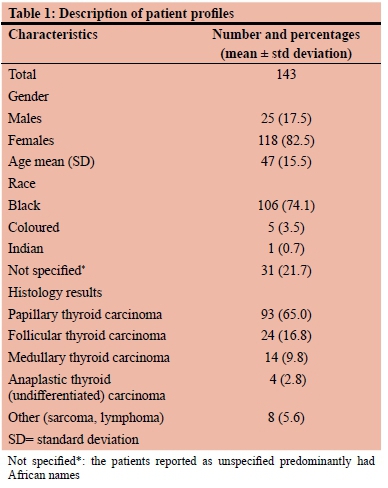
BACKGROUND: The histological type of thyroid cancer in well-resourced countries is predominantly papillary. Follicular carcinoma is predisposed by iodine deficiency that was present the Black population of South Africa until salt iodination in 1995. The aim of this study was to analyse the profile of thyroid cancer in Black South Africans from January 2001 to December 2017 and to identify any temporal changes in thyroid cancer histological subtypes since salt iodinationMETHOD: Histopathological reports of patients who underwent thyroidectomy for cancer at Chris Hani Baragwanath Academic Hospital in Johannesburg, South Africa between January 2001 and December 2017 were retrospectively assessed. Data captured included name, age, gender, race, the date when the specimen was sent and the detailed histopathological reportRESULTS: Of the 143 thyroidectomies performed for malignancy, papillary thyroid cancer was the predominant type (65%) with a papillary to follicular thyroid cancer ratio of 4:1. Follicular, medullary and anaplastic cancers were 16.8%, 9.8% and 2.8% respectively. The reports were incomplete in 5 cases and there were 3 non-epithelial neoplasmsCONCLUSION: There is a gradual temporal increase in the frequency of resected papillary cancer over a 16 year period while follicular has remained static. These changes may be attributable to better salt iodination
Background
Thyroid cancer is the most frequent endocrine malignancy, ranging from 7.3% to 15% in surgical series in Africa.1 2234
The SEER data reported an annual percent change (APC) of 2.4% to 6.6% in the USA.22
In South Africa in 1988, 359 thyroid cancers were recorded in the South African National Cancer Registry (NCR) with a crude national annual incidence of 1.25/100 000 with a population of approximately 30 million.562
Environmental factors may well be a significant contributor to the increased incidence of thyroid cancers in a population. In 1988, Kalk demonstrated that many areas in South Africa appeared to be iodine-deficient as evidenced by the predominance of follicular thyroid cancer (FTC), suggesting that the prevalence of FTC compared to PTC could be used as a surrogate marker for iodine deficiency in a certain area.5
Iodine intake in population varies and it determines the occurrence of benign thyroid disorders.7678
What seems to be unclear is whether chronic TSH stimulation leads to thyroid tumours. In iodine deficiency, TSH is increased and this may lead to thyroid cell proliferation, which leads to marked thyroid hyperplasia and hypertrophy.77758710
Conversely, Cairncross published a study that showed predominance of papillary carcinoma in an urban population in Cape Town.11111312
To combat iodine deficiency disorders (IDD) in South Africa, which may range from endemic goiter to cretinism, guidelines from the WHO and UNICEF universal iodination programs were implemented.1314
In South Africa, a sub-standard attempt at eliminating IDD was started in 1954 and entailed "optional" salt iodisation.15 151515
Objective
The current study was undertaken to examine the histopathological profile of thyroid cancer in patients who underwent thyroidectomy for cancer at Chris Hani Baragwanath Academic Hospital (CHBAH) that mainly serves the urban Black population of Johannesburg. The study is an attempt to identify any effect that mandatory iodination of diets may have had on the profile of thyroid cancer.
Methods
This is a retrospective review of histopathology reports of patients who underwent thyroidectomy for malignancy between January 2001 and December 2017 at CHBAH.
The data was collected from theatre registries, patient files and the National Health Laboratory Services (NHLS) database using a Systematized Nomenclature of Medicine (SNOMED) extract. This database records patients' demographic details (name, age, gender, race) and the date on which the biopsy was taken. The coded database identifies the site of the biopsy and the histopathological result of a specified patient. Where race was missing, it was inferred from the patient name. Race was also used as a proxy for access to iodination because of social and economic disadvantage historically assigned by racial category.
Thyroidectomies done for benign disease were excluded. Stata and Excel were used to analyse the data.
Results
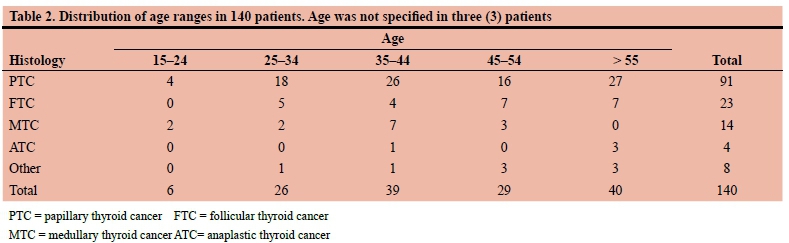
The results are depicted in Tables 1 and 2.
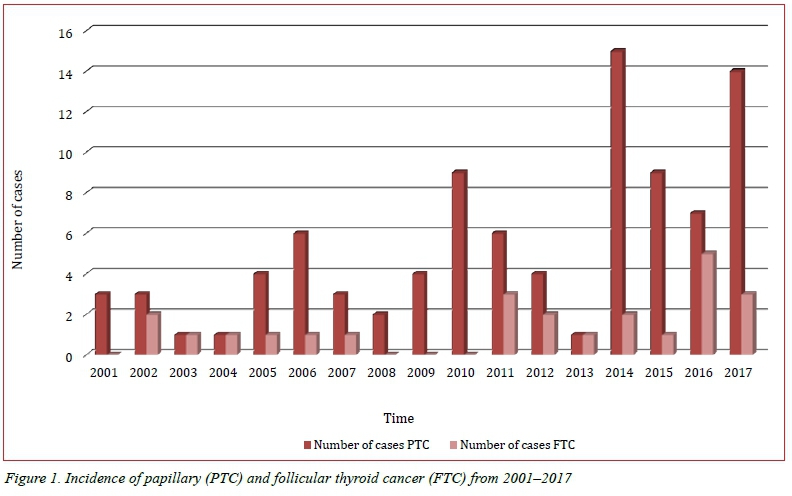
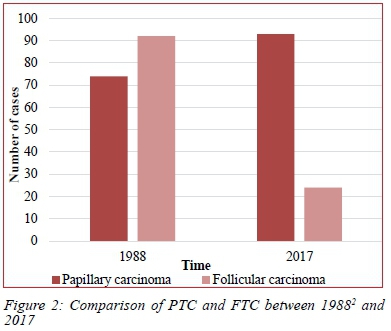
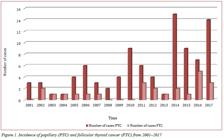
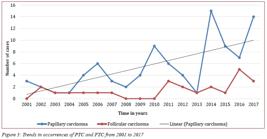
Figure 1 demonstrates an undulating pattern in the incidence of PTC and an overall widening gap between PTC and FTC. The incidence of FTC has been constant, with a slight increase in 2016 and 2017. The net result is that the papillary to follicular ratio has increased to 4:1 at the end of the study (2017) from an almost 1:1 ratio in the early phase of the study (2002). The current preponderance of PTC is best evidenced by comparison between the 1988 results to the findings of this study (Figure 2).
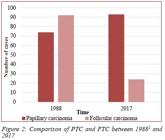
In 1988, there were 74 cases of PTC and the number increased to more than 90 in 2017 as shown in Figure 2. FTC was very high with 92 cases in 1988 but the number decreased to 24 cases in 2017.
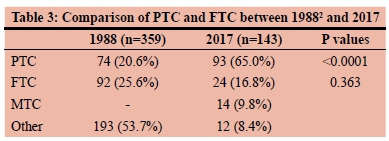
Table 3 compares PTC and FTC between 1988 and 2017. A large proportion of patients with PTC (65%) were recorded in 2017 compared to 20.6% in 1988 with statistically significant differences in proportion (p < 0.0001).
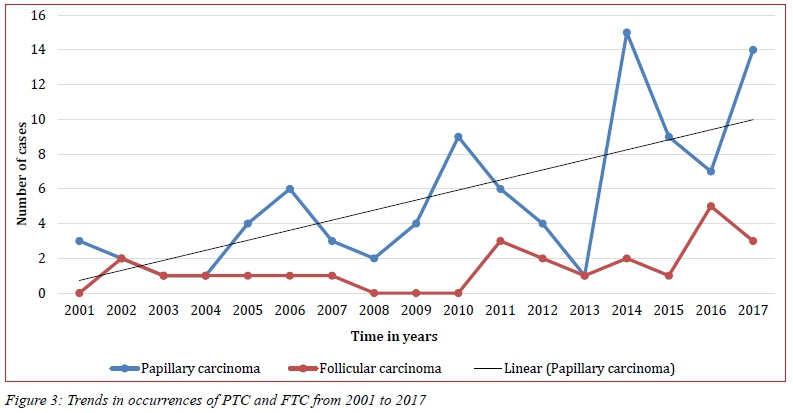
Overall, the number of PTC has been increasing as shown in Figure 3. From 2010 to 2013, there appeared to be a steady decline in PTC, followed by a sharp increase in 2014.
Discussion
In this study, the larger proportions of female to male ratio is in line with global findings, although the age of the patients with papillary carcinoma is slightly higher than similar cases reported in Western countries. Papillary thyroid cancer is most commonly seen in individuals in the third to fifth decade of life, which is also consistent with the findings in this study. More than 75% of cases occur in women, making this the fifth most common malignancy in women.1213Table 2) were between age 20 and 55 years. The increase in the incidence of papillary thyroid cancers in this study is clear and mirrors that in iodine-rich areas.
Globally the detection of papillary micro-carcinomas has contributed to an increased incidence of PTC in well-resourced countries. The WHO classifies papillary thyroid micro-carcinomas as cancers that me asure 1 cm or less. In the USA, papillary thyroid micro-carcinomas have become the most common PTC detected in patients older than 45 years with an excellent prognosis.1116131418 19 eding to raised levels of TSH and areas of hyperplasia in the thyroid gland. The continuing stimulus by TSH may initiate a sequence of hyperplasia, dysplasia and finally thyroid tumorigenesis.15,17 This sequence has been suggested as the explanation for the association of iodine-deficiency with follicular thyroid carcinoma. Over the past thirty years more and more of the Black population has moved from rural areas to urban centres in search of employment, better healthcare and better educational facilities. The result is that most of Gauteng province has been reclassified as urban.121111 97
This study has some limitations. These include its retrospective nature, missing data and the failure to record race accurately. Another limiting factor is the fact that iodination could not be directly measured in the study, therefore race and urban/rural location were used as proxy.
Conclusion
An overall increase in incidence of thyroid cancer and significant relative increase in the proportion of papillary to follicular carcinoma has been demonstrated in this study. This serves as indirect evidence that the urban Black population in Soweto, Johannesburg, which may have been iodine-deficient prior to mandatory iodination of table salt and bread, is now iodine replete.
Recommendation
A nationwide study that directly measures the iodine level in the urine is likely to confirm that South Africa is an iodine replete country.
Ethics approval
Ethics approval was obtained from the Human Research Ethics Committee of the University of the Witwatersrand and the Research Review Board at CHBAH (M160538).
REFERENCES
- 1. Sidibe EH, Kasse AA, Woto-Gaye G, Ka-Cisse M. Primary thyroid cancer in Africa. Nucl Med. 2001;5(1):17-23.
- 2. Pellegriti G, Frasca F, Regalbuto C, Squatrito S, Vigneri R. Worldwide increasing incidence of thyroid cancer: update on epidemiology and risk factors. J Cancer Epidemiol. 2013;2013:965212.
-
3. Hoang JK, Langer JE, Middleton WD, et al. Managing Incidental Thyroid Nodules Detected on Imaging: White paper of the ACR Incidental Thyroid Findings Committee. J Am Coll Rad. 2015;12(2):143-50. doi: http://dx.doi.org/10.1016/j.jacr.2014.09.038.
» http://dx.doi.org/10.1016/j.jacr.2014.09.038 - 4. Ross DS. Papillary thyroid microcarcinoma. In: Surgery of the thyroid and Parathyroid glands. 2nd ed. Elsevier Saunders;2013. p. 192-6.
- 5. Kalk WJ, Sitas F, Patterson AC. Thyroid cancer in South Africa- an indicator of regional iodine deficiency. S Afr Med J. 1997;87(6):735-8.
-
6. Available from: www.cansa.org.za
» www.cansa.org.za - 7. Zimmermann MB, Galleti V. Iodine intake as a risk factor for thyroid cancer: a comprehensive review of animal and human studies. Thyroid Research. 2015:8(1):1.
- 8. Mulaudzi TV, Ramdial PK, Madiba TE, Callaghan RA. Thyroid carcinoma at King Edward VIII Hospital, Durban, South Africa. East Afr Med J. 2001;78(5):242-5.
- 9. Sidibe EH. Thyroid diseases in sub-Saharan Africa. Sante. 2007;17(1):33-9.
- 10. Nkanza NK. Carcinoma of the thyroid at Harare histopathology laboratory (Zimbabwe). Cent Afr J Med. 1990;36(2):34-43.
- 11. Cairncross L, Panieri E. Pre-operative diagnosis of thyroid cancer: Clinical, radiological and pathological correlation. S Afr J Surg. 2013;51(2):46-9.
- 12. Bombil I, Bentley A, Kruger D, Luvhengo TE. Incidental cancer in multinodular goitre post thyroidectomy. S Afr J Surg. 2014;51(1):5-9.
- 13. Jooste PL, Zimmermann MB. Progress towards eliminating iodine deficiency in South Africa. South Afr J Clin Nutr. 2008;21(1):08-14.
- 14. Townsend CM, Beauchamp RD, Evers BM, Mattox KL. Sabiston Textbook of Surgery: The Biological Basis of Modern Surgical Practice. 19th ed. Philadelphia. Elsevier; 2012.
- 15. Lehohla P. Migration and urbanisation in South Africa. Statistics South Africa. 2006; Report no 03-04-02.
-
16. Thyroid cancer. American Cancer Society. Available from: http://www.cancer.org/acs/groups/cid/documer.pdf.pdf. Updated January 20, 2012. Accessed 2012 Mar 8.
» http://www.cancer.org/acs/groups/cid/documer.pdf.pdf - 17. Hughes DT, Haymart MR, Miller BS, Gauger PG, Doherty GM. The most commonly occurring papillary thyroid cancer in the United States is now a microcarcinoma in a patient older than 45 years. Thyroid. 2011;21(3):231-6
-
18. American Cancer Society 2018. Available from: www.cancer.org
» www.cancer.org - 19. Nussey S, Whitehead S. Endocrinology: An Integrated Approach. Oxford: BIOS Scientific Publishers; 2001. Chapter 3, The thyroid gland.