The epidemiology of acid burns in an academic hospital in South Africa: 9-year audit
Abstract
BACKGROUND: Chemical burns worldwide are caused by highly concentrated acidic and alkaline substances being placed onto exposed skin surface with resultant tissue injury. These chemical substances have high toxicity and deep tissue penetrability causing significant morbidity and mortality to patients. This study describes the epidemiology and mortality of acid-related burn injuries to improve patient assessment and management strategies. METHODS: A cross-sectional retrospective analysis of the records of 66 patients admitted to Chris Hani Baragwanath Academic Hospital Adult Burns Unit over a period of 9 years between 2015 and 2024. RESULTS: This study found that 91% of cases were due to assault, compared to 8% accidental injury. Patients admitted were predominantly male (n = 43; 65%). The mean total body surface area (TBSA) involved was 17.7% with the most common areas involved being the face and arms (n = 47, 72%). The neck was affected in 35 cases (54%), and the chest in 34 cases (52%). Other affected areas included the back (n = 24, 37%), eyes (n = 14, 22%), legs (n = 12, 19%), buttocks (n = 4, 6%), and genitalia (n = 3, 5%). Patient mortality is limited in cases where TBSA < 25%; however, when TBSA > 25% mortality is 75%, further increasing to 100% when patients were ventilated. CONCLUSION: This study showed a high rate of acid burns associated with domestic violence and assaults. Prevention strategies should be coordinated with strategies aimed at reducing interpersonal violence.
acid burns; chemical burns; epidemiology; mortality; interpersonal violence
Introduction
Chemical burns worldwide are caused by highly concentrated acidic and alkaline substances being placed onto exposed skin surface with resultant tissue injury. These chemical substances have high toxicity and deep tissue penetrability causing significant morbidity and mortality to patients. Acid burn injuries due to work-related injuries are common occurrences in industrialised countries such as China where chemicals such as hydrofluoric acid and sulfuric acid are used in processes of industry. Studies done in these regions have found that the majority of causes of these injuries were due to inappropriate chemical handling or machine malfunctions.1,2 However, in developing countries, such as Iran, Jamaica, Bangladesh, Columbia and Cambodia, there is a comparatively higher incidence of acid burns associated with assault.3,4 The studies in these regions have revealed that the average total body surface area (TBSA) burn percentage involved is 16% but is associated with a high morbidity due to associated disability.5-7 This provides cause for alarm as these burns incur high economic costs to patients, hospitals, healthcare systems and families. South Africa (SA) has limited data available regarding chemical burns, despite the relatively common availability of acidic substances.
Chemical burns may be caused by both alkaline or acidic agents and may be treated similarly in the initial hospital or clinic setting as causative agents may be unidentifiable initially on arrival. Common sources in the South African setting include those used in household cleaners, industry and agriculture with little to no education given to those individuals who use these agents in domestic and industrial settings.8,9 The agent used also determines the depth of injury and the method used would determine whether there is eye, lung or gastrointestinal involvement with long-term side effects. Alkaline burns cause liquefactive necrosis with protein denaturation and saponification of lipids within the skin and are therefore more commonly associated with full-thickness burns. However, these alkaline substances are rarely produced at high enough concentrations in commonly available substances to cause chemical burns. Comparatively, lab alkalis, such as ammonia or sodium hydroxide, are available in high enough concentrations to cause chemical burns. For the purposes of this study, we will focus on acid burns specifically.
The most common acidic agents are sulfuric acid, hydrochloric acid and hydrofluoric acid found in household cleaners, rust removers or battery acid. Vitriolage caused by sulfuric acid exposure occurs when the acid reacts with the water naturally present in skin, releasing heat as byproduct and causing erosion of the skin.1011,12 All of these acids are commonly accessible for over-the-counter purchase in SA with limited control as to the use of the substance.
The aim of this study is to describe the epidemiology and mortality of acid-related burn injuries in a specialised burn centre in Johannesburg, SA, thereby providing data to improve patient assessment and management strategies.
Methods
We conducted a retrospective descriptive study of all patients admitted to Chris Hani Baragwanath Hospital Adult Burns Unit from March 2015 to March 2024. Patients admitted to other units and those under the age of 10 years were excluded. Data was collected using convenience sampling of records available to the researchers. Patient details were entered into a database which captured all admissions from 2015 to 2024. These records included 2 383 patients, of which 2 317 patients were excluded. This resulted in 66 patients identified with acid burns and patient records were consulted regarding treatments and patient outcomes. The study variables included sex, age, TBSA percentage involved, body surfaces involved, method of injury of the burn, causative substance of the burn, length of stay and final outcome of the patient.
Anonymised data was exported into R (RStudio Version 2023.12.0+369). Shapiro-Wilk tests were performed to assess for normality. Descriptive statistics were used to summarise data. Non-parametric continuous variables were summarised as median with interquartile range (IQR), while categorical variables were expressed as frequencies and percentages.
Continuous variables were compared using Wilcoxon rank-sum test for non-parametric data and categorical variables were compared with chi-square or Fisher's exact test. All tests were two-tailed and a _p-value of < 0.05 was interpreted as statistically significant.
Results
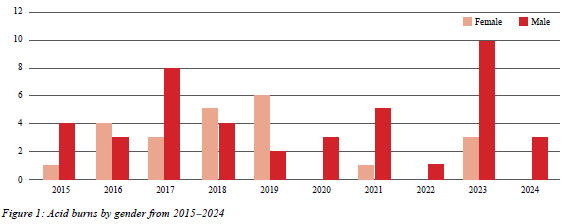
This is a study of 66 cases of acid burns admitted to Chris Hani Baragwanath Hospital Adult Burns Unit between 2015 to 2024. The highest frequency of cases occurred in 2023 (13 cases, 20%), followed by 2017 (11 cases, 17%). The lowest frequency of cases was in 2022 (1 case, 2%) and 2020 (3 cases, 5%). The median age of the population was 32 years (IQR: 26-36 years). Males comprised 65% (43 cases) of the population, while females accounted for 35% (23 cases). Initially there was equal distribution between gender groups, yet from 2020 there was a higher rate of male to female admissions (Figure 1).
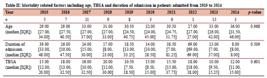
The median duration of admission was 21 days (IQR: 9-37 days) and the median total surface area affected was 15% (IQR: 10-20%). A correlation could be made between TBSA > 15% (38 cases) and longer durations of stay with an average of 33 days.
Of the 66 cases, 10 patients (15%) demised, while 56 (85%) were discharged. Mortality also significantly increased when TBSA was > 25% with a 75% mortality in these cases. Of these cases where TBSA was > 25%, ventilated patients had a mortality rate of 100%.
Accidental cases comprised 9% (5 cases), while 91% (50 cases) of cases were reported as assaults. A third of these assault cases were reported as domestic violence cases, or otherwise as assault by a known or unknown assailant. Amongst the types of agents involved, drain acid accounted for the highest proportion (6 cases, 40%), followed by battery acid and thinners, each in 3 cases (20%). Paint thinners, spirits, and sulphuric acid each accounted for 1 case (7%). Even though there was limited information available regarding the distribution of types of agents, they differed significantly between the groups (p = 0.010). Battery acid, drain acid, spirits, sulphuric acid, and thinners were only reported in the discharged group. Paint thinners were exclusively associated with the demised group.


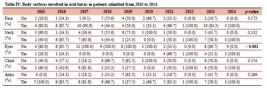
The mean burn percentage was 15% (10-20%), the most commonly affected body parts were the face and arms, each involved in 47 cases (72%). The neck was affected in 35 cases (54%), and the chest in 34 cases (52%). Other affected areas included the back (24 cases, 37%), eyes (14 cases, 22%), legs (12 cases, 19%), buttocks (4 cases, 6%), and genitalia (3 cases, 5%). Of these cases, leg involvement was considered statistically significant (40.9% vs. 7.0%, p = 0.003).
Discussion
In this study, initially a gradual increase from 2015 until 2019 in female patients was identified, however, during and post SARS COVID-19 pandemic the overall number of cases decreased with a drastic increase in 2023 in male patients compared to female patients. The higher proportion of male patients in our study are consistent with the findings of similar studies in developed countries, compared to a higher female predilection found in developing countries. This may be due to the higher prevalence of men employed in industry-related settings; however, this should be countered by the higher number of women in domestic settings. In our setting, these men were victims of domestic disputes as well as interpersonal disputes between friends, highlighting that there is greater inclination to use acid as weapon in interpersonal violence.
This study also shows an increase in assault related cases involving acid from 2020 until 2024 with the highest number of cases occurring in 2023. This is consistent with an overall increase in crime related to disputes with neighbours and domestic violence according to national crime statistics.13
Furthermore, we found that mortality was minimal in cases where TBSA was < 25%; however, mortality significantly increased when TBSA was > 25% with a 75% mortality in these cases. Of these cases where TBSA was > 25%, the cases which required ventilation had an increased mortality of 100%. These results indicate a need to adjust protocols for initial and long-term treatment management in the cases of ventilated patients as their risk increases significantly.
Conclusion
Our study findings emphasise a need to improve occupational health and safety measures with education and training regarding the adverse effects of acids. Community education regarding the composition of common household cleaners and immediate treatment post-exposure is necessary to reduce overall incidences. Strategies to decrease interpersonal violence and domestic violence, specifically related to the use of acid, should also be implemented to reduce incidents of acid-related attacks.
Conflict of interest
The authors declare no conflict of interest.
Funding source
No funding was required.
Ethical approval
Ethical approval was obtained from the University of the Witwatersrand Human Research Ethics Committee (Medical) (Ref: M2411139).
ORCID
B Beneke https://orcid.org/0000-0001-8397-1723
S Znamerovskyi https://orcid.org/0000-0002-2305-3151
A Muganza https://orcid.org/0000-0001-5832-6095
T Netshiongolwe https://orcid.org/0000-0003-3005~6112
REFERENCES
-
1. Li W, Wu X, Gao C. Ten-year epidemiological study of chemical burns in Jinshan, Shanghai, PR China. Burns. 2013;39(7):1468-73. https://doi.org/10.1016/j.burns.2013.03.012.
» https://doi.org/10.1016/j.burns.2013.03.012 - 2. Mao SL, Zhang YH, Wu JM, et al. Research advances on the treatment of hydrofluoric acid burns. 2022;38(9):878-82. Chinese.
- 3. Schwerin DL, Hatcher JD. Hydrofluoric acid burns. In: StatPearls [Internet]. Treasure Island (FL): StatPearls Publishing; 2023 Jan. PMID: 28722859.
-
4. Ye C, Wang X, Zhang Y, et al. Ten-year epidemiology of chemical burns in western Zhejiang Province, China. Burns. 2016;42(3):668-74. https://doi.org/10.1016/j.burns.2015.12.004.
» https://doi.org/10.1016/j.burns.2015.12.004 - 5. Mehrabani D, Farjam M, Geramizadeh B, et al. The healing effect of curcumin on burn wounds in rat. World J Plast Surg. 2015;4:29-35.
-
6. Guerrero L. Burns due to acid assaults in Bogotá, Colombia. Burns. 2013;39(5):1018-23. https://doi.org/10.1016/j.burns.2012.10.022.
» https://doi.org/10.1016/j.burns.2012.10.022 -
7. Waldron NR, Kennifer D, Bourgois E, et al. Acid violence in Cambodia: the human, medical and surgical implications. Burns. 2014;40(8):1799-804. https://doi.org/10.1016/j.burns.2014.04.012.
» https://doi.org/10.1016/j.burns.2014.04.012 -
8. Palao R, Monge I, Ruiz M, Barret JP. Chemical burns: pathophysiology and treatment. Burns. 2010;36(3):295-304. https://doi.org/10.1016/j.burns.2009.07.009.
» https://doi.org/10.1016/j.burns.2009.07.009 -
9. Mozingo DW, Smith AA, McManus WF, Pruitt BA Jr, Mason AD Jr. Chemical burns. J Trauma. 1988;28(5):642-7. https://doi.org/10.1097/00005373-198805000-00014.
» https://doi.org/10.1097/00005373-198805000-00014 -
10. Flammiger A, Maibach H. Sulfuric acid burns (corrosion and acute irritation): evidence-based overview to management. Cutan Ocul Toxicol. 2006;25(1):55-61. https://doi.org/10.1080/15569520500536634.
» https://doi.org/10.1080/15569520500536634 -
11. Kozawa S, Kakizaki E, Muraoka E, et al. An autopsy case of chemical burns by hydrochloric acid. Leg Med (Tokyo). 2009;11(Suppl 1):S535-7. https://doi.org/10.1016/j.legalmed.2009.01.008.
» https://doi.org/10.1016/j.legalmed.2009.01.008 - 12. Abbasi H, Dehghani A, Mohammadi AA, Ghadimi T, Keshavarzi A. The epidemiology of chemical burns among the patients referred to burn centres in Shiraz, Southern Iran, 2008-2018. Bull Emerg Trauma. 2021;9(4):195-200.
-
13. Stat SA. Governance, Public Safety, and Justice Survey GPSJS 2021/22/2022. Available from: https://www.statssa.gov.za/?page_id=1854&PPN=P0340&SCH=73505.
» https://www.statssa.gov.za/?page_id=1854&PPN=P0340&SCH=73505