Outcomes and prognostic factors of secondary and tertiary peritonitis in an ICU: a prospective analysis
Abstract
BACKGROUND: Intra-abdominal infections (IAIs) causing secondary and tertiary peritonitis contribute significantly to sepsis and septic shock-related mortality in African ICUs. Yet the data from low-to-middle income countries (LMICs) remain sparse. This study evaluates prognostic factors and outcomes in a tertiary care ICU in South Africa. METHODS: A prospective observational study was conducted on 129 adult patients with secondary or tertiary peritonitis admitted to ICU at Dr George Mukhari Academic Hospital (DGMAH) between February 2022 and February 2023. Demographics, antimicrobial resistance, and surgical management strategies were assessed. Predictors of mortality and prolonged ICU stay were analysed using Cox regression. RESULTS: Median patient age was 52 years (IQR 37-65); 59.7% were male. Gastroduodenal perforations (34.1%) were most common. Multidrug-resistant (MDR) organisms were isolated in 23.3%. ICU mortality was 21.7%. APACHE II ≥ 25 (HR 3.1, 95% CI: 1.7-5.7; p < 0.001), ≥ 3 relooks (HR 2.99, 95% CI: 1.2-7.3; p = 0.014), and open abdomen (HR 3.2, 95% CI: 1.3-7.9; p = 0.008) were associated with mortality. Multiple organ dysfunction syndrome (MODS) was associated with prolonged ventilation (HR 1.41; p = 0.002). CONCLUSION: Secondary and tertiary peritonitis in African ICUs is associated with sepsis and septic shock and high surgical burden. Early risk stratification, timely source control, and antibiotic stewardship are essential. This is among the few prospective analyses from an LMIC setting and provides actionable data for context-sensitive guidelines.
secondary peritonitis; tertiary peritonitis; intra-abdominal infection; ICU outcomes; prognostic factors; antimicrobial resistance; relook laparotomy; open abdomen; LMIC surgical burden; intra-abdominal sepsis
Introduction
Peritonitis remains a formidable challenge in emergency surgical care, particularly in low- and middle-income countries (LMICs), where systemic limitations amplify its lethality.1-4 Secondary peritonitis, often arising from gastrointestinal perforation or anastomotic leakage, can escalate rapidly into sepsis and multiple organ dysfunction syndrome (MODS).5-7 Tertiary peritonitis, the persistence of inflammation despite intervention, represents a particularly ominous clinical trajectory.8
While outcomes in high-income countries have improved through advances in surgical techniques, early detection, and antimicrobial stewardship,910-13 There is also a paucity of data from the continent to guide risk stratification and clinical decision-making.14
This prospective study evaluates the clinical and microbiological characteristics, surgical interventions, and prognostic indicators of ICU patients with intra-abdominal infections at a South African tertiary care hospital.
Patients and methods
Study design and setting
A prospective, observational study was conducted over 12 months (February 2022-February 2023) in the general ICU at Dr George Mukhari Academic Hospital (DGMAH), a tertiary academic hospital affiliated with Sefako Makgatho Health Sciences University. The unit admits all critically ill non-trauma patients in a catchment area serving approximately 90 000 individuals, based on the latest Government census.15
Patient selection
All adult patients (≥ 18 years) with surgically confirmed secondary or tertiary peritonitis were included. Patients with palliative metastatic cancer or incomplete records were excluded. Tertiary peritonitis was defined as persistence or recurrence of intra-abdominal infection ≥ 48-72 hours after initial adequate source control.
Data collection
Data were collected using structured forms and included parameters derived from scoring systems selected for their prognostic reliability in surgical ICU cohorts.16-18 These parameters included: demographics and comorbidities, aetiology of infection, surgical management details, ICU outcomes (ventilation, length of stay, mortality), microbiology results and antimicrobial resistance, and severity scores (APACHE II, MPI, and qSOFA).
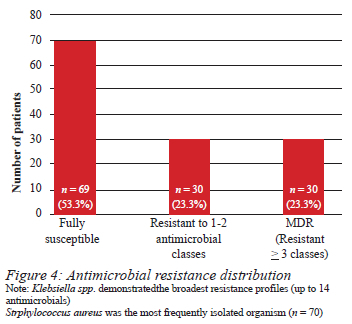
Multi-drug resistance was defined as resistance to at least one agent in three or more antimicrobial classes. Susceptibility testing and interpretation followed Clinical and Laboratory Standards Institute (CLSI) breakpoints.
Prolonged ICU stay was defined as >15 days. This threshold was selected as a pragmatic marker of prolonged ICU resource utilisation and approximated the upper quartile of ICU stay in this cohort. While ≥ 15 days is more commonly used in the literature, > 15 days was chosen to specifically identify patients requiring care beyond the 15-day threshold, representing the most resource-intensive cases.15
Sample size and statistical analysis
The sample size was calculated based on an expected mortality rate of 20% (based on prior regional studies), with the ability to detect a hazard ratio of 2.0 for key predictors (APACHE II ≥ 25, MDR infection, open abdomen) with 80% power at α = 0.05. The minimal calculated sample required was 128 patients.
Data were analysed using STATA/SE 13.0. Descriptive statistics were reported as median with interquartile range (IQR) and mean with standard deviation (SD) for continuous variables, and frequencies with percentages for categorical variables. Logistic regression and Cox proportional hazards models were used to identify independent predictors of mortality and prolonged ICU stay. Confounder adjustment in Cox regression models included age, comorbidities, source of infection, and empirical antibiotic regimen adequacy. Statistical significance was set at p < 0.05.
Results
Patient demographics and aetiology
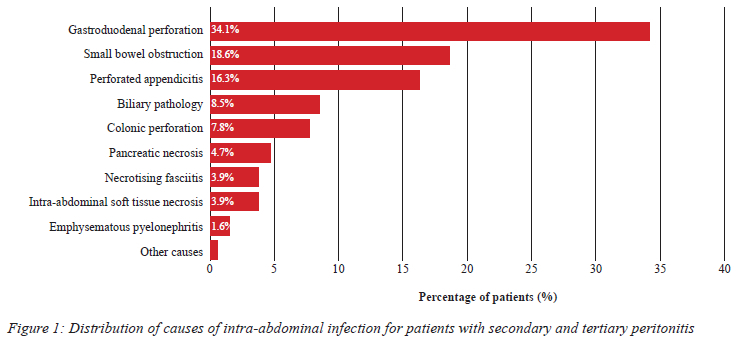
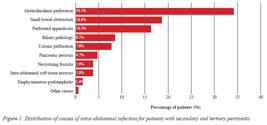
Out of 137 screened patients, 129 met inclusion criteria. The median age was 52 years (IQR 37-65), with 59.7% being male. As is shown in Figure 1, The most common causes of infection were gastroduodenal perforations (34.1%), small bowel obstruction (18.6%) and perforated appendicitis (16.3%).
Disease severity assessment
The mean APACHE II score was 23.2 (SD = 7.8); 42% of patients scored ≥ 25. The mean MPI score was 28.7 (SD = 4.5). The qSOFA mean score was 2.74 (91% of patients scored ≥ 2).
Antimicrobial therapy and resistance patterns
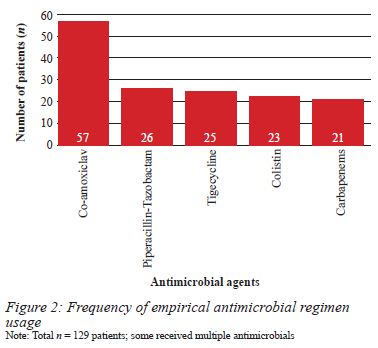
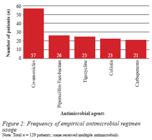
Empirical regimens used included: Amoxicillin-clavulanic acid 44.2% (n = 57), Piperacillin-Tazobactam 20.2% (n = 26), Carbapenems for high-risk infections (suspected nosocomial infection and/or recent antibiotic exposure) 16.3% (n = 21), and Tigecycline 19.4% (n = 25), Colistin 17.8% (n = 23) for MDR cases (Figure 2).
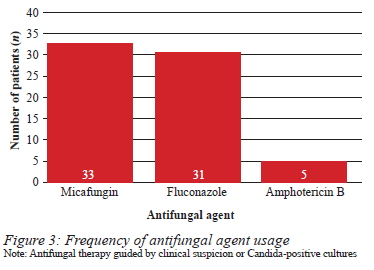
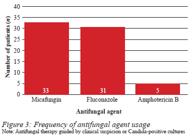
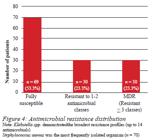
Antifungal agents used were Micafungin 25,6% (n = 33), Fluconazole 24% (n = 31), and Amphotericin B 3.8% (n = 5) (Figure 3). MDR organisms (resistant/non-susceptible to ≥ 1 agent in ≥ 3 antimicrobial classes) were found in 23.3%, with Klebsiella spp. showing the highest resistance rates, followed by E coli and Enterococcus (Figure 4).
Surgical source control strategies
All patients underwent operative source control: laparoscopy attempted in 70.5%; 17.1% required conversion. Open abdomen strategy was used in 20.2%. Ninety-one-point five (91.5%) percent underwent relook laparotomies, and 44.2% required three or more. Relook laparotomies were performed using a hybrid approach: scheduled/planned (mandatory) second look at 24-48 hours for patients with extensive contamination, bowel ischemia, or incomplete source control at index operation; and on-demand relooks for clinical deterioration (rising lactate, persistent fever, increasing vasopressor requirements) or radiological evidence of ongoing sepsis. The decision for ≥ 3 relooks was driven by persistent intra-abdominal contamination, anastomotic complications, or progressive bowel necrosis requiring serial debridement.
Clinical outcomes
The ICU Mortality was 21.7% and prolonged ICU stay (> 15 days) occurred in 42.6% of patients. Most patients developed MODS (75.9%). The mean duration of mechanical ventilation was 5.75 days.
Predictors of mortality
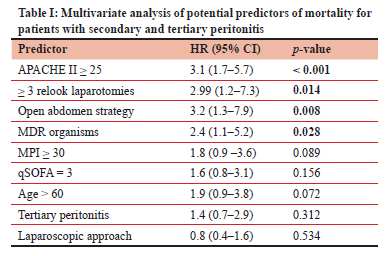
In multivariate analysis, independent predictors of mortality included: APACHE II ≥ 25 (HR 3.1, 95% CI: 1.7-5.7, p < 0.001), ≥ 3 relook laparotomies (HR 2.99, 95% CI: 1.2-7.3, p = 0.014), Open abdomen strategy (HR 3.2, 95% CI: 1.3-7.9, p = 0.008) and the presence of MDR organisms (HR 2.4, 95% CI: 1.1-5.2; p = 0.028) (Table I).
MODS was strongly associated with prolonged ventilation (HR 1.41, 95% CI: 1.14-1.75; p = 0.002, indicating a 41% increased hazard of prolonged mechanical ventilation (> 7 days)).
Discussion
This study affirms that intra-abdominal infections requiring ICU care in LMICs are associated with advanced disease, antimicrobial resistance, and high surgical burden. The mortality rate of 21.7% mirrors international estimates but reflects the added strain of limited resources and delayed care.1920
Regional disease patterns and aetiology
Gastroduodenal perforation (34.11% in this study) remains the predominant cause of peritonitis in Africa,2122
Surgical burden and resource implications
Repeated surgeries and open abdomen strategies, while sometimes unavoidable, increase ICU dependency and complications. Prognostic scoring systems like APACHE II and MPI retained predictive value in this setting, though local calibration may enhance accuracy. The pathophysiological mechanisms linking these predictors to mortality are multifactorial: open abdomen management leads to massive fluid and protein losses, hypothermia, and increased risk of nosocomial infection; repeated laparotomies cause cumulative surgical trauma, immunosuppression, and anastomotic complications; MDR infections limit effective antimicrobial options and prolong sepsis duration; and high APACHE II scores reflect severe physiological derangement with limited reserve capacity. However, these scores were developed primarily in high-income settings and may require local calibration to account for differences in baseline physiology, comorbidity patterns, and resource availability in LMIC contexts. Future research should explore simplified, context-appropriate risk stratification tools that can be rapidly calculated at the bedside without laboratory-intensive parameters.
Limitations
This study is limited by its single-centre design at a tertiary academic hospital, which may limit generalisability to other LMIC settings with different resource constraints and patient populations. Long-term outcomes after ICU discharge, including functional status, quality of life, and late mortality, were not assessed. There may be potential underestimation of tertiary peritonitis cases, as the 48-72-hour definition may not capture all cases of persistent infection. Important unmeasured confounders may include nutritional status at presentation, source of referral (direct vs. transferred), time from symptom onset to surgery, and pre-hospital antibiotic exposure. Additionally, comparative ICU length-of-stay data (median and IQR) for survivors versus non-survivors were not available for this analysis, limiting our ability to fully characterise resource utilisation patterns.
Conclusion
This study offers one of the few prospective insights into secondary and tertiary peritonitis in a sub-Saharan ICU. The findings underscore the importance of early diagnosis, aggressive source control, and resistance monitoring. The high incidence of MODS and antimicrobial resistance demands urgent investment in ICU infrastructure, surgical training, and stewardship programs. Effective antibiotic stewardship in this context requires a protocol-based approach for empirical therapy selection, mandatory infectious disease consultation for MDR cases, daily review of culture results with de-escalation within 48-72 hours when appropriate, and integration of local antibiogram data into treatment algorithms.
Conflict of interest
The authors declare no conflict of interest.
Funding source
This research received no specific grant from any funding agency in the public, commercial, or not-for-profit sectors.
Ethical approval
This study was approved by the Sefako Makgatho Health Sciences University Research Ethics Committee (Reference No: SMUREC/M/02/2022: PG), with waivers of consent granted due to the critical condition of patients.
ORCID
M Elabor https://orcid.org/0009-0009-8594-4441
NC Kalenga https://orcid.org/0000-0002-3225-9653
S Makhadi https://orcid.org/0000-0003-3381-5866
REFERENCES
-
1. Sartelli M, Viale P, Catena F, et al. WSES guidelines for management of intra-abdominal infections. World J Emerg Surg. 2013;8(1):3. https://doi.org/10.1186/1749-7922-8-3.
» https://doi.org/10.1186/1749-7922-8-3 -
2. Marshall JC. Intra-abdominal infections. Microbes Infect. 2004;6(11):1015-25. https://doi.org/10.1016/j.micinf.2004.05.017.
» https://doi.org/10.1016/j.micinf.2004.05.017 -
3. Solomkin JS, Mazuski JE, Bradley JS, et al. Diagnosis and management of complicated intra-abdominal infection. Clin Infect Dis. 2010;50(2):133-64. https://doi.org/10.1086/649554.
» https://doi.org/10.1086/649554 -
4. Levison ME, Bush LM. Peritonitis and intra-abdominal abscesses. In: Mandell, Douglas, and Bennett editors. Principles and Practice of Infectious Diseases. Drexel University Libraries; 2015. p. 935-59. https://doi.org/10.1016/B978-1-4557-4801-3.00076-X.
» https://doi.org/10.1016/B978-1-4557-4801-3.00076-X -
5. Schein M. Surgical management of intra-abdominal sepsis. Langenbecks Arch Surg. 2002;387(5-6):333-41. https://doi.org/10.1007/s00423-002-0276-z.
» https://doi.org/10.1007/s00423-002-0276-z -
6. Tochie JN, Agbor NV, Leonel TTF, et al. Global epidemiology of acute generalised peritonitis: A protocol for a systematic review and meta-analysis. BMJ Open. 2020;10(1):e034326. https://doi.org/10.1136/bmjopen-2019-034326.
» https://doi.org/10.1136/bmjopen-2019-034326 -
7. Buijk SE, Bruining HA. Future directions in the management of tertiary peritonitis. Intensive Care Med. 2002;28(8):1024-9. https://doi.org/10.1007/s00134-002-1383-6.
» https://doi.org/10.1007/s00134-002-1383-6 -
8. Mazuski JE, Solomkin JS. Intra-abdominal infections. Surg Clin North Am. 2009;89(2):421-37, ix. https://doi.org/10.1016/j.suc.2008.12.001.
» https://doi.org/10.1016/j.suc.2008.12.001 -
9. Eckmann C, Dryden M, Montravers P, Kozlov R, Sganga G. Antimicrobial treatment of "complicated" intra-abdominal infections and the new IDSA guidelines? A commentary and an alternative European approach according to clinical definitions. Eur J Med Res. 2011;16(3):115-26. https://doi.org/10.1186/2047-783X-16-3-115.
» https://doi.org/10.1186/2047-783X-16-3-115 -
10. Okoroh JS, Riviello R. Challenges in healthcare financing for surgery in sub-Saharan Africa. Pan Afr Med J. 2021;38:198. https://doi.org/10.11604/pamj.2021.38.198.27115.
» https://doi.org/10.11604/pamj.2021.38.198.27115 -
11. Chu KM, Ford N, Trelles M. Operative mortality in resource limited settings: The experience of Medecins Sans Frontieres in 13 countries. Arch Surg. 2010;145(8):721-5. https://doi.org/10.1001/archsurg.2010.137.
» https://doi.org/10.1001/archsurg.2010.137 -
12. Launey Y, Duteurtre B, Larmet R, et al. Risk factors for mortality in postoperative peritonitis in critically ill patients. World J Crit Care Med. 2017;6(1):48-55. https://doi.org/10.5492/wjccm.v6.i1.48.
» https://doi.org/10.5492/wjccm.v6.i1.48 -
13. Memon AA, Siddiqui FG, Abro AH, et al. An audit of secondary peritonitis at a tertiary care university hospital of Sindh, Pakistan. World J Emerg Surg. 2012;7:6. https://doi.org/10.1186/1749-7922-7-6.
» https://doi.org/10.1186/1749-7922-7-6 -
14. Meara JG, Leather AJ, Hagander L, et al. Global Surgery 2030: evidence and solutions for achieving health equity. Lancet. 2015;386(9993):569-624. https://doi.org/10.1016/S0140-6736(15)60160-X.
» https://doi.org/10.1016/S0140-6736(15)60160-X -
15. Statistics South Africa. Mid-year population estimates, 2022. Report P0302. Pretoria: Statistics South Africa; 2022. Available from: https://www.statssa.gov.za/publications/P0302/P03022022.pdf.
» https://www.statssa.gov.za/publications/P0302/P03022022.pdf -
16. Demmel N, Maag K, Osterholzer G. Wertigkeit klinischer Parameter zur Prognosebeurteilung der Peritonitis - Validierung des Mannheimer Peritonitis-Index [The value of clinical parameters for determining the prognosis of peritonitis - validation of the Mannheim Peritonitis Index]. Langenbecks Arch Chir. 1994;379(3):152-8. https://doi.org/10.1007/BF00680111.
» https://doi.org/10.1007/BF00680111 -
17. Knaus WA, Draper EA, Wagner DP, Zimmerman JE. APACHE II: a severity of disease classification system. Crit Care Med. 1985;13(10):818-29. https://doi.org/10.1097/00003246-198510000-00009.
» https://doi.org/10.1097/00003246-198510000-00009 -
18. Vincent JL, Moreno R, Takala J. The SOFA (Sepsis-related Organ Failure Assessment) score. Intensive Care Med. 1996;22(7):707-10. https://doi.org/10.1007/BF01709751.
» https://doi.org/10.1007/BF01709751 -
19. World Health Organization. Global action plan on antimicrobial resistance. Geneva: World Health Organization; 2015. Available from: https://Iris.who.int>handle>9789241509763eng.
» https://Iris.who.int>handle>9789241509763eng -
20. Ntirenganya F, Ntakiyiruta G, Kakande I. Prediction of outcome using the Mannheim Peritonitis Index in patients with peritonitis at Kigali University Teaching Hospital [Internet]. ECAJS. 2012;17(2):52-64. Available from: https://www.ecajs.org/article/119498.
» https://www.ecajs.org/article/119498 -
21. Hameed T, Kumar A, Sahni S, Bhatia R, Vidhyarthy AK. Emerging spectrum of perforation peritonitis in developing world. Front Surg. 20205;7:50. https://doi.org/10.3389/fsurg.2020.00050.
» https://doi.org/10.3389/fsurg.2020.00050 -
22. Mortensen LQ, Andresen K, Thygesen L, Pommergaard HC, Rosenberg J. Diverticulitis is associated with increased risk of colon cancer-A nationwide register-based cohort study. J Clin Med. 2024;13(9):2503. https://doi.org/10.3390/jcm13092503.
» https://doi.org/10.3390/jcm13092503