Injury patterns in motorbike collisions - a retrospective review in an urban trauma unit in Johannesburg, South Africa
Abstract
BACKGROUND: Motorbike collisions (MBC) pose significant public health challenges in low- to middle-income countries (LMICs), particularly in urban settings. This study examines the injury patterns of patients involved in MBCs at the Charlotte Maxeke Johannesburg Academic Hospital (CMJAH) trauma unit over a two-year period (May 2022 to Apri 2024). METHODS: This was a retrospective review of all patients involved in MBCs. RESULTS: A total of 134 patients were identified, predominantly male (97.1%), with a mean age of 32 years (SD ± 8.8) Most of these incidents were work-related, highlighting the increasing use of motorbikes for commercial purposes, including food delivery. The analysis revealed that head injuries were present in 22.4% of patients, with 9.7% sustaining facial fractures and one patient presenting with a cervical spine injury. Chest injuries were reported in 21.6% of cases, while abdominal and pelvic injuries occurred in 8.2% and 6.7% of patients, respectively. The predominant injuries were long bone fractures, with 58 patients affected. The mean injury severity score (ISS) was 25 (SD plus-minus 2), indicating high levels of trauma. The mortality rate after an MBC was 2.2%. Two patients died in the emergency department due to severe injuries. The findings underscore the complexity of injuries sustained in MBCs, which often involve multiple body regions. CONCLUSION: This study highlights the urgent need for targeted interventions to enhance the safety of motorbike riders in urban areas, particularly as the prevalence of MBCs rises in association with commercial transport services. Improved trauma care and public health strategies are essential to address the ongoing challenge of motorbike-related injuries in Johannesburg and similar urban contexts.
motorbike; injury; fractures; head injury; femur fracture; rib fractures
Introduction
Trauma is one of the leading causes of death globally.123
Between 2010 and 2021, the number of people who died in traffic incidents in Africa rose by 17% despite global road traffic deaths (RTD) decreasing by 15%.42555
Motorbikes are widely used in low- to middle-income countries (LMICs) for public transport and delivery services.6 677
The food industry in South Africa is growing driven by the increasing numbers and convenience of food delivery applications.8888
The most fatal road accidents are those to motorcyclists.8,9 Head injuries are the most fatal injury described in MBCs.8,9 Injuries sustained in MBCs are classified into low side, high side, top side and collision.99
A previous study in Tembisa, South Africa, described orthopaedic injuries sustained in e-hailing motorbike accidents.1010101010,11
There are few studies to improve safety of motorbike riders in Africa,11
Methods
This was a retrospective review of all patients involved in MBC seen in the Charlotte Maxeke Johannesburg Academic Hospital (CMJAH) trauma unit over 2 years (1 May 2022 to 30 April 2024). Patients 18 years and older were included in the study. Those with missing records were excluded from the study.
Data was collected from the emergency department (ED) records. Clinical records and Medibank forms were reviewed. The data collected included demographics, physiological status in ED (blood pressure [BP], pulse rate, respiratory rate, Glasgow Coma Scale [GCS], the base excess, lactate levels,) revised trauma score (RTS) in ED and transfusion requirements during the first 24 hours. The injury severity score (ISS) and the new injury severity score (NISS) were also documented. The disposition of the patient was also noted. In the case of in-hospital mortality, the determination of the cause of the mortality was noted.
Assessment and treatment
MBC patients who presented as priority one patients were resuscitated by the trauma team. The team is made up of 2 doctors and 2 nurses. The initial evaluation is done by the general surgery trainee rotating in the trauma unit, with trauma consultant cover. The primary survey and secondary survey are conducted by the team. Other surgical specialties were consulted after the adjuncts of the secondary survey are completed.
Statistical analysis
Means (standard deviations, SD) and medians (interquartile ranges, IQR) were calculated for normally distributed and skewed continuous variables, respectively. Frequencies and percentages were used to describe distributions of categorical variables.
All analyses were done using STATA version 18 (StataCorp. (2023). Stata Statistical Software: Release 18. College Station, TX: StataCorp LLC). Continuous variables were first tested for normality using the Shapiro-Wilk test. Fisher's exact test was used to test the significance of the relationship between categorical variables. Ap-value of < 0.05 was considered statistically significant.
Results
There were 134 patients involved in MBC identified. There were 130 males. The mean age was 32 years (SD ± 8.8). The majority (97.1%) of patients were involved in MBC for work related purposes. The majority of patients had more than 1 body region injured (polytrauma). The mortality rate after an MBC was 2.2%. Two patients died in the ED due to a bleeding pelvis and another due to a severe head injury. One patient died on the theatre table from a bleeding liver injury.
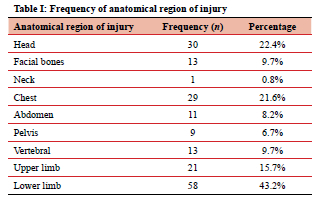
Injuries sustained were mostly to the lower limb, head and chest (Table I). Soft tissue injuries were present in 17.4% (n = 23).
The most common brain injury was a concussion (mild traumatic brain injury) (88.7%). The computed tomography (CT) findings revealed intracerebral haemorrhage in 56% (n = 17), traumatic subarachnoid in 46.7 % (n = 14), subdural haematoma in 26.7% (n=8), extradural haematoma in 10% (n = 3) and skull fractures in 10% (n = 3). Fifteen patients sustained moderate to severe head injury according to the GCS. Eighteen patients needed intubation and ventilation after an MBC.
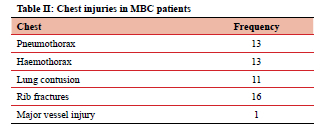
Rib fractures were the most commonly occurring injury to the chest, followed by pneumothorax and haemothorax (Table II). Ten patients had solid organ injuries that were managed non-operatively, liver (n = 4), spleen (n = 3), kidney (n = 2) and minor pancreatic injury (n = 1). Six patients (4.5%) required emergency laparotomy for small bowel and large bowel injuries. Two patients had bladder injuries associated with pelvic fractures which needed repair.
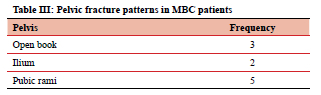
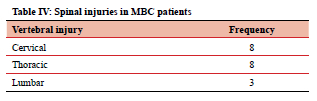
Ten patients sustained a pelvic fracture (Table III). Three patients sustained dislocations, with the involved joints being hip, knee and shoulder. Cervical and thoracic spine injuries occurred in 8 patients each (Table IV).
Five patients had popliteal artery injuries with three having an associated tibial plateau fracture. Two patients had blunt aortic injuries. One patient had an axillary artery injury. Four patients had primary lower limb amputations, two for mangled limbs and two for popliteal artery injuries with non-viable limbs at time of surgery.
On presentation to the ED, the mean systolic and diastolic blood pressures were 128 mmHg (SD ± 21) and 81 mmHg (SD ± 16). The median pulse was 88 beats per minute (IQR 78-147). Four patients (3%) presented with severe metabolic acidosis (pH7.2). The mean pH in the ED was 7.36 (SD ± 0.76). The median lactate and base excess were 2.5 mmol/l (IQR 1.4-9.1) and -4 (IQR -1.8 to -15.4) respectively. The mean haemoglobin was 14 g/dl (SD ± 2). Among the patients requiring blood transfusion, six patients required massive transfusion protocol with 93.2% patients receiving a single unit of blood during the resuscitation period.
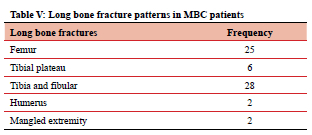
Most patients were polytrauma patients with the chest and long bones commonly injured. The average ISS and NISS were 25 and 32, respectively. Long bone fractures were the most common injury (Table V).
Orthopaedic surgery admitted the most patients (38.2%). Twenty-nine per cent were discharged home from the ED. Twenty-four per cent of patients were admitted to the trauma unit (ward), with 55% of these being trauma ICU admissions. Only 5 (4.1%) patients were admitted to the neurosurgical ward. Six patients were stepped down to our referring district hospitals for neurological observation.
Discussion
There is a rise in MBCs, especially with rise in food delivery applications.7,10 A previous study at CMJAH had 259 patients over 7 years.1213
Studies have shown that the majority of motorbike riders are male.10,13 This was also noted in our study group. Previous studies found young commercial motor riders to be injured often due to risk-taking behaviour.141010
Riders are susceptible to limb fractures due to their exposure.101097,9 It is a common mechanism of injury. The most common injuries are tibia fractures.15
MBC can result in disablement.16916
Head and facial fractures are frequently observed in MBC.179,17 In a systematic review, the most common brain injury observed was a concussion (mild TBI).1819
Chest and abdominal injuries pose a risk of death in trauma patients. Chest injuries are common with MBC.19 20
Pelvic fractures in MBC are attributed to the patient contacting the fuel tank during the collision.9
The low mortality rate of 2.2% in this study group might be attributed to the trauma resuscitation teamwork or those with severe injuries died on scene.
This is one of the few studies looking at the injury pattern of MBC in LMICs. It includes all patients presenting to the emergency department. We recommend motorbike patients be seen by a general surgery or trauma team initially to identify all life-threatening injuries. There is a critical need for medical insurance that includes commercial riders, as the healthcare system is already overwhelmed with cases. This coverage will facilitate early treatment and help individuals return to work. Establishing a central system for collecting and analysing data on commercial motorbike accidents may inform future policies and identify high risk areas.
The limitations of the study include that it is a retrospective review done at a single centre. There is no long-term follow-up on patients included in the study. Future prospective outcome studies in MBC patients are essential for enhancing our understanding and improving trauma care.
Conclusions
This study highlights the urgent need for targeted interventions to enhance the safety of motorbike riders in urban areas, particularly as the prevalence of MBCs rises in association with commercial transport services. Improved trauma care and public health strategies are essential to address the ongoing challenge of motorbike-related injuries in Johannesburg and similar urban contexts.
Conflict of interest
The authors declare no conflict of interest.
Funding source
No funding was required.
Ethical approval
Ethical approval was obtained from the University of the Witwatersrand Human Ethics Committee and the hospital CEO. Ethics number M201134.
ORCID
S Makhadi https://orcid.org/0000-0003-3381-5866
Q Qwabe https://orcid.org/0009-0001-2873-1679
REFERENCES
-
1. Rossiter ND. Trauma-the forgotten pandemic? Int Orthop. 2022;46(1):3-11. https://doi.org/10.1007/s00264-021-05213-z.
» https://doi.org/10.1007/s00264-021-05213-z - 2. World Health Organization (WHO). Global Status Report on Road Safety 2018. Geneva, Switzerland: The World Health Organization (WHO); December 2018.
-
3. Babaie M, Joulani M, Ranjbar Hameghavandi MH, et al. Risk of permanent medical impairment after road traffic crashes: a systematic review. Chin J Traumatol. 2023;26(5):267-75. https://doi.org/10.1016/j.cjtee.2022.11.002.
» https://doi.org/10.1016/j.cjtee.2022.11.002 - 4. World Health Organization (WHO). Road safety in the WHO African Region 2023. Geneva, Switzerland: The World Health Organization (WHO); December 2023.
-
5. State of Road Safety in South Africa. Road Traffic Management Corporation (RTMC). 2022. Available from: https://www.rtmc.co.za/images/rtmc/docs/traffic_reports/calendar/2022-State_of_Road_Safety_Report.pdf. Accessed 15/03/24.
» https://www.rtmc.co.za/images/rtmc/docs/traffic_reports/calendar/2022-State_of_Road_Safety_Report.pdf -
6. Peters K, Jenkins J, Ntramah S, et al. COVID-19 and the motorcycle taxi sector in Sub-Saharan African cities: A key stakeholders' perspective. Transp Res Rec. 2023;2677(4):751-64. https://doi.org/10.1177/03611981221131538.
» https://doi.org/10.1177/03611981221131538 -
7. Demir N, Sayar S, Dokur M, et al. Analysis of increased motorcycle accidents during the COVID-19 pandemic: A single-centre study from Türkiye. Ulus Travma Acil Cerrahi Derg. 2024;30(2):114-22. https://doi.org/10.14744/tjtes.2024.08791.
» https://doi.org/10.14744/tjtes.2024.08791 -
8. Asher-Schapiro KH. Risks for South Africa's food couriers surge during the pandemic. Available from: https://www.context.news/socioeconomic-inclusion/long-read/risks-for-south-africas-food-couriers-surge-during-the-pandemic?utm_source=news-trust&utm_medium=redirect&utm_campaign=context&utm_content=article. Accessed 16 March 24.
» https://www.context.news/socioeconomic-inclusion/long-read/risks-for-south-africas-food-couriers-surge-during-the-pandemic?utm_source=news-trust&utm_medium=redirect&utm_campaign=context&utm_content=article -
9. Petit L, Zaki T, Hsiang W, Leslie MP, Wiznia DH. A review of common motorcycle collision mechanisms of injury. EFORT Open Rev. 2020;5(9):544-8. https://doi.org/10.1302/2058-5241.5.190090.
» https://doi.org/10.1302/2058-5241.5.190090 - 10. Govender ST, Connellan GI, Ngcoya NS. Orthopaedic-related trauma in e-hailing motorcycle drivers at a single centre in South Africa. SA Orthop. 2024;23(2):82-5.
-
11. Ntramah S, Peters K, Jenkins J, et al. Safety, health and environmental impacts of commercial motorcycles in Sub-Saharan African cities. Urban, Planning and Transport Research. 2023;11(1). https://doi.org/10.1080/21650020.2023.2259233.
» https://doi.org/10.1080/21650020.2023.2259233 -
12. Pswarayi R, Moeng MS. Trauma patients at risk of in-hospital mortality. J Surg Case Rep. 2022:5(5). https://doi.org/10.31579/2690-1897/125.
» https://doi.org/10.31579/2690-1897/125 -
13. Konlan KD, Hayford L. Factors associated with motorcycle-related road traffic crashes in Africa, a scoping review from 2016 to 2022. BMC Public Health. 2022;22(1):649. https://doi.org/10.1186/s12889-022-13075-2.
» https://doi.org/10.1186/s12889-022-13075-2 -
14. Wong JT, Chung YS, Huang SH. Determinants behind young motorcyclists' risky riding behaviour. Accid Anal Prev. 2010;42(1):275-81. https://doi.org/10.1016/j.aap.2009.08.004.
» https://doi.org/10.1016/j.aap.2009.08.004 -
15. Batista F dos S, Silveira LO, Castillo JJ, et al. Epidemiological profile of extremity fractures in victims of motorcycle accidents. Acta Ortop Bras. 2015;23(1):43-6. https://doi.org/10.1590/1413-78522015230100998.
» https://doi.org/10.1590/1413-78522015230100998 -
16. Alghnam S, Alsulaim HA, BinMuneif YA, et al. Injuries following motorcycle crashes at a level 1 trauma centre in Riyadh. Ann Saudi Med. 2019;39(3):185-91. https://doi.org/10.5144/0256-4947.2019.185.
» https://doi.org/10.5144/0256-4947.2019.185 -
17. Joshi UM, Ramdurg S, Saikar S, et al. Brain injuries and facial fractures - a prospective study of incidence of head injury associated with maxillofacial trauma. J Maxillofac Oral Surg. 2018;17(4):531-7. https://doi.org/10.1007/s12663-017-1078-8.
» https://doi.org/10.1007/s12663-017-1078-8 -
18. Giovannini E, Santelli S, Pelletti G, et al. Motorcycle injuries: A systematic review for forensic evaluation. Int J Legal Med. 2024;138(5):1907-24. https://doi.org/10.1007/s00414-024-03250-y.
» https://doi.org/10.1007/s00414-024-03250-y -
19. Liu BC, Ivers R, Norton R, et al. Helmets for preventing injury in motorcycle riders. Cochrane Database Syst Rev. 2008;1:CD004333. https://doi.org/10.1002/14651858.CD004333.pub3.
» https://doi.org/10.1002/14651858.CD004333.pub3 -
20. Guerrero MA, Lin PH, Bush RL, et al. Splenic and pancreatic infarction due to motorcycle handlebar injury. J Trauma. 2005;58(6):1304. https://doi.org/10.1097/01.TA.0000169427.28625.97.
» https://doi.org/10.1097/01.TA.0000169427.28625.97