Eight-year survival with metastatic oesophageal carcinoma: a case report and review of the literature
Abstract
Oesophageal cancer is common and holds a poor prognosis, with an estimated 604 000 new cases in 2020 and 544 000 deaths globally. South Africa has an incidence of 4.41 and 2.39 new cases of oesophageal cancer per 100 000 males and females respectively, with up to 95% predominance of squamous cell carcinoma (SCC). Five-year survival in patients with distant metastasis is less than 5%. We present a remarkable case of a patient with metastatic oesophageal SCC who survived eight years post-palliative chemotherapy despite being lost to follow-up.
oesophageal cancer; metastatic disease; palliative stent; palliative chemotherapy; long-term survival
CASE REPORT
Eight-year survival with metastatic oesophageal carcinoma: a case report and review of the literature
H KasaiI; W BeggII; M MihalikIII, IV
IDepartment of General Surgery, Paarl Hospital, South Africa
IIDepartment of Oncology, Tygerberg Hospital, South Africa
IIIDepartment of General surgery, New Somerset Hospital, South Africa
IVDepartment of General Surgery, Groote Schuur Hospital, South Africa
SUMMARY
Oesophageal cancer is common and holds a poor prognosis, with an estimated 604 000 new cases in 2020 and 544 000 deaths globally. South Africa has an incidence of 4.41 and 2.39 new cases of oesophageal cancer per 100 000 males and females respectively, with up to 95% predominance of squamous cell carcinoma (SCC). Five-year survival in patients with distant metastasis is less than 5%. We present a remarkable case of a patient with metastatic oesophageal SCC who survived eight years post-palliative chemotherapy despite being lost to follow-up.
Keywords: oesophageal cancer, metastatic disease, palliative stent, palliative chemotherapy, long-term survival
Case report
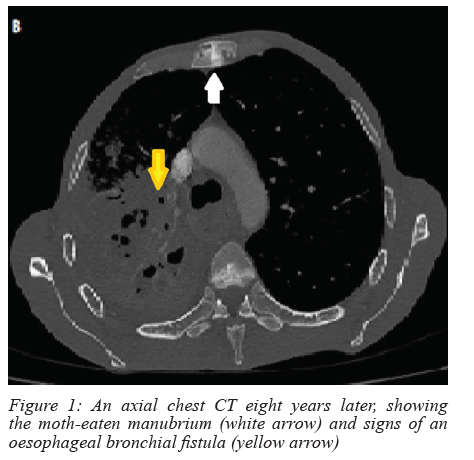
A 40-year-old male presented with symptoms of dysphagia to solids, loss of weight, chronic cough and post-prandial vomiting. The patient claimed to have been treated for "lung cancer" many years ago, which prompted imaging to assess for recurrence of pulmonary disease. A computerised tomography (CT) scan of his chest showed a suspicious long segment oesophageal thickening with associated oesophageal-pulmonary fistula and multiple mediastinal lymph nodes. A moth-eaten manubrium and signs of an oesophageal bronchial fistula were also evident (Figure 1). The patient underwent careful endoscopy which revealed an oesophageal tumour at 30 cm from the incisors and a suspected tracheoesophageal fistula, with an inability to enter the oesophageal-gastric junction. The biopsies taken confirmed oesophageal squamous cell carcinoma (SCC).
On further history, the patient revealed that he had been treated eight years previously for complete dysphagia to solids and liquids. Hospital records pertaining to that admission were retrieved. These revealed that an upper endoscopy at the time showed a gastroesophageal tumour which was confirmed to be a non-keratinising SCC. A staging CT scan had shown an oesophageal tumour extending from the level of the 9th-11th thoracic vertebrae with necrotic mediastinal lymph nodes and liver metastases in segment 8. He received a palliative oesophageal stent and completed six cycles of chemotherapy with cisplatin and 5-fluorouracil (FU). A follow-up CT scan was performed six months later to evaluate response to chemotherapy and showed a distal oesophageal and oesophageal-gastric junction thickening, a migrated stent and subcarinal lymph nodes. The posterior manubrium was disrupted and moth-eaten suggesting metastases, but there were no liver lesions. There were unfortunately no subsequent clinical notes found, and it appears that the patient was lost to follow-up until he represented to us eight years later.
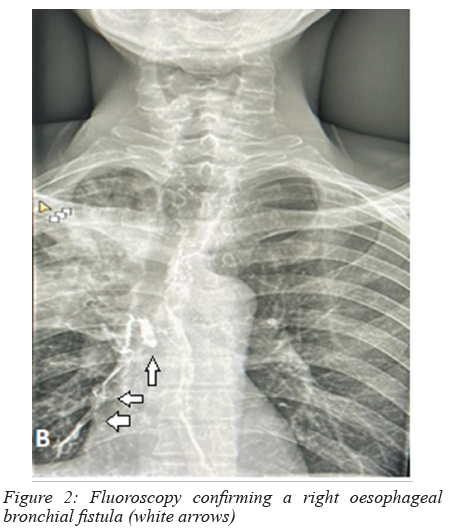
During this admission, fluoroscopy in conjunction with the CT scan confirmed a right oesophageal-bronchial fistula (Figure 2), and he underwent repeat oesophageal stenting. He was able to tolerate clear fluids on discharge and was referred for further palliative care. Unfortunately, he died a few months later.
Discussion
Oesophageal cancer ranks 7th in incidence and 6th in mortality, and has a mortality-to-incidence ratio of 90.1% globally.123453
Palliative stenting allows for continued oral nutrition, improved metabolic status, and quality of life. It also provides for subsequent therapy, like chemotherapy, to be continued.6
Our patient received cisplatin and 5-FU, which is the most widely used combination chemotherapy regimen for palliative chemotherapy.789
There have been cases of long-term survival in patients with metastatic oesophageal cancer when treated aggressively with chemoradiotherapy and/or surgical resection. Picket et al.1010 10
Conflict of interest
The authors declare no conflict of interest.
Funding source
No funding source to be declared.
Ethical approval
The authors declare that this submission is in accordance with the principles laid down by the Responsible Research Publication Position Statements as developed at the 2nd World Conference on Research Integrity in Singapore, 2010. Informed written consent was obtained from the patient in the study.
ORCIDH Kasai https://orcid.org/0000-0002-9742-6731
REFERENCES
-
1. Sung H, Ferlay J, Siegel RL, et al. Global Cancer Statistics 2020: GLOBOCAN Estimates of Incidence and Mortality Worldwide for 36 Cancers in 185 Countries. CA Cancer J Clin. 2021;71(3):209-49. https://doi.org/10.3322/caac.21660.
» https://doi.org/10.3322/caac.21660 -
2. Asomban AW, Chishinga N, Nkhoma A, et al. Systematic review and meta-analysis of oesophageal cancer in Africa: epidemiology, risk factors, management and outcomes. World J Gastroenterol. 2019;25(31):4512-33. https://doi.org/10.3748/wjg.v25.i31.4512.
» https://doi.org/10.3748/wjg.v25.i31.4512 -
3. Ferndale L, Aldous C. Oesophageal cancer in South Africa. A scoping review. S Afr J Oncol. 2022;6(1):1-9. https://doi.org/10.4102/sajo.v6i1.217.
» https://doi.org/10.4102/sajo.v6i1.217 -
4. Vendrely V, Launay V, Najah H, et al. Prognostic factors in oesophageal cancer treated with curative intent. Dig Liver Dis. 2018;50(10):991-6. https://doi.org/10.1016/j.dld.2018.08.002.
» https://doi.org/10.1016/j.dld.2018.08.002 -
5. Jamel S, Tukanova K, Markar SR. Detection and management of oligometastatic disease in oesophageal cancer and identification of prognostic factors: a systematic review. World J Gastrointest Oncol. 2019;11(9):741-9. https://doi.org/10.4251/wjgo.v11.i9.741.
» https://doi.org/10.4251/wjgo.v11.i9.741 -
6. Wlodarczyk J, Kuzdzal J. Stenting in palliation of unresectable oesophageal cancer. World J Surg. 2018;42(12)3988-96. https://doi.org/10.1007/s00268-018-4722-7.
» https://doi.org/10.1007/s00268-018-4722-7 -
7. Behrens A, Ell C, Lordick F. Perioperative and palliative chemotherapy for oesophageal cancer. Visz Gastrointest Med Surg. 2015;31(5):341-6. https://doi.org/10.1159/000438470.
» https://doi.org/10.1159/000438470 -
8. Hiramoto S, Kato K, Shoji H, et al. A retrospective analysis of 5-fluorouracil plus cisplatin as first-line chemotherapy in the recent treatment strategy for patients with metastatic or recurrent oesophageal squamous cell carcinoma. Int J Clin Oncol. 2018;23(3):466-72. https://doi.org/10.1007/s10147-018-1239-x.
» https://doi.org/10.1007/s10147-018-1239-x -
9. Liu Y, Xiong Z, Beasley A, D'Amico T, Chen XL. Personalised and targeted therapy of oesophageal squamous cell carcinoma: an update. Ann N Y Acad Sci. 2016;1381(1):66-73. https://doi.org/10.1111/nyas.13144.
» https://doi.org/10.1111/nyas.13144 -
10. Pickett L, Dunne M, Monaghan O, et al. Oesophageal cancer metastases: an observational study of a more aggressive approach. World J Gastrointest Surg. 2022;14(9):997-1007. https://doi.org/10.4240/wjgs.v14.i9.997.
» https://doi.org/10.4240/wjgs.v14.i9.997