Ileus following duodenal stent fracture and migration: a rare occurrence
Abstract
An 80-year-old male with a history of intermittent, colicky, abdominal pain for one month duration, presented with acute exacerbation of his symptoms. The patient had had a covered, duodenal stent placed 10 years earlier due to a benign stricture. The cause of obstruction was revealed to be stent fracture with subsequent migration and embedding of a stent fragment into the jejunal wall. The affected jejunum was resected. Postoperative recovery was uneventful. To the best of the authors' knowledge, no similar complication has been reported. Further research is needed into outcomes for duodenal stents indicated for benign strictures.
duodenal; stent; migration; fracture; ileus
CASE REPORT
Ileus following duodenal stent fracture and migration: a rare occurrence
I Nađj; V Čolović; S Guslarević; S Todorović; B Tošković
University Hospital Medical Centre Bežanijska Kosa, Serbia
SUMMARY
An 80-year-old male with a history of intermittent, colicky, abdominal pain for one month duration, presented with acute exacerbation of his symptoms. The patient had had a covered, duodenal stent placed 10 years earlier due to a benign stricture. The cause of obstruction was revealed to be stent fracture with subsequent migration and embedding of a stent fragment into the jejunal wall. The affected jejunum was resected. Postoperative recovery was uneventful.
To the best of the authors' knowledge, no similar complication has been reported. Further research is needed into outcomes for duodenal stents indicated for benign strictures.
Keywords: duodenal, stent, migration, fracture, ileus
Case report
An 80-year-old male patient with a history of intermittent, colicky, abdominal pain for one month duration, presented with acute exacerbation of his symptoms. The patient had had an open cholecystectomy 10 years earlier due to acute cholecystitis caused by gallstones. He also had a metal, covered, duodenal stent placed endoscopically due to a benign, duodenal stricture. The patient had no significant comorbidities nor other previous abdominal surgery.
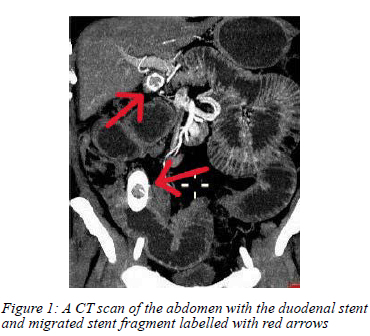
An abdominal X-ray showed signs of bowel obstruction. The patient was started on intravenous rehydration and symptomatic treatment. This was followed by a computed tomography (CT) scan of the abdomen and pelvic region. The abdominal CT revealed a foreign body of metallic density in the region of the second part of the duodenum that correlated with the previously placed stent. In the region of the ileo-jejunal junction, an impacted stent fragment was visible, which had migrated and led to intestinal obstruction. There was no free fluid visible in the abdominal cavity nor visible signs of intestinal perforation (Figure 1).
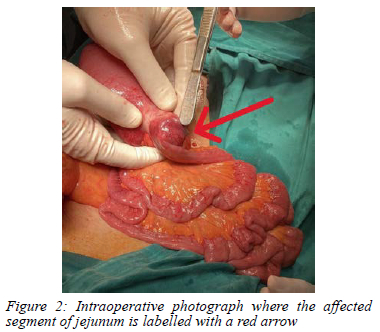
Due to the previous laparotomy as well as the uniqueness of this case, a decision was made to proceed with open rather than laparoscopic surgery. Upon gaining access to the abdominal cavity, there were dilated loops of the jejunum, just proximal to the ileo-jejunal junction, with chronic infiltration in the inner jejunal wall where the stent had migrated and become embedded (Figure 2). In these circumstances, around 50 cm of the jejunum was resected and repaired with a side-to-side anastomosis using a double stapler technique. Postoperative pathohistology confirmed the benign nature of the lesion.
Postoperative recovery was uneventful. The patient was discharged on the eighth postoperative day. Subsequent follow-ups have also been uneventful, and the patient has been alive and well for the past 6 years.
Discussion
Endoscopic, duodenal stent placement was first described in 1992 for a patient with intestinal obstruction due to gastric cancer. This revolutionary technique soon became widely accepted and was followed by many studies aimed at comparing its results with those of the more classical surgical approach involving biliodigestive anastomoses.111212
Certain complications of endoscopic treatment can be dependent on the type of stent used: uncovered stents are most often complicated by restenosis and tissue ingrowth. Duodenal stent migration is significantly more common with completely covered stents, with a rate of 20-40%,3,4 meanwhile the migration of partially covered and uncovered stents is significantly rarer, 2.4% and 1.6%, respectively.3,5
Management of stent migration can be non-invasive or invasive. Non-invasive management consists of observation combined with symptomatic therapy until spontaneous passage of the stent. Invasive management involves endoscopic or surgical procedures. The ileocaecal valve presents a considerable barrier to the passage of metal stents, resulting in a significant risk of consequent bowel obstruction and/or perforation. Ko et al.67
Stent fracture is a rare complication of duodenal stents. Its incidence, according to previous reports, is 0-4.8%.858
Stent placement due to benign strictures is rare and the majority of studies examining outcomes only include patients with malignant obstruction.910
To the best of the authors' knowledge, no previous case of stent fracture, migration and then embedding in the small intestinal wall causing ileus 10 years after placement has been previously described. Fujikawa et al.8
Conflict of interest
The authors declare no conflict of interest.
Funding source
No funding was required.
ORCIDI Nađj https://orcid.org/0000-0003-2555-9444
V Čolović https://orcid.org/0009-0001-7931-0276
S Guslarević https://orcid.org/0009-0001-0786-9599
S Todorović https://orcid.org/0000-0001-5857-227X
B Tošković https://orcid.org/0000-0002-7054-3778
REFERENCES
-
1. Hosono S, Ohtani H, Arimoto Y, Kanamiya Y. Endoscopic stenting versus surgical gastroenterostomy for palliation of malignant gastroduodenal obstruction: A meta-analysis. J Gastroenterol. 2007;42:283-90. https://doi.org/10.1007/s00535-006-2003-y.
» https://doi.org/10.1007/s00535-006-2003-y -
2. Upchurch E, Ragusa M, Cirocchi R. Stent placement versus surgical palliation for adults with malignant gastric outlet obstruction. Cochrane Database Syst Rev. 2018;5:CD012506. https://doi.org/10.1002/14651858.CD012506.pub2.
» https://doi.org/10.1002/14651858.CD012506.pub2 -
3. Jung K, Ahn JY, Jung HY, et al. Outcomes of endoscopically inserted self-expandable metal stents in malignancy according to the type of stent and the site of obstruction. Surg Endosc. 2016;30(9):4001-10. https://doi.org/10.1007/s00464-015-4712-x.
» https://doi.org/10.1007/s00464-015-4712-x -
4. Malgras B, Lo Dico R, Pautrat K, et al. Gastrointestinal stenting: Current status and imaging features. Diagn Interv Imaging. 2015;96(6):593-606. https://doi.org/10.1016/j.diii.2015.04.001.
» https://doi.org/10.1016/j.diii.2015.04.001 -
5. Kim JW, Jeong JB, Lee KL, et al. Comparison between uncovered and covered self-expandable metal stent placement in malignant duodenal obstruction. World J Gastroenterol. 2015;21:1580-7. https://doi.org/10.3748/wjg.v21.i5.1580.
» https://doi.org/10.3748/wjg.v21.i5.1580 -
6. Ko HK, Song HY, Shin JH, et al. Fate of migrated oesophageal and gastroduodenal stents: Experience in 70 patients. J Vasc Interv Radiol. 2007;18:725-32. https://doi.org/10.1016/j.jvir.2007.02.030.
» https://doi.org/10.1016/j.jvir.2007.02.030 -
7. Hori Y, Hayashi K, Naitoh I, et al. A pilot study of novel duodenal covered self-expandable metal stent fixation. Sci Rep. 2021;11(1):19708. https://doi.org/10.1038/s41598-021-99265-1.
» https://doi.org/10.1038/s41598-021-99265-1 -
8. Fujikawa H, Saigusa S, Aono Y, et al. Small bowel obstruction caused by migration of fractured metal stent in patients with malignant gastric outlet obstruction: A report of two cases and review of the literature. Intern Med. 2024;63(13):1873-8. https://doi.org/10.2169/internalmedicine.2058-23.
» https://doi.org/10.2169/internalmedicine.2058-23 -
9. Cho RS, Magulick J, Madden S, Burdick JS. Choledochoscope with stent placement for treatment of benign duodenal strictures: A case report. World J Gastrointest Endosc. 2019;11(3):256-61. https://doi.org/10.4253/wjge.v11.i3.256.
» https://doi.org/10.4253/wjge.v11.i3.256 -
10. Kim JH, Shin JH, Song HY. Benign strictures of the oesophagus and gastric outlet: Interventional management. Korean J Radiol. 2010;11(5):497-506. https://doi.org/10.3348/kjr.2010.11.5.497.
» https://doi.org/10.3348/kjr.2010.11.5.497