Upper gastrointestinal endoscopy training: impact of the COVID pandemic on general surgery trainees
Abstract
BACKGROUND: Upper gastrointestinal endoscopy (UGE) is a vital skill for general surgeons, yet the adequacy of training in low-resource settings like South Africa remains unclear. This study assesses endoscopy training for general surgery registrars at Groote Schuur Hospital, with a focus on the impact of the COVID-19 pandemic. METHODS: A retrospective analysis of the Upper Gastrointestinal Surgery Registry was conducted from 1 April 2018 to 30 September 2024. Data on diagnostic and interventional UGEs were reviewed across three periods: pre-COVID-19, during COVID-19, and post-COVID-19. Registrar exposure was evaluated based on the number of procedures performed during a standard three-month rotation. Descriptive and comparative statistical methods were applied (p < 0.05). RESULTS: Of 12 455 UGEs, 6 901 (55.3%) were performed by registrars. Diagnostic procedures accounted for 66.9% of all UGEs, with registrars performing 64.1%, while interventional procedures made up 33.1%, with 37.8% performed by registrars. Training during the COVID-19 period was significantly reduced, with only two registrars completing full rotations, compared to the usual 12-18. Although procedural volume increased post-COVID - 21.8% for diagnostic and 60.2% for interventional UGEs - median registrar exposure per rotation dropped from 131 pre-COVID to 112 post-COVID. This indicates that despite increased service delivery, registrar training opportunities did not return to pre-pandemic levels. CONCLUSION: General surgery registrars at Groote Schuur Hospital receive substantial endoscopy exposure; however, the COVID-19 pandemic disrupted training significantly. Enhancing simulation-based learning and optimising rotations are crucial to ensure adequate competency in UGE.
general surgery training; upper gastrointestinal endoscopy
Introduction
Upper gastrointestinal endoscopy (UGE) is an essential diagnostic and therapeutic procedure, particularly for general surgeons in sub-Saharan Africa. Concerns about the quality and provision of endoscopy training have been highlighted, specifically in the United Kingdom (UK), where traditional methods of assessing competency through estimated procedure numbers or subjective evaluations are being questioned. Increasingly, there is a shift towards objective methods to ensure proper training and proficiency in endoscopy.1,2,3
The Joint Advisory Group on Gastrointestinal Endoscopy (JAG), established in the UK in 1994, has been instrumental in setting standards for endoscopy training and ensuring quality assurance. Despite these advancements, challenges remain. Studies by Hammond et al.22-7 While all surgical trainee endoscopies are directly supervised locally, a standardised competency-based assessment such as DOPS is not followed, with training presently assessed only quantitatively as procedures completed without assistance.
In sub-Saharan Africa, the capacity for endoscopy remains severely limited, with studies conducted by organisations like the African Esophageal Cancer Consortium (AfrECC) revealing critical gaps in healthcare infrastructure, with many countries lacking adequate therapeutic and emergency endoscopy services, equipment and trained personnel. In some countries, the resources available for gastrointestinal endoscopy are less than 10% of those in high-income nations.8-11
Parker et al.81213,14 No recommended guidelines exist for the South African surgical trainee.
During the COVID-19 pandemic practical endoscopy training was significantly disrupted, with an increased reliance on simulation-based training as an alternative. Simulation based endoscopy training opportunities are highly variable both in quality and availability, with no upper endoscopy simulation available at our institution. The pandemic highlighted the importance of adaptable training methods to ensure that surgeons and gastroenterologists continue to develop necessary skills despite such disruptions.15,16
Methods
This study was a retrospective analysis using data from the Upper Gastrointestinal Surgery Registry (UGSR), an ethically approved and prospectively maintained registry (HREC R031/2015) which includes all endoscopic procedures performed within the unit. Conducted at Groote Schuur Hospital (GSH), the study focused on general surgery registrars rotating through the Upper Gastrointestinal Surgery Unit, with each rotation typically lasting three months and including 2-3 registrars. The primary training focus is on diagnostic upper UGEs, with limited exposure to interventional procedures. The unit also accommodates subspecialty medical and surgical gastroenterology fellowship trainees and visiting consultants. Due to the standard rotation being only 3 months, the unit does not follow a formal competency-based assessment, like DOPS, but rather aims to provide the general surgery registrar with quantitative exposure ensuring sufficient practical skills to safely and confidently perform diagnostic UGEs.
The Upper Gastrointestinal Surgery Unit is responsible for three emergency UGE and two interventional lists per week. A consultant is always present in the endoscopy suite. Trainees who are endoscopic novices are taught upper endoscopy sequentially in four steps, performing a single step repeatedly and only proceeding to the next component on satisfaction of the attending consultant performing the UGE. Step one is retroflexion within the stomach to view the proximal stomach; step two is to negotiate from the oesophagus down along the lesser curve to the pylorus; step three is passing through the pylorus into the second part of the duodenum. As the majority of our diagnostic scopes are performed without sedation, the final step of intubating the oesophagus is left until last when the trainee is more adept at handling the endoscope. We find this stepped approach allows time to appreciate the handling of the endoscope, allows for repetitive teaching, with minimal disruption to service delivery and patient discomfort. The speed of progression is individualised to the trainee. The study period spanned 78 months (1 April 2018 - 30 September 2024), divided into three COVID-19-related phases: Pre-COVID-19 (1 April 2018 - 26 March 2020), COVID-19 (27 March 2020 - 1 October 2021), and Post-COVID-19 (2 October 2021 - 30 September 2024). The dates of the 18-month COVID-19 phase were chosen based on the national COVID-19 lockdown period in South Africa.
All endoscopies performed by the Upper GI Surgery Unit at GSH during the study period were included and analysed according to whether a registrar performed the procedure or not. Registrar-performed UGEs included both full and partial procedures, provided the registrar actively handled the endoscope during key components of the case. Analysis of individual registrar endoscopy exposure was performed for all registrars who completed a standard 3-month rotation. Overall numbers of UGEs performed with an adjusted value including the total number of UGEs performed by an individual registrar over time (total rotation time in weeks present in the unit, excluding any periods of absence or leave) were reviewed. This adjusted value gives a more accurate assessment of the exposure related to the time actually spent in the unit. Registrars who joined the unit temporarily or did not complete a full rotation were excluded from the individual registrar analysis; however, their endoscopies performed were still included in the overall analysis. This study was approved by the University of Cape Town Human Research Ethics Committee (HREC 995/2024).
Statistical analysis
Data exploration and analysis were conducted using IBM SPSS Statistics (v29.0) and Microsoft Excel. Descriptive statistics summarised numerical data as means ± standard deviation for normally distributed variables and as medians with interquartile ranges for non-parametric data. Group differences were analysed using t-test for numerical variables, Pearson's chi-square or Fisher's exact test for categorical data, and the Kruskal-Wallis test with post-hoc Mann-Whitney U tests for multi-group comparisons. A p-value of < 0.05 was considered statistically significant.
Results
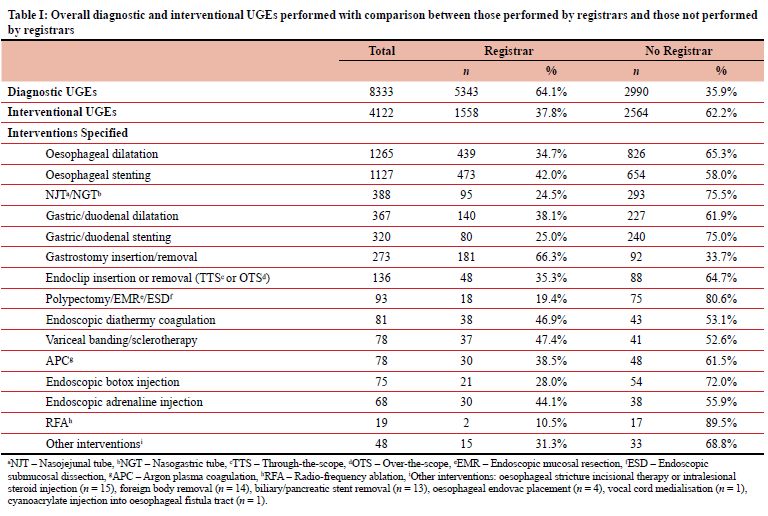
A total of 12 455 UGEs were performed during the 78-month study period, with an average of 159.9 procedures per month. Of these, 8 333 (66.9%) were diagnostic UGEs, while 4 122 (33.1%) were interventional (Table I). Registrars were involved in 6 901 UGEs (55.3%), performing an average of 88.5 procedures per month, with 5 343 (64.1%) being diagnostic and 1 558 (37.8%) interventional.
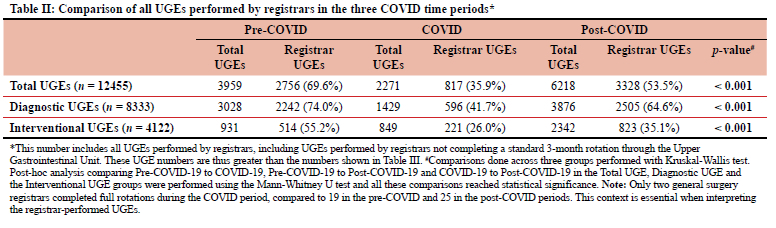
The impact of the COVID-19 pandemic was evident in registrar training volumes. Before the pandemic, 19 registrars were trained, completing 69.6% of UGEs. During the COVID-19 period, only two registrars were trained, completing 35.9% of UGEs, indicating a significant reduction in procedural exposure. In the post-COVID-19 period, 25 registrars were trained, completing 53.5% of UGEs (Table II). It was estimated that 10-16 general surgery registrars missed their rotations due to the pandemic.
When reviewing normal service delivery periods (excluding COVID-19), pre- and post-COVID-19 service delivery requirements to the unit have changed with a clear increasing trend noted. There was a 21.8% increase in diagnostic UGEs performed in the third period compared to pre-COVID-19. Similarly, an even more significant increase was noted in the interventional UGE service delivery requirements to the unit with a 60.2% increase.
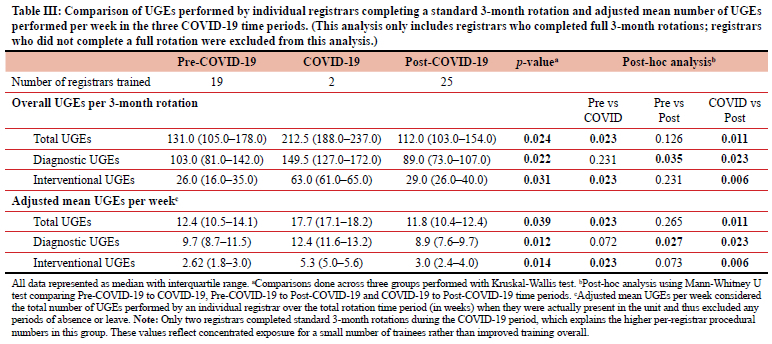
Although the median UGEs per registrar increased during the COVID-19 period (212.5 vs. 131 pre-COVID-19), this was solely due to the reduced number of registrars rotating through the unit. Only two registrars completed full rotations during the COVID-19 timeframe, resulting in a significant loss of training opportunities for the broader cohort. In the post-COVID-19 period, per-registrar exposure declined further, with a median of 112 UGEs (IQR: 103-154). Although total procedural volume increased post-COVID-19 (6218 UGEs for 25 registrars vs. 3959 for 19 registrars pre-COVID-19), resulting in a higher average potential exposure (248 vs. 208 scopes per registrar), this does not reflect real training distribution. The inclusion of an upper GI surgery fellow and rotating medical gastroenterology fellows may have diverted procedural opportunities away from general surgery registrars. Additionally, the greatest increase was seen in interventional procedures, which are less suitable for novice training. A significant reduction in adjusted weekly median UGEs was observed during the COVID-19 and post-COVID-19 periods (p < 0.05), underscoring the pandemic's negative impact on procedural exposure and training continuity (Table III).
Discussion
This study evaluates the UGE training for general surgery registrars at GSH, focusing on procedural exposure, the impact of the COVID-19 pandemic, and alignment with international training standards, such as those recommended by the JAG on gastrointestinal endoscopy.
Registrars performed a substantial proportion (55.3%) of all UGEs, with a focus on diagnostic procedures (64.1%), while participation in interventional procedures remained limited (37.8%). This imbalance reflects the unit's primary objective of ensuring basic diagnostic competency within the three-month rotation. Internationally, JAG emphasises competency-based training with structured assessments like the DOPS and a minimum of 200 diagnostic procedures for competency. However, GSH registrars train within a significantly shorter timeframe, averaging 131 procedures per rotation. Despite this substantial exposure, the absence of structured competency assessments locally limits objective verification of readiness for independent practice.
The COVID-19 pandemic significantly disrupted training, reducing procedural exposure and limiting the number of trained registrars to only two during the pandemic period, compared to 19 pre-COVID-19 and 25 post-COVID-19. The sharp decline in procedural volume (35.9% of UGEs performed during COVID-19) underscores the vulnerability of traditional training models and highlights the need for simulation-based and virtual learning platforms to ensure continuity in skill development during crises. Although the number of UGEs performed per registrar increased during the COVID-19 period, this was a reflection that only one registrar (instead of the usual 2-3) was present during the rotation period. With only two registrars completing the standard training during the COVID-19 period, this reflects very poorly as regards the endoscopic exposure for the registrar group as a whole.
Overall endoscopy exposure rates (including both observation and hands-on training) increased after COVID-19 from 208 (3959 UGEs for 19 registrars) to 248 (6218 UGEs for 25 registrars). However, despite training volumes improving post-pandemic, with registrars performing 53.5% of UGEs, procedural completion remained below pre-pandemic levels (112 vs. 131 UGEs per registrar). This suggests that either the unit has not fully recovered its training capacity, likely due to resource constraints and increased service demands or the training commitments have altered with time. While the post-COVID-19 period showed an increase in total UGEs and a higher average number of procedures per registrar (248 vs. 208 pre-COVID-19), this did not translate into improved hands-on training. The unit now trains a full-time upper GI fellow and periodically hosts medical gastroenterology fellows, which likely reduces the number of cases available to general surgery registrars. In addition, the most substantial increase in volume occurred in interventional UGEs, which are typically consultant- or fellow-led and not suitable for novice registrars. As a result, the increased service load has not necessarily improved the training experience for general surgery registrars.
Compared to international standards, the shorter but intensive training at GSH provides substantial exposure, yet interventional training for general surgical registrars remains limited. This is in part due to the unit now having an obligation to train a full-time upper gastrointestinal surgery fellow plus rotating gastroenterology fellows in interventional endoscopy. While interventional endoscopy training is not the primary aim for a novice endoscopy trainee, incorporating simulation-based training, as seen in international programmes, could enhance procedural competence and bridge gaps in interventional exposure for our general surgery registrars.
The study's strengths include the use of a prospectively maintained registry, allowing a detailed analysis of training outcomes. However, limitations include its retrospective design and the absence of competency-based assessments. Future studies should incorporate validated assessment tools like DOPS to objectively evaluate registrar proficiency. To optimise training, GSH would benefit from competency-based assessments, increased interventional exposure, and extended rotations. Additionally, innovative strategies such as tele-mentoring, modular training, and simulation-based learning could enhance skill acquisition in resource-limited settings, ensuring alignment with global training standards.
Conclusion
The training programme at GSH's Upper GI Surgery Unit provides significant procedural exposure within a short three-month rotation, particularly in diagnostic endoscopy. However, the training duration and volume fall short of international standards, such as those endorsed by JAG, which assume longer training periods and higher procedure counts. Limited interventional exposure further highlights gaps in skill development. While the programme offers a strong foundation, adopting competency-based assessments, expanding interventional training, and integrating simulation-based learning will be crucial to achieving international standards and preparing registrars for independent practice. Addressing these areas will ensure the programme remains competitive and continues to produce highly skilled surgeons.
Conflict of interest
All authors declare no conflict of interest
Funding source
No funding was required.
Ethical approval
This study was approved by the University of Cape Town Human Research Ethics Committee (HREC 995/2024).
ORCIDI Musa https://orcid.org/0009-0008-8214-6578
G Chinnery https://orcid.org/0000-0002-9097-8648
REFERENCES
-
1. Jones RP, Stylianides NA, Robertson AG, Yip VSK, Chadwick G. National survey on endoscopy training in the UK. Ann R Coll Surg Engl. 2015;97(5):386-9. https://doi.org/10.1308/003588415X14181254790400.
» https://doi.org/10.1308/003588415X14181254790400 -
2. Hammond JS, Watson NF, Lund JN, Barton JR. Surgical endoscopy training: the Joint Advisory Group on gastrointestinal endoscopy national review. Frontline Gastroenterol. 2013;4(1):20-4. https://doi.org/10.1136/flgastro-2012-100242.
» https://doi.org/10.1136/flgastro-2012-100242 - 3. Freeman ML. Training and competence in gastrointestinal endoscopy. Rev Gastroenterol Disord. 2001;1(2):73-86. PMID: 12120177.
-
4. Siau K, Green JT, Hawkes ND, et al. Impact of the Joint Advisory Group on Gastrointestinal Endoscopy (JAG) on endoscopy services in the UK and beyond. Frontline Gastroenterol. 2019;10(2):93-106. https://doi.org/10.1136/flgastro-2018-100969.
» https://doi.org/10.1136/flgastro-2018-100969 -
5. Isaacs P. Endoscopic retrograde cholangiopancreatography training in the United Kingdom: A critical review. World J Gastrointest Endosc. 2011;3(2):30-3. https://doi.org/10.4253/wjge.v3.i2.30.
» https://doi.org/10.4253/wjge.v3.i2.30 -
6. Haycock A, Koch AD, Familiari P, et al. Training and transfer of colonoscopy skills: a multinational, randomised, blinded, controlled trial of simulator versus bedside training. Gastrointest Endosc. 2010;71(2):298-307. https://doi.org/10.1016/j.gie.2009.07.017.
» https://doi.org/10.1016/j.gie.2009.07.017 -
7. Haycock AV, Youd P, Bassett P, et al. Simulator training improves practical skills in therapeutic GI endoscopy: Results from a randomised, blinded, controlled study. Gastrointestinal Endoscopy. 2009;70:835-45.e2. https://doi.org/10.1016/j.gie.2009.01.001.
» https://doi.org/10.1016/j.gie.2009.01.001 -
8. Parker RK, Mwachiro MM, Topazian HM, et al. Gastrointestinal endoscopy experience of surgical trainees throughout rural Africa. Surg Endosc. 2021;35(12):6708-16. https://doi.org/10.1007/s00464-020-08174-3.
» https://doi.org/10.1007/s00464-020-08174-3 -
9. Mwachiro M, Topazian HM, Kayamba V, et al. Gastrointestinal endoscopy capacity in Eastern Africa. Endosc Int Open. 2021;9(11):E1827-E1836. https://doi.org/10.1055/a-1551-3343.
» https://doi.org/10.1055/a-1551-3343 -
10. Hassan C, Aabakken L, Ebigbo A, et al. Partnership with African Countries: European Society of Gastrointestinal Endoscopy (ESGE) - Position Statement. Endosc Int Open. 2018;6(10):E1247-E1255. https://doi.org/10.1055/a-0677-2026.
» https://doi.org/10.1055/a-0677-2026 -
11. Van Turenhout ST, Terhaarsive Droste JS, Meijer GA, et al. Anticipating implementation of colorectal cancer screening in The Netherlands: A nationwide survey on endoscopic supply and demand. BMC Cancer. 2012;12:46. https://doi.org/10.1186/1471-2407-12-46.
» https://doi.org/10.1186/1471-2407-12-46 -
12. Van Essen C, Steffes BC, Thelander K, et al. Increasing and retaining African surgeons working in rural hospitals: An analysis of PAACS surgeons with twenty-year program follow-up. World J Surg. 2019;43(1):75-86. https://doi.org/10.1007/s00268-018-4781-9.
» https://doi.org/10.1007/s00268-018-4781-9 - 13. ABS Booklet of Info - surgery. American Board of Surgery: Philadelphia, PA; 2018.
-
14. Faulx AL, Lightdale JR, Acosta RD, et al. Guidelines for privileging, credentialing, and proctoring to perform GI endoscopy. Gastrointest Endosc. 2017;85(2):273-81. https://doi.org/10.1016/j.gie.2017.03.1527.
» https://doi.org/10.1016/j.gie.2017.03.1527 - 15. Vargo JJ, Rex DK. The impact of the COVID-19 pandemic on gastrointestinal endoscopy training in the United States: A nationwide survey of fellows. Gastrointest Endosc. 2020;92(4):925-35.
- 16. Patwardhan VR, Singh T, Patwardhan RV, Dharmarajan S. Impact of COVID-19 on procedural volume, personal protective equipment usage, and trainee education in United States gastroenterology fellowship programmes. World J Gastrointest Endosc. 2021;13(1):26-34.