Short-stay hospitalisation for thyroid surgery - a feasible option in a resource constrained community
Abstract
BACKGROUND: Short-stay thyroid surgery is still nascent in developing nations like Nigeria. With the increasing cost of healthcare, there is consistently the need to reduce healthcare delivery costs. Short-stay services in selected cases meet this goal, in addition to other benefits of short hospital stays. This study aimed to highlight the feasibility of the practice of short-stay thyroidectomy in a rural tertiary hospital in Nigeria. METHODS: The study is a retrospective review of all patients who had short-stay thyroidectomy in a rural tertiary hospital in Nigeria from January 2017 to December 2021. RESULTS: The study reviewed 73 patients admitted for thyroidectomy on a short-stay basis within the study period. There were 70 (95.9%) females and three (4.1%) males, giving a ratio of 23:1 and a mean age of 39.8 years. Sixty-eight (93.2%) patients had no complications, and the others had minor complications that did not otherwise prolong their hospitalisation. Seventy-one (97.3%) patients were discharged within 24 hours of surgery, while two (2.7%) were discharged within 48 hours. There were no readmissions, and no mortality was recorded. CONCLUSION: Short-stay hospitalisation for thyroid surgery is feasible and a viable alternative to the conventional 72-hour postoperative hospital stay in our setting.
short-stay; hospitalisation; thyroidectomy; complications; Nigeria
Introduction
Goitre, characterised by enlargement of the thyroid gland, is one of the most common endocrine disorders worldwide.1,2 It is relatively common in Nigeria, with the incidence varying in different parts of the country, similar to varying rates across countries on the African continent, and with various aetiologies postulated.3
Thyroidectomy is the most common treatment for goitre presently in Nigeria.245
Previously, patients undergoing thyroid surgery were observed for up to 72 hours before discharge, but in recent years there has been a shift towards shorter hospital stays (same day or within 24 hours).67
The overall low risk of thyroidectomy, low complication rates and low analgesic needs along with recent advancements in technology and surgical technique have all contributed to the observed downward trend in the length of hospital stay post-thyroidectomy.68
Some surgeons leave a drain at thyroidectomy to prevent any collection in the operative field and thus reduce the risk of a postoperative seroma. Recommendations differ in terms of the timing for removing drains. However, it has been demonstrated that drains, when used, can be removed and the discharge process initiated when the drainage rate is < 1 ml/hour.9
Some centres do not discharge patients from the hospital until drains have been removed. Therefore, in the absence of other factors that might preclude discharge, the timing of drain removal may have a significant influence on the duration of hospitalisation and, hence, the cost of care. We conducted this study to determine the feasibility and safety of short-stay thyroid surgery in our low-resource setting.
Methods
This is a retrospective review of all patients who had a thyroid surgery between 1 January 2017 and 31 December 2021 in general surgical unit 2 of the department of surgery, Irrua Specialist Teaching Hospital (ISTH), Nigeria. The hospital is a tertiary care institution, located in the rural community of Irrua in Edo State, South-South Nigeria. The rural location implies low population density and small settlements. The hospital serves as a major referral centre from various parts of Edo and neighbouring states of Ondo, Kogi, and Delta. Edo North, which is dominated by rural farmers, has been known for several years to have a high prevalence of endemic goitre and is within the catchment area of our hospital. This area represents part of the goitre belt of Midwestern Nigeria.3
Patients with uncontrolled hyperthyroidism, cervical lymph node metastases requiring neck dissection and those with clinical or laboratory indications of coagulation disorders were excluded from the study. No patient was excluded based on the size of the thyroid or re-operation in the neck.
A proforma was used to collect demographic and clinical data from patient files. These included age, sex, type of goitre, weight of the thyroid gland, type of thyroid surgery, duration of surgery, intraoperative blood loss, 6-hourly volume of effluent from wound drain, and postoperative complications.
All patients had a clinical examination, thyroid function test, preoperative serum calcium (Ca2+) and phosphate (PO4) assay, plain radiographs of the neck and thoracic inlet, an ultrasound scan of the neck and laryngoscopy (direct or indirect). Patients were admitted the day before surgery. Short-stay was defined as a total postoperative hospital stay of 24 hours or less.
All patients had either a lobectomy, subtotal, near total or total thyroidectomy, performed under general anaesthesia with endotracheal intubation, depending on the indication for thyroidectomy. Intraoperative nerve monitoring is not available at our centre. Thyroidectomy was carried out through a standard Kocher collar crease incision by consultant general surgeons. Drains were inserted for all patients.
The start of the "postoperative stay" was the time recorded at the end of surgery (last skin stitch). In all cases, the drain reservoirs were emptied, and their volumes measured and recorded at 6-hourly intervals after the operation. Complications, such as hypocalcaemia, airway obstruction, voice quality, and compressive haematoma were assessed clinically in the postoperative period. The haematocrit, serum Ca2+ and PO4 were routinely assessed on the first postoperative day before discharge. Parathyroid hormone (PTH) levels were not routinely assessed pre- or postoperatively. Drains were removed after the 4th emptying (24 hours postoperatively) or when the volume was < 1 ml/ hour. Criteria for discharge included stable vital signs, absence of wound and airway problems, ability to tolerate diet, ambulate and be capable of self-care activities, normal postoperative haematocrit, serum Ca2+ and PO4 levels.
Patients were discharged with the contact phone number of the managing surgeons in the event of an emergency, such as a neck haematoma or profound hypocalcaemia. Patients were counselled on the symptoms of these potentially life-threatening emergencies. Follow-up was telephonic for the first week then at outpatient clinic. A treating surgeon was tasked with telephonically contacting the patients every 48 hours for the first week to specifically inquire about complications.
Statistical analysis
Patient data were analysed using the Statistical Product and Service Solutions (SPSS) version 25. Simple descriptive analysis was used to calculate frequencies, percentages and means of all variables. The chi-square test was used to test the association between categorical variables. A p-value of < 0.05 was considered statistically significant. Results were represented in pie charts, bar charts, and tables.
Ethical considerations
Approval for the study was obtained from the Research and Ethics Committee of ISTH (Approval No.: ISTH/ HREC/202330064/479), and conduct followed the guidelines of the Helsinki Declaration on biomedical research in human subjects. Confidentiality of patient identity and personal health information was ensured by making sure no identifier was used on the proforma for data collection, rather codes were used. Also, patient information was kept on password-protected computers with restricted access.
Results
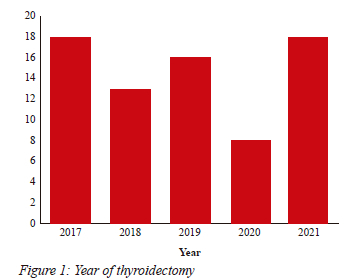
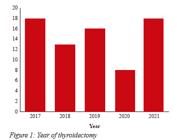
A total of 73 thyroidectomies, performed between January 2017 and December 2021 with complete data, were reviewed (Figure 1). There were 70 (95.9%) females and three (4.1%) males, giving a ratio of 23:1. The ages ranged from 17-68 years, with a mean age of 39.8 years and a standard deviation of 12.7. Most patients, 67 (91.9%), resided in rural locations at the time of presentation.
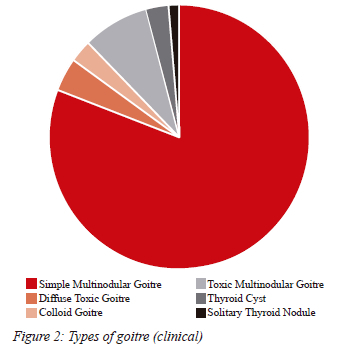
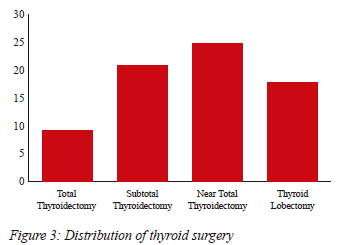
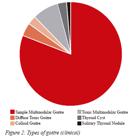
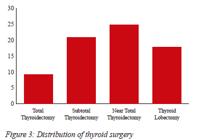
The indication for surgery is noted in Figure 2. Surgical interventions are denoted in Figure 3 - total thyroidectomy (9, 12.3%), near total thyroidectomy (25, 34.2%), subtotal thyroidectomy (21, 28.8%) and lobectomy (18, 24.7%). There was one case with retrosternal thyroidal extension, which did not require a sternotomy.
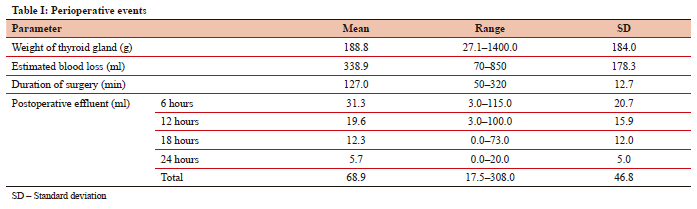
The results regarding the duration of surgery, weight of the thyroid gland, intraoperative blood loss, and volume of drain effluent measured every 6 hours are summarised in Table I. The duration of surgery ranged from 50-320 minutes (mean 127 minutes), with an average blood loss of 338.9 millilitres. Three patients (4.1%) had intraoperative blood transfusions due to blood loss exceeding 500 ml.
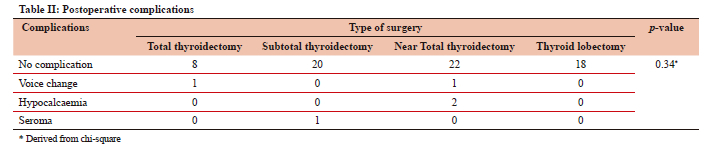
Sixty-eight (93.2%) patients had no complications (Table II). Of the five (6.8%) patients with complications, two (2.7%) had asymptomatic hypocalcaemia and were placed on oral calcium supplementation. Hypocalcaemia was defined as a postoperative calcium level below 8.0 mg/dL (2.00 mmol/L) - reference range 8.0-10.5 mg/dL or 2.00-2.60 mmol/L. One (1.4%) patient had a seroma which was aspirated in the clinic and two (2.7%) had transient reduced voice quality, which had normalised at three-month follow-up. We found no significant difference in the complication rate between the different types of operations (p = 0.34), although we did not record any complication in the patients who had lobectomy.
Seventy-one (97.3%) patients were discharged within 24 hours of surgery, while the two (2.7%) with hypocalcaemia, who failed to meet the discharge criteria, were observed, and discharged within 48 hours. There were no deaths.
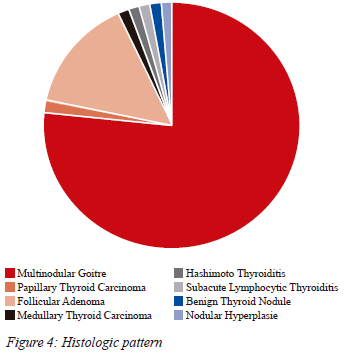
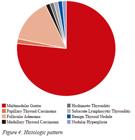
Figure 4 highlights the histology profile of the resected thyroid glands. The majority were multinodular goitres, 56 (77.0%). There were two cases of occult malignancy -papillary thyroid carcinoma (1%) and medullary thyroid carcinoma (1%).
All the patients were satisfied with the short stay following surgery. This was assessed at the clinic by asking them if they were dissatisfied, indifferent, or satisfied with their experience of short-stay thyroid surgery and their responses were documented. However, a validated questionnaire was not designed for this assessment. They were followed up for a period of 1 to 2 years.
Discussion
The duration of hospital stay following surgical procedures has decreased significantly in recent years. With the advancement in technology and safe surgical techniques, short-stay surgery is being undertaken for a growing list of surgical procedures including thyroid surgery. Short-stay thyroid surgery (< 24-hour hospital stay) has been performed and reported in the literature as safe and cost-effective.6,7 Though the concept has been tested and is in practice in the developed countries, it is still nascent in developing nations like Nigeria. Reasons for this include lack of resources, such as medical technology, adequate skilled personnel, and poor socioeconomic status of a vast majority of patients.7
Seventy-three cases of thyroid diseases were operated on over the five-year period of the study. The reduced incidence of goitre in the year 2020 as shown in Figure 1 may be related to the coronavirus pandemic which had a major impact on healthcare service delivery globally. The female to male ratio found in this study is 23:1 which is consistent with an earlier study in this centre by Kpolugbo et al.3
The most common preoperative diagnosis was simple multinodular goitre occurring in 81% of the study population. A similar finding of simple multinodular goitre (68.6%) was recorded by Afolabi et al. in Ibadan, Southwestern Nigeria.10 7,11-13 All types of open thyroidectomy (subtotal, near total, total and lobectomy) were included in our study in contrast to a previous report on short-stay thyroid surgery from a low-resource country which was restricted only to hemithyroidectomy.611331415
The average duration of surgery in this study of 127 minutes (50-320 minutes) is similar to the 128 minutes observed in a study by Arowolo et al.1216
Seventy-one (97.3%) patients met the discharge criteria and were discharged within 24 hours of surgery, while two (2.7%) were discharged within 48 hours. This finding of only 2.7% patients requiring a postoperative stay of longer than 24 hours is consistent with other studies which have shown that most patients can be discharged safely within 24 hours, while only a small percentage require more than 24 hours of hospital stay.7,17
Sixty-eight (93.2%) patients had no complications following thyroidectomy. The complication rate of 6.8% in our study compares well with the study by Olatoke et al. with a frequency of overall post thyroidectomy complication of 4.4%11
Postoperative hypocalcaemia may preclude early discharge as noted in our two patients whose discharge was longer than the short-stay time of 24 hours. Hypocalcaemia, (asymptomatic or symptomatic) usually occurs a few days after surgery. In the literature, both temporary and permanent hypocalcaemia have been reported in 1.6-50% and 1.5-4% of cases respectively.1819
The most common pathological diagnosis as seen in this study is multinodular goitre occurring in 76% of the study population. Similar findings were documented by Ayandipo et al. (73%),2411
Limitations of the study
We are limited in carrying out cost analysis assessment between short-stay thyroid surgery and the traditional 72-hour, or longer-stay. We also recognise our failure to use a validated questionnaire or Lickert scale for the assessment of patients' satisfaction as a limitation.
Conclusion
Short-stay thyroid surgery is feasible in the majority of patients with goitres in low-resource settings. In the hands of an experienced surgeon, following standard surgical practice, it is a safe and preferred alternative to the traditional 72-hour, or longer, hospital stay. The complication rates in this study were low and comparable with the literature. Careful patient assessment and counselling prior to discharge is imperative, to preclude patients that may need further in-hospital monitoring and/or care. This practice, in developing nations such as Nigeria, could help reduce the cost of surgery for poor patients by reducing the duration of hospital stay and subsequently increase hospital bed and resource availability. This may also, in effect, help to demystify thyroidectomy and improve its acceptance among the poor rural dwellers.
Conflict of interest
The authors report no conflict of interest.
Funding source
None.
Ethical approval
Approval for the study was obtained from the Research and Ethics Committee of ISTH (Approval No.: ISTH/ HREC/202330064/479)
ORCID
E Tagar https://orcid.org/0000-0003-0862-1840
J Kpolugbo https://orcid.org/0009-0009-7347-3996
AOkomayin https://orcid.org/0009-0007-3428-0433
IM Chukwu https://orcid.org/0000-0001-6652-1499
HO Chukwuma https://orcid.org/0009-0007-0464-4267
REFERENCES
-
1. Salami BA, Odusan O, Ebili HO, Akintola PA. Spectrum and prevalence of thyroid diseases seen at a tertiary health facility in Sagamu, South-West Nigeria. Niger Postgrad Med J. 2016;23(3):137. https://doi.org/10.4103/1117-1936.190345.
» https://doi.org/10.4103/1117-1936.190345 -
2. Ayandipo O, Adigun T, Afuwape O, Afolabi A, Daniel A. Airway complications and outcome after thyroidectomy in IbadanL a 15-year review. Arch Med. 2016;8:4. https://doi.org/10.21767/1989-5216.1000151.
» https://doi.org/10.21767/1989-5216.1000151 -
3. Kpolugbo J, Uhumnwagho O, Obasikene G, Alili U. Blood transfusion, antibiotics use, and surgery outcome in thyroid surgery: experience from a suburban centre in Nigeria. Niger J Clin Pract. 2012;15(4):458-61. https://doi.org/10.4103/1119-3077.104525.
» https://doi.org/10.4103/1119-3077.104525 - 4. Soyannwo OA, Ajao OG, Agbejule OA, Amanor-Boadu SD. Anaesthesia and surgical aspects of thyroid swelling - the Ibadan experience. East Afr Med J. 1995;72(10):675-7.
-
5. Chahardahmasumi E, Salehidoost R, Amini M, et al. Assessment of the early and late complication after thyroidectomy. Adv Biomed Res. 2019;8:14. https://doi.org/10.4103/abr.abr_3_19.
» https://doi.org/10.4103/abr.abr_3_19 -
6. Bansal N, Yadav SK, Mishra SK, et al. Short stay thyroid surgery: Can we replicate the same in low resource setting? J Thyroid Res. 2018;2018:4910961. https://doi.org/10.1155/2018/4910961.
» https://doi.org/10.1155/2018/4910961 -
7. Ale AF, Isichei MW, Misauno MA. The outcome of short stay thyroidectomy in rural medical outreach settings in Northern Nigeria. Int J Res Med Sci. 2020;8(3):1007-11. https://doi.org/10.18203/2320-6012.ijrms20200771.
» https://doi.org/10.18203/2320-6012.ijrms20200771 -
8. Raspanti C, Porrello C, Augello G, et al. 23-hour observation endocrine neck surgery: lessons learned from a case series of over 1700 patients. Il G Chir. 2017;38(1):15-22. https://doi.org/10.11138/gchir/2017.38.1.015.
» https://doi.org/10.11138/gchir/2017.38.1.015 -
9. Amir I, Morar P, Belloso A. Postoperative drainage in head and neck surgery. Ann R Coll Surg Engl. 2010;92(8):651-4. https://doi.org/10.1308/003588410X12699663904754.
» https://doi.org/10.1308/003588410X12699663904754 - 10. Afolabi AO, Ayandipo OO, Afuwape OO, Ogundoyin OA. A fifteen-year experience of total thyroidectomy for the management of simple multinodular goitres in a low medium income country. S Afr J Surg. 2016;54(4):40-5.
- 11. Olatoke S, Agodirin S, Fasiku O, et al. Review of surgical management of goitre in University of Ilorin Teaching Hospital, Ilorin, Nigeria. Niger Stethosc. 2019;1(1):7-10.
-
12. Arowolo OA, Olasehinde O, Adisa AO, et al. Early experience with ligasure thyroidectomy in a Nigeria Teaching Hospital. Niger J Surg Off Publ Niger Surg Res Soc. 2019;25(1):64-9. https://doi.org/10.4103/njs.NJS_40_18.
» https://doi.org/10.4103/njs.NJS_40_18 -
13. Samuel SA, Rebecca SH. Complications of thyroidectomy at a tertiary health institution in Nigeria. Sub-Saharan Afr J Med. 2019;6:1-9. https://doi.org/10.4103/ssajm.ssajm_33_18.
» https://doi.org/10.4103/ssajm.ssajm_33_18 - 14. Bekele A, Osman M. Goitre in a teaching hospital in Northwestern Ethiopia. East Cent Afr J Surg. 2006;11:21-7.
- 15. Afolabi AO, Fasola FA. Blood transfusion practice in patients undergoing thyroidectomy in Ibadan, Nigeria. East Afr Med J. 2018;95:1995-2004.
-
16. Ayandipo OO, Afolabi AO, Onwudinjor CJ, et al. The impact of non-closure of the platysma muscle layer on the cosmesis of thyroidectomy scar: a randomised double-blind controlled trial. S Afr J Surg. 2022;60(2):128-33. https://doi.org/10.17159/2078-5151/SAJS3625.
» https://doi.org/10.17159/2078-5151/SAJS3625 -
17. Dionigi G, Rovera F, Carrafiello G, Boni L, Dionigi R. Ambulatory thyroid surgery: Need for stricter patient selection criteria. Int J Surg. 2008;6:S19-21. https://doi.org/10.1016/j.ijsu.2008.12.026.
» https://doi.org/10.1016/j.ijsu.2008.12.026 -
18. Noureldine SI, Genther DJ, Lopez M, Agrawal N, Tufano RP. Early predictors of hypocalcemia after total thyroidectomy: an analysis of 304 patients using a short-stay monitoring protocol. JAMA Otolaryngol Neck Surg. 2014;140(11):1006-13. https://doi.org/10.1001/jamaoto.2014.2435.
» https://doi.org/10.1001/jamaoto.2014.2435 -
19. Roh JL, Park CI. Routine oral calcium and vitamin D supplements for prevention of hypocalcemia after total thyroidectomy. Am J Surg. 2006;192(5):675-8. https://doi.org/10.1016/j.amjsurg.2006.03.010.
» https://doi.org/10.1016/j.amjsurg.2006.03.010