Registrar perceptions on general surgical training in South Africa: A report by the South African Society of Surgeons in Training (SASSiT)
Abstract
BACKGROUND: Surgical training varies significantly amongst universities within the same country. This trend is reflected in South Africa and provides an opportunity for innovation to improve the quality of general surgical training OBJECTIVE: To assess the perceptions of South African general surgery registrars regarding surgical training METHOD: A prospective descriptive study was performed by means of a confidential questionnaire distributed to general surgical registrars at all eight training centers in South Africa. Participants were asked to give comments regarding adequacy of formal academic teaching, level of supervision during surgical procedures, exposure to and training in minimally invasive surgery (MIS), and preparation for examinations. Descriptive statistics were generated with Microsoft Excel. Ethics clearance was obtained from the University of the Witwatersrand Human Research Ethics Committee RESULTS: Of 200 questionnaires distributed 105 (52.5%) were returned. 44% (105/241) of all registrars from six training institutions participated. 89.5% (94/105) of respondents reported that they attended less than six hours of formal academic teaching per week and 71.4% (75/105) indicated that their institution offered less than six hours of formal academic teaching per week. 76.2% (80/105) of respondents regarded lack of protected academic time as the greatest obstacle to their surgical training and 95.2% (99/105) reported that clinical responsibilities prevented them from attending formal academic teaching regularly. Overall, only 31.4% (33/105), 41.9% (44/105) and 37.1% (39/105) were satisfied with the amount of formal academic teaching, level of supervision during theatre procedures and exposure to minimally invasive surgery respectively. Lack of resources and lack of appropriate skills were identified as a hindrance to MIS training by 47.6% (50/105) and 28.6% (30/105) of respondents respectively CONCLUSION: Surgical registrars are dissatisfied with the amount of formal academic teaching and protected academic time, level of supervision in theatre and their exposure to MIS. These challenges compromise trainees' ability to practice independently after qualification. Numerous interventions are necessary and possible to address these challenges
Surgery; Training; Education; South Africa
Introduction
Surgical training has undergone major changes in the past decade, both internationally and in South Africa.112345
A survey of general surgical residents in the United States revealed that nearly 40% of new graduates lack confidence in their surgical skills.5,6 The same survey found that up to 80% of the surgical graduates elect to undertake post graduate fellowships in order to gain the confidence, maturity and clinical acumen required for independent practice.5,6 In South Africa, a 2014 study found that newly qualified specialists felt that there was insufficient exposure to the latest surgical techniques during their training, particularly in the field of minimal invasive surgery (MIS).78
Methods
A prospective descriptive study was performed by means of a confidential questionnaire. The registrar representative of the South African Society of Surgeons in Training (SASSiT) at each university distributed questionnaires to surgical registrars in each department. The questionnaire was divided into four sections that assessed perceptions on: (i) time dedicated to formal academic teaching, (ii) supervised surgical training within theatre, (iii) exposure to and training in MIS, and (iv) major hindrances to surgical training. Descriptive statistics were generated with Microsoft Ethics. Clearance was obtained from the University of Witwatersrand Human Research Ethics Committee. A total of 200 questionnaires were distributed to surgical registrars at 8 universities in South Africa. All participants provided written consent; participation was voluntary and no participant received material benefit from participation. No identifying data were captured.
Results
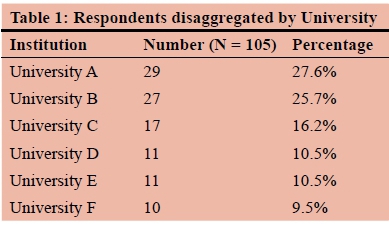
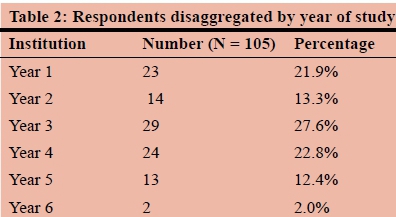
Of 200 questionnaires distributed, 52.5% (105/200) were returned representing 43.5% (105/241) of all surgical registrars nationally. Respondents spanned six of the eight medical universities in South Africa. For breakdown of respondents according to institution and year of study see Table 1 and Table 2. Specific universities are not identified in order to minimise potential for identification of respondents.
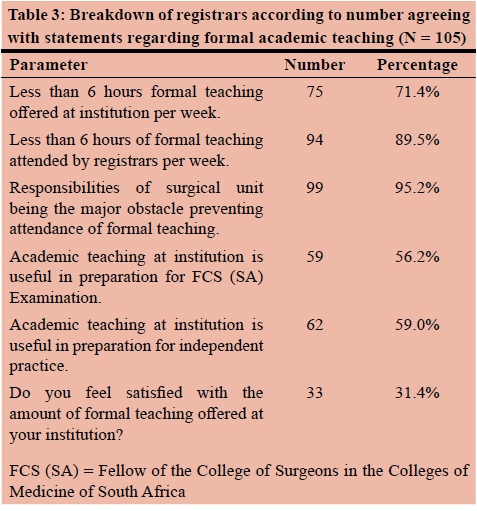
As presented in Table 3, 71.4% (75/105) of respondents reported that their institution offered less than six hours of formal academic teaching per week and 89.5% (94/105) indicated that they attended less than six hours of academic teaching weekly. 95.2% (99/105) reported that clinical responsibilities prevented them from attending formal academic teaching regularly and 31.4% (33/105) were satisfied with the amount of formal academic teaching offered at their institution.
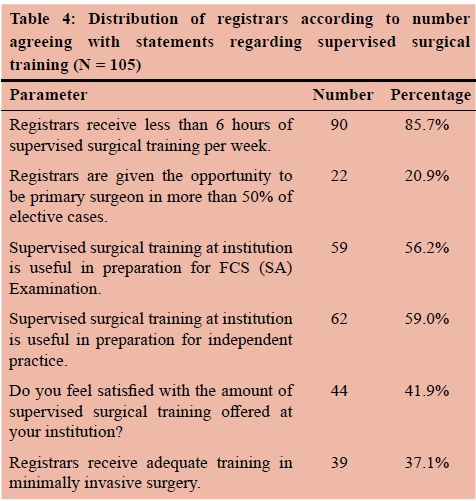
85.7% (90/105) of respondents reported receiving less than six hours of supervised surgical training per week and only 20.9% (22/105) reported the opportunity to be the primary surgeon in more than half of all elective cases. Only 37.1% (39/105) of registrars reported receiving adequate training in MIS. Further data on registrar perceptions of supervised surgical training are presented in Table 4.
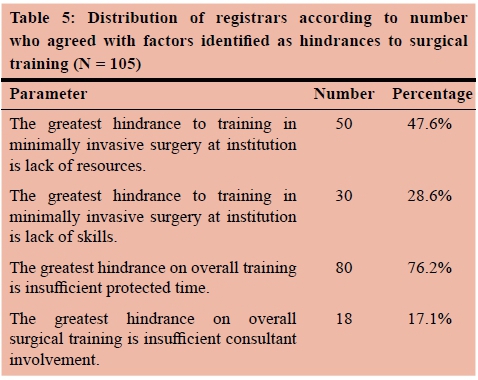
Lack of resources and appropriate skills were identified as hindrances to MIS training by 47.6% (50/105) and 28.6% (30/105) of respondents, respectively. 76.2% (80/105) of respondents regarded lack of protected academic time as the greatest hindrance to their surgical training. These data are presented in Table 5.
Discussion
General surgical training in South Africa is sought after by international and local trainees due to an abundance of surgical pathologies and the opportunity for hands-on experience.9101112
It is concerning that less than one third of registrars (31.4%) are satisfied with the amount of formal academic teaching offered at their institution and that close to 90% attend less than six hours of academic teaching per week. This is despite the fact that the majority of registrars (59%) agree that formal teaching is vital in the preparation of surgical trainees for independent practice. An overwhelming majority (95.2%) of registrars consider clinical responsibilities the main obstacle to participation in academic teaching. Further, 76.2% of registrars identified a lack of protected academic time as a key impediment to surgical training. Emphasis on service delivery over academic commitments is a recurring finding in local studies over the past two decades as reflected in Thomson and Baker131
Nearly 86% of trainees reported receiving less than six hours of supervised surgical training with a consultant per week. Furthermore, less than half of the respondents (41.9%) are satisfied with the amount of supervision when it is provided. This finding of the low level of supervision of surgical trainees is consistent with the findings of Kruger and Veller8141575,14,16
Minimal access surgery is now considered best practice in the management of a range of surgical pathologies. As demonstrated in certain centers in South Africa, the adoption and growth of MIS is possible within the public health sector.17 17171871717
Limitations
We acknowledge that this study was limited by the low sample size, the fact that results were not reported by institution (to minimise the potential for real or imagined repercussions for respondents) and that only 6 of 8 training centers in the country were sampled. This said, we believe this study highlights important trends inhibiting surgical training in South Africa.
Conclusion
General surgical registrars are concerned with the current training programme which they perceive to be confronted by three main challenges. These are lack of protected academic time, inadequate senior supervision in theatre and insufficient exposure to MIS. There is doubt amongst registrars that the level of training currently received is adequate to impart sufficient skills and acumen to practice independently upon qualification. South Africa has a long tradition of training skilled surgeons.10
Recommendations
On the basis of our findings and given that the immediate enrolment of newly qualified specialists in fellowship programmes in low and middle income countries (such as South Africa) with small specialist pools and high surgical needs may be detrimental to the surgical needs of these countries, we suggest that the current model for general surgical training be reviewed. We propose greater monitoring of the academic and service delivery responsibilities of consultants employed in the public and private sectors. We also suggest mentorship programmes for junior specialists, as utilised by the American College of Surgeons,18
Acknowledgements
The authors would like to thank Dr. Tumi Mabogoane, Dr. Siddharth R Gautam, Dr. Chun-Yen Wu and Dr Megan Peffer for their contribution.
REFERENCES
-
1. Kong VY, Odendaal JJ, Clarke DL. Surgical resident working hours in South Africa. S Afr J Surg. 2015;53(3):8-10. Available from: http://dx.doi.org/10.7196/SAJS.7845
» http://dx.doi.org/10.7196/SAJS.7845 -
2. Mattar SG, Alseidi AA, Jones DB, et al. General Surgery Residency Inadequately Prepares Trainees for Fellowship. Ann Surg. 2013;258(3):440-9. Available from: http://dx.doi.org/10.1097/SLA.0b013e3182a191ca
» http://dx.doi.org/10.1097/SLA.0b013e3182a191ca - 3. Krige JEJ. Departments of Surgery in South Africa - legacies of the past, challenges for the future. S Afr J Surg. 2004;42(3):76-7.
-
4. Patel N, Naidoo P, Govender T, et al. South African general surgery registrar perceptions of the research component of training: Hope for the future? S Afr Med J. 2016;106(2):169-71. Available from: http://dx.di.org//10.7196/SAMJ.2016.v106i2.10310
» http://dx.di.org//10.7196/SAMJ.2016.v106i2.10310 -
5. Debas HT, Bass B, Brennan MF, et al. American Surgical Association Blue Ribbon Committee Report on Surgical Education: 2004. Ann Surg. 2005;241(1):1-8. Available from: http://dx.doi.org/10.1097/01.sla.0000150066.83563.52
» http://dx.doi.org/10.1097/01.sla.0000150066.83563.52 -
6. Sachdeva AK, Bell RH, Britt LD, et al. National Efforts to Reform Residency Education in General Surgery. Acad Med. 2007;82(12):1200-10. Available from: http://dx.doi.org/10.1097/ACM.0b013e318159e052
» http://dx.doi.org/10.1097/ACM.0b013e318159e052 -
7. De Beer MM, Karusseit VOL, Pienaar BH. Perspectives of South African general surgeons regarding their postgraduate training. S Afr J Surg. 2014;52(3):67-71. Available from: http://dx.doi.org/10.7196/SAJS.1993
» http://dx.doi.org/10.7196/SAJS.1993 -
8. Kruger D, Veller MG. Exposure to key surgical procedures during general surgical training in South Africa. S Afr J Surg. 2014;52(4):96-100. Available from: http://dx.doi.org/10.7196/sajs.2162
» http://dx.doi.org/10.7196/sajs.2162 -
9. Connor K, Teasdale E, Johnson S, et al. Surgical training in South Africa - A practical guide to getting a job. Int J Surg. 2014;12(3):S75. Available from: http://dx.doi.org/10.1016/j.ijsu.2014.08.17
» http://dx.doi.org/10.1016/j.ijsu.2014.08.17 -
10. Degiannis E, Oettle GJ, Smith MD. Surgical education in South Africa. World J Surg. 2009;33:170-3. Available from: http://dx.doi.org/10.1007/s00268-008-9815-2
» http://dx.doi.org/10.1007/s00268-008-9815-2 - 11. Smith MD. Perspectives of South African General Surgeons regarding their postgraduate training. SAJS. 2014;52(3):66.
-
12. Van Rensburg HCJ. South Africa's protracted struggle for equal distribution and equitable access - still not there. Hum Resour Health. 2014;12(26):1-16. Available from: http://dx.doi.org/10.1186/1478-4491-12-26
» http://dx.doi.org/10.1186/1478-4491-12-26 - 13. Thomson SR, Baker LW. Health care provision and surgical education in South Africa. World J Surg. 1994;18(5):701-5.
-
14. Ibrahim A, Ibrahim ZD, Edaigbini SA, et al. Teaching the surgical craft: Surgery residents perceptions of the operating theatre education environment in a tertiary institution in Nigeria. Niger J Surg. 2013;19(2):61-7. Available from: http://dx.doi.org/10.4103/1117-6806.119240
» http://dx.doi.org/10.4103/1117-6806.119240 -
15. Greensmith M, Cho J, Hargest R. Changes in surgical training opportunities in Britain and South Africa. Int J Surg. 2015;25:76-81. Available from: http://dx.doi.org/10.1016/j.ijsu.2015.11.052
» http://dx.doi.org/10.1016/j.ijsu.2015.11.052 -
16. Terpstra OT, Stegeman JH. Effects of the restriction of working time for residents: A Dutch perspective. J Grad Med Educ. 2011;3(4):462-4. Available from: http://dx.dori.org/10.4300/JGME-D-11-00202.1
» http://dx.dori.org/10.4300/JGME-D-11-00202.1 - 17. Apostolou C, Panieri E. National survey of surgeon's attitudes to laparoscopic surgical training in South Africa. SAJS. 2007;47(3):86-91.
-
18. Kotsis SV, Chung KC. Application of see one, do one, teach one concept in surgical training. Plast Reconstr Surg. 2013;131(5):1194-1201. Available from: http://dx.doi.org/10.1097/PRS.0b013e318287a0b3
» http://dx.doi.org/10.1097/PRS.0b013e318287a0b3