Spontaneous pneumomediastinum in two young women
Abstract
Spontaneous pneumomediastinum (SPM) is a rare benign condition which must be differentiated from secondary pneumomediastinum due to chest trauma, abscess formation or Boerhaave's syndrome. We present two young women with SPM due to chronic self-induced vomiting and starvation associated with psychosis and pregnancy-associated vomiting respectively. This report highlights the exclusionary diagnostic pathway, the principles of conservative management and the need for a tailored multidisciplinary approach to enhance patient recovery and prevent future recurrence.
surgical emphysema; mediastinal emphysema
CASE REPORT
Spontaneous pneumomediastinum in two young women
CL FaroI; SR ČačalaI, II; C BucklandI; P MilliganIII, IV; GV OosthuizenI, II
IDepartment of Surgery, Ngwelezana Hospital, South Africa
IIDepartment of Surgery, School of Medicine, University of KwaZulu-Natal, South Africa
IIIDepartment of Psychiatry, Ngwelezana Hospital, South Africa
IVDepartment of Psychiatry, School of Medicine, University of KwaZulu-Natal, South Africa
SUMMARY
Spontaneous pneumomediastinum (SPM) is a rare benign condition which must be differentiated from secondary pneumomediastinum due to chest trauma, abscess formation or Boerhaave's syndrome. We present two young women with SPM due to chronic self-induced vomiting and starvation associated with psychosis and pregnancy-associated vomiting respectively. This report highlights the exclusionary diagnostic pathway, the principles of conservative management and the need for a tailored multidisciplinary approach to enhance patient recovery and prevent future recurrence.
Keywords: surgical emphysema, mediastinal emphysema
Case 1
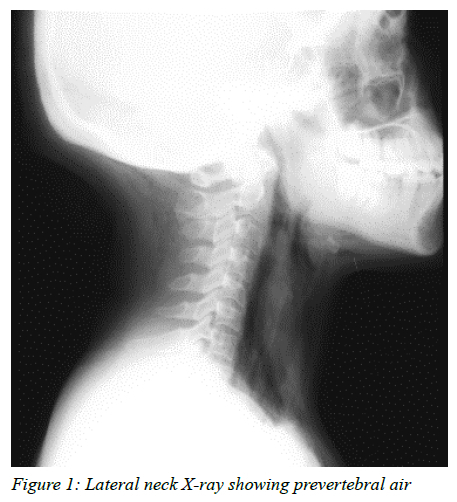
A 27-year-old woman presented with a three-month history of dysphagia for solids, inability to swallow, vomiting, heartburn and weight loss. There was no history of coughing, dyspnea, fever and trauma. She demonstrated persecutory delusions of being poisoned when eating and later admitted to self-induced vomiting due to this fear. On physical examination she was emaciated. The initial laboratory investigations showed hypokalaemia (2.5mmol/L), hypophosphataemia (0.43 mmol/L), hypomagnesaemia (0.54 mmol/L) and hypoalbuminaemia (30g/L) consistent with malnutrition and vomiting. Chest and lateral neck radiographs revealed subcutaneous emphysema, pneumomediastinum and prevertebral air (Figure 1). These findings, along with a small right pneumothorax were confirmed on computed tomography (CT) of the chest. Water-soluble swallow and upper gastrointestinal endoscopy (UGIE) were normal. The patient complained of inability to swallow, however swallowing assessment by speech therapy was normal. The diagnosis of spontaneous pneumomediastinum (SPM) was, therefore, made. The biochemical abnormalities were corrected with intravenous fluids and electrolytes and dietary supplements. She was referred to psychology and psychiatry in view of her fear of being given poisoned food and was diagnosed with a major depressive disorder with psychotic features. She did not meet diagnostic criteria for an eating disorder. On the eighth day of her admission her management was taken over by psychiatry who prescribed her an anti-psychotic, an anti-depressant and a benzodiazepine. She gained four kilograms over four weeks and was eating normally at follow-up.
Case 2
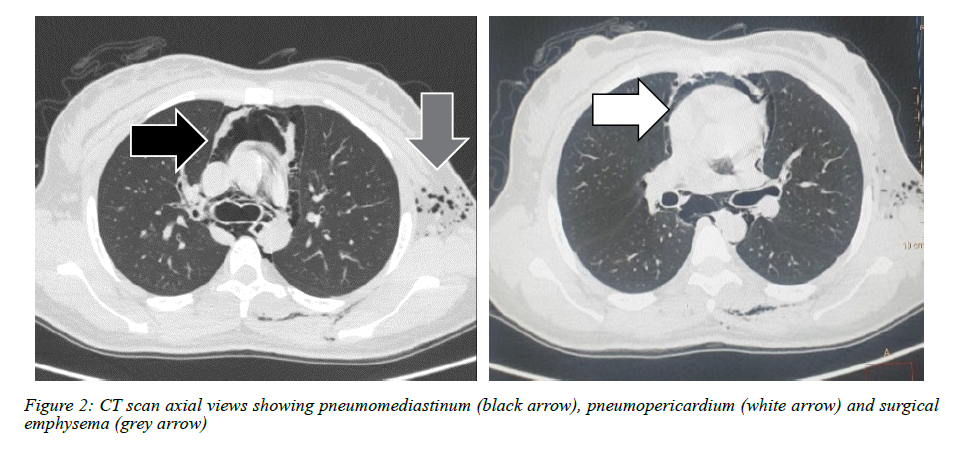
An eight-week pregnant 24-year-old presented with a two-day history of persistent vomiting, odynophagia and dysphagia. There was no history of gastro-oesophageal reflux disease or corrosive ingestion. She had a slender physique, signs of dehydration and extensive surgical emphysema of her neck and chest. Her laboratory analysis showed hypokalaemia (2.8 mmol/L) and an acute kidney injury (urea: 15.8 mmol/L and creatinine: 220 umol/L). Chest and neck X-rays revealed a pneumomediastinum and prevertebral air. On CT scan, she had surgical emphysema, pneumomediastinum and pneumopericardium, (Figure 2). An inflamed oesophagus was seen on endoscopy. A water-soluble swallow showed no evidence of oesophageal leak.
After exclusion ofaerodigestive injury,she was diagnosed with SPM. Her laboratory abnormalities were corrected with intravenous fluids and potassium replacf ment. Initially, the patient was started on a broad-spectrum antibiotic whilst awaiting her water-soluble swallow to exclude oesophageal perforation. These were discontinued once this investigation was normal. Antiemetics were prescribed and an obstetric review organised for her pregnancy-associated vomiting in the event this would be an ongoing problem for her. Her symptoms and signs of SPM resolved by day two and she was discharged on day four. At two-week follow-up she had no complaints.
Discussion
Over a two-month period, we admitted two young women with histories of vomiting, diagnosed with SPM. This is a rare, usually benign medical condition, characterised by free air in the mediastinum, without trauma, iatrogenic causes or underlying pulmonary pathology.1234567
Experimentally, caloric restriction has been shown to cause thinning of the alveolar walls82,9 In this report, as in both our cases,patienjs were slender and presented with dysphagia and surgical emphysema, although 26 of their 33 patients were male.
Patients with SPM are haemodynamically stable and clinically well, indicating the benign nature of this condition. In 30% of cases, the diagnosis of SPM may be made on chest X-ray,9
In a review of 34 patients with SPM by Ebina et al.10 9
Conclusion
SPM is a rare clinical condition to be considered in a patient presenting with mediastinal emphysema without clinical signs of mediastinitis. Aerodigestive injury should be ruled out by imaging and/or endoscopy. Management of SPM is supportive and may warrant multidisciplinary input to treat the precipitating condition. In our cases, this was the psychiatrist and the obstetrician. SPM spontaneously resolves, and a good outcome can be expected.
Conflict of interest
The authors declare no conflict of interest.
Funding source
The authors have no financial support or relationships that may pose a conflict of interest. No funding source to be declared.
Ethical approval
Written informed consent was obtained from both patients in this case study. Ethics Committee approval was obtained from the University of KwaZulu-Natal Biomedical Research Ethics Committee BREC Ref No: BCA027/19.
ORCID
CL Faro https://orcid.org/0000-0003-3744-2630
SR Cácala https://orcid.org/0000-0003-0713-3925
C Buckland https://orcid.org/0000-0002-4622-6705
Ρ Milliganhttps://orcid.org/0000-0001-6878-599X
GV Oosthuizen https://orcid.org/0000-0001-6898-2969
REFERENCES
-
1. Panack EA, Singer AJ, Sherman BW, Prescott A, Rutherford WF. Spontaneous pneumomediastinum: clinical and natural history. Ann Emerg Med. 1992;21(10):1222-7. https://doi.org/10.1016/s0196-0644(05)81750-0.
» https://doi.org/10.1016/s0196-0644(05)81750-0 - 2. Hamman L. Spontaneous mediastinal emphysema. Bull Johns Hopkins Hosp. 1939;64:1-21.
-
3. Wintermark M, Wicky S, Schnyder P, Capasso P. Blunt traumatic pneumomediastinum: using CT to reveal the Macklin effect. AJR Am J Roentgenol. 1999; 172:129-30. https://doi.org/10.2214/ajr.172.L9888752.
» https://doi.org/10.2214/ajr.172.L9888752 - 4. Macklin MT, Macklin CC. Malignant interstitial emphysema of the lungs and mediastinum as an important occult complication in many respiratory diseases and other conditions: interpretation of the clinical literature in the light of laboratory experiment. Medicine. 1944;23:281-358.
-
5. Murayama S, Gibo S. Spontaneous pneumomediastinum and Macklin effect: Overview and appearance on computed tomography. World J Radiol. 2014;6(11):850-4.https://doi.org/10.4329/wjr.v6.i11.850.
» https://doi.org/10.4329/wjr.v6.i11.850 -
6. Huang HR, Wong KS, Lien R, Chiu CY. Spontaneous pneumomediastinum due to gastroesophageal reflux disease in an adolescent boy. Respirology. 2008;13:744-74. https://doi.org/10.1111/j.1440-1843.2008.01298.x.
» https://doi.org/10.1111/j.1440-1843.2008.01298.x -
7. Hochlehnert A, Löwe B, Bludau HB, et al. Spontaneous pneumomediastinum in anorexia nervosa: a case report and review of the literature on pneumomediastinum and pneumothorax. Eur Eat Disord Rev. 2010;18:107-15. https://doi.org/10.1002/erv.1002.
» https://doi.org/10.1002/erv.1002 -
8. Massaro D, Massaro GD, Baras A, Hoffman EP, Clerch LB. Calorie-related rapid onset of alveolar loss, regeneration, and changes in mouse lung gene expression. Am J Physiol Lung Cell Mol Physiol. 2004;286:L896-906. https://doi.org/10.1152/ajplung.00333.2003.
» https://doi.org/10.1152/ajplung.00333.2003 -
9. Kaneki T, Kubo K, Kawashima, A et al. Spontaneous pneumomediastinum in 33 patients: yield of chest computed tomography for the diagnosis of the mild type. Respiration. 2000;67(4):408-11. https://doi.org/10.1159/000029539.
» https://doi.org/10.1159/000029539 -
10. Ebina M, Inoue A, Takaba A, Ariyoshi K. Management of spontaneous pneumomediastinum: are hospitalization and prophylactic antibiotics needed? Am J Emerg Med. 2017;35(8):1150-53. https://doi.org/10.1016/j.ajem.2017.03.017.
» https://doi.org/10.1016/j.ajem.2017.03.017