Advancing the concepts of industrial ecology in South African institutions
Abstract
Industrial ecology seeks to apply the knowledge of systems in nature to the design and operation of industrial activities, to achieve integrated and sustainable relationships between the natural world and industry. Although the theoretical underpinning of the field corresponds in some ways to that of the emerging discipline of sustainability science, industrial ecology has evolved along two main directions that may be more practical for industry and policy-makers: 'eco-industrial parks' and islands of sustainability; and 'dematerialization-decarbonization' and the service economy. The opportunities and risks associated with applying the concepts of industrial ecology have been argued globally. This article provides an overview of how the concepts have already been applied to some extent in South Africa. We recommend how industrial ecology may be nurtured here, prioritizing areas where the field can be institutionalized.
Introduction
A recent commentary in this journal1
• Location at the interface between human society and its sustaining natural environment;
• focus on the resilience of complex socio-ecological systems;
• a transdisciplinary approach to understanding system complexity and resilience;
• acknowledgement of the validity of multiple epistemologies, extending beyond the objectivity of science to include the subjectivity of alternative knowledge systems; and
• emphasis on learning and adaptation.
Many of these elements also manifest themselves in the field of 'industrial ecology'; indeed, it has been argued that these concepts underpin industrial ecology, which may therefore be regarded as the science of sustainability.2334
• Economies, society and nature co-evolve;
• economies and society are embedded in a larger natural system, which must function within its carrying capacity;
• material and energy flows in industry interact with the material and energy cycles in nature; the consequences are determined by the common properties of all matter;
• efficiency and resilience translate into the sustainability of an ecosystem, which depends largely on its capacity to withstand disturbance. This can contribute to the sustainability of an industrial ecosystem;
• wastes and pollution are (to a degree) minimized in nature, which should also apply to industry;
• treating companies as organisms and economies as ecosystems can emulate the natural diversity and interconnectedness of organisms in the economic system, and may eventually call for a systems approach to describe it;
• the importance of information and communication is underlined as a strategy for improving the interconnectedness within an industrial ecosystem;
• issues of locality should be addressed in terms of reducing a system's dependence on external resources, focusing on local interdependence, and managing production and storage of hazardous substances in a responsible manner.
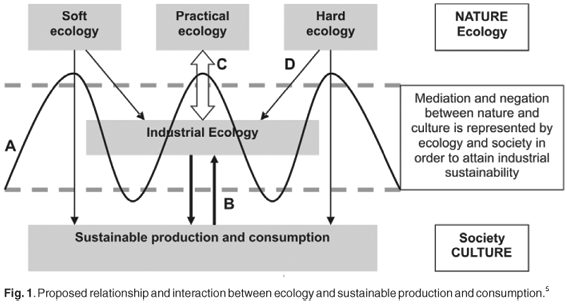
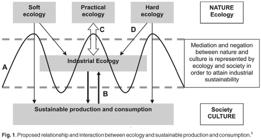
Figure 1 illustrates how 'industrial ecology' is a construction between what is ecologically possible within the framework of the capacity of the ecosystems involved (the biosphere) and what is socially desirable and acceptable within the framework of a sustainable society.5
These descriptions represent the latest theoretical and conceptual perspectives. However, given the would-be environmentally-benign manufacturing foundation of industrial ecology,678
Eco-industrial parks, and islands of sustainability
The concept of 'eco-industrial parks' (EIPs)910118
Dematerialization-decarbonization and the service economy
Strategies to optimize the flows of materials and energy within the economy that are based on technological evolution are the second main elements of industrialecology. They seek to increase the productive use of resources, or dematerialization,1281314
• Analytical support for 'green engineering' and environmental policy, which relate to tools for green engineering, improvement in life-cycle assessment, aggregation of environmental impacts, and effectiveness of range of innovative policy approaches; and
• the dynamics of technology, economics and environmental impact, as they relate to the environmental effects of material and energy consumption, the potential for material and energy efficiency, the relation of technological and economic development to changes in consumption patterns, and the potential for technology to overcome environmental impacts and constraints.
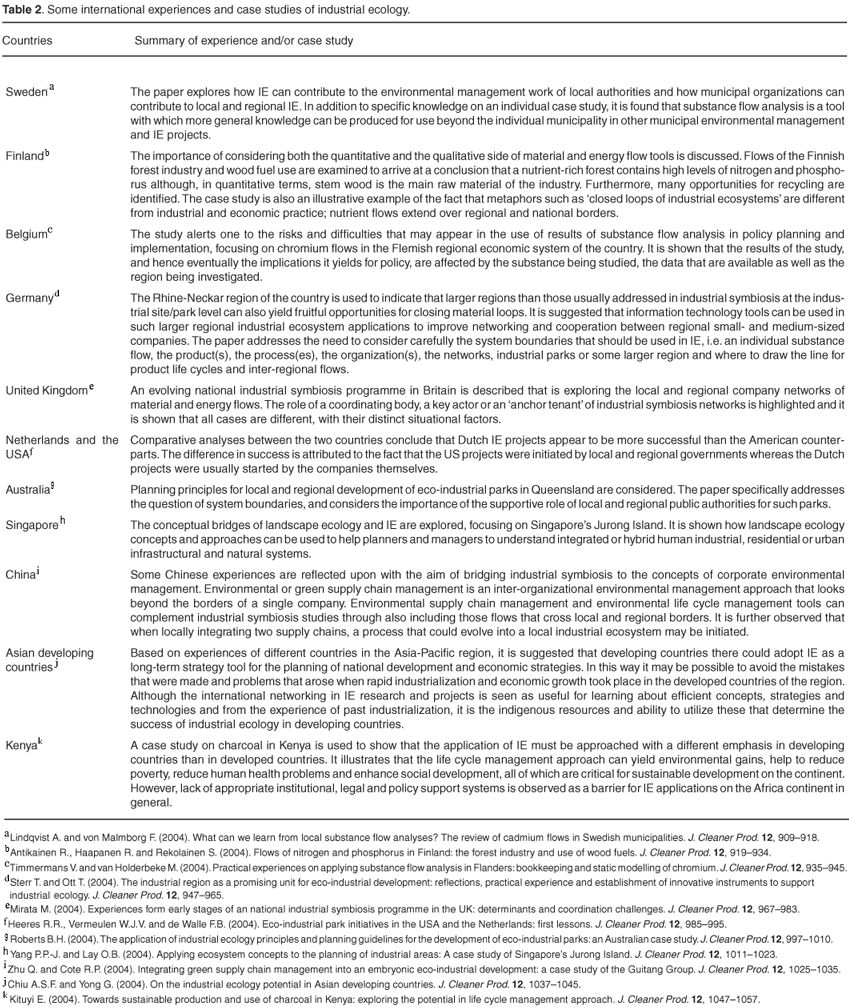
The online supplement for this article (at www.sajs.co.za) provides an overview of globally perceived opportunities and risks associated with applying industrial ecology in terms of the two main directions in which industrial ecology has evolved,15-28 and summarizes related international experiences.29
Applications of industrial ecology in South Africa
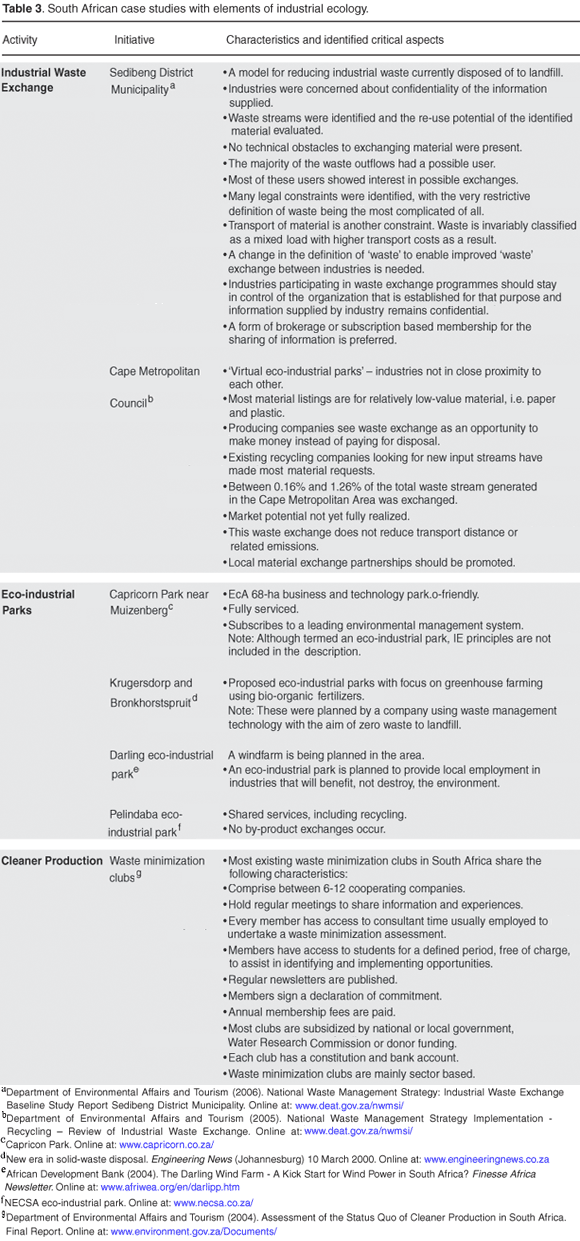
Experiences in South Africa relating to industrial ecology are summarized in a table in the online supplement; selected examples are used for further discussion.
Eco-industrial parks and industrial symbiosis
Eco-industrial parks (EIPs) are not new in this country. The Nuclear Energy Corporation of South Africa (NECSA), for example, owns and manages an EIP between Pretoria and Hartbeespoort Dam, with over 80 tenants with shared services, including recycling.3031
• Collective setting of available utilities;
• the collective processing of waste streams;
• mutual exchange of materials and energy;
• consume residual products from remote companies; and
• deliver residual products to remote companies.
The characteristics of foreign EIPs do, nevertheless, manifest in the planning of South African industrial development zones (IDZs), for instance, the Coega IDZ near Port Elizabeth.32,33 Although the concept of international EIPs is envisaged for the IDZs, the ideal has yet to become practice. Lessons can be learnt from regional applications of industrial symbiosis, such as the Integrated Waste Exchange (IWE) programme of the Cape Metropolitan Council (CMC) (see online supplement).34-36 A study was initiated to investigate the success of the programme in terms of economic efficiency, based on a cost-benefit analysis and its possible environmental and social consequences.3738
The limited success is typical of industrial symbiosis projects launched by local and regional authorities, and not the private sector (see the comparison of Dutch and American experiences in the online supplement). The market potential for the IWE programme has nevertheless not yet been fully realized and, because its implementation is believed to still be in an initial phase, further pioneering strategies will be required to increase its success.38
Dematerialization-decarbonization and the service economy
The public and private sectors in South Africa have in the past adopted only the tools that are used in terms of the dematerialization and decarbonization focus of industrial ecology, e.g. life-cycle assessment (LCA) and material flow analysis (MFA),39404142,43 the industrial ecology tools are used to quantify potential GHG reductions.
Projects to minimize GHG emissions have also created opportunities to improve material usage.4445464136
Advancing industrial ecology in the South African context
The adoption of industrial ecology in South Africa suggests that the most progress in terms of institutionalizing the field can be made through industrial symbiosis strategies at local and regional level. Three different stages in the evolution of industrial ecology initiatives for brown field sites have been conceptualized,2727
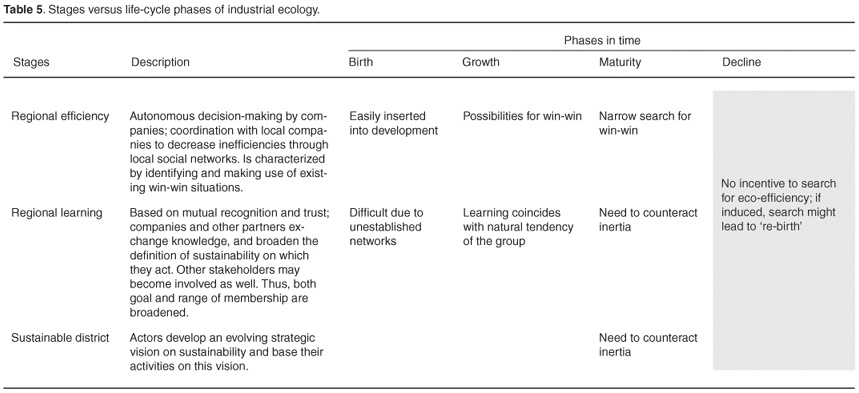
The life cycle of industrial ecology can also be expressed in terms of phases in time and the type of relationship between organizations in an area;27243847
Obstacles to initiation and management of an industrial ecosystem have been noted:48
• Company concerns with regard to propriety or confidential information;
• negotiating balance of payments;
• reluctance on the part of a business to be involved in inflexible contractual commitments that do not relate directly to their core activity; for instance, guaranteeing a waste stream for a contractual period;
• supervision and operation of co-treatment facilities; and
• the complexity of managing the wastes produced by the companies.
An additional barrier in South Africa is that there is no legislative support for industrial symbiosis; specifically, there is no clear guidance as to the responsibilities of the parties associated with the waste streams. Five mechanisms have been proposed to promote industrial symbiosis:38
Working through public-private partnerships, for example, between local authorities who operate treatment facilities and landfill sites, industries that discharge problem waste to these facilities and sites, waste companies that specialize in waste re-use and recycling, and national government that is responsible for legislative guidelines;
• using the South African National Cleaner Production Centre (NCPC)49
• use of trading platforms to link waste generators and waste re-users and recyclers;
• introducing funding mechanisms, particularly to enhance and support the exchange of low value commodities; and
• linking waste minimization clubs, waste exchanges and future industrial ecological parks and zones.
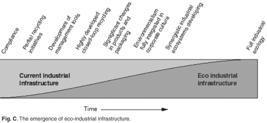
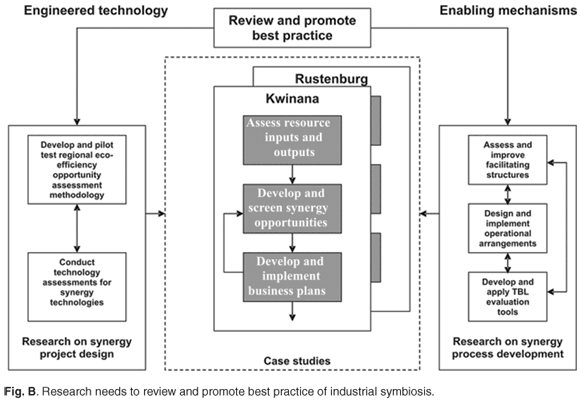
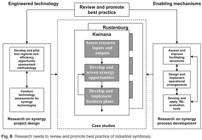
In terms of the latter, specific research needs have been identified to review and promote best practice in industrial regions (see online supplement).5050, 51 It is envisaged that a changing nature of industrialization in South Africa can eventually be instilled through such efforts, culminating in a comprehensive approach to industrial ecology, whereby all process systems and equipment, with plant and factory design, will eventually be fully compatible with existing industrial ecosystems as a matter of course.52
Conclusions
If production and consumption methods in human controlled systems could be made to emulate the efficiencies of naturalsystems, then greater sustainability would ensue, and a means would emerge to address the growing amount of waste produced by industry and a consumption-driven society.53 53
One of the more intricate implementations of industrial ecology lies in the establishment of industrial ecosystems (where an industrial estate operates as an 'ecosystem'), with residual energy and materials being traded or sold between companies or co-treated for ultimate disposal. Industrial facilities individually implement waste minimization programmes and cleaner production initiatives under this system. The estate, as a whole, looks for the potential for on-site re-use, recycling, recovery or co-treatment for disposal of the wastes that cannot be economically managed by the individual facilities. A few such industrial ecosystems have been set up abroad; it is envisaged that the field of industrial ecology may be institutionalized in South Africa through this routeCindustrial ecology can thus be used to realise the concept of sustainability. The science of sustainability may thereby not only manifest itself in the thinking of research institutions, but also in policy, planning and management practices of government and industry. We have identified a number of barriers that need to be overcome to facilitate the adoption of industrial ecology in South African institutions, and ongoing regional case studies could lead to solutions that will overcome these barriers. The role of economic development officials and researchers should be to promote policies that will remove the obstacles to the recovery of industrial resources, and to educate the public and private sectors as to the benefit of industrial symbiosis. As such, more emphasis should be on the development of mechanisms that would more effectively encourage individual companies to manage waste streams effectively while leaving them the necessary freedom to develop new and profitable uses for by-products.
References
- 1. Burns M., Audouin M. and Weaver A. (2006). Advancing sustainability science in South Africa. S. Afr. J. Sci. 102, 379-384.
- 2. Ehrenfeld J.R. (2004). Can industrial ecology be the 'Science of Sustainability'? J. Ind. Ecol. 8(1-2), 1-3.
- 3. Allenby B. (2006). The ontologies of industrial ecology? Prog. Ind. Ecol. 3(1/2), 28-38.
- 4. Kronenberg J. (2006). Industrial ecology and ecological economics. Prog. Ind. Ecol. 3(1/2), 95-113.
- 5. Hermansen J.E. (2006). Industrial ecology as mediator and negotiator between ecology and industrial sustainability. Prog. Ind. Ecol. 3(1/2), 75-94.
- 6. Frosch R.A. and Gallopoulus N.E. (1989). Strategies for manufacturing. Sci. Am. 261(3), 94-102.
- 7. Ehrenfeld J. (2004). Industrial ecology: a new field or only a metaphor? J. Cleaner Prod. 12, 825-831.
- 8. Erkman S. (1997). Industrial ecology: an historical view. J. Cleaner Prod. 5(1-2), 1-10.
- 9. Heeres R.R., Vermeulen W.J.V. and de Walle F.B. (2004). Eco-industrial park initiatives in the USA and the Netherlands: first lessons. J. Cleaner Prod. 12, 985-995.
- 10. Deschenes P.J. and Chertow M. (2004). An island approach to industrial ecology: towards sustainability in the island context. J. Env. Plan. Manage. 47(2), 201-217.
- 11. Fischer-Kowalski M. (2003). On the history of industrial metabolism. In Perspectives in Industrial Ecology, eds D. Bourg and S. Erkmand, pp. 35-45. Greenleaf Publishing, Sheffield
- 12. Van der Voet E., Van Oers L. and Nikolic I. (2004). Dematerialization: not just a matter of weight. J. Ind. Ecol. 8(4), 121-137.
- 13. Huesemann M.H. (2006). Can advances in science and technology prevent global warming? A critical review of limitations and challenges. Mitigation and Adaptation Strategies for Global Change 11(3), 539-577.
- 14. Thomas V.M. and Graedel T.E. (2003). Research issues in sustainable consumption: toward an analytical framework for materials and the environment. Environ. Sci. Tech. 37, 5383-5388.
- 15. Robért K.-H., Schmidt-Bleek B., Aloise de Larderel J., Basik G., Janson J.L., Kuehr R., Price Thomas P., Susiki M., Hawken P. and Wackernagel M. (2002). Strategic sustainable development: selection, design and synergies of applied tools. J. Cleaner Prod. 10, 197-214.
- 16. Korhonen J. (2004). Industrial ecology in the strategic sustainable development model: strategic applications of industrial ecology. J. Cleaner Prod. 12, 809-823.
- 17. Mayumi K., Giampietro M. and Gowdy J.M. (1998). Georgescu-Roegen/Daly versus Solow/ Stiglitz revisited. Ecol. Econ. 27, 115-117.
- 18. Berkhout P.H.G., Muskens C. and Velthuijsen J.W. (2000). Defining the rebound effect. Energy Policy 28, 425-432.
- 19. Gallopoulos N.E. (2006). Industrial ecology: an overview. Prog. Ind. Ecol. 3(1/2), 10-27.
- 20. Brent A.C. (2003). A proposed lifecycle impact assessment framework for South Africa from available environmental data. S. Afr. J. Sci. 99, 115-122.
- 21. Agyeman J. and Angus B. (2003). The role of civic environmentalism in the pursuit of sustainable communities. J. Environ. Plan. Manage. 46(3), 345-363.
- 22. MacDonald J.P. (2005). Strategic sustainable development using the ISO 14001 standard. J. Cleaner Prod. 13, 631-643.
- 23. Boons F.A. and Baas L.W. (1997). Types of industrial ecology: the problem of coordination. J. Cleaner Prod. 5, 79-86.
- 24. Boons F.A. and Behrends M. (2001). Stretching the boundary: the possibilities of flexibility as an organizational capability in industrial ecology. Business Strategy and the Environment 10(2), 115-124.
- 25. Salmi O. (2003). Development and path dependence in the industrial system of the Kola Peninsula. In Technology, Society, Environment. ed. J. Hukkinen, pp. 29-46. Espoo, Otamedeia Oy., Helsinki University of Technology, Finland.
- 26. Korhonen J. and Snäkin J-P. (2005). Analysing the evolution of industrial ecosystems: concepts and application. Ecol. Econ. 52, 169-186.
- 27. Baas L.W. and Boons F.A. (2004). An industrial ecology project in practice: exploring the boundaries of decision-making levels in regional industrial systems. J. Cleaner Prod. 12, 1073-1085.
- 28. Seager T.P. and Theis T.L. (2004). A taxonomy of metrics for testing the industrial ecology hypotheses and application to design of freezer insulation. J. Cleaner Prod. 12, 865-875.
- 29. Korhonen J., Huisingh D. and Chiu A.S.F. (2004). Applications of industrial ecology: an overview of the special issue. J. Cleaner Prod. 12, 803-807.
-
30. NECSA (2007). Eco-industrial park. Online at: www.necsa.co.za
» www.necsa.co.za - 31. Lambert A.J.D. and Boons F.A. (2002). Eco-industrial parks: stimulating sustainable development in mixed industrial parks. Technovation 22, 471-484.
- 32. Raghubir S., Mukhwanazi A. and Hietkamp S. (2002). Environmental Impact Assessment for the proposed aluminium Pechiney smelter within the Coega Industrial Zone, Port Elizabeth, South Africa - Specialist study: materials handling and solid waste. CSIR report ENV-S-C 2002-092(B), Stellenbosch.
-
33. DTI (2006). Industrial Development Zones (IDZ). Online at: www.dti.gov.za
» www.dti.gov.za -
34. City of Cape Town (2004). Integrated Waste Exchange. Online at: www.capetown.gov.za/iwe/
» www.capetown.gov.za/iwe/ - 35. Van Beers D. and Graedel T.E. (2003). The magnitude and spatial distribution of in-use copper stocks in Cape Town. S. Afr. J. Sci. 99, 61-69.
- 36. Buen J. (2001). Industrial ecology - Only needed in the north? Int. J. Econ. Dev. 3(2), 1-50.
- 37. Nissing C. (2002). Analysis and evaluation of the existing Integrated Waste Exchange of the City of Cape Town with regards to its economic efficiency and its possible social and ecological consequences. Thesis, RWTH Aachen and the Department of Chemical Engineering, University of Cape Town.
- 38. Department of Environmental Affairs and Tourism (2005). National Waste Management Strategy implementation South Africa - Recycling: Annexure G - Review of Industrial Waste Exchange. Report No. 12/9/6, Pretoria.
- 39. Kytzia S. (2004). Bridging the gap to economic analysis: economic tools for industrial ecology. Prog. Ind. Ecol. 1(1/2/3), 142-164.
- 40. Brent A.C., Rohwer M.B., Friedrich E. and von Blottnitz H. (2002). Status of Life Cycle Assessment and Engineering research in South Africa. I. J. Life Cycle Assess. 7(3), 167-172.
-
41. Department of Minerals and Energy (2007). Designated National Authority. Online at: www.dme. gov.za/dna/index.stm
» www.dme. gov.za/dna/index.stm -
42. United Nations Framework Convention on Climate Change (2007). Clean Development Mechanism. Online at: http://cdm.unfccc.int/
» http://cdm.unfccc.int/ - 43. Brent A.C., Heuberger R. and Manzini D. (2005). Evaluating projects that are potentially eligible for Clean Development Mechanism (CDM) funding in the South African context: a case study to establish weighting values for sustainable development criteria. Environ. Develop. Econ. 10(5), 631-649.
- 44. Hekkert M. (2000). Improving material management to reduce greenhouse gas emissions. Ph.D. thesis, Utrecht University, the Netherlands.
- 45. Department of Minerals and Energy (2005). Dolomite and limestone in South Africa: supply and demand, 2005. Mineral Economics Directorate report no. R49/2005, Pretoria.
- 46. Ruth M., Worrell E. and Price L. (2000). Evaluating Clean Development Mechanism projects in the cement industry using a process-step benchmarking approach. Energy Analysis Department report no. LBNL- 45346, Environmental Energy Technologies Division, Ernest Orlando Lawrence Berkeley National Laboratory, University of California, Berkley.
-
47. Department of Environmental Affairs and Tourism (2004). Assessment and status quo of cleaner production in South Africa - final report. Online at: www.environment.gov.za
» www.environment.gov.za - 48. Boyle C.A. and Baetz B.W. (1998). A prototype knowledge-based decision support system for industrial waste management: part I. The decision support system. Waste Manage. 18, 87-97.
-
49. National Cleaner Production Centre (2006). Online at: www.ncpc.co.za
» www.ncpc.co.za - 50. Bossilkov A., van Beers D. and van Berkel R. (2005). Industrial symbiosis as an integrative business practice in the Kwinana industrial area: Lessons learnt and ways forward. Proc. 11th International Sustainable Development Research Conference, Finland.
- 51. Van Beers D., Corder G., Bossilkov A. and van Berkel R. (2007). Industrial symbiosis in the Australian minerals industry: the case of Kwinana and Gladstone. J. Ind. Ecol. 11(1), 55-72.
-
52. Tibbs H. (1993). Industrial ecology: an environmental agenda for industry. Global Business Network, Online at: www.gbn.com
» www.gbn.com - 53. Roberts B.H. (2004). The application of industrial ecology principles and planning guidelines for the development of eco-industrial parks: an Australian case study. J. Cleaner Prod. 12, 997-1010.
- 54. Desrochers P. (2004). Industrial symbiosis: the case for market coordination. J. Cleaner Prod. 12, 1099-1110.
- 55. Chertow M.R. (2007). 'Uncovering' industrial symbiosis. J. Ind. Ecol. 11(1), 11-30.
* Author for correspondence. E-mail:
Supplementary material to:
Brent A.C., Oelofse S. and Godfrey L. (2008). Advancing the concepts of industrial ecology in South African institutions. S. Afr. J. Sci. 104, 9-12.
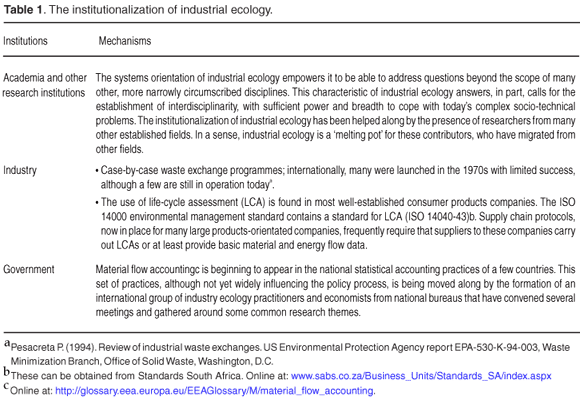
The institutionalization of the concepts of industrial ecology
The attempts to integrate the concepts of industrial ecology in international institutions are summarized in Table 1.6
Strategic opportunities and risks associated with the application of industrial ecology and international experiences
A hierarchical model has been proposed for a systems approach for strategic sustainable development.1516Box 1.

However, if industrial ecology is not used within such a structured, holistic model, i.e. only at singular levels of such a model, there are many risks that it can actually contribute to unsustainability, thereby making sustainability policy and management more difficult:
• Policies, approaches, technologies and the tools, instruments and techniques associated with industrial ecology should be applied with caution, to avoid suboptimal solutions. For example, the 'Jevon's paradox'171819Box 1).16
• The fundamental and normative, as well as the practical and instrumental, stages of the sustainability concept must be taken into account when applying the techniques of industrial ecology. If the eco-industrial park or local industrial symbiosis approaches are used to contrast individual product-based environmental life cycle assessments2016
• Two stages for a paradigm shift must be considered to make progress on local and regional sustainable development, i.e. the paradigmatic and the practice stages.161621
• The emphasis of industrial ecology on networks and inter-organizational environmental management can have negative effects, if long-term continuous improvement is not considered.162223,24 or path dependencies25
These risks indicate that the field of industrial ecology has been developed without a strategic perspective. The lack of strategic thinking and understanding can lead to reductionism and costly piecemeal approaches, or to failing to see the holistic, big picture, the intent of industrial ecology. The understanding of the evolution of industrial systems over time toward sustainable or unsustainable ways of operation is especially important for the purposes of environmental performance analyses and subsequent future planning of policy and management2616272829Table 2), are valuable for understanding and institutionalizing the field in South Africa.
Danish example of industrial symbiosis
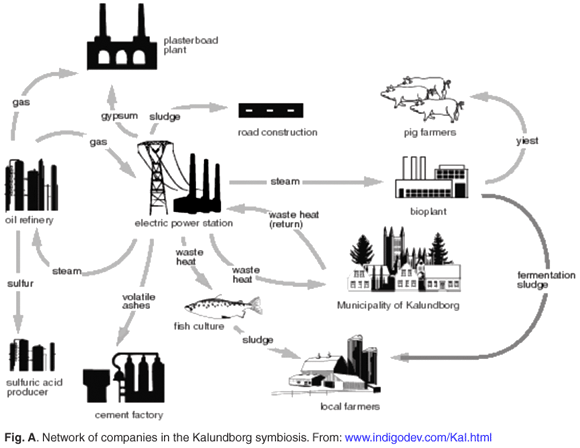
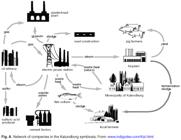
The small city of Kalundborg in Denmark provides the currently best-known example of industrial symbiosis in action. The primary business includes an oil refinery, power station, gypsum board facility, and a pharmaceutical company that share ground water, surface water, wastewater, steam, and fuel, and exchange a variety of by-products that become inputs in other processes. The network of companies in the Kalundborg symbiosis, showing the extent of the material and energy exchanges in 1995, is illustrated in Fig. A (more details can be found at www.indigodev.com/Kal.html). Symbiosis in Kalundborghas resulted in substantial economic and environmental benefits. Since the publicity of Kalundborg's symbiosis in the early 1990s, researchers have been investigating many questions that are also relevant for the South African context: Why did this phenomenon occur in Kalundborg? Are there other regions exhibiting industrial symbiosis? How can such systems be replicated? Are they strictly the product of self-organization by economic entities, or can they be planned in a structured manner? Answering these critical questions requires the engagement of a variety of disciplines: science, engineering, economics, business, policy, environmental management, systems engineering, law, and planning.
South African cases
South African case studies that show elements of industrial ecology are summarized in Table 3.
The Integrated Waste Exchange programme of the Cape Metropolitan Council
The Waste Management Department of the Cape Metropolitan Council (CMC) launched an Integrated Waste Exchange (IWE) programme in May 2000 as a pilot project.34353634
The cost-benefit analysis of the CMC IWE integrated waste exchange programme
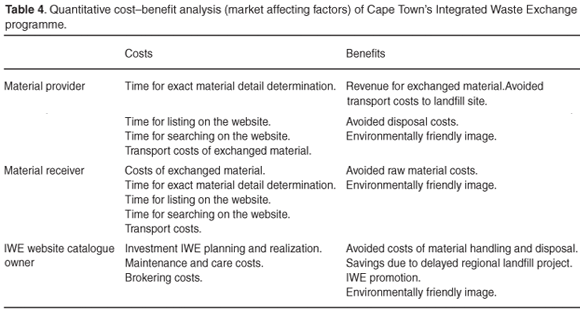
A qualitative cost-benefit analysis (market-affecting factors) of the Integrated Waste Exchange programme of Cape Town is provided in Table 4.34
Overview of the Clean Development Mechanism
The purpose of the Clean Development Mechanism (CDM) is to assist developing countries (not included in Annexure 1 of Article 12 of the Kyoto Protocol) in achieving sustainable development and in contributing to the ultimate objective of the United National Framework Convention on Climate Change, and to assist developed countries (included in Annexure 1) in achieving compliance with quantified emission limitation and reduction commitments under Article 3 of the Protocol.4243
Stages versus the life cycle phases of industrial ecology.
The stages as compared to the life cycle phases of industrial ecology27Table 5.
Further research requirements
Research is needed to review and promote best practice of industrial symbiosis50Fig. B.
Emergence of eco-industrial infrastructure
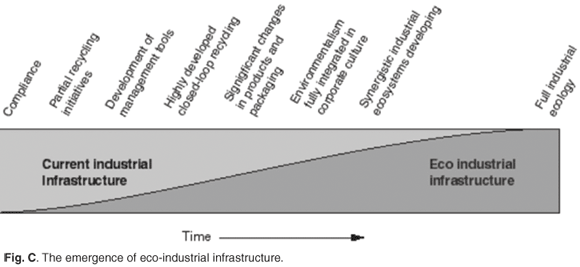
The emergence of eco-industrial infrastructure is illustrated in Fig. C.52