Hyper-resistance to arsenic in bacteria isolated from an antimony mine in South Africa
Abstract
Soil and water sites were sampled at a South African antimony mine with elevated levels of arsenic due to the refining process. Enriched media yielded two pure bacterial cultures able to grow in both arsenite and arsenate. These were identified as Stenotrophomonas maltophilia SA Ant 15 and Serratia marcescens SA Ant 16. Stenotrophomonas maltophilia SA Ant 15 was resistant to 10 mmol l-1 arsenite and 20 mmol l-1 arsenate, whereas S. marcescens SA Ant 16 grew in 15 mmol l-1 arsenite and in up to 500 mmol l-1 arsenate, making it the most arsenic-resistant organism described to date. During growth, addition of arsenate or arsenite anions adversely affected biomass production and maximum specific growth rate and, in some instances, longer lag phases were induced. Reduction of arsenate to arsenite partly accounted for the high tolerance of the bacteria to arsenate. Our results suggest the use of these hyper-resistant bacteria as remediation agents in areas where arsenic contamination is prohibitively high.
Introduction
Arsenic is widely distributed throughout the earth's crust, ranging from trace levels up to hundreds of milligrams per kilogram. Sources of contamination include erosion of local rocks, industrial effluents, various commercial processes and combustion of fossil fuels.1 2 3 2 4 5 6 7 8 9 10–13 The aim of the study reported here was to isolate and identify bacteria from an arsenic-impacted environment, to determine the level of arsenic resistance and to establish if resistance is due to the reduction of arsenate to arsenite.
Materials and methods
See Appendix
Results
Enrichments and identification
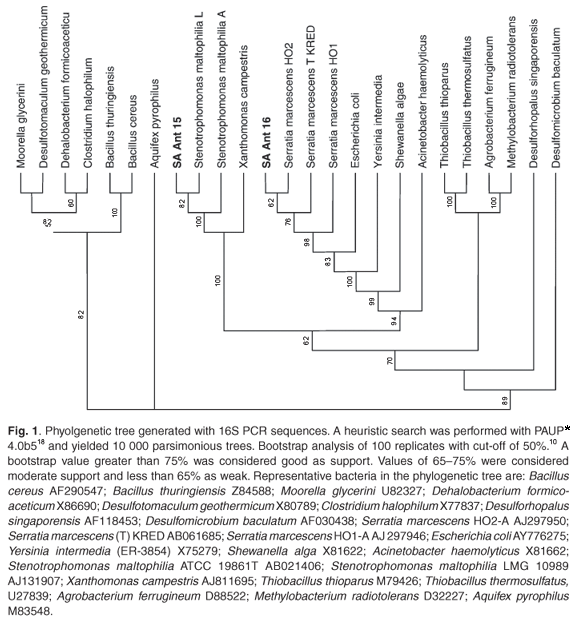
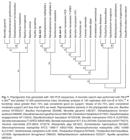
Two bacterial cultures, resistant to antimony and arsenate, were selected from the isolates. Near full-length 16S rDNA sequences were deposited in the NCBI database under accession numbers DQ 079059 and AY551938. BLAST (v 2.2.13) analysis, with entries available at the EMBL, GenBank, and Ribosomal Data Project (release 9.35) databases, retrieved an optimum alignment (98% identity) with the 16S rDNA of Serratia marcescens (AB061685) and (99% identity) with the 16S rDNA of Stenotrophomonas maltophilia (AJ131114), respectively. The phylogenetic tree (Fig. 1) illustrates the relatedness of these isolates to their counterparts. API and Biolog testing confirmed isolate SA Ant 16 as Serratia marcescens with a similarity index of 0.58. It was not possible to make a definitive identification using biochemical testing for isolate SA Ant 15.
Growth
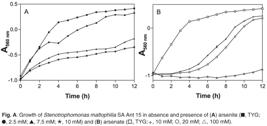
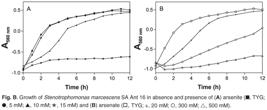
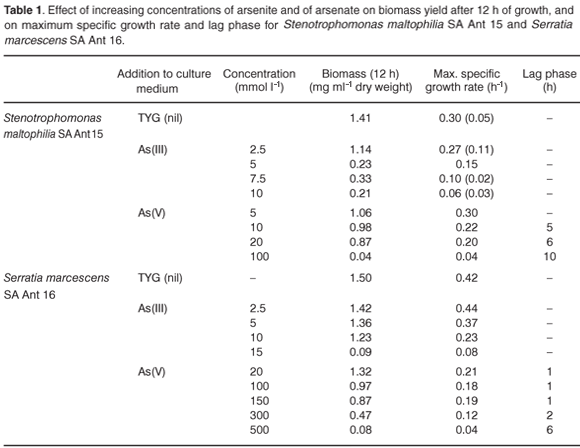
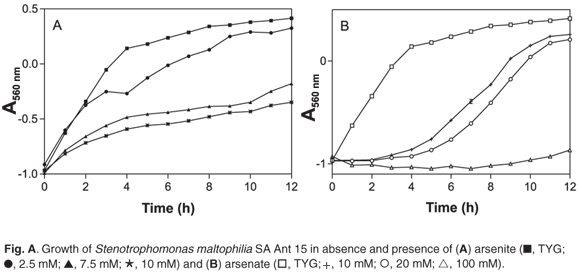
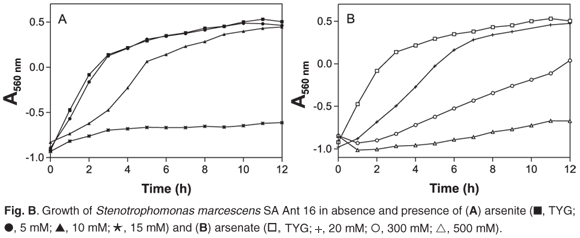
The bacteria exhibited varying tolerance levels for both arsenite and arsenate. Stenotrophomonas maltophilia SA Ant 15 grew in up to 10 mmol l–1 arsenite and 20 mmol l–1 arsenate (see Fig. A in supplementary material online), while Serratia marcescens SA Ant 16 was able to grow in 15 mmol l–1 arsenite and in up to 500 mmol l–1 arsenate (Fig. B in online supplement). Both the specific growth rate and biomass yield were severely inhibited for S. maltophilia SA Ant 15 in the presence of arsenite. Arsenate inhibited growth less than arsenite, as indicated by specific growth rate and biomass yield, but longer lag phases were observed with the addition of increasing arsenic concentrations. For S. marcescens SA Ant 16, addition of arsenite resulted in a decrease in both specific growth rate and biomass up to a threshold concentration of 10 mmol l–1 with a sharp decline in both these parameters at higher concentrations. As for S. maltophilia SA Ant 15, addition of arsenate resulted in a proportionately lengthened lag phase. A linear decrease in total biomass yield was observed as well as a decline in specific growth rate up to 500 mmol l–1 arsenate. Results are summarized in Table 1.
Arsenate reduction by resting cells
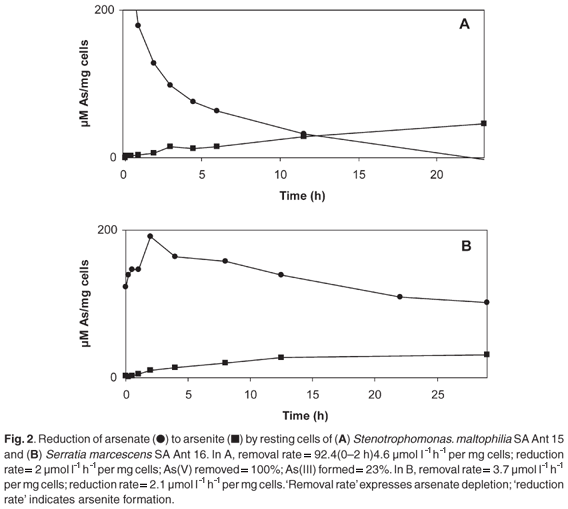
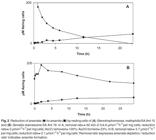
Stenotrophomonas maltophilia SA Ant 15 removed 100% of the arsenate at a rate of 92.4 µmol l–1 h–1per mg cells over the first 2 h. Of all the arsenate removed, 25% of this removal rate could be attributed to reduction to arsenite at 4 µmol l–1h–1 per mg cells. Serratia marcescens SA Ant 16 removed 50% of the arsenate and, in total, 15% of the arsenate added was reduced to arsenite at approximately 2 µmol l–1h–1 per mg cells (Fig. 2). No chemical reduction was observed in control experiments.
Discussion
Two pure bacterial cultures, hyper-resistant to arsenate and arsenite, were isolated and identified as Stenotrophomonas maltophilia SA Ant 15 and Serratia marcescens SA Ant 16. The bacteria tolerated exceptionally high concentrations of arsenate (up to 500 mmol l–1 or ~37 500 ppm) and high concentrations of arsenite (up to 15 mmol l–1 or ~1125 ppm) during growth. A model bacterium such as E. coli has been shown to grow in up to 50 mmol l–1 arsenate,20 –1 (C.R. Anderson, pers. comm.). While arsenic concentrations in soils naturally vary from 0.1 ppm to 1000 ppm,21 22
Biomass yield, growth rate and duration of lag phase depended on the type of oxyanion enrichment. Both isolates were more sensitive to arsenite and increasing concentrations of arsenate caused longer growth lag phases, lower biomass yields and lower growth rates. It is important to interpret these results in the context of a dynamic system where the combined effects of the oxyanion and the transformation products are biologically significant. Other factors, such as a change in external pH during growth,23
Both bacteria were able to reduce arsenate and extrude the resulting arsenite, but a significant portion of arsenate removed (69–77%) was not recovered as arsenite. The differences between the removal and reduction rates indicate additional mechanisms of arsenate removal, such as adsorption of the negatively charged arsenic ions by oppositely charged amino groups in the bacterial cell walls,24,25 methylation following reduction of arsenate to arsenite,26 26,27
The hyper-resistant bacteria described in this report thus have significant potential for bioremediation in environments with excess arsenic and its products.
This work was supported by a grant from the National Research Foundation.
References
- 1. Smedley P.L. and Kinniburgh D.G. (2002). A review of the source, behavior and distribution of arsenic in natural waters. Appl. Geochem. 17, 517–568.
- 2. Ahman D., Krumholtz L.R., Hemond H.F., Lovley D.R. and Morel F.M.M. (1997). Microbial mobilization of arsenic from sediments of the Aberjona Watershed. Environ. Sci. Technol. 31, 2923–2930.
- 3. Dowdle P.R., Laverman A.M. and Oremland R.S. (1996). Bacterial reduction of arsenic(V) to arsenic(III) in anoxic sediments. Appl. Environ. Microbiol. 62, 1664–1669.
- 4. Newman D.K., Beveridge T.J. and Morel F.M.M. (1997). Precipitation of arsenic trisulfide by Desulfotomaculum auripigmentum. Appl. Environ. Microbiol. 63, 2022–2028.
- 5. Rittle K.A., Drever J.I. and Colberg P.J. (1995). Precipitation of arsenic during sulfate reduction. Geomicrobiol. J. 13, 1–12.
- 6. Cervantes C., Ji G., Ramirez J.L. and Silver S. (1994). Resistance to arsenic compounds in microorganisms. FEMS Microbiol. Rev. 15, 355–367.
- 7. Turpein R., Pantsar-Kallio M., Haggblom M. and Kairesalo T. (1999). Influence of microbes on the mobilization, toxicity and biomethylation of arsenic in soil. Sci. Tot. Environ. 236, 173–180.
- 8. Say R., Yilmaz N. and Denizli A. (2003). Biosorption of cadmium, lead, mercury, and arsenic ions by the fungus Penicillium purpurogenum. Sep. Sci. Technol. 38, 2039–2053.
- 9. Stolz J.F. and Oremland R.S. (1999). Bacterial respiration of arsenic and selenium. FEMS Microbiol. Rev. 23, 615–627.
- 10. Rosen B.P., Weigel U., Monticello R.A. and Edwards B.P.F. (1991). Molecular analysis of an anion pump: purification of the ArsC protein. Arch. Biochem. Biophys. 284, 381–385.
- 11. Ji G., Garber E.A.E., Armes L.G., Chen C-M., Fuchs J.A. and Silver S. (1994). Arsenate reductase of Staphylococcus aureus plasmid pI258. Biochemistry 33, 7294–7299.
- 12. Bennett M.S., Guan Z., Laurberg M. and Su X-D. (2001). Bacillus subtilis arsenate reductase is structurally and functionally similar to low molecular weight protein tyrosine phosphatases. Proc. Natl Acad. Sci. USA 98, 13577–13582.
- 13. Mukhopadhyay R., Shi J. and Rosen B.P. (2000). Purification and characterization of Acr2p, the Saccharomyces cerevisiae arsenate reductase. J. Biol. Chem. 275, 21149–21157.
- 14. Lane D.J., Weisberg W.G., Barns S.M. and Pelletier D.A. (1991). 16S ribosomal DNA amplification for phylogenetic study. J. Bacteriol. 173, 697–703.
- 15. Thompson J.D., Gibson T.J. Plewniak F., Jeanmougin F. and Higgins D.G. (1997). The ClustalX windows interface: flexible strategies for multiple sequence alignment aided by quality analysis tools. Nucl. Acids Res. 24, 4876–4882.
- 16. Altschul S.F., Gish W., Miller W., Myers E.W. and Lipman D.J. (1990). Basic local alignment search tool. J. Mol. Biol. 215, 403–410.
- 17. Cole J.R., Chai B., Farris R.J., Wang Q., Kulam S.A., McGarrell D.M., Garrity G.M. and Tiedje J.M. (2005). The Ribosomal Database Project (RDP-II): sequences and tools for high-throughput rRNA analysis. Nucl. Acids Res. 33 (Database Issue), D294–D296.
- 18. Swofford DL (2002) PAUP*. Phylogenetic Analysis Using Parsimony (*and other Methods) Version 4. Sinauer Associates, Sunderland, MA.
- 19. Meerow A.W., Lehmiller D.J. and Clayton J.R. (2003). Phylogeny and biogeography of Crinum L. (Amaryllidaceae) inferred from nuclear and limited plastid non-coding DNA sequences. Bot. J. Linn. Soc. 141, 349–363
- 20. Silver S., Budd K., Leahy K.M., Shaw W.V., Hammond D., Novick R.P., Willsky G.R., Malamy M.H. and Rosenberg H. (1981). Inducible plasmid-determined resistance to arsenate, arsenite, and antimony(III) in Escherichia coli and Staphylococcus aureus. J. Bact. 146, 983–996.
- 21. Cullen W.R. and Reimer K.J. (1989). Arsenic speciation in the environment. Chem. Rev. 89, 713–764.
- 22. Davis D.R., Paterson D.B. and Griffiths D.H.C. (1986). Antimony in South Africa. J. S. Afr. Inst. Min. Metall. 86, 173–193.
- 23. Anderson C.R. and Cook G.M. (2004). Isolation and characterization of arsenate-reducing bacteria from arsenic-contaminated sites in New Zealand. Curr. Microbiol. 48, 341–347.
- 24. Bai R.S. and Abraham T.E. (2003). Studies on chromium(VI) adsorption-desorption using immobilized fungal biomass. Bioresour. Technol. 87, 17–26.
- 25. Urrutia M.M. and Beveridge T.M. (1994). Formation of fine-grained metal and silicate precipitates on a bacterial surface (Bacillus subtilis). Chem. Geol. 116, 261–280.
- 26. Brunken H.S., Nehrhorn A. and Breunig H.J. (1996). Isolation and characterization of a new arsenic methylating bacterium from soil. Microbiol. Res. 151, 37–41.
- 27. Dhankher O.M., Li Y., Rosen B.P., Shi J., Salt D., Senecoff J.F., Sashti N.A. and Meagher R.B. (2002). Engineering tolerance and hyperaccumulation of arsenic in plants by combining arsenate reductase and γ-glutamylcysteine synthetase expression. Nature Biotechnol. 20, 1140–1145.
‡ Author for correspondence.E-mail:
Supplementary material to:
Botes E., Van Heerden E. and Litthauer D. (2007). Hyper-resistance to arsenic in bacteria isolated from an antimony mine in South Africa. S. Afr. J. Sci. 103, 279–281.